in School Laboratory
- Главная
- Разное
- Образование
- Спорт
- Естествознание
- Природоведение
- Религиоведение
- Французский язык
- Черчение
- Английский язык
- Астрономия
- Алгебра
- Биология
- География
- Геометрия
- Детские презентации
- Информатика
- История
- Литература
- Математика
- Музыка
- МХК
- Немецкий язык
- ОБЖ
- Обществознание
- Окружающий мир
- Педагогика
- Русский язык
- Технология
- Физика
- Философия
- Химия
- Шаблоны, фоны, картинки для презентаций
- Экология
- Экономика
Презентация, доклад исследовательского проекта: Investigation of Some Physical and Chemical Properties of Amber in School Laboratory
Содержание
- 1. Презентация исследовательского проекта: Investigation of Some Physical and Chemical Properties of Amber in School Laboratory
- 2. Basic properties of amberAmber is fossil resin,
- 3. Main aims and tasks of our investigationIn
- 4. Composition of amber Amber is a common
- 5. Location of amber Amber meets in Russia
- 6. Application of amber Amber is used for
- 7. Determination of amber densityExperimentalsMaterials: pieces of amber,
- 8. Determination of amber densityThen density of amber
- 9. Hardness on Mohs’ scale of mineral hardnessMaterials:
- 10. Comparative evaluation of the ability of electrificationMaterials:
- 11. Materials: pieces of amberEquipments: UV lamp The
- 12. Action of some organic solvents on
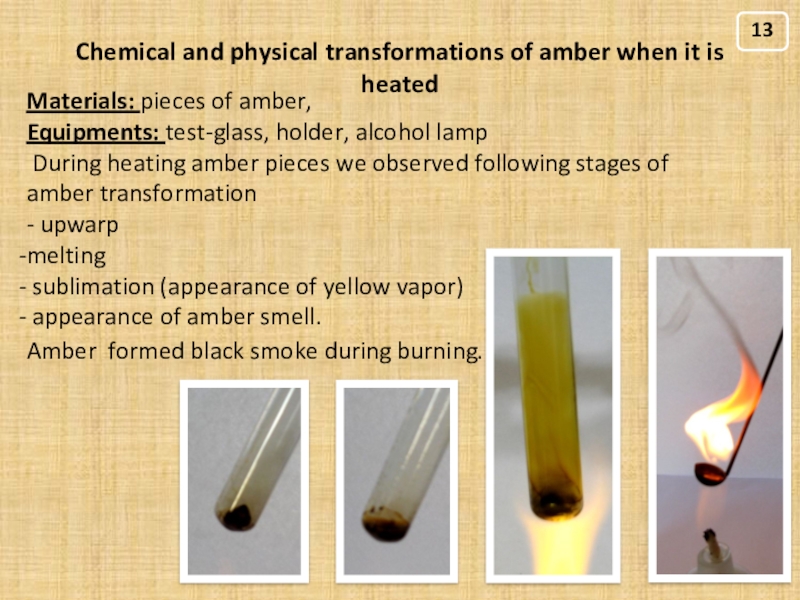
- 13. Chemical and physical transformations of amber when it is heated
- 14. After heating we dissolved some destructed
- 15. The effect of acids and alkalis on
- 16. The hardness of amber is 2.5 on
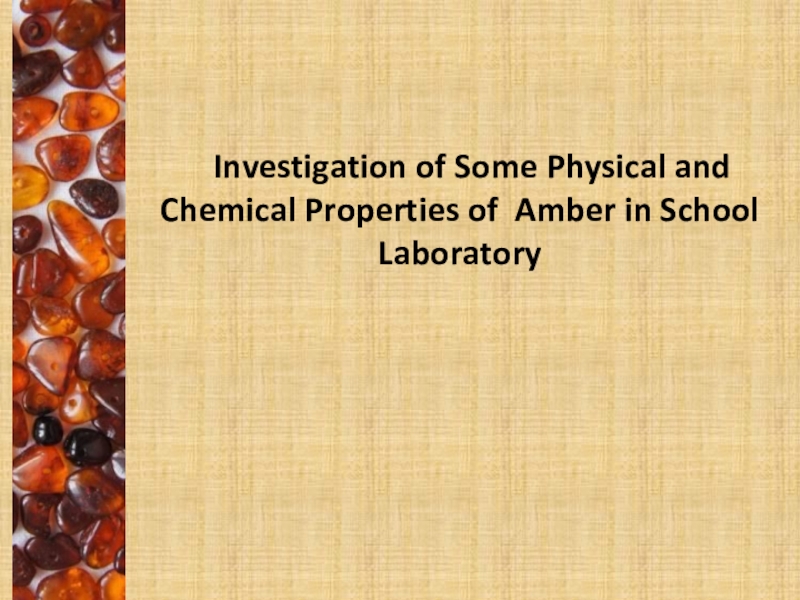
Basic properties of amberAmber is fossil resin, mineral of class of organic compounds. Amber is used for making of jewelries, medications. Amber has got many poetic names - "sea tears", "gift of the Sun." Amber does
Слайд 2Basic properties of amber
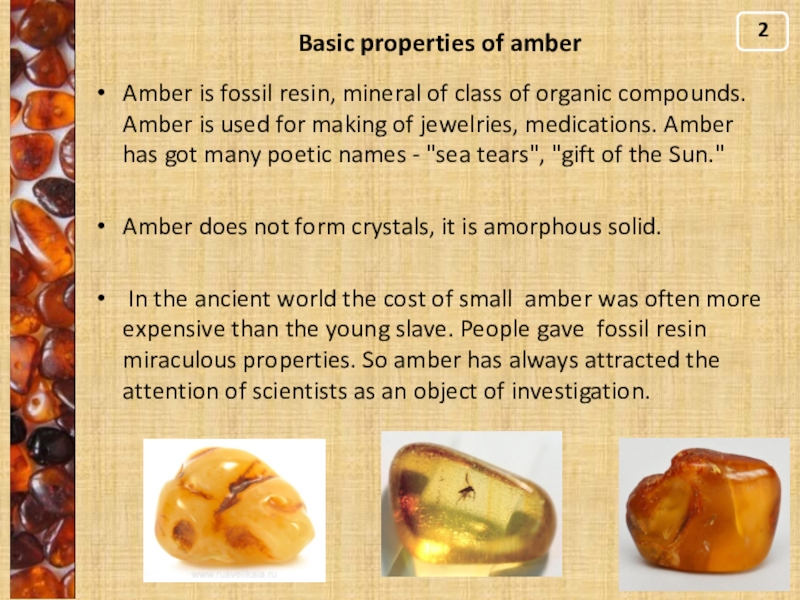
Amber is fossil resin, mineral of class of
organic compounds. Amber is used for making of jewelries, medications. Amber has got many poetic names - "sea tears", "gift of the Sun."
Amber does not form crystals, it is amorphous solid.
In the ancient world the cost of small amber was often more expensive than the young slave. People gave fossil resin miraculous properties. So amber has always attracted the attention of scientists as an object of investigation.
Amber does not form crystals, it is amorphous solid.
In the ancient world the cost of small amber was often more expensive than the young slave. People gave fossil resin miraculous properties. So amber has always attracted the attention of scientists as an object of investigation.
Слайд 3Main aims and tasks of our investigation
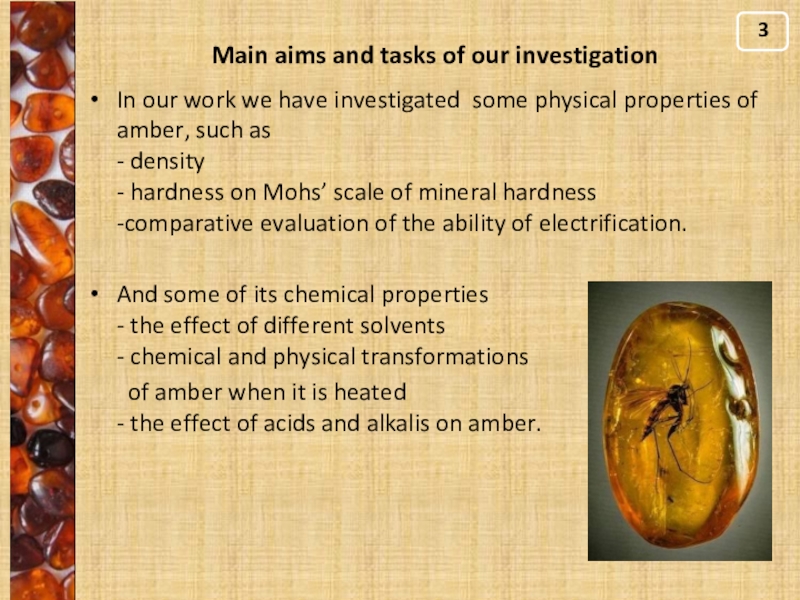
In our work we have
investigated some physical properties of amber, such as
- density
- hardness on Mohs’ scale of mineral hardness
-comparative evaluation of the ability of electrification.
And some of its chemical properties - the effect of different solvents - chemical and physical transformations
of amber when it is heated - the effect of acids and alkalis on amber.
And some of its chemical properties - the effect of different solvents - chemical and physical transformations
of amber when it is heated - the effect of acids and alkalis on amber.
Слайд 4Composition of amber
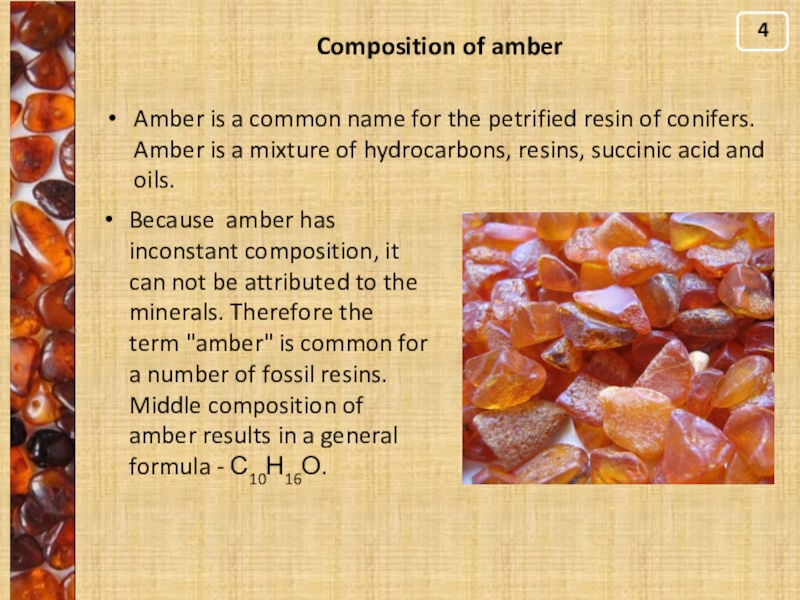
Amber is a common name for the petrified
resin of conifers. Amber is a mixture of hydrocarbons, resins, succinic acid and oils.
Because amber has inconstant composition, it can not be attributed to the minerals. Therefore the term "amber" is common for a number of fossil resins. Middle composition of amber results in a general formula - С10Н16О.
Слайд 5Location of amber
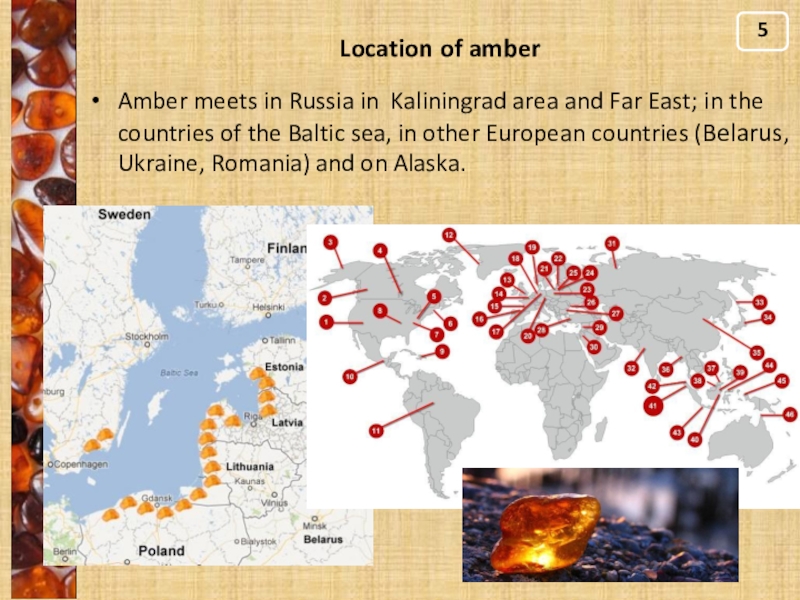
Amber meets in Russia in Kaliningrad area and
Far East; in the countries of the Baltic sea, in other European countries (Belarus, Ukraine, Romania) and on Alaska.
Слайд 6Application of amber
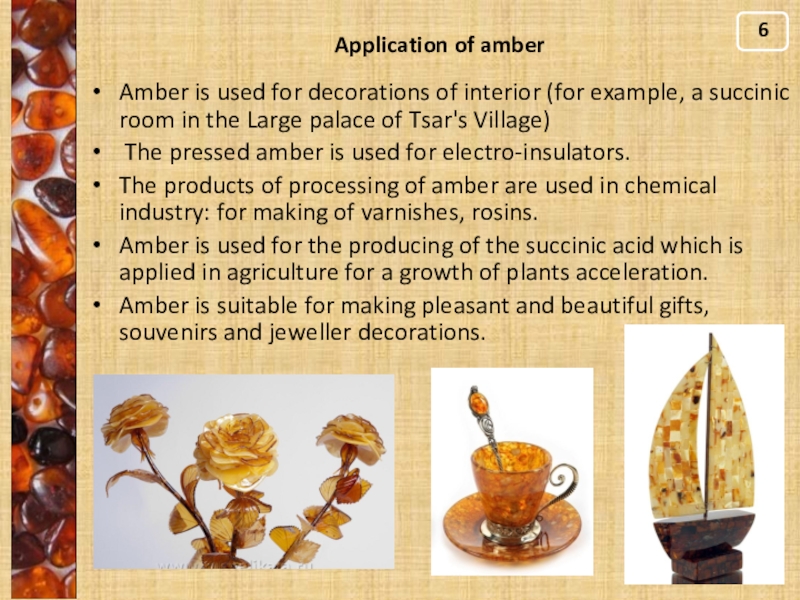
Amber is used for decorations of interior (for
example, a succinic room in the Large palace of Tsar's Village)
The pressed amber is used for electro-insulators.
The products of processing of amber are used in chemical industry: for making of varnishes, rosins.
Amber is used for the producing of the succinic acid which is applied in agriculture for a growth of plants acceleration.
Amber is suitable for making pleasant and beautiful gifts, souvenirs and jeweller decorations.
The pressed amber is used for electro-insulators.
The products of processing of amber are used in chemical industry: for making of varnishes, rosins.
Amber is used for the producing of the succinic acid which is applied in agriculture for a growth of plants acceleration.
Amber is suitable for making pleasant and beautiful gifts, souvenirs and jeweller decorations.
Слайд 7Determination of amber density
Experimentals
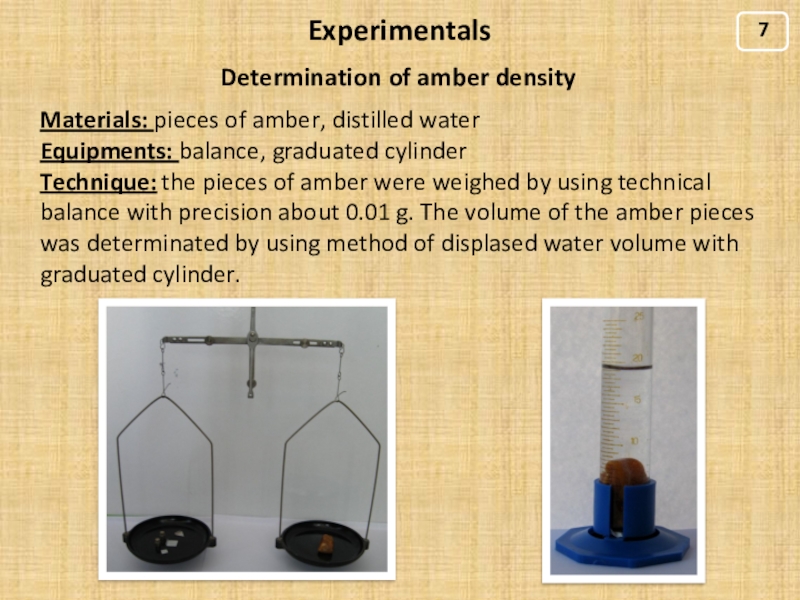
Materials: pieces of amber, distilled water
Equipments: balance, graduated
cylinder
Technique: the pieces of amber were weighed by using technical balance with precision about 0.01 g. The volume of the amber pieces was determinated by using method of displased water volume with graduated cylinder.
Technique: the pieces of amber were weighed by using technical balance with precision about 0.01 g. The volume of the amber pieces was determinated by using method of displased water volume with graduated cylinder.
Слайд 8Determination of amber density
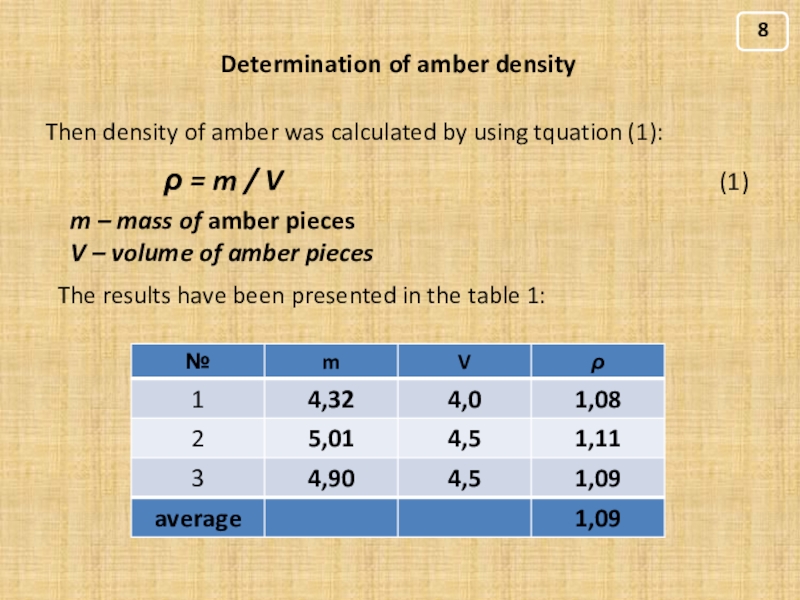
Then density of amber was calculated by using
tquation (1):
ρ = m / V (1)
The results have been presented in the table 1:
m – mass of amber pieces
V – volume of amber pieces
Слайд 9Hardness on Mohs’ scale of mineral hardness
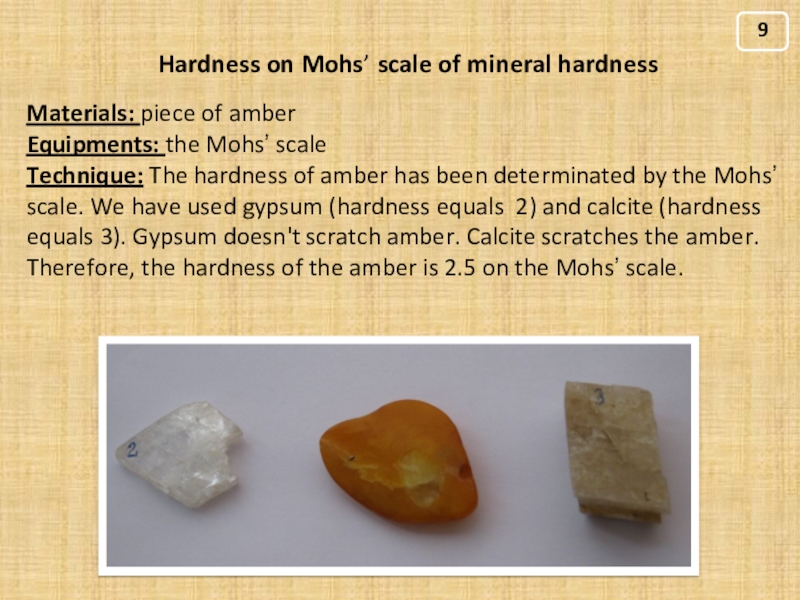
Materials: piece of amber
Equipments: the
Mohs’ scale
Technique: The hardness of amber has been determinated by the Mohs’ scale. We have used gypsum (hardness equals 2) and calcite (hardness equals 3). Gypsum doesn't scratch amber. Calcite scratches the amber. Therefore, the hardness of the amber is 2.5 on the Mohs’ scale.
Technique: The hardness of amber has been determinated by the Mohs’ scale. We have used gypsum (hardness equals 2) and calcite (hardness equals 3). Gypsum doesn't scratch amber. Calcite scratches the amber. Therefore, the hardness of the amber is 2.5 on the Mohs’ scale.
Слайд 10Comparative evaluation of the ability of electrification
Materials: pieces of amber, glass
, ebonite and wool
Equipments: electrometer
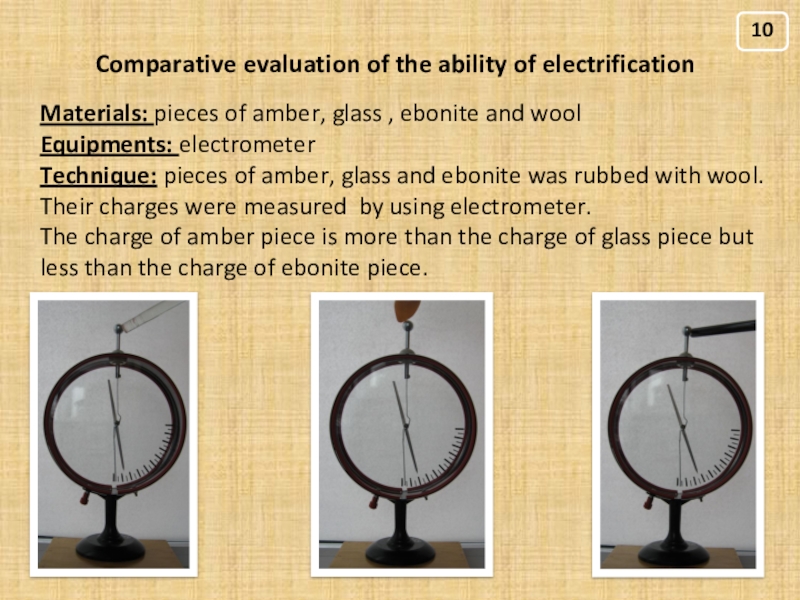
Technique: pieces of amber, glass and ebonite was rubbed with wool.
Their charges were measured by using electrometer.
The charge of amber piece is more than the charge of glass piece but less than the charge of ebonite piece.
Equipments: electrometer
Technique: pieces of amber, glass and ebonite was rubbed with wool.
Their charges were measured by using electrometer.
The charge of amber piece is more than the charge of glass piece but less than the charge of ebonite piece.
Слайд 11Materials: pieces of amber
Equipments: UV lamp
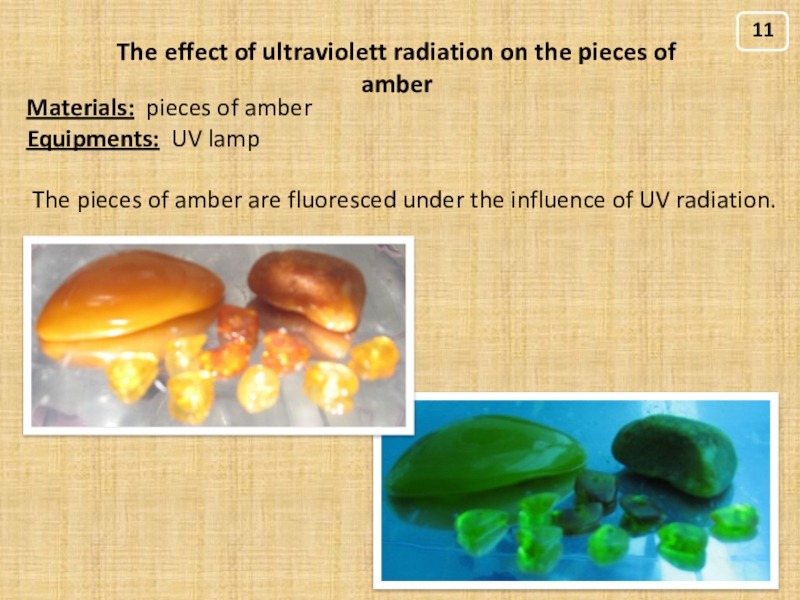
The pieces of amber are
fluoresced under the influence of UV radiation.
The effect of ultraviolett radiation on the pieces of amber
Слайд 12
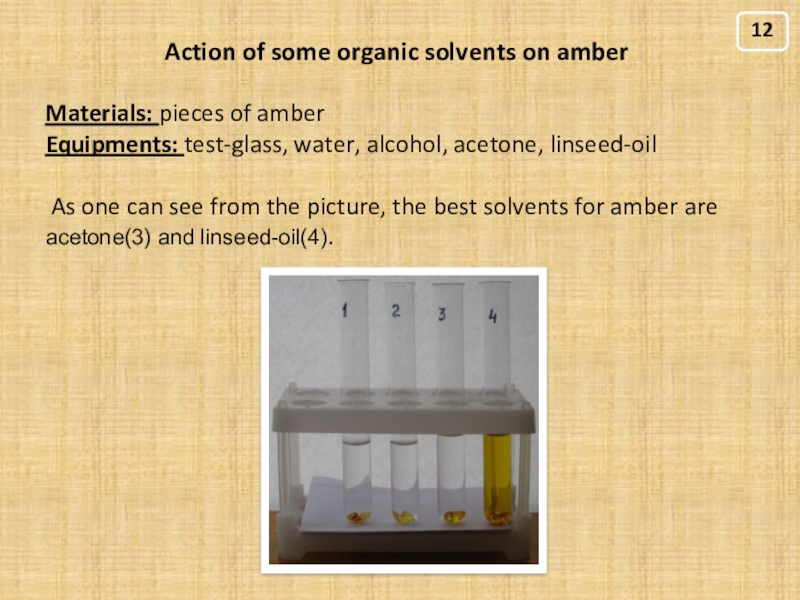
Action of some organic solvents on amber
Materials: pieces of amber
Equipments:
test-glass, water, alcohol, acetone, linseed-oil
As one can see from the picture, the best solvents for amber are acetone(3) and linseed-oil(4).
As one can see from the picture, the best solvents for amber are acetone(3) and linseed-oil(4).
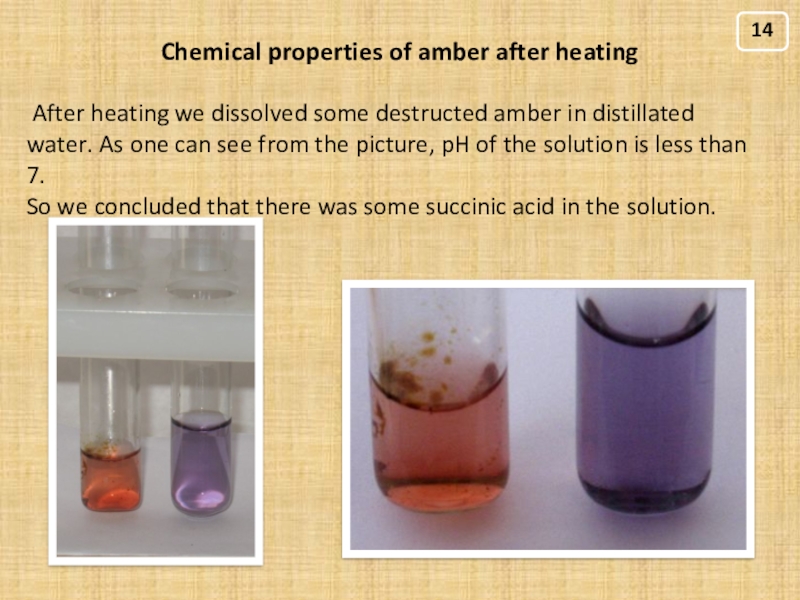
Слайд 14 After heating we dissolved some destructed amber in distillated water.
As one can see from the picture, pH of the solution is less than 7.
So we concluded that there was some succinic acid in the solution.
So we concluded that there was some succinic acid in the solution.
Chemical properties of amber after heating
Слайд 15The effect of acids and alkalis on amber
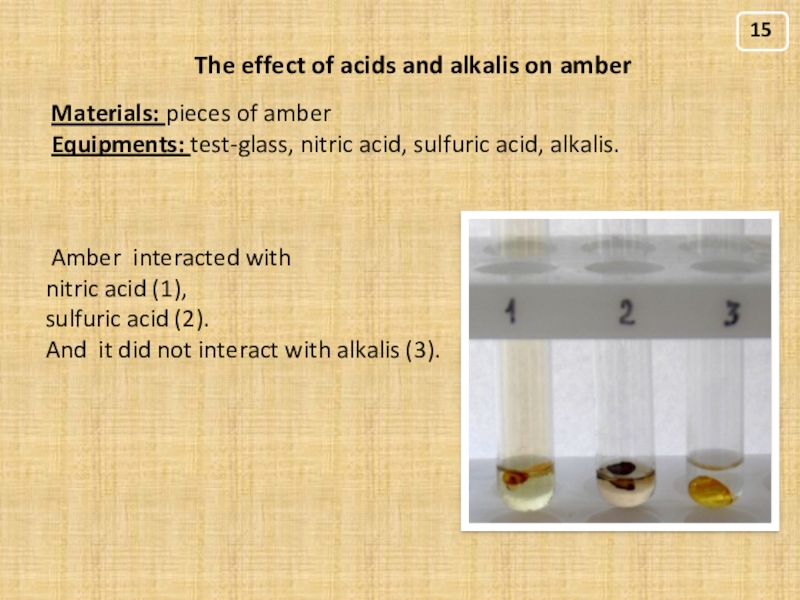
Amber interacted with
nitric acid (1),
sulfuric acid (2).
And it did not interact with alkalis (3).
Materials: pieces of amber
Equipments: test-glass, nitric acid, sulfuric acid, alkalis.
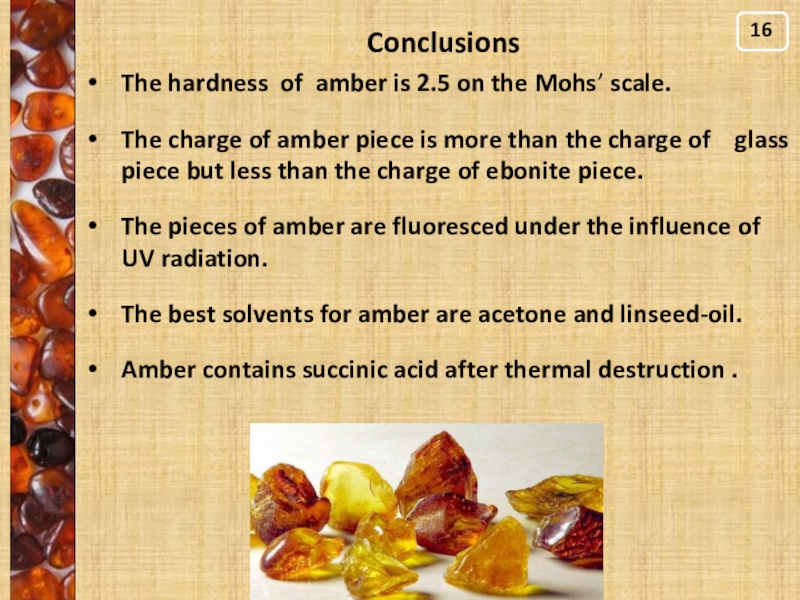
Слайд 16The hardness of amber is 2.5 on the Mohs’ scale.
The charge
of amber piece is more than the charge of glass piece but less than the charge of ebonite piece.
The pieces of amber are fluoresced under the influence of UV radiation.
The best solvents for amber are acetone and linseed-oil.
Amber contains succinic acid after thermal destruction .
The pieces of amber are fluoresced under the influence of UV radiation.
The best solvents for amber are acetone and linseed-oil.
Amber contains succinic acid after thermal destruction .
Conclusions