idioms in classes.
- Главная
- Разное
- Образование
- Спорт
- Естествознание
- Природоведение
- Религиоведение
- Французский язык
- Черчение
- Английский язык
- Астрономия
- Алгебра
- Биология
- География
- Геометрия
- Детские презентации
- Информатика
- История
- Литература
- Математика
- Музыка
- МХК
- Немецкий язык
- ОБЖ
- Обществознание
- Окружающий мир
- Педагогика
- Русский язык
- Технология
- Физика
- Философия
- Химия
- Шаблоны, фоны, картинки для презентаций
- Экология
- Экономика
Презентация, доклад на тему The development of students language awareness of the base of using idioms in classes.
Содержание
- 1. The development of students language awareness of the base of using idioms in classes.
- 2. To achieve the set aim we determine
- 3. For gaining the mentioned aim we used
- 4. Слайд 4
- 5. Слайд 5
- 6. Idioms connected with positive and negative qualities,
- 7. They are positive and negative feelings, moods
- 8. The translation of the Russian idiomatic phrase
- 9. (b) "ВЗЯТЬ себя в руки" when someone
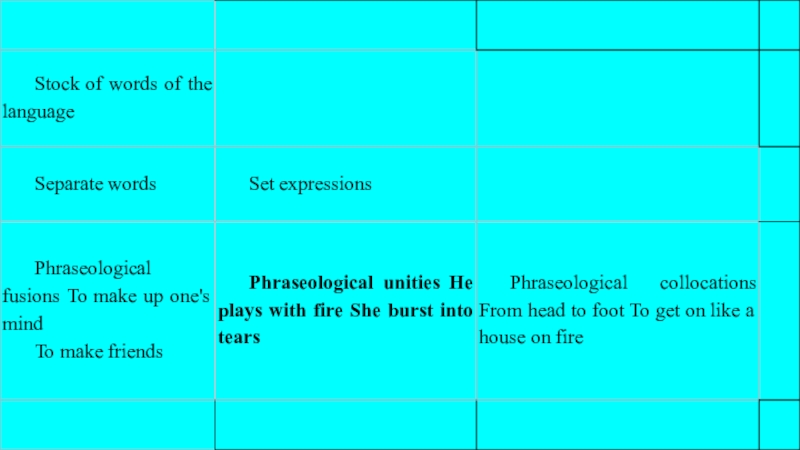
To achieve the set aim we determine the following tasks: →1. to classify idioms;→2. to study the problem of the translation of idioms;→3. to understand the aim of the modern usage of idioms;→4. to distinguish different
Слайд 2To achieve the set aim we determine the following tasks:
→1.
to classify idioms;
→2. to study the problem of the translation of idioms;
→3. to understand the aim of the modern usage of idioms;
→4. to distinguish different kinds of idioms;
→5. to analyze the frequency of idioms' usage referring to English and Russian.
→2. to study the problem of the translation of idioms;
→3. to understand the aim of the modern usage of idioms;
→4. to distinguish different kinds of idioms;
→5. to analyze the frequency of idioms' usage referring to English and Russian.
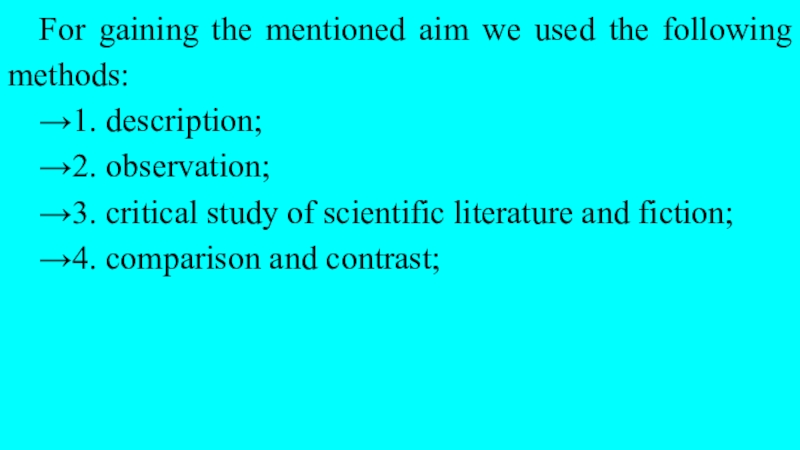
Слайд 3For gaining the mentioned aim we used the following methods:
→1. description;
→2.
observation;
→3. critical study of scientific literature and fiction;
→4. comparison and contrast;
→3. critical study of scientific literature and fiction;
→4. comparison and contrast;
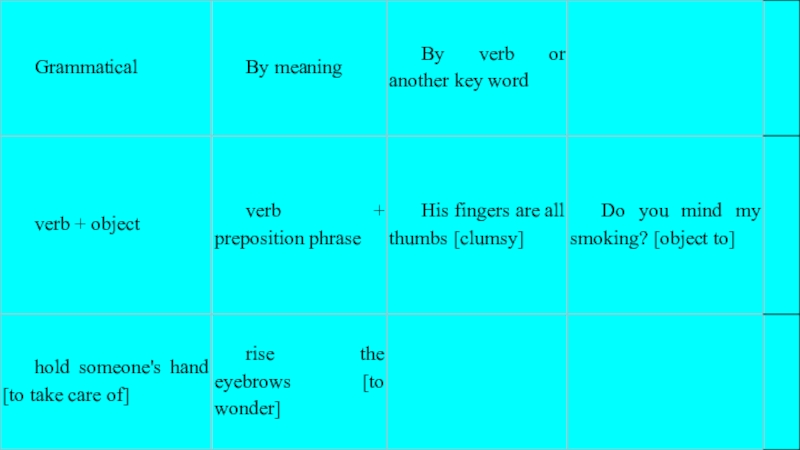
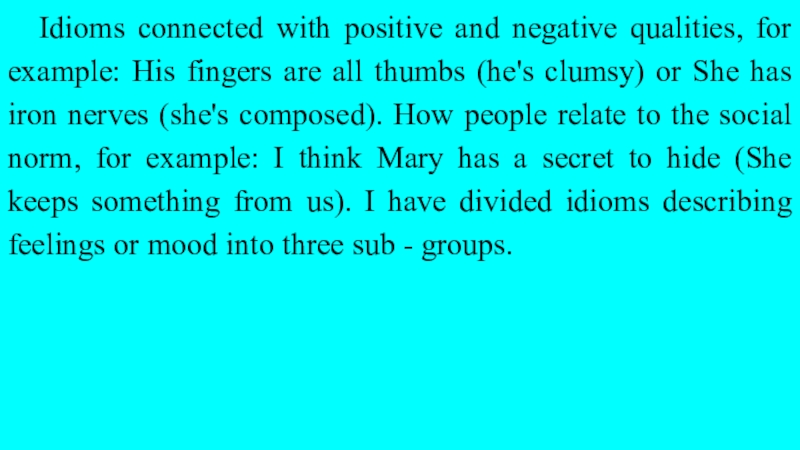
Слайд 6Idioms connected with positive and negative qualities, for example: His fingers
are all thumbs (he's clumsy) or She has iron nerves (she's composed). How people relate to the social norm, for example: I think Mary has a secret to hide (She keeps something from us). I have divided idioms describing feelings or mood into three sub - groups.
Слайд 7They are positive and negative feelings, moods and states. For example:
to get on someone's nerves (to exasperate), to have a horror of (to disgust), to be as happy as the day is long (extremely content). Physical feelings and states. For example: to burst into tears (to cry). And people's fear or fright. For example: She was scared stiff, (very scared).
Слайд 8The translation of the Russian idiomatic phrase "взять (брать) себя в
руки" (or: "держать себя в руках") depends on the context, that is, on what the author means:
(a) "Взять себя в руки" when one is under a moment's strain usually means 'to pull oneself together' and... stop crying or being panicky, or the like. Example:
- Возьми в данный момент же себя в руки, Клавдия. (А. Толстой)
-"Pull yourself together this moment, Klavdia."
Слайд 9(b) "ВЗЯТЬ себя в руки" when someone is under a more
or less permanent strain and is worrying about something usually means 'to take oneself in hand'. Example:
...Я, говорит, в своих ҹувствах не волен, моя любовь сильнее меня. Мы, конечно, с Сергеем Андҏеевичем ҏекомендовали ему в руки себя взять -- куда там! У него, видите ли, сдерживающие центры отказали. (Ю. Герман)
..."I can't help my feelings," he said, "my love is stronger than my will." Sergei Andreyevich and I naturally advised him to pull him- Self together--but he wouldn't listen. He said his control centres had snapped! How d'you like that?