the world.
- Главная
- Разное
- Образование
- Спорт
- Естествознание
- Природоведение
- Религиоведение
- Французский язык
- Черчение
- Английский язык
- Астрономия
- Алгебра
- Биология
- География
- Геометрия
- Детские презентации
- Информатика
- История
- Литература
- Математика
- Музыка
- МХК
- Немецкий язык
- ОБЖ
- Обществознание
- Окружающий мир
- Педагогика
- Русский язык
- Технология
- Физика
- Философия
- Химия
- Шаблоны, фоны, картинки для презентаций
- Экология
- Экономика
Презентация, доклад по теме Проблемы подростков
Содержание
- 1. Презентация по теме Проблемы подростков
- 2. I’ve got some problems with my parents…
- 3. My problem is that my parents
- 4. When I do my homework, It takes
- 5. My parents don’t let me go out
- 6. The aim of the projectTo create a
- 7. The tasks of the project. To learn
- 8. What about my classmates problems?
- 9. The problems of teenagers in the world.
- 10. The majority of parents don’t listen to
- 11. Independence and ControlMost teenagers are heavily influenced
- 12. ExpectationsParents have expectations of their children with
- 13. ExperimentingThe teenage years are also the time
- 14. Family ConflictWhen parents argue, teenagers may feel
- 15. - One fifth of all teenagers will
- 16. Слайд 16
- 17. Слайд 17
- 18. Слайд 18
- 19. To cease to clash with parents I
- 20. Respect your parents’ opinion Do my homework
- 21. Internet and Gaming AddictionHow to solve teenage
- 22. Violence At Home Do not ignore signs
- 23. Teen Suicide Do find out if the
- 24. Independence and control Maintain perspective. Keep your
- 25. Asking the Right QuestionsChoosing a careerAsking what
- 26. Education and InterestsComparing classes a teen enjoys
- 27. Being RealisticA teen with stage-fright, for example,
- 28. ExperimentingIf your teen is using alcohol, tobacco,
- 29. To help prevent substance use: Talk to
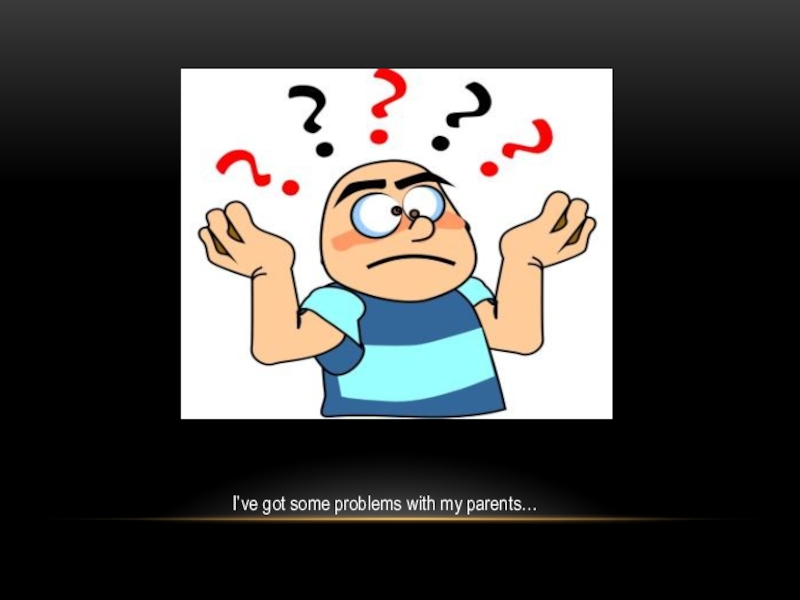
I’ve got some problems with my parents…
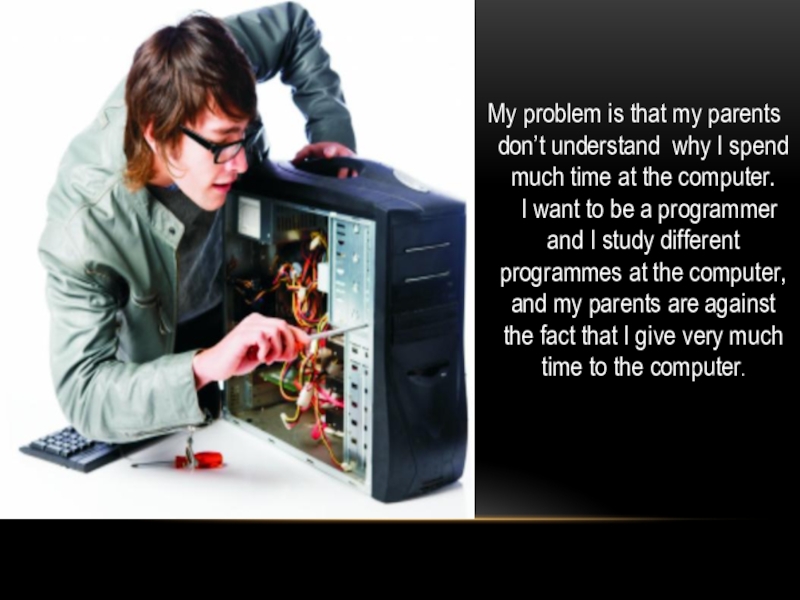
Слайд 3 My problem is that my parents don’t understand why I
spend much time at the computer.
I want to be a programmer and I study different programmes at the computer, and my parents are against the fact that I give very much time to the computer.
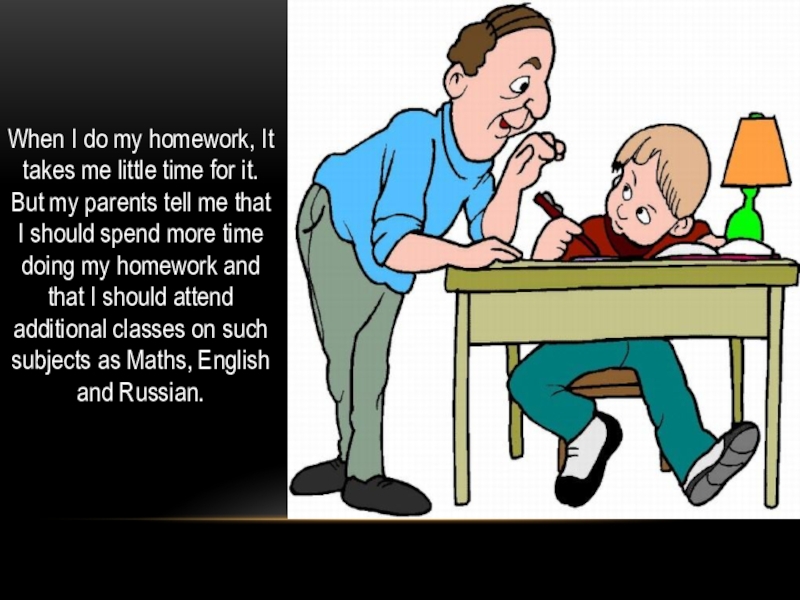
Слайд 4When I do my homework, It takes me little time for
it. But my parents tell me that I should spend more time doing my homework and that I should attend additional classes on such subjects as Maths, English and Russian.
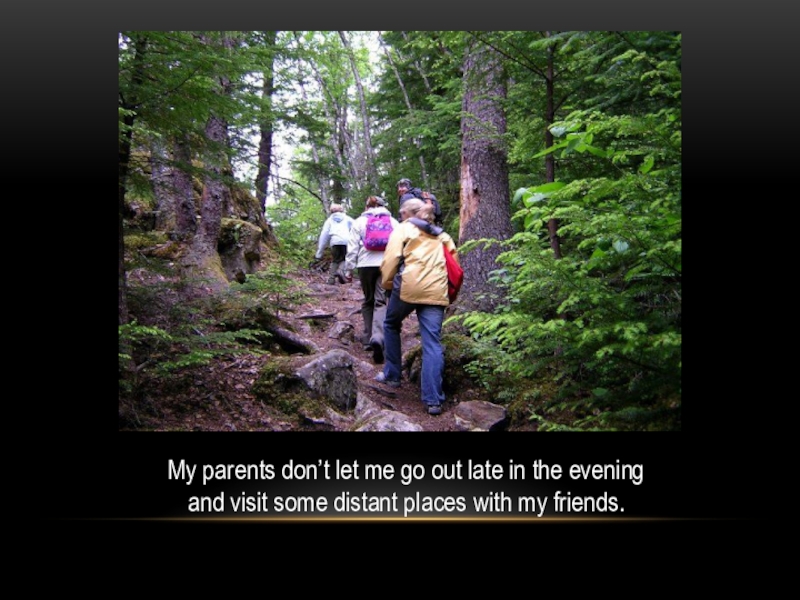
Слайд 5My parents don’t let me go out late in the evening
and visit some distant places with my friends.
Слайд 6The aim of the project
To create a list of rules, which
can help me to improve my relations with parents and use them in my life.
To learn teenage problems in my school and in the world and work out the ways of their decision
To learn teenage problems in my school and in the world and work out the ways of their decision
Слайд 7The tasks of the project.
To learn what problems my classmates
have and what problems teenagers in the world suffer from.
To learn and to create some recommendations for solving teenagers’ problems.
To learn and to create some recommendations for solving teenagers’ problems.
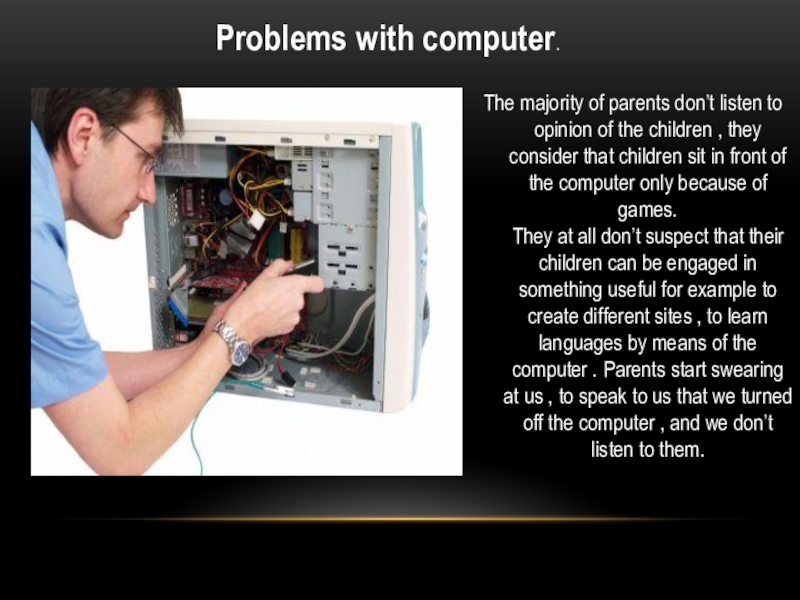
Слайд 10The majority of parents don’t listen to opinion of the children
, they consider that children sit in front of the computer only because of games.
They at all don’t suspect that their children can be engaged in something useful for example to create different sites , to learn languages by means of the computer . Parents start swearing at us , to speak to us that we turned off the computer , and we don’t listen to them.
Problems with computer.
Слайд 11Independence and Control
Most teenagers are heavily influenced by people outside their
family with music, what to wear and other fads that their parents may not approve of. Parents need to realize that this is normal and they are still important in their children's lives, even when it appears that the teens are trying to push them away.
As the teen gets older, she is likely to fight for control, which may create conflict with her parents. This can leave her parents feeling hurt and rejected, creating stress because there is a constant battle of wills.
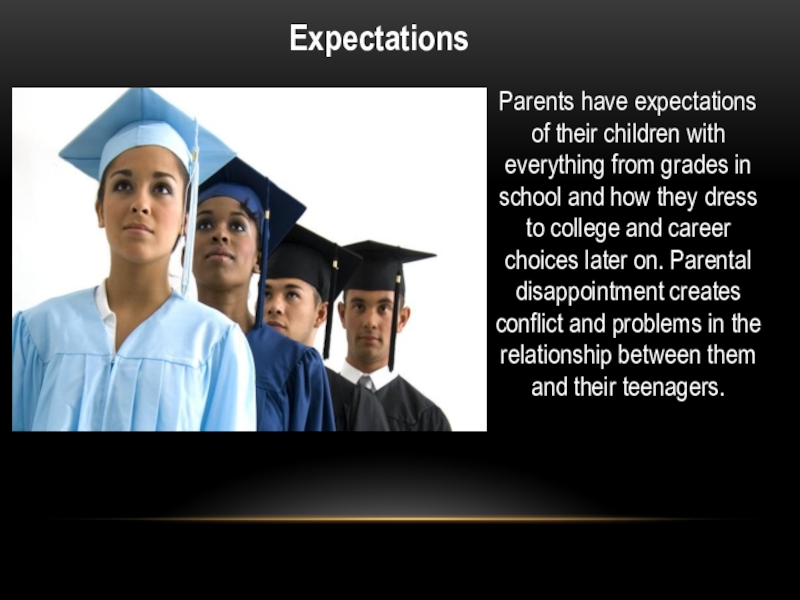
Слайд 12Expectations
Parents have expectations of their children with everything from grades in
school and how they dress to college and career choices later on. Parental disappointment creates conflict and problems in the relationship between them and their teenagers.
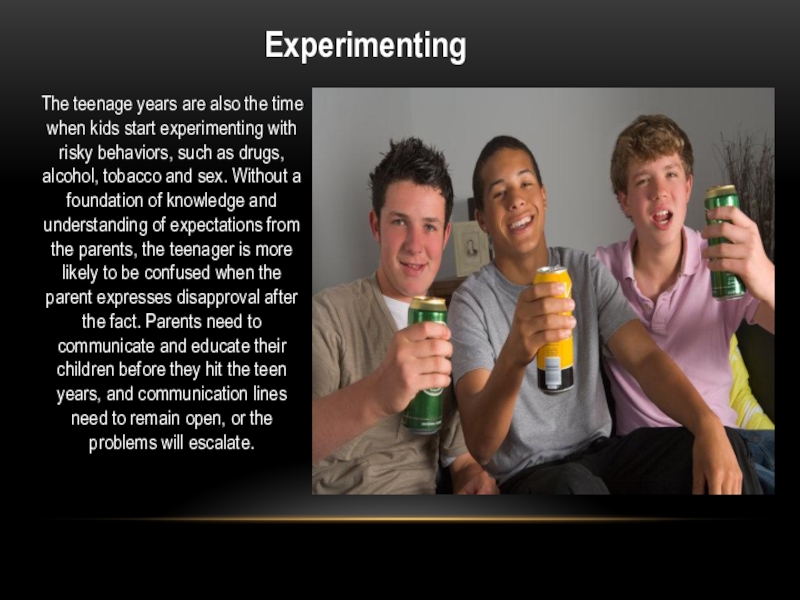
Слайд 13Experimenting
The teenage years are also the time when kids start experimenting
with risky behaviors, such as drugs, alcohol, tobacco and sex. Without a foundation of knowledge and understanding of expectations from the parents, the teenager is more likely to be confused when the parent expresses disapproval after the fact. Parents need to communicate and educate their children before they hit the teen years, and communication lines need to remain open, or the problems will escalate.
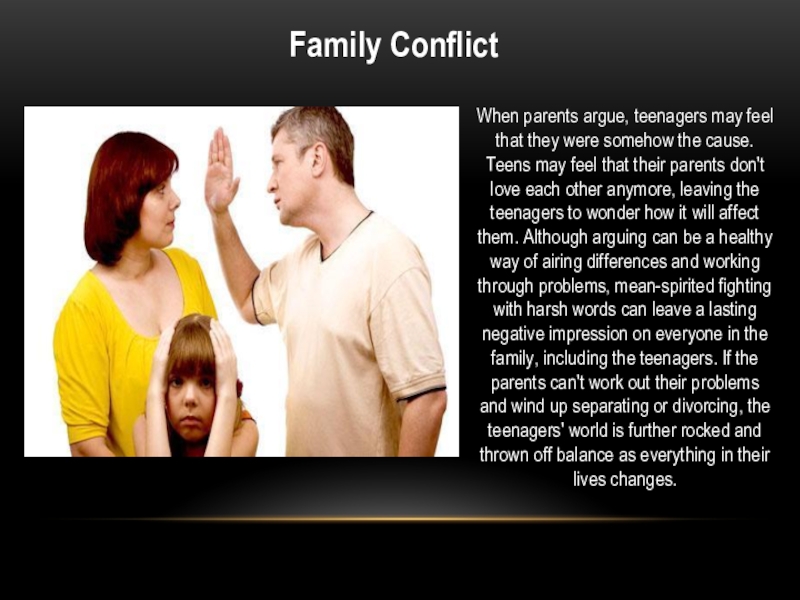
Слайд 14Family Conflict
When parents argue, teenagers may feel that they were somehow
the cause. Teens may feel that their parents don't love each other anymore, leaving the teenagers to wonder how it will affect them. Although arguing can be a healthy way of airing differences and working through problems, mean-spirited fighting with harsh words can leave a lasting negative impression on everyone in the family, including the teenagers. If the parents can't work out their problems and wind up separating or divorcing, the teenagers' world is further rocked and thrown off balance as everything in their lives changes.
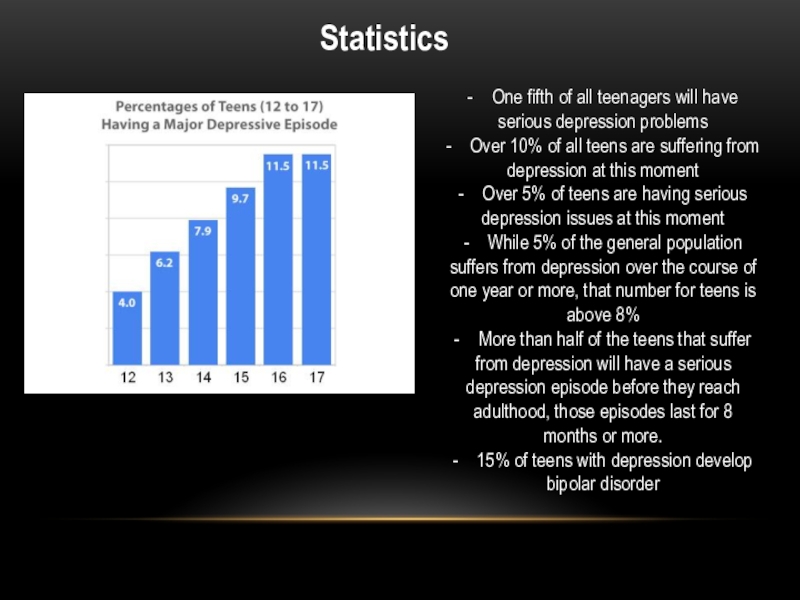
Слайд 15- One fifth of all teenagers will have serious depression problems -
Over 10% of all teens are suffering from depression at this moment
- Over 5% of teens are having serious depression issues at this moment
- While 5% of the general population suffers from depression over the course of one year or more, that number for teens is above 8%
- More than half of the teens that suffer from depression will have a serious depression episode before they reach adulthood, those episodes last for 8 months or more.
- 15% of teens with depression develop bipolar disorder
Statistics
Слайд 19To cease to clash with parents I made the set of
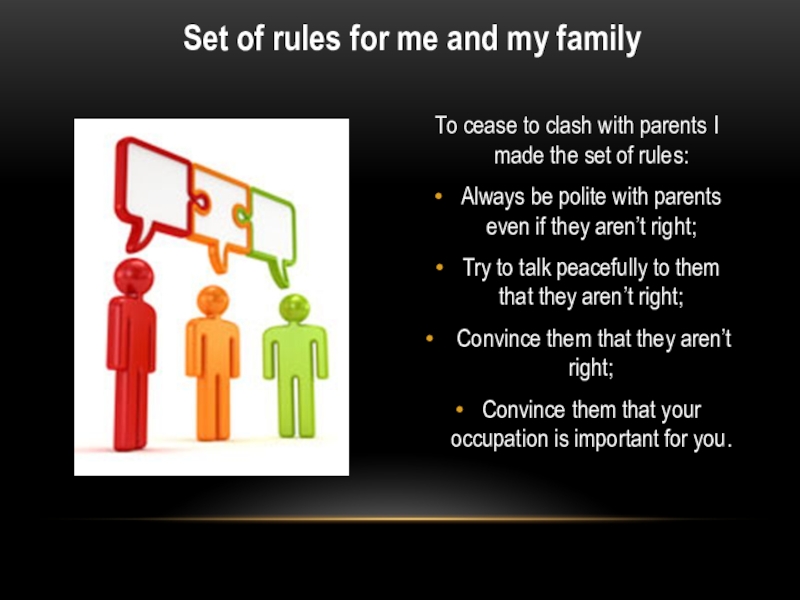
rules:
Always be polite with parents even if they aren’t right;
Try to talk peacefully to them that they aren’t right;
Convince them that they aren’t right;
Convince them that your occupation is important for you.
Always be polite with parents even if they aren’t right;
Try to talk peacefully to them that they aren’t right;
Convince them that they aren’t right;
Convince them that your occupation is important for you.
Set of rules for me and my family
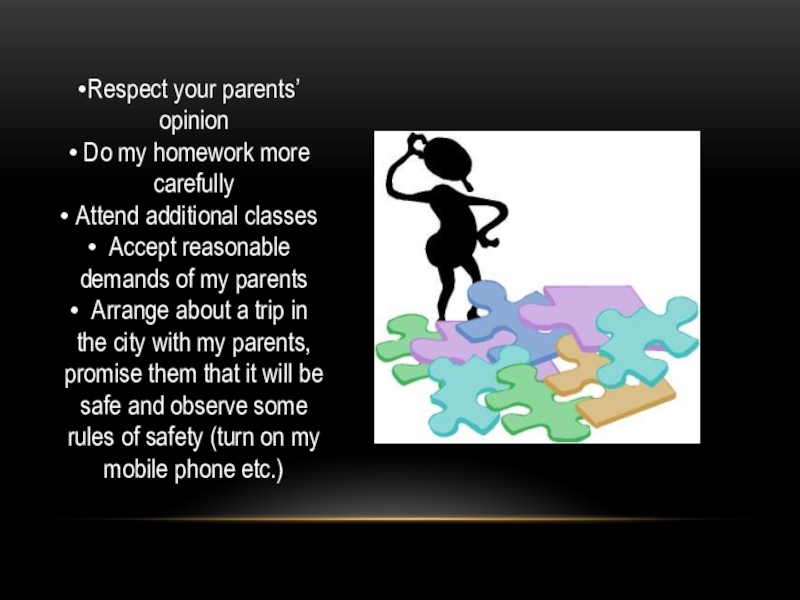
Слайд 20Respect your parents’ opinion
Do my homework more carefully
Attend additional
classes
Accept reasonable demands of my parents
Arrange about a trip in the city with my parents, promise them that it will be safe and observe some rules of safety (turn on my mobile phone etc.)
Accept reasonable demands of my parents
Arrange about a trip in the city with my parents, promise them that it will be safe and observe some rules of safety (turn on my mobile phone etc.)
Слайд 21Internet and Gaming Addiction
How to solve teenage problems?
Learn about the
meaning of the Internet for your children.
Understand that most children do not just sit idly in front of the screen. Most often, they communicate, create, socialize, post photos, explore, listen to music, and learn.
Don't nag, label ("You're sick!"), blame ("You're wasting your life!"), scold, prematurely threaten or demand that they must change.
Observe your children with open eyes & open heart.
Do not diminish the importance of the Internet & other advanced technology as this is the world they are growing up in.
Be genuinely curious about draws them to the game.
Understand that most children do not just sit idly in front of the screen. Most often, they communicate, create, socialize, post photos, explore, listen to music, and learn.
Don't nag, label ("You're sick!"), blame ("You're wasting your life!"), scold, prematurely threaten or demand that they must change.
Observe your children with open eyes & open heart.
Do not diminish the importance of the Internet & other advanced technology as this is the world they are growing up in.
Be genuinely curious about draws them to the game.
Discover what do they like and enjoy about the games, and what applications & technologies are being used?
Figure out what actual games are played, how these games played, how much time they spend playing, when and where they play, and with whom they play.
Learn how Internet and online games serve your child. What does s/he like about the games? What are the emotional and psychological allures of the games? What might s/he be trying to avoid by playing the game?
Try to agree on time limits with your child rather than coming up with your own limits.
Discuss balance between online and offline activities, weekend vs. weekdays, etc.
Learn about rating of games for violence and offensive content.
Install parental control when and if necessary.
Слайд 22Violence At Home
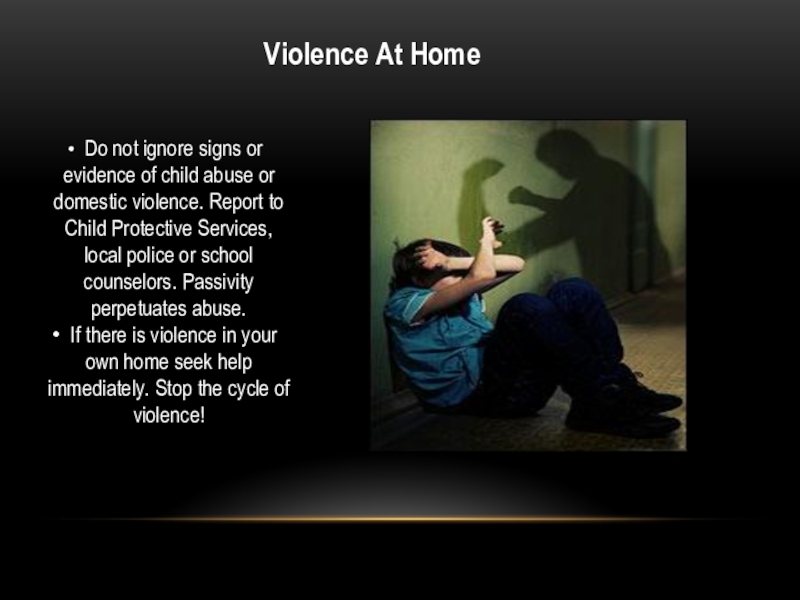
Do not ignore signs or evidence of child
abuse or domestic violence. Report to Child Protective Services, local police or school counselors. Passivity perpetuates abuse.
If there is violence in your own home seek help immediately. Stop the cycle of violence!
If there is violence in your own home seek help immediately. Stop the cycle of violence!
Слайд 23Teen Suicide
Do find out if the individual has suicide ideation,
a plan and means, and if so, what does it entail? Remember, the more specific the plan, the higher the degree of risk.
Do acknowledge that suicide is one solution to the problem, but it is not the only, nor the best, solution to the problem.
Do state that you will do whatever you can to prevent this suicide.
Do accept that in some cases you may not be able to keep the individual from committing suicide.
Do remember ambivalence. Most people do not want to die, and individuals who want to kill themselves are suicidal for a limited time only.
Do acknowledge that suicide is one solution to the problem, but it is not the only, nor the best, solution to the problem.
Do state that you will do whatever you can to prevent this suicide.
Do accept that in some cases you may not be able to keep the individual from committing suicide.
Do remember ambivalence. Most people do not want to die, and individuals who want to kill themselves are suicidal for a limited time only.
Do make sure that someone removes any guns or potentially lethal medication from the person. The police department will accept any lethal means that people do not want to keep at home. (If other alternatives are available, do not keep it in your office.)
Do tell the person that he/she does not have to solve this problem alone.
Do recognize the warning signs. This is a key to preventing teen suicide. While there is no single warning sign indicating that a person will attempt suicide, there are warning signs that teenagers give that may alert us to their danger.
Do remind them that death is final and emphasize that suicide is a permanent solution to a temporary problem.
Do respond to a student's suicide by following up and utilizing multiple approaches to prevent future suicides or cluster suicides.
Слайд 24Independence and control
Maintain perspective. Keep your eye on the long-term
picture (the horizon), as well as what is troubling you right now to remind you that despite stormy times, most teen-agers turn out just fine.
Stay in touch with the needs of your teen-ager. Stop and take a reality check with yourself at times. Ask yourself “What would I have needed as a teenager if the roles were reversed?”
Maintain your sense of humor. Unless it is life-threatening or morally wrong, most disasters are today’s teaching experiences and tomorrow’s amusing memories.
Respect teenagers’ need for space and privacy. Unless you suspect a serious problem such as drugs, be interested in what they and their friends have to say, but don’t be pushy. Draw it out of them; don’t squeeze it out of them.
Encourage kids involvement in positive activities. Sports, the arts, hobbies and nature help teens learn about life while also having good experiences. Good experiences make for good friends and good memories.
Stay in touch with the needs of your teen-ager. Stop and take a reality check with yourself at times. Ask yourself “What would I have needed as a teenager if the roles were reversed?”
Maintain your sense of humor. Unless it is life-threatening or morally wrong, most disasters are today’s teaching experiences and tomorrow’s amusing memories.
Respect teenagers’ need for space and privacy. Unless you suspect a serious problem such as drugs, be interested in what they and their friends have to say, but don’t be pushy. Draw it out of them; don’t squeeze it out of them.
Encourage kids involvement in positive activities. Sports, the arts, hobbies and nature help teens learn about life while also having good experiences. Good experiences make for good friends and good memories.
Practice what you preach. Most kids learn more by your example (what they see) than they do by your instruction (what they are told).
Keep the lines of communication open with your teen’s school. Even during these tight economic times when school resources are really stretched, most teachers are more than happy to meet with you to help your teen stay on course.
Catch your teen doing things right! Even though they may act indifferent, a steady diet of encouraging compliments will do more to help teens want to stay on course than regular criticism, however well-intended.
Get your own peer support group going with other parents of teens. Your kids have theirs so why shouldn’t you?
Слайд 25Asking the Right Questions
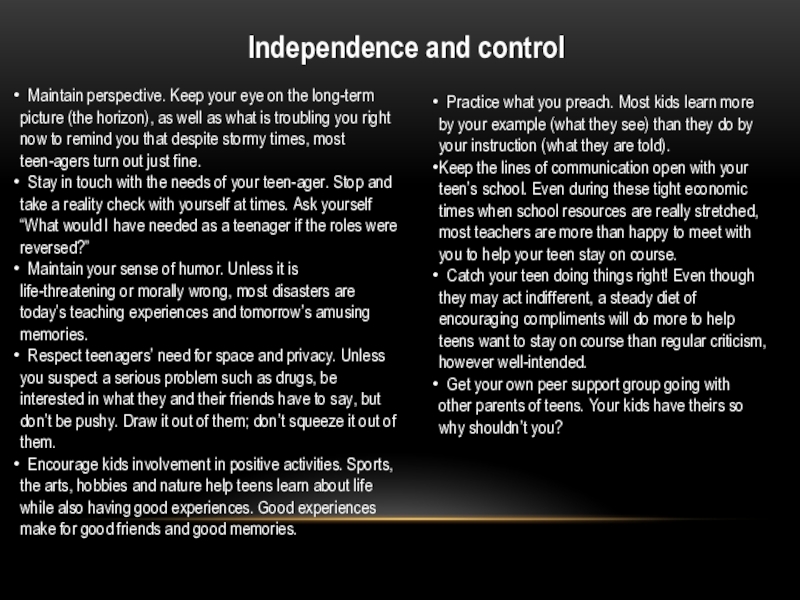
Choosing a career
Asking what you want to be
when you grow up is fine for young children, but it's hardly a helpful question for teenagers looking at a career
First, asking "Who am I?" helps a teen explore her likes and dislikes.
Secondly, "How do I want to live my life?" helps her determine lifestyle issues. For example, helping others may be more of a priority than financial success. Being free to travel may be more important than being rooted in an office.
Thirdly, asking "What do I have to give?" helps a teen examine her unique set of skills and interests to find a place in society where these can be useful to others while allowing the individual to thrive.
First, asking "Who am I?" helps a teen explore her likes and dislikes.
Secondly, "How do I want to live my life?" helps her determine lifestyle issues. For example, helping others may be more of a priority than financial success. Being free to travel may be more important than being rooted in an office.
Thirdly, asking "What do I have to give?" helps a teen examine her unique set of skills and interests to find a place in society where these can be useful to others while allowing the individual to thrive.
Слайд 26Education and Interests
Comparing classes a teen enjoys with those she doesn't
can be a good guide to exploring career paths. What may be an obvious example is a teen who excels in math and science looking at a career in those fields. What may not be so obvious is to explore the subjects within a class that a teen thrives on while not particularly enjoying the class as a whole. For example, a teen may be bored by the dates or political aspects of history, but completely intrigued by the personalities behind those events, leading to careers ranging anywhere from psychology to journalism.
Слайд 27Being Realistic
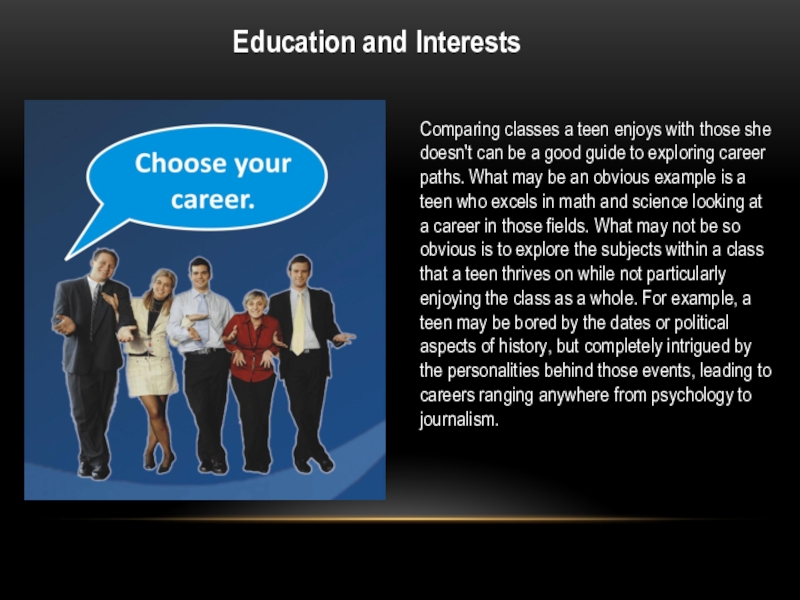
A teen with stage-fright, for example, will have some challenges
to explore before seriously going on to become an actress or musician. A teen who consistently gets D's in math may have to reconsider a career in science or medicine. Parents should be realistic too by considering their children's interests and aptitudes before trying to push one career path over another, or encouraging them to proceed on a difficult path. Some careers may seem attractive while in high school, but actually making a living as a painter, a writer or a marine biologist is easier dreamt of than actually done. For such difficult careers, having a back-up plan is good idea.
Слайд 28Experimenting
If your teen is using alcohol, tobacco, or drugs, take it
seriously. One of the most important things you can do is to talk openly with your teen about the problem. Urge him or her to do the same. Try not to use harsh, judging words. Be as supportive as you can during this time.
In most cases, a hostile, angry face-to-face meeting pushes your teen away from the family. If you don't know what to do or if you feel uncomfortable, ask for help from a pediatrician, psychologist, or psychiatrist.
In most cases, a hostile, angry face-to-face meeting pushes your teen away from the family. If you don't know what to do or if you feel uncomfortable, ask for help from a pediatrician, psychologist, or psychiatrist.
The type of treatment your teen needs depends on the level of substance abuse. For example, if your teen has tried drugs or alcohol only a few times, talking openly with him or her about the problem may be all that you need to do. But if your teen has a substance abuse problem, then he or she needs to be seen by a doctor, a counselor, or both. If your teen is addicted to a drug or alcohol, he or she may need to have detoxification treatment or a treatment that replaces the substance with medicine. Medicine works best if it is combined with one-on-one or family counseling, or both.
Returning to substance abuse, called relapse, is common after treatment. It is not a failure on the part of your teen or the treatment program. Recovery from addiction is hard and takes time. Know that there may be setbacks that your teen will need to overcome one step at a time.
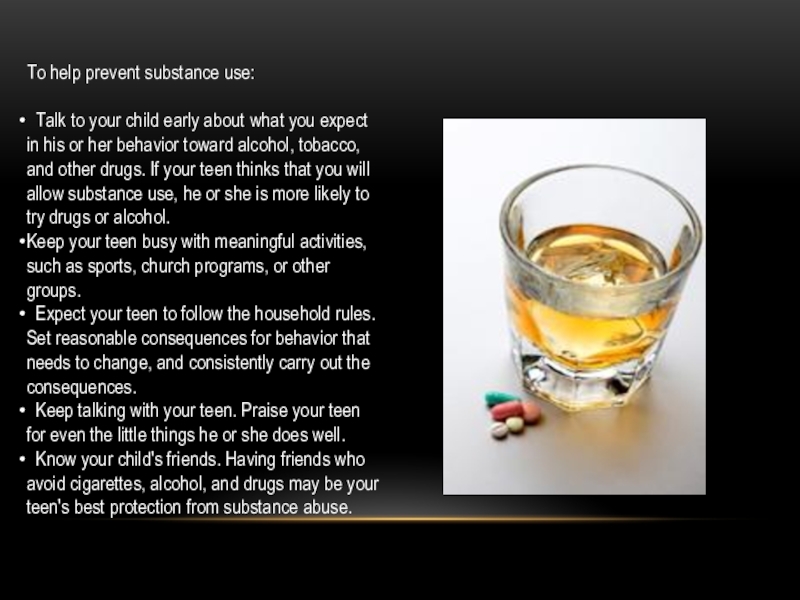
Слайд 29To help prevent substance use:
Talk to your child early about
what you expect in his or her behavior toward alcohol, tobacco, and other drugs. If your teen thinks that you will allow substance use, he or she is more likely to try drugs or alcohol.
Keep your teen busy with meaningful activities, such as sports, church programs, or other groups.
Expect your teen to follow the household rules. Set reasonable consequences for behavior that needs to change, and consistently carry out the consequences.
Keep talking with your teen. Praise your teen for even the little things he or she does well.
Know your child's friends. Having friends who avoid cigarettes, alcohol, and drugs may be your teen's best protection from substance abuse.
Keep your teen busy with meaningful activities, such as sports, church programs, or other groups.
Expect your teen to follow the household rules. Set reasonable consequences for behavior that needs to change, and consistently carry out the consequences.
Keep talking with your teen. Praise your teen for even the little things he or she does well.
Know your child's friends. Having friends who avoid cigarettes, alcohol, and drugs may be your teen's best protection from substance abuse.