Презентация, доклад по иностранному языку на тему Vitamins

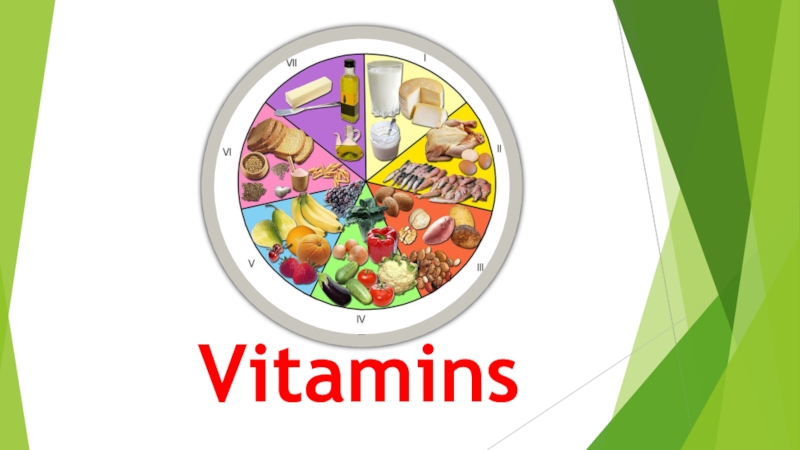
Vitamins

Слайд 1Государственное бюджетное учреждение Профессиональная образовательная организация «Астраханский базовый медицинский колледж»
Предмет: «Иностранный

язык» Тема: «Vitamins»

Преподаватель: Белянский А.А.

Астрахань – 2016 г.
Государственное бюджетное учреждение  Профессиональная образовательная организация  «Астраханский базовый медицинский колледж»Предмет: «Иностранный язык» Тема: «Vitamins»Преподаватель: Белянский

Слайд 2Vitamins

Vitamins

Слайд 3Content
Classification of vitamins
vitamin C
vitamin of group B
vitamin PP
vitamin A
vitamin D
vitamin

E
vitamin U
Clinical-pharmacological characteristics of the main vitamins
ContentClassification of vitaminsvitamin Cvitamin of group B vitamin PPvitamin Avitamin Dvitamin Evitamin UClinical-pharmacological characteristics of the main

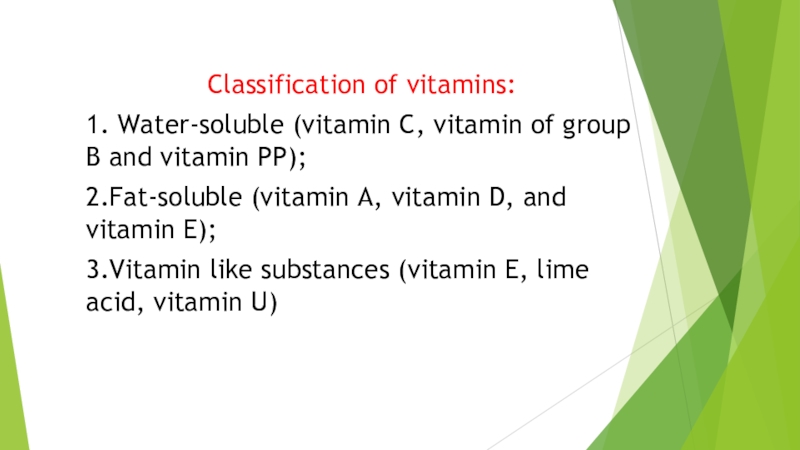
Слайд 4Classification of vitamins:
1. Water-soluble (vitamin C, vitamin of group B

and vitamin PP);
2.Fat-soluble (vitamin A, vitamin D, and vitamin E);
3.Vitamin like substances (vitamin E, lime acid, vitamin U)
Classification of vitamins: 1. Water-soluble (vitamin C, vitamin of group B and vitamin PP); 2.Fat-soluble (vitamin A,

Слайд 5Vitamin C
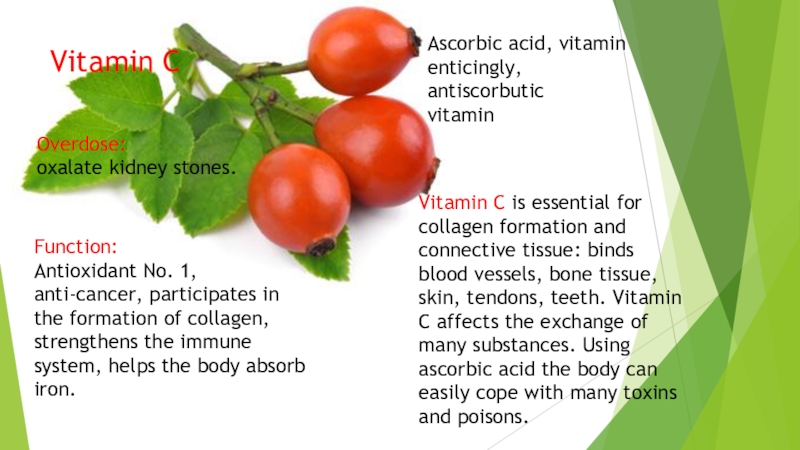
Ascorbic acid, vitamin enticingly, antiscorbutic vitamin
Function: Antioxidant No. 1, anti-cancer, participates

in the formation of collagen, strengthens the immune system, helps the body absorb iron.

Overdose: oxalate kidney stones.

Vitamin C is essential for collagen formation and connective tissue: binds blood vessels, bone tissue, skin, tendons, teeth. Vitamin C affects the exchange of many substances. Using ascorbic acid the body can easily cope with many toxins and poisons.
Vitamin CAscorbic acid, vitamin enticingly, antiscorbutic  vitaminFunction: Antioxidant No. 1, anti-cancer, participates in the formation of

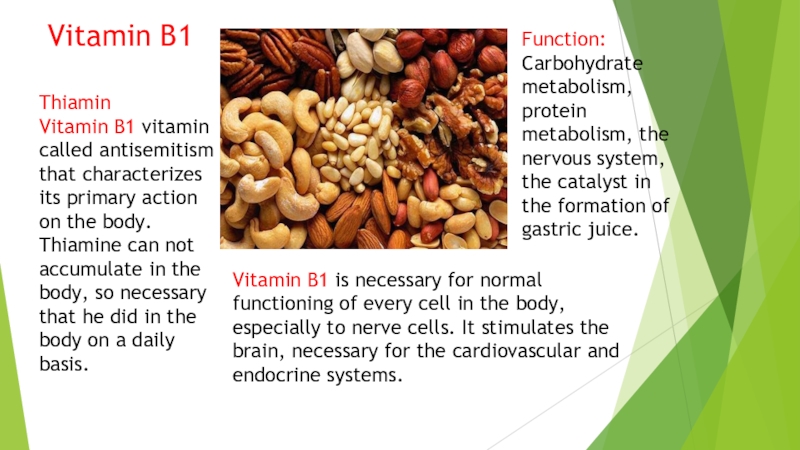
Слайд 6Thiamin Vitamin B1 vitamin called antisemitism that characterizes its primary action on

the body. Thiamine can not accumulate in the body, so necessary that he did in the body on a daily basis.

Vitamin B1

Function: Carbohydrate metabolism, protein metabolism, the nervous system, the catalyst in the formation of gastric juice.

Vitamin B1 is necessary for normal functioning of every cell in the body, especially to nerve cells. It stimulates the brain, necessary for the cardiovascular and endocrine systems.
Thiamin Vitamin B1 vitamin called antisemitism that characterizes its primary action on the body. Thiamine can not

Слайд 7Vitamin B2
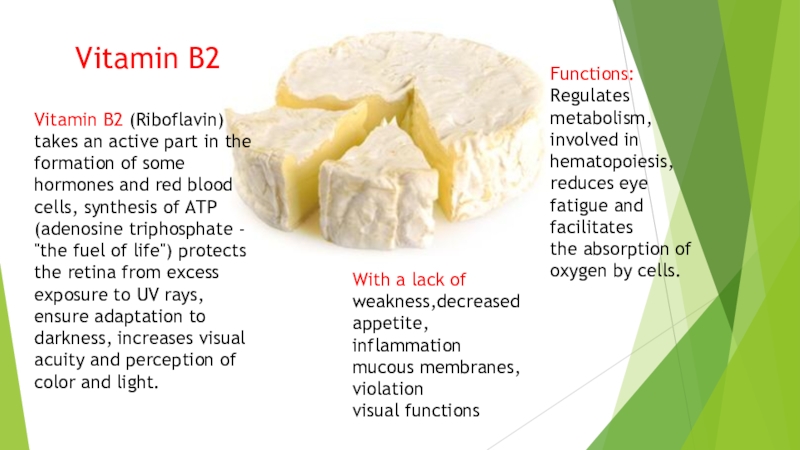
Vitamin B2 (Riboflavin) takes an active part in the formation

of some hormones and red blood cells, synthesis of ATP (adenosine triphosphate - "the fuel of life") protects the retina from excess exposure to UV rays, ensure adaptation to darkness, increases visual acuity and perception of color and light.

Functions: Regulates metabolism, involved in hematopoiesis, reduces eye fatigue and facilitates the absorption of oxygen by cells.

With a lack of weakness,decreased appetite, inflammation mucous membranes, violation visual functions
Vitamin B2Vitamin B2 (Riboflavin) takes an active part in the formation of some hormones and red blood

Слайд 8Vitamin B5
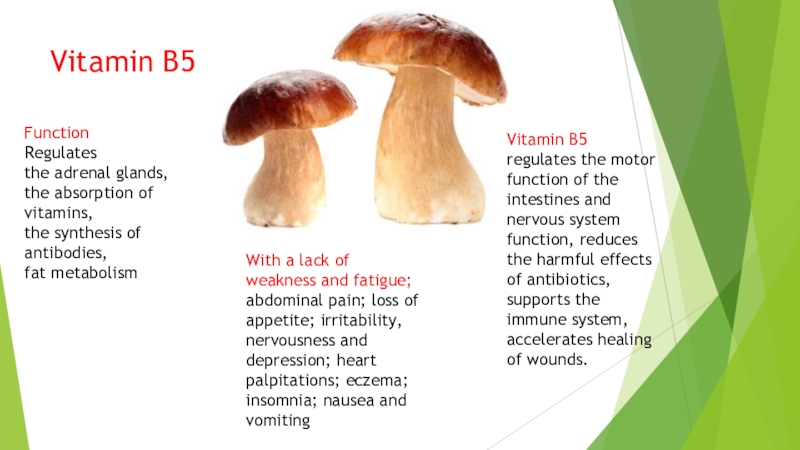
Function Regulates the adrenal glands, the absorption of vitamins, the synthesis of antibodies, fat

metabolism

Vitamin B5 regulates the motor function of the intestines and nervous system function, reduces the harmful effects of antibiotics, supports the immune system, accelerates healing of wounds.

With a lack of weakness and fatigue; abdominal pain; loss of appetite; irritability, nervousness and depression; heart palpitations; eczema; insomnia; nausea and vomiting
Vitamin B5Function Regulates  the adrenal glands, the absorption of vitamins, the synthesis of antibodies, fat metabolismVitamin

Слайд 9Vitamin B12
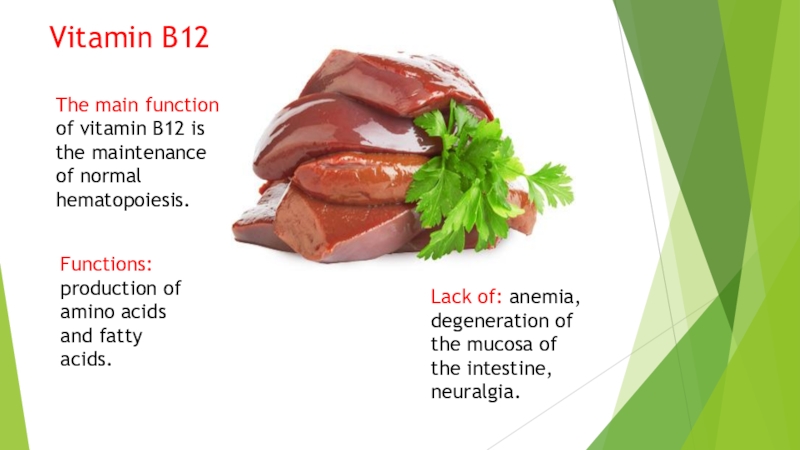
The main function of vitamin B12 is the maintenance of

normal hematopoiesis.

Functions: production of amino acids and fatty acids.

Lack of: anemia, degeneration of the mucosa of the intestine, neuralgia.
Vitamin B12The main function of vitamin B12 is the maintenance of normal hematopoiesis.Functions: production of amino acids

Слайд 10Vitamin PP
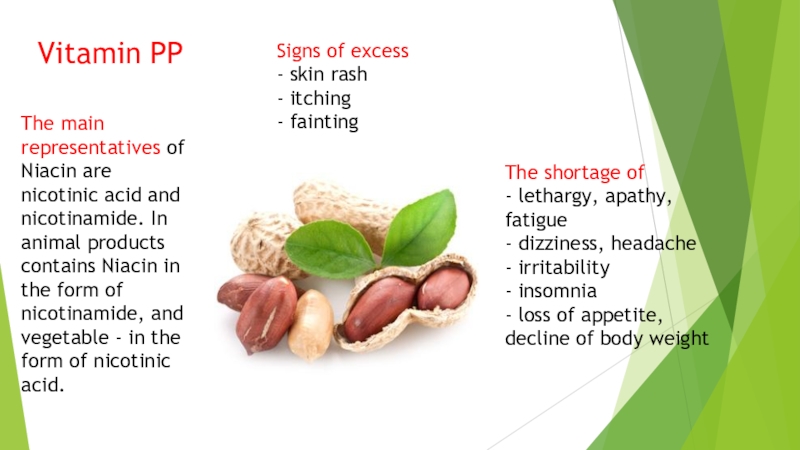
The main representatives of Niacin are nicotinic acid and nicotinamide.

In animal products contains Niacin in the form of nicotinamide, and vegetable - in the form of nicotinic acid.

The shortage of - lethargy, apathy, fatigue - dizziness, headache - irritability - insomnia - loss of appetite, decline of body weight

Signs of excess - skin rash - itching - fainting
Vitamin PPThe main representatives of Niacin are nicotinic acid and nicotinamide. In animal products contains Niacin in

Слайд 11Vitamin A
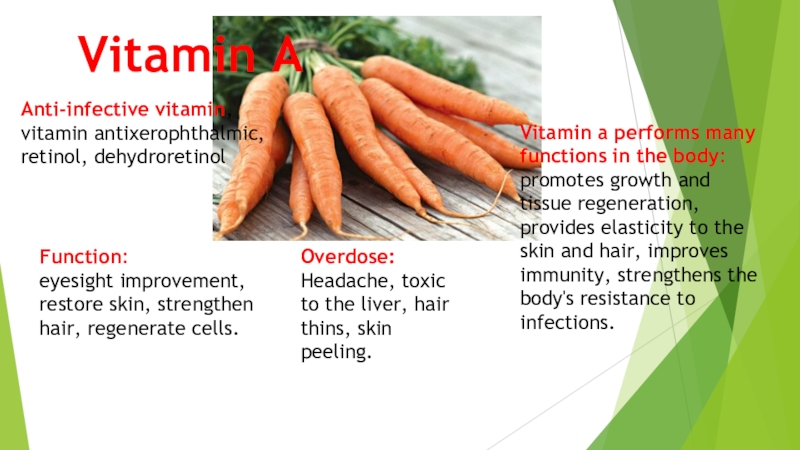
Anti-infective vitamin, vitamin antixerophthalmic, retinol, dehydroretinol
Function: eyesight improvement, restore skin,

strengthen hair, regenerate cells.

Overdose: Headache, toxic to the liver, hair thins, skin peeling.

Vitamin a performs many functions in the body: promotes growth and tissue regeneration, provides elasticity to the skin and hair, improves immunity, strengthens the body's resistance to infections.
Vitamin A Anti-infective vitamin, vitamin antixerophthalmic, retinol, dehydroretinol Function: eyesight improvement, restore skin, strengthen hair, regenerate cells.Overdose:

Слайд 12Vitamin D
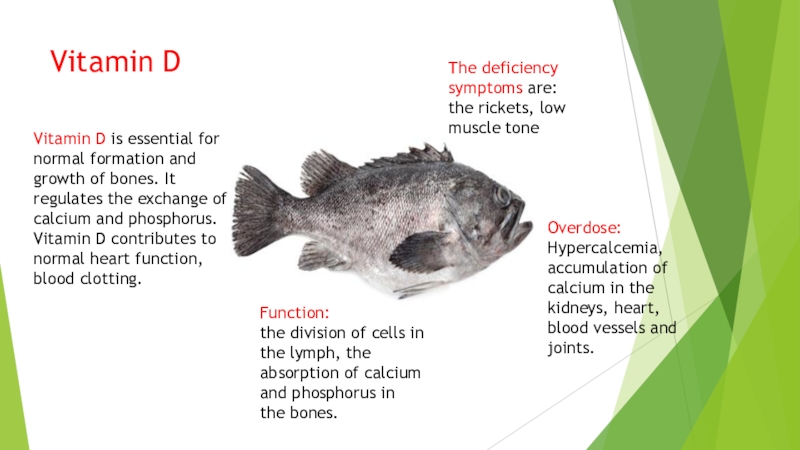
Vitamin D is essential for normal formation and growth of

bones. It regulates the exchange of calcium and phosphorus. Vitamin D contributes to normal heart function, blood clotting.

Overdose: Hypercalcemia, accumulation of calcium in the kidneys, heart, blood vessels and joints.

Function: the division of cells in the lymph, the absorption of calcium and phosphorus in the bones.

The deficiency symptoms are: the rickets, low muscle tone
Vitamin DVitamin D is essential for normal formation and growth of bones. It regulates the exchange of

Слайд 13Vitamin E
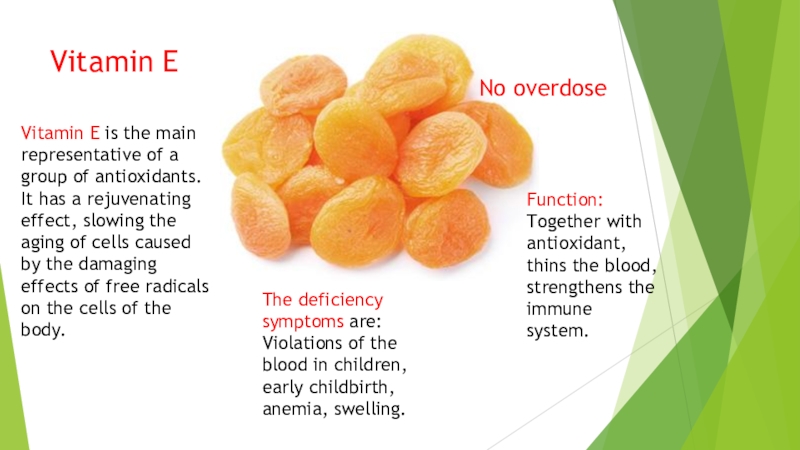
Vitamin E is the main representative of a group of

antioxidants. It has a rejuvenating effect, slowing the aging of cells caused by the damaging effects of free radicals on the cells of the body.

Function: Together with antioxidant, thins the blood, strengthens the immune system.

No overdose

The deficiency symptoms are: Violations of the blood in children, early childbirth, anemia, swelling.
Vitamin EVitamin E is the main representative of a group of antioxidants. It has a rejuvenating effect,

Слайд 14Vitamin U
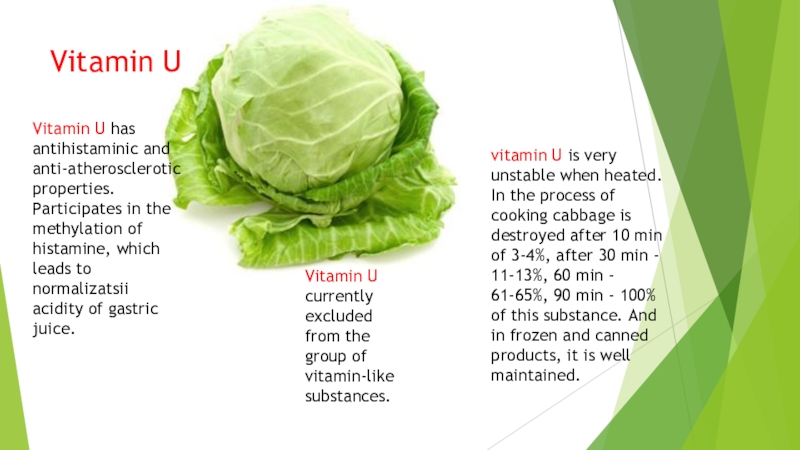
Vitamin U has antihistaminic and anti-atherosclerotic properties. Participates in the

methylation of histamine, which leads to normalizatsii acidity of gastric juice.

Vitamin U currently excluded from the group of vitamin-like substances.

vitamin U is very unstable when heated. In the process of cooking cabbage is destroyed after 10 min of 3-4%, after 30 min - 11-13%, 60 min - 61-65%, 90 min - 100% of this substance. And in frozen and canned products, it is well maintained.
Vitamin UVitamin U has antihistaminic and anti-atherosclerotic properties. Participates in the methylation of histamine, which leads to

Слайд 15Clinical-pharmacological characteristics of the main vitamins
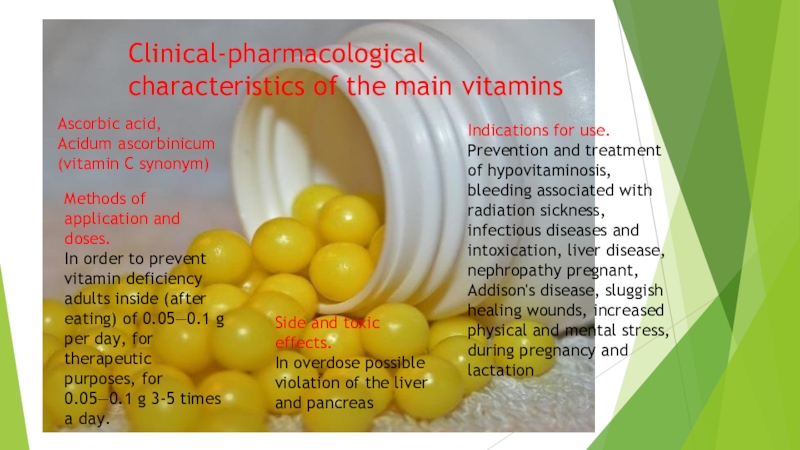
Ascorbic acid, Acidum ascorbinicum (vitamin C

synonym)

Indications for use. Prevention and treatment of hypovitaminosis, bleeding associated with radiation sickness, infectious diseases and intoxication, liver disease, nephropathy pregnant, Addison's disease, sluggish healing wounds, increased physical and mental stress, during pregnancy and lactation

Methods of application and doses.
In order to prevent vitamin deficiency adults inside (after eating) of 0.05—0.1 g per day, for therapeutic purposes, for 0.05—0.1 g 3-5 times a day.

Side and toxic effects.
In overdose possible violation of the liver and pancreas
Clinical-pharmacological characteristics of the main vitaminsAscorbic acid, Acidum ascorbinicum (vitamin C synonym)Indications for use. Prevention and treatment

Слайд 16Benfotiamine, Benphothiaminum
The basic properties. Synthetic analog of thiamine; corresponds in properties,

but is superior in activity

Methods of application and doses.
Inside (after eating) for adults 0.025—0.05 g 1-4 times a day. Daily dose for adults 0.1—0.2 g, treatment course — 15-30 days. Persons of elderly and senile age — 0.025 g 1-2 times a day; children from 1 year to 10 years — 0.01—0.03 g / day (course of treatment is 10-20 days), children older than 10 years — and 0.03—0.06 g per day (treatment course — 15-30 days)
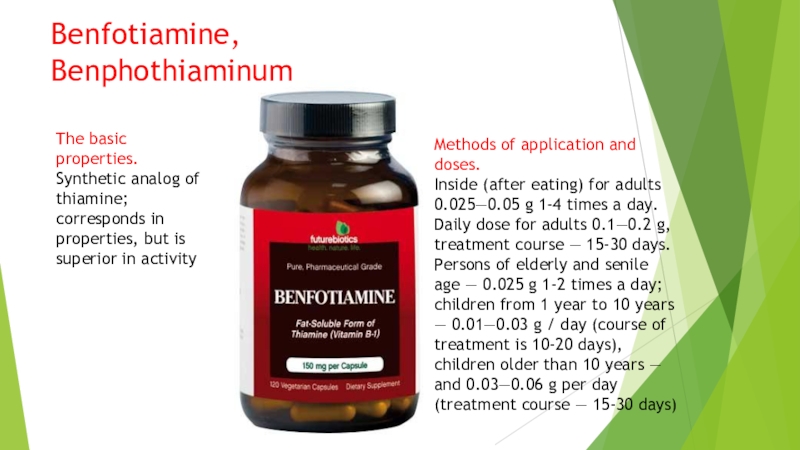
Benfotiamine, BenphothiaminumThe basic properties. Synthetic analog of thiamine; corresponds in properties, but is superior in activityMethods of

Слайд 17Calcium pangamat, Calcii pangamas (synonym: vitamin B15, Culham)
The basic properties. Regulates

lipid metabolism, improves the absorption of oxygen by tissues, increases the content of creatine phosphate and glycogen in the muscles and liver, eliminates the effects of hypoxia

Methods of application and doses.
Inside adult for 0.05—0.1 g 3-4 times a day. Daily dose for adults 0,1—0,3 g, for children up to 3 years — 0.05 g, from 3 to 7 years — 0.1 g, 7 to 14 years — 0.15 g. the Course of treatment is 20-40 days. Repeated courses in 2-3 months.

Side and toxic effects. With a significant increase in blood pressure, the drug is prescribed with caution
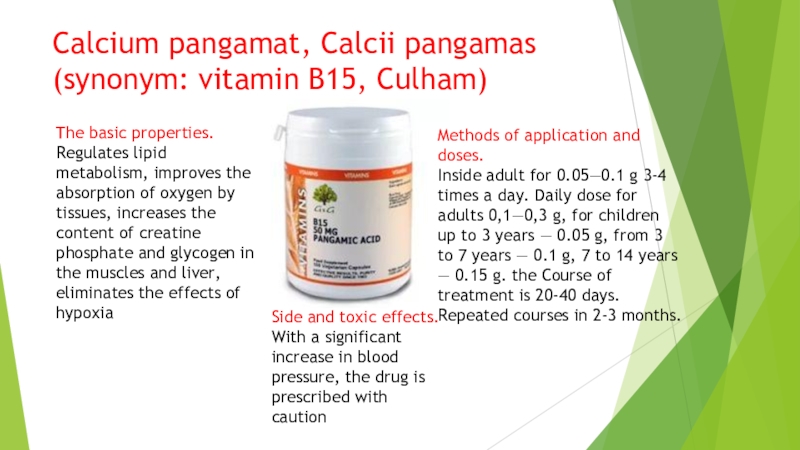
Calcium pangamat, Calcii pangamas (synonym: vitamin B15, Culham)The basic properties. Regulates lipid metabolism, improves the absorption of

Слайд 18Thank you for your attention!

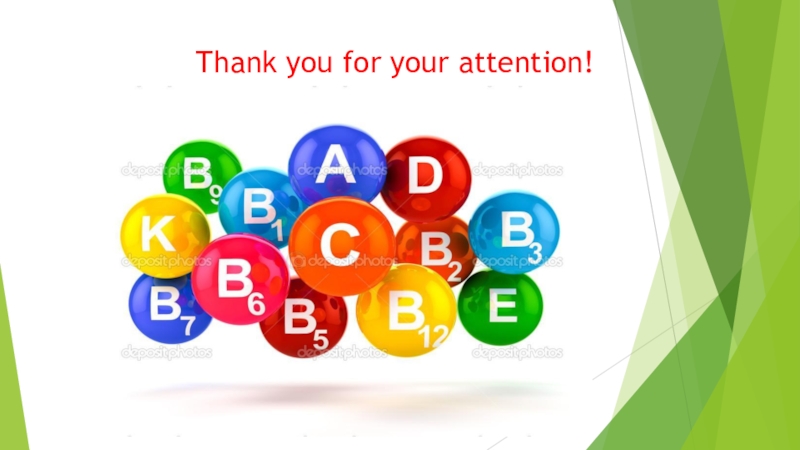
Thank you for your attention!

Что такое shareslide.ru?

Это сайт презентаций, где можно хранить и обмениваться своими презентациями, докладами, проектами, шаблонами в формате PowerPoint с другими пользователями. Мы помогаем школьникам, студентам, учителям, преподавателям хранить и обмениваться учебными материалами.


Для правообладателей

Яндекс.Метрика

Обратная связь

Email: Нажмите что бы посмотреть