- Главная
- Разное
- Образование
- Спорт
- Естествознание
- Природоведение
- Религиоведение
- Французский язык
- Черчение
- Английский язык
- Астрономия
- Алгебра
- Биология
- География
- Геометрия
- Детские презентации
- Информатика
- История
- Литература
- Математика
- Музыка
- МХК
- Немецкий язык
- ОБЖ
- Обществознание
- Окружающий мир
- Педагогика
- Русский язык
- Технология
- Физика
- Философия
- Химия
- Шаблоны, фоны, картинки для презентаций
- Экология
- Экономика
Презентация, доклад по английскому языку Stonehenge
Содержание
- 1. Презентация по английскому языку Stonehenge
- 2. Слайд 2
- 3. 10. Stonehenge is Believed to be ancient
- 4. Слайд 4
- 5. 9. Did Aliens build the Stonehenge?Beside the
- 6. Слайд 6
- 7. 8. Misguiding Theories of StonehengeHaving already talked
- 8. Слайд 8
- 9. 7. The Construction of Megalithic Stonehenge is
- 10. 6. Was Stonehenge Just a Burial Site
- 11. 5. What we see today is Just
- 12. Слайд 12
- 13. 4. Stonehenge Has a Healing AuraStonehenge is
- 14. Слайд 14
- 15. 3. Stonehenge Has Been Featured in Numbers
- 16. Слайд 16
- 17. 2. Michael Johnson Ran around Stonehenge with
- 18. Слайд 18
- 19. 1. Destructive Road-building Scheme Threat to StonehengeIt
10. Stonehenge is Believed to be ancient than Egyptian PyramidsTo our knowledge, Egyptian Pyramids are known to be the most ancient built structures in the earth. But, this is controversial as the Stonehenge is said to

Слайд 310. Stonehenge is Believed to be ancient than Egyptian Pyramids
To our
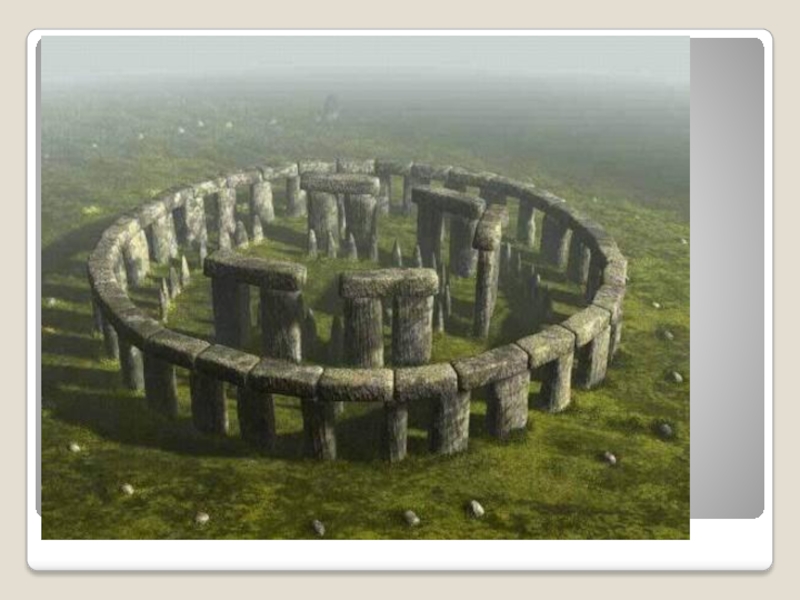
knowledge, Egyptian Pyramids are known to be the most ancient built structures in the earth. But, this is controversial as the Stonehenge is said to have been built nearly 400 years before the Egyptian Pyramids were constructed. Archaeologists say that the construction of Stonehenge began during 31st century BC, which took 1500 years to complete with 33 million labour hours. The first Egyptian Pyramid is known to have been built during 27th century BC only. Stonehenge is one of the 900 stone circles in England, whose megalithic construction is as baffling as the gigantic Egyptian Pyramids. The actual purpose of Stonehenge is still unknown, but it is believed to be a burial site of prehistoric period.
Слайд 59. Did Aliens build the Stonehenge?
Beside the antiquity of Stonehenge, there
is much debate regarding the builders of Stonehenge. There exist several different theories about the architects of Stonehenge. Popularly, the Druids are credited for the construction of Stonehenge, who used the site for performing their ritual rites. Another theory suggests that it were the Neolithic Agrarians, also called the Windmill Hill people, who could have built the Stonehenge. This comes from the reference that the site probably was a burial place before the Druids would come there for religious worshipping. And the most interesting theory of all is that of alien construction of the megalithic monument. It suggests that the perfect geometrical design of Stonehenge circle, which is likely to be undiscovered during the Stone Age, couldn’t be built by the humans. So, there are also numbers of scientists who get rid of the debate arguing that the megalithic Stonehenge was built by the Aliens.
Слайд 78. Misguiding Theories of Stonehenge
Having already talked about the builders of
Stonehenge, it would also be interesting here to write about the misguiding theories given by some thinkers related to Stonehenge. It is seen that during 17th century, an English architect John Webb, said that the Stonehenge was originally built by the Romans. There is no obvious reasoning behind architect Webb’s supposition, but he did mention that the Stonehenge was actually built as a temple dedicated to a Roman God of Sky, Coelus. Later, architect Webb’s contemporary philosopher Dr. Walter Charleton gave another counter theory that it were Danish arriving after the Romans, who built the Stonehenge. But, both of these theories have been disproved. Yet, there still exists one more interesting folktale about Merlin, a mythical character, to have been created Stonehenge. There are certain illustrations of Merlin and Stonehenge in various arts, but it remains as a legend.
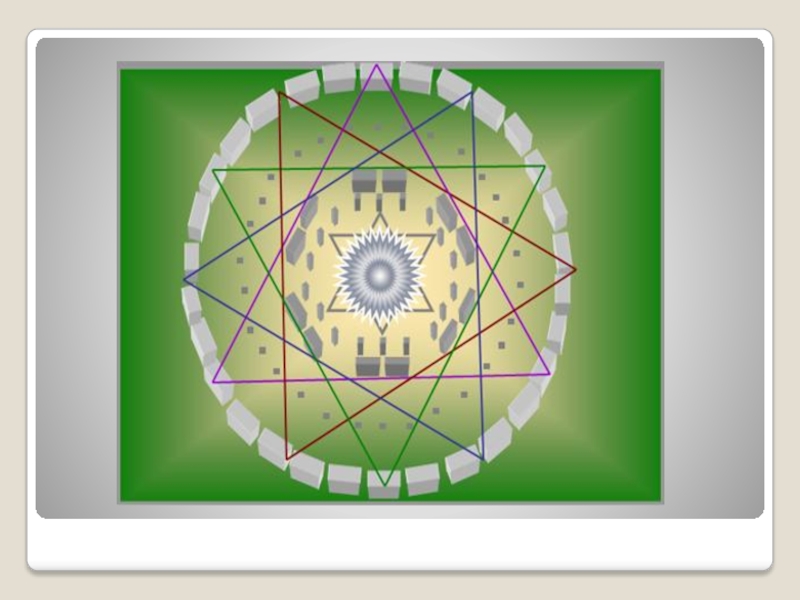
Слайд 97. The Construction of Megalithic Stonehenge is Perfectly Geometric
The ancient dating
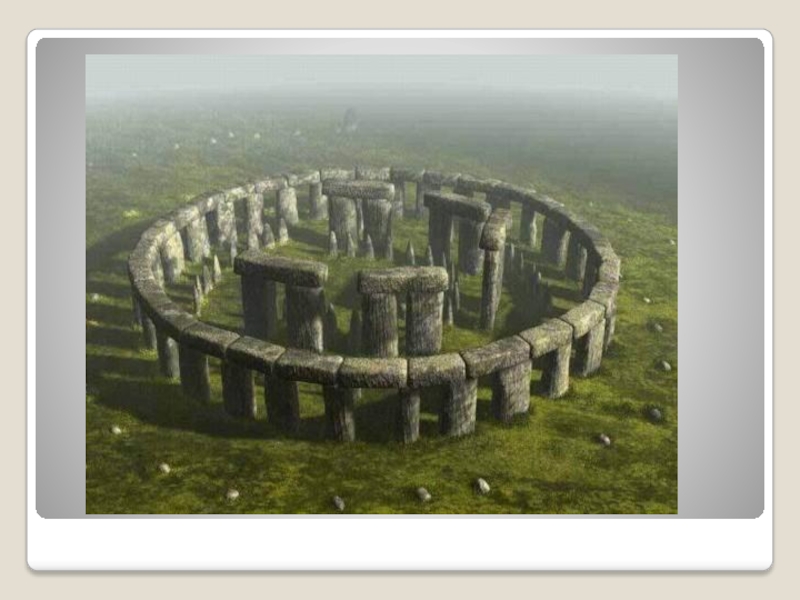
of Stonehenge is barely unknown to people, but what is more amazing is about its perfect geometric construction. Stonehenge is basically a ditch consisting of circular ring of standing stones making concentric crop circles. There were two major types of stones used in the construction, namely Sarsen stones weighing 25 tons with an average height of 18 ft. and the Bluestones, weighing up to 4 tons. It is believed that the Bluestones, which are special type of volcanic rocks, were brought to the site from nearly 240 miles away. The complex mathematical and geometric plan and the structure of Stonehenge leave behind unmatched construction concept of the ancient builders. The precisely proportioned structure of Stonehenge has left many questions regarding the actual function of the Stonehenge itself.
Слайд 106. Was Stonehenge Just a Burial Site or an Astronomical Clock?
In
front of the mystic legacy of Stonehenge, there remains an unanswered question regarding the purpose of monumental Stonehenge. After going through massive literature of prehistoric civilization associated with Stonehenge, archaeologists have come up with one or more identifying value of Stonehenge. One of the poor findings is that Stonehenge simply did serve as a burial site or a religious ritual site for ancient people who lived around the period. Denying this insufficient proposition, we have another more interesting story. During the mid-20th century, some researchers involved themselves in exploring the geometric construction of Stonehenge. They were surprised to find out the meaning-flooded astronomical alignments in Stonehenge, which gave evidences that it was possibly an astronomical observatory. The concrete findings were that Stonehenge was actually both a ritual site and an astronomical clock, which would indicate annually occurring solstices, equinoxes and lunar days representing various ritual festivals and celebrations.
Слайд 115. What we see today is Just a Part of Actual
Stonehenge
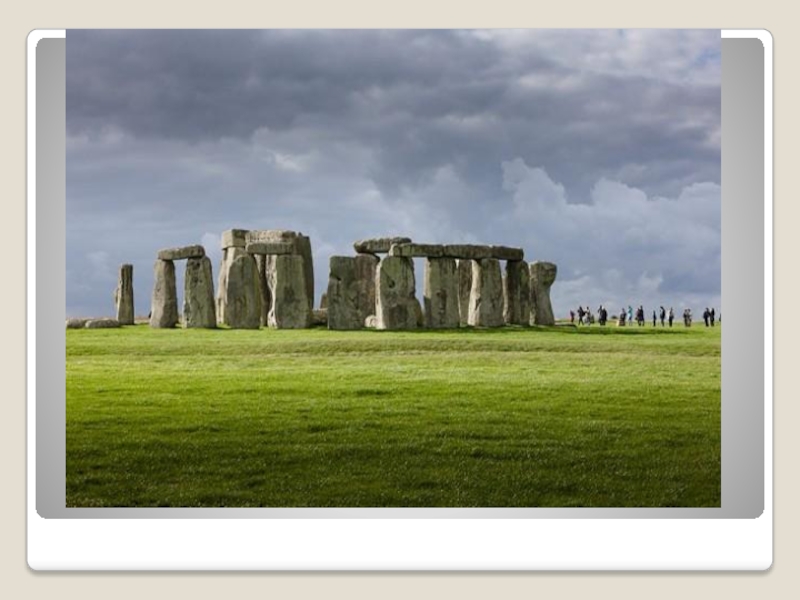
Given that the major part of ancient Stonehenge has fallen down over periods, we are able to see only the part structure of it on present day. Since its construction in 31st century BC till 16thcentury BC, the Stonehenge structure was repeatedly reconstructed beginning from the diameter of 110 meters. About 6 Stonehenge circles were added to the initial one during the course. Visitors today know Stonehenge by observing a part of it. It is believed that almost half of the structure has disappeared from or fallen apart in the site. The full of heritage landscape of Stonehenge was scientifically examined first in 1666 by John Aubrey. Since then, several organizations and parties including UNESCO, English Heritage and National Trust have been working on archaeological and architectural conservation of the site attracting nearly 1 million visitors a year.
Given that the major part of ancient Stonehenge has fallen down over periods, we are able to see only the part structure of it on present day. Since its construction in 31st century BC till 16thcentury BC, the Stonehenge structure was repeatedly reconstructed beginning from the diameter of 110 meters. About 6 Stonehenge circles were added to the initial one during the course. Visitors today know Stonehenge by observing a part of it. It is believed that almost half of the structure has disappeared from or fallen apart in the site. The full of heritage landscape of Stonehenge was scientifically examined first in 1666 by John Aubrey. Since then, several organizations and parties including UNESCO, English Heritage and National Trust have been working on archaeological and architectural conservation of the site attracting nearly 1 million visitors a year.
Слайд 134. Stonehenge Has a Healing Aura
Stonehenge is certainly famous for its
celebrated ancient religious values and other alluring dimensions of archaeology and architecture. Apart from it, one of the more enticing reason for visitors to come there is that people believe that Stonehenge has a healing atmosphere entrenched in its sacred landscape. This particular belief has also been justified by the archaeologists that they had found some out of the region or non-native human archaeology in the site. This evidence strongly supports that people far from around the world would come to the sanctified site of Stonehenge to purify them and to treat their physical injuries or illness. Even these days, hundreds of thousands of people gather at the Stonehenge site on several auspicious or festive celebrations with belief of sanctifying them at the pious healing center of Stonehenge.
Слайд 153. Stonehenge Has Been Featured in Numbers of Movies
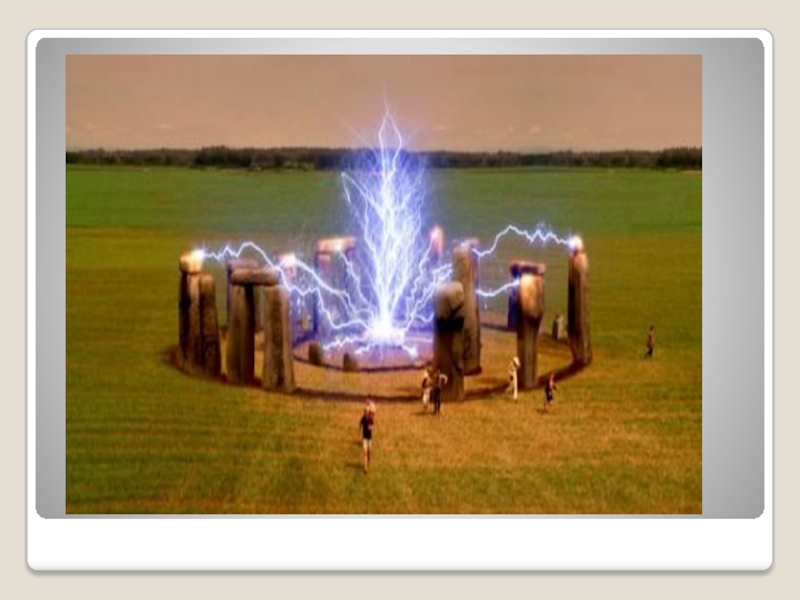
There are many
movies based on or featuring ancient monumental structures. If you are crazy about watching adventurous and mythical movies, I bet that you would have surely loved the Indiana Jones films. As such there are many movies featuring the Stonehenge. If you are eager to know about those films, the films are: King Lear (1971), This Is Spinal Tap (1984), National Lampoon’s European Vacation (1985), Tess of the D’Urbervilles (2008), “Doctor Who” The Pandorica Opens (2010), Stonehenge Apocalypse (2010) and many more to mention. In these films and TV series, some of the best of the legendary aspects of Stonehenge have been interestingly depicted, which are worth watching being both knowledgeable and entertaining.
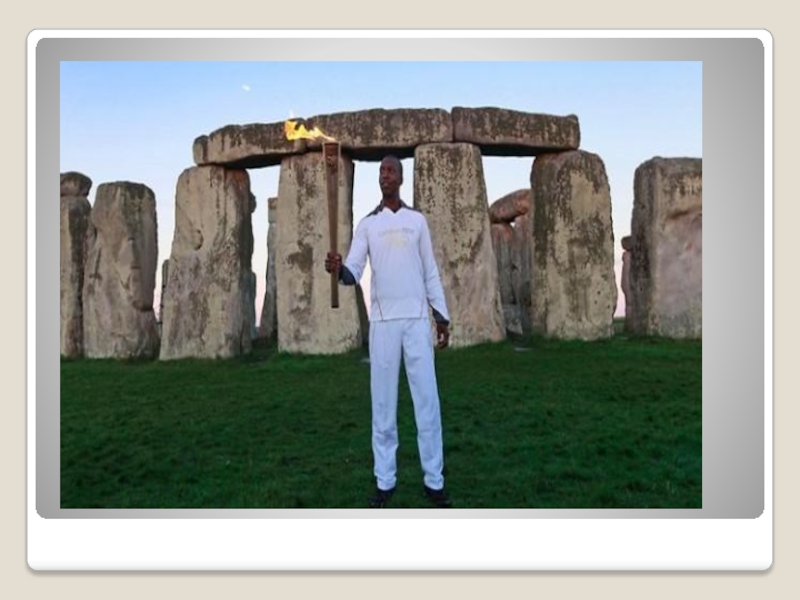
Слайд 172. Michael Johnson Ran around Stonehenge with the Olympic Torch in
2012 Olympics Torch Relay
During the 2012 Olympics Torch Relay, news media was flooded with news of Michael Johnson, the American sprinter who currently holds the world and Olympic records in the 400 m, carrying the Olympic flame on a dawn procession to Stonehenge. It was the 55th day of the torch relay on 12th July of 2012 where the flame was carried by 116 runners on a 107 miles route from Cathedral Garden to Salisbury around the site of Stonehenge. As it was reported, the event was a ‘magic moment’ for Johnson, and the ancient Stonehenge site was turned to ‘glowing fairytale environment’. Johnson ran around the Stonehenge with the Olympic torch, and was triumphant as he said, “Sun’s out, Sun’s rising, clear skies today and running with the torch around Stonehenge was an incredible moment.”
During the 2012 Olympics Torch Relay, news media was flooded with news of Michael Johnson, the American sprinter who currently holds the world and Olympic records in the 400 m, carrying the Olympic flame on a dawn procession to Stonehenge. It was the 55th day of the torch relay on 12th July of 2012 where the flame was carried by 116 runners on a 107 miles route from Cathedral Garden to Salisbury around the site of Stonehenge. As it was reported, the event was a ‘magic moment’ for Johnson, and the ancient Stonehenge site was turned to ‘glowing fairytale environment’. Johnson ran around the Stonehenge with the Olympic torch, and was triumphant as he said, “Sun’s out, Sun’s rising, clear skies today and running with the torch around Stonehenge was an incredible moment.”
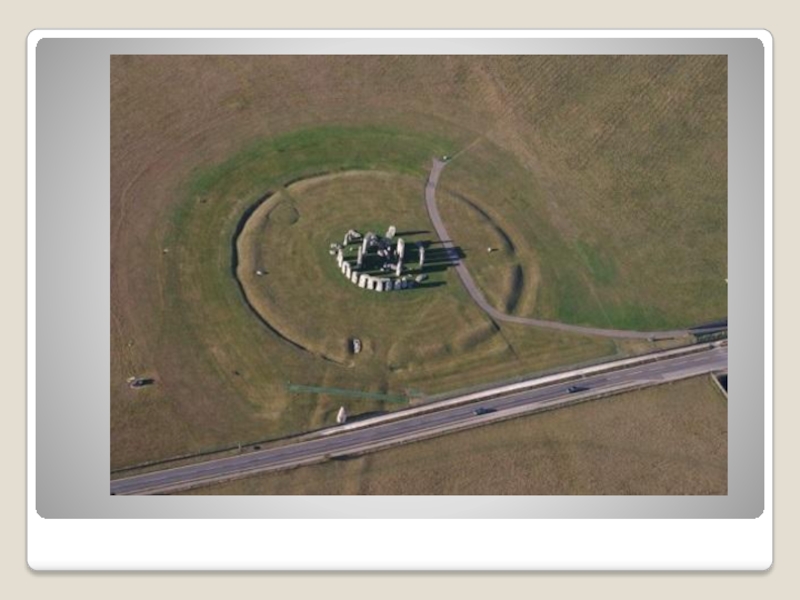
Слайд 191. Destructive Road-building Scheme Threat to Stonehenge
It isn’t any new fact
that most of the World Heritage Sites around the world are always facing possible urban or some sort of developmental plan threats. It also occurred the same with the ancient prehistoric legacy of Stonehenge when the British Government’s Department of Transport proposed new road-building scheme during 2000’s that would damage the landscape of Stonehenge. The Department of Transport was planning to widen a highway running close to the Stonehenge site, and several activists, researchers and concerned institutions find out that such type of plan would have major ecological impacts, damage to archaeological remains and also to the local community. They united and confronted to stop the destructible action that would split the landscape of Stonehenge. After fighting for long, finally they became successful to stop the scheme on 6 December 2007. But again, the conflict between the British Government and the activists rises time to time regarding new plans and schemes affecting the heritage integrity of Stonehenge.