Homo sapiens arrived around 29,000 years ago.
- Главная
- Разное
- Образование
- Спорт
- Естествознание
- Природоведение
- Религиоведение
- Французский язык
- Черчение
- Английский язык
- Астрономия
- Алгебра
- Биология
- География
- Геометрия
- Детские презентации
- Информатика
- История
- Литература
- Математика
- Музыка
- МХК
- Немецкий язык
- ОБЖ
- Обществознание
- Окружающий мир
- Педагогика
- Русский язык
- Технология
- Физика
- Философия
- Химия
- Шаблоны, фоны, картинки для презентаций
- Экология
- Экономика
Презентация, доклад по английскому языку по теме История Великобритании
Содержание
- 1. Презентация по английскому языку по теме История Великобритании
- 2. THE CELTS The Celts were the
- 3. THE CELTSIn the Iron Age (600B.C.),
- 4. ROMANS Julius Caesar invaded Britain in 55-54
- 5. Why did the Romans invade Britain?Romans came
- 6. the Romans FOUNDED LondonThe River Thames
- 7. What did the Romans leave behind?Romans built
- 8. Why was the Roman Empire important?
- 9. POST-ROMAN BRITAIN From the 2nd century
- 10. How the Anglo-Saxons livedAnglo-Saxons worshipped lots
- 11. ANGLO-SAXON CONQUESTSEach group of Anglo-Saxon settlers had
- 12. ANGLO-SAXON KINGDOMSBy around AD 600 there
- 13. Scandinavians attacked Britain in AD 793 –
- 14. Viking Houses The Vikings lived on
- 15. What religion did the Vikings follow?The Vikings
- 16. Who Really Discovered North America First?
- 17. King Alfred the Great defeats
- 18. The END OF Anglo-Saxon period The
- 19. The Norman CONQUESTWilliam, Duke of Normandy and
- 20. THE NORMANS IN BRITAIN (1066 - 1154)England
- 21. William Duke Of Normandy, King of EnglandWilliam
- 22. WILLIAM THE CONQUERORIn 1067, William started building
- 23. DOMESDAY BOOKThe thing for which William is
- 24. The Middle Ages (1154
- 25. The Black Death of 1348 The plague
- 26. from 1485 until 1603 Tudor dynasty
- 27. Golden Age of English literature William Shakespeare,
- 28. BRITAIN becomes PROTESTANTThe Parliament of England in
- 29. Stuart dynasty16001665166617071805British ships sail for America, the
- 30. English Republic 1649-1653 King Charles I (1600 –
- 31. Victorian BritainAlexandrina Victoria was the Queen of
- 32. The population of England had almost doubled
- 33. The Edwardian period After the
- 34. The House of WindsorGeorge V was King
- 35. The House of Windsor George VI
- 36. Elizabeth IIElizabeth II was crowned at Westminster
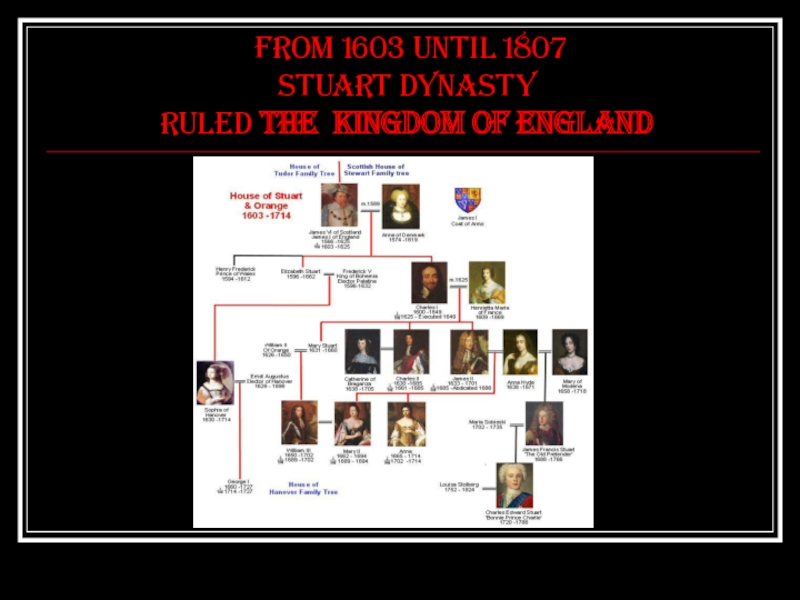
- 37. from 1603 until 1807 Stuart dynasty ruled the Kingdom of England
- 38. the national anthem of
- 39. What Do You Know About Britain?Did you
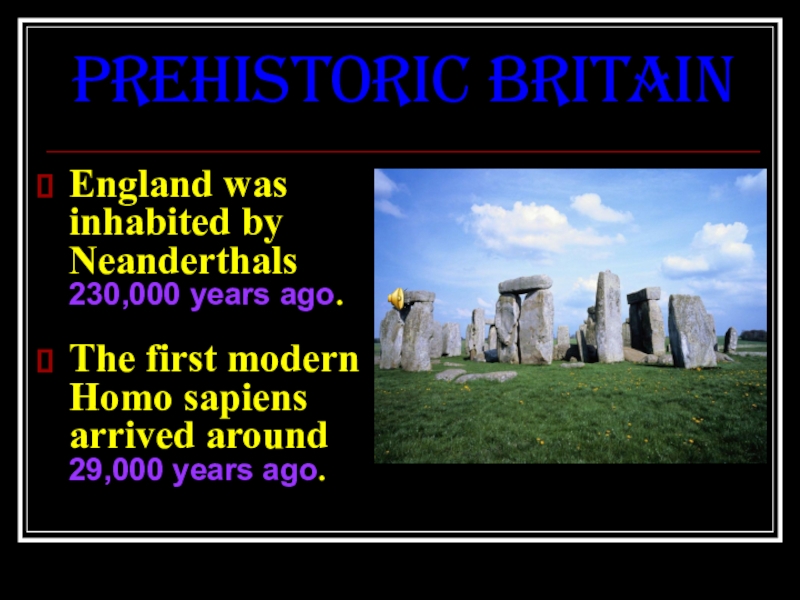
THE CELTS The Celts were the most powerful people who lived in central and northern Europe from around 750 BC to 12 BC There were manytribes of Celts, speaking a common language.Celtic Calendar
Слайд 2THE CELTS
The Celts were the
most powerful people who
lived in central and northern Europe from around 750 BC to 12 BC
There were many
tribes of Celts, speaking
a common language.
There were many
tribes of Celts, speaking
a common language.
Celtic Calendar
Слайд 3
THE CELTS
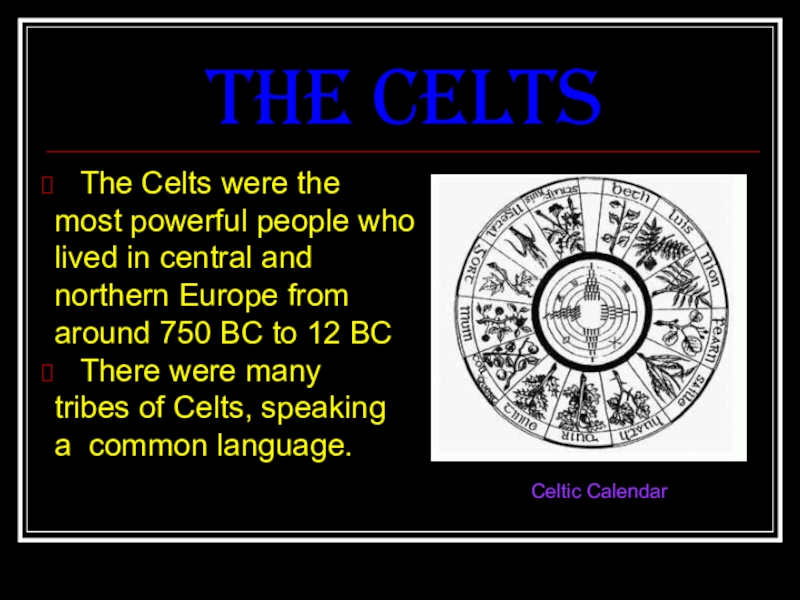
In the Iron Age (600B.C.),
England was inhabited
by
the Celtic people known as Britons.
Britons used iron tools.
People live on hunting, fishing and farming.
the Celtic people known as Britons.
Britons used iron tools.
People live on hunting, fishing and farming.
Слайд 4ROMANS
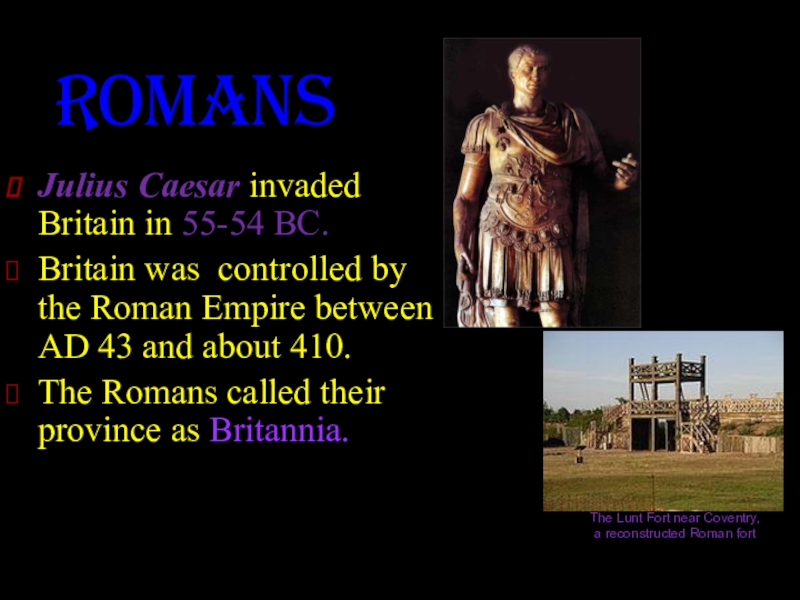
Julius Caesar invaded Britain in 55-54 BC.
Britain was controlled
by the Roman Empire between AD 43 and about 410.
The Romans called their province as Britannia.
The Romans called their province as Britannia.
The Lunt Fort near Coventry,
a reconstructed Roman fort
Слайд 5Why did the Romans invade Britain?
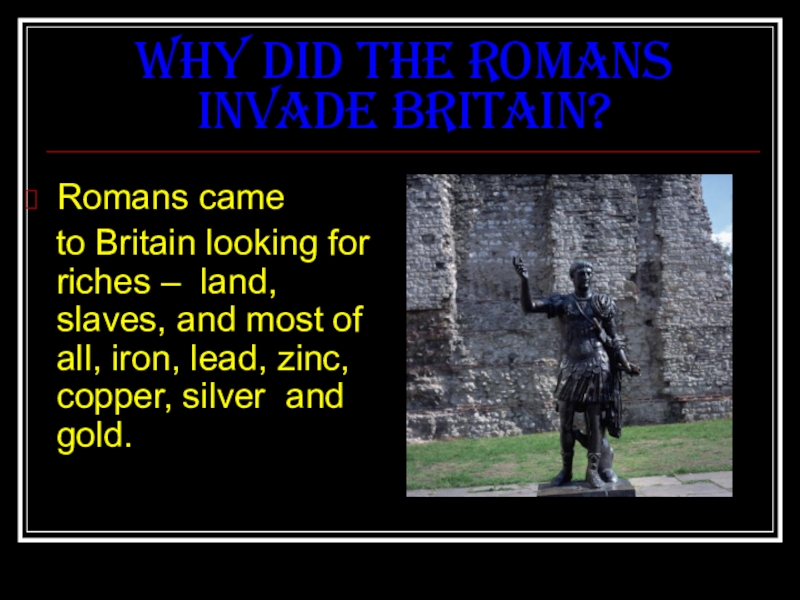
Romans came
to Britain
looking for riches – land, slaves, and most of all, iron, lead, zinc, copper, silver and gold.
Слайд 6 the Romans FOUNDED London
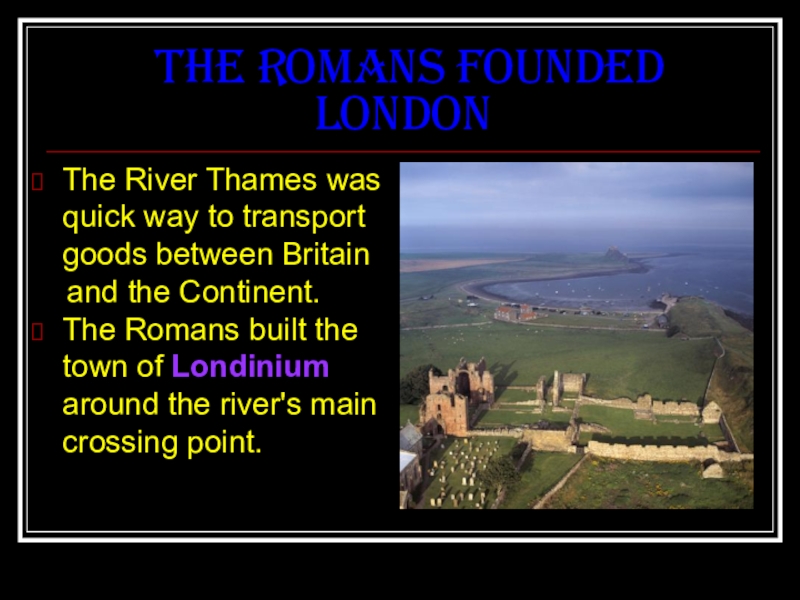
The River Thames was quick way to
transport goods between Britain
and the Continent.
The Romans built the town of Londinium around the river's main crossing point.
and the Continent.
The Romans built the town of Londinium around the river's main crossing point.
Слайд 7What did the Romans leave behind?
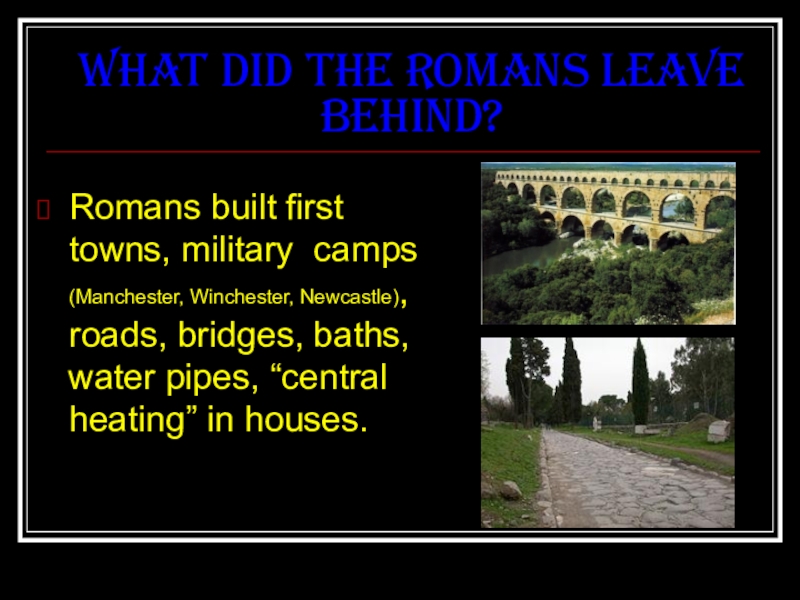
Romans built first towns, military camps
(Manchester, Winchester, Newcastle), roads, bridges, baths,
water pipes, “central heating” in houses.
water pipes, “central heating” in houses.
Слайд 8Why was the Roman Empire important?
They gave us:
Language
The Romans spoke and wrote in Latin and many of English words are based on Latin words.
Christianity
The Romans introduced Christianity to Britain
Christianity
The Romans introduced Christianity to Britain
The Calendar we use today is more than 2,000 years old.
The names of our months are taken from the names of Roman gods and rulers.
Laws and a legal system came originally from the Roman Empire.
Слайд 9POST-ROMAN BRITAIN
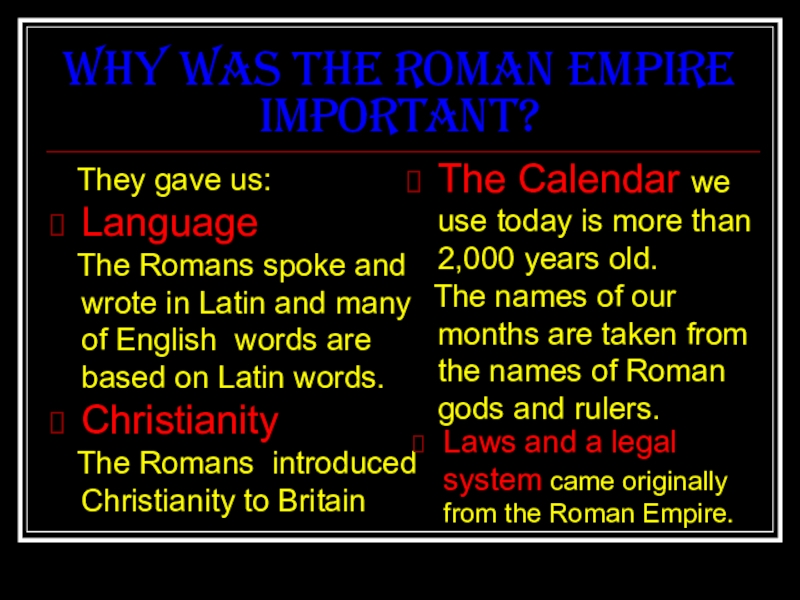
From the 2nd century AD Roman Britain was under
attack from 'barbarians‘.
The last Roman soldiers left Britain in AD 410.
Anglo-Saxons tribes
invaded Britain.
They were a mixture of people from north Germany, Denmark and northern Holland.
The last Roman soldiers left Britain in AD 410.
Anglo-Saxons tribes
invaded Britain.
They were a mixture of people from north Germany, Denmark and northern Holland.
Слайд 10How the Anglo-Saxons lived
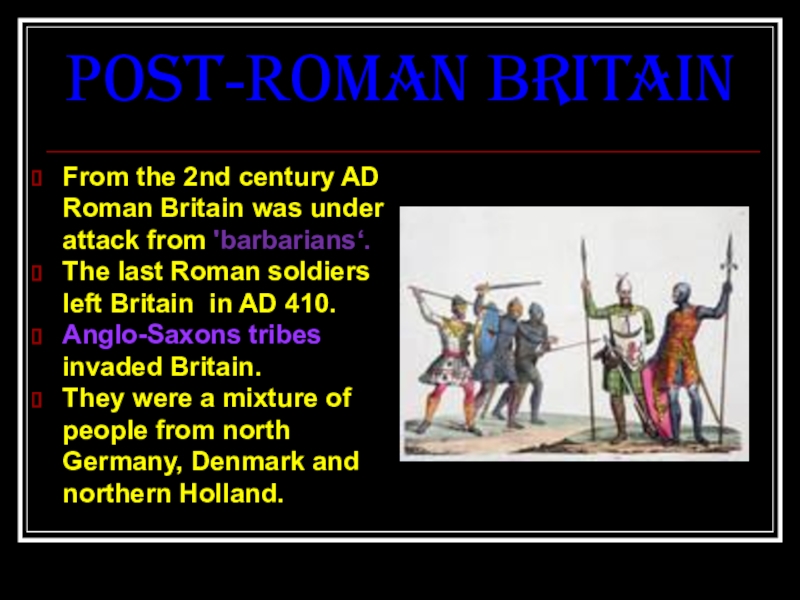
Anglo-Saxons worshipped
lots of gods and goddesses.
Anglo-Saxons were also
farmers and sailors.
They built wooden ships
with oars and sailed
to settle in new lands.
Слайд 11ANGLO-SAXON CONQUESTS
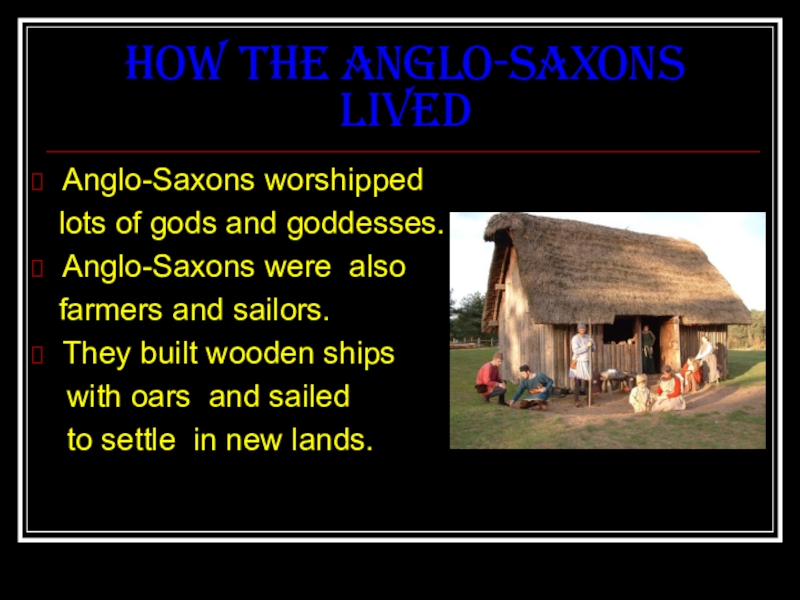
Each group of Anglo-Saxon settlers had a leader or war-chief
('cyning' - 'king‘).
Each king ruled a kingdom and led a small army.
There were many quarrels and wars between kings, to see who was the strongest.
Each king ruled a kingdom and led a small army.
There were many quarrels and wars between kings, to see who was the strongest.
Reconstruction of a helmet buried in Satton-Hu the king of East Anglia
(approximately 625)
Слайд 12ANGLO-SAXON KINGDOMS
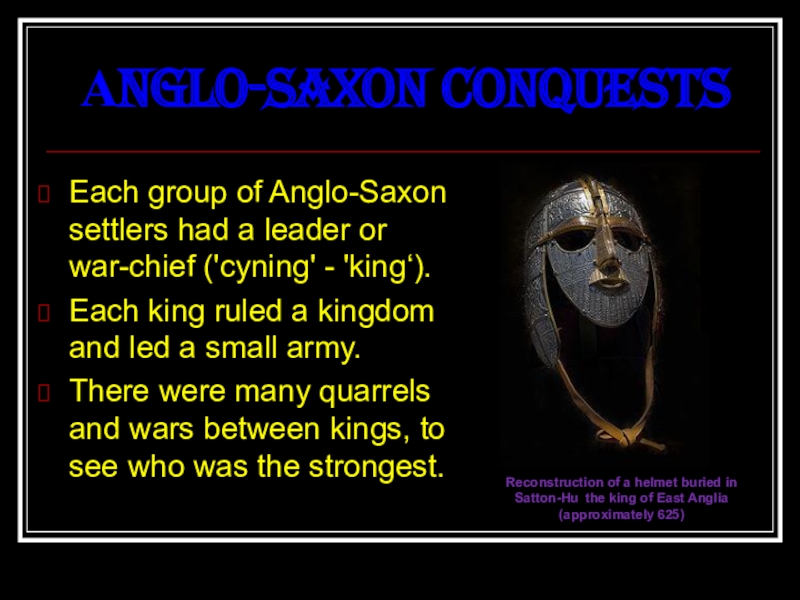
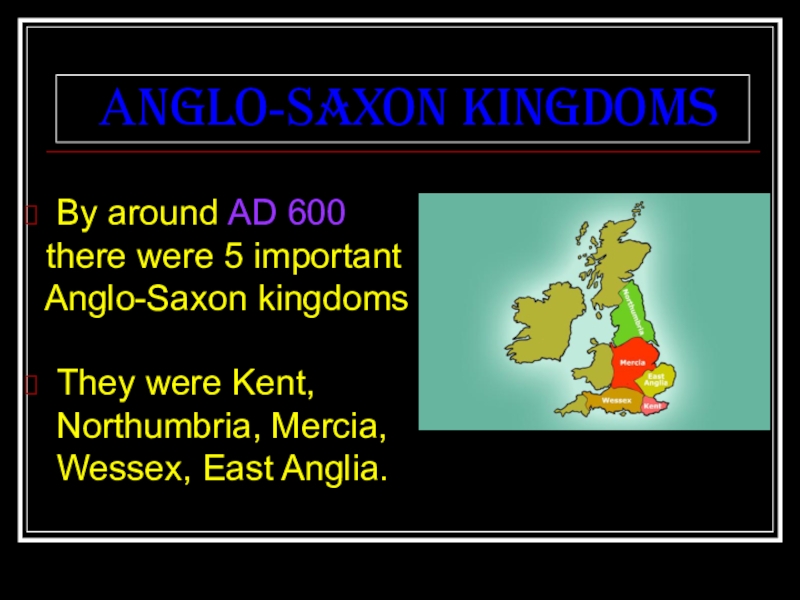
By around AD 600
there were 5 important
Anglo-Saxon kingdoms
They were Kent, Northumbria, Mercia, Wessex, East Anglia.
They were Kent, Northumbria, Mercia, Wessex, East Anglia.
Слайд 13Scandinavians attacked Britain in AD 793 – 1066
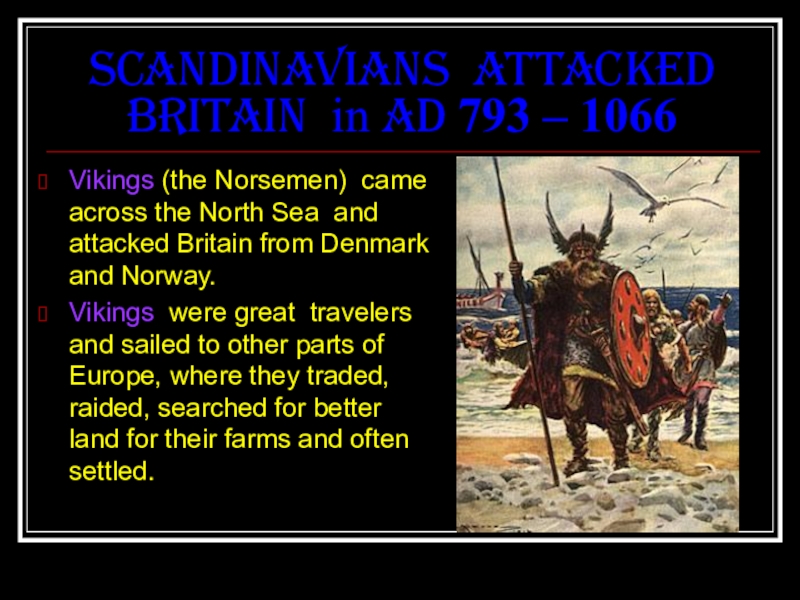
Vikings (the Norsemen)
came across the North Sea and attacked Britain from Denmark and Norway.
Vikings were great travelers and sailed to other parts of Europe, where they traded, raided, searched for better land for their farms and often settled.
Vikings were great travelers and sailed to other parts of Europe, where they traded, raided, searched for better land for their farms and often settled.
Слайд 14Viking Houses
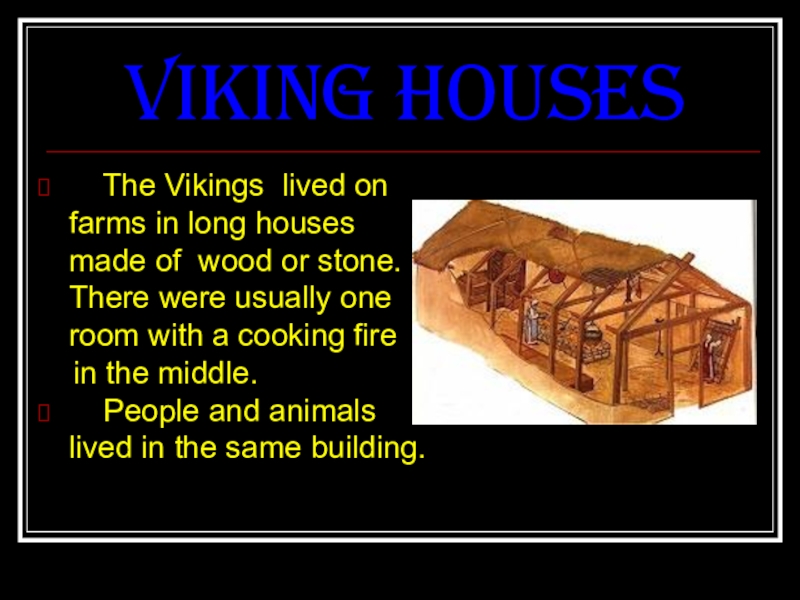
The Vikings lived on farms in long houses
made of wood or stone. There were usually one room with a cooking fire
in the middle.
People and animals lived in the same building.
in the middle.
People and animals lived in the same building.
Слайд 15What religion did the Vikings follow?
The Vikings worshipped many
different gods, but there were
3 that were especially important.
Odin, the leader of the gods, god of knowledge and war
Thor, provided protection from cold, hunger, giants and other dangers.
Freya, goddess of love and beauty.
3 that were especially important.
Odin, the leader of the gods, god of knowledge and war
Thor, provided protection from cold, hunger, giants and other dangers.
Freya, goddess of love and beauty.
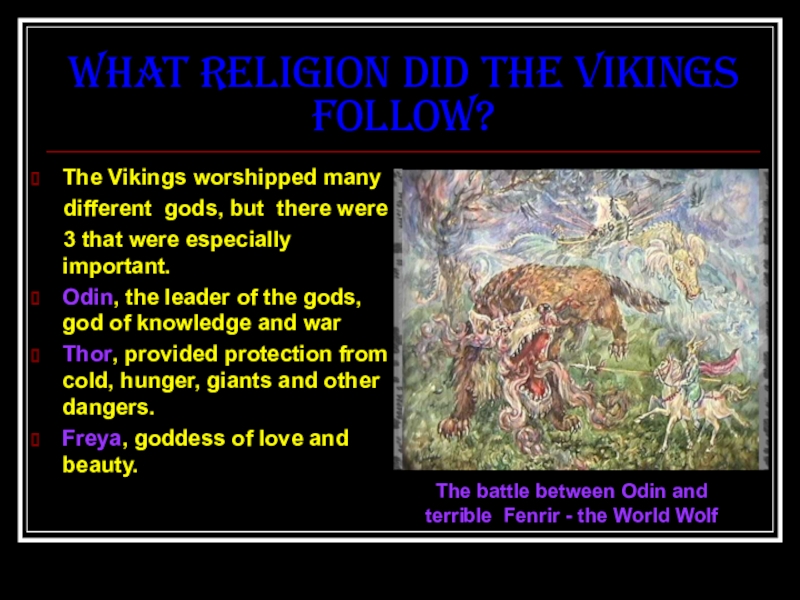
The battle between Odin and terrible Fenrir - the World Wolf
Слайд 16Who Really Discovered North America First?
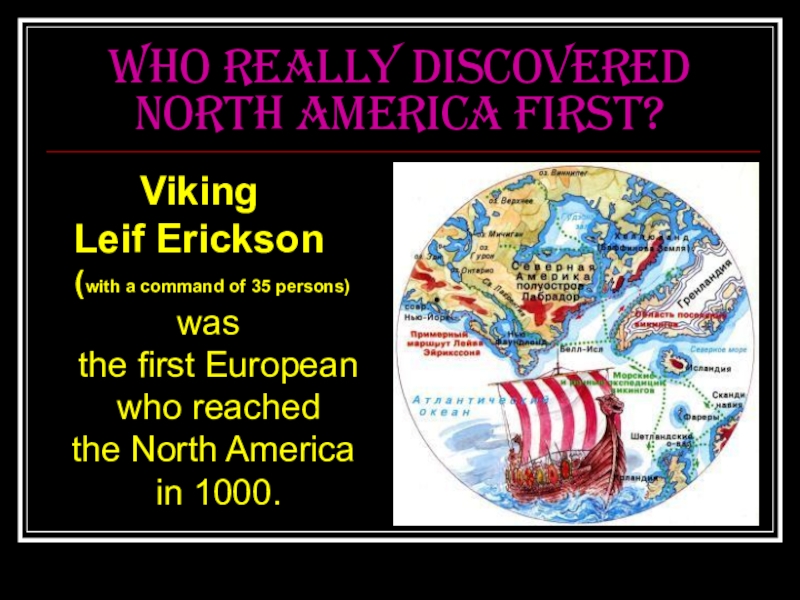
Viking
Leif Erickson
(with a command of 35 persons)
was
the first European who reached
the North America in 1000.
Слайд 17King Alfred the Great
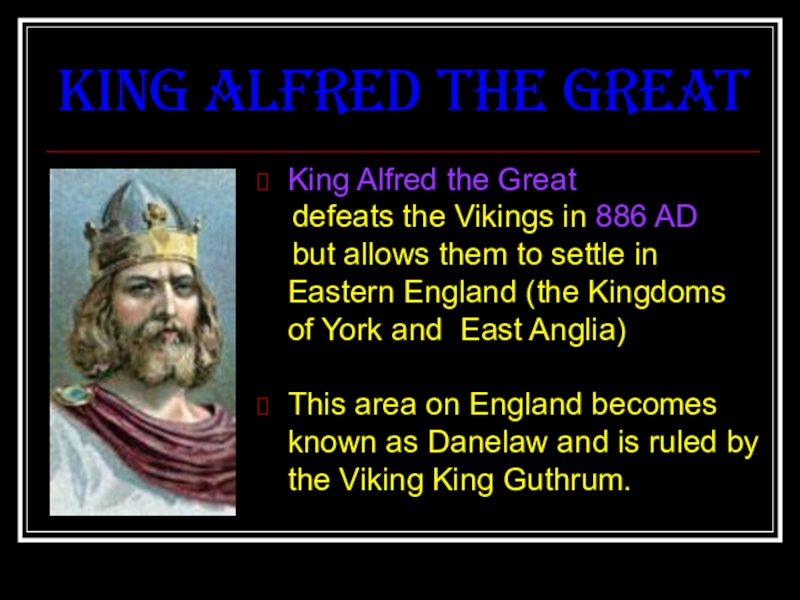
defeats the Vikings in 886
AD
but allows them to settle in Eastern England (the Kingdoms of York and East Anglia)
This area on England becomes known as Danelaw and is ruled by the Viking King Guthrum.
but allows them to settle in Eastern England (the Kingdoms of York and East Anglia)
This area on England becomes known as Danelaw and is ruled by the Viking King Guthrum.
king ALFRED THE GREAT
Слайд 18The END OF Anglo-Saxon period
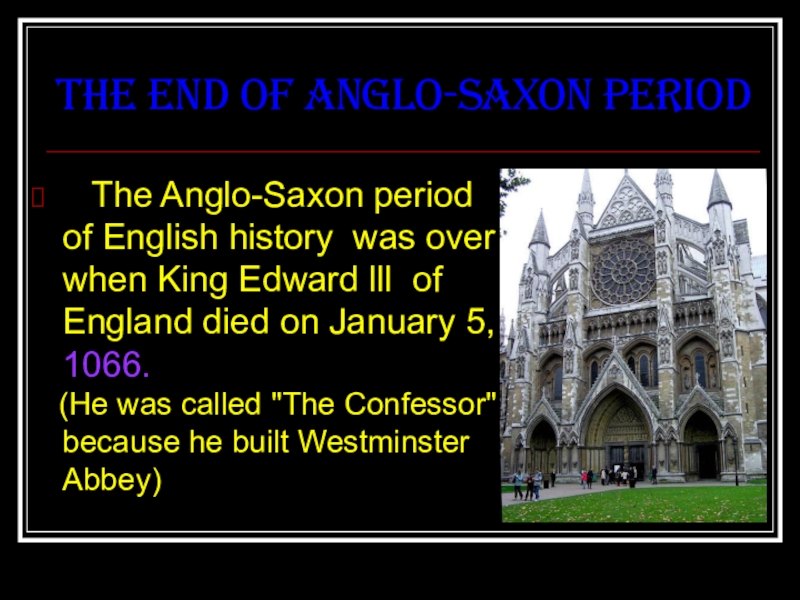
The Anglo-Saxon period of
English history was over when King Edward lll of England died on January 5, 1066.
(He was called "The Confessor" because he built Westminster Abbey)
(He was called "The Confessor" because he built Westminster Abbey)
Слайд 19The Norman CONQUEST
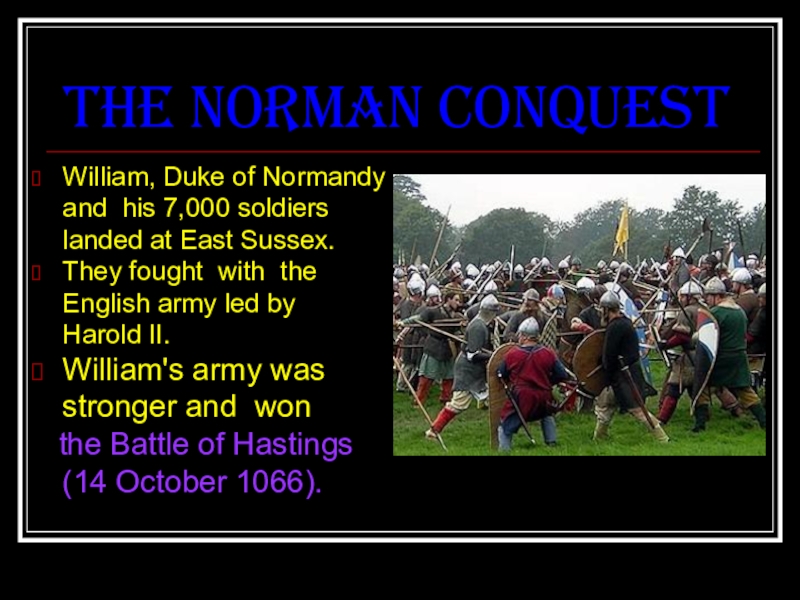
William, Duke of Normandy and his 7,000 soldiers landed
at East Sussex.
They fought with the English army led by Harold II.
William's army was stronger and won
the Battle of Hastings (14 October 1066).
They fought with the English army led by Harold II.
William's army was stronger and won
the Battle of Hastings (14 October 1066).
Слайд 20THE NORMANS IN BRITAIN (1066 - 1154)
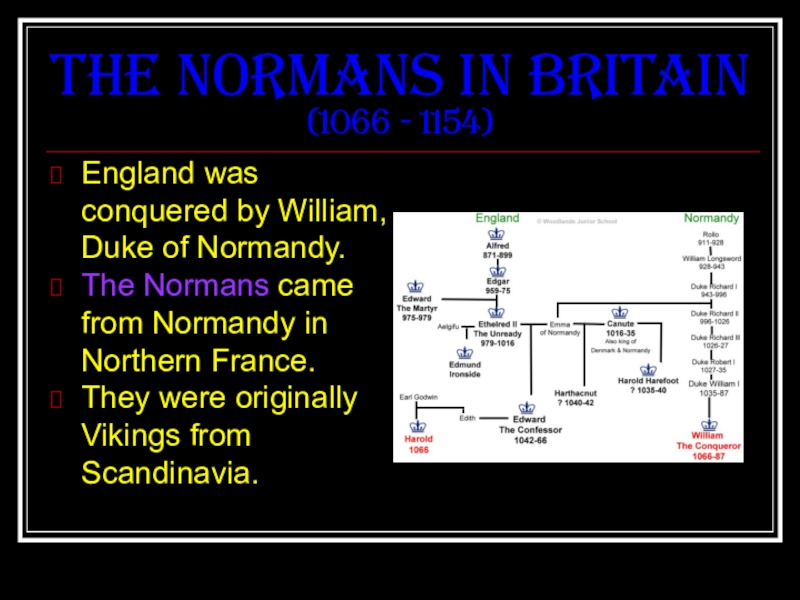
England was conquered by William,
Duke of Normandy.
The Normans came from Normandy in Northern France.
They were originally Vikings from Scandinavia.
The Normans came from Normandy in Northern France.
They were originally Vikings from Scandinavia.
Слайд 21William Duke Of Normandy,
King of England
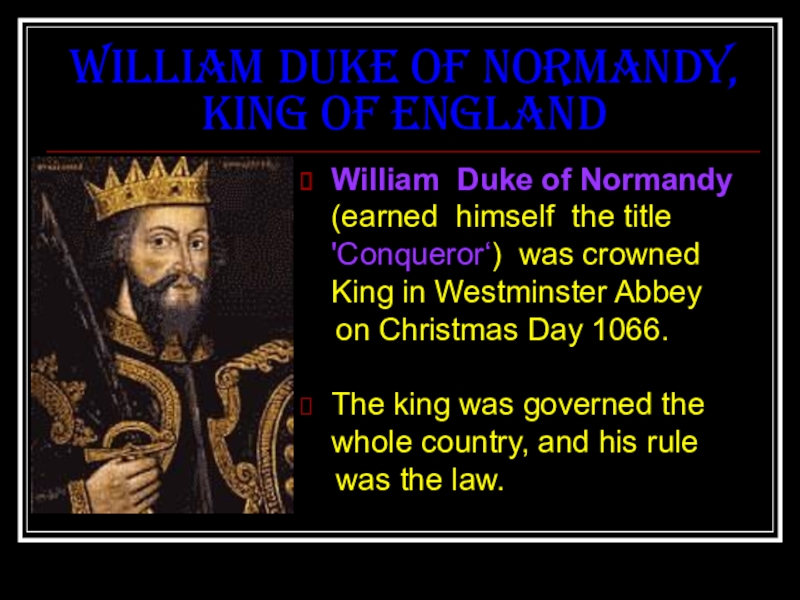
William Duke of Normandy (earned himself
the title 'Conqueror‘) was crowned King in Westminster Abbey
on Christmas Day 1066.
The king was governed the whole country, and his rule
was the law.
on Christmas Day 1066.
The king was governed the whole country, and his rule
was the law.
Слайд 22WILLIAM THE CONQUEROR
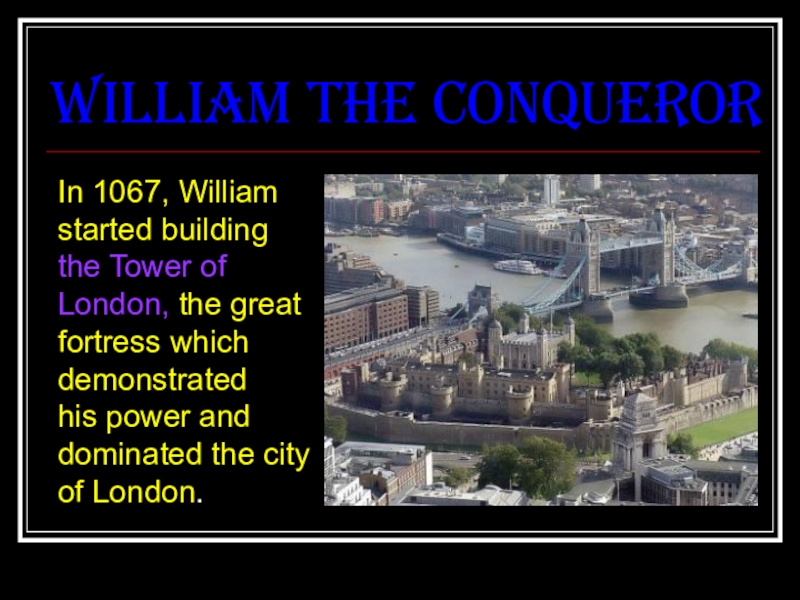
In 1067, William started building
the Tower of London,
the great fortress which demonstrated
his power and
dominated the city
of London.
his power and
dominated the city
of London.
Слайд 23DOMESDAY BOOK
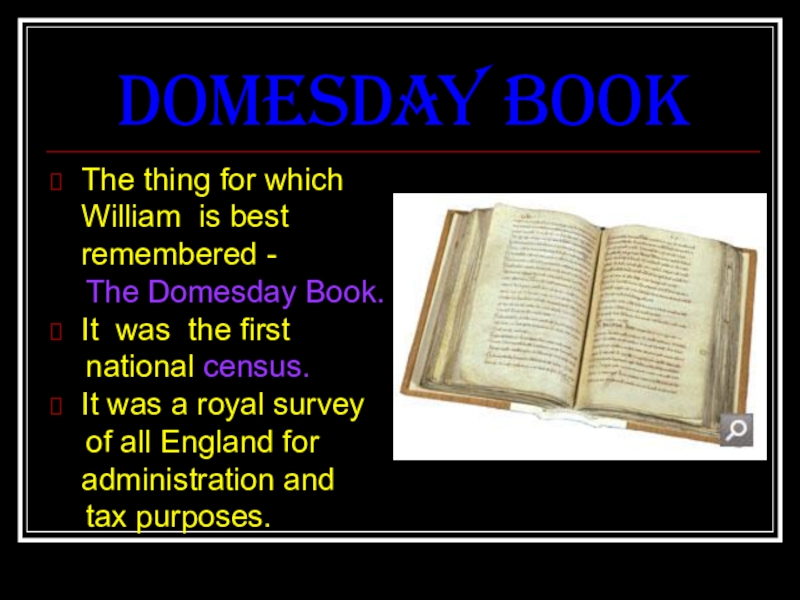
The thing for which William is best remembered -
The Domesday Book.
It was the first
national census.
It was a royal survey
of all England for administration and
tax purposes.
It was the first
national census.
It was a royal survey
of all England for administration and
tax purposes.
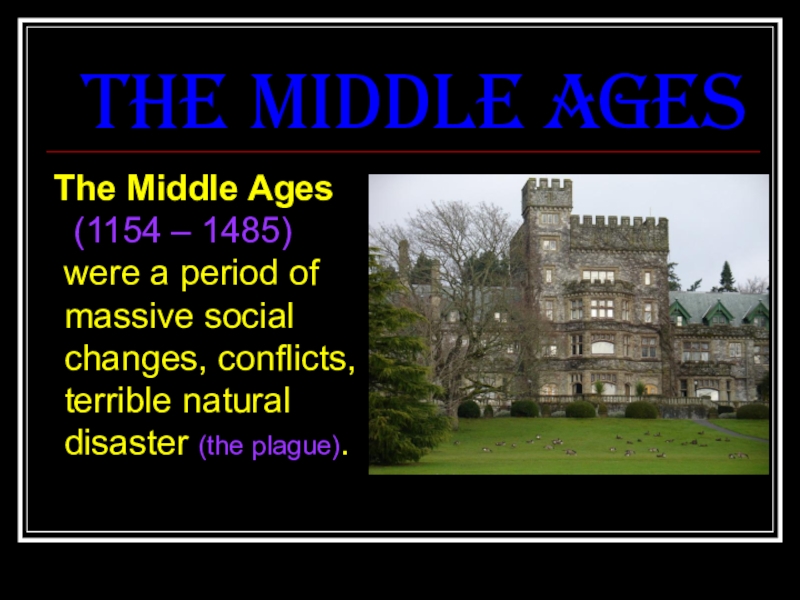
Слайд 24 The Middle Ages
(1154 – 1485)
were a period of massive social changes, conflicts, terrible natural disaster (the plague).
THE MIDDLE AGES
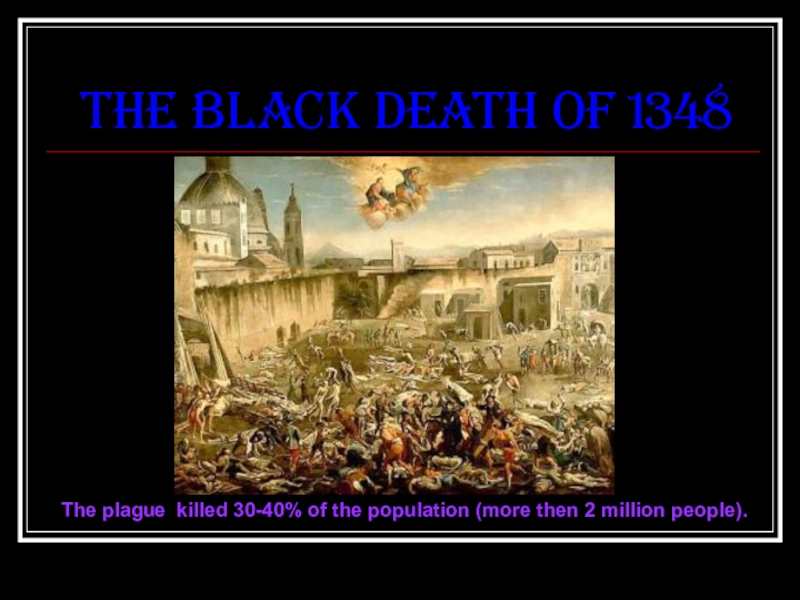
Слайд 25The Black Death of 1348
The plague killed 30-40% of the
population (more then 2 million people).
Слайд 26from 1485 until 1603
Tudor dynasty
ruled the Kingdom of England
It was the Renaissance period:
the culture blossoming;
the formation of an absolutism;
active participation in the European policy;
the beginning of colonization
of America ( the end of XV century);
the sea victory over Spanish «Invincible armada» in 1588.
the culture blossoming;
the formation of an absolutism;
active participation in the European policy;
the beginning of colonization
of America ( the end of XV century);
the sea victory over Spanish «Invincible armada» in 1588.
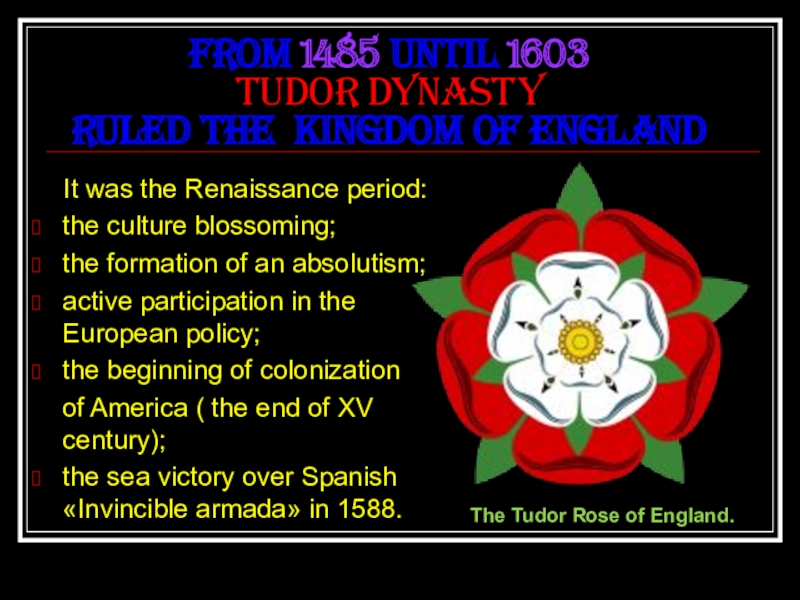
The Tudor Rose of England.
Слайд 27Golden Age of English literature
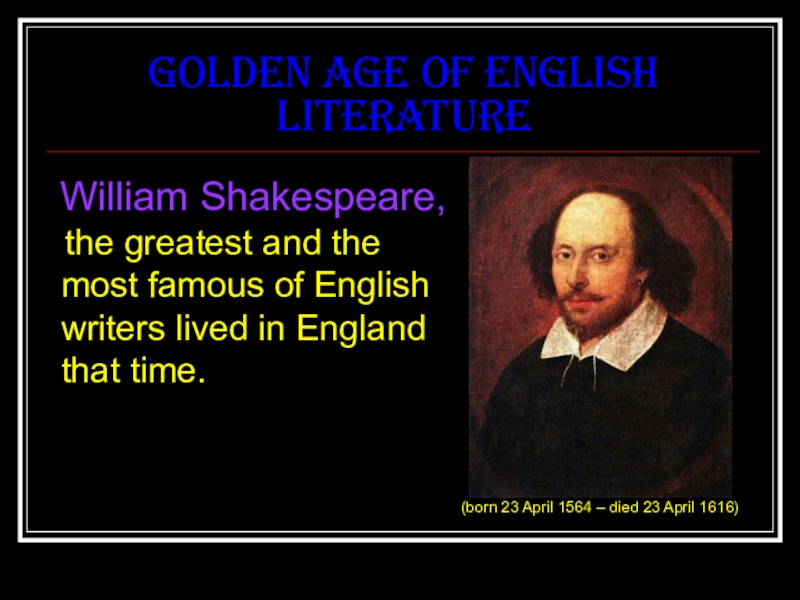
William Shakespeare,
the greatest and
the most famous of English writers lived in England that time.
(born 23 April 1564 – died 23 April 1616)
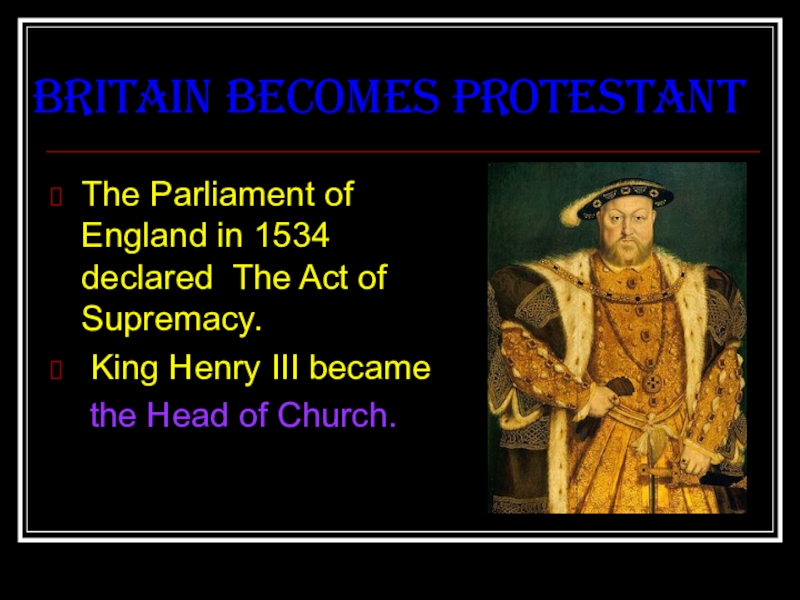
Слайд 28BRITAIN becomes PROTESTANT
The Parliament of England in 1534 declared The
Act of Supremacy.
King Henry III became
the Head of Church.
King Henry III became
the Head of Church.
Слайд 29Stuart dynasty
1600
1665
1666
1707
1805
British ships sail for America, the West Indies;
colonies founded; pirates on the high seas;
Great Plaque of London / 100.000 people died.
Great fire of London - 90% of the City destroyed.
The Acts of Union joined the Kingdom of England and the Kingdom of Scotland into a single Kingdom of Great Britain.
War with France brought victory at Trafalgar and Waterloo, and gave Britain control of the seas.
During the reign of the Stuarts, Scotland developed from a poor and feudal country into a prosperous and centralized state.
Great Plaque of London / 100.000 people died.
Great fire of London - 90% of the City destroyed.
The Acts of Union joined the Kingdom of England and the Kingdom of Scotland into a single Kingdom of Great Britain.
War with France brought victory at Trafalgar and Waterloo, and gave Britain control of the seas.
During the reign of the Stuarts, Scotland developed from a poor and feudal country into a prosperous and centralized state.
Слайд 30English Republic
1649-1653
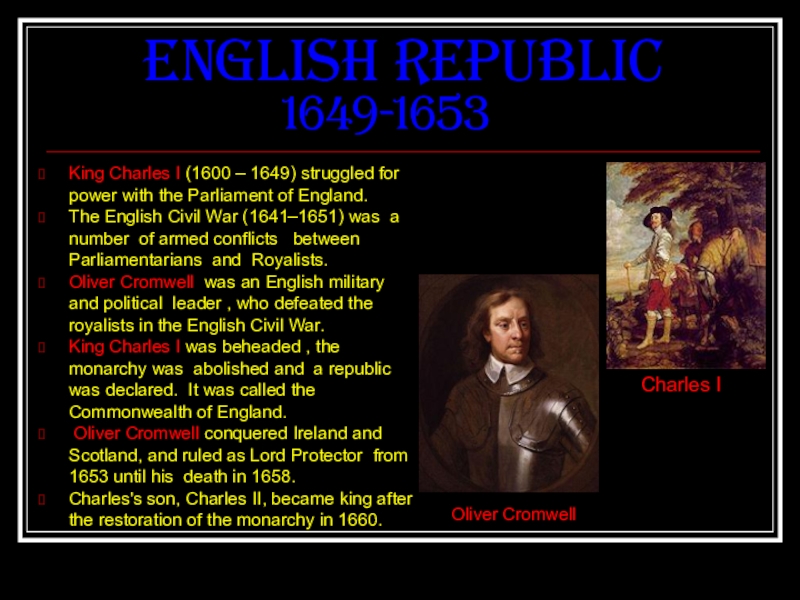
King Charles I (1600 – 1649) struggled for power with
the Parliament of England.
The English Civil War (1641–1651) was a number of armed conflicts between Parliamentarians and Royalists.
Oliver Cromwell was an English military and political leader , who defeated the royalists in the English Civil War.
King Charles I was beheaded , the monarchy was abolished and a republic was declared. It was called the Commonwealth of England.
Oliver Cromwell conquered Ireland and Scotland, and ruled as Lord Protector from 1653 until his death in 1658.
Charles's son, Charles II, became king after the restoration of the monarchy in 1660.
The English Civil War (1641–1651) was a number of armed conflicts between Parliamentarians and Royalists.
Oliver Cromwell was an English military and political leader , who defeated the royalists in the English Civil War.
King Charles I was beheaded , the monarchy was abolished and a republic was declared. It was called the Commonwealth of England.
Oliver Cromwell conquered Ireland and Scotland, and ruled as Lord Protector from 1653 until his death in 1658.
Charles's son, Charles II, became king after the restoration of the monarchy in 1660.
Charles I
Oliver Cromwell
Слайд 31Victorian Britain
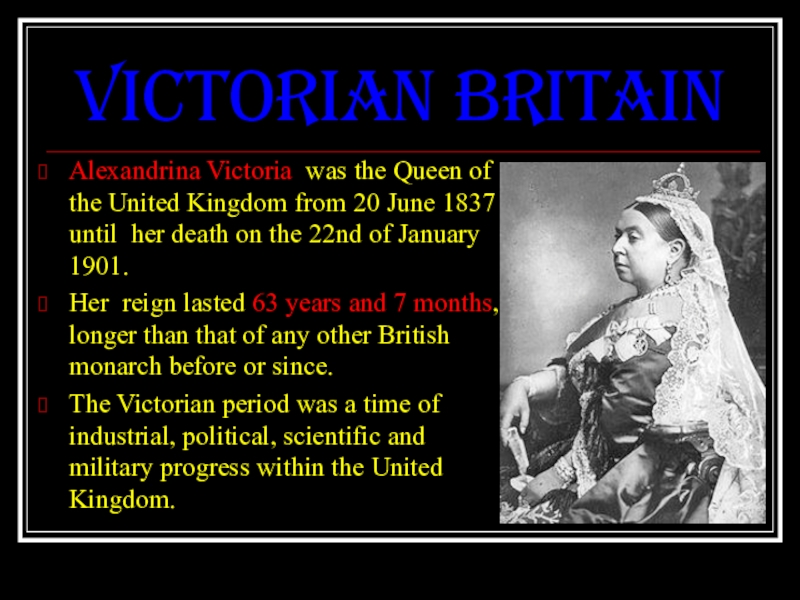
Alexandrina Victoria was the Queen of the United Kingdom from
20 June 1837 until her death on the 22nd of January 1901.
Her reign lasted 63 years and 7 months, longer than that of any other British monarch before or since.
The Victorian period was a time of industrial, political, scientific and military progress within the United Kingdom.
Her reign lasted 63 years and 7 months, longer than that of any other British monarch before or since.
The Victorian period was a time of industrial, political, scientific and military progress within the United Kingdom.
Слайд 32The population of England had almost doubled from 16.8 million
in 1851 to 30.5 million in 1901.
Ireland’s population reduced
from 8.2 million in 1841 to less
than 4.5 million in 1901.
Around 15 million emigrants left the United Kingdom and settled mostly
in the United States, Canada,
and Australia.
Ireland’s population reduced
from 8.2 million in 1841 to less
than 4.5 million in 1901.
Around 15 million emigrants left the United Kingdom and settled mostly
in the United States, Canada,
and Australia.
Victorian Britain
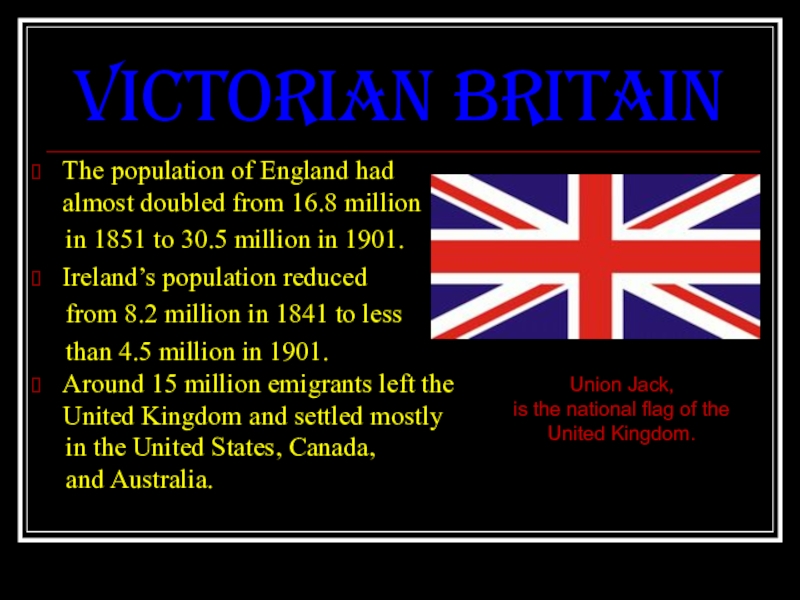
Union Jack,
is the national flag of the United Kingdom.
Слайд 33
The Edwardian period
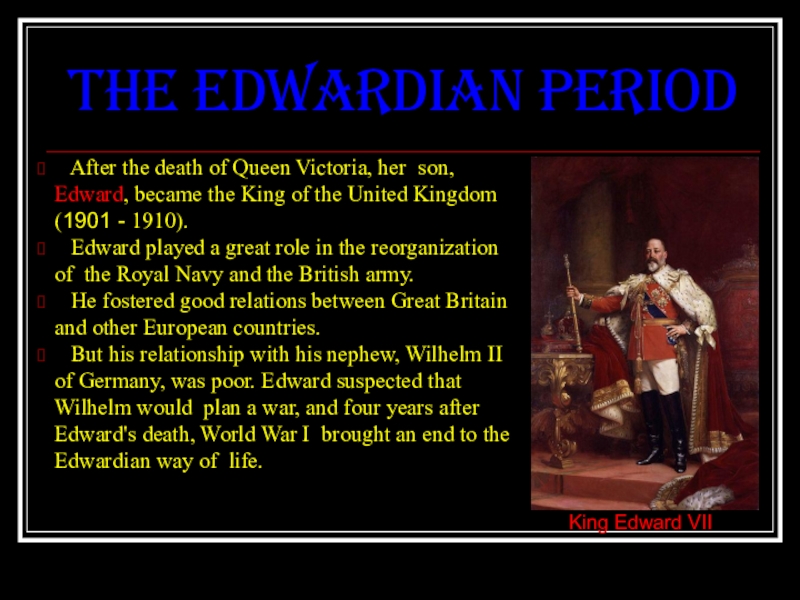
After the death of Queen Victoria, her
son, Edward, became the King of the United Kingdom (1901 - 1910).
Edward played a great role in the reorganization of the Royal Navy and the British army.
He fostered good relations between Great Britain and other European countries.
But his relationship with his nephew, Wilhelm II of Germany, was poor. Edward suspected that Wilhelm would plan a war, and four years after Edward's death, World War I brought an end to the Edwardian way of life.
Edward played a great role in the reorganization of the Royal Navy and the British army.
He fostered good relations between Great Britain and other European countries.
But his relationship with his nephew, Wilhelm II of Germany, was poor. Edward suspected that Wilhelm would plan a war, and four years after Edward's death, World War I brought an end to the Edwardian way of life.
King Edward VII
Слайд 34The House of Windsor
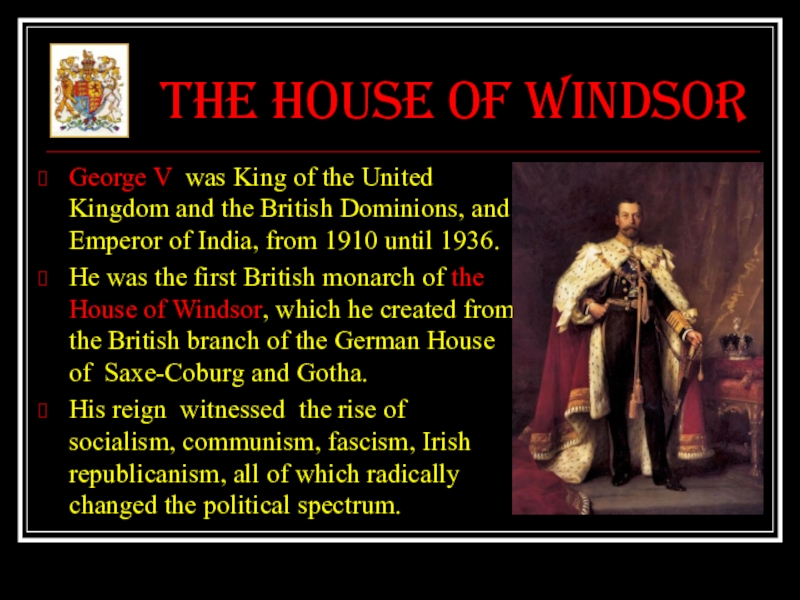
George V was King of the United Kingdom
and the British Dominions, and Emperor of India, from 1910 until 1936.
He was the first British monarch of the House of Windsor, which he created from the British branch of the German House of Saxe-Coburg and Gotha.
His reign witnessed the rise of socialism, communism, fascism, Irish republicanism, all of which radically changed the political spectrum.
He was the first British monarch of the House of Windsor, which he created from the British branch of the German House of Saxe-Coburg and Gotha.
His reign witnessed the rise of socialism, communism, fascism, Irish republicanism, all of which radically changed the political spectrum.
Слайд 35The House of Windsor
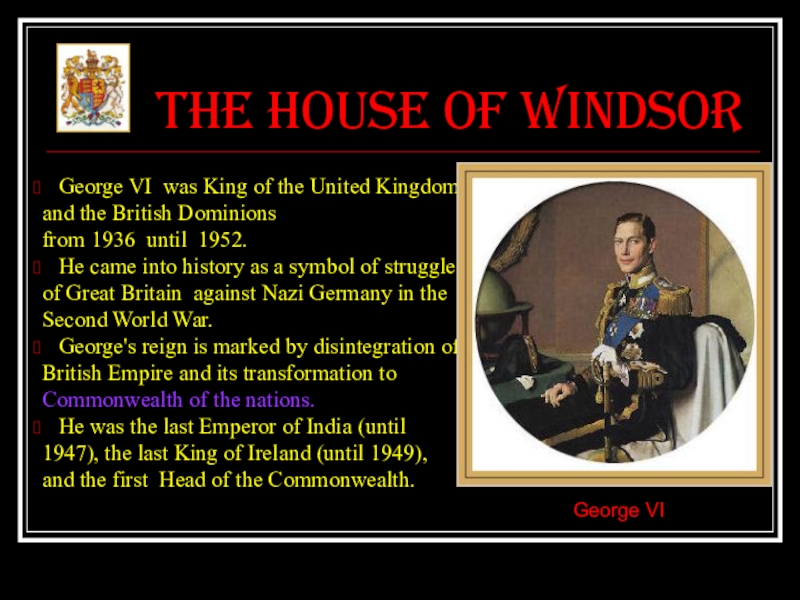
George VI was King of the
United Kingdom and the British Dominions
from 1936 until 1952.
He came into history as a symbol of struggle of Great Britain against Nazi Germany in the Second World War.
George's reign is marked by disintegration of British Empire and its transformation to Commonwealth of the nations.
He was the last Emperor of India (until 1947), the last King of Ireland (until 1949),
and the first Head of the Commonwealth.
from 1936 until 1952.
He came into history as a symbol of struggle of Great Britain against Nazi Germany in the Second World War.
George's reign is marked by disintegration of British Empire and its transformation to Commonwealth of the nations.
He was the last Emperor of India (until 1947), the last King of Ireland (until 1949),
and the first Head of the Commonwealth.
George VI
Слайд 36Elizabeth II
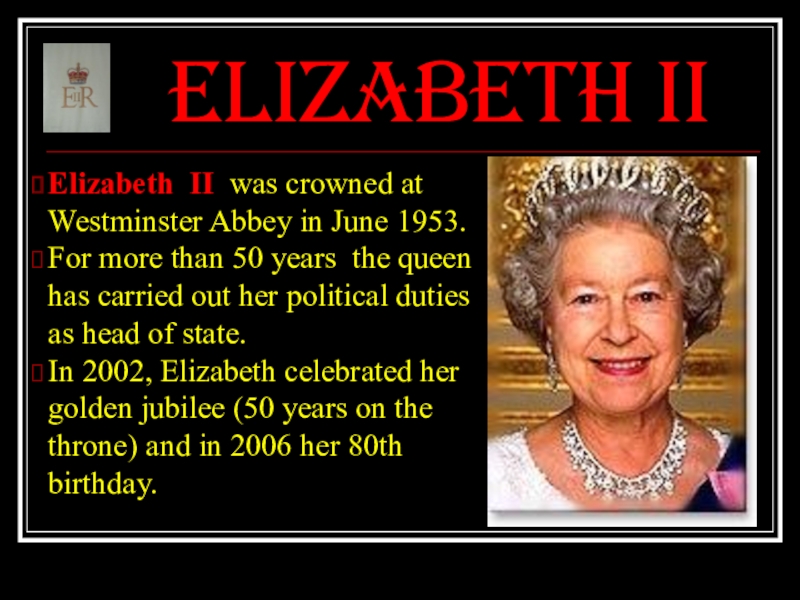
Elizabeth II was crowned at Westminster Abbey in June 1953.
For
more than 50 years the queen has carried out her political duties as head of state.
In 2002, Elizabeth celebrated her golden jubilee (50 years on the throne) and in 2006 her 80th birthday.
In 2002, Elizabeth celebrated her golden jubilee (50 years on the throne) and in 2006 her 80th birthday.
Слайд 38
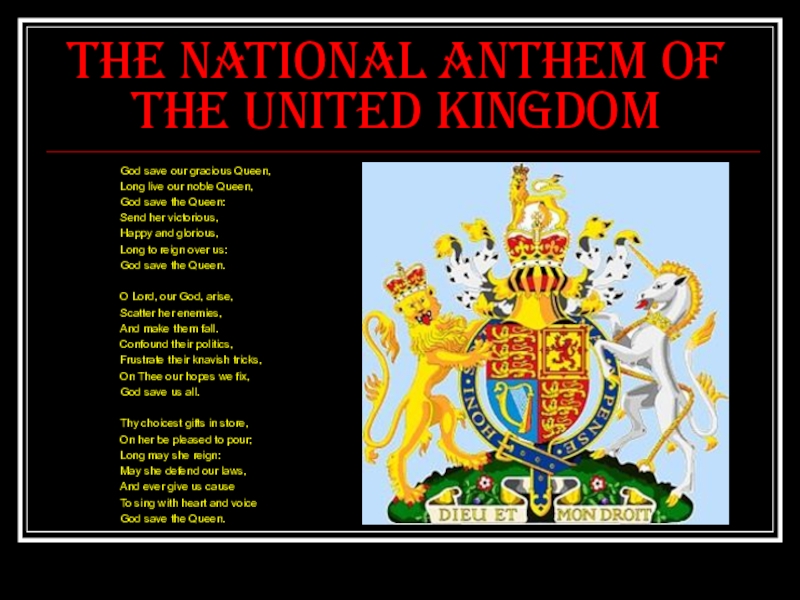
the national anthem of the United Kingdom
God save our gracious Queen,
Long
live our noble Queen,
God save the Queen:
Send her victorious,
Happy and glorious,
Long to reign over us:
God save the Queen.
O Lord, our God, arise,
Scatter her enemies,
And make them fall.
Confound their politics,
Frustrate their knavish tricks,
On Thee our hopes we fix,
God save us all.
Thy choicest gifts in store,
On her be pleased to pour;
Long may she reign:
May she defend our laws,
And ever give us cause
To sing with heart and voice
God save the Queen.
God save the Queen:
Send her victorious,
Happy and glorious,
Long to reign over us:
God save the Queen.
O Lord, our God, arise,
Scatter her enemies,
And make them fall.
Confound their politics,
Frustrate their knavish tricks,
On Thee our hopes we fix,
God save us all.
Thy choicest gifts in store,
On her be pleased to pour;
Long may she reign:
May she defend our laws,
And ever give us cause
To sing with heart and voice
God save the Queen.
Слайд 39What Do You Know About Britain?
Did you like the presentation?
What new information have you
learnt from it ?