- Главная
- Разное
- Образование
- Спорт
- Естествознание
- Природоведение
- Религиоведение
- Французский язык
- Черчение
- Английский язык
- Астрономия
- Алгебра
- Биология
- География
- Геометрия
- Детские презентации
- Информатика
- История
- Литература
- Математика
- Музыка
- МХК
- Немецкий язык
- ОБЖ
- Обществознание
- Окружающий мир
- Педагогика
- Русский язык
- Технология
- Физика
- Философия
- Химия
- Шаблоны, фоны, картинки для презентаций
- Экология
- Экономика
Презентация, доклад по английскому языку на тему Существительные
Содержание
- 1. Презентация по английскому языку на тему Существительные
- 2. IntroductionIn English there are countable and uncountable
- 3. Countable NounsMost English nouns are countable nouns.
- 4. Countable Nouns We can put numbers and
- 5. Countable Nouns However, we
- 6. Countable Nouns Some collections of countable nouns
- 7. Uncountable Nouns Some English nouns are uncountable
- 8. Uncountable NounsWe can use many uncountabel nouns
- 9. Uncountable Nouns We use some/any/little/much with uncountable
- 10. Uncountable Nouns Material, liquids, and collections are
- 11. Counting Uncountable NounsAlthough we can’t count uncountable
- 12. Singular/Plural Uncountable NounsSome uncountable nouns are plural
- 13. Singular/Plural Uncountable Nounsmoney – Money makes the
- 14. Singular/Plural Uncountable Nouns Certain other nouns are
- 15. ExercisesDecide if the sentences are correct or
- 16. ExercisesComplete the sentences
- 17. ExercisesChoose the correct countable/uncountable noun to complete
- 18. ExercisesDecide if the sentences are correct or
- 19. ExercisesComplete the
IntroductionIn English there are countable and uncountable nouns. Countable nouns have two forms – singular and plural. Uncountable nouns, however, have only one form.Mike and his sister Sandra are shopping. They need milk, apples, and bread.Sandra
Слайд 2Introduction
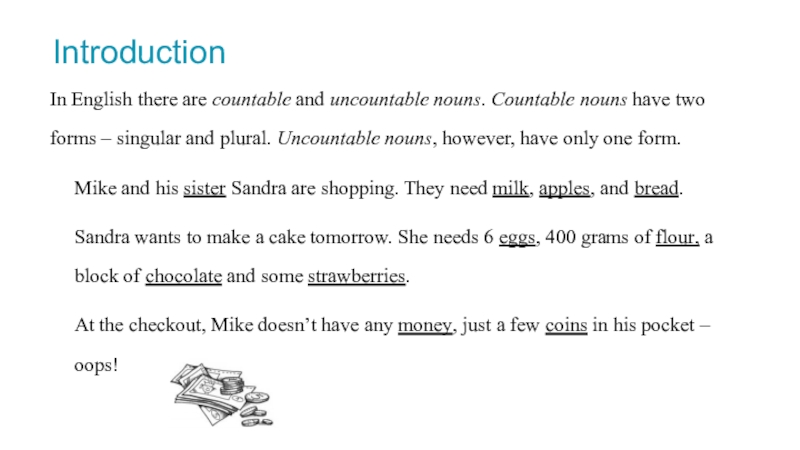
In English there are countable and uncountable nouns. Countable nouns have
two forms – singular and plural. Uncountable nouns, however, have only one form.
Mike and his sister Sandra are shopping. They need milk, apples, and bread.
Sandra wants to make a cake tomorrow. She needs 6 eggs, 400 grams of flour, a block of chocolate and some strawberries.
At the checkout, Mike doesn’t have any money, just a few coins in his pocket – oops!
Mike and his sister Sandra are shopping. They need milk, apples, and bread.
Sandra wants to make a cake tomorrow. She needs 6 eggs, 400 grams of flour, a block of chocolate and some strawberries.
At the checkout, Mike doesn’t have any money, just a few coins in his pocket – oops!
Слайд 3Countable Nouns
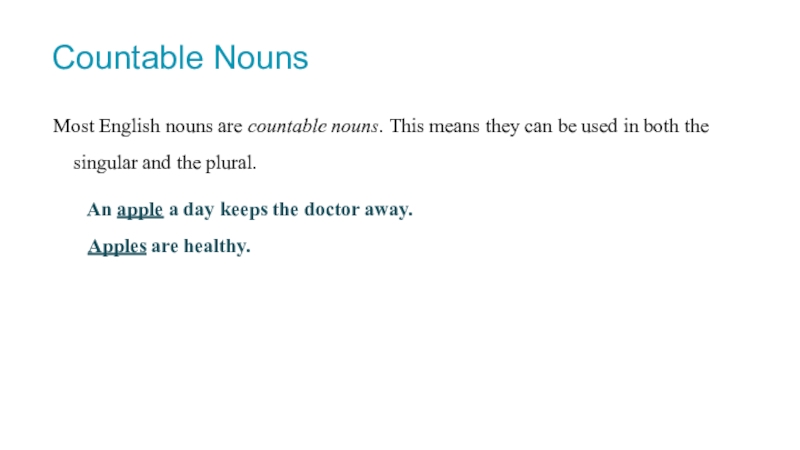
Most English nouns are countable nouns. This means they can
be used in both the singular and the plural.
An apple a day keeps the doctor away.
Apples are healthy.
An apple a day keeps the doctor away.
Apples are healthy.
Слайд 4Countable Nouns
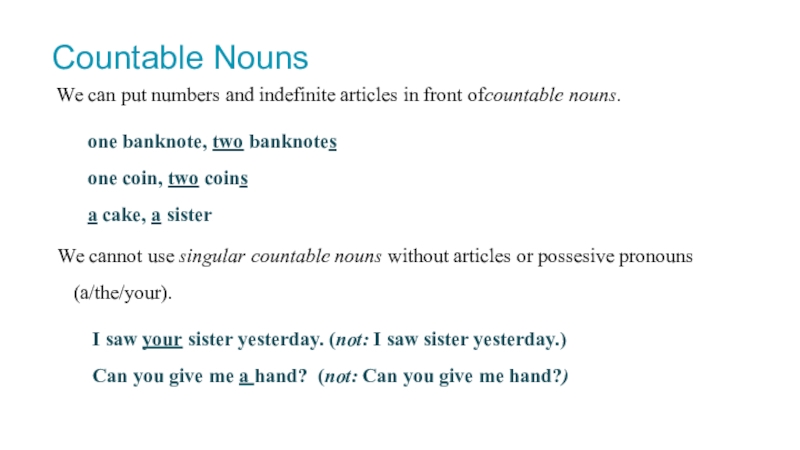
We can put numbers and indefinite articles in front
ofcountable nouns.
one banknote, two banknotes
one coin, two coins
a cake, a sister
We cannot use singular countable nouns without articles or possesive pronouns (a/the/your).
I saw your sister yesterday. (not: I saw sister yesterday.)
Can you give me a hand? (not: Can you give me hand?)
one banknote, two banknotes
one coin, two coins
a cake, a sister
We cannot use singular countable nouns without articles or possesive pronouns (a/the/your).
I saw your sister yesterday. (not: I saw sister yesterday.)
Can you give me a hand? (not: Can you give me hand?)
Слайд 5Countable Nouns
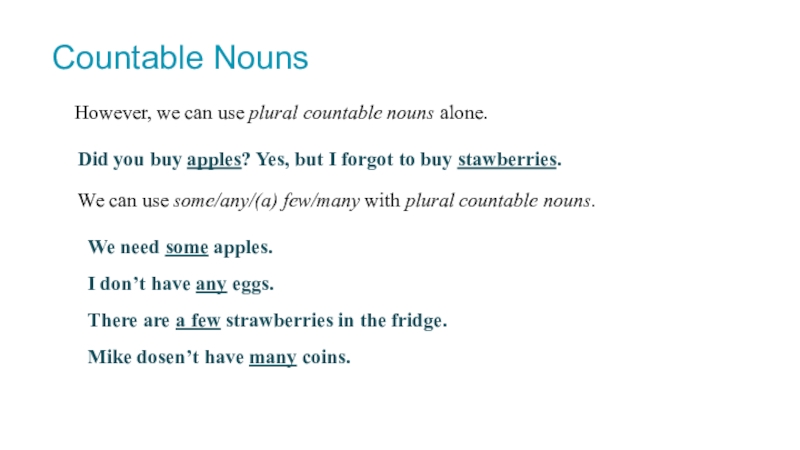
However, we can use plural countable
nouns alone.
Did you buy apples? Yes, but I forgot to buy stawberries.
We can use some/any/(a) few/many with plural countable nouns.
We need some apples.
I don’t have any eggs.
There are a few strawberries in the fridge.
Mike dosen’t have many coins.
Did you buy apples? Yes, but I forgot to buy stawberries.
We can use some/any/(a) few/many with plural countable nouns.
We need some apples.
I don’t have any eggs.
There are a few strawberries in the fridge.
Mike dosen’t have many coins.
Слайд 6Countable Nouns
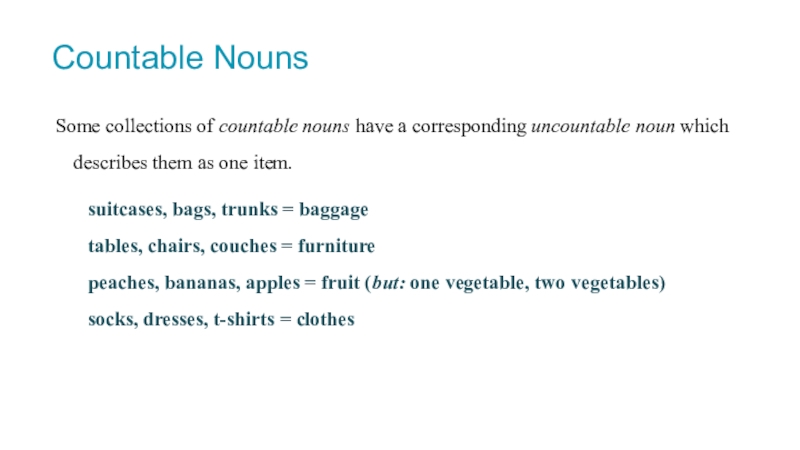
Some collections of countable nouns have a corresponding uncountable
noun which describes them as one item.
suitcases, bags, trunks = baggage
tables, chairs, couches = furniture
peaches, bananas, apples = fruit (but: one vegetable, two vegetables)
socks, dresses, t-shirts = clothes
suitcases, bags, trunks = baggage
tables, chairs, couches = furniture
peaches, bananas, apples = fruit (but: one vegetable, two vegetables)
socks, dresses, t-shirts = clothes
Слайд 7Uncountable Nouns
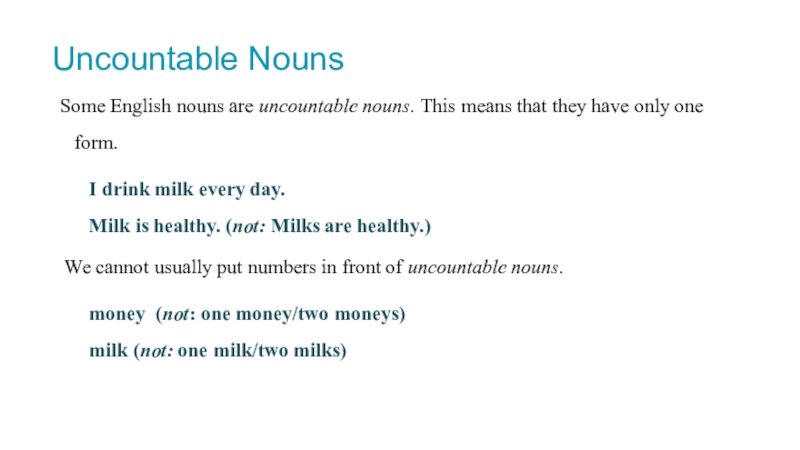
Some English nouns are uncountable nouns. This means that
they have only one form.
I drink milk every day.
Milk is healthy. (not: Milks are healthy.)
We cannot usually put numbers in front of uncountable nouns.
money (not: one money/two moneys)
milk (not: one milk/two milks)
I drink milk every day.
Milk is healthy. (not: Milks are healthy.)
We cannot usually put numbers in front of uncountable nouns.
money (not: one money/two moneys)
milk (not: one milk/two milks)
Слайд 8Uncountable Nouns
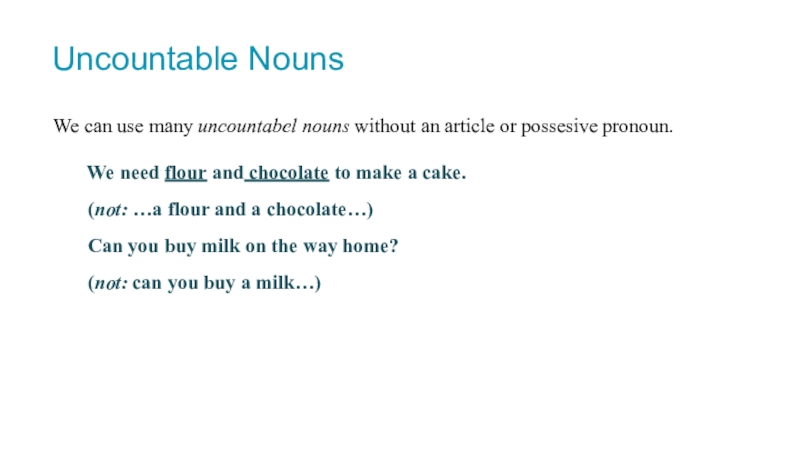
We can use many uncountabel nouns without an article or
possesive pronoun.
We need flour and chocolate to make a cake.
(not: …a flour and a chocolate…)
Can you buy milk on the way home?
(not: can you buy a milk…)
We need flour and chocolate to make a cake.
(not: …a flour and a chocolate…)
Can you buy milk on the way home?
(not: can you buy a milk…)
Слайд 9Uncountable Nouns
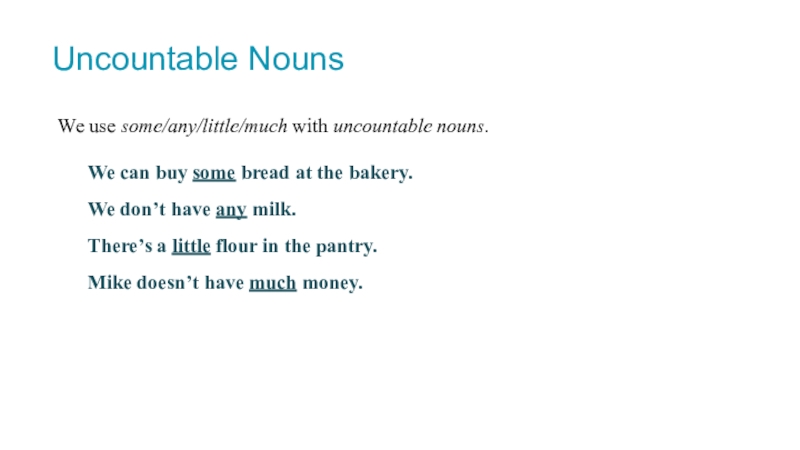
We use some/any/little/much with uncountable nouns.
We can buy some bread at the bakery.
We don’t have any milk.
There’s a little flour in the pantry.
Mike doesn’t have much money.
We don’t have any milk.
There’s a little flour in the pantry.
Mike doesn’t have much money.
Слайд 10Uncountable Nouns
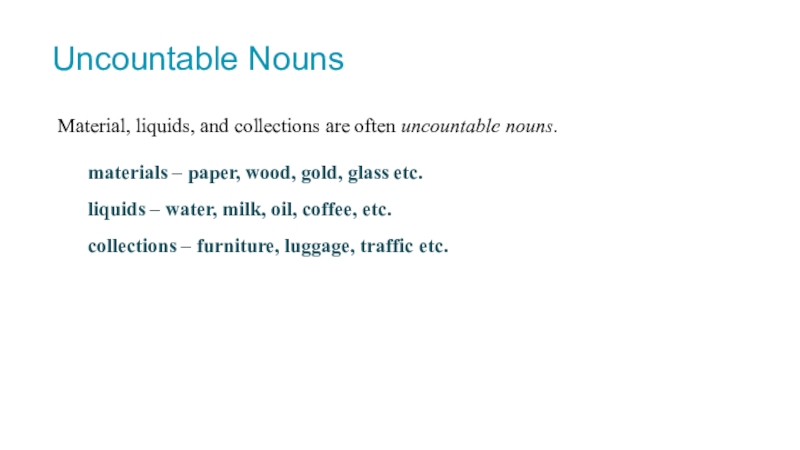
Material, liquids, and collections are often uncountable nouns.
materials – paper, wood, gold, glass etc.
liquids – water, milk, oil, coffee, etc.
collections – furniture, luggage, traffic etc.
liquids – water, milk, oil, coffee, etc.
collections – furniture, luggage, traffic etc.
Слайд 11Counting Uncountable Nouns
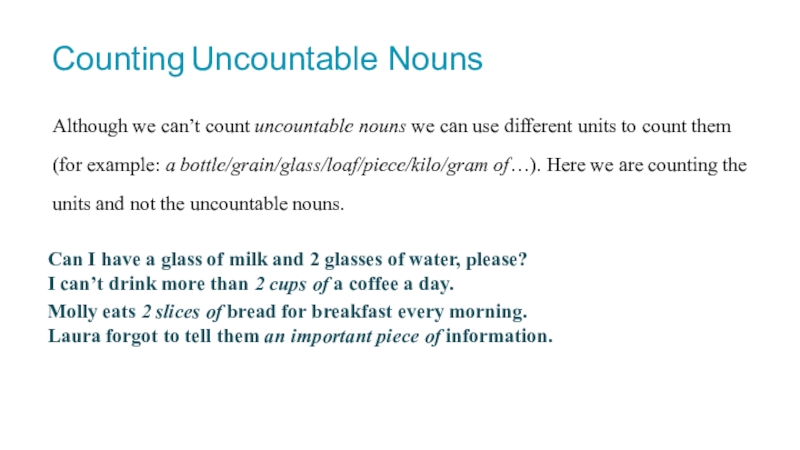
Although we can’t count uncountable nouns we can use
different units to count them (for example: a bottle/grain/glass/loaf/piece/kilo/gram of…). Here we are counting the units and not the uncountable nouns.
Can I have a glass of milk and 2 glasses of water, please?
I can’t drink more than 2 cups of a coffee a day.
Molly eats 2 slices of bread for breakfast every morning.
Laura forgot to tell them an important piece of information.
Can I have a glass of milk and 2 glasses of water, please?
I can’t drink more than 2 cups of a coffee a day.
Molly eats 2 slices of bread for breakfast every morning.
Laura forgot to tell them an important piece of information.
Слайд 12Singular/Plural Uncountable Nouns
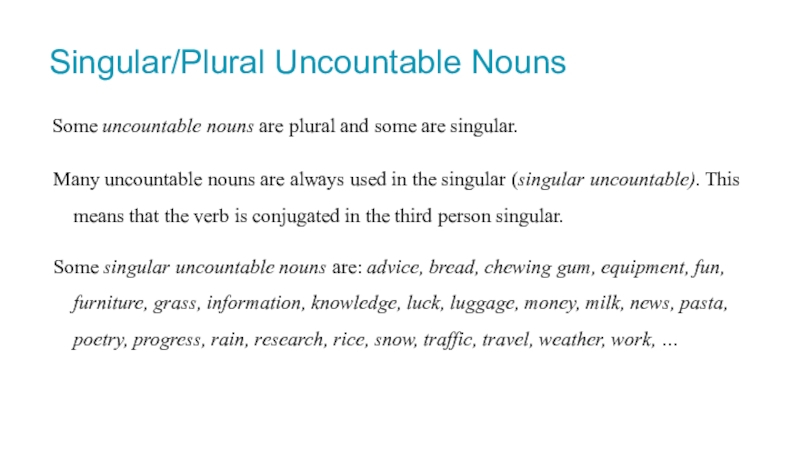
Some uncountable nouns are plural and some are singular.
Many
uncountable nouns are always used in the singular (singular uncountable). This means that the verb is conjugated in the third person singular.
Some singular uncountable nouns are: advice, bread, chewing gum, equipment, fun, furniture, grass, information, knowledge, luck, luggage, money, milk, news, pasta, poetry, progress, rain, research, rice, snow, traffic, travel, weather, work, …
Some singular uncountable nouns are: advice, bread, chewing gum, equipment, fun, furniture, grass, information, knowledge, luck, luggage, money, milk, news, pasta, poetry, progress, rain, research, rice, snow, traffic, travel, weather, work, …
Слайд 13Singular/Plural Uncountable Nouns
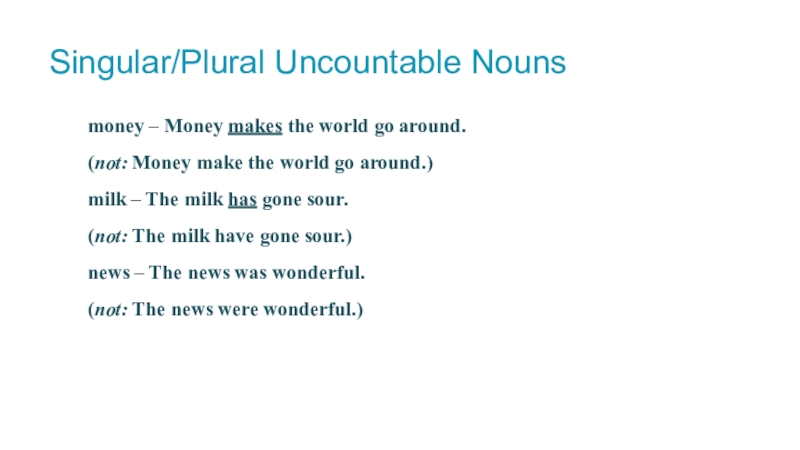
money – Money makes the world go around.
(not: Money
make the world go around.)
milk – The milk has gone sour.
(not: The milk have gone sour.)
news – The news was wonderful.
(not: The news were wonderful.)
milk – The milk has gone sour.
(not: The milk have gone sour.)
news – The news was wonderful.
(not: The news were wonderful.)
Слайд 14Singular/Plural Uncountable Nouns
Certain other nouns are only used in the
plural (plural uncountables). This means that the verb is always conjugated in the plural. Some plural uncountables are: clothes, remains, thanks, groceries, glasses, jeans, scissors, trousers/pants
clothes – His clothes are too big.
(not: His clothes is too big.)
groceries – The groceries were expensive..
(not: The groceries was expensive.)
clothes – His clothes are too big.
(not: His clothes is too big.)
groceries – The groceries were expensive..
(not: The groceries was expensive.)
Слайд 15Exercises
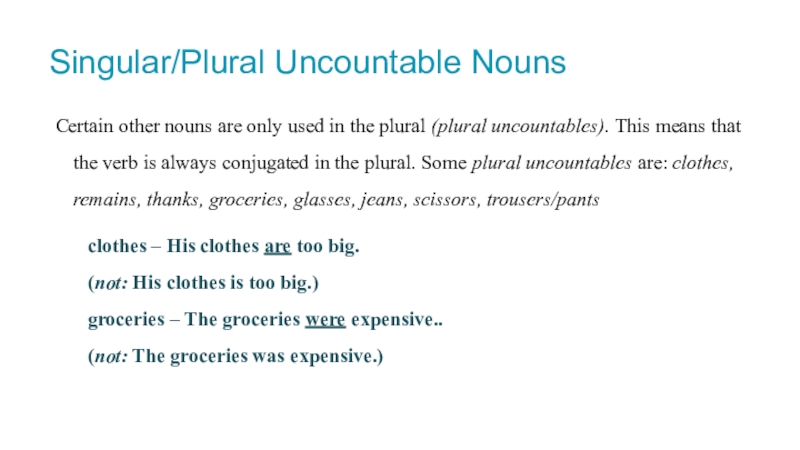
Decide if the sentences are correct or incorrect.
1.
There are some chairs and tables in the kitchen.
o 2. We need some new furnitures for our kitchen.
o 3. Two breads, please.
o 4. That’s an important information.
o 5. He saw three rare birds on his last birdwatching trip.
o 6. I saw a lot of bird migrating south.
o 2. We need some new furnitures for our kitchen.
o 3. Two breads, please.
o 4. That’s an important information.
o 5. He saw three rare birds on his last birdwatching trip.
o 6. I saw a lot of bird migrating south.
Слайд 16 Exercises
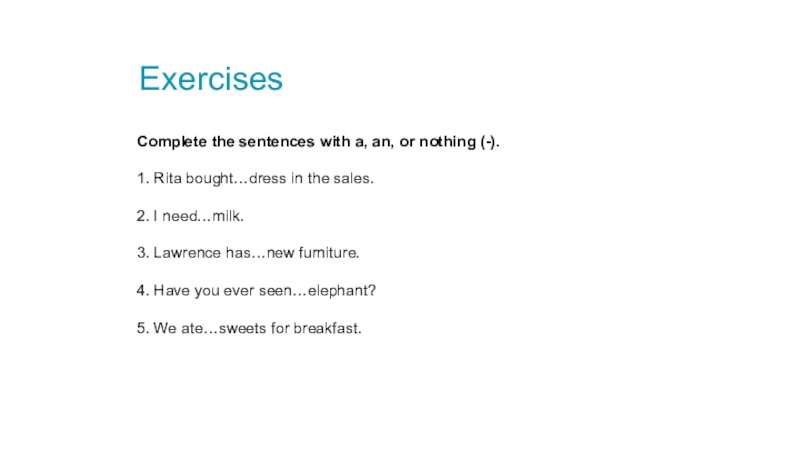
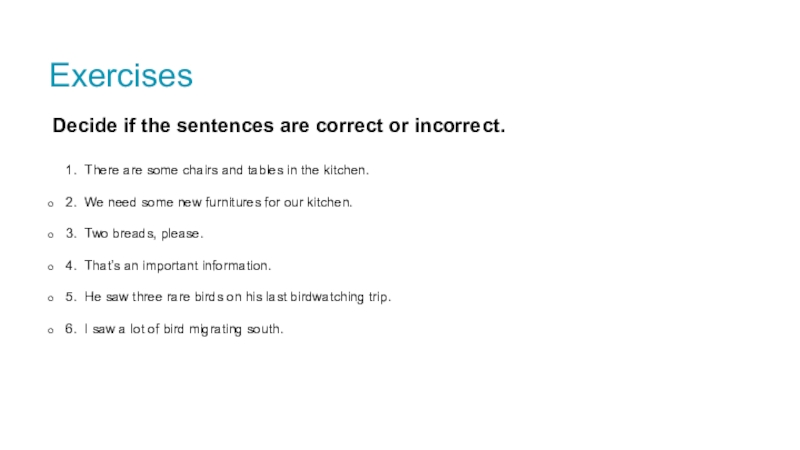
Complete the sentences with a, an, or
nothing (-).
1. Rita bought…dress in the sales.
2 I need…milk.
3. Lawrence has…new furniture.
4. Have you ever seen…elephant?
5. We ate…sweets for breakfast.
1. Rita bought…dress in the sales.
2 I need…milk.
3. Lawrence has…new furniture.
4. Have you ever seen…elephant?
5. We ate…sweets for breakfast.
Слайд 17Exercises
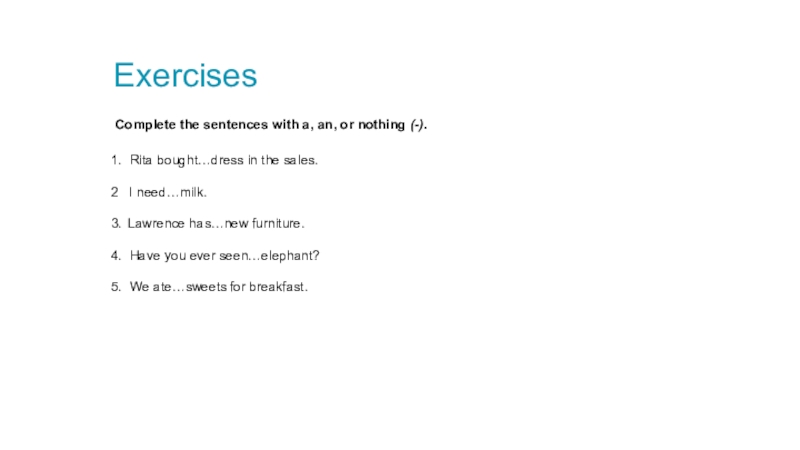
Choose the correct countable/uncountable noun to complete the sentences.
1. Rita
asked for a glass of…
2. Alex eats 6…every week.
3. Can you buy a block of…at the shops?
4. There are a few….in the fridge.
5. I got home quickly because there was very little…on the road.
2. Alex eats 6…every week.
3. Can you buy a block of…at the shops?
4. There are a few….in the fridge.
5. I got home quickly because there was very little…on the road.
Слайд 18Exercises
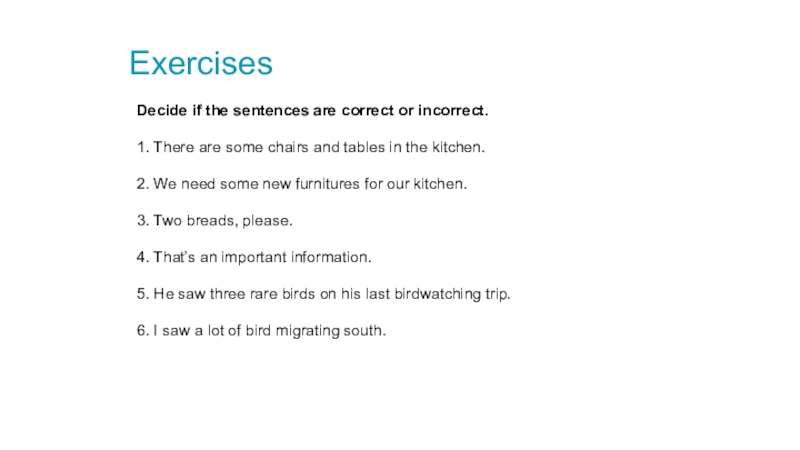
Decide if the sentences are correct or incorrect.
1. There are some
chairs and tables in the kitchen.
2. We need some new furnitures for our kitchen.
3. Two breads, please.
4. That’s an important information.
5. He saw three rare birds on his last birdwatching trip.
6. I saw a lot of bird migrating south.
2. We need some new furnitures for our kitchen.
3. Two breads, please.
4. That’s an important information.
5. He saw three rare birds on his last birdwatching trip.
6. I saw a lot of bird migrating south.
Слайд 19 Exercises
Complete the sentences with a, an,
or nothing (-).
1. Rita bought…dress in the sales.
2. I need…milk.
3. Lawrence has…new furniture.
4. Have you ever seen…elephant?
5. We ate…sweets for breakfast.
1. Rita bought…dress in the sales.
2. I need…milk.
3. Lawrence has…new furniture.
4. Have you ever seen…elephant?
5. We ate…sweets for breakfast.