- Главная
- Разное
- Образование
- Спорт
- Естествознание
- Природоведение
- Религиоведение
- Французский язык
- Черчение
- Английский язык
- Астрономия
- Алгебра
- Биология
- География
- Геометрия
- Детские презентации
- Информатика
- История
- Литература
- Математика
- Музыка
- МХК
- Немецкий язык
- ОБЖ
- Обществознание
- Окружающий мир
- Педагогика
- Русский язык
- Технология
- Физика
- Философия
- Химия
- Шаблоны, фоны, картинки для презентаций
- Экология
- Экономика
Презентация, доклад по английскому языку на тему Modal Verbs (11 класс)
Содержание
- 1. Презентация по английскому языку на тему Modal Verbs (11 класс)
- 2. Obligation/Duty/Necessity Must V – duty/strong obligation to
- 3. Have to V – strong necessity/obligation.
- 4. Had to V– форма прошедшего времени для
- 5. Absence of necessityDon’t have to V/don’t need
- 6. Didn’t have to V/didn’t need to V–
- 7. Permission/ProhibitionCan/may V – are used to ask
- 8. PossibilityCan V - general possibility.e.g. Going to
- 9. Ability/InabilityCan V – ability in the present/future.
- 10. Logical Assumptions/DeductionsMust – almost certain that this
- 11. May /might/could V – possible that sth
- 12. Negative Logical Assumptions Can’t/couldn’t – almost
- 13. Critisism Could V– e.g. You could be
- 14. Offers/SuggestionsCan I give you a hand?Would you
- 15. Probability (вероятность) He will call me tonight.
- 16. Advice You should stop smoking.You ought to
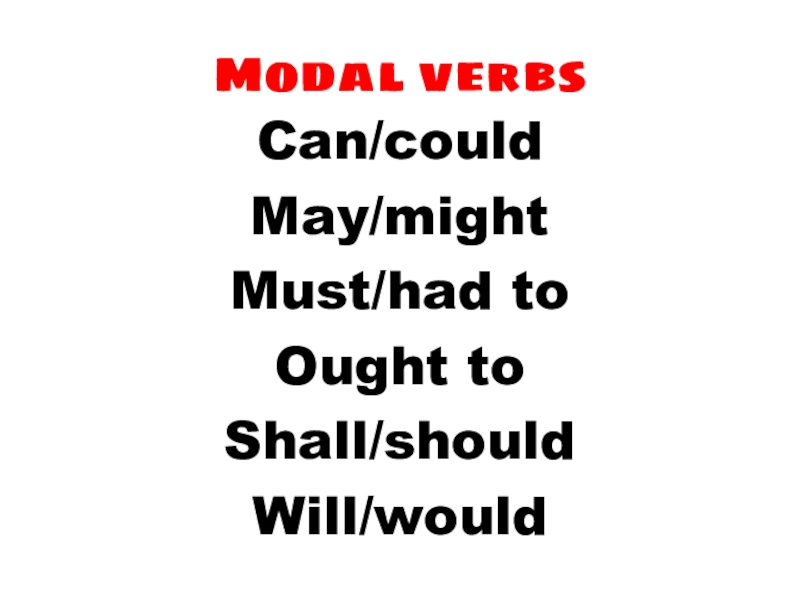
Obligation/Duty/Necessity Must V – duty/strong obligation to do sth, sth is essential. It is a rule. The speaker has decided that sth is necessary (subjective). e.g. You must stop when the traffic light is red. (that’s
Слайд 2Obligation/Duty/Necessity
Must V – duty/strong obligation to do sth, sth is
essential. It is a rule. The speaker has decided that sth is necessary (subjective).
e.g. You must stop when the traffic light is red. (that’s the rule).
e.g. I must contact the school for further information. (it is necessary).
e.g. You must stop when the traffic light is red. (that’s the rule).
e.g. I must contact the school for further information. (it is necessary).
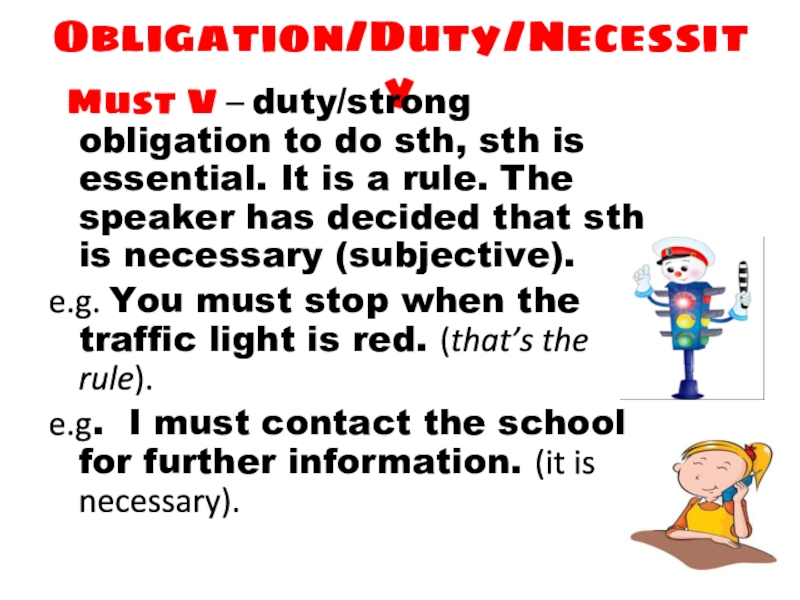
Слайд 3 Have to V – strong necessity/obligation. We use have to
when somebody else other than the speaker has decided that sth is necessary (objective).
e.g. I have to wear a uniform at work.
e.g. I have to wear a uniform at work.
Слайд 4Had to V– форма прошедшего времени для must and have to.
Should/ought
to V– duty/weak obligation, advice, recommendation.
e.g. We should / ought to clear away the mess in the kitchen.
e.g. We should / ought to clear away the mess in the kitchen.
Слайд 5Absence of necessity
Don’t have to V/don’t need to V/Needn’t V –
it isn’t necessary to do sth in the present/future (нет необходимости)
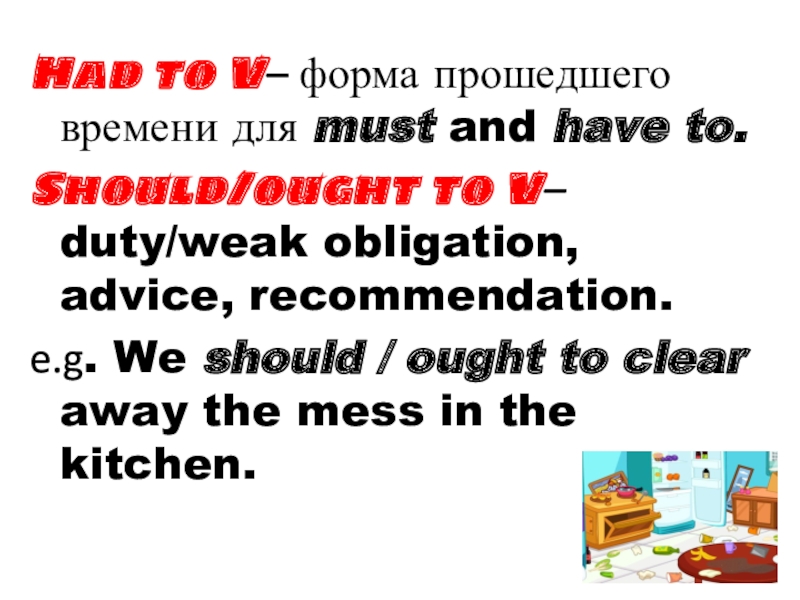
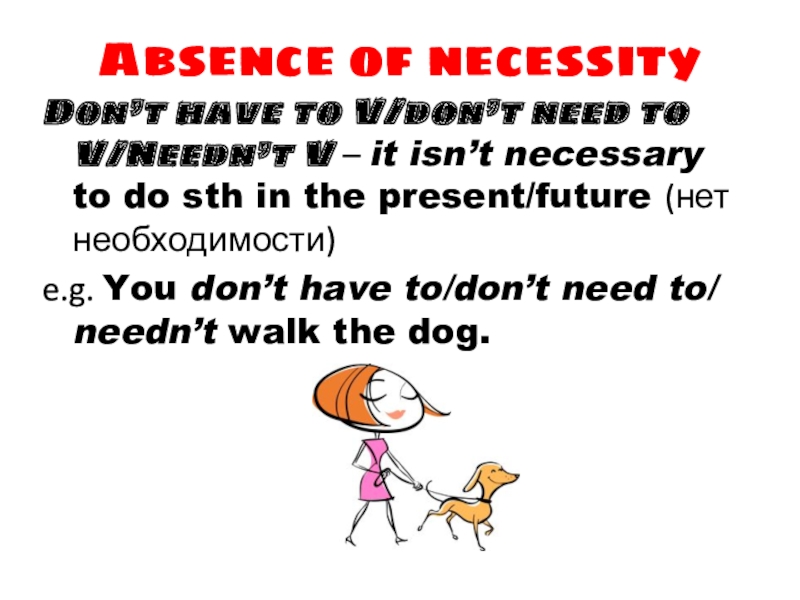
e.g. You don’t have to/don’t need to/ needn’t walk the dog.
e.g. You don’t have to/don’t need to/ needn’t walk the dog.
Слайд 6Didn’t have to V/didn’t need to V– it wasn’t necessary to
do sth in the past.
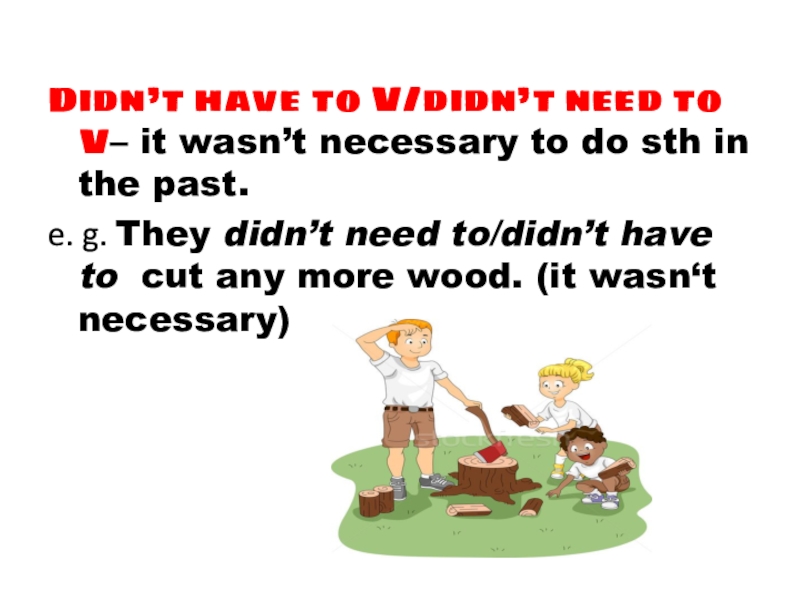
e. g. They didn’t need to/didn’t have to cut any more wood. (it wasn‘t necessary)
e. g. They didn’t need to/didn’t have to cut any more wood. (it wasn‘t necessary)
Слайд 7Permission/Prohibition
Can/may V – are used to ask for/give permission (попросить разрешения/разрешить
что-либо)
e.g. Can/may I use your phone, please? Yes, you can/may.
Mustn’t/can’t V – it is forbidden to do sth; it is against the rules/law; you are not allowed to do sth (запрещено правилами, законом)
e.g. You mustn’t/can’t enter here.
e.g. Can/may I use your phone, please? Yes, you can/may.
Mustn’t/can’t V – it is forbidden to do sth; it is against the rules/law; you are not allowed to do sth (запрещено правилами, законом)
e.g. You mustn’t/can’t enter here.
Слайд 8Possibility
Can V - general possibility.
e.g. Going to the museum can be
boring.
Could/may/might V – possibility in a specific situation. (present, future)
e.g. She should take a map with her. She might get lost.
Could/might/would have V3 – sth in the past was possible but didn’t happen.
e.g. They could have come with us if they hadn’t missed the train.
Could/may/might V – possibility in a specific situation. (present, future)
e.g. She should take a map with her. She might get lost.
Could/might/would have V3 – sth in the past was possible but didn’t happen.
e.g. They could have come with us if they hadn’t missed the train.
Слайд 9Ability/Inability
Can V – ability in the present/future. e.g. Tony can run
fast.
Could V – general repeated ability in the past.
e.g. When he was young he could climb trees.
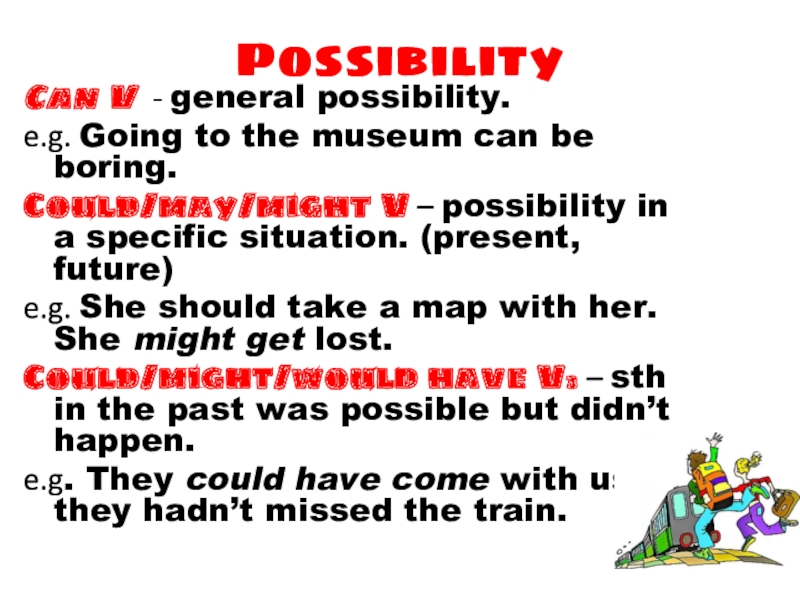
Was(n’t) able to V – (in)ability on a specific occasion in the past, single action in the past.
e.g. He was able to reach the top of the mountain.
Couldn’t V – any kind of inability in the past, repeated or specific.
e.g. He couldn’t ride a bike when he was two.
Could V – general repeated ability in the past.
e.g. When he was young he could climb trees.
Was(n’t) able to V – (in)ability on a specific occasion in the past, single action in the past.
e.g. He was able to reach the top of the mountain.
Couldn’t V – any kind of inability in the past, repeated or specific.
e.g. He couldn’t ride a bike when he was two.
Слайд 10Logical Assumptions/Deductions
Must – almost certain that this is/was true.
e.g. They must
be on holiday. (I am sure they are on holiday).
e.g. He must have strained his back. (I am certain)
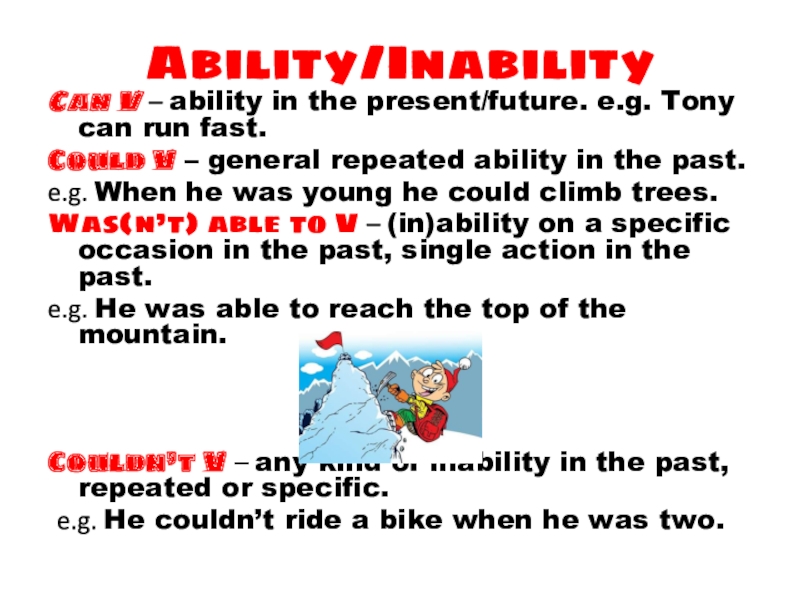
e.g. The drivers must have been driving too fast.
e.g. He must have strained his back. (I am certain)
e.g. The drivers must have been driving too fast.
Слайд 11May /might/could V – possible that sth is/was true.
e.g. The
computer is out of order. It may be broken.
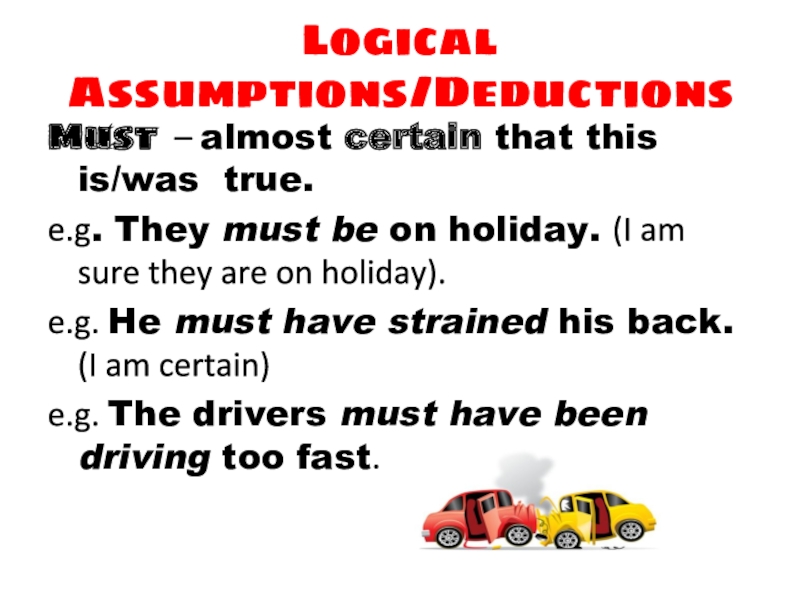
e.g. She was lucky. She could have been killed.
e.g. She was lucky. She could have been killed.
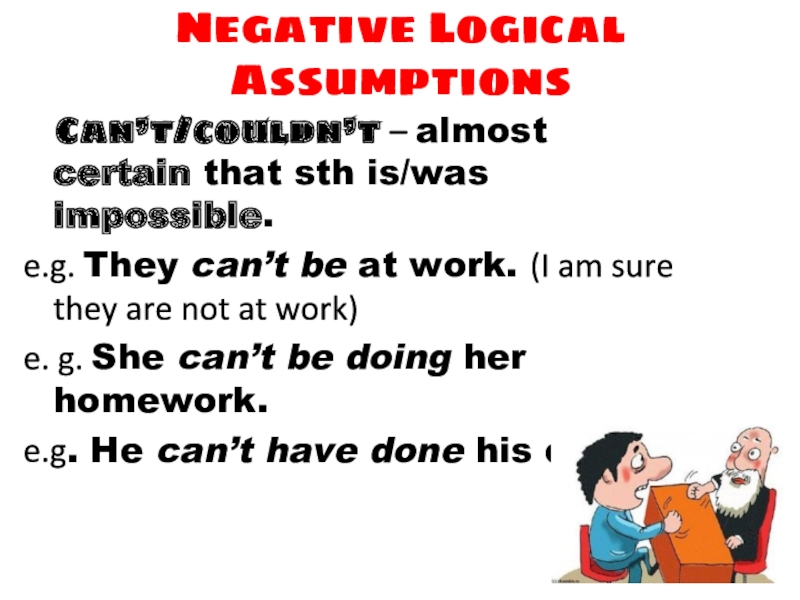
Слайд 12Negative Logical Assumptions
Can’t/couldn’t – almost certain that sth is/was
impossible.
e.g. They can’t be at work. (I am sure they are not at work)
e. g. She can’t be doing her homework.
e.g. He can’t have done his exam.
e.g. They can’t be at work. (I am sure they are not at work)
e. g. She can’t be doing her homework.
e.g. He can’t have done his exam.
Слайд 13Critisism
Could V– e.g. You could be polite to her
(present).
Could have V3 – e.g. You could have called to cancel it yesterday (past).
Should V– e.g. He should call us back. (present)
Should have V3 - She should have told us. (but she didn’t).
Ought to V– e.g. You ought to be more careful. (I advise you to be more careful).
Could have V3 – e.g. You could have called to cancel it yesterday (past).
Should V– e.g. He should call us back. (present)
Should have V3 - She should have told us. (but she didn’t).
Ought to V– e.g. You ought to be more careful. (I advise you to be more careful).
Слайд 14Offers/Suggestions
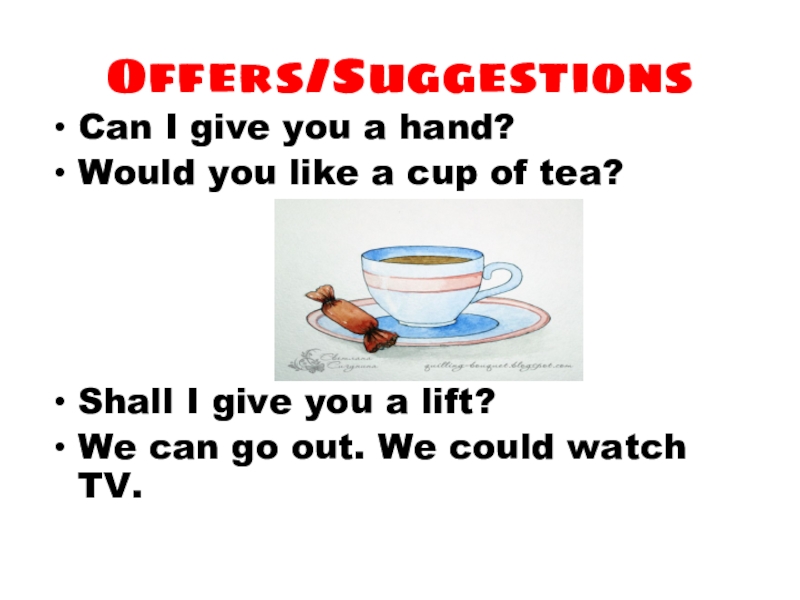
Can I give you a hand?
Would you like a cup of
tea?
Shall I give you a lift?
We can go out. We could watch TV.
Shall I give you a lift?
We can go out. We could watch TV.
Слайд 15Probability (вероятность)
He will call me tonight. (100% certain)
The weather should/ought
to get better tomorrow. (90% certain; future only, it’s probable)
Слайд 16Advice
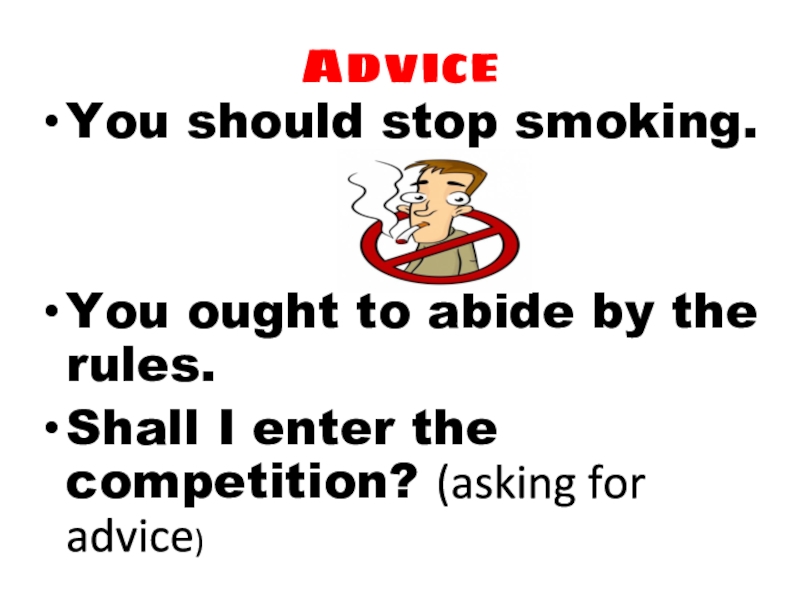
You should stop smoking.
You ought to abide by the rules.
Shall
I enter the competition? (asking for advice)