- Главная
- Разное
- Образование
- Спорт
- Естествознание
- Природоведение
- Религиоведение
- Французский язык
- Черчение
- Английский язык
- Астрономия
- Алгебра
- Биология
- География
- Геометрия
- Детские презентации
- Информатика
- История
- Литература
- Математика
- Музыка
- МХК
- Немецкий язык
- ОБЖ
- Обществознание
- Окружающий мир
- Педагогика
- Русский язык
- Технология
- Физика
- Философия
- Химия
- Шаблоны, фоны, картинки для презентаций
- Экология
- Экономика
Презентация, доклад по английскому языку на тему история моды
Содержание
- 1. Презентация по английскому языку на тему история моды
- 2. KEY TERMS bartercelluloseIndustrial Revolutionready-to-wearsumptuary lawssweatshopstechnology
- 3. When you slip in favorite pair of
- 4. Fashion of Early Civilizations 1.Ancient GreeceThe Greeks
- 5. Roman Empire The long piece of toga
- 6. China and JapanGradually, clothing stylesbecame similar throughout
- 7. In the Manchu region of China, women
- 8. Слайд 8
- 9. THE EVOLUTION OF FASHIONMany years ago, fashion
- 10. The Middle AgesThe Middle Ages spanned from
- 11. Renaissance Splendor During the Renaissance, clothing styles
- 12. The Seventeenth CenturyDuring the reign of Louis
KEY TERMS bartercelluloseIndustrial Revolutionready-to-wearsumptuary lawssweatshopstechnology
Слайд 2KEY TERMS
barter
cellulose
Industrial Revolution
ready-to-wear
sumptuary laws
sweatshops
technology

Слайд 3
When you slip in favorite pair of blue jeans, do you
stop to think that a coal miner born 150 years ago appreciated the same sturdy, riveted denim construction? When you put on running shoes, do you realize that a Briton sheepherder laced his boots in the same crisscross pattern 1500 years ago? Throughout history, garment styles have reappeared. They may look the same or they may be changed slightly to reflect new needs and new technology.
Слайд 4Fashion of Early Civilizations
1.Ancient Greece
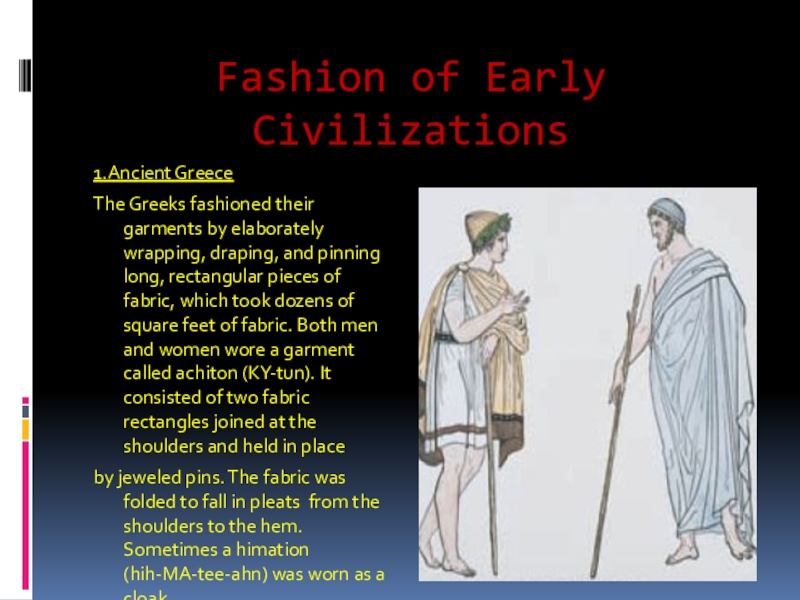
The Greeks fashioned their garments by
elaborately wrapping, draping, and pinning long, rectangular pieces of fabric, which took dozens of square feet of fabric. Both men and women wore a garment called achiton (KY-tun). It consisted of two fabric rectangles joined at the shoulders and held in place
by jeweled pins. The fabric was folded to fall in pleats from the shoulders to the hem. Sometimes a himation (hih-MA-tee-ahn) was worn as a cloak.
by jeweled pins. The fabric was folded to fall in pleats from the shoulders to the hem. Sometimes a himation (hih-MA-tee-ahn) was worn as a cloak.
Слайд 5Roman Empire
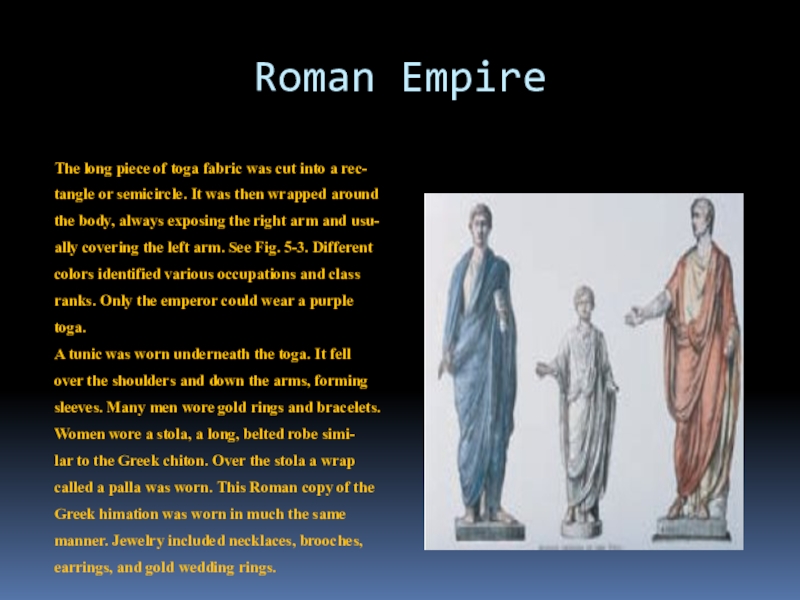
The long piece of toga fabric was cut into
a rec-
tangle or semicircle. It was then wrapped around
the body, always exposing the right arm and usu-
ally covering the left arm. See Fig. 5-3. Different
colors identified various occupations and class
ranks. Only the emperor could wear a purple
toga.
A tunic was worn underneath the toga. It fell
over the shoulders and down the arms, forming
sleeves. Many men wore gold rings and bracelets.
Women wore a stola, a long, belted robe simi-
lar to the Greek chiton. Over the stola a wrap
called a palla was worn. This Roman copy of the
Greek himation was worn in much the same
manner. Jewelry included necklaces, brooches,
earrings, and gold wedding rings.
tangle or semicircle. It was then wrapped around
the body, always exposing the right arm and usu-
ally covering the left arm. See Fig. 5-3. Different
colors identified various occupations and class
ranks. Only the emperor could wear a purple
toga.
A tunic was worn underneath the toga. It fell
over the shoulders and down the arms, forming
sleeves. Many men wore gold rings and bracelets.
Women wore a stola, a long, belted robe simi-
lar to the Greek chiton. Over the stola a wrap
called a palla was worn. This Roman copy of the
Greek himation was worn in much the same
manner. Jewelry included necklaces, brooches,
earrings, and gold wedding rings.
Слайд 6China and Japan
Gradually, clothing styles
became similar throughout the country. Women
wore a
coat and a long skirt; men wore a long
robe. Later on, both genders began to wear trousers.
Both the coat and robe were simple shapes with straight lines. A common style featured a high, narrow collar and fastened diagonally from the center of the neckline to just under the right arm and down the right side of the body. Although the shapes were
simple, the garments often featured very elabo-
rate silk embroidery. Some designs symbolized
beliefs and customs; others provided information
about the wearer’s status.
robe. Later on, both genders began to wear trousers.
Both the coat and robe were simple shapes with straight lines. A common style featured a high, narrow collar and fastened diagonally from the center of the neckline to just under the right arm and down the right side of the body. Although the shapes were
simple, the garments often featured very elabo-
rate silk embroidery. Some designs symbolized
beliefs and customs; others provided information
about the wearer’s status.
Слайд 7In the Manchu region of China, women wore a
slim, fitted dress
called a cheongsam (CHAWNG-
sahm). This high-collared dress, which buttoned
on the right side and had long side slits, is still
popular today.
sahm). This high-collared dress, which buttoned
on the right side and had long side slits, is still
popular today.
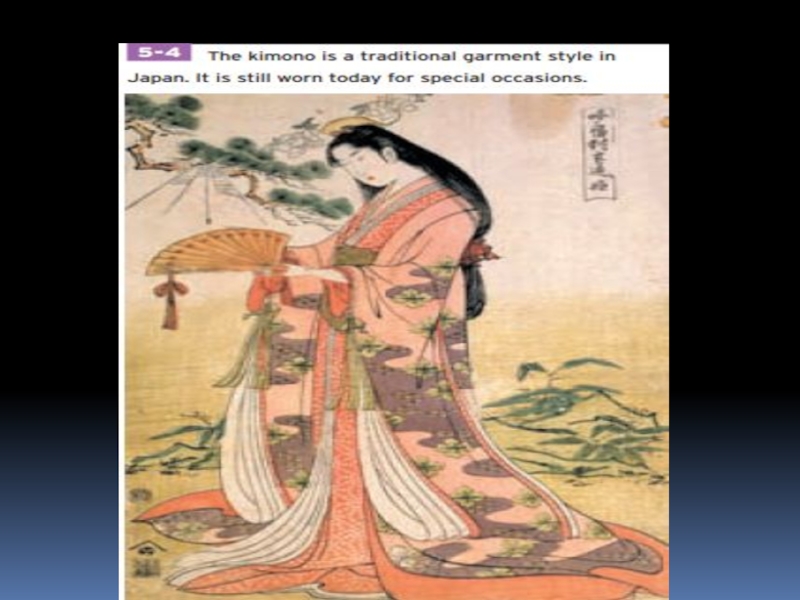
As far back as the fourth century in Japan, the
kimono (kuh-MOH-noh) was the standard dress
for both men and women. The first
kimonos were made from one piece of linen and wrapped to fit the body. Later, two-piece kimonos
made from silk were common. By the 700s, the
kimono included various inner and outer layers,
as well as a wide decorative sash, called an obi
(OH-bee). The rank of the wearer and the for-
mality of the occasion were indicated by the fab-
ric, the colors, and the arrangement of the layers
Слайд 9THE EVOLUTION OF
FASHION
Many years ago, fashion changed very slowly.
People often wore
the same clothing style for life.
A particular style could continue past a lifetime.
An outfit for special occasions was often handed
down from one generation to another.
Until the fourteenth century, European clothes
were loose-fitting and draped. People from differ-
ent cultures wore similar clothes. Around 1350,
people started wearing more fitted styles. From
then on, regional differences in garments began
to develop in Europe.
A particular style could continue past a lifetime.
An outfit for special occasions was often handed
down from one generation to another.
Until the fourteenth century, European clothes
were loose-fitting and draped. People from differ-
ent cultures wore similar clothes. Around 1350,
people started wearing more fitted styles. From
then on, regional differences in garments began
to develop in Europe.
Слайд 10The Middle Ages
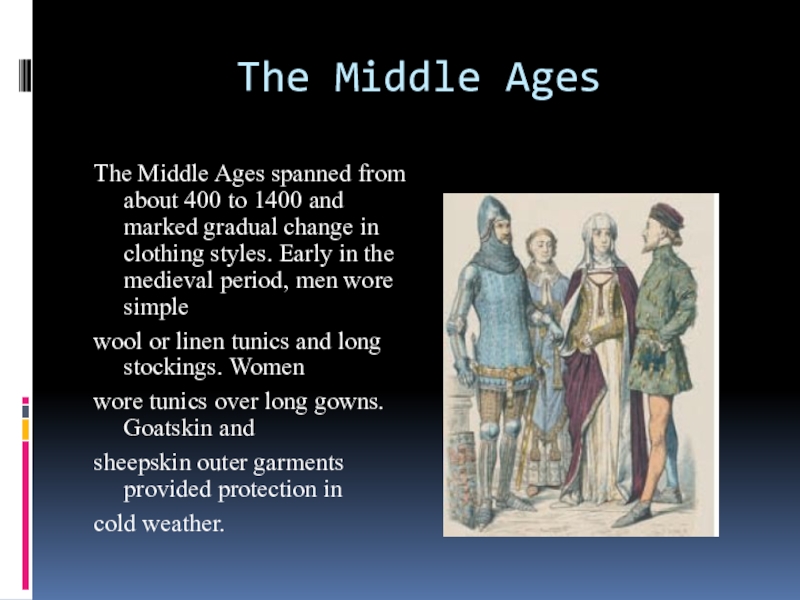
The Middle Ages spanned from about 400 to 1400
and marked gradual change in clothing styles. Early in the medieval period, men wore simple
wool or linen tunics and long stockings. Women
wore tunics over long gowns. Goatskin and
sheepskin outer garments provided protection in
cold weather.
wool or linen tunics and long stockings. Women
wore tunics over long gowns. Goatskin and
sheepskin outer garments provided protection in
cold weather.
Слайд 11Renaissance Splendor
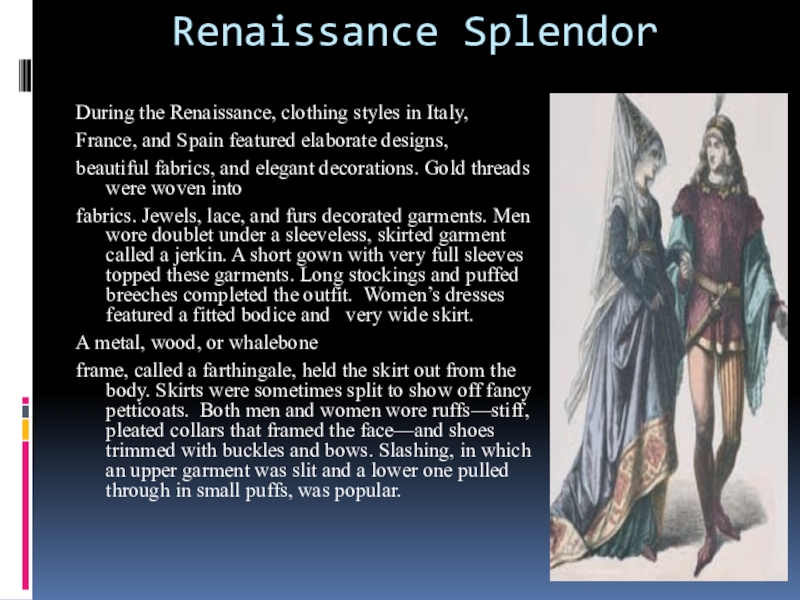
During the Renaissance, clothing styles in Italy,
France, and Spain
featured elaborate designs,
beautiful fabrics, and elegant decorations. Gold threads were woven into
fabrics. Jewels, lace, and furs decorated garments. Men wore doublet under a sleeveless, skirted garment called a jerkin. A short gown with very full sleeves topped these garments. Long stockings and puffed breeches completed the outfit. Women’s dresses featured a fitted bodice and very wide skirt.
A metal, wood, or whalebone
frame, called a farthingale, held the skirt out from the body. Skirts were sometimes split to show off fancy petticoats. Both men and women wore ruffs—stiff, pleated collars that framed the face—and shoes trimmed with buckles and bows. Slashing, in which an upper garment was slit and a lower one pulled through in small puffs, was popular.
beautiful fabrics, and elegant decorations. Gold threads were woven into
fabrics. Jewels, lace, and furs decorated garments. Men wore doublet under a sleeveless, skirted garment called a jerkin. A short gown with very full sleeves topped these garments. Long stockings and puffed breeches completed the outfit. Women’s dresses featured a fitted bodice and very wide skirt.
A metal, wood, or whalebone
frame, called a farthingale, held the skirt out from the body. Skirts were sometimes split to show off fancy petticoats. Both men and women wore ruffs—stiff, pleated collars that framed the face—and shoes trimmed with buckles and bows. Slashing, in which an upper garment was slit and a lower one pulled through in small puffs, was popular.
Слайд 12The Seventeenth Century
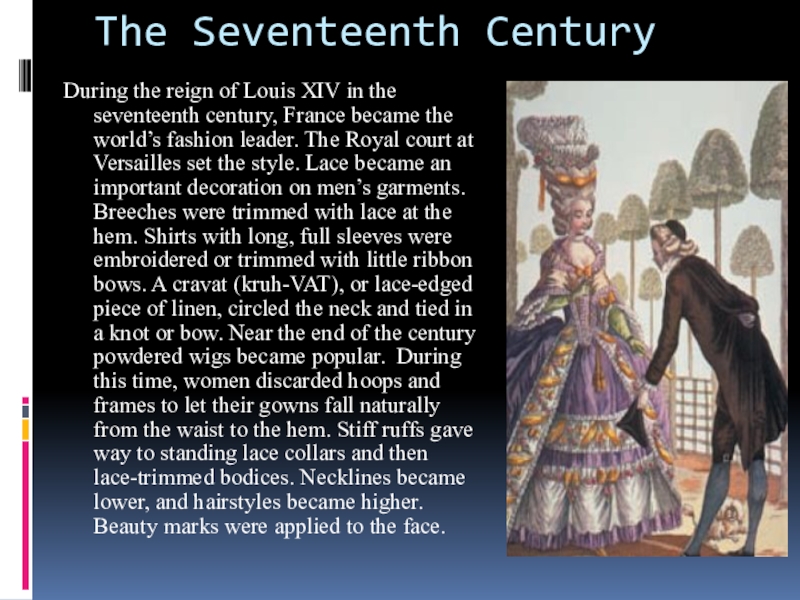
During the reign of Louis XIV in the seventeenth
century, France became the world’s fashion leader. The Royal court at Versailles set the style. Lace became an important decoration on men’s garments. Breeches were trimmed with lace at the hem. Shirts with long, full sleeves were embroidered or trimmed with little ribbon bows. A cravat (kruh-VAT), or lace-edged piece of linen, circled the neck and tied in a knot or bow. Near the end of the century powdered wigs became popular. During this time, women discarded hoops and frames to let their gowns fall naturally from the waist to the hem. Stiff ruffs gave way to standing lace collars and then lace-trimmed bodices. Necklines became lower, and hairstyles became higher. Beauty marks were applied to the face.