год
- Главная
- Разное
- Образование
- Спорт
- Естествознание
- Природоведение
- Религиоведение
- Французский язык
- Черчение
- Английский язык
- Астрономия
- Алгебра
- Биология
- География
- Геометрия
- Детские презентации
- Информатика
- История
- Литература
- Математика
- Музыка
- МХК
- Немецкий язык
- ОБЖ
- Обществознание
- Окружающий мир
- Педагогика
- Русский язык
- Технология
- Физика
- Философия
- Химия
- Шаблоны, фоны, картинки для презентаций
- Экология
- Экономика
Презентация, доклад по английскому языку Means of communication
Содержание
- 1. Презентация по английскому языку Means of communication
- 2. Цели урока: 1.Образовательная: познакомить
- 3. Слайд 3
- 4. 3. Проверка домашнего задания -Упр.7, с.74. 1.Who
- 5. 3. Работа с текстами
- 6. Writing is very important.3. Read the “Means
- 7. Слайд 7
- 8. Do you often have a telephone call?Read
- 9. What does @ mean?Scan the “E-mail” text
- 10. Упражнение
- 11. ФизкультминуткаHands up! Hands down!(поднимают и опускают руки)
- 12. 1.Which of these things can you call
- 13. Работа с учебником.Упр. 4 стр. 73 Listen,
- 14. 5. Повторение грамматического материала. Если мы хотим
- 15. Выполнение грамматического упражнения по теме: «Модальные глаголы».
- 16. Повторение модальных глаголов Say what we must
- 17. Повторение модальных глаголов. Вставить модальные глаголы can,
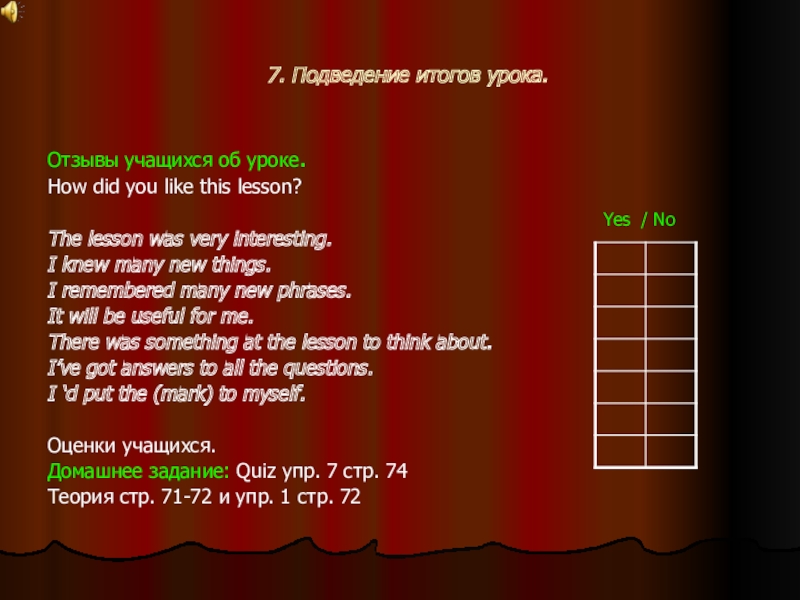
- 18. 7. Подведение итогов урока.Отзывы учащихся об уроке.
Цели урока: 1.Образовательная: познакомить учащихся с великими изобретениями в рамках речевой ситуации «Средства коммуникации и их роль в обществе» и обучать кратко высказываться о фактах и событиях, изложенных в текстах, повторить изученный материал
Слайд 1Урок английского языка
в 7 «Г» классе
Means of communication
Modal verbs
Учитель: Гусева Ксения
Валерьевна
2017
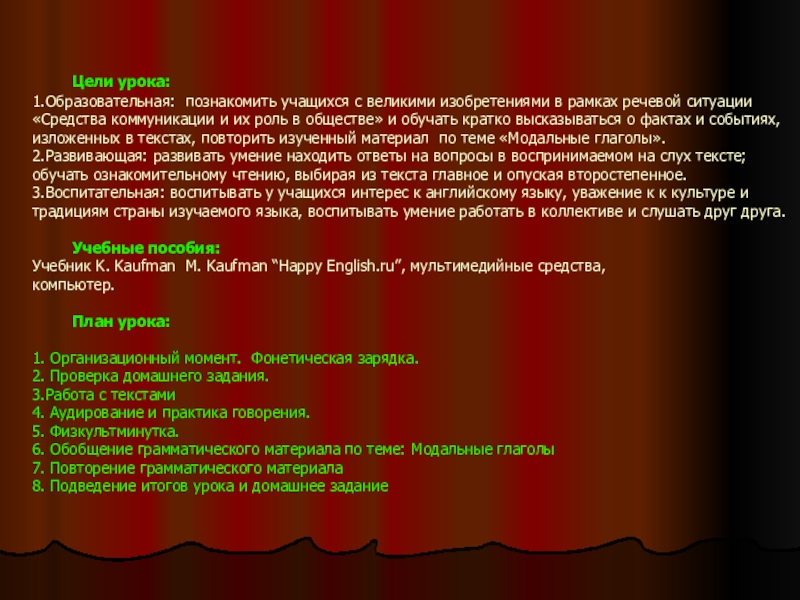
Слайд 2 Цели урока: 1.Образовательная: познакомить учащихся с великими изобретениями в
рамках речевой ситуации «Средства коммуникации и их роль в обществе» и обучать кратко высказываться о фактах и событиях, изложенных в текстах, повторить изученный материал по теме «Модальные глаголы».
2.Развивающая: развивать умение находить ответы на вопросы в воспринимаемом на слух тексте;обучать ознакомительному чтению, выбирая из текста главное и опуская второстепенное.
3.Воспитательная: воспитывать у учащихся интерес к английскому языку, уважение к к культуре и традициям страны изучаемого языка, воспитывать умение работать в коллективе и слушать друг друга.
Учебные пособия:
Учебник K. Kaufman M. Kaufman “Happy English.ru”, мультимедийные средства,
компьютер.
План урока:
1. Организационный момент. Фонетическая зарядка.
2. Проверка домашнего задания.
3.Работа с текстами
4. Аудирование и практика говорения.
5. Физкультминутка.
6. Обобщение грамматического материала по теме: Модальные глаголы
7. Повторение грамматического материала
8. Подведение итогов урока и домашнее задание
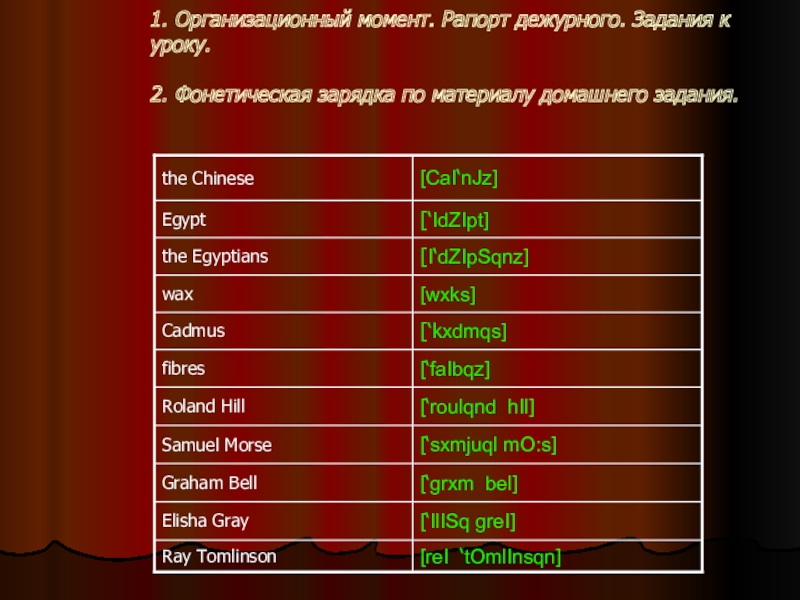
Слайд 3 1. Организационный момент. Рапорт дежурного.
Задания к уроку.
2. Фонетическая зарядка по материалу домашнего задания.
[reI ‘tOmlInsqn]
Ray Tomlinson
[‘IlISq greI]
Elisha Gray
[‘grxm bel]
Graham Bell
[‘sxmjuql mO:s]
Samuel Morse
[‘roulqnd hIl]
Roland Hill
[‘faIbqz]
fibres
[‘kxdmqs]
Cadmus
[wxks]
wax
[I‘dZIpSqnz]
the Egyptians
[‘IdZIpt]
Egypt
[CaI‘nJz]
the Chinese
Слайд 43. Проверка домашнего задания -
Упр.7, с.74.
1.Who invented paper?
the Chinese
b) the Japanese c) the English
2. Who invented the alphabet?
the Jews b) the Greeks c) the Egyptians
3. Who invented ink?
the Egyptians and the Chinese b) the Chinese c) the Arabs
4.Who first sent private letters from one person to another?
the Greeks b) the Egyptians c) the Romans
5. Who invented the stamp?
the English b) the Russians c) the Americans
6. Who invented the telephone?
Telephone b) Popov c) Alexander Graham Bell
7. Who invented the telegraph?
Alexander Graham Bell b) Samuel Morse c) Mary Telegraph
8. Who invented the e-mail?
a) the Americans b) the Russians c) the Germans
2. Who invented the alphabet?
the Jews b) the Greeks c) the Egyptians
3. Who invented ink?
the Egyptians and the Chinese b) the Chinese c) the Arabs
4.Who first sent private letters from one person to another?
the Greeks b) the Egyptians c) the Romans
5. Who invented the stamp?
the English b) the Russians c) the Americans
6. Who invented the telephone?
Telephone b) Popov c) Alexander Graham Bell
7. Who invented the telegraph?
Alexander Graham Bell b) Samuel Morse c) Mary Telegraph
8. Who invented the e-mail?
a) the Americans b) the Russians c) the Germans
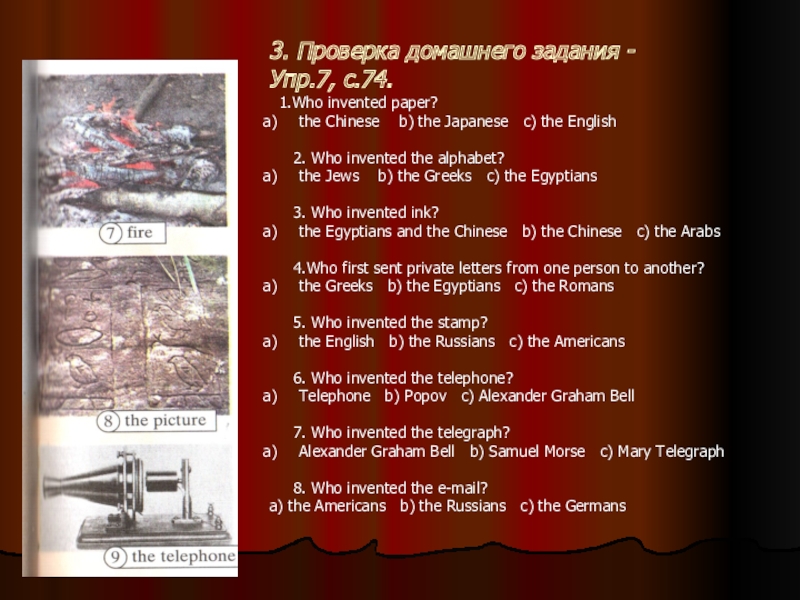
Слайд 5 3. Работа с текстами
People invented ink more than four thousand years ago, didn’t they?
Yes, they did.
---------------------------------------------------------------------------------------
2.Did the Chinese and the Egyptians invent ink at the same time?
Yes, they did.
---------------------------------------------------------------------------------------
3.Where did the first man who used ink come from?
He came from China.
----------------------------------------------------------
1. Read the “Ink” text and answer the questions.
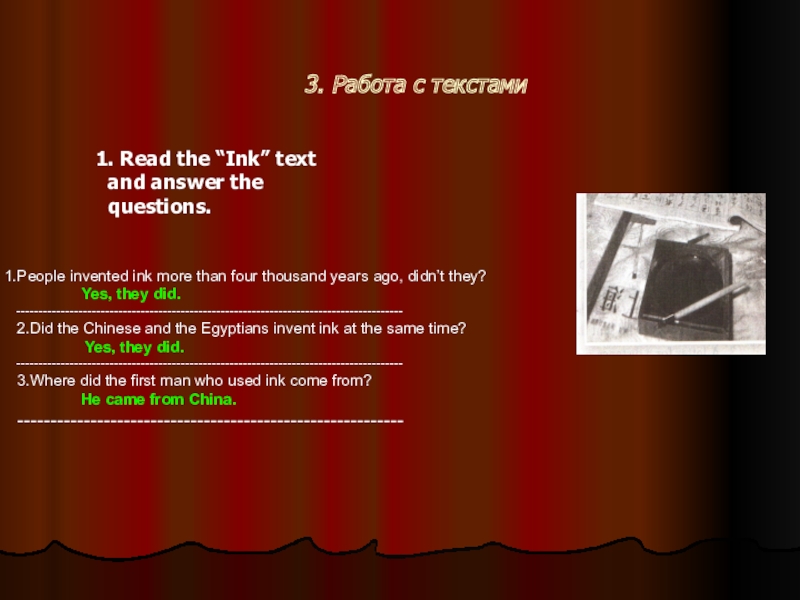
Слайд 6Writing is very important.
3. Read the “Means of writing and letters”
text and answer the questions.
1. Who made the first writing stylus?
The Greeks did.
---------------------------------------------------------------------------------------
2. Did the Greeks write their messages on paper?
No, they didn’t. There were wax-coated tablets.
---------------------------------------------------------------------------------------
3. How did Cadmus send his messages?
He sent his messages by foot messengers.
---------------------------------------------------------------------------------------
4. Read the “Paper” text and write True or False.
1. Paper came from Turkey. F T
-------------------------------------------------------------
2. The Chinese learned about paper in the second century AD. F T
------------------
3. The oldest piece of paper was made of hemp fibres. F T
-------------------------------
4. The archaeologists found the oldest piece of paper in a tomb. F T
------------------
1. Who made the first writing stylus?
The Greeks did.
---------------------------------------------------------------------------------------
2. Did the Greeks write their messages on paper?
No, they didn’t. There were wax-coated tablets.
---------------------------------------------------------------------------------------
3. How did Cadmus send his messages?
He sent his messages by foot messengers.
---------------------------------------------------------------------------------------
4. Read the “Paper” text and write True or False.
1. Paper came from Turkey. F T
-------------------------------------------------------------
2. The Chinese learned about paper in the second century AD. F T
------------------
3. The oldest piece of paper was made of hemp fibres. F T
-------------------------------
4. The archaeologists found the oldest piece of paper in a tomb. F T
------------------
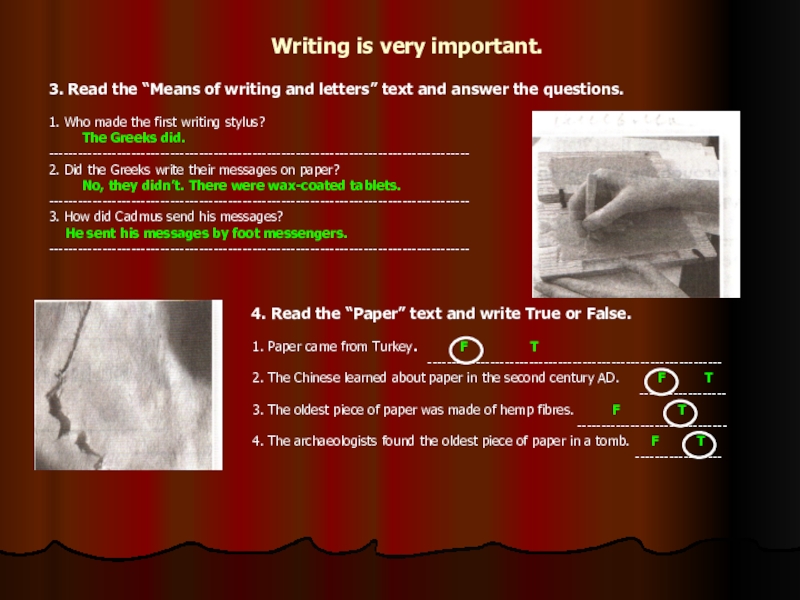
Слайд 7
5. Look through the “Telegraph” text and answer the questions:
What does the word “telegraph” mean?
It means “to write far”
Does the telegraph transmit signals?
Yes, it does.
Who invented the electronic alphabet?
Samuel Morse did.
What was it possible to do with the help of Morse code?
It was possible to code the letters and signs of a language.
Which two cities did the first telegraph connect?
It connected Washington and Baltimore.
What does the word “telegraph” mean?
It means “to write far”
Does the telegraph transmit signals?
Yes, it does.
Who invented the electronic alphabet?
Samuel Morse did.
What was it possible to do with the help of Morse code?
It was possible to code the letters and signs of a language.
Which two cities did the first telegraph connect?
It connected Washington and Baltimore.
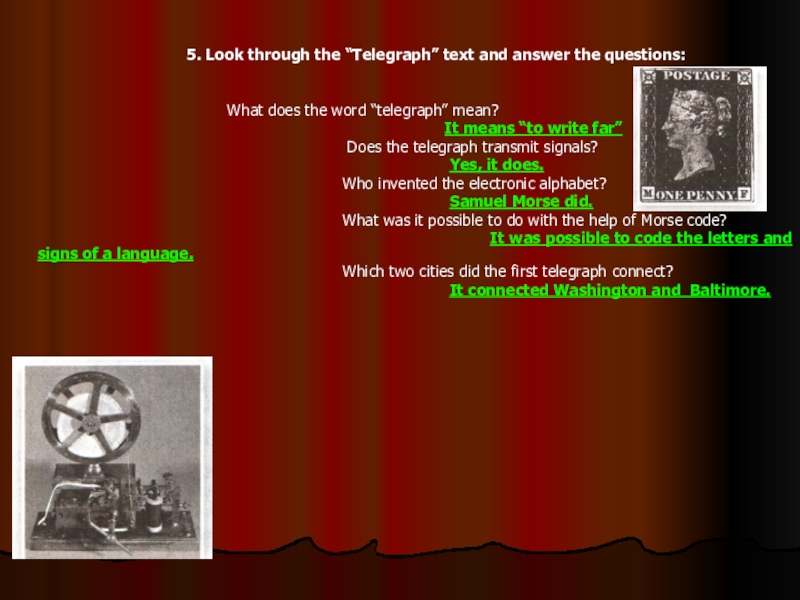
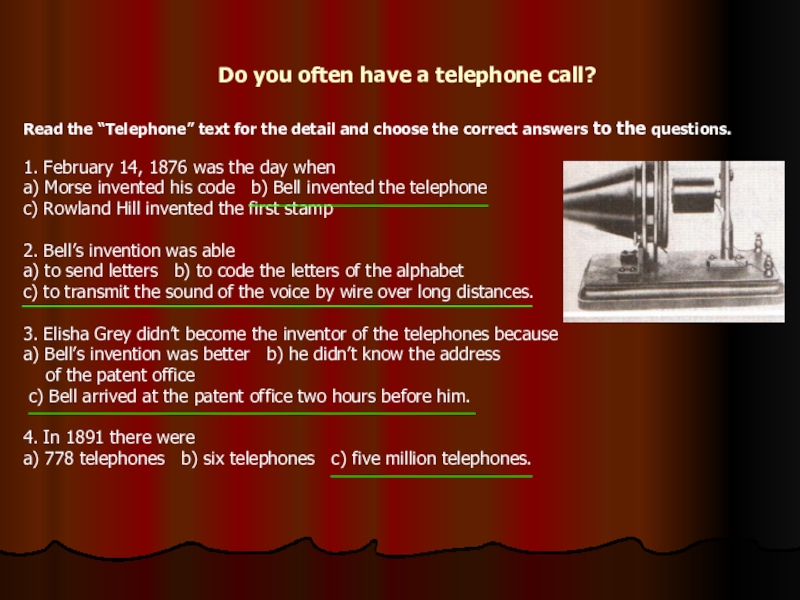
Слайд 8Do you often have a telephone call?
Read the “Telephone” text for
the detail and choose the correct answers to the questions.
1. February 14, 1876 was the day when
a) Morse invented his code b) Bell invented the telephone
c) Rowland Hill invented the first stamp
2. Bell’s invention was able
a) to send letters b) to code the letters of the alphabet
c) to transmit the sound of the voice by wire over long distances.
3. Elisha Grey didn’t become the inventor of the telephones because
a) Bell’s invention was better b) he didn’t know the address
of the patent office
c) Bell arrived at the patent office two hours before him.
4. In 1891 there were
a) 778 telephones b) six telephones c) five million telephones.
1. February 14, 1876 was the day when
a) Morse invented his code b) Bell invented the telephone
c) Rowland Hill invented the first stamp
2. Bell’s invention was able
a) to send letters b) to code the letters of the alphabet
c) to transmit the sound of the voice by wire over long distances.
3. Elisha Grey didn’t become the inventor of the telephones because
a) Bell’s invention was better b) he didn’t know the address
of the patent office
c) Bell arrived at the patent office two hours before him.
4. In 1891 there were
a) 778 telephones b) six telephones c) five million telephones.
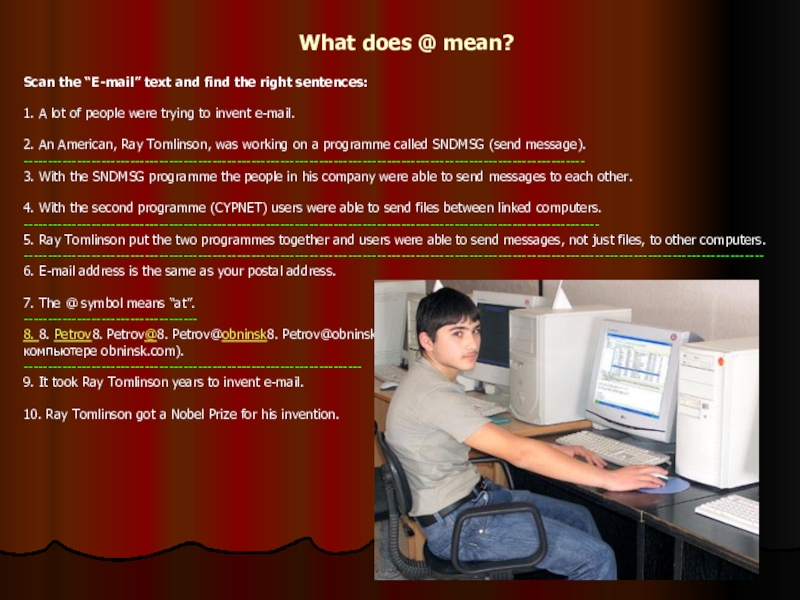
Слайд 9What does @ mean?
Scan the “E-mail” text and find the right
sentences:
1. A lot of people were trying to invent e-mail.
2. An American, Ray Tomlinson, was working on a programme called SNDMSG (send message).
--------------------------------------------------------------------------------------------------------------------
3. With the SNDMSG programme the people in his company were able to send messages to each other.
4. With the second programme (CYPNET) users were able to send files between linked computers.
-----------------------------------------------------------------------------------------------------------------------
5. Ray Tomlinson put the two programmes together and users were able to send messages, not just files, to other computers.
---------------------------------------------------------------------------------------------------------------------------------------------------------
6. E-mail address is the same as your postal address.
7. The @ symbol means “at”.
------------------------------------
8. 8. Petrov8. Petrov@8. Petrov@obninsk8. [email protected]. [email protected] means (пользователь Петров на
компьютере obninsk.com).
----------------------------------------------------------------------
9. It took Ray Tomlinson years to invent e-mail.
10. Ray Tomlinson got a Nobel Prize for his invention.
1. A lot of people were trying to invent e-mail.
2. An American, Ray Tomlinson, was working on a programme called SNDMSG (send message).
--------------------------------------------------------------------------------------------------------------------
3. With the SNDMSG programme the people in his company were able to send messages to each other.
4. With the second programme (CYPNET) users were able to send files between linked computers.
-----------------------------------------------------------------------------------------------------------------------
5. Ray Tomlinson put the two programmes together and users were able to send messages, not just files, to other computers.
---------------------------------------------------------------------------------------------------------------------------------------------------------
6. E-mail address is the same as your postal address.
7. The @ symbol means “at”.
------------------------------------
8. 8. Petrov8. Petrov@8. Petrov@obninsk8. [email protected]. [email protected] means (пользователь Петров на
компьютере obninsk.com).
----------------------------------------------------------------------
9. It took Ray Tomlinson years to invent e-mail.
10. Ray Tomlinson got a Nobel Prize for his invention.
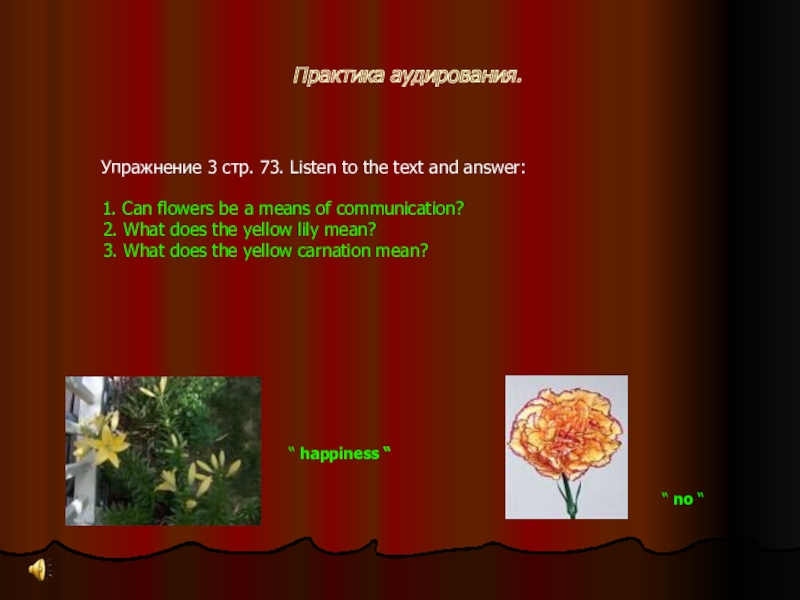
Слайд 10
Упражнение 3 стр. 73.
Listen to the text and answer:
1. Can flowers be a means of communication?
2. What does the yellow lily mean?
3. What does the yellow carnation mean?
“ happiness “
1. Can flowers be a means of communication?
2. What does the yellow lily mean?
3. What does the yellow carnation mean?
“ happiness “
Практика аудирования.
“ no “
Слайд 11Физкультминутка
Hands up! Hands down!
(поднимают и опускают руки)
Hands on hips! Sit
down!
(руки на пояс, садятся)
Hands up! To the sides!
(руки наверх, в стороны)
Bend left! Bend right!
(наклоняются влево, вправо)
One, two, three... Hop!
(прыгают)
One, two, three... Stop!
(останавливаются).
Stand still!
(успокаиваются)
(руки на пояс, садятся)
Hands up! To the sides!
(руки наверх, в стороны)
Bend left! Bend right!
(наклоняются влево, вправо)
One, two, three... Hop!
(прыгают)
One, two, three... Stop!
(останавливаются).
Stand still!
(успокаиваются)
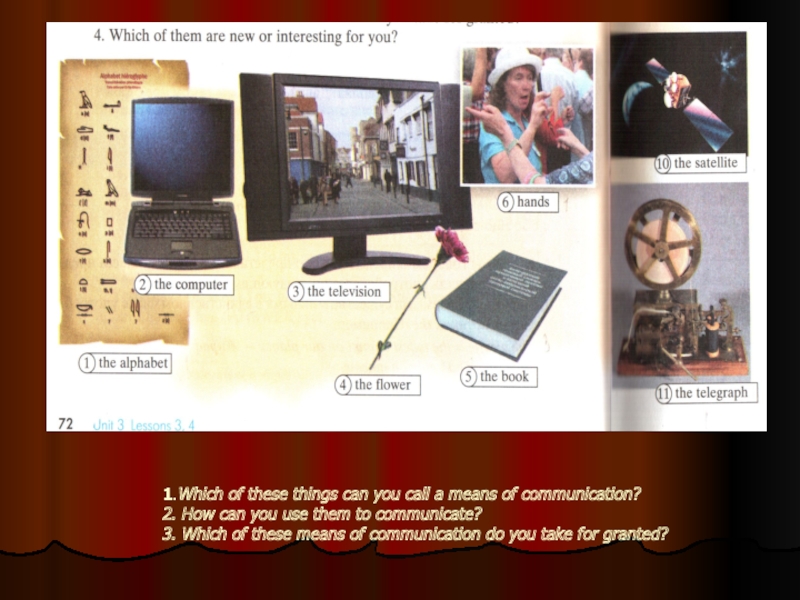
Слайд 121.Which of these things can you call a means of communication? 2.
How can you use them to communicate?
3. Which of these means of communication do you take for granted?
Слайд 13Работа с учебником.
Упр. 4 стр. 73 Listen, follow the text and
mark the answer:
1. What did people do when they didn't have the alphabet?
2. What did people do when they didn’t have post offices?
3. What did people do when they didn’t have the telephone and the telegraph?
4. A physical training minute:
Are you tired? Let’s do exercises.
Hands up! Hands down!
Hands on hips! Sit down!
Stand up! Hands to the sides!
Turn left, turn right!Hands on hips!
1. What did people do when they didn't have the alphabet?
2. What did people do when they didn’t have post offices?
3. What did people do when they didn’t have the telephone and the telegraph?
4. A physical training minute:
Are you tired? Let’s do exercises.
Hands up! Hands down!
Hands on hips! Sit down!
Stand up! Hands to the sides!
Turn left, turn right!Hands on hips!
Слайд 145. Повторение грамматического материала.
Если мы хотим рассказать о том, что умеем
делать, то употребляем модальный глагол….
Если нужно спросить о разрешении что-то выполнить, то мы используем глагол…
Модальный глагол must употребляется, когда нужно сказать о….
Форма модальных глаголов для всех лиц и чисел…
После модальных глаголов основной глагол употребляется….
В отрицательных предложениях частица not …
Чтобы задать вопрос к предложению с модальным глаголом , нужно…
Если нужно спросить о разрешении что-то выполнить, то мы используем глагол…
Модальный глагол must употребляется, когда нужно сказать о….
Форма модальных глаголов для всех лиц и чисел…
После модальных глаголов основной глагол употребляется….
В отрицательных предложениях частица not …
Чтобы задать вопрос к предложению с модальным глаголом , нужно…
Слайд 15Выполнение грамматического упражнения по теме: «Модальные глаголы». Используя лексику, постройте правильные
предложения
1. can / you / help / I ?
2. English / read / must / books / we / .
3. come / may / I / in / ?
4. you / speak / English / can / ?
5. may / I / open / the / window/ .
6. I ? learn / must / this / poem / ?
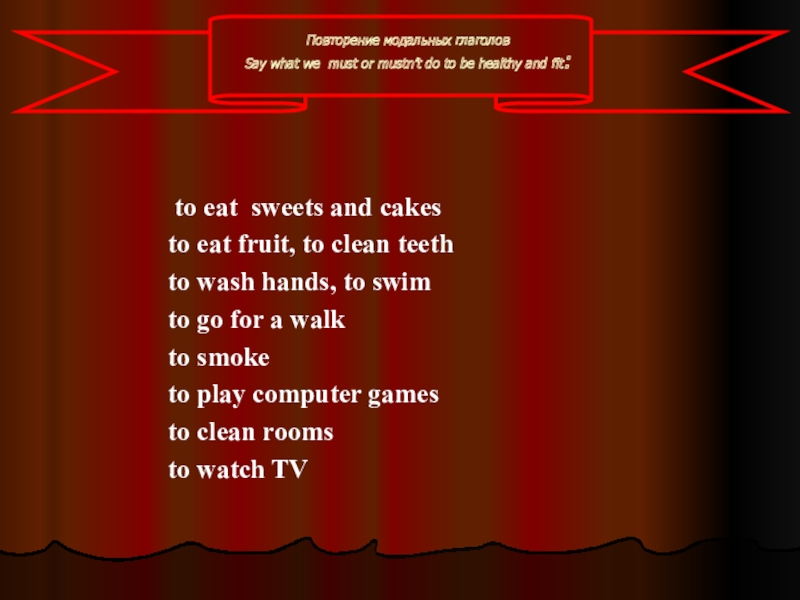
Слайд 16Повторение модальных глаголов Say what we must or mustn’t do to be
healthy and fit:
to eat sweets and cakes
to eat fruit, to clean teeth
to wash hands, to swim
to go for a walk
to smoke
to play computer games
to clean rooms
to watch TV
Слайд 17Повторение модальных глаголов.
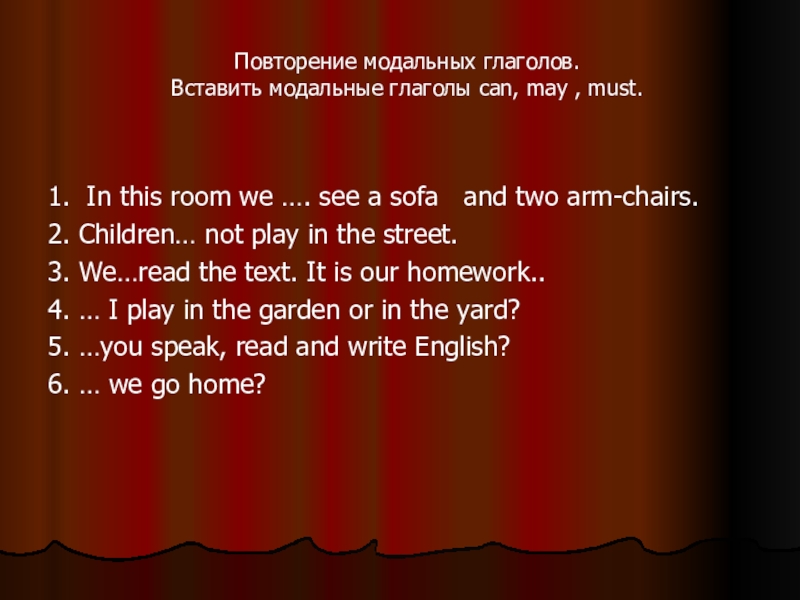
Вставить модальные глаголы can, may , must.
1. In this
room we …. see a sofa and two arm-chairs.
2. Children… not play in the street.
3. We…read the text. It is our homework..
4. … I play in the garden or in the yard?
5. …you speak, read and write English?
6. … we go home?
2. Children… not play in the street.
3. We…read the text. It is our homework..
4. … I play in the garden or in the yard?
5. …you speak, read and write English?
6. … we go home?
Слайд 187. Подведение итогов урока.
Отзывы учащихся об уроке.
How did you like
this lesson?
The lesson was very interesting.
I knew many new things.
I remembered many new phrases.
It will be useful for me.
There was something at the lesson to think about.
I’ve got answers to all the questions.
I ‘d put the (mark) to myself.
Оценки учащихся.
Домашнее задание: Quiz упр. 7 стр. 74
Теория стр. 71-72 и упр. 1 стр. 72
The lesson was very interesting.
I knew many new things.
I remembered many new phrases.
It will be useful for me.
There was something at the lesson to think about.
I’ve got answers to all the questions.
I ‘d put the (mark) to myself.
Оценки учащихся.
Домашнее задание: Quiz упр. 7 стр. 74
Теория стр. 71-72 и упр. 1 стр. 72