- Главная
- Разное
- Образование
- Спорт
- Естествознание
- Природоведение
- Религиоведение
- Французский язык
- Черчение
- Английский язык
- Астрономия
- Алгебра
- Биология
- География
- Геометрия
- Детские презентации
- Информатика
- История
- Литература
- Математика
- Музыка
- МХК
- Немецкий язык
- ОБЖ
- Обществознание
- Окружающий мир
- Педагогика
- Русский язык
- Технология
- Физика
- Философия
- Химия
- Шаблоны, фоны, картинки для презентаций
- Экология
- Экономика
Презентация, доклад по английскому языку London
Содержание
- 1. Презентация по английскому языку London
- 2. Thames river- also known
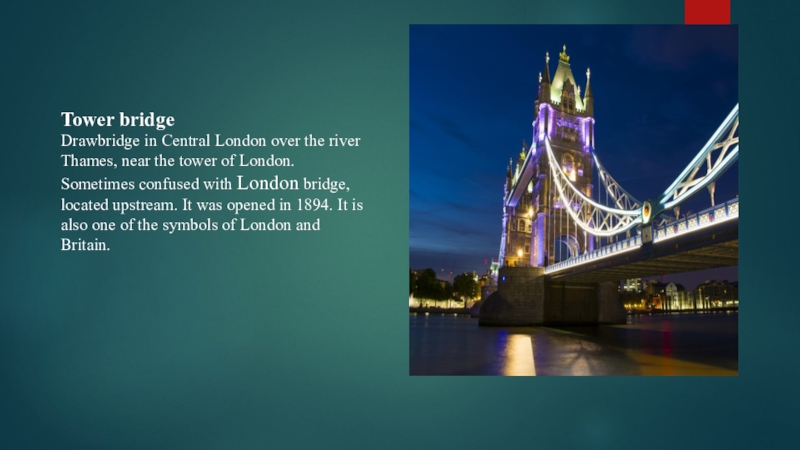
- 3. Tower bridge Drawbridge
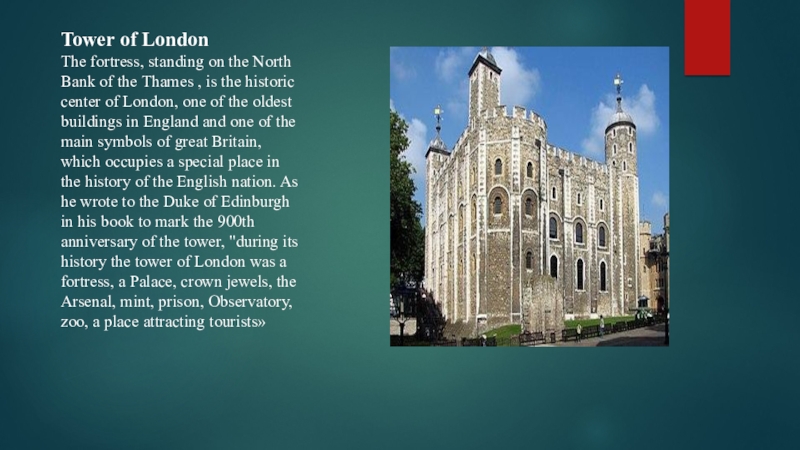
- 4. Tower of London The fortress, standing on
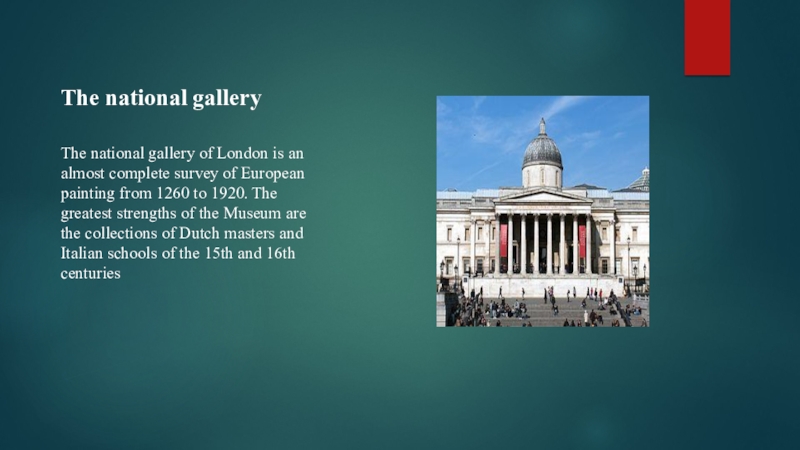
- 5. The national gallery
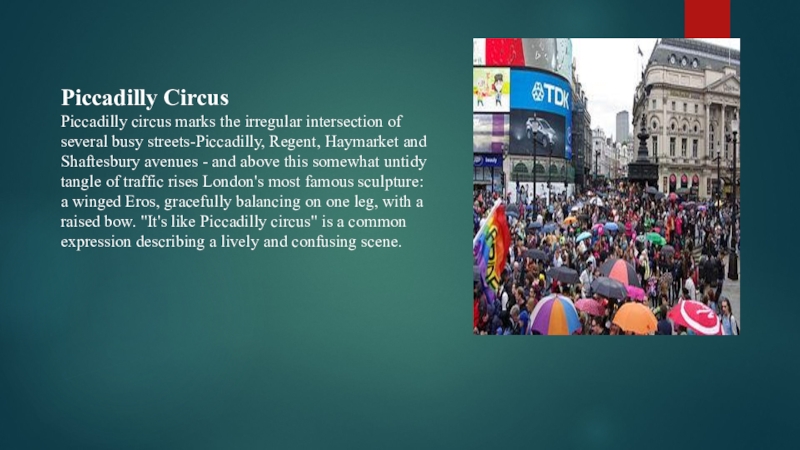
- 6. Piccadilly Circus Piccadilly circus marks
- 7. Trafalgar square Trafalgar square was built to
- 8. Westminster Abbey Аnother place with
- 9. St Paul's Cathedral The largest and most
- 10. Buckingham palace Buckingham Palace was
- 11. St. James’s Palace an important
- 12. House of parliament In the middle of
- 13. Big Ben Big Ben is
- 14. Thanks for watching
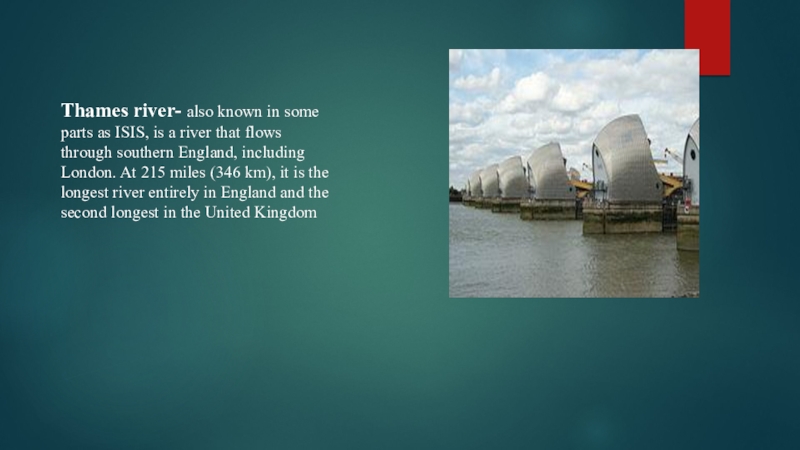
Thames river- also known in some parts as ISIS, is a river that flows through southern England, including London. At 215 miles (346 km), it is the longest river entirely in England and

Слайд 2 Thames river- also known in some parts as ISIS, is a
river that flows through southern England, including London. At 215 miles (346 km), it is the longest river entirely in England and the second longest in the United Kingdom
Слайд 3 Tower bridge Drawbridge in Central London over the river Thames,
near the tower of London. Sometimes confused with London bridge, located upstream. It was opened in 1894. It is also one of the symbols of London and Britain.
Слайд 4Tower of London The fortress, standing on the North Bank of the
Thames , is the historic center of London, one of the oldest buildings in England and one of the main symbols of great Britain, which occupies a special place in the history of the English nation. As he wrote to the Duke of Edinburgh in his book to mark the 900th anniversary of the tower, "during its history the tower of London was a fortress, a Palace, crown jewels, the Arsenal, mint, prison, Observatory, zoo, a place attracting tourists»
Слайд 5 The national gallery The national gallery of London is an almost
complete survey of European painting from 1260 to 1920. The greatest strengths of the Museum are the collections of Dutch masters and Italian schools of the 15th and 16th
centuries
Слайд 6 Piccadilly Circus Piccadilly circus marks the irregular intersection of several busy streets-Piccadilly,
Regent, Haymarket and Shaftesbury avenues - and above this somewhat untidy tangle of traffic rises London's most famous sculpture: a winged Eros, gracefully balancing on one leg, with a raised bow. "It's like Piccadilly circus" is a common expression describing a lively and confusing scene.
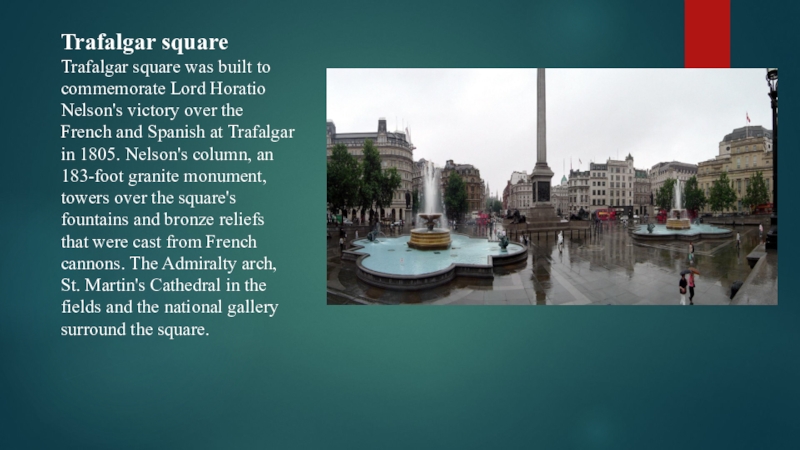
Слайд 7Trafalgar square Trafalgar square was built to commemorate Lord Horatio Nelson's victory
over the French and Spanish at Trafalgar in 1805. Nelson's column, an 183-foot granite monument, towers over the square's fountains and bronze reliefs that were cast from French cannons. The Admiralty arch, St. Martin's Cathedral in the fields and the national gallery surround the square.
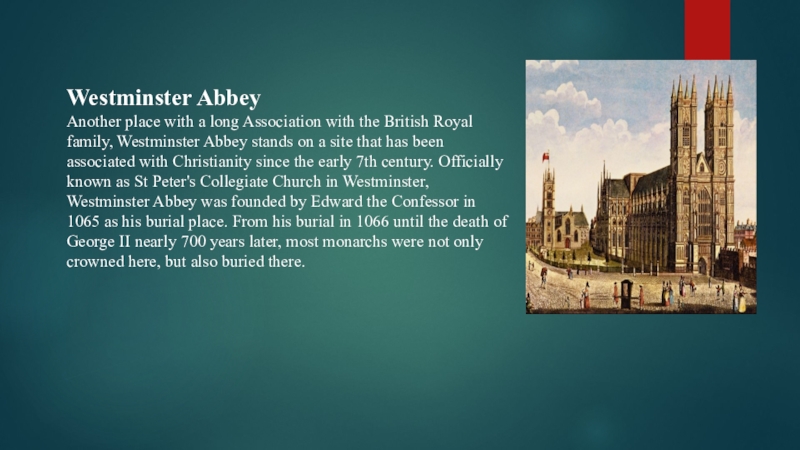
Слайд 8 Westminster Abbey Аnother place with a long Association with the British Royal
family, Westminster Abbey stands on a site that has been associated with Christianity since the early 7th century. Officially known as St Peter's Collegiate Church in Westminster, Westminster Abbey was founded by Edward the Confessor in 1065 as his burial place. From his burial in 1066 until the death of George II nearly 700 years later, most monarchs were not only crowned here, but also buried there.
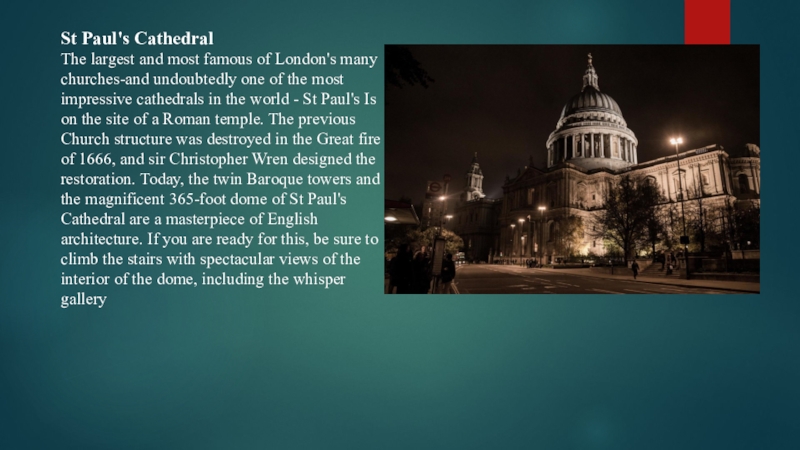
Слайд 9St Paul's Cathedral The largest and most famous of London's many churches-and
undoubtedly one of the most impressive cathedrals in the world - St Paul's Is on the site of a Roman temple. The previous Church structure was destroyed in the Great fire of 1666, and sir Christopher Wren designed the restoration. Today, the twin Baroque towers and the magnificent 365-foot dome of St Paul's Cathedral are a masterpiece of English architecture. If you are ready for this, be sure to climb the stairs with spectacular views of the interior of the dome, including the whisper gallery
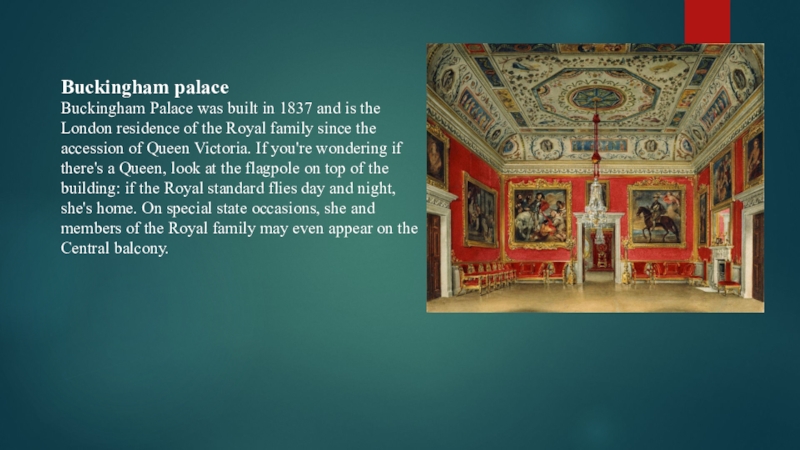
Слайд 10 Buckingham palace Buckingham Palace was built in 1837 and is the London
residence of the Royal family since the accession of Queen Victoria. If you're wondering if there's a Queen, look at the flagpole on top of the building: if the Royal standard flies day and night, she's home. On special state occasions, she and members of the Royal family may even appear on the Central balcony.
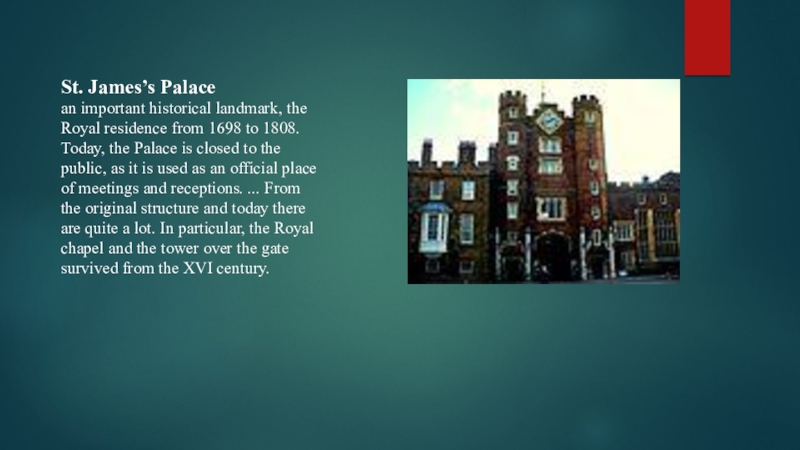
Слайд 11 St. James’s Palace an important historical landmark, the Royal residence from 1698
to 1808. Today, the Palace is closed to the public, as it is used as an official place of meetings and receptions. ... From the original structure and today there are quite a lot. In particular, the Royal chapel and the tower over the gate survived from the XVI century.
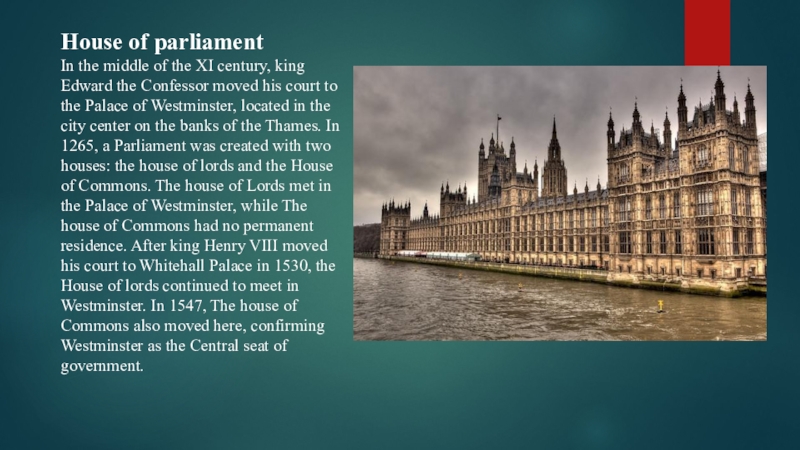
Слайд 12House of parliament In the middle of the XI century, king Edward
the Confessor moved his court to the Palace of Westminster, located in the city center on the banks of the Thames. In 1265, a Parliament was created with two houses: the house of lords and the House of Commons. The house of Lords met in the Palace of Westminster, while The house of Commons had no permanent residence. After king Henry VIII moved his court to Whitehall Palace in 1530, the House of lords continued to meet in Westminster. In 1547, The house of Commons also moved here, confirming Westminster as the Central seat of government.
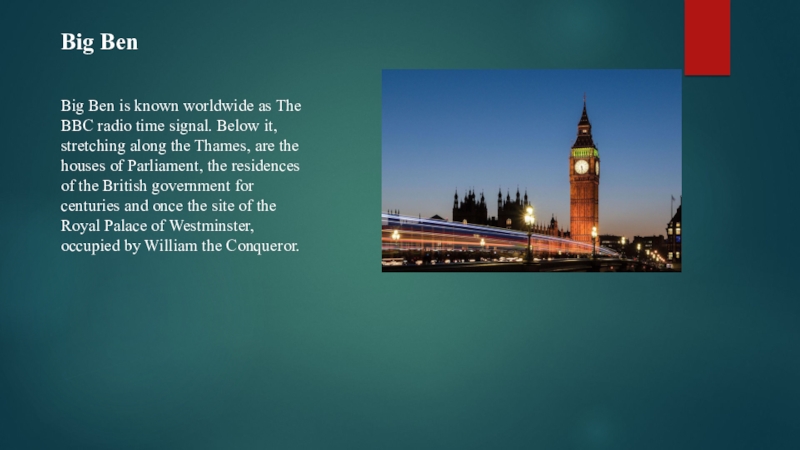
Слайд 13Big Ben Big Ben is known worldwide as The BBC radio time
signal. Below it, stretching along the Thames, are the houses of Parliament, the residences of the British government for centuries and once the site of the Royal Palace of Westminster, occupied by William the Conqueror.