- Главная
- Разное
- Образование
- Спорт
- Естествознание
- Природоведение
- Религиоведение
- Французский язык
- Черчение
- Английский язык
- Астрономия
- Алгебра
- Биология
- География
- Геометрия
- Детские презентации
- Информатика
- История
- Литература
- Математика
- Музыка
- МХК
- Немецкий язык
- ОБЖ
- Обществознание
- Окружающий мир
- Педагогика
- Русский язык
- Технология
- Физика
- Философия
- Химия
- Шаблоны, фоны, картинки для презентаций
- Экология
- Экономика
Презентация, доклад по английскому языку Discussion and values clarification techniques
Содержание
- 1. Презентация по английскому языку Discussion and values clarification techniques
- 2. Discussion gamesatmospherecooperationadvertisementsControversial opinionsImaginationFlexibilityvaluesPrioritiesStudents’ interestReasons for viewsPossible roles in discussion:initiatorsummarizergrumblerramblerSilent memberclownmediatorhesitator
- 3. WAYS OF ORGANIZING DISCUSSION GROUPSBuzz groupsA problem
- 4. Discussions and decisionsPMI – P(plus), M (minus),
- 5. One student from team 1 (optimist) begins
- 6. Aims: Skills – speakingLanguage – giving
- 7. Each team or group receives a copy
- 8. The students work together in groups.
- 9. V I E W P O I
- 10. Mary Taylor, 35, housewife (physics and maths
- 11. AIMS: Skills – writing, speaking Language
- 12. DISCUSSION WHEEL Fashion is fineOnly childrenshould playEverything
- 13. ConsequencesThe teacher divides the class into groups.
- 14. What is being advertisedA number of different
- 15. Secret topicTwo students agree on a topic
- 16. Discussion games Mad discussion
- 17. Uses and abusesThe teacher and the
- 18. Five students are asked to
- 19. Magic shop A teacher should prepare
- 20. Слайд 20
- 21. Слайд 21
- 22. VALUESCLARIFICATIONTECHNIQUES
- 23. MIRACLEWORKERSStep 1: Each student receives a handout
- 24. MIRACLEWORKERSA group of 15 experts are offering
- 25. PERSONALITIESLIFESTYLESkills – speaking, writingLanguage – descriptive sentences,
- 26. SPENDING MONEYEach student writes down what he
- 27. VALUES CONTINUUMSTEP 1: Each student fills in
- 28. TWENTY THINGS I’D LIKE TO DOSTEP 1:
- 29. Unfinished sentences (circles)The class is divided
- 30. Слайд 30

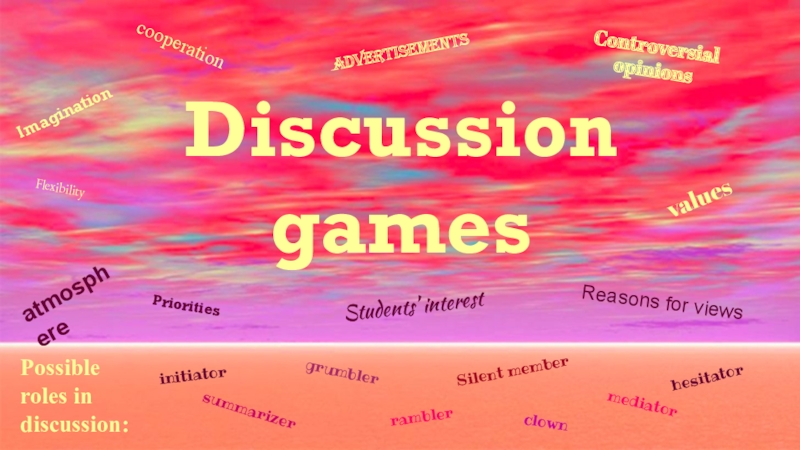
Слайд 2Discussion games
atmosphere
cooperation
advertisements
Controversial opinions
Imagination
Flexibility
values
Priorities
Students’ interest
Reasons for views
Possible roles in discussion:
initiator
summarizer
grumbler
rambler
Silent member
clown
mediator
hesitator
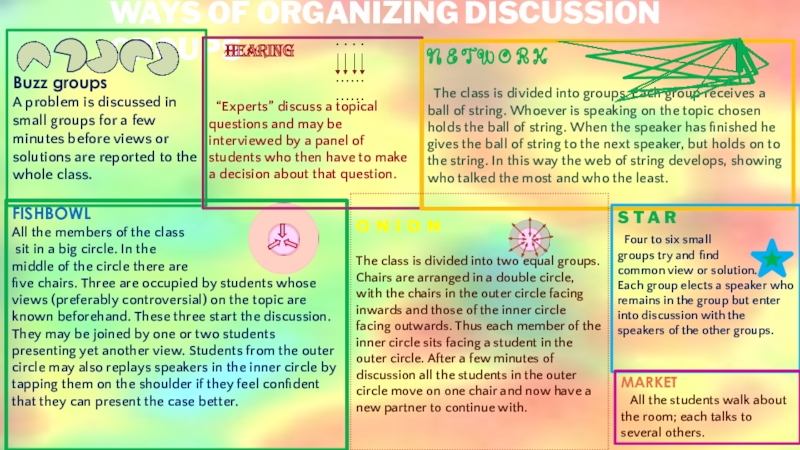
Слайд 3WAYS OF ORGANIZING DISCUSSION GROUPS
Buzz groups
A problem is discussed in small
FISHBOWL
All the members of the class
sit in a big circle. In the
middle of the circle there are
five chairs. Three are occupied by students whose views (preferably controversial) on the topic are known beforehand. These three start the discussion. They may be joined by one or two students presenting yet another view. Students from the outer circle may also replays speakers in the inner circle by tapping them on the shoulder if they feel confident that they can present the case better.
HEARING
“Experts” discuss a topical
questions and may be interviewed by a panel of students who then have to make a decision about that question.
. . . .
…………
N E T W O R K
The class is divided into groups. Each group receives a ball of string. Whoever is speaking on the topic chosen holds the ball of string. When the speaker has finished he gives the ball of string to the next speaker, but holds on to the string. In this way the web of string develops, showing who talked the most and who the least.
O N I O N
The class is divided into two equal groups. Chairs are arranged in a double circle, with the chairs in the outer circle facing inwards and those of the inner circle facing outwards. Thus each member of the inner circle sits facing a student in the outer circle. After a few minutes of discussion all the students in the outer circle move on one chair and now have a new partner to continue with.
S T A R
Four to six small
groups try and find
common view or solution.
Each group elects a speaker who remains in the group but enter into discussion with the speakers of the other groups.
MARKET
All the students walk about the room; each talks to several others.
Слайд 4Discussions and decisions
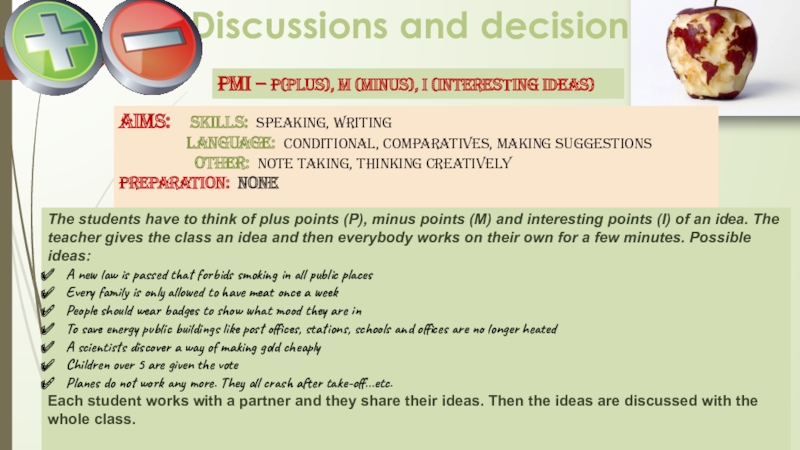
PMI – P(plus), M (minus), I (interesting ideas)
Aims:
language: conditional, comparatives, making suggestions
other: note taking, thinking creatively
Preparation: none
The students have to think of plus points (P), minus points (M) and interesting points (I) of an idea. The teacher gives the class an idea and then everybody works on their own for a few minutes. Possible ideas:
A new law is passed that forbids smoking in all public places
Every family is only allowed to have meat once a week
People should wear badges to show what mood they are in
To save energy public buildings like post offices, stations, schools and offices are no longer heated
A scientists discover a way of making gold cheaply
Children over 5 are given the vote
Planes do not work any more. They all crash after take-off…etc.
Each student works with a partner and they share their ideas. Then the ideas are discussed with the whole class.
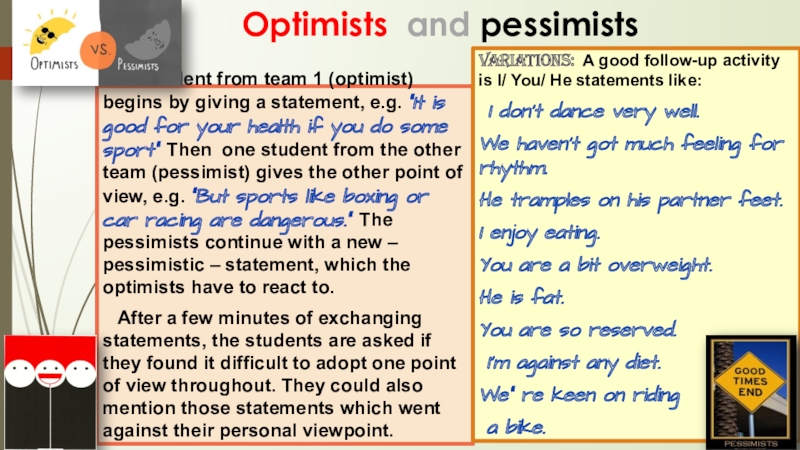
Слайд 5One student from team 1 (optimist) begins by giving a statement,
After a few minutes of exchanging statements, the students are asked if they found it difficult to adopt one point of view throughout. They could also mention those statements which went against their personal viewpoint.
Variations: A good follow-up activity is I/ You/ He statements like:
I don’t dance very well.
We haven’t got much feeling for rhythm.
He tramples on his partner feet.
I enjoy eating.
You are a bit overweight.
He is fat.
You are so reserved.
I’m against any diet.
We” re keen on riding
a bike.
Optimists and pessimists
Слайд 6Aims: Skills – speaking
Language – giving reasons, agreeing and disagreeing,
Time: 20 – 30 minutes
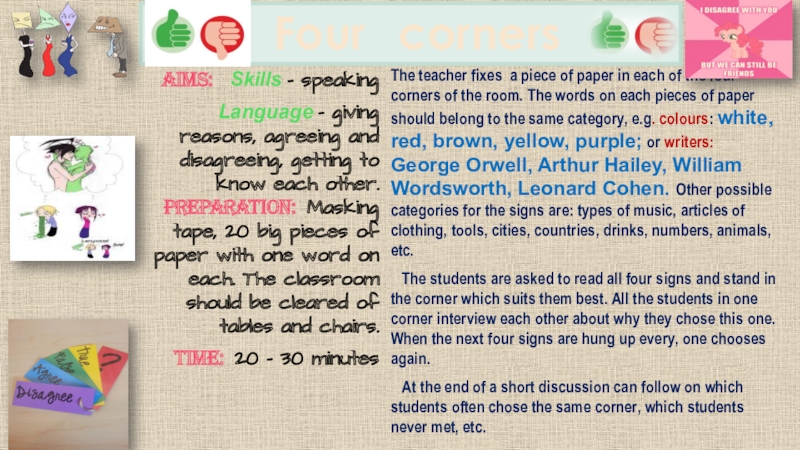
The teacher fixes a piece of paper in each of the four corners of the room. The words on each pieces of paper should belong to the same category, e.g. colours: white, red, brown, yellow, purple; or writers: George Orwell, Arthur Hailey, William Wordsworth, Leonard Cohen. Other possible categories for the signs are: types of music, articles of clothing, tools, cities, countries, drinks, numbers, animals, etc.
The students are asked to read all four signs and stand in the corner which suits them best. All the students in one corner interview each other about why they chose this one. When the next four signs are hung up every, one chooses again.
At the end of a short discussion can follow on which students often chose the same corner, which students never met, etc.
Four corners
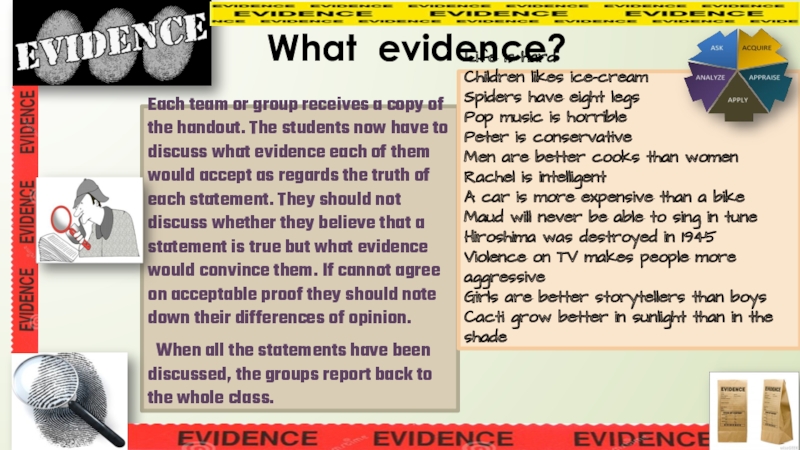
Слайд 7Each team or group receives a copy of the handout. The
When all the statements have been discussed, the groups report back to the whole class.
Life is hard Children likes ice-cream Spiders have eight legs Pop music is horrible Peter is conservative Men are better cooks than women Rachel is intelligent A car is more expensive than a bike Maud will never be able to sing in tune Hiroshima was destroyed in 1945 Violence on TV makes people more aggressive Girls are better storytellers than boys Cacti grow better in sunlight than in the shade
What evidence?
Слайд 8 The students work together in groups. Each member of the
You are walking in a wood; describe what it is like. Then you come to some water; describe what it is like. What do you feel about this water and what do you do about it? Next you find a key. Describe it and say what you would do with it. At the end of the wood there is a barrier. What is it like? What is on the other side? What do you do about it?
What does it mean
Tell us a story
Remarks: This activity should not be taken too seriously. It is not meant to provide a psychoanalyst’s couch for the foreign language classroom.
When everyone has told his story the teacher reveals how each episode of the story might be interpreted. The wood gives the indication of the storyteller’s view of life. Is it described as dark and frightening or sunlit and happy? Full of menace, or full of hopeful possibilities? It depends on attitudes to living.
The water is sex. Is it dark and dirty or lovely and sparkling? Deep or shallow? Frightening, but pleasantly so? Do you dive right in or keep well out?
The key is worldly success and ambition to attain it. Do you see a big golden key or dreary little Yale key? Is it rusty or shining? Do you reject or hold on to it? Do you use it immediately in some way, or later on, perhaps finding a box full of treasure to go with it, or do you just hopefully tuck it in your pocket? Do you give it away to someone you think may want it?
The barrier is death, the view beyond a picture of the life hereafter. (When I first played this game, I saw a range of formidable mountains, and nothing beyond. I disliked it intensely, and turned round and went back the way I’d come. There’s hope!)
Слайд 9V I E W P O I N T S
The teacher
Mary Taylor, a 35 year-old housewife, would like to go back to her job, teaching physics and mathematics, after an eight year break. Imagine what her husband, her eight year-old daughter, her mother-in-law, her parents and the headmaster might feel about the situation.
The teacher writes the names, ages and jobs of the people mentioned in the situation on the board and assigns one of these people to each group. The students discuss amongst themselves what they think this particular person might feel.
The teacher gives each group that part of the handout which concerns “their” person. The groups compare their own ideas with those on the handout. Then they try to add more thoughts and arguments.
One person from each group comes forward. This students sit in a circle in the middle of the class and hold a conversation in which they put their arguments and feelings. The “fishbowl” procedure is followed.
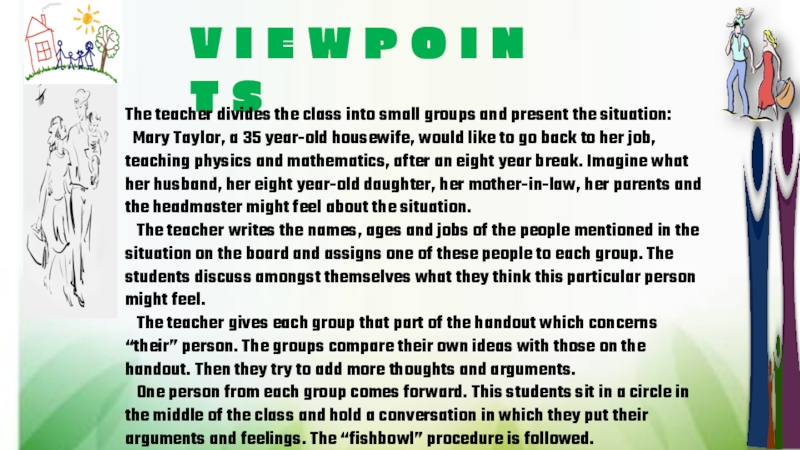
Слайд 10Mary Taylor, 35, housewife (physics and maths teacher would like to
Moira Taylor, 8, at school, is afraid her mother will have less time for her when working; would like a brother or sister.
Frank and Elizabeth Martin, 70 and 58, Mary’s parents, retired postman and housewife, both very much against Mary going back to work, feel both Moira and Mark would suffer, think Mary has everything she needs, live in the next street, come and see their daughter very often.
Mark Taylor, 40, architect, is understanding, does not mind Mary working, has a demanding job, no time or desire to help in the house, feels that Mary have forgotten a lot about the subject.
Margaret Taylor, 68, widow, Mark’s mother, runs a bookshop, has been working all her life, supports Mary, lives far away.
Gordon Parson, 45, headmaster of the school, thinks women cannot be good mathematicians, but thinks women are good at classroom management, desperately needs a physics and maths teacher for his school, feels that Mary is a bit shy and may not know about the latest developments in her subjects.
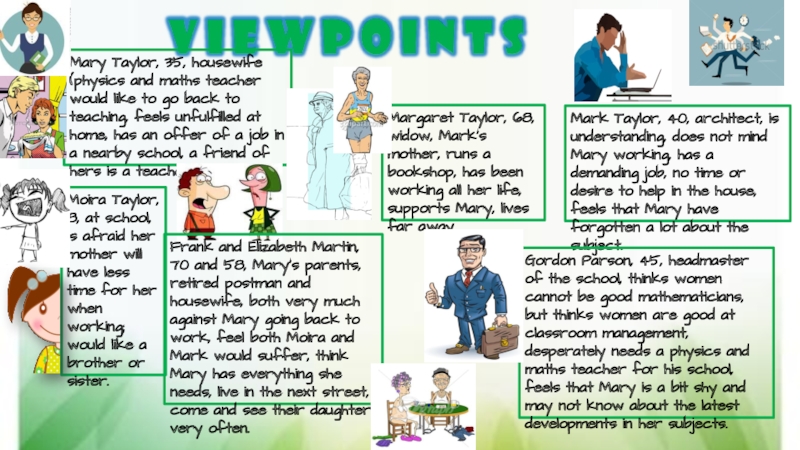
Слайд 11AIMS: Skills – writing, speaking Language – future tense, making
When students have finished, they form groups to share and discuss their hopes and fears for the future. Each group can focus on one time period and report the good and bad feelings of their group.
It is important to see the connection between the various squares.
Futures
Each student receives two copies of the chart. He is asked to fill in one with Good Things, the other with Bad Things by writing examples in each square.
What happens in the world now may well affect our children in twenty years’ time.
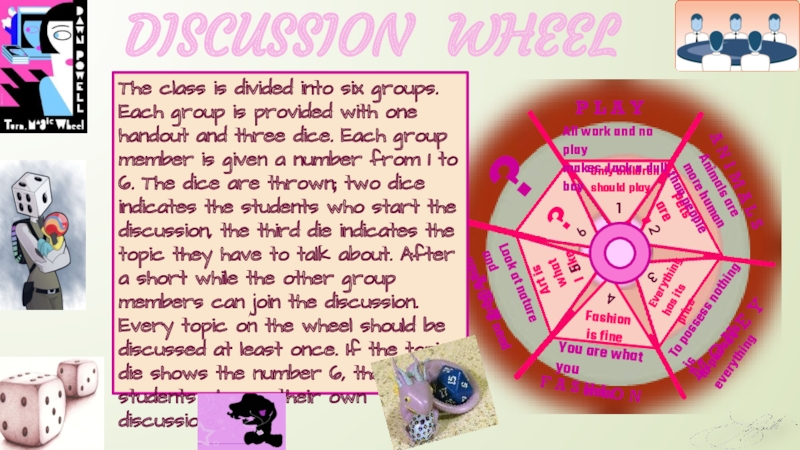
Слайд 12DISCUSSION WHEEL
Fashion is fine
Only children
should play
Everything
has its price
Art is
I like
Pets are
a pest
?
All work and no play
makes Jack a dull boy
P L A Y
Animals are more human than people
A N I M A L S
To possess nothing is
to possess everything
M O N E Y
You are what you
wear
F A S H I O N
Look at nature and
you will not need art
A R T
?
The class is divided into six groups. Each group is provided with one handout and three dice. Each group member is given a number from 1 to 6. The dice are thrown; two dice indicates the students who start the discussion, the third die indicates the topic they have to talk about. After a short while the other group members can join the discussion. Every topic on the wheel should be discussed at least once. If the topic die shows the number 6, the two students choose their own discussion topic.
1
2
3
4
5
6
Слайд 13Consequences
The teacher divides the class into groups. She gives each group
A25-hour working week is introduced.
A lorry driver empties a tankful of poisonous waste into the river near a town.
Animal merchants catch the last animals of a dying species and sell them to zoo in Europe and
North America.
Men can get maternity leave (paternity leave) like women.
Scientists discover that cancer is caused by pollution.
Robots that can do housework are built.
Each now has to think of the possible long-term and short-term consequences this action may have. The group secretary writes down all the consequences.
When the group cannot think of any more consequences they exchange cards with another group. With each new card a different group member becomes secretary.
The consequences of each action are shared and discussed with the whole class. It should be stressed that there is rarely a chain of events triggered by one action alone. This technique is slightly misleading as it does not take complex situations and reasons for actions into account. Nevertheless it may help students realize that simple actions have far- reaching consequences.
You are free to choose but you are not free from the consequences of your choice.
Слайд 14What is being advertised
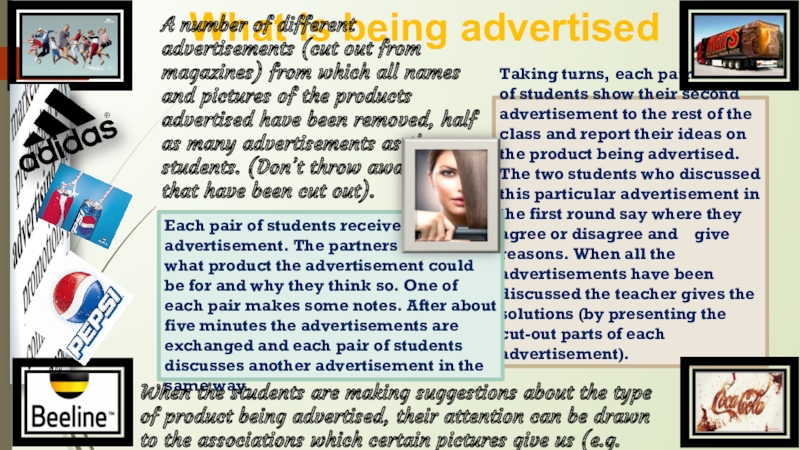
A number of different advertisements (cut out from
Taking turns, each pair of students show their second advertisement to the rest of the class and report their ideas on the product being advertised. The two students who discussed this particular advertisement in the first round say where they agree or disagree and give reasons. When all the advertisements have been discussed the teacher gives the solutions (by presenting the cut-out parts of each advertisement).
Each pair of students receives one advertisement. The partners discuss what product the advertisement could be for and why they think so. One of each pair makes some notes. After about five minutes the advertisements are exchanged and each pair of students discusses another advertisement in the same way.
When the students are making suggestions about the type of product being advertised, their attention can be drawn to the associations which certain pictures give us (e.g. waterfall – clean air; health – cigarettes).
Слайд 15Secret topic
Two students agree on a topic they want to talk
Variations:
Students who think they know the secret topic have to write it on a piece of paper and show it to the two students before they are accepted.
The game can be played in teams and points awarded according to the number of people who find out the secret topic.
Level: advanced
Language: talking without coming to the point, fun, imagination.
Time: 10 – 20 minutes
Слайд 16Discussion games
Mad discussion
The students are given
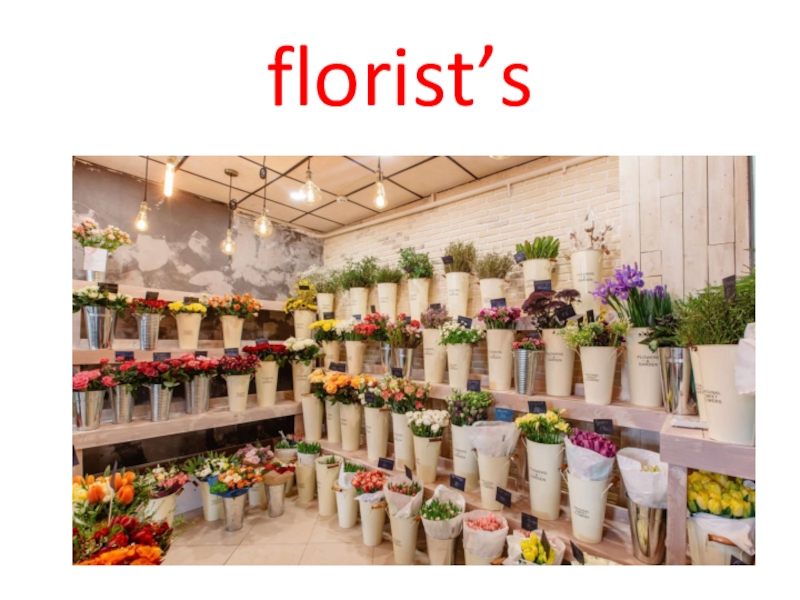
Possible topics: flowers, New York, operas, ships, plastic spoons, birthday cards, passport, watches, modern art, detective novels, schools, bakers, socks, zips, paper, the wheel, etc.
A jury decides who has put the best arguments and awards points for each team. Then the next two students continue with new topics.
In this game it is important not only to put forward good arguments for one’s own case but to try and contradict the opponent’s point of view.
Word wizard
The teacher asks the class to imagine the following situation: “A wizard has taken away all the words from the world. Everybody can keep just four words. Choose four words which you would like to keep and write them down.
Each student finds a partner and tries to communicate using only his four words. The pair share their words with each other so that now both have eight words they can use. Each student shares his eight words with another student, so that both have 16, then twice more. In the end everybody has 64 words.
Each alone or with a partner the students write a story or poem using only their words. The stories are read out or stuck up on the wall.
Слайд 17Uses and abuses
The teacher and the class prepare two lists
Example: A B
Teacher Book
Mother Walking stick
Shop-assistant Plaster
Baby 50 coins
Elephant Pen
Crocodile Loaf of bread
Soldier Car
Dustman Cactus
Old woman Glass of beer
Nurse Safety pin
The two teams sit facing each other. The secretary from team 1 starts by inserting one word from list A and one word from list B into one of the two sentence patterns: “What can a/an A do with a/an B?” “Why a/an A need a/an B?” The students in team 2 must find three answers quickly. Then the secretary makes up a new question for team1
The game is finished when all the words have been used up.
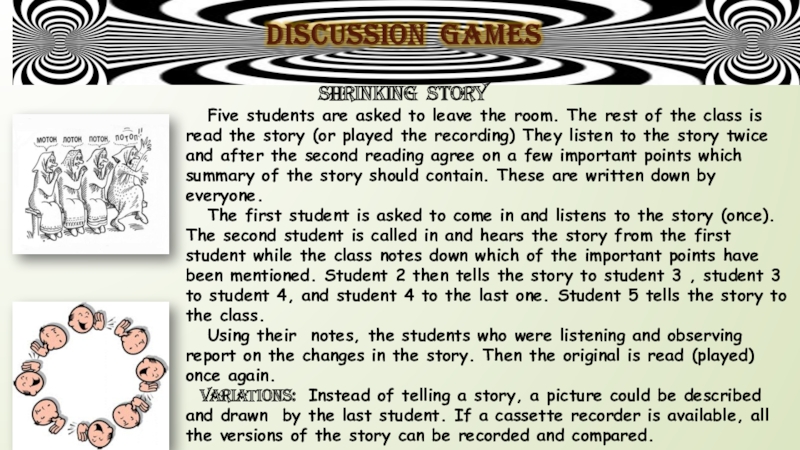
Слайд 18 Five students are asked to leave the room. The
The first student is asked to come in and listens to the story (once). The second student is called in and hears the story from the first student while the class notes down which of the important points have been mentioned. Student 2 then tells the story to student 3 , student 3 to student 4, and student 4 to the last one. Student 5 tells the story to the class.
Using their notes, the students who were listening and observing report on the changes in the story. Then the original is read (played) once again.
Variations: Instead of telling a story, a picture could be described and drawn by the last student. If a cassette recorder is available, all the versions of the story can be recorded and compared.
Shrinking story
Слайд 19Magic shop
A teacher should prepare slips of paper with
Each student receives three slips of paper, each with a positive human quality on it, e.g. honesty, intelligence, fairness, humour, health, beauty, stubbornness, curiosity, cheerfulness, gentleness, humility, optimism, perseverance, politeness, hospitality, helpfulness, thoughtfulness, wisdom, justice, friendliness, adaptability, charity.
Each student decides which of his three qualities he would like to keep and which to exchange for others. Students then barter with different people.
After 10 minutes of bartering, students report on which qualities they received, which ones they kept and whether they are happy with their present one(s) (they may have more or fewer than three).
Слайд 20 Guided interviews
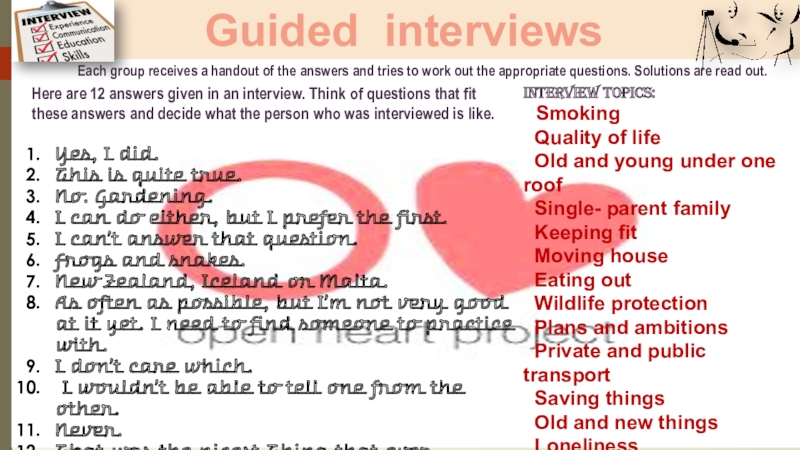
Each group
Here are 12 answers given in an interview. Think of questions that fit these answers and decide what the person who was interviewed is like.
Yes, I did.
This is quite true.
No. Gardening.
I can do either, but I prefer the first.
I can’t answer that question.
Frogs and snakes.
New Zealand, Iceland or Malta.
As often as possible, but I’m not very good at it yet. I need to find someone to practice with.
I don’t care which.
I wouldn’t be able to tell one from the other.
Never.
That was the nicest Thing that ever happened to me.
Interview topics:
Smoking
Quality of life
Old and young under one roof
Single- parent family
Keeping fit
Moving house
Eating out
Wildlife protection
Plans and ambitions
Private and public transport
Saving things
Old and new things
Loneliness
Слайд 21 Holidays
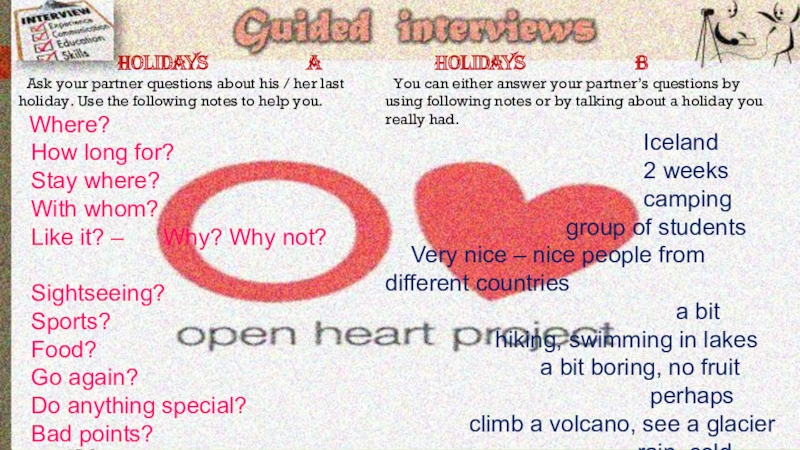
Ask your partner questions about his / her last holiday. Use the following notes to help you.
Where?
How long for?
Stay where?
With whom?
Like it? – Why? Why not?
Sightseeing?
Sports?
Food?
Go again?
Do anything special?
Bad points?
Holidays B
You can either answer your partner’s questions by using following notes or by talking about a holiday you really had.
Iceland
2 weeks
camping
group of students
Very nice – nice people from different countries
a bit
hiking, swimming in lakes
a bit boring, no fruit
perhaps
climb a volcano, see a glacier
rain, cold

Слайд 23MIRACLE
WORKERS
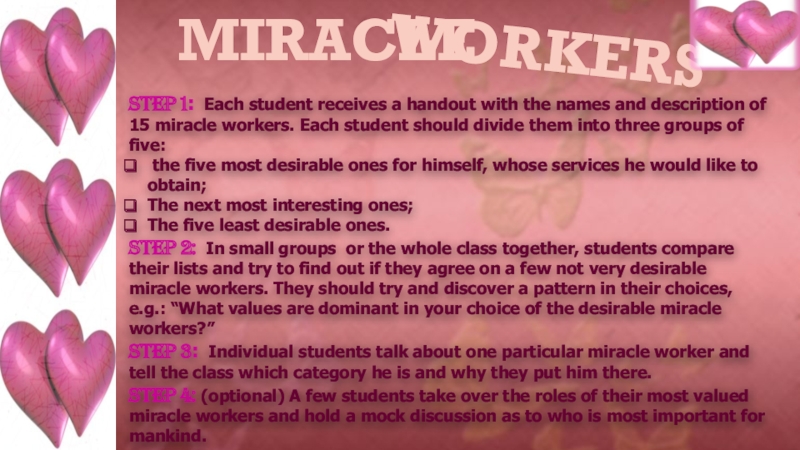
Step 1: Each student receives a handout with the names and
the five most desirable ones for himself, whose services he would like to obtain;
The next most interesting ones;
The five least desirable ones.
Step 2: In small groups or the whole class together, students compare their lists and try to find out if they agree on a few not very desirable miracle workers. They should try and discover a pattern in their choices, e.g.: “What values are dominant in your choice of the desirable miracle workers?”
Step 3: Individual students talk about one particular miracle worker and tell the class which category he is and why they put him there.
Step 4: (optional) A few students take over the roles of their most valued miracle workers and hold a mock discussion as to who is most important for mankind.
Слайд 24MIRACLE
WORKERS
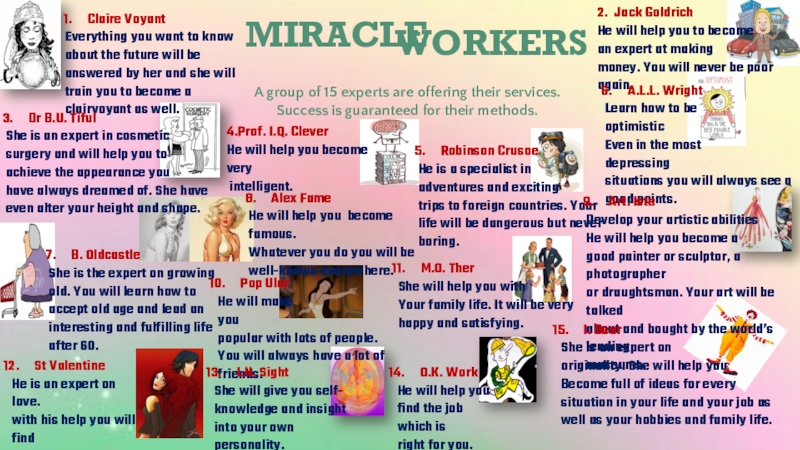
A group of 15 experts are offering their services.
Success is guaranteed
Claire Voyant
Everything you want to know about the future will be answered by her and she will train you to become a clairvoyant as well.
2. Jack Goldrich
He will help you to become
an expert at making
money. You will never be poor again.
Dr B.U. Tiful
She is an expert in cosmetic
surgery and will help you to
achieve the appearance you
have always dreamed of. She have even alter your height and shape.
4.Prof. I.Q. Clever
He will help you become very
intelligent.
Robinson Crusoe
He is a specialist in
adventures and exciting
trips to foreign countries. Your
life will be dangerous but never
boring.
A.L.L. Wright
Learn how to be optimistic
Even in the most depressing
situations you will always see a good points.
B. Oldcastle
She is the expert on growing old. You will learn how to accept old age and lead an interesting and fulfilling life after 60.
Alex Fame
He will help you become famous.
Whatever you do you will be
well-known everywhere.
Art. Iste
Develop your artistic abilities
He will help you become a
good painter or sculptor, a photographer
or draughtsman. Your art will be talked
about and bought by the world’s leading
museums.
Pop Ular
He will make you
popular with lots of people. You will always have a lot of friends.
M.O. Ther
She will help you with
Your family life. It will be very happy and satisfying.
St Valentine
He is an expert on love.
with his help you will find
the right partner.
I.N. Sight
She will give you self-
knowledge and insight
into your own personality.
O.K. Work
He will help you
find the job which is
right for you.
I. Dear
She is an expert on
originality. She will help you
Become full of ideas for every situation in your life and your job as well as your hobbies and family life.
Слайд 25PERSONALITIES
LIFESTYLE
Skills – speaking, writing
Language – descriptive sentences, past tense (reported speech)
Other
Aims:
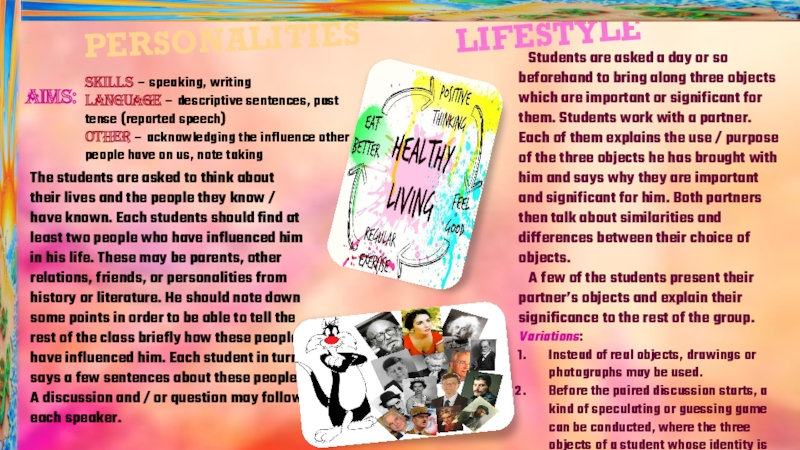
The students are asked to think about their lives and the people they know / have known. Each students should find at least two people who have influenced him in his life. These may be parents, other relations, friends, or personalities from history or literature. He should note down some points in order to be able to tell the rest of the class briefly how these people have influenced him. Each student in turn says a few sentences about these people. A discussion and / or question may follow each speaker.
Students are asked a day or so beforehand to bring along three objects which are important or significant for them. Students work with a partner. Each of them explains the use / purpose of the three objects he has brought with him and says why they are important and significant for him. Both partners then talk about similarities and differences between their choice of objects.
A few of the students present their partner’s objects and explain their significance to the rest of the group.
Variations:
Instead of real objects, drawings or photographs may be used.
Before the paired discussion starts, a kind of speculating or guessing game can be conducted, where the three objects of a student whose identity is not revealed are shown, and suggestions about their significance are made.
Слайд 26SPENDING MONEY
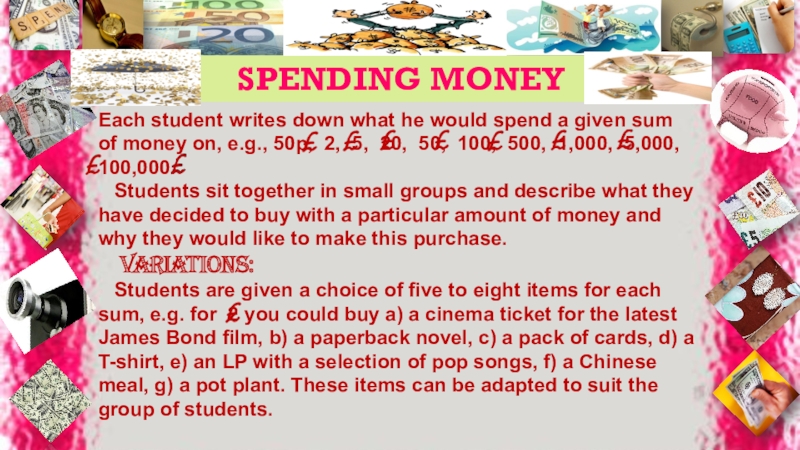
Each student writes down what he would spend a given
Students sit together in small groups and describe what they have decided to buy with a particular amount of money and why they would like to make this purchase.
VARIATIONS:
Students are given a choice of five to eight items for each sum, e.g. for 2 you could buy a) a cinema ticket for the latest James Bond film, b) a paperback novel, c) a pack of cards, d) a T-shirt, e) an LP with a selection of pop songs, f) a Chinese meal, g) a pot plant. These items can be adapted to suit the group of students.
Слайд 27VALUES CONTINUUM
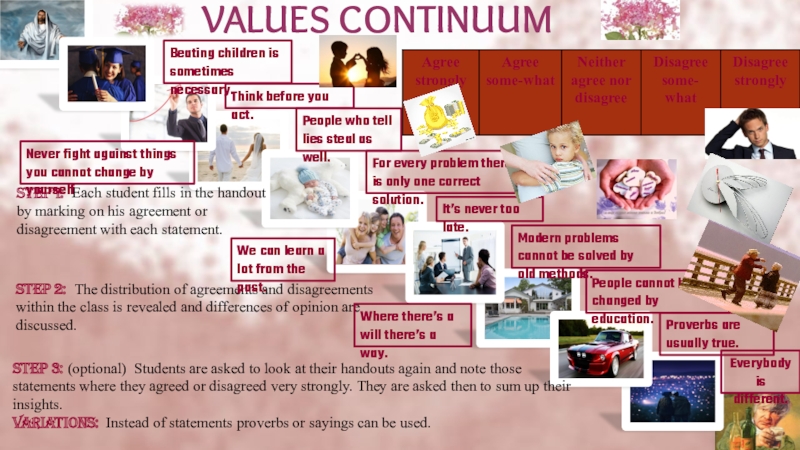
STEP 1: Each student fills in the handout by marking
STEP 2: The distribution of agreements and disagreements within the class is revealed and differences of opinion are discussed.
STEP 3: (optional) Students are asked to look at their handouts again and note those statements where they agreed or disagreed very strongly. They are asked then to sum up their insights.
VARIATIONS: Instead of statements proverbs or sayings can be used.
Beating children is sometimes necessary.
Think before you act.
People who tell lies steal as well.
For every problem there is only one correct solution.
It’s never too late.
Modern problems cannot be solved by old methods.
People cannot be changed by education.
Proverbs are usually true.
Where there’s a will there’s a way.
We can learn a lot from the past.
Never fight against things you cannot change by yourself
Everybody is different.
Слайд 28TWENTY THINGS I’D LIKE TO DO
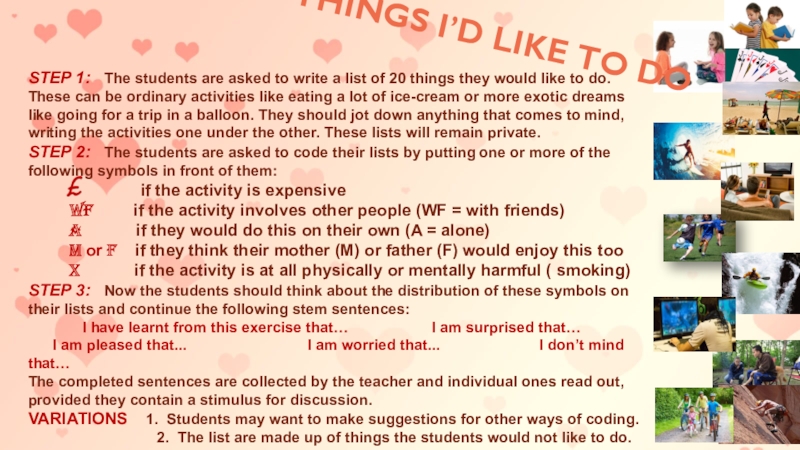
STEP 1: The students are
STEP 2: The students are asked to code their lists by putting one or more of the following symbols in front of them:
if the activity is expensive
WF if the activity involves other people (WF = with friends)
A if they would do this on their own (A = alone)
M or F if they think their mother (M) or father (F) would enjoy this too
X if the activity is at all physically or mentally harmful ( smoking)
STEP 3: Now the students should think about the distribution of these symbols on their lists and continue the following stem sentences:
I have learnt from this exercise that… I am surprised that…
I am pleased that... I am worried that... I don’t mind that…
The completed sentences are collected by the teacher and individual ones read out, provided they contain a stimulus for discussion.
VARIATIONS 1. Students may want to make suggestions for other ways of coding.
2. The list are made up of things the students would not like to do.
Слайд 29 Unfinished sentences (circles)
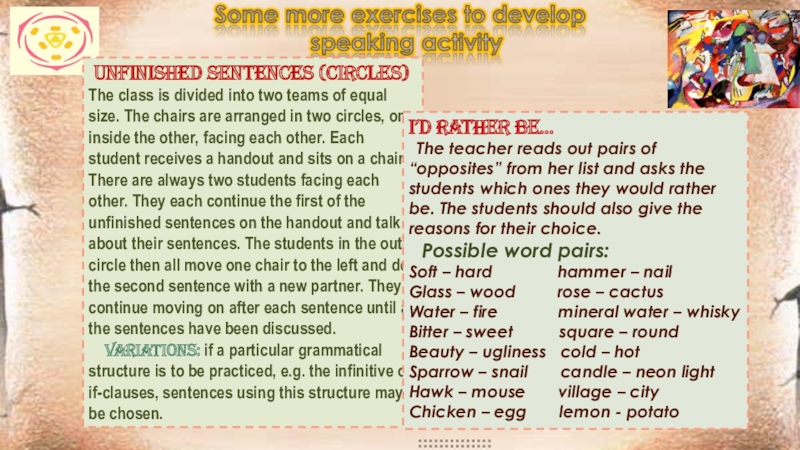
The class is divided into two teams of
Variations: if a particular grammatical structure is to be practiced, e.g. the infinitive or if-clauses, sentences using this structure may be chosen.
I’d rather be…
The teacher reads out pairs of “opposites” from her list and asks the students which ones they would rather be. The students should also give the reasons for their choice.
Possible word pairs:
Soft – hard hammer – nail
Glass – wood rose – cactus
Water – fire mineral water – whisky
Bitter – sweet square – round
Beauty – ugliness cold – hot
Sparrow – snail candle – neon light
Hawk – mouse village – city
Chicken – egg lemon - potato