- Главная
- Разное
- Образование
- Спорт
- Естествознание
- Природоведение
- Религиоведение
- Французский язык
- Черчение
- Английский язык
- Астрономия
- Алгебра
- Биология
- География
- Геометрия
- Детские презентации
- Информатика
- История
- Литература
- Математика
- Музыка
- МХК
- Немецкий язык
- ОБЖ
- Обществознание
- Окружающий мир
- Педагогика
- Русский язык
- Технология
- Физика
- Философия
- Химия
- Шаблоны, фоны, картинки для презентаций
- Экология
- Экономика
Презентация, доклад по английскому языку Ancient wonders of the world
Содержание
- 1. Презентация по английскому языку Ancient wonders of the world
- 2. Слайд 2
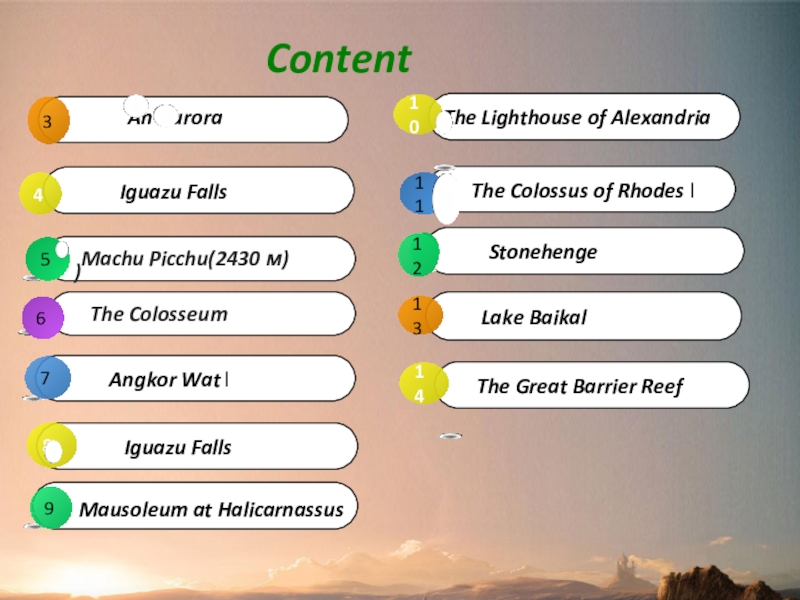
- 3. An Aurora is
- 4. Iguazu Falls are waterfalls of the Iguazu River on the border of the Argentine
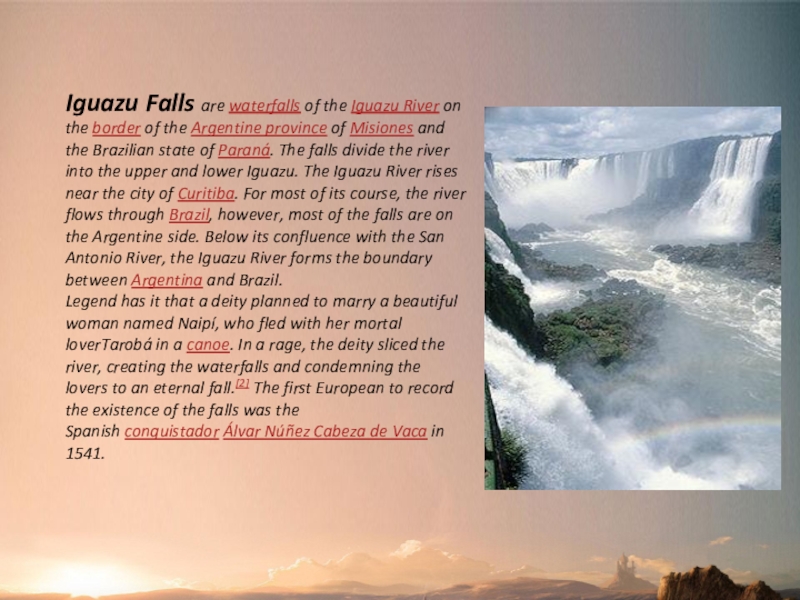
- 5. Machu Picchu(2430 м) It is located
- 6. The Colosseum or Coliseum also known as the Flavian Amphitheatre is
- 7. Angkor
- 8. The Temple of Artemis or Artemision was a Greek temple dedicated to
- 9. Mausoleum at HalicarnassusIn the 4th century BCE, Halicarnassus
- 10. The Lighthouse of Alexandria, sometimes called the Pharos of
- 11. Слайд 11
- 12. Stonehenge is a prehistoric monument located in Wiltshire, England,
- 13. Lake Baikal is
- 14. Слайд 14
- 15. THANK YOU FOR ATTENTION !
Content Lake Baikal ) 13Mausoleum at Halicarnassus
Слайд 1
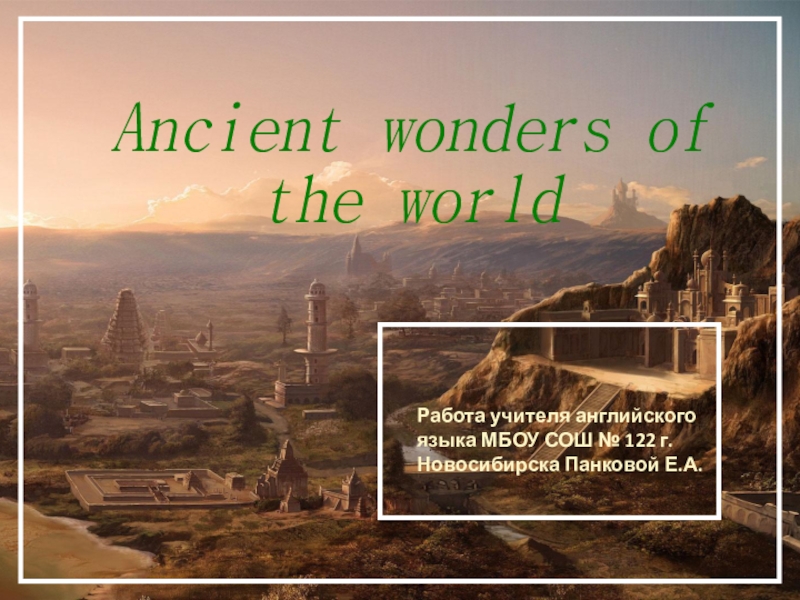
Ancient wonders of the world
Работа учителя английского языка МБОУ СОШ № 122 г.Новосибирска Панковой Е.А.
Слайд 3 An Aurora
is a natural light display
in the sky, predominantly seen in the high latitude (Arctic andAntarctic) regions.[nb 1] Auroras are produced when the magnetosphere is sufficiently disturbed by the solar wind that the trajectories of charged particles in both solar wind andmagnetospheric plasma, mainly in the form of electrons and protons, precipitate them into the upper atmosphere (thermosphere/exosphere), where their energy is lost. The resulting ionization and excitation of atmospheric constituents emits light of varying colour and complexity. The form of the aurora, occurring within bands around both polar regions, is also dependent on the amount of acceleration imparted to the precipitating particles. Precipitating protons generally produce optical emissions as incident hydrogen atoms after gaining electrons from the atmosphere. Proton auroras are usually observed at lower latitudes
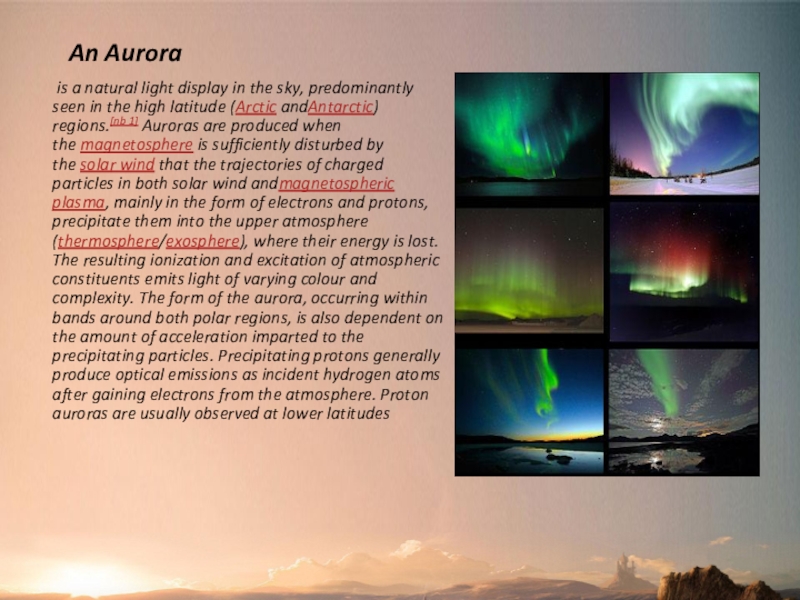
Слайд 4Iguazu Falls are waterfalls of the Iguazu River on the border of the Argentine province of Misiones and the Brazilian state
of Paraná. The falls divide the river into the upper and lower Iguazu. The Iguazu River rises near the city of Curitiba. For most of its course, the river flows through Brazil, however, most of the falls are on the Argentine side. Below its confluence with the San Antonio River, the Iguazu River forms the boundary between Argentina and Brazil.
Legend has it that a deity planned to marry a beautiful woman named Naipí, who fled with her mortal loverTarobá in a canoe. In a rage, the deity sliced the river, creating the waterfalls and condemning the lovers to an eternal fall.[2] The first European to record the existence of the falls was the Spanish conquistador Álvar Núñez Cabeza de Vaca in 1541.
Legend has it that a deity planned to marry a beautiful woman named Naipí, who fled with her mortal loverTarobá in a canoe. In a rage, the deity sliced the river, creating the waterfalls and condemning the lovers to an eternal fall.[2] The first European to record the existence of the falls was the Spanish conquistador Álvar Núñez Cabeza de Vaca in 1541.
Слайд 5
Machu Picchu(2430 м)
It is located in the Cusco Region, Urubamba Province, Machupicchu
District in Peru.t is situated on a mountain ridge above the Sacred Valley which is 80 kilometres (50 mi) northwest of Cuzco and through which the Urubamba River Urubamba River flows. Most archaeologists believe that Machu Picchu was built as an estate for the Inca emperor Pachacuti (1438–1472). Often mistakenly referred to as the "Lost City of the Incas" (a title more accurately applied to Vilcabamba), it is the most familiar icon of Inca civilization. The Incas built the estate around 1450, but abandoned it a century later at the time of the Spanish Conquest.
AlthoughMachu Picchu was declared a Peruvian Historical Sanctuary in 1981 and a UNESCO World Heritage Site in 1983. In 2007, Machu Picchu was voted one of the New Seven Wonders of the World in a worldwide Internet poll.
Machu Picchu was built in the classical Inca style, with polished dry-stone walls. Its three primary structures are the Inti Watana, the Temple of the Sun, and the Room of the Three Windows.
AlthoughMachu Picchu was declared a Peruvian Historical Sanctuary in 1981 and a UNESCO World Heritage Site in 1983. In 2007, Machu Picchu was voted one of the New Seven Wonders of the World in a worldwide Internet poll.
Machu Picchu was built in the classical Inca style, with polished dry-stone walls. Its three primary structures are the Inti Watana, the Temple of the Sun, and the Room of the Three Windows.
Слайд 6The Colosseum or Coliseum
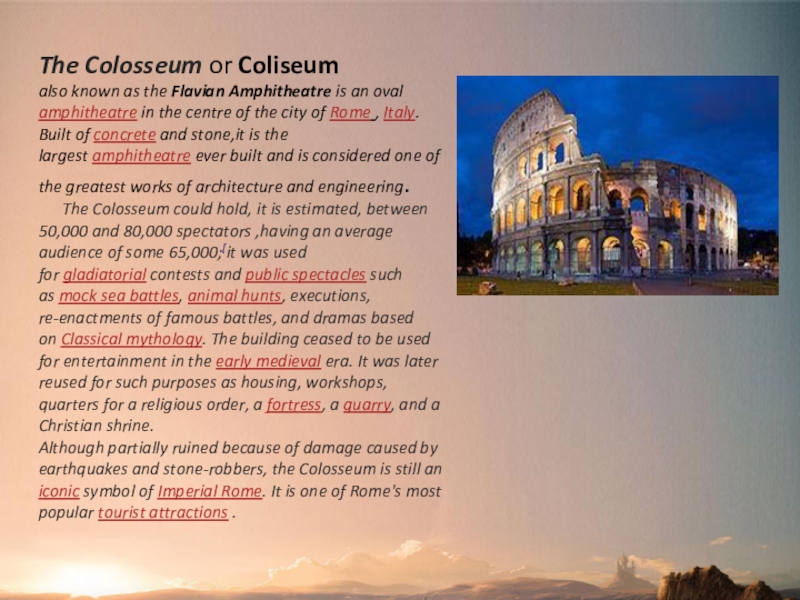
also known as the Flavian Amphitheatre is an oval amphitheatre in the
centre of the city of Rome , Italy. Built of concrete and stone,it is the largest amphitheatre ever built and is considered one of the greatest works of architecture and engineering.
The Colosseum could hold, it is estimated, between 50,000 and 80,000 spectators ,having an average audience of some 65,000;[it was used for gladiatorial contests and public spectacles such as mock sea battles, animal hunts, executions, re-enactments of famous battles, and dramas based on Classical mythology. The building ceased to be used for entertainment in the early medieval era. It was later reused for such purposes as housing, workshops, quarters for a religious order, a fortress, a quarry, and a Christian shrine.
Although partially ruined because of damage caused by earthquakes and stone-robbers, the Colosseum is still an iconic symbol of Imperial Rome. It is one of Rome's most popular tourist attractions .
The Colosseum could hold, it is estimated, between 50,000 and 80,000 spectators ,having an average audience of some 65,000;[it was used for gladiatorial contests and public spectacles such as mock sea battles, animal hunts, executions, re-enactments of famous battles, and dramas based on Classical mythology. The building ceased to be used for entertainment in the early medieval era. It was later reused for such purposes as housing, workshops, quarters for a religious order, a fortress, a quarry, and a Christian shrine.
Although partially ruined because of damage caused by earthquakes and stone-robbers, the Colosseum is still an iconic symbol of Imperial Rome. It is one of Rome's most popular tourist attractions .
Слайд 7 Angkor Wat is a temple
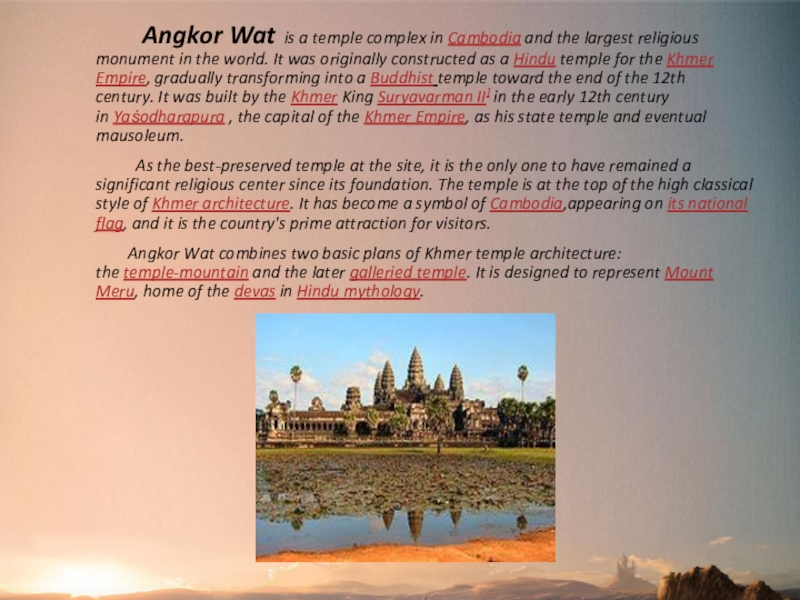
complex in Cambodia and the largest religious monument in the world. It was originally constructed as a Hindu temple for the Khmer Empire, gradually transforming into a Buddhist temple toward the end of the 12th century. It was built by the Khmer King Suryavarman II] in the early 12th century in Yaśodharapura , the capital of the Khmer Empire, as his state temple and eventual mausoleum.
As the best-preserved temple at the site, it is the only one to have remained a significant religious center since its foundation. The temple is at the top of the high classical style of Khmer architecture. It has become a symbol of Cambodia,appearing on its national flag, and it is the country's prime attraction for visitors.
Angkor Wat combines two basic plans of Khmer temple architecture: the temple-mountain and the later galleried temple. It is designed to represent Mount Meru, home of the devas in Hindu mythology.
As the best-preserved temple at the site, it is the only one to have remained a significant religious center since its foundation. The temple is at the top of the high classical style of Khmer architecture. It has become a symbol of Cambodia,appearing on its national flag, and it is the country's prime attraction for visitors.
Angkor Wat combines two basic plans of Khmer temple architecture: the temple-mountain and the later galleried temple. It is designed to represent Mount Meru, home of the devas in Hindu mythology.
Слайд 8The Temple of Artemis or Artemision was a Greek temple dedicated to the goddess Artemis. It
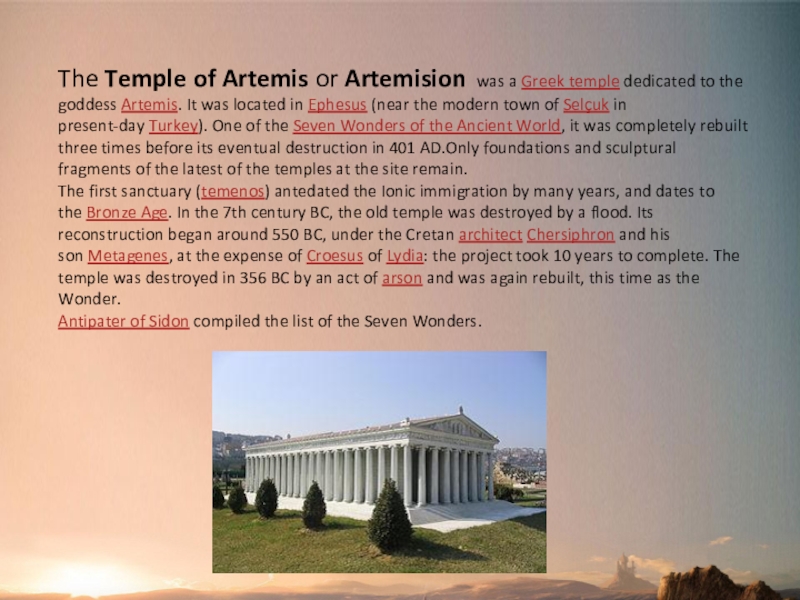
was located in Ephesus (near the modern town of Selçuk in present-day Turkey). One of the Seven Wonders of the Ancient World, it was completely rebuilt three times before its eventual destruction in 401 AD.Only foundations and sculptural fragments of the latest of the temples at the site remain.
The first sanctuary (temenos) antedated the Ionic immigration by many years, and dates to the Bronze Age. In the 7th century BC, the old temple was destroyed by a flood. Its reconstruction began around 550 BC, under the Cretan architect Chersiphron and his son Metagenes, at the expense of Croesus of Lydia: the project took 10 years to complete. The temple was destroyed in 356 BC by an act of arson and was again rebuilt, this time as the Wonder.
Antipater of Sidon compiled the list of the Seven Wonders.
The first sanctuary (temenos) antedated the Ionic immigration by many years, and dates to the Bronze Age. In the 7th century BC, the old temple was destroyed by a flood. Its reconstruction began around 550 BC, under the Cretan architect Chersiphron and his son Metagenes, at the expense of Croesus of Lydia: the project took 10 years to complete. The temple was destroyed in 356 BC by an act of arson and was again rebuilt, this time as the Wonder.
Antipater of Sidon compiled the list of the Seven Wonders.
Слайд 9
Mausoleum at Halicarnassus
In the 4th century BCE, Halicarnassus was the capital of a small
regional kingdom within the Achaemenid Persian Empire on the western coast of Asia Minor. In 377 BCE, the nominal ruler of the region, Hecatomnus of Milas, died and left the control of the kingdom to his son, Mausolus. Hecatomnus, a local satrap under the Persians, took control of several of the neighboring cities and districts. After Artemisia and Mausolus, he had several other daughters and sons:Ada (adoptive mother of Alexander the Great), Idrieus and Pixodarus.
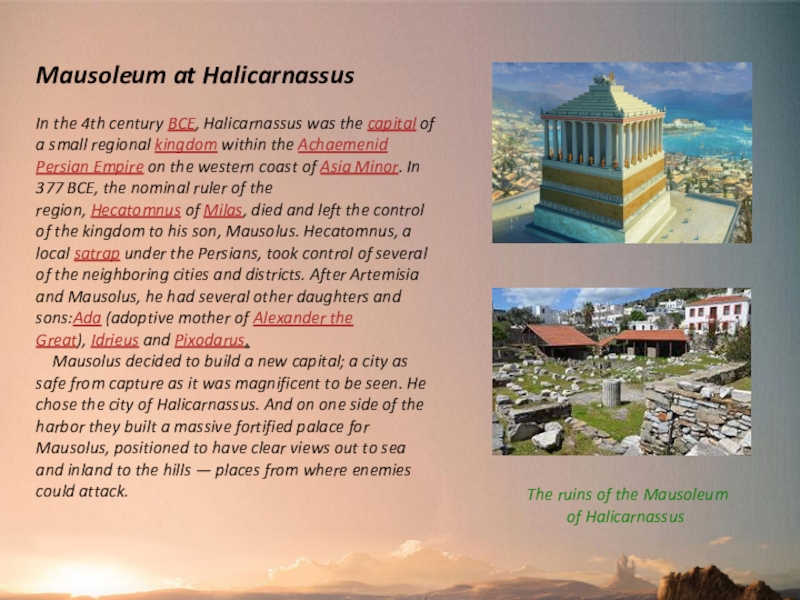
Mausolus decided to build a new capital; a city as safe from capture as it was magnificent to be seen. He chose the city of Halicarnassus. And on one side of the harbor they built a massive fortified palace for Mausolus, positioned to have clear views out to sea and inland to the hills — places from where enemies could attack.
Mausolus decided to build a new capital; a city as safe from capture as it was magnificent to be seen. He chose the city of Halicarnassus. And on one side of the harbor they built a massive fortified palace for Mausolus, positioned to have clear views out to sea and inland to the hills — places from where enemies could attack.
The ruins of the Mausoleum of Halicarnassus
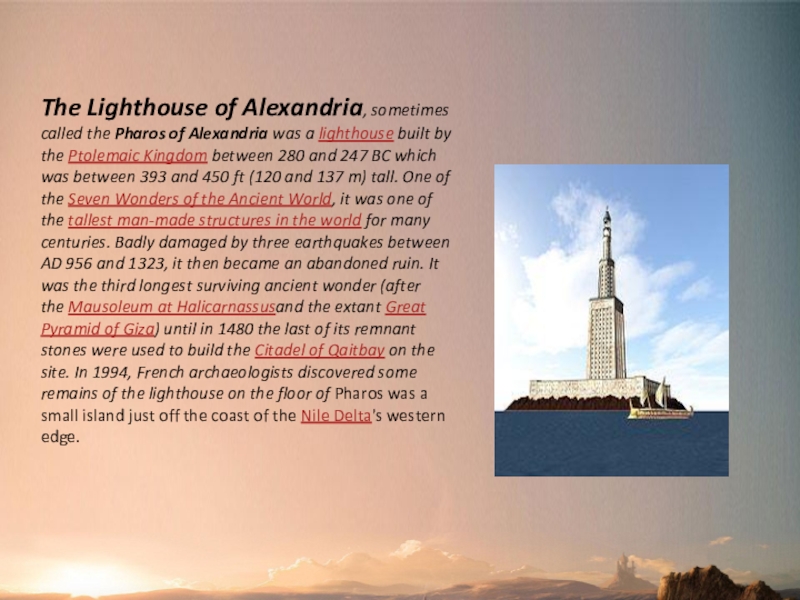
Слайд 10The Lighthouse of Alexandria, sometimes called the Pharos of Alexandria was a lighthouse built by the Ptolemaic
Kingdom between 280 and 247 BC which was between 393 and 450 ft (120 and 137 m) tall. One of the Seven Wonders of the Ancient World, it was one of the tallest man-made structures in the world for many centuries. Badly damaged by three earthquakes between AD 956 and 1323, it then became an abandoned ruin. It was the third longest surviving ancient wonder (after the Mausoleum at Halicarnassusand the extant Great Pyramid of Giza) until in 1480 the last of its remnant stones were used to build the Citadel of Qaitbay on the site. In 1994, French archaeologists discovered some remains of the lighthouse on the floor of Pharos was a small island just off the coast of the Nile Delta's western edge.
Слайд 11
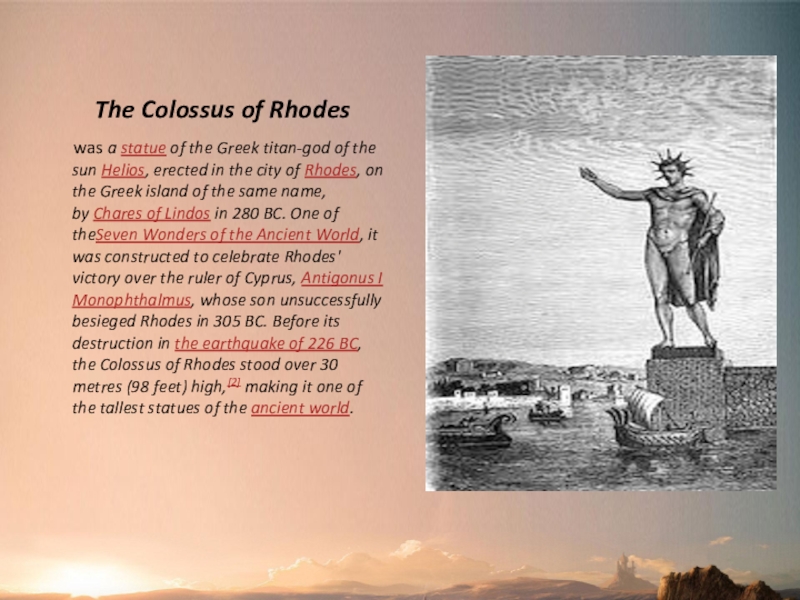
The Colossus of Rhodes
was a statue of the Greek titan-god of the sun Helios, erected in the city of Rhodes, on the Greek island of the same name, by Chares of Lindos in 280 BC. One of theSeven Wonders of the Ancient World, it was constructed to celebrate Rhodes' victory over the ruler of Cyprus, Antigonus I Monophthalmus, whose son unsuccessfully besieged Rhodes in 305 BC. Before its destruction in the earthquake of 226 BC, the Colossus of Rhodes stood over 30 metres (98 feet) high,[2] making it one of the tallest statues of the ancient world.
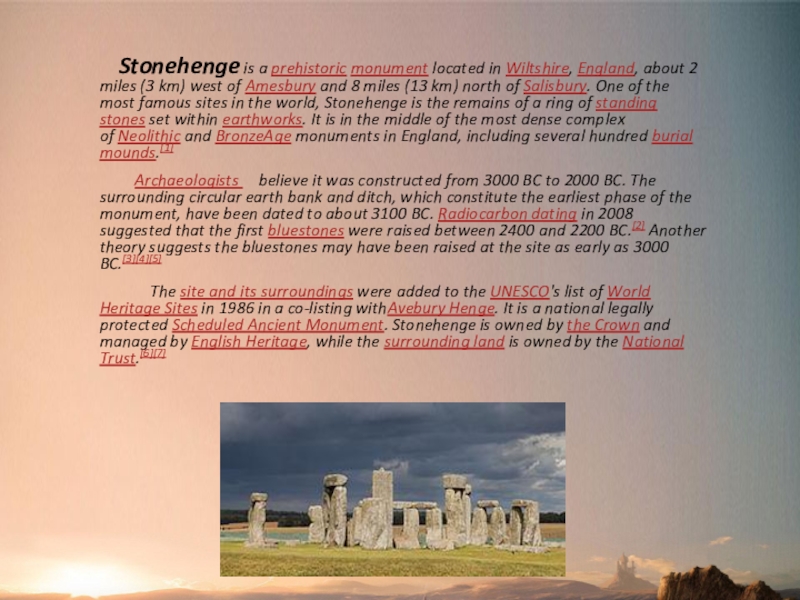
Слайд 12 Stonehenge is a prehistoric monument located in Wiltshire, England, about 2 miles (3 km)
west of Amesbury and 8 miles (13 km) north of Salisbury. One of the most famous sites in the world, Stonehenge is the remains of a ring of standing stones set within earthworks. It is in the middle of the most dense complex of Neolithic and BronzeAge monuments in England, including several hundred burial mounds.[1]
Archaeologists believe it was constructed from 3000 BC to 2000 BC. The surrounding circular earth bank and ditch, which constitute the earliest phase of the monument, have been dated to about 3100 BC. Radiocarbon dating in 2008 suggested that the first bluestones were raised between 2400 and 2200 BC.[2] Another theory suggests the bluestones may have been raised at the site as early as 3000 BC.[3][4][5]
The site and its surroundings were added to the UNESCO's list of World Heritage Sites in 1986 in a co-listing withAvebury Henge. It is a national legally protected Scheduled Ancient Monument. Stonehenge is owned by the Crown and managed by English Heritage, while the surrounding land is owned by the National Trust.[6][7]
Archaeologists believe it was constructed from 3000 BC to 2000 BC. The surrounding circular earth bank and ditch, which constitute the earliest phase of the monument, have been dated to about 3100 BC. Radiocarbon dating in 2008 suggested that the first bluestones were raised between 2400 and 2200 BC.[2] Another theory suggests the bluestones may have been raised at the site as early as 3000 BC.[3][4][5]
The site and its surroundings were added to the UNESCO's list of World Heritage Sites in 1986 in a co-listing withAvebury Henge. It is a national legally protected Scheduled Ancient Monument. Stonehenge is owned by the Crown and managed by English Heritage, while the surrounding land is owned by the National Trust.[6][7]
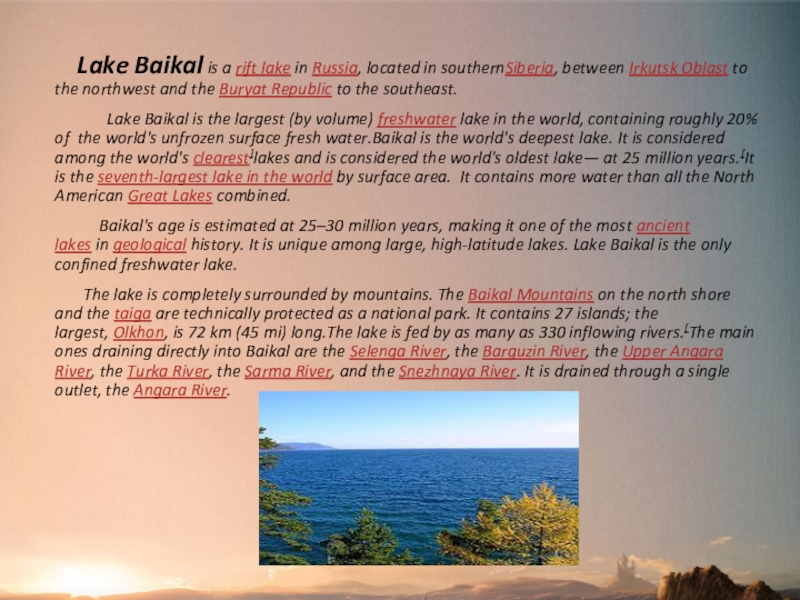
Слайд 13 Lake Baikal is a rift lake in Russia, located in
southernSiberia, between Irkutsk Oblast to the northwest and the Buryat Republic to the southeast.
Lake Baikal is the largest (by volume) freshwater lake in the world, containing roughly 20% of the world's unfrozen surface fresh water.Baikal is the world's deepest lake. It is considered among the world's clearest]lakes and is considered the world's oldest lake— at 25 million years.[It is the seventh-largest lake in the world by surface area. It contains more water than all the North American Great Lakes combined.
Baikal's age is estimated at 25–30 million years, making it one of the most ancient lakes in geological history. It is unique among large, high-latitude lakes. Lake Baikal is the only confined freshwater lake.
The lake is completely surrounded by mountains. The Baikal Mountains on the north shore and the taiga are technically protected as a national park. It contains 27 islands; the largest, Olkhon, is 72 km (45 mi) long.The lake is fed by as many as 330 inflowing rivers.[The main ones draining directly into Baikal are the Selenga River, the Barguzin River, the Upper Angara River, the Turka River, the Sarma River, and the Snezhnaya River. It is drained through a single outlet, the Angara River.
Lake Baikal is the largest (by volume) freshwater lake in the world, containing roughly 20% of the world's unfrozen surface fresh water.Baikal is the world's deepest lake. It is considered among the world's clearest]lakes and is considered the world's oldest lake— at 25 million years.[It is the seventh-largest lake in the world by surface area. It contains more water than all the North American Great Lakes combined.
Baikal's age is estimated at 25–30 million years, making it one of the most ancient lakes in geological history. It is unique among large, high-latitude lakes. Lake Baikal is the only confined freshwater lake.
The lake is completely surrounded by mountains. The Baikal Mountains on the north shore and the taiga are technically protected as a national park. It contains 27 islands; the largest, Olkhon, is 72 km (45 mi) long.The lake is fed by as many as 330 inflowing rivers.[The main ones draining directly into Baikal are the Selenga River, the Barguzin River, the Upper Angara River, the Turka River, the Sarma River, and the Snezhnaya River. It is drained through a single outlet, the Angara River.
Слайд 14
The Great Barrier Reef is the
world's largest coral reef system[1][2] composed of over 2,900 individual reefs[3] and 900 islands stretching for over 2,300 kilometres (1,400 mi) over an area of approximately 344,400 square kilometres (133,000 sq mi).[4][5] The reef is located in the Coral Sea, off the coast of Queensland, Australia.
The Great Barrier Reef can be seen from outer space and is the world's biggest single structure made by living organisms.[6] This reef structure is composed of and built by billions of tiny organisms, known as coral polyps.[7] It supports a wide diversity of life and was selected as a World Heritage Site in 1981.[1][2] CNN labelled it one of the seven natural wonders of the world.[8] The Queensland National Trust named it a state icon of Queensland.[9]
A large part of the reef is protected by the Great Barrier Reef Marine Park, which helps to limit the impact of human use, such as fishing and tourism. Other environmental pressures on the reef and its ecosystem include runoff, climate change accompanied by mass coral bleaching, and cyclic population outbreaks of the crown-of-thorns starfish.
![The Great Barrier Reef is the world's largest coral reef system[1][2] composed](/img/tmb/4/304909/66a63a70e62463869834c4a78ddc9b90-800x.jpg "Презентация по английскому языку Ancient wonders of the world The Great Barrier Reef is the world's largest coral")