Слайд 1RUSSIAN HANDICRAFTS
ДЕПАРТАМЕНТ ВНУТРЕННЕЙ И КАДРОВОЙ ПОЛИТИКИ БЕЛГОРОДСКОЙ ОБЛАСТИ
ОБЛАСТНОЕ ГОСУДАРСТВЕННОЕ АВТОНОМНОЕ ПРОФЕССИОНАЛЬНОЕ
ОБРАЗОВАТЕЛЬНОЕ УЧРЕЖДЕНИЕ
«АЛЕКСЕЕВСКИЙ КОЛЛЕДЖ»
Выполнил студент 821 группы
специальности 43.02.10 Туризм
Бахарев Сергей
Преподаватель:
Кришталь Е.В
Слайд 2Matryoshka dolls
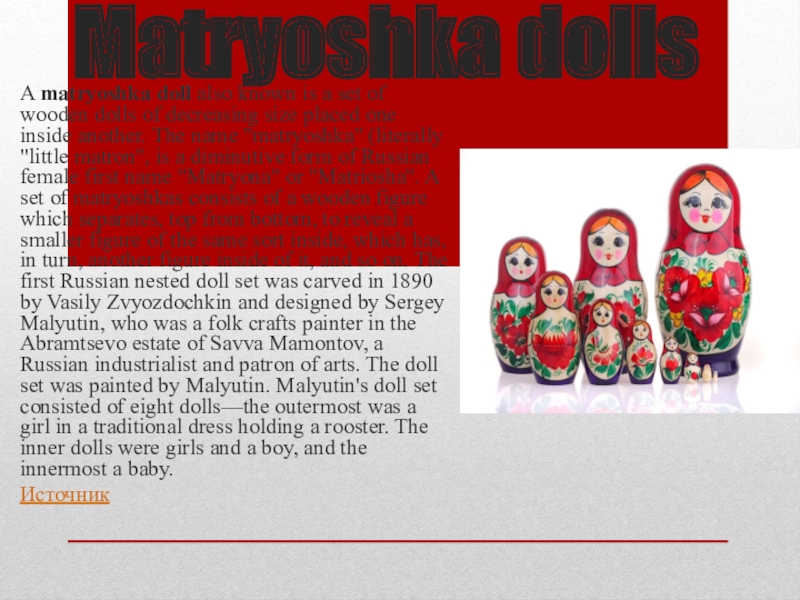
A matryoshka doll also known is a set of wooden
dolls of decreasing size placed one inside another. The name "matryoshka" (literally "little matron", is a diminutive form of Russian female first name "Matryona" or "Matriosha". A set of matryoshkas consists of a wooden figure which separates, top from bottom, to reveal a smaller figure of the same sort inside, which has, in turn, another figure inside of it, and so on. The first Russian nested doll set was carved in 1890 by Vasily Zvyozdochkin and designed by Sergey Malyutin, who was a folk crafts painter in the Abramtsevo estate of Savva Mamontov, a Russian industrialist and patron of arts. The doll set was painted by Malyutin. Malyutin's doll set consisted of eight dolls—the outermost was a girl in a traditional dress holding a rooster. The inner dolls were girls and a boy, and the innermost a baby.
Источник
Слайд 3Gzhel and Khokhloma
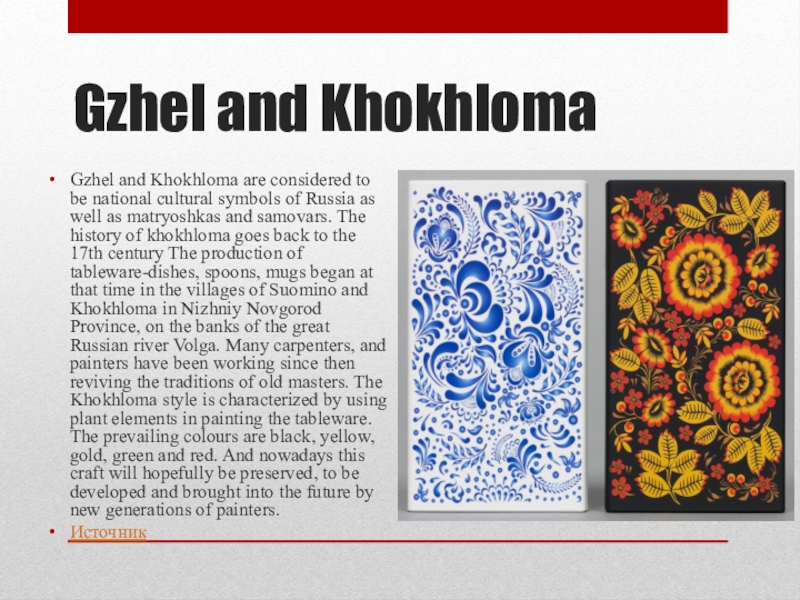
Gzhel and Khokhloma are considered to be national cultural
symbols of Russia as well as matryoshkas and samovars. The history of khokhloma goes back to the 17th century The production of tableware-dishes, spoons, mugs began at that time in the villages of Suomino and Khokhloma in Nizhniy Novgorod Province, on the banks of the great Russian river Volga. Many carpenters, and painters have been working since then reviving the traditions of old masters. The Khokhloma style is characterized by using plant elements in painting the tableware. The prevailing colours are black, yellow, gold, green and red. And nowadays this craft will hopefully be preserved, to be developed and brought into the future by new generations of painters.
Источник
Слайд 4Whistle
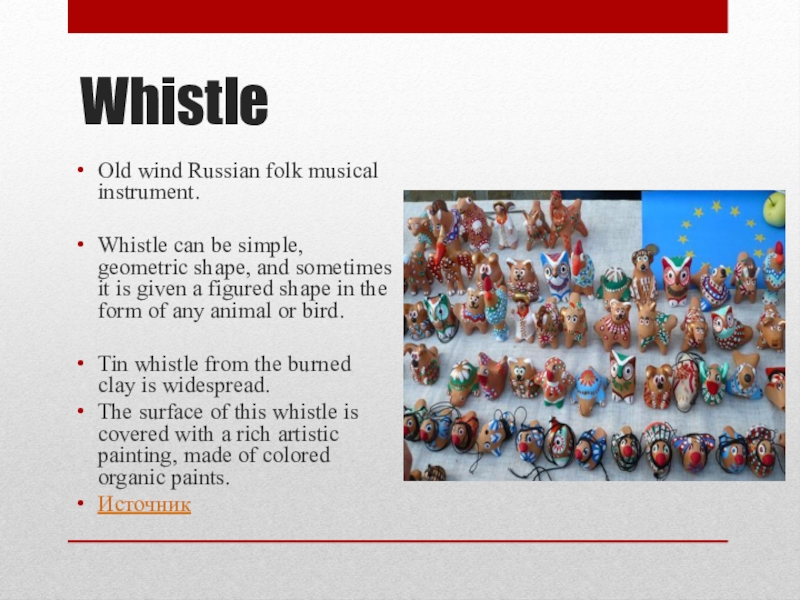
Old wind Russian folk musical instrument.
Whistle can be simple, geometric shape,
and sometimes it is given a figured shape in the form of any animal or bird.
Tin whistle from the burned clay is widespread.
The surface of this whistle is covered with a rich artistic painting, made of colored organic paints.
Источник
Слайд 5Samovar
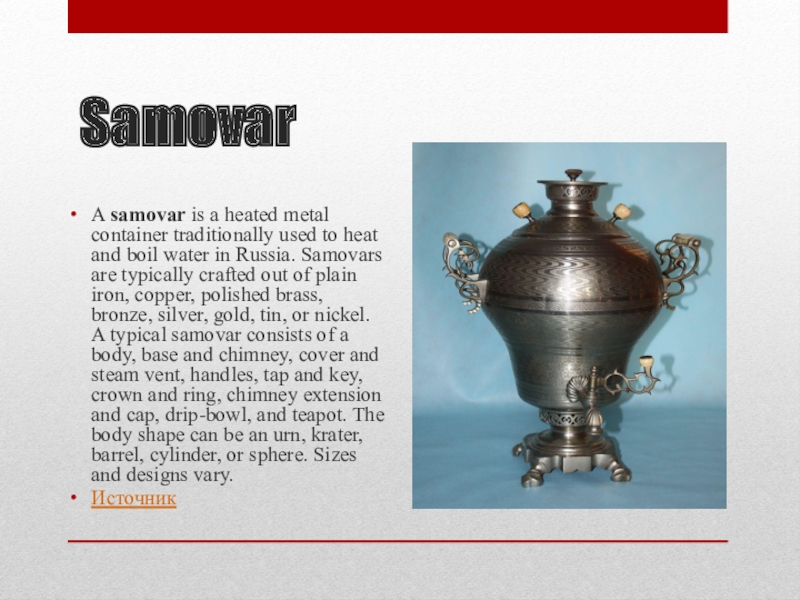
A samovar is a heated metal container traditionally used to heat
and boil water in Russia. Samovars are typically crafted out of plain iron, copper, polished brass, bronze, silver, gold, tin, or nickel. A typical samovar consists of a body, base and chimney, cover and steam vent, handles, tap and key, crown and ring, chimney extension and cap, drip-bowl, and teapot. The body shape can be an urn, krater, barrel, cylinder, or sphere. Sizes and designs vary.
Источник
Слайд 6Lapti
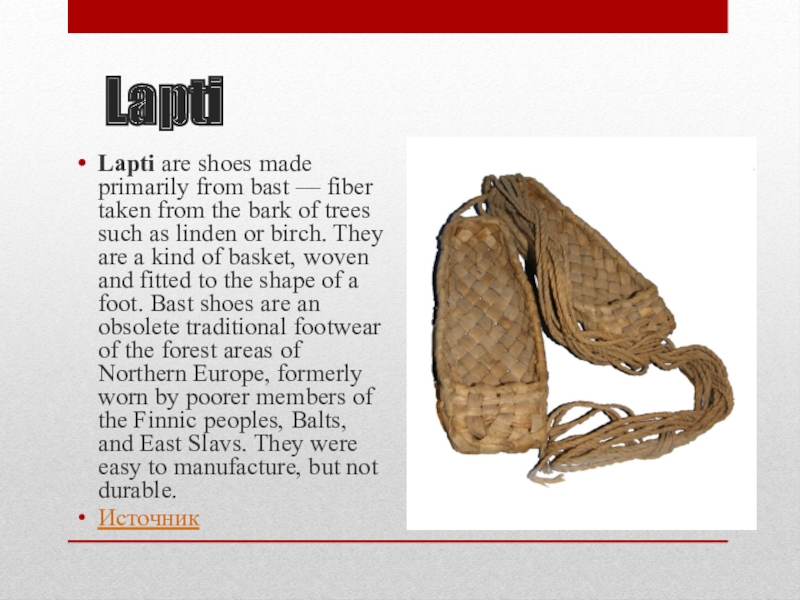
Lapti are shoes made primarily from bast — fiber taken from
the bark of trees such as linden or birch. They are a kind of basket, woven and fitted to the shape of a foot. Bast shoes are an obsolete traditional footwear of the forest areas of Northern Europe, formerly worn by poorer members of the Finnic peoples, Balts, and East Slavs. They were easy to manufacture, but not durable.
Источник
Слайд 7Valenki
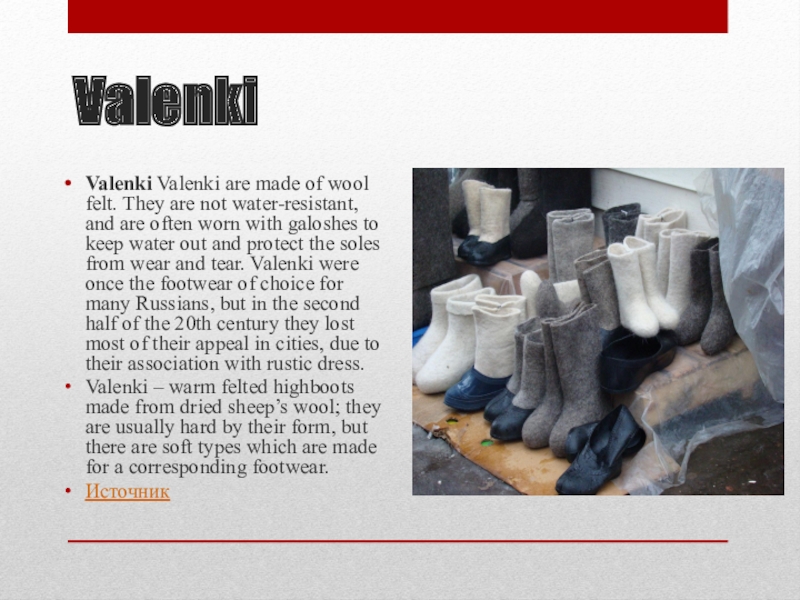
Valenki Valenki are made of wool felt. They are not water-resistant,
and are often worn with galoshes to keep water out and protect the soles from wear and tear. Valenki were once the footwear of choice for many Russians, but in the second half of the 20th century they lost most of their appeal in cities, due to their association with rustic dress.
Valenki – warm felted highboots made from dried sheep’s wool; they are usually hard by their form, but there are soft types which are made for a corresponding footwear.
Источник
Слайд 8Balalaika
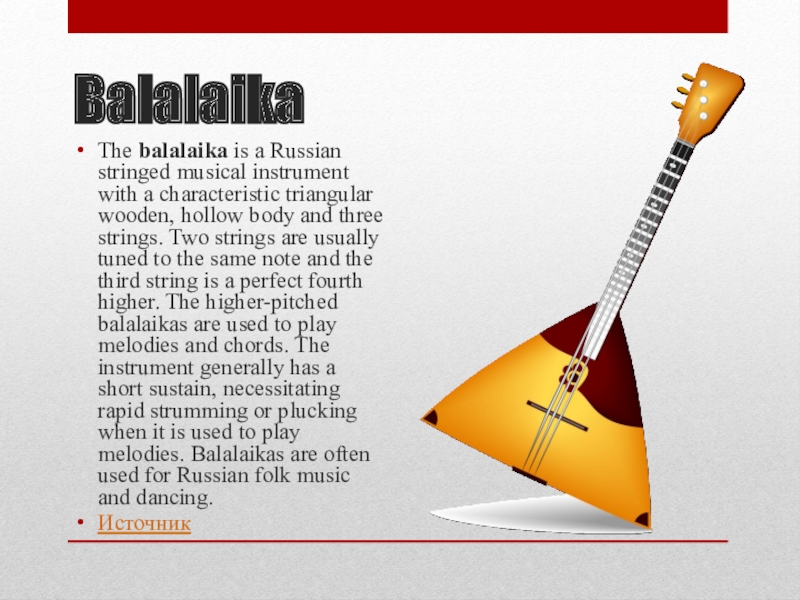
The balalaika is a Russian stringed musical instrument with a characteristic
triangular wooden, hollow body and three strings. Two strings are usually tuned to the same note and the third string is a perfect fourth higher. The higher-pitched balalaikas are used to play melodies and chords. The instrument generally has a short sustain, necessitating rapid strumming or plucking when it is used to play melodies. Balalaikas are often used for Russian folk music and dancing.
Источник
Слайд 9Vologda Lace
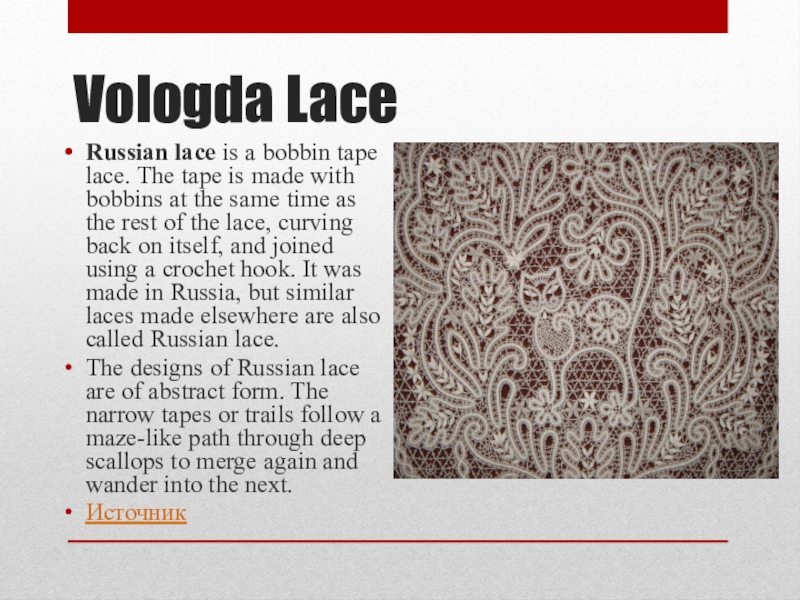
Russian lace is a bobbin tape lace. The tape is
made with bobbins at the same time as the rest of the lace, curving back on itself, and joined using a crochet hook. It was made in Russia, but similar laces made elsewhere are also called Russian lace.
The designs of Russian lace are of abstract form. The narrow tapes or trails follow a maze-like path through deep scallops to merge again and wander into the next.
Источник
Слайд 10Palekh
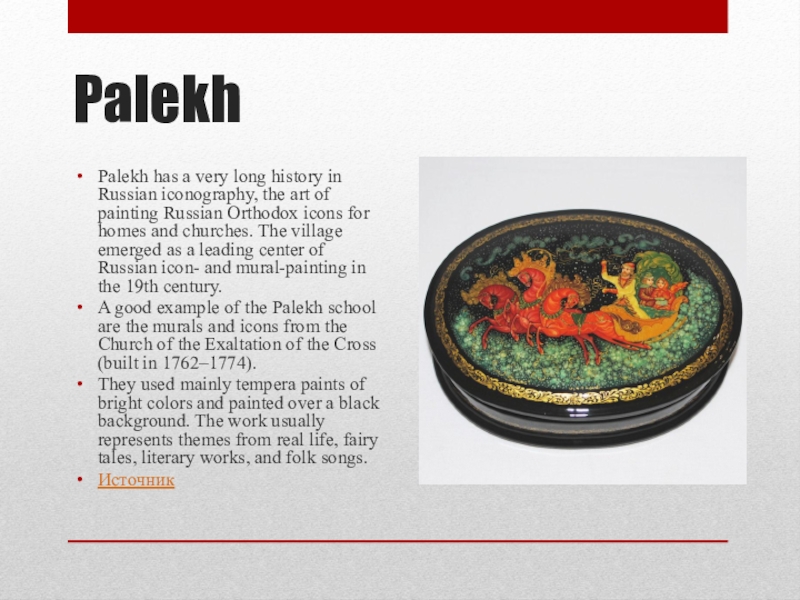
Palekh has a very long history in Russian iconography, the art
of painting Russian Orthodox icons for homes and churches. The village emerged as a leading center of Russian icon- and mural-painting in the 19th century.
A good example of the Palekh school are the murals and icons from the Church of the Exaltation of the Cross (built in 1762–1774).
They used mainly tempera paints of bright colors and painted over a black background. The work usually represents themes from real life, fairy tales, literary works, and folk songs.
Источник
Слайд 11Zhostovo painting
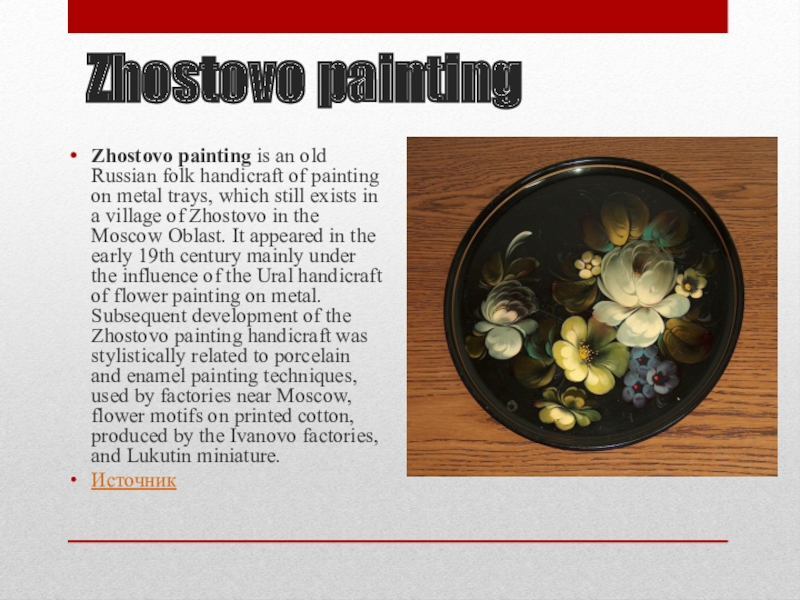
Zhostovo painting is an old Russian folk handicraft of painting
on metal trays, which still exists in a village of Zhostovo in the Moscow Oblast. It appeared in the early 19th century mainly under the influence of the Ural handicraft of flower painting on metal. Subsequent development of the Zhostovo painting handicraft was stylistically related to porcelain and enamel painting techniques, used by factories near Moscow, flower motifs on printed cotton, produced by the Ivanovo factories, and Lukutin miniature.
Источник