- Главная
- Разное
- Образование
- Спорт
- Естествознание
- Природоведение
- Религиоведение
- Французский язык
- Черчение
- Английский язык
- Астрономия
- Алгебра
- Биология
- География
- Геометрия
- Детские презентации
- Информатика
- История
- Литература
- Математика
- Музыка
- МХК
- Немецкий язык
- ОБЖ
- Обществознание
- Окружающий мир
- Педагогика
- Русский язык
- Технология
- Физика
- Философия
- Химия
- Шаблоны, фоны, картинки для презентаций
- Экология
- Экономика
Презентация, доклад Ломоносов и литература (английский язык).
Содержание
- 1. Презентация Ломоносов и литература (английский язык).
- 2. The role of M.V. Lomonosov in the
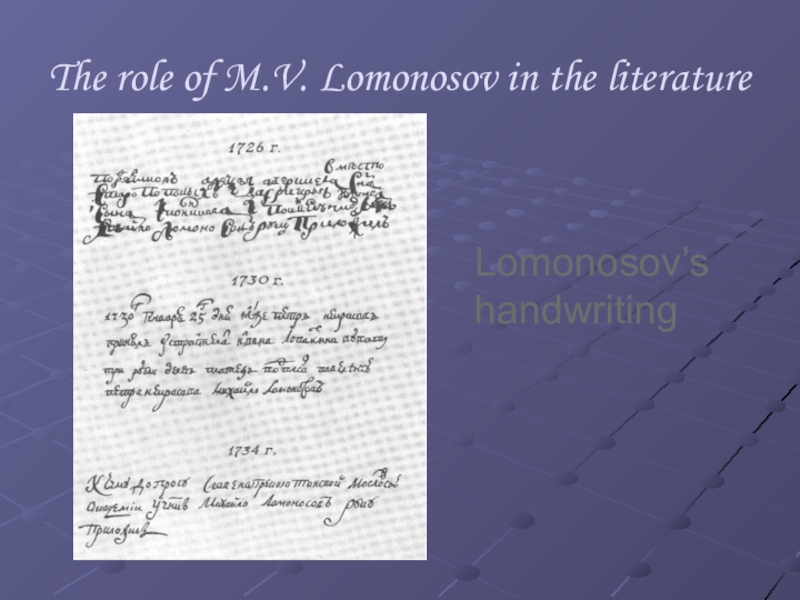
- 3. The role of M.V. Lomonosov in the literatureLomonosov’s handwriting
- 4. The role of M.V. Lomonosov in the literatureLomonosov wrote the first scientific grammar of Russian language
- 5. The role of M.V. Lomonosov in the
- 6. The role of M.V. Lomonosov in the
- 7. The role of M.V. Lomonosov in the
- 8. The role of M.V. Lomonosov in the
- 9. The role of M.V. Lomonosov in the
- 10. The role of M.V. Lomonosov in the
- 11. The role of M.V. Lomonosov in the
- 12. The role of M.V. Lomonosov in the
- 13. The role of M.V. Lomonosov in the
- 14. The role of M.V. Lomonosov in the
- 15. The role of M.V. Lomonosov in the
- 16. The role of M.V. Lomonosov in the
- 17. The role of M.V. Lomonosov in the
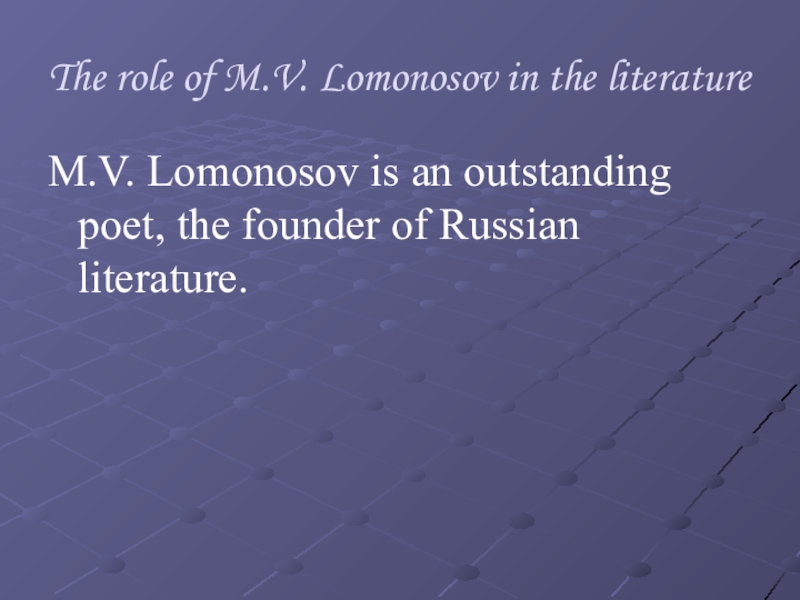
The role of M.V. Lomonosov in the literatureM.V. Lomonosov is an outstanding poet, the founder of Russian literature.
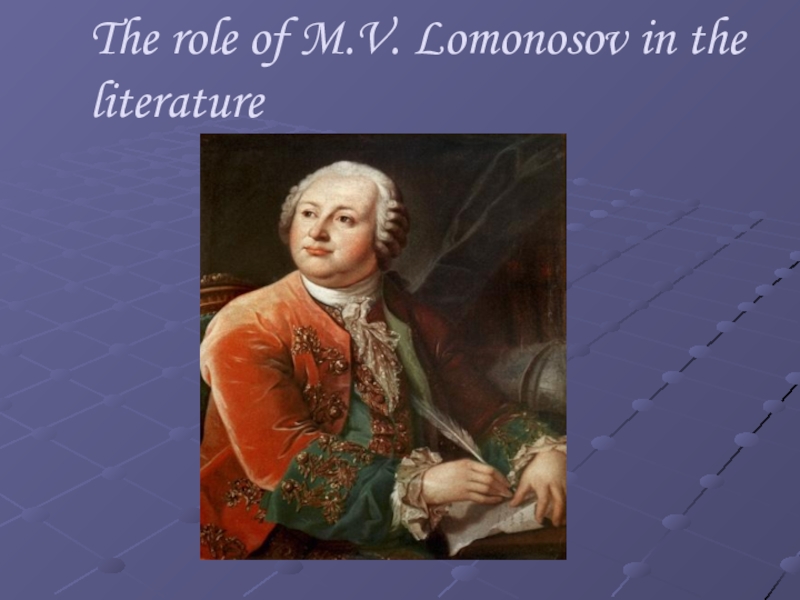
Слайд 2The role of M.V. Lomonosov in the literature
M.V. Lomonosov is an
outstanding poet, the founder of Russian literature.
Слайд 4The role of M.V. Lomonosov in the literature
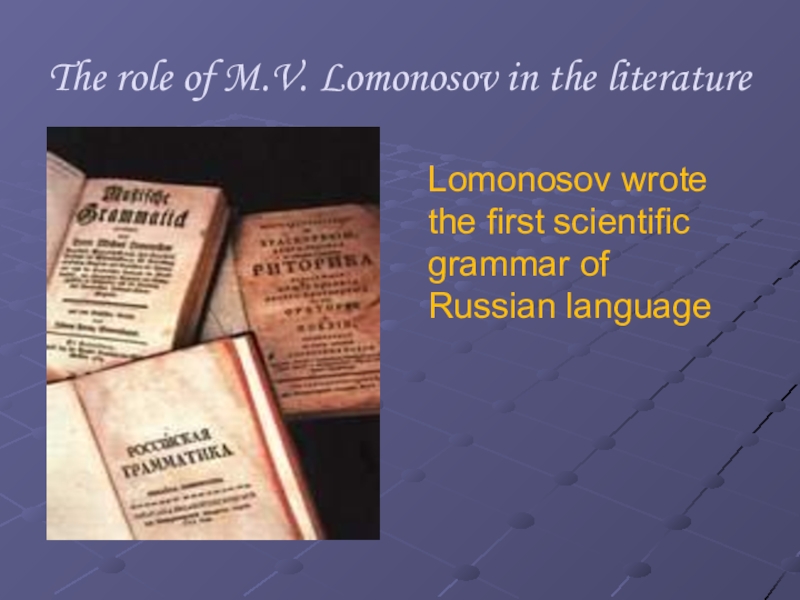
Lomonosov wrote the first
scientific grammar of Russian language
Слайд 6The role of M.V. Lomonosov in the literature
In 1755, M.V. Lomonosov
reformed the Russian literary language by combining Old Church Slavonic with the vernacular.
He applied an idiosyncratic theory to his later poems – tender subjects needed words containing the front vowel sounds E, I, YU, whereas things that may cause fear (like “anger,” “envy,” “pain” and “sorrow”) needed words with back vowel sounds O, U, Y - an early version of what is now called sound symbolism.
He applied an idiosyncratic theory to his later poems – tender subjects needed words containing the front vowel sounds E, I, YU, whereas things that may cause fear (like “anger,” “envy,” “pain” and “sorrow”) needed words with back vowel sounds O, U, Y - an early version of what is now called sound symbolism.
Слайд 7The role of M.V. Lomonosov in the literature
M.V. Lomonosov was the
author of poems, epistles, tragedies, satires, fundamental philological works and scientific grammar of Russian.
Слайд 8The role of M.V. Lomonosov in the literature
M.V. Lomonosov was the
greatest Russian poet-enlightener of the 18th century, one of the founders of syllabic-tonic versification. Lomonosov was the founder of philosophical and Russian odes of high civil character.
Слайд 9The role of M.V. Lomonosov in the literature
Abroad Lomonosov worked in
the field of Russian poetry and created the harmonious theory of the Russian syllabic-tonic verse, which was presented by him in “Letter on rules of Russian versification” and which is still in use today.
Слайд 10The role of M.V. Lomonosov in the literature
He understood that there
wasn't a uniform Russian literary language or a uniform Russian culture. He decided to do everything possible to lay the foundations of new Russian culture, science, literature and literary language.
Слайд 11The role of M.V. Lomonosov in the literature
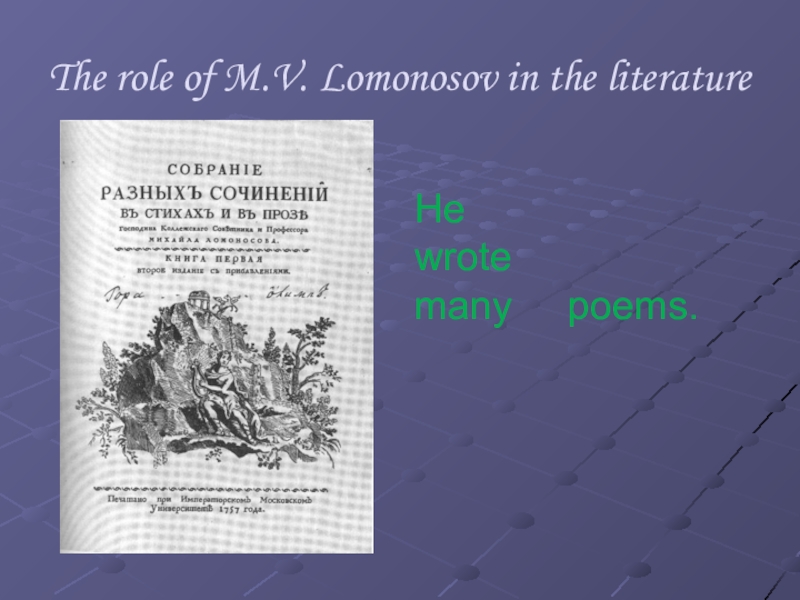
His “Russian Grammar” which
defined features of Russian literary language, was the first real Russian grammar; “Eloquence compendium” is a course of general theory of literature. The treatise “About benefits of church books in Russian language” is the first experience in Russian stylistics.
Poetry occupied an important place in the life of Lomonosov: “Conversation with Anakreon” and “The Hymn to Beard.” He also wrote the plays “Tamira and Selim” and “Demofont” and numerous odes.
Poetry occupied an important place in the life of Lomonosov: “Conversation with Anakreon” and “The Hymn to Beard.” He also wrote the plays “Tamira and Selim” and “Demofont” and numerous odes.
Слайд 12The role of M.V. Lomonosov in the literature
Reacting to Trediakovsky's tract
of 1735, "The New and Brief Method for Writing Russian Verse," Lomonosov comes up with his own method and writes "A Letter on the Rules of Composing Russian Poetry." In developing Trediakovsky's basic idea (that Russian verse ought to be measured in feet rather than in syllables) into a more flexible system, Lomonosov establishes the syllabatonic mode that remains the most basic element of Russian verse composition.
Слайд 13The role of M.V. Lomonosov in the literature
1742-1744
Intensive period of both
academic and poetic production. Works from this period include his most famous odes, "Morning Meditation on the Greatness of God" and Evening Meditation on the Greatness of God on the occasion of the Northern Lights" (see right), and the first edition of his "Short Guide to Rhetoric."
Слайд 14The role of M.V. Lomonosov in the literature
1751
The Academy publishes the
first collection of Lomonosov's poetry.
1752 M.V. Lomonosov publishes the long poem "On the Utility of Glass" and writes the second play, Demofont, which is less successful than Tamira and Selim.
1752 M.V. Lomonosov publishes the long poem "On the Utility of Glass" and writes the second play, Demofont, which is less successful than Tamira and Selim.
Слайд 15The role of M.V. Lomonosov in the literature
1757
M.V. Lomonosov publishes "Russian
Grammar". For the Moscow University press, he begins work on the first volume of his collected works, for which he writes the "Foreword on the Utility of the Ecclesiastical Books in the Russian Language." In it he establishes the importance of the relationship between spoken Russian and Chruch Slavonic, arguing that, because of its connection to Ancient Greece via the Byzantines, the ecclesiastical language makes intellectual life accessible to the literate Russian.
Слайд 16The role of M.V. Lomonosov in the literature
Spoken Russian and Church
Slavonic, Lomonosov argues can be combined in three styles, according to the loftiness of the writer's goals: the first, "high" style is used for tragedies, odes and elegies, should include more Slavonicsims; the second, "middle" style, consisting of an equal mix of Russian and Slavonic, should be used for drama, correspondence, and satire; and the third, "low" style includes mostly Russian words and exists for comedies, epigrams and everyday speech. This understanding of style proved extremely influential in the development of the poetic tradition in Russia.
Слайд 17The role of M.V. Lomonosov in the literature
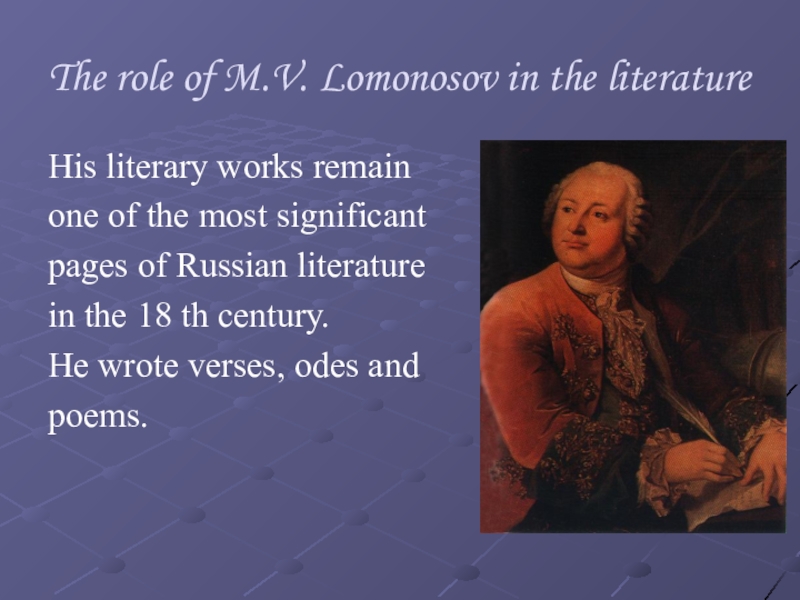
His literary works remain
one of the most significant
pages of Russian literature
in the 18 th century.
He wrote verses, odes and
poems.