Презентация, доклад на тему Different principles of sentence classification.

Classification according to their form:The periodic sentence ( When the mother discovered that her son had snuck out of the house, the teenage boy lost all his social privileges! ) Cumulative or loose

Слайд 1Different principles of sentence

classification.

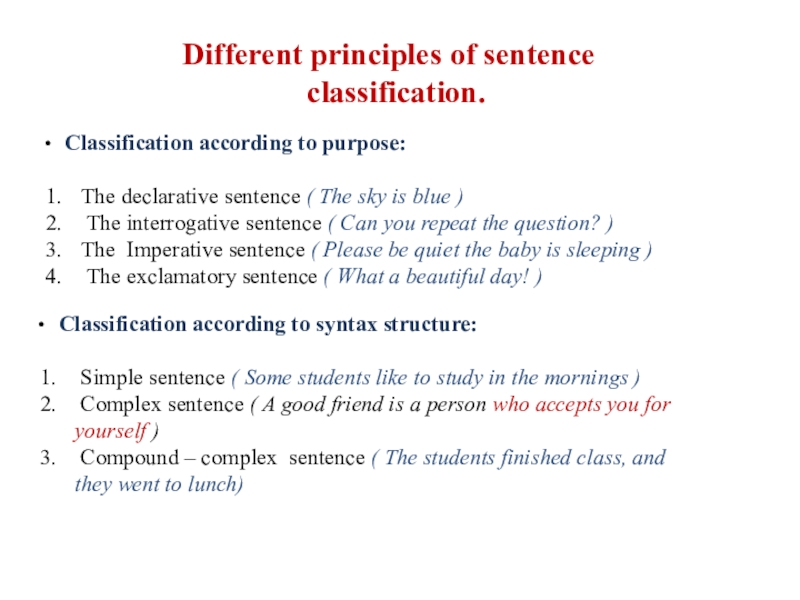
Classification according to purpose:

The declarative sentence ( The sky is blue )
The interrogative sentence ( Can you repeat the question? )
The Imperative sentence ( Please be quiet the baby is sleeping )
The exclamatory sentence ( What a beautiful day! )

Classification according to syntax structure:

Simple sentence ( Some students like to study in the mornings )
Complex sentence ( A good friend is a person who accepts you for yourself )
Compound – complex sentence ( The students finished class, and they went to lunch)
Different principles of sentence          classification.  Classification according

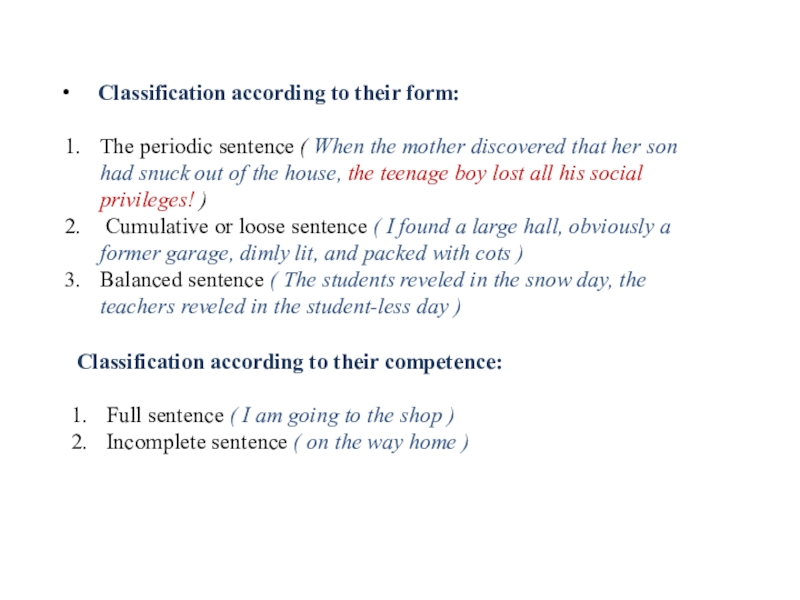
Слайд 2 Classification according to their form:

The periodic sentence (

When the mother discovered that her son had snuck out of the house, the teenage boy lost all his social privileges! )
Cumulative or loose sentence ( I found a large hall, obviously a former garage, dimly lit, and packed with cots )
Balanced sentence ( The students reveled in the snow day, the teachers reveled in the student-less day )

Classification according to their competence:

Full sentence ( I am going to the shop )
Incomplete sentence ( on the way home )

Classification according to their form:The periodic sentence ( When the mother discovered that her

Слайд 3A one-member  sentence does not comprise a subject and a predicate, but

consists only of one principle part, which can only conditionally be interpreted as subject or predicate:

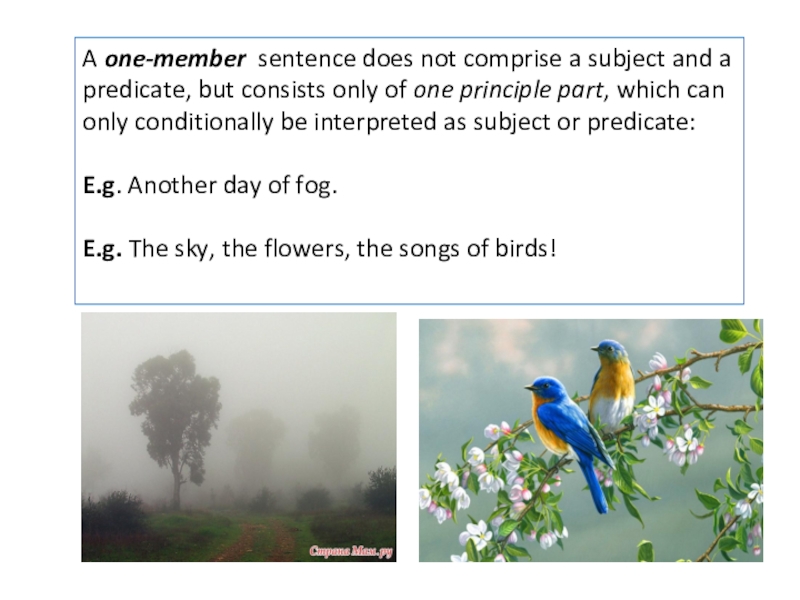
E.g. Another day of fog.

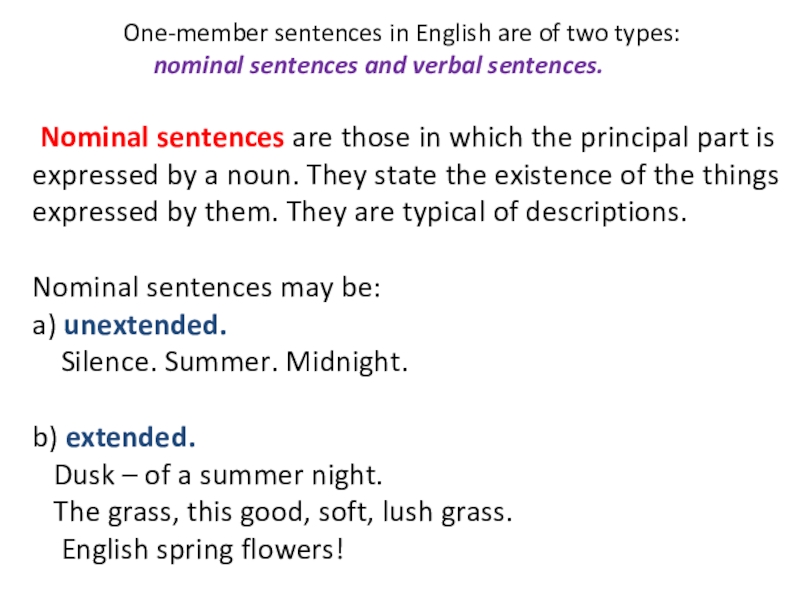
E.g. The sky, the flowers, the songs of birds!
 
A one-member  sentence does not comprise a subject and a predicate, but consists only of one principle part, which

Слайд 4 One-member sentences in

English are of two types:
nominal sentences and verbal sentences.
   
Nominal sentences are those in which the principal part is expressed by a noun. They state the existence of the things expressed by them. They are typical of descriptions.

Nominal sentences may be:
a) unextended.
Silence. Summer. Midnight.

b) extended.
Dusk – of a summer night.
The grass, this good, soft, lush grass.
English spring flowers!
One-member sentences in English are of two types:

Слайд 5Verbal sentences are those in which the principal part is expressed

by a non-finite form of the verb, either an infinitive or a gerund.

Infinitive and gerundial one-member sentences are mostly used to describe different emotional perceptions of reality.

To think of that!
To think that he should have met her again in this way!
Living at the mercy of a woman!

Imperative sentences with no subject of the action mentioned are also to be classed among one-member sentences

Get away from me! Fear not, fair lady!

Verbal sentences are those in which the principal part is expressed by a non-finite form of the

Слайд 6The usual type of sentence is the two-member sentence that comprises a subject and a predicate: e.g.

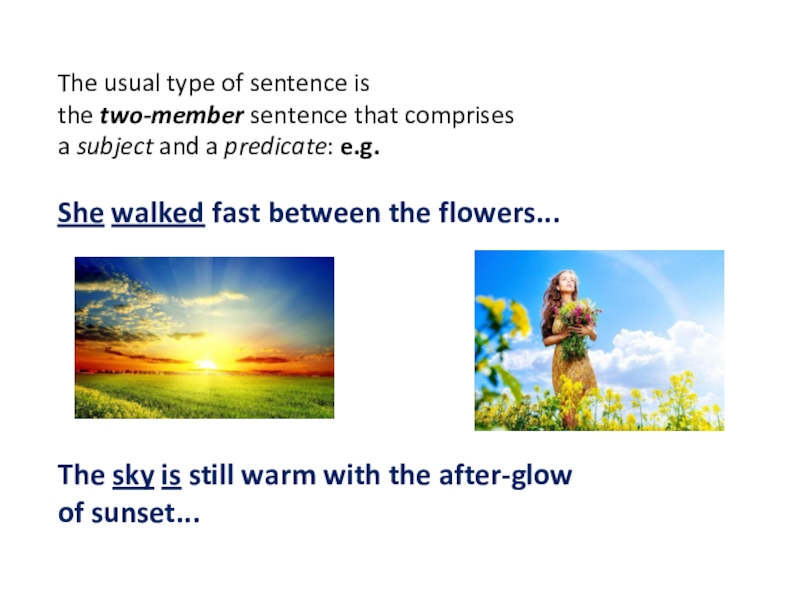
She walked fast

between the flowers...


The sky is still warm with the after-glow of sunset...
The usual type of sentence is the two-member sentence that comprises a subject and a predicate: e.g.She walked fast between the flowers... The sky is still warm with

Что такое shareslide.ru?

Это сайт презентаций, где можно хранить и обмениваться своими презентациями, докладами, проектами, шаблонами в формате PowerPoint с другими пользователями. Мы помогаем школьникам, студентам, учителям, преподавателям хранить и обмениваться учебными материалами.


Для правообладателей

Яндекс.Метрика

Обратная связь

Email: Нажмите что бы посмотреть