- Главная
- Разное
- Образование
- Спорт
- Естествознание
- Природоведение
- Религиоведение
- Французский язык
- Черчение
- Английский язык
- Астрономия
- Алгебра
- Биология
- География
- Геометрия
- Детские презентации
- Информатика
- История
- Литература
- Математика
- Музыка
- МХК
- Немецкий язык
- ОБЖ
- Обществознание
- Окружающий мир
- Педагогика
- Русский язык
- Технология
- Физика
- Философия
- Химия
- Шаблоны, фоны, картинки для презентаций
- Экология
- Экономика
Презентация, доклад по билингвальной биологии на тему Палеонтология
Содержание
- 1. Презентация по билингвальной биологии на тему Палеонтология
- 2. The formation of fossilsFossils are generally of
- 3. The formation of fossilsNot all fossils are
- 4. Fossil DNAThe current limit for fossil DNA
- 5. Finding fossilsThe discovery of fossils is greatly
- 6. Dating of Sedimentary Rock© 2016 Paul Billiet ODWS
- 7. Relative datingSedimentary rock is laid down in
- 8. Absolute datingAccurate dating can be obtained using
- 9. Potassium-Argon Method Potassium-40 (40-K) decays to form
- 10. Potassium-Argon MethodVolcanic rock is particularly useful for
- 11. Carbon-14 Method Carbon-14 (14-C) decays to form
- 12. Carbon-14 MethodThe ratio of 14-C to 12-C
- 13. Carbon-14 Method © 2016 Paul Billiet ODWS
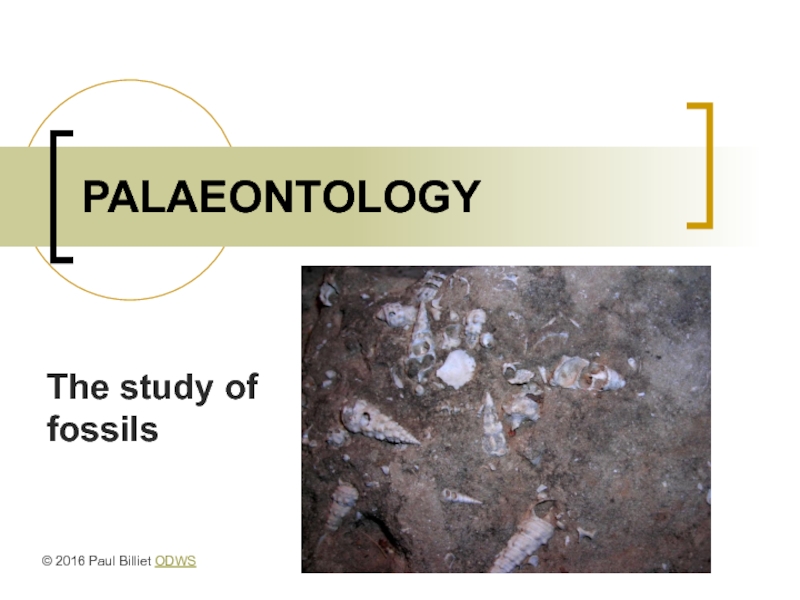
The formation of fossilsFossils are generally of rock that had replaced the preserved organism or its tracesIt usually occurs when the organism is covered quickly so it is preserved Sediment, forming sedimentary rock, is then laid
Слайд 2The formation of fossils
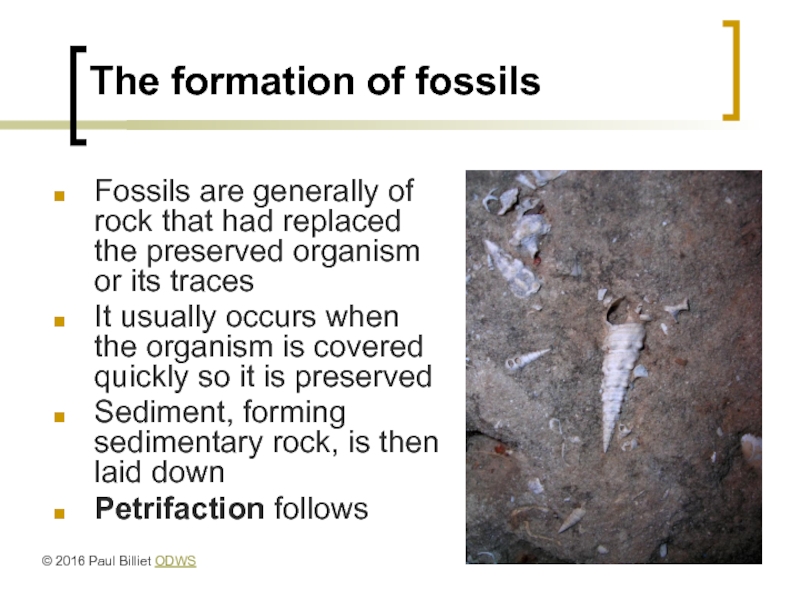
Fossils are generally of rock that had replaced
the preserved organism or its traces
It usually occurs when the organism is covered quickly so it is preserved
Sediment, forming sedimentary rock, is then laid down
Petrifaction follows
It usually occurs when the organism is covered quickly so it is preserved
Sediment, forming sedimentary rock, is then laid down
Petrifaction follows
© 2016 Paul Billiet ODWS
Слайд 3The formation of fossils
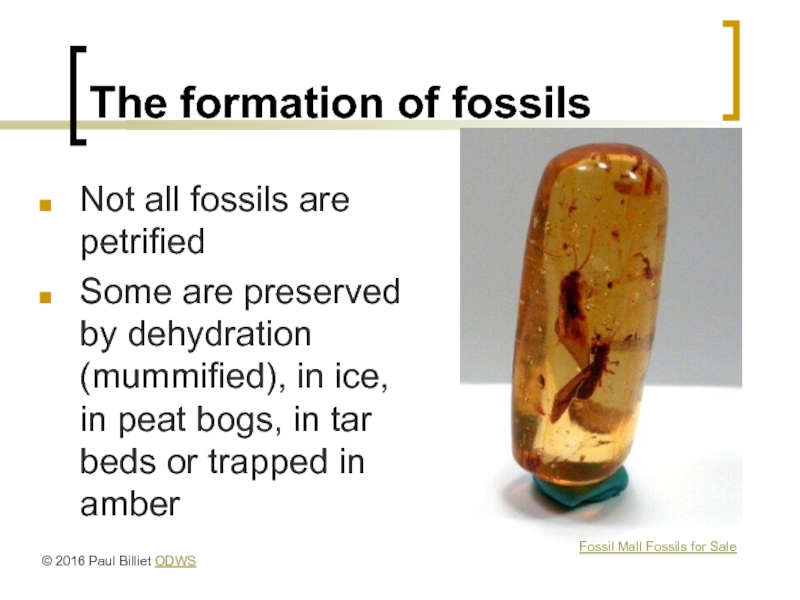
Not all fossils are petrified
Some are preserved
by dehydration (mummified), in ice, in peat bogs, in tar beds or trapped in amber
Fossil Mall Fossils for Sale
© 2016 Paul Billiet ODWS
Слайд 4Fossil DNA
The current limit for fossil DNA appears to be about
100 000 years old
Oxygen and water damage the molecule with time.
Oxygen and water damage the molecule with time.
Amazon.com
© 2016 Paul Billiet ODWS
Слайд 5Finding fossils
The discovery of fossils is greatly assisted where there has
been natural erosion, which exposes the deeper, older layers containing the fossils
Useful sites include gorges, quarries, caves and desert areas.
Therefore, fossils are only formed under certain conditions and then have to be uncovered
The chance that a body will be fossilised is rare and the chance that it will be discovered is even rarer
The fossil record is far from complete
This may account for the ‘missing links’ and for apparently restricted distribution of many species
But palaeontologists can improve their chances by searching systematically in places where fossils are likely to be found
Useful sites include gorges, quarries, caves and desert areas.
Therefore, fossils are only formed under certain conditions and then have to be uncovered
The chance that a body will be fossilised is rare and the chance that it will be discovered is even rarer
The fossil record is far from complete
This may account for the ‘missing links’ and for apparently restricted distribution of many species
But palaeontologists can improve their chances by searching systematically in places where fossils are likely to be found
© 2016 Paul Billiet ODWS
Слайд 7Relative dating
Sedimentary rock is laid down in layers or strata the
deepest usually being the oldest
This sequence forms the stratigraphy of the rock and together with the fossils and artefacts which are present, give a relative dating
However, due to earth movements in the past and to the great time spans and migrations of some organisms, this method is not very accurate.
This sequence forms the stratigraphy of the rock and together with the fossils and artefacts which are present, give a relative dating
However, due to earth movements in the past and to the great time spans and migrations of some organisms, this method is not very accurate.
© 2016 Paul Billiet ODWS
Слайд 8Absolute dating
Accurate dating can be obtained using radiometric dating
This uses the
phenomenon of radioactive decay of isotopes
When sedimentation occurs radioactive isotopes are incorporated
These decay to form other atoms at a known rate
This rate is measured as the half-life of the isotope, defined as the time taken for half the parent atoms to decay to the daughter atoms
When sedimentation occurs radioactive isotopes are incorporated
These decay to form other atoms at a known rate
This rate is measured as the half-life of the isotope, defined as the time taken for half the parent atoms to decay to the daughter atoms
© 2016 Paul Billiet ODWS
Слайд 9Potassium-Argon Method
Potassium-40 (40-K) decays to form Argon-40 (40-Ar), which is
trapped in the rocks
The amount of argon is measured, so that this is known as an accumulation method
The half-life of 40-K is 1.3 x10⁶ years, so it is useful for dating very old rock (as old as the Earth), the minimum age being 100 000 years.
The limitation is the degree of precision of the measuring devices
As these improve more recent events may be dated
The amount of argon is measured, so that this is known as an accumulation method
The half-life of 40-K is 1.3 x10⁶ years, so it is useful for dating very old rock (as old as the Earth), the minimum age being 100 000 years.
The limitation is the degree of precision of the measuring devices
As these improve more recent events may be dated
© 2016 Paul Billiet ODWS
Слайд 10Potassium-Argon Method
Volcanic rock is particularly useful for this technique
When it melts
the rock releases any 40-Ar it has in it, setting the clock to zero
Then when the molten rock crystallises it becomes impermeable which traps 40-Ar gas so it cannot escape
With time the 40-Ar builds up and the 40-K diminishes
Volcanic rock, however, does not contain fossils
So when fossils are dated using this method their association with the lava flow or ash fall needs to be established
Then when the molten rock crystallises it becomes impermeable which traps 40-Ar gas so it cannot escape
With time the 40-Ar builds up and the 40-K diminishes
Volcanic rock, however, does not contain fossils
So when fossils are dated using this method their association with the lava flow or ash fall needs to be established
© 2016 Paul Billiet ODWS
Слайд 11Carbon-14 Method
Carbon-14 (14-C) decays to form nitrogen-14
Carbon-14 is formed in
the upper atmosphere by the action of cosmic rays on Nitrogen-14
14-C is oxidised to 14-CO2 that gets taken up by plants in photosynthesis. The 14-C becomes incorporated in living tissue and travels up the food chain like other isotopes of Carbon (e.g. 12-C)
Whilst an organism is living it incorporates a known amount of carbon-14
At death, no more is taken in, and so the amount declines as the 14-C decays back to 14-N
Death starts the clock!
14-C is oxidised to 14-CO2 that gets taken up by plants in photosynthesis. The 14-C becomes incorporated in living tissue and travels up the food chain like other isotopes of Carbon (e.g. 12-C)
Whilst an organism is living it incorporates a known amount of carbon-14
At death, no more is taken in, and so the amount declines as the 14-C decays back to 14-N
Death starts the clock!
© 2016 Paul Billiet ODWS
Слайд 12Carbon-14 Method
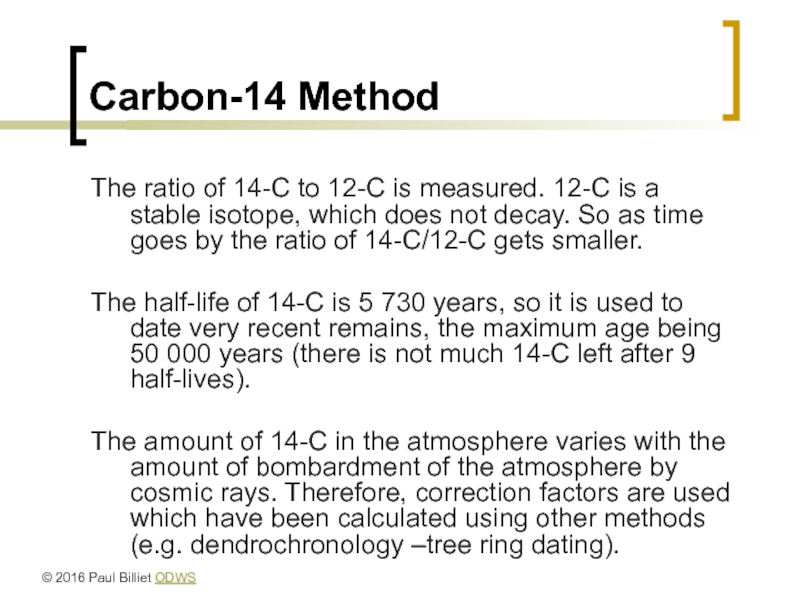
The ratio of 14-C to 12-C is measured. 12-C is
a stable isotope, which does not decay. So as time goes by the ratio of 14-C/12-C gets smaller.
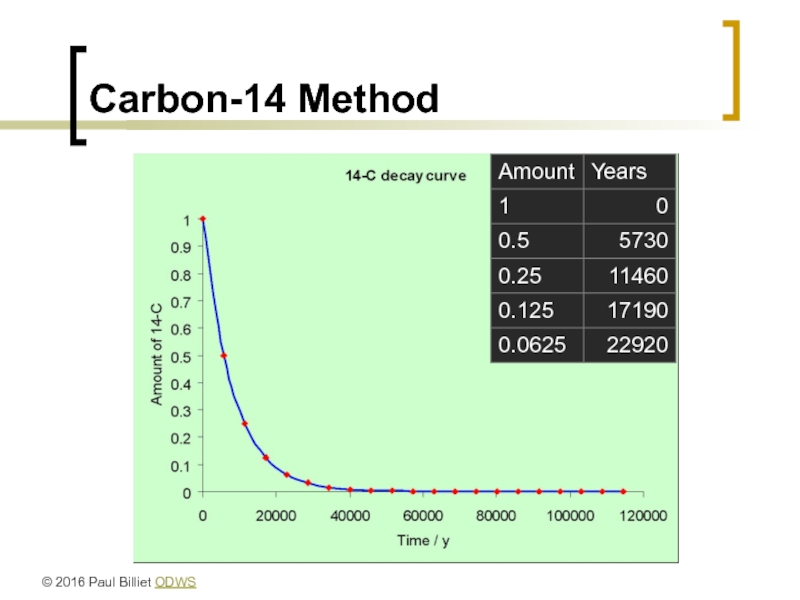
The half-life of 14-C is 5 730 years, so it is used to date very recent remains, the maximum age being 50 000 years (there is not much 14-C left after 9 half-lives).
The amount of 14-C in the atmosphere varies with the amount of bombardment of the atmosphere by cosmic rays. Therefore, correction factors are used which have been calculated using other methods (e.g. dendrochronology –tree ring dating).
The half-life of 14-C is 5 730 years, so it is used to date very recent remains, the maximum age being 50 000 years (there is not much 14-C left after 9 half-lives).
The amount of 14-C in the atmosphere varies with the amount of bombardment of the atmosphere by cosmic rays. Therefore, correction factors are used which have been calculated using other methods (e.g. dendrochronology –tree ring dating).
© 2016 Paul Billiet ODWS