Uzeyir Hajibeyov
- Главная
- Разное
- Образование
- Спорт
- Естествознание
- Природоведение
- Религиоведение
- Французский язык
- Черчение
- Английский язык
- Астрономия
- Алгебра
- Биология
- География
- Геометрия
- Детские презентации
- Информатика
- История
- Литература
- Математика
- Музыка
- МХК
- Немецкий язык
- ОБЖ
- Обществознание
- Окружающий мир
- Педагогика
- Русский язык
- Технология
- Физика
- Философия
- Химия
- Шаблоны, фоны, картинки для презентаций
- Экология
- Экономика
Презентация, доклад на тему Uzeir Hajibeyov is the great Azerbaijani composer.
Содержание
- 1. Uzeir Hajibeyov is the great Azerbaijani composer.
- 2. Uzeyir bey Abdul Huseyn oglu Hajibeyov was
- 3. Hajibeyov received his early education in a
- 4. The singers liked my voice. They would
- 5. In 1908, Hajibeyov wrote his first opera, Leyli
- 6. Hajibeyov's second opera Sheikh Sanan was written in 1909
- 7. In October 2006, the musical comedy Arshin Mal
- 8. In 1931, Hajibeyov helped in establishing the
- 9. In 1936, Hajibeyov assisted in founding of
- 10. Hajibeyov was the creator of the first
- 11. Hajibeyov died of diabetes at the age of 63,
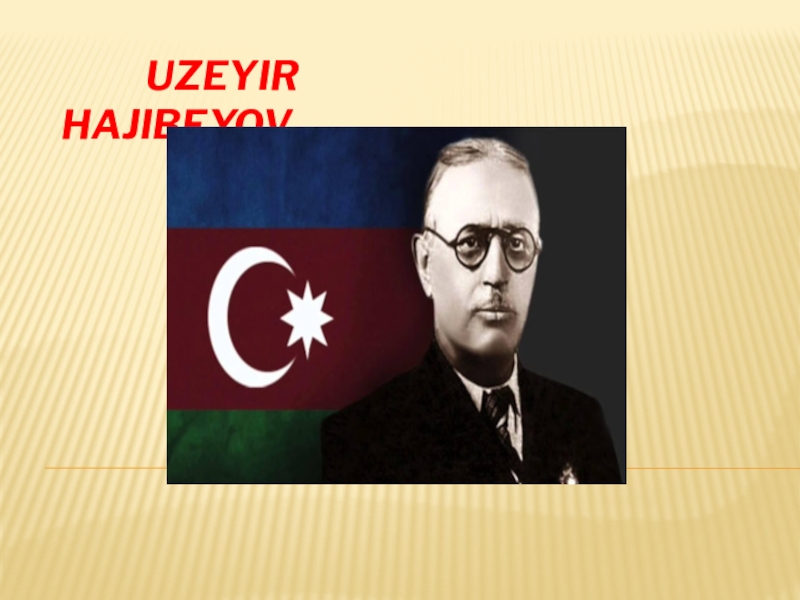
Uzeyir bey Abdul Huseyn oglu Hajibeyov was born on September 18, 1885 in Shusha (Aghjabadi village), he was an Azerbaijani and Soviet composer, conductor, publicist, playwright, teacher, translator, and social figure from Azerbaijan. He is recognized as the father of Azerbaijani composed classical music and opera. Uzeyir Hajibeyov
Слайд 2Uzeyir bey Abdul Huseyn oglu Hajibeyov was born on September 18,
1885 in Shusha (Aghjabadi village), he was an Azerbaijani and Soviet composer, conductor, publicist, play
wright, teacher, translator, and social figure from Azerbaijan. He is recognized as the father of Azerbaijani composed classical music and opera. Uzeyir Hajibeyov composed the music of the national anthem of Azerbaijan Democratic Republic (which was re-adopted after Azerbaijan regained its independence from the Soviet Union in 1991). He also composed the anthem used by Azerbaijan during the Soviet period. He was the first composer of an opera in the Islamic world.
wright, teacher, translator, and social figure from Azerbaijan. He is recognized as the father of Azerbaijani composed classical music and opera. Uzeyir Hajibeyov composed the music of the national anthem of Azerbaijan Democratic Republic (which was re-adopted after Azerbaijan regained its independence from the Soviet Union in 1991). He also composed the anthem used by Azerbaijan during the Soviet period. He was the first composer of an opera in the Islamic world.
Слайд 3Hajibeyov received his early education in a religious school (madrasah), where
he perfected his Arabic and Persian. Later he studied at a two-year Russian-Azerbaijani school. Here, with the help of his favourite teacher Mirza Mehdi Hasanzadeh, he familiarized himself with the heritage of the famous classic writers of the East and the West. The richness of the musical performance tradition of Shusha greatly influenced the musical education of Uzeyir Hajibeyov. He would later reflect on his experiences: "The first musical education I got as a child in Shusha came from best singers and saz-players. At that time I sang mughams and tasnifs.
Слайд 4The singers liked my voice. They would make me sing and
teach me at the same time." Uzeyir Hajibeyov's first teacher was his uncle Agalar Aliverdibeyov, an excellent connoisseur of Azeri folk music. In 1897–1898, when Azerbaijani playwright Abdurrahim Hagverdiyev and singer Jabbar Garyagdyoglustaged the episode Majnun on Leyli's grave from Leyli and Majnun, 13-year old Uzeyir sang in the choir. From 1899 to 1904 Uzeyir Hajibeyov studied at the Gori Pedagogical Seminary. There, along with general education, he also acquired music. In this school Hajibeyov learned to play the violin, the violoncello and the brass instrument.
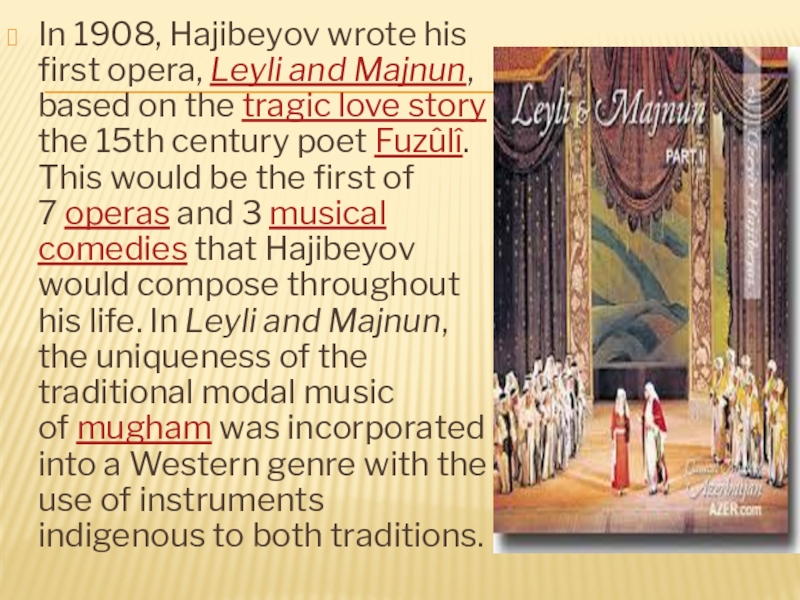
Слайд 5In 1908, Hajibeyov wrote his first opera, Leyli and Majnun, based on
the tragic love story by the 15th century poet Fuzûlî. This would be the first of 7 operas and 3 musical comedies that Hajibeyov would compose throughout his life. In Leyli and Majnun, the uniqueness of the traditional modal music of mugham was incorporated into a Western genre with the use of instruments indigenous to both traditions.
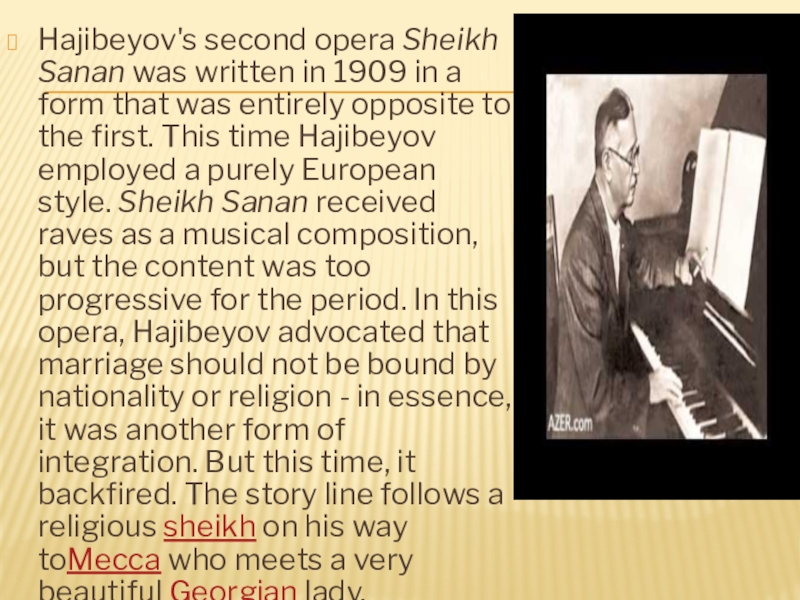
Слайд 6Hajibeyov's second opera Sheikh Sanan was written in 1909 in a form that
was entirely opposite to the first. This time Hajibeyov employed a purely European style. Sheikh Sanan received raves as a musical composition, but the content was too progressive for the period. In this opera, Hajibeyov advocated that marriage should not be bound by nationality or religion - in essence, it was another form of integration. But this time, it backfired. The story line follows a religious sheikh on his way toMecca who meets a very beautiful Georgian lady.
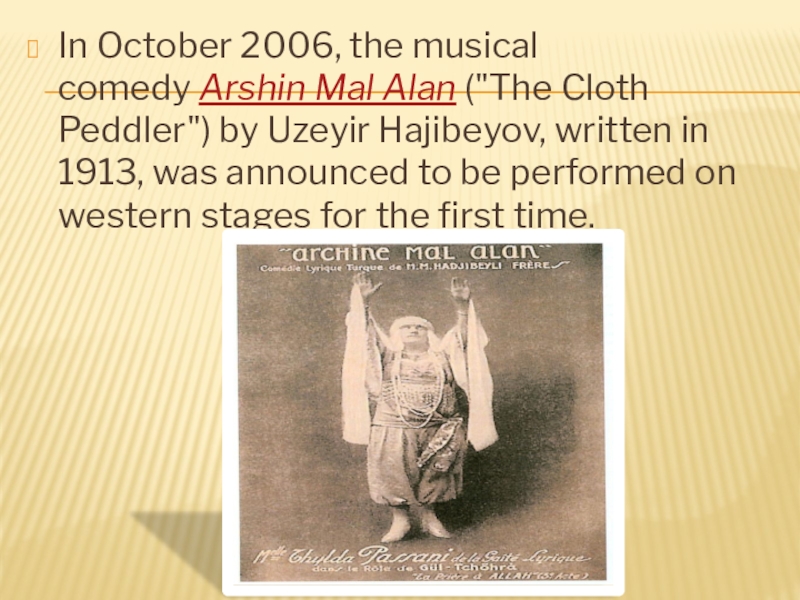
Слайд 7In October 2006, the musical comedy Arshin Mal Alan ("The Cloth Peddler") by
Uzeyir Hajibeyov, written in 1913, was announced to be performed on western stages for the first time.
Слайд 8In 1931, Hajibeyov helped in establishing the Azeri Folk Instruments Orchestra
affiliated with the Radio Committee. This orchestra performed European classical pieces, such as those by Mikhail Glinka, Wolfgang Amadeus Mozart, Franz Schubert, Georges Bizet and others. Hajibeyov thus was the first musician to adapt the note system to traditional Azeri musical instruments.
Слайд 9In 1936, Hajibeyov assisted in founding of the Azerbaijani State Choir
within the Azerbaijan Philharmonic Society. One of the most serious problems he faced was the mono-voiced repertoire of Azeri folk songs, which allowed harmonization distort style of the song and, on occasion, even alter the melody line when it changed modes. Hajibeyov resolved this problem by using contrapuntal polyphony andunison-doubling rather than four-part singing in the problematic sections.
Слайд 10Hajibeyov was the creator of the first operas and operettas in the Orient. In 1938,
he was awarded with the title of People's Artist of the USSR. During the entire Soviet history, only three or four Azerbaijani musicians ever attained this level. He was also honored with the Order of Lenin and the Stalin Prize which he won twice, once in 1941 for the opera Koroghlu (1936), and the other time in 1946 for the 1945 film based on his opera Arshin Mal Alan.
Hajibeyov was a professor at the Baku Academy of Music (of which he was also head in 1928–1929 and 1939–1948) and Active Member of the Academy of Sciences of Azerbaijan. For the last 10 years of his life, he was Chairman of the Union of Azerbaijani Composers.
Hajibeyov was a professor at the Baku Academy of Music (of which he was also head in 1928–1929 and 1939–1948) and Active Member of the Academy of Sciences of Azerbaijan. For the last 10 years of his life, he was Chairman of the Union of Azerbaijani Composers.
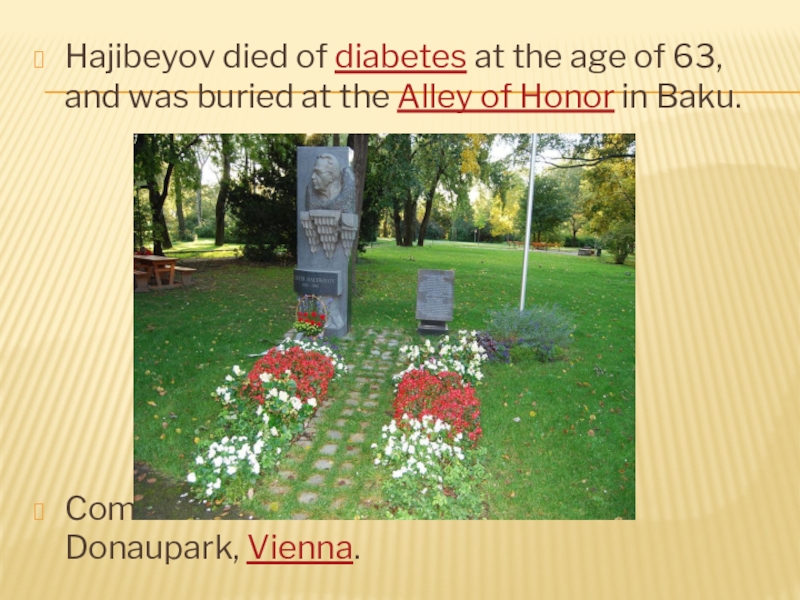
Слайд 11Hajibeyov died of diabetes at the age of 63, and was buried at
the Alley of Honor in Baku.
Commemorative stelae in Donaupark, Vienna.
Commemorative stelae in Donaupark, Vienna.