- Главная
- Разное
- Образование
- Спорт
- Естествознание
- Природоведение
- Религиоведение
- Французский язык
- Черчение
- Английский язык
- Астрономия
- Алгебра
- Биология
- География
- Геометрия
- Детские презентации
- Информатика
- История
- Литература
- Математика
- Музыка
- МХК
- Немецкий язык
- ОБЖ
- Обществознание
- Окружающий мир
- Педагогика
- Русский язык
- Технология
- Физика
- Философия
- Химия
- Шаблоны, фоны, картинки для презентаций
- Экология
- Экономика
Презентация, доклад по внеклассной работе Welcome to Scotland
Содержание
- 1. Презентация по внеклассной работе Welcome to Scotland
- 2. Physical FactsTotal Area: 78.772 sq km Urban
- 3. People FactsPopulation: ~ 5.15 million, 48% male,
- 4. Scotland`s GeographyScotland is approximately half the size
- 5. Symbols of Scotland
- 6. FlagSt. Andrew is believed to have died
- 7. EmblemThe thistle is the national emblem of
- 8. Foreign tourists. What do they see?Edinburgh Castle;Kelvingrove
- 9. What do they enjoy visiting?Edinburgh International FestivalFringe FestivalHighland GamesEdinburgh MelaSaint Andrew`s DayTattoo SpectacularBurns` Night
- 10. Edinburgh International Festival The Edinburgh International Festival
- 11. Fringe Festival The Edinburgh Festival from the
- 12. Highland GamesThe games which are now celebrated
- 13. Scotsmen`s hobbyScottish people like to dance very
- 14. What Scotsmеn wearA Scotsman’s traditional clothes are
- 15. ClansEvery Scotsman belongs to a clan. A
- 16. TartansA tartan may be in different colours.
- 17. Edinburgh MelaMelas first came to Britain in
- 18. Saint Andrew`s DaySt. Andrews Day is on
- 19. Tattoo SpectacularThe Edinburgh military tattoo takes place
- 20. Burns` Night25 th of January is celebrated
- 21. Scotland and its peopleThe Scots: Whether in
- 22. Scottish namesIf a man is called Jock
- 23. How they speakScottish people speak English but
- 24. Scottish characterEnglish people say that Scottish people
- 25. Some quotes on Scottish characterTouch his head,
- 26. To be continued! Thank you very much!
Physical FactsTotal Area: 78.772 sq km Urban Area: 3% of totalMountains: Ben Nevis-1,344 m. Ben Macdhui-1,309 m. Braeriach-1,296 m. Cairn Toul-1,291, Cairn Corm-1,244 inLochs: 2% of total area, over 31,400: Lomond -71 sq km. Ness -56.
Слайд 1Did not strong connections draw me elsewhere, I believe Scotland would
be the country
I would choose to end my days in.
Benjamin Franklin
Слайд 2Physical Facts
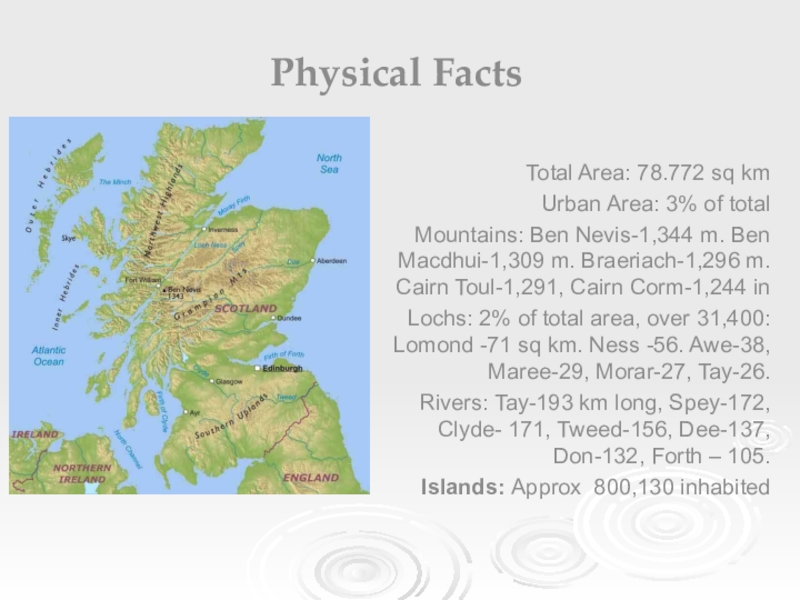
Total Area: 78.772 sq km
Urban Area: 3% of total
Mountains:
Ben Nevis-1,344 m. Ben Macdhui-1,309 m. Braeriach-1,296 m. Cairn Toul-1,291, Cairn Corm-1,244 in
Lochs: 2% of total area, over 31,400: Lomond -71 sq km. Ness -56. Awe-38, Maree-29, Morar-27, Tay-26.
Rivers: Tay-193 km long, Spey-172, Clyde- 171, Tweed-156, Dee-137, Don-132, Forth – 105.
Islands: Approx 800,130 inhabited
Lochs: 2% of total area, over 31,400: Lomond -71 sq km. Ness -56. Awe-38, Maree-29, Morar-27, Tay-26.
Rivers: Tay-193 km long, Spey-172, Clyde- 171, Tweed-156, Dee-137, Don-132, Forth – 105.
Islands: Approx 800,130 inhabited
Слайд 3People Facts
Population: ~ 5.15 million, 48% male, 52% female
Urban areas:
Glasgow~700,000; Edinburgh~400,000; Aberdeen -200,000; Dundee -150,000.
Citizens born outside Scotland: Total~10%: England-6.5%, N. Ireland-0.5%, Irish Republic-0.4%. Wales -0.3%, Rest of Europe-0.5%, Indian SubC-0.4%, Canada, Oz, NZ, SA - 0.3, USA 0.2%, SE Asia -0.2%.
Religion: Roman Catholic 14.0%, Church of Scotland (Presbyterian) - 13.0%. Episcopal 1.0%. Other Christian-1.5%, Muslim-0.5%, Hebrew-0.1%.
Citizens born outside Scotland: Total~10%: England-6.5%, N. Ireland-0.5%, Irish Republic-0.4%. Wales -0.3%, Rest of Europe-0.5%, Indian SubC-0.4%, Canada, Oz, NZ, SA - 0.3, USA 0.2%, SE Asia -0.2%.
Religion: Roman Catholic 14.0%, Church of Scotland (Presbyterian) - 13.0%. Episcopal 1.0%. Other Christian-1.5%, Muslim-0.5%, Hebrew-0.1%.
Слайд 4Scotland`s Geography
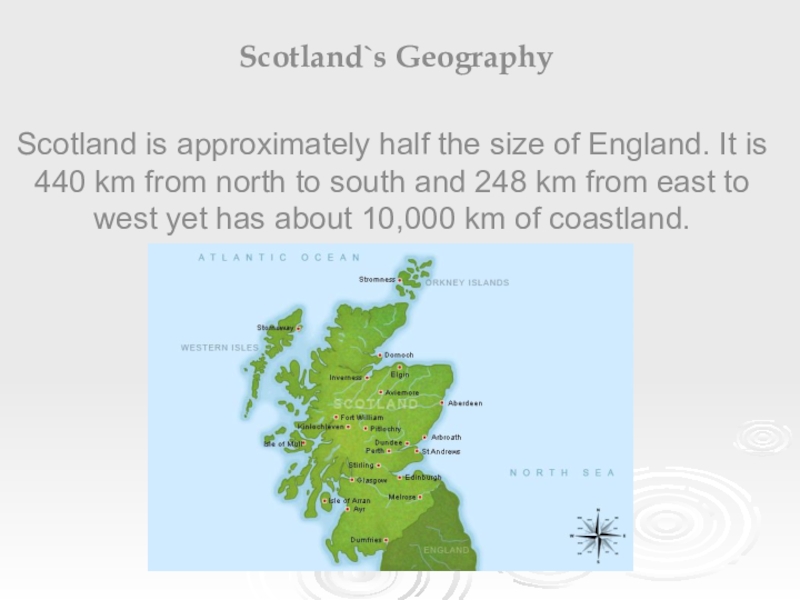
Scotland is approximately half the size of England. It is
440 km from north to south and 248 km from east to west yet has about 10,000 km of coastland.
Слайд 6Flag
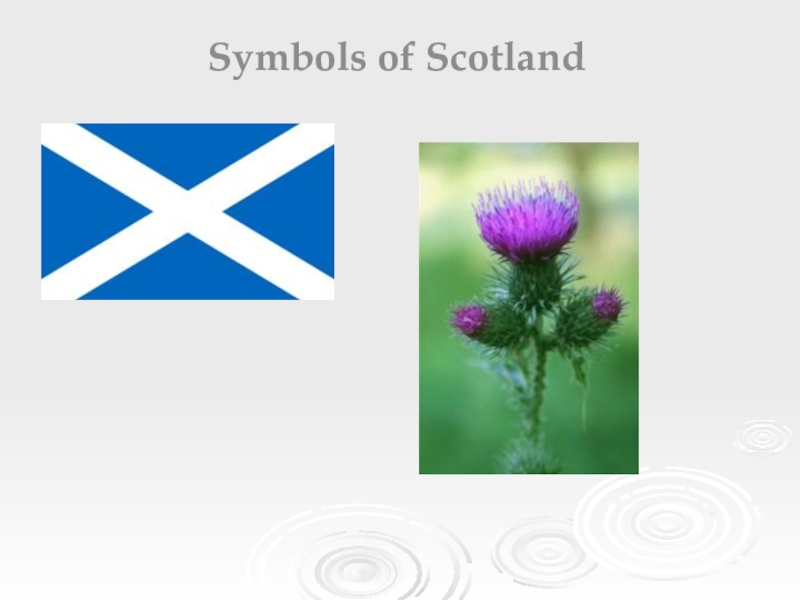
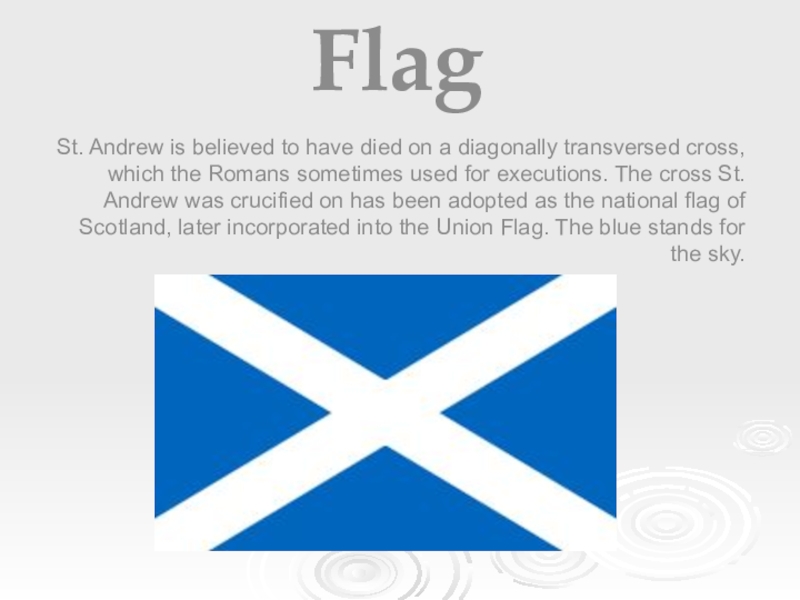
St. Andrew is believed to have died on a diagonally transversed
cross, which the Romans sometimes used for executions. The cross St. Andrew was crucified on has been adopted as the national flag of Scotland, later incorporated into the Union Flag. The blue stands for the sky.
Слайд 7Emblem
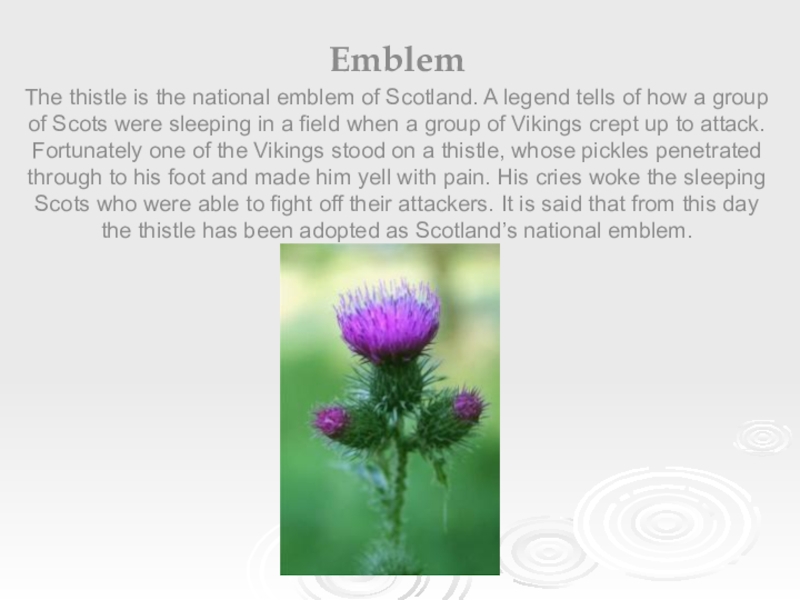
The thistle is the national emblem of Scotland. A legend tells
of how a group of Scots were sleeping in a field when a group of Vikings crept up to attack. Fortunately one of the Vikings stood on a thistle, whose pickles penetrated through to his foot and made him yell with pain. His cries woke the sleeping Scots who were able to fight off their attackers. It is said that from this day the thistle has been adopted as Scotland’s national emblem.
Слайд 8Foreign tourists.
What do they see?
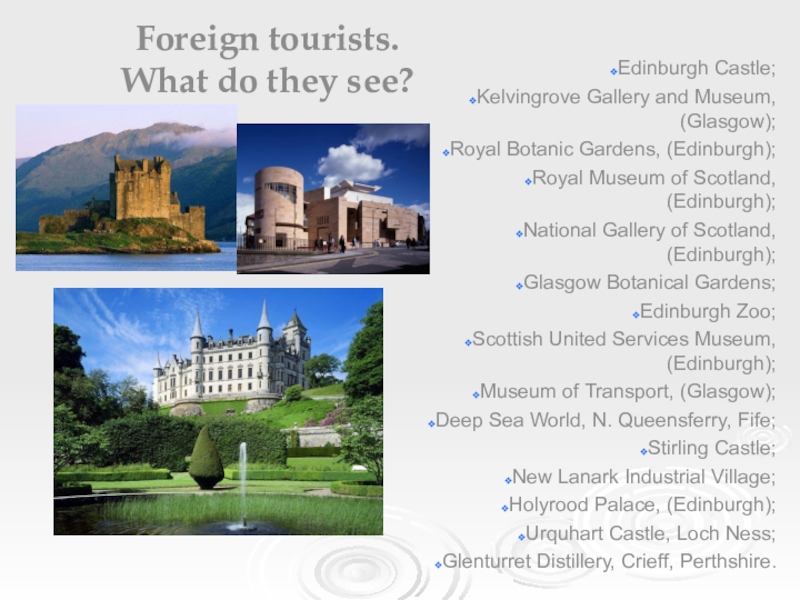
Edinburgh Castle;
Kelvingrove Gallery and Museum, (Glasgow);
Royal Botanic
Gardens, (Edinburgh);
Royal Museum of Scotland, (Edinburgh);
National Gallery of Scotland, (Edinburgh);
Glasgow Botanical Gardens;
Edinburgh Zoo;
Scottish United Services Museum, (Edinburgh);
Museum of Transport, (Glasgow);
Deep Sea World, N. Queensferry, Fife;
Stirling Castle;
New Lanark Industrial Village;
Holyrood Palace, (Edinburgh);
Urquhart Castle, Loch Ness;
Glenturret Distillery, Crieff, Perthshire.
Royal Museum of Scotland, (Edinburgh);
National Gallery of Scotland, (Edinburgh);
Glasgow Botanical Gardens;
Edinburgh Zoo;
Scottish United Services Museum, (Edinburgh);
Museum of Transport, (Glasgow);
Deep Sea World, N. Queensferry, Fife;
Stirling Castle;
New Lanark Industrial Village;
Holyrood Palace, (Edinburgh);
Urquhart Castle, Loch Ness;
Glenturret Distillery, Crieff, Perthshire.
Слайд 9What do they enjoy visiting?
Edinburgh International Festival
Fringe Festival
Highland Games
Edinburgh Mela
Saint Andrew`s
Day
Tattoo Spectacular
Burns` Night
Tattoo Spectacular
Burns` Night
Слайд 10Edinburgh International Festival
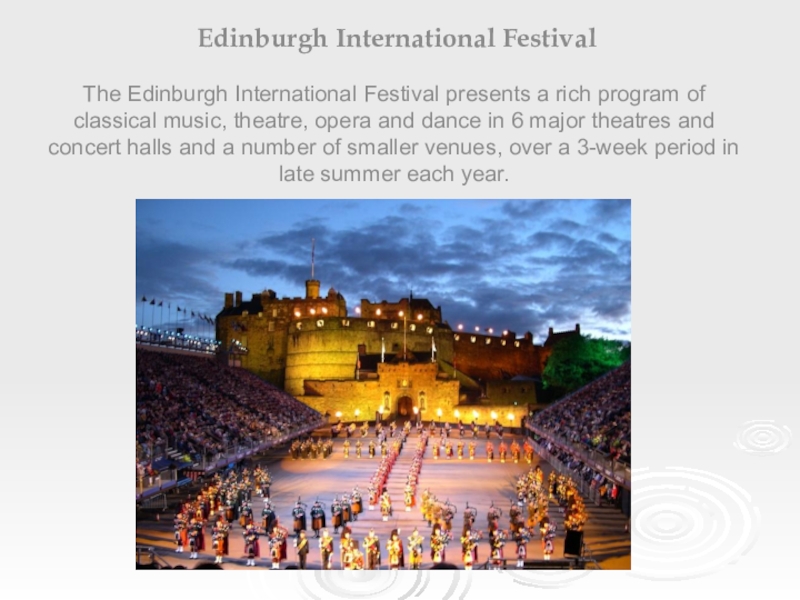
The Edinburgh International Festival presents a rich program
of classical music, theatre, opera and dance in 6 major theatres and concert halls and a number of smaller venues, over a 3-week period in late summer each year.
Слайд 11Fringe Festival
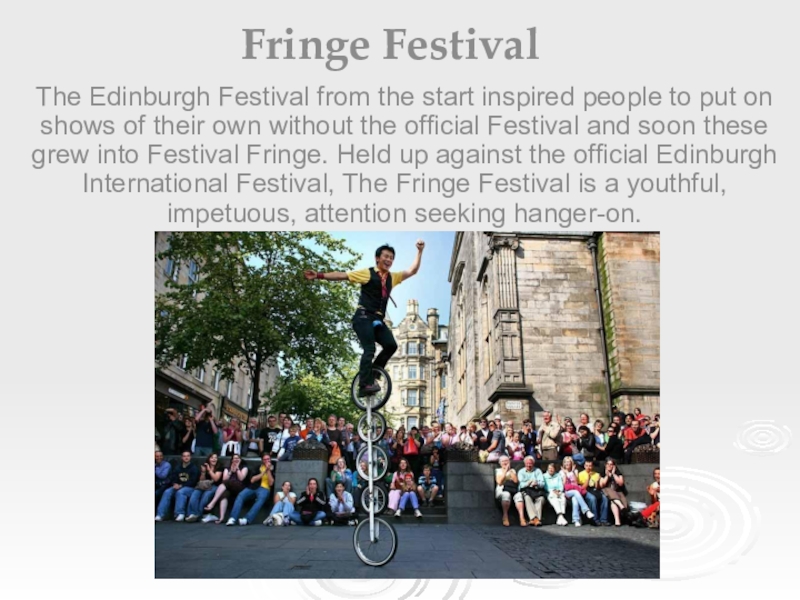
The Edinburgh Festival from the start inspired people to
put on shows of their own without the official Festival and soon these grew into Festival Fringe. Held up against the official Edinburgh International Festival, The Fringe Festival is a youthful, impetuous, attention seeking hanger-on.
Слайд 12Highland Games
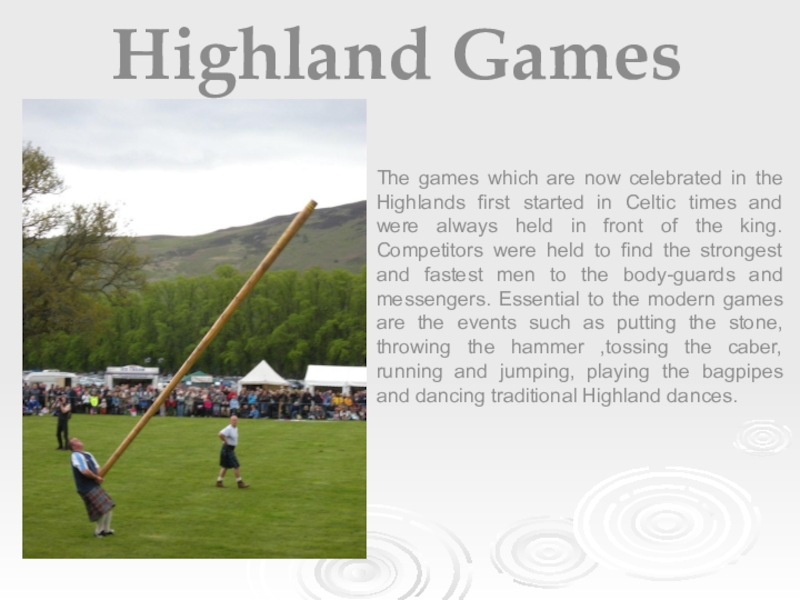
The games which are now celebrated in the Highlands first
started in Celtic times and were always held in front of the king. Competitors were held to find the strongest and fastest men to the body-guards and messengers. Essential to the modern games are the events such as putting the stone, throwing the hammer ,tossing the caber, running and jumping, playing the bagpipes and dancing traditional Highland dances.
Слайд 13Scotsmen`s hobby
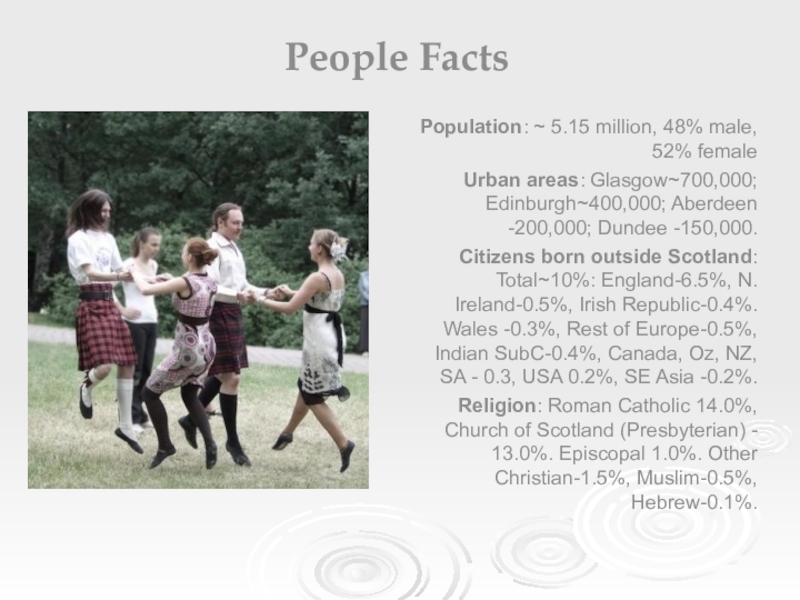
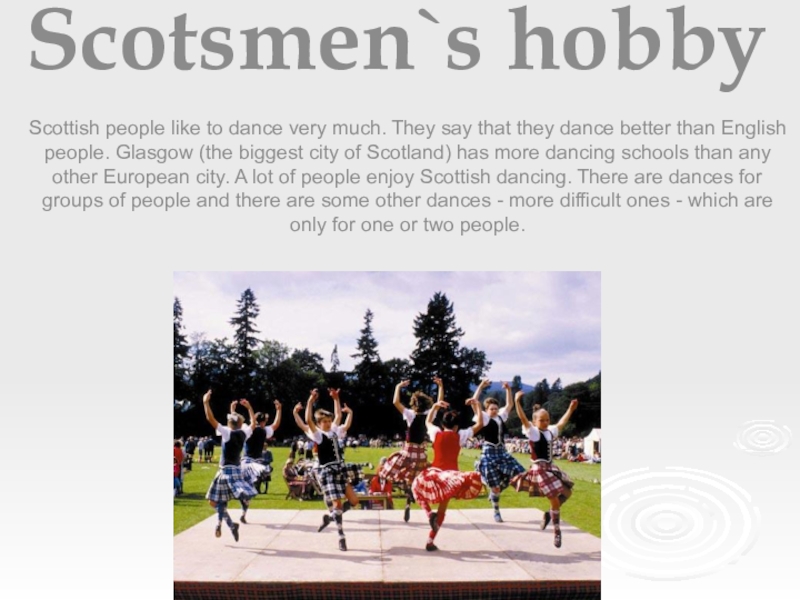
Scottish people like to dance very much. They say that
they dance better than English people. Glasgow (the biggest city of Scotland) has more dancing schools than any other European city. A lot of people enjoy Scottish dancing. There are dances for groups of people and there are some other dances - more difficult ones - which are only for one or two people.
Слайд 14What Scotsmеn wear
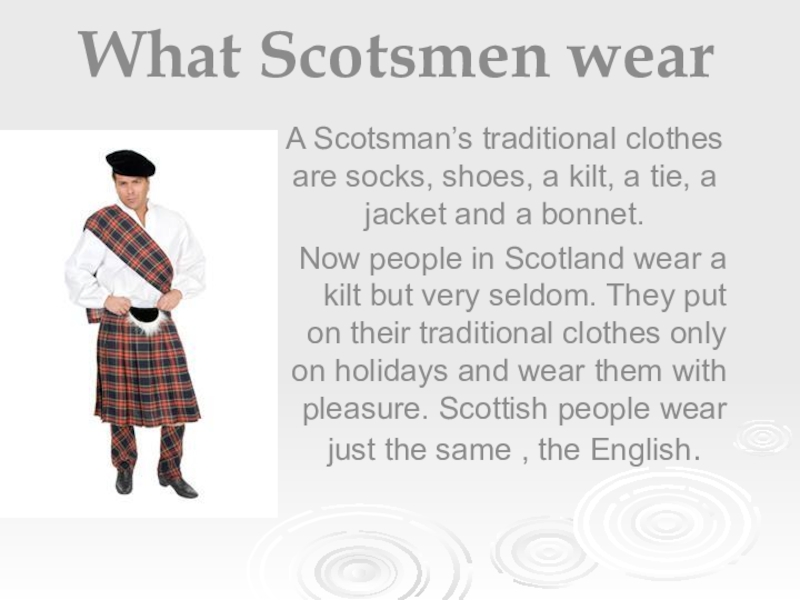
A Scotsman’s traditional clothes are socks, shoes, a kilt,
a tie, a jacket and a bonnet.
Now people in Scotland wear a kilt but very seldom. They put on their traditional clothes only on holidays and wear them with pleasure. Scottish people wear just the same , the English.
Now people in Scotland wear a kilt but very seldom. They put on their traditional clothes only on holidays and wear them with pleasure. Scottish people wear just the same , the English.
Слайд 15Clans
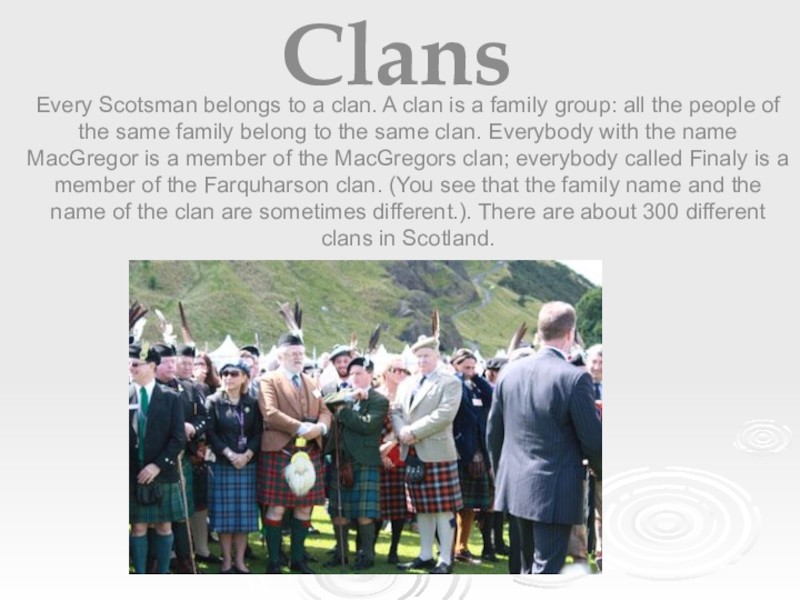
Every Scotsman belongs to a clan. A clan is a family
group: all the people of the same family belong to the same clan. Everybody with the name MacGregor is a member of the MacGregors clan; everybody called Finaly is a member of the Farquharson clan. (You see that the family name and the name of the clan are sometimes different.). There are about 300 different clans in Scotland.
Слайд 16Tartans
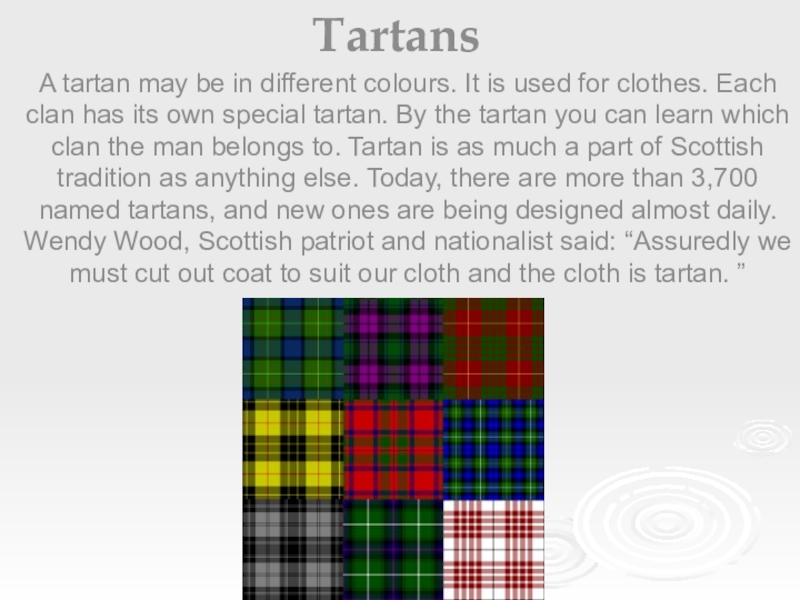
A tartan may be in different colours. It is used for
clothes. Each clan has its own special tartan. By the tartan you can learn which clan the man belongs to. Tartan is as much a part of Scottish tradition as anything else. Today, there are more than 3,700 named tartans, and new ones are being designed almost daily. Wendy Wood, Scottish patriot and nationalist said: “Assuredly we must cut out coat to suit our cloth and the cloth is tartan. ”
Слайд 17Edinburgh Mela
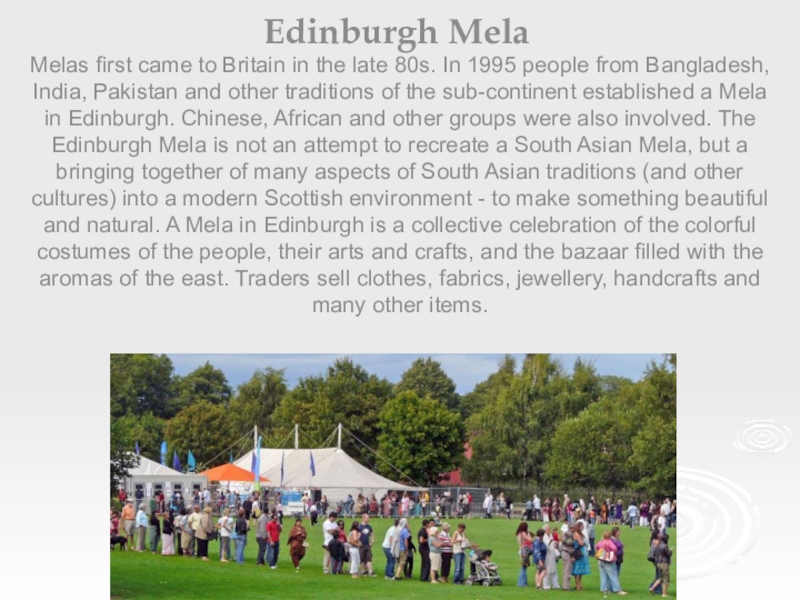
Melas first came to Britain in the late 80s. In
1995 people from Bangladesh, India, Pakistan and other traditions of the sub-continent established a Mela in Edinburgh. Chinese, African and other groups were also involved. The Edinburgh Mela is not an attempt to recreate a South Asian Mela, but a bringing together of many aspects of South Asian traditions (and other cultures) into a modern Scottish environment - to make something beautiful and natural. A Mela in Edinburgh is a collective celebration of the colorful costumes of the people, their arts and crafts, and the bazaar filled with the aromas of the east. Traders sell clothes, fabrics, jewellery, handcrafts and many other items.
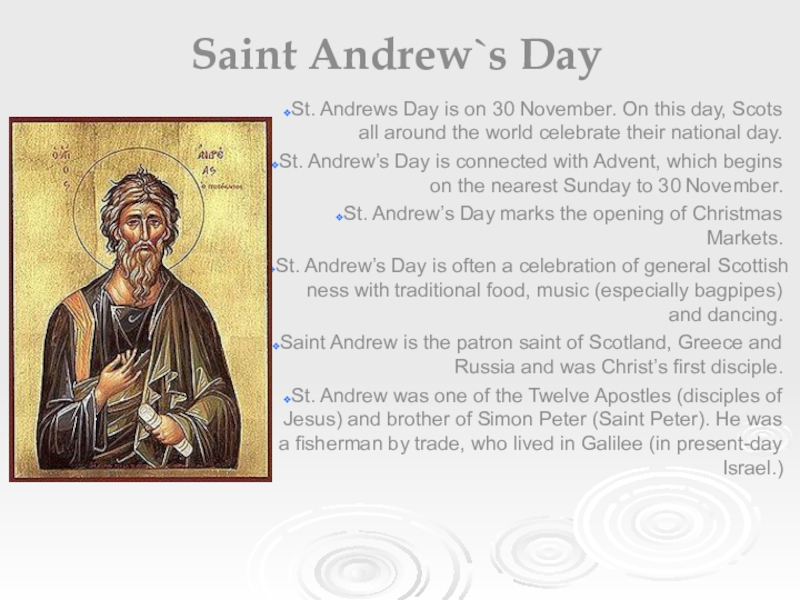
Слайд 18Saint Andrew`s Day
St. Andrews Day is on 30 November. On this
day, Scots all around the world celebrate their national day.
St. Andrew’s Day is connected with Advent, which begins on the nearest Sunday to 30 November.
St. Andrew’s Day marks the opening of Christmas Markets.
St. Andrew’s Day is often a celebration of general Scottish ness with traditional food, music (especially bagpipes) and dancing.
Saint Andrew is the patron saint of Scotland, Greece and Russia and was Christ’s first disciple.
St. Andrew was one of the Twelve Apostles (disciples of Jesus) and brother of Simon Peter (Saint Peter). He was a fisherman by trade, who lived in Galilee (in present-day Israel.)
St. Andrew’s Day is connected with Advent, which begins on the nearest Sunday to 30 November.
St. Andrew’s Day marks the opening of Christmas Markets.
St. Andrew’s Day is often a celebration of general Scottish ness with traditional food, music (especially bagpipes) and dancing.
Saint Andrew is the patron saint of Scotland, Greece and Russia and was Christ’s first disciple.
St. Andrew was one of the Twelve Apostles (disciples of Jesus) and brother of Simon Peter (Saint Peter). He was a fisherman by trade, who lived in Galilee (in present-day Israel.)
Слайд 19Tattoo Spectacular
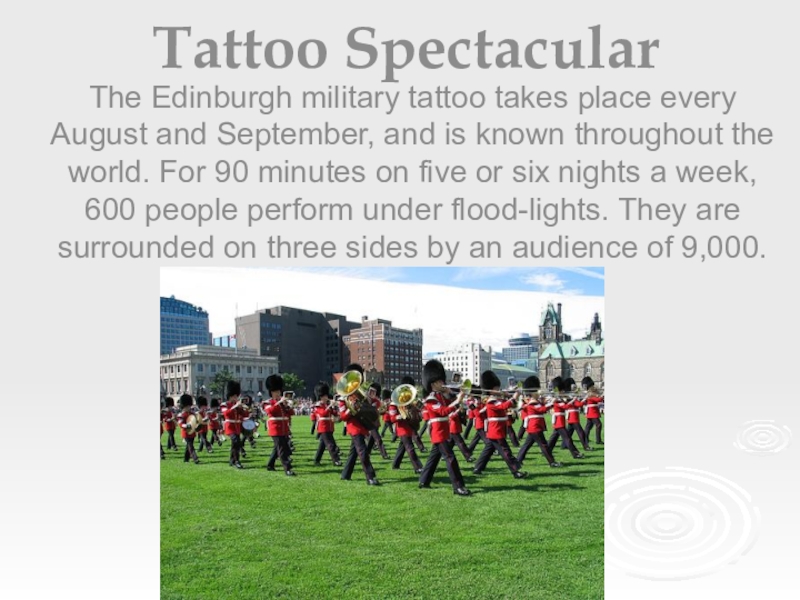
The Edinburgh military tattoo takes place every August and September,
and is known throughout the world. For 90 minutes on five or six nights a week, 600 people perform under flood-lights. They are surrounded on three sides by an audience of 9,000.
Слайд 20Burns` Night
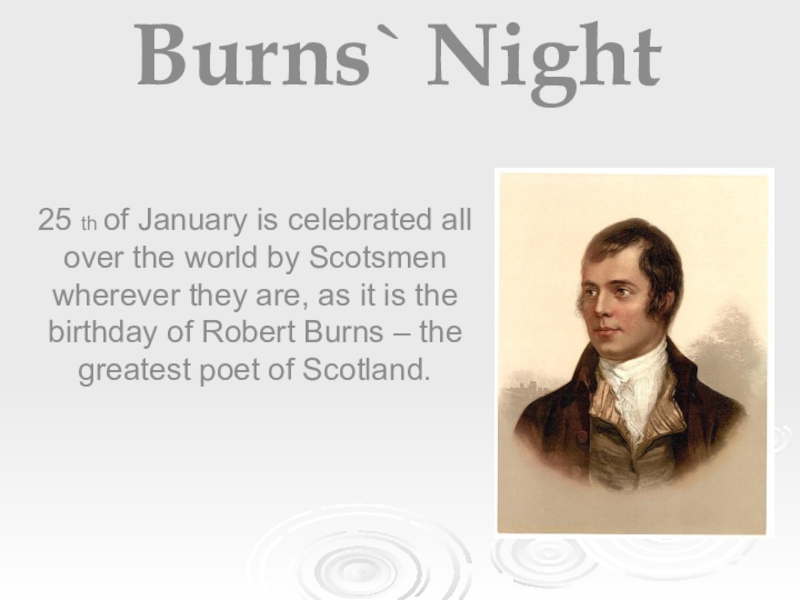
25 th of January is celebrated all over the world
by Scotsmen wherever they are, as it is the birthday of Robert Burns – the greatest poet of Scotland.
Слайд 21Scotland and its people
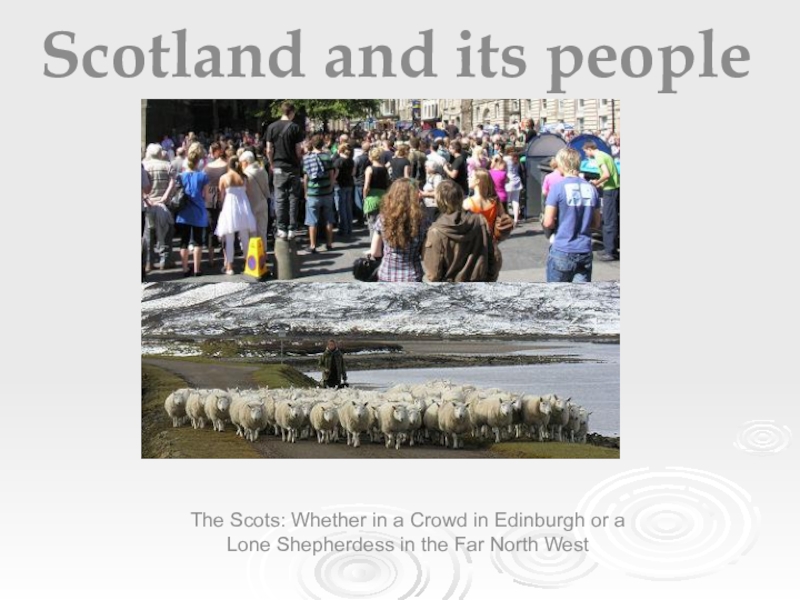
The Scots: Whether in a Crowd in Edinburgh
or a
Lone Shepherdess in the Far North West
Слайд 22Scottish names
If a man is called Jock MacTarvish, it is clear
that he is a Scotsman. A lot of Scottish family names begin with “Mac” or “Mc” - like MacDonald, MacMillian or McHale.
And Jock is a popular Scottish name for John or Jack. A lot of people in England call any Scotsman Jock even if his name is Peter or David. (Remember Russian Ivan or German Fruitz.)
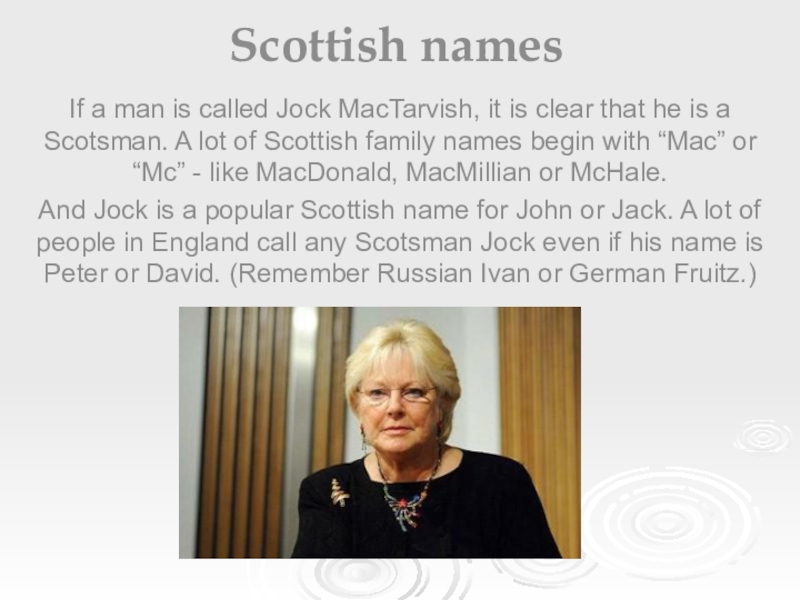
Politician Margo MacDonald
And Jock is a popular Scottish name for John or Jack. A lot of people in England call any Scotsman Jock even if his name is Peter or David. (Remember Russian Ivan or German Fruitz.)
Politician Margo MacDonald
Слайд 23How they speak
Scottish people speak English but with their own accent.
For example, when a Scotsman uses the word arm he says “ar-r-m” so that you can hear the sound “r”. They often use their native words such as loch which means lake.
Слайд 24Scottish character
English people say that Scottish people do not like to
spend money. Scottish people say that they like spending money on their friends and visitors - not on themselves.
People say that Scotsman work hard: many good doctors and engineers come from Scotland.
People say that Scotsman work hard: many good doctors and engineers come from Scotland.
Слайд 25Some quotes on Scottish character
Touch his head, and he will bargain
and argue with you to the last.
Touch his heart, and he falls upon your breast.
(Andrew Carnegie)
The truth is that we are at bottom the most sentimental and emotional people on earth.
(John Buchan)
Touch his heart, and he falls upon your breast.
(Andrew Carnegie)
The truth is that we are at bottom the most sentimental and emotional people on earth.
(John Buchan)