- Главная
- Разное
- Образование
- Спорт
- Естествознание
- Природоведение
- Религиоведение
- Французский язык
- Черчение
- Английский язык
- Астрономия
- Алгебра
- Биология
- География
- Геометрия
- Детские презентации
- Информатика
- История
- Литература
- Математика
- Музыка
- МХК
- Немецкий язык
- ОБЖ
- Обществознание
- Окружающий мир
- Педагогика
- Русский язык
- Технология
- Физика
- Философия
- Химия
- Шаблоны, фоны, картинки для презентаций
- Экология
- Экономика
Презентация, доклад по теме The famous places of interest of the USA
Содержание
- 1. Презентация по теме The famous places of interest of the USA
- 2. Contests:The Statue of LibertyThe White HouseNiagara FallsThe
- 3. The Statue of Liberty is a colossal
- 4. The White House is the official residence
- 5. Niagara Falls is the collective name for
- 6. The Golden Gate Bridge is a suspension
- 7. The Grand Canyon is a steep-sided canyon
- 8. Times Square is a major commercial intersection,
- 9. The Empire State Building is a 102-story
- 10. Hollywood is a neighborhood in the central
- 11. Mount Rushmore National Memorial is a sculpture
- 12. Roosevelt Island is a narrow island in
- 13. The Washington Monument is an obelisk on
Contests:The Statue of LibertyThe White HouseNiagara FallsThe Golden Gate BridgeThe Grand CanyonTimes SquareThe Empire State BuildingHollywoodMount RushmoreRoosevelt IslandWashington Monument
Слайд 2Contests:
The Statue of Liberty
The White House
Niagara Falls
The Golden Gate Bridge
The Grand
Canyon
Times Square
The Empire State Building
Hollywood
Mount Rushmore
Roosevelt Island
Washington Monument
Times Square
The Empire State Building
Hollywood
Mount Rushmore
Roosevelt Island
Washington Monument
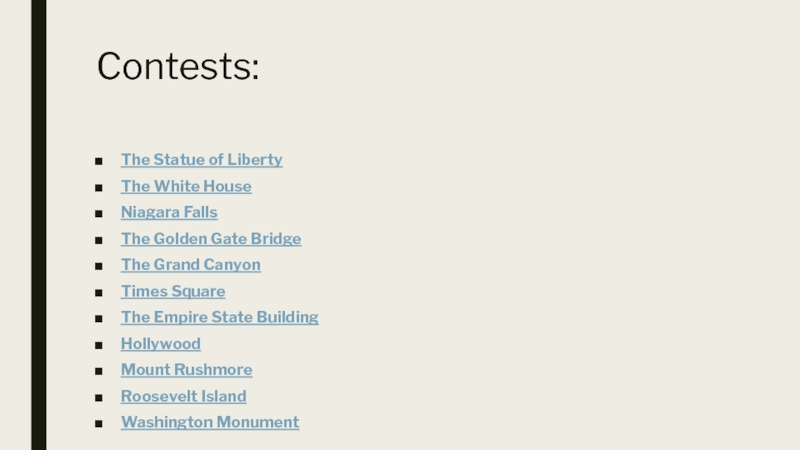
Слайд 3The Statue of Liberty is a colossal neoclassical sculpture on Liberty
Island in New York Harbor in New York City, in the United States. The copper statue, a gift from the people of France to the people of the United States, was designed by French sculptor Frédéric Auguste Bartholdi and built by Gustave Eiffel. The statue was dedicated on October 28, 1886.
The Statue of Liberty is a figure of a robed woman representing Libertas, a Roman goddess. She holds a torch above her head, and in her left arm carries a tabula ansata inscribed in Roman numerals with "JULY IV MDCCLXXVI" (July 4, 1776), the date of the U.S. Declaration of Independence. A broken chain lies at her feet. The statue became an icon of freedom and of the United States, and was a welcoming sight to immigrants arriving from abroad.
Bartholdi was inspired by a French law professor and politician, Édouard René de Laboulaye, who is said to have commented in 1865 that any monument raised to U.S. independence would properly be a joint project of the French and American peoples. Because of the post-war instability in France, work on the statue did not commence until the early 1870s. In 1875, Laboulaye proposed that the French finance the statue and the U.S. provide the site and build the pedestal. Bartholdi completed the head and the torch-bearing arm before the statue was fully designed, and these pieces were exhibited for publicity at international expositions.
The torch-bearing arm was displayed at the Centennial Exposition in Philadelphia in 1876, and in Madison Square Park in Manhattan from 1876 to 1882. Fundraising proved difficult, especially for the Americans, and by 1885 work on the pedestal was threatened by lack of funds. Publisher Joseph Pulitzer, of the New York World, started a drive for donations to finish the project and attracted more than 120,000 contributors, most of whom gave less than a dollar. The statue was built in France, shipped overseas in crates, and assembled on the completed pedestal on what was then called Bedloe's Island. The statue's completion was marked by New York's first ticker-tape parade and a dedication ceremony presided over by President Grover Cleveland.
The statue was administered by the United States Lighthouse Board until 1901 and then by the Department of War; since 1933 it has been maintained by the National Park Service. Public access to the balcony around the torch has been barred for safety since 1916.
The Statue of Liberty is a figure of a robed woman representing Libertas, a Roman goddess. She holds a torch above her head, and in her left arm carries a tabula ansata inscribed in Roman numerals with "JULY IV MDCCLXXVI" (July 4, 1776), the date of the U.S. Declaration of Independence. A broken chain lies at her feet. The statue became an icon of freedom and of the United States, and was a welcoming sight to immigrants arriving from abroad.
Bartholdi was inspired by a French law professor and politician, Édouard René de Laboulaye, who is said to have commented in 1865 that any monument raised to U.S. independence would properly be a joint project of the French and American peoples. Because of the post-war instability in France, work on the statue did not commence until the early 1870s. In 1875, Laboulaye proposed that the French finance the statue and the U.S. provide the site and build the pedestal. Bartholdi completed the head and the torch-bearing arm before the statue was fully designed, and these pieces were exhibited for publicity at international expositions.
The torch-bearing arm was displayed at the Centennial Exposition in Philadelphia in 1876, and in Madison Square Park in Manhattan from 1876 to 1882. Fundraising proved difficult, especially for the Americans, and by 1885 work on the pedestal was threatened by lack of funds. Publisher Joseph Pulitzer, of the New York World, started a drive for donations to finish the project and attracted more than 120,000 contributors, most of whom gave less than a dollar. The statue was built in France, shipped overseas in crates, and assembled on the completed pedestal on what was then called Bedloe's Island. The statue's completion was marked by New York's first ticker-tape parade and a dedication ceremony presided over by President Grover Cleveland.
The statue was administered by the United States Lighthouse Board until 1901 and then by the Department of War; since 1933 it has been maintained by the National Park Service. Public access to the balcony around the torch has been barred for safety since 1916.
The Statue of Liberty
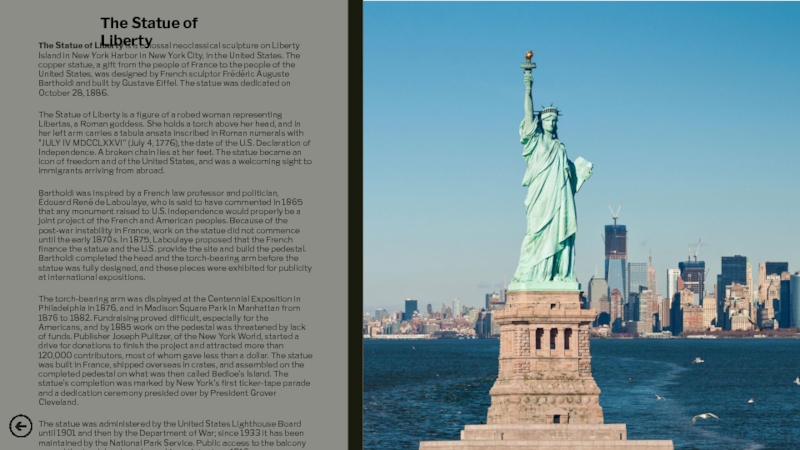
Слайд 4The White House is the official residence and workplace of the
President of the United States. It is located at 1600 Pennsylvania Avenue NW in Washington, D.C., and has been the residence of every U.S. president since John Adams in 1800. The term White House is often used as a metonym for the president and his advisers, as in "The White House announced that...".
The residence was designed by Irish-born architect James Hoban in the Neoclassical style. Construction took place between 1792 and 1800 using Aquia Creek sandstone painted white. When Thomas Jefferson moved into the house in 1801, he (with architect Benjamin Henry Latrobe) added low colonnades on each wing that concealed stables and storage. In 1814, during the War of 1812, the mansion was set ablaze by the British Army in the Burning of Washington, destroying the interior and charring much of the exterior. Reconstruction began almost immediately, and President James Monroe moved into the partially reconstructed Executive Residence in October 1817. Exterior construction continued with the addition of the semi-circular South portico in 1824 and the North portico in 1829.
Because of crowding within the executive mansion itself, President Theodore Roosevelt had all work offices relocated to the newly constructed West Wing in 1901. Eight years later in 1909, President William Howard Taft expanded the West Wing and created the first Oval Office, which was eventually moved as the section was expanded. In the main mansion, the third-floor attic was converted to living quarters in 1927 by augmenting the existing hip roof with long shed dormers. A newly constructed East Wing was used as a reception area for social events; Jefferson's colonnades connected the new wings. East Wing alterations were completed in 1946, creating additional office space. By 1948, the house's load-bearing exterior walls and internal wood beams were found to be close to failure. Under Harry S. Truman, the interior rooms were completely dismantled and a new internal load-bearing steel frame constructed inside the walls. Once this work was completed, the interior rooms were rebuilt.
The modern-day White House complex includes the Executive Residence, West Wing, East Wing, the Eisenhower Executive Office Building—the former State Department, which now houses offices for the President's staff and the Vice President—and Blair House, a guest residence. The Executive Residence is made up of six stories—the Ground Floor, State Floor, Second Floor, and Third Floor, as well as a two-story basement. The property is a National Heritage Site owned by the National Park Service and is part of the President's Park. In 2007, it was ranked second on the American Institute of Architects list of "America's Favorite Architecture".
The residence was designed by Irish-born architect James Hoban in the Neoclassical style. Construction took place between 1792 and 1800 using Aquia Creek sandstone painted white. When Thomas Jefferson moved into the house in 1801, he (with architect Benjamin Henry Latrobe) added low colonnades on each wing that concealed stables and storage. In 1814, during the War of 1812, the mansion was set ablaze by the British Army in the Burning of Washington, destroying the interior and charring much of the exterior. Reconstruction began almost immediately, and President James Monroe moved into the partially reconstructed Executive Residence in October 1817. Exterior construction continued with the addition of the semi-circular South portico in 1824 and the North portico in 1829.
Because of crowding within the executive mansion itself, President Theodore Roosevelt had all work offices relocated to the newly constructed West Wing in 1901. Eight years later in 1909, President William Howard Taft expanded the West Wing and created the first Oval Office, which was eventually moved as the section was expanded. In the main mansion, the third-floor attic was converted to living quarters in 1927 by augmenting the existing hip roof with long shed dormers. A newly constructed East Wing was used as a reception area for social events; Jefferson's colonnades connected the new wings. East Wing alterations were completed in 1946, creating additional office space. By 1948, the house's load-bearing exterior walls and internal wood beams were found to be close to failure. Under Harry S. Truman, the interior rooms were completely dismantled and a new internal load-bearing steel frame constructed inside the walls. Once this work was completed, the interior rooms were rebuilt.
The modern-day White House complex includes the Executive Residence, West Wing, East Wing, the Eisenhower Executive Office Building—the former State Department, which now houses offices for the President's staff and the Vice President—and Blair House, a guest residence. The Executive Residence is made up of six stories—the Ground Floor, State Floor, Second Floor, and Third Floor, as well as a two-story basement. The property is a National Heritage Site owned by the National Park Service and is part of the President's Park. In 2007, it was ranked second on the American Institute of Architects list of "America's Favorite Architecture".
The White House
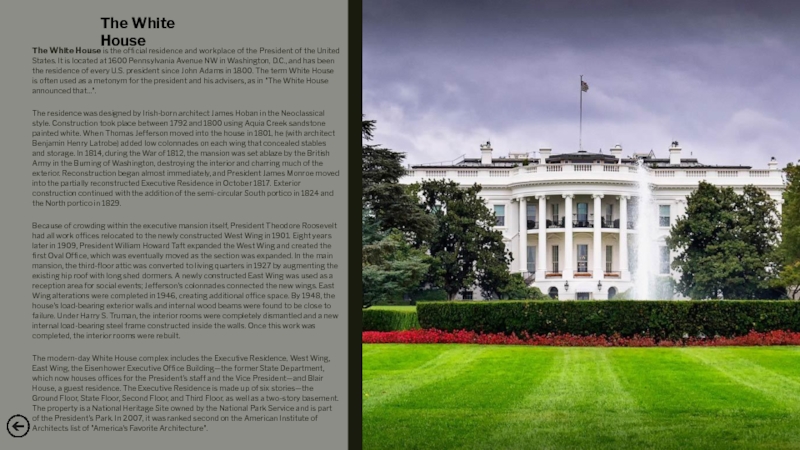
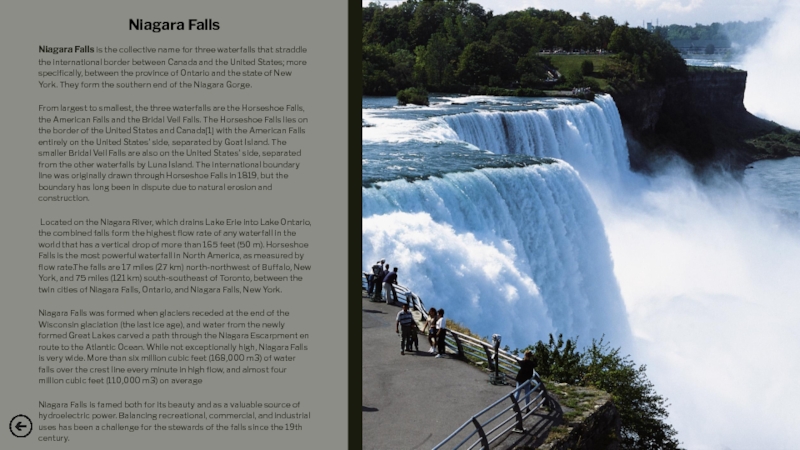
Слайд 5Niagara Falls is the collective name for three waterfalls that straddle
the international border between Canada and the United States; more specifically, between the province of Ontario and the state of New York. They form the southern end of the Niagara Gorge.
From largest to smallest, the three waterfalls are the Horseshoe Falls, the American Falls and the Bridal Veil Falls. The Horseshoe Falls lies on the border of the United States and Canada[1] with the American Falls entirely on the United States' side, separated by Goat Island. The smaller Bridal Veil Falls are also on the United States' side, separated from the other waterfalls by Luna Island. The international boundary line was originally drawn through Horseshoe Falls in 1819, but the boundary has long been in dispute due to natural erosion and construction.
Located on the Niagara River, which drains Lake Erie into Lake Ontario, the combined falls form the highest flow rate of any waterfall in the world that has a vertical drop of more than 165 feet (50 m). Horseshoe Falls is the most powerful waterfall in North America, as measured by flow rate.The falls are 17 miles (27 km) north-northwest of Buffalo, New York, and 75 miles (121 km) south-southeast of Toronto, between the twin cities of Niagara Falls, Ontario, and Niagara Falls, New York.
Niagara Falls was formed when glaciers receded at the end of the Wisconsin glaciation (the last ice age), and water from the newly formed Great Lakes carved a path through the Niagara Escarpment en route to the Atlantic Ocean. While not exceptionally high, Niagara Falls is very wide. More than six million cubic feet (168,000 m3) of water falls over the crest line every minute in high flow, and almost four million cubic feet (110,000 m3) on average
Niagara Falls is famed both for its beauty and as a valuable source of hydroelectric power. Balancing recreational, commercial, and industrial uses has been a challenge for the stewards of the falls since the 19th century.
From largest to smallest, the three waterfalls are the Horseshoe Falls, the American Falls and the Bridal Veil Falls. The Horseshoe Falls lies on the border of the United States and Canada[1] with the American Falls entirely on the United States' side, separated by Goat Island. The smaller Bridal Veil Falls are also on the United States' side, separated from the other waterfalls by Luna Island. The international boundary line was originally drawn through Horseshoe Falls in 1819, but the boundary has long been in dispute due to natural erosion and construction.
Located on the Niagara River, which drains Lake Erie into Lake Ontario, the combined falls form the highest flow rate of any waterfall in the world that has a vertical drop of more than 165 feet (50 m). Horseshoe Falls is the most powerful waterfall in North America, as measured by flow rate.The falls are 17 miles (27 km) north-northwest of Buffalo, New York, and 75 miles (121 km) south-southeast of Toronto, between the twin cities of Niagara Falls, Ontario, and Niagara Falls, New York.
Niagara Falls was formed when glaciers receded at the end of the Wisconsin glaciation (the last ice age), and water from the newly formed Great Lakes carved a path through the Niagara Escarpment en route to the Atlantic Ocean. While not exceptionally high, Niagara Falls is very wide. More than six million cubic feet (168,000 m3) of water falls over the crest line every minute in high flow, and almost four million cubic feet (110,000 m3) on average
Niagara Falls is famed both for its beauty and as a valuable source of hydroelectric power. Balancing recreational, commercial, and industrial uses has been a challenge for the stewards of the falls since the 19th century.
Niagara Falls
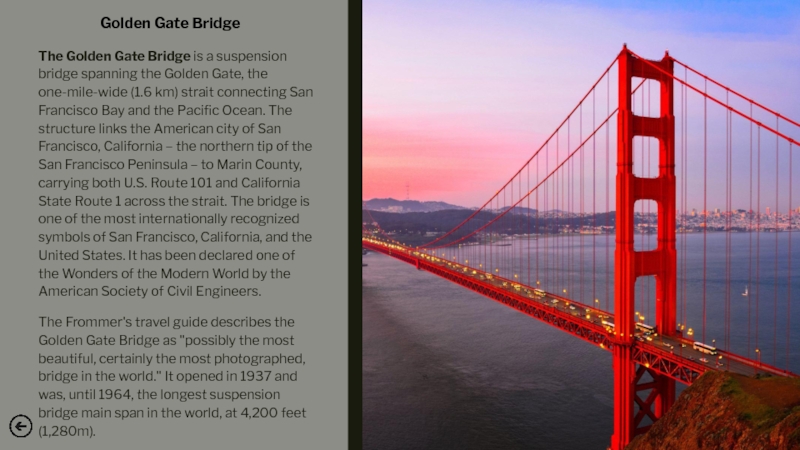
Слайд 6The Golden Gate Bridge is a suspension bridge spanning the Golden
Gate, the one-mile-wide (1.6 km) strait connecting San Francisco Bay and the Pacific Ocean. The structure links the American city of San Francisco, California – the northern tip of the San Francisco Peninsula – to Marin County, carrying both U.S. Route 101 and California State Route 1 across the strait. The bridge is one of the most internationally recognized symbols of San Francisco, California, and the United States. It has been declared one of the Wonders of the Modern World by the American Society of Civil Engineers.
The Frommer's travel guide describes the Golden Gate Bridge as "possibly the most beautiful, certainly the most photographed, bridge in the world." It opened in 1937 and was, until 1964, the longest suspension bridge main span in the world, at 4,200 feet (1,280m).
The Frommer's travel guide describes the Golden Gate Bridge as "possibly the most beautiful, certainly the most photographed, bridge in the world." It opened in 1937 and was, until 1964, the longest suspension bridge main span in the world, at 4,200 feet (1,280m).
Golden Gate Bridge
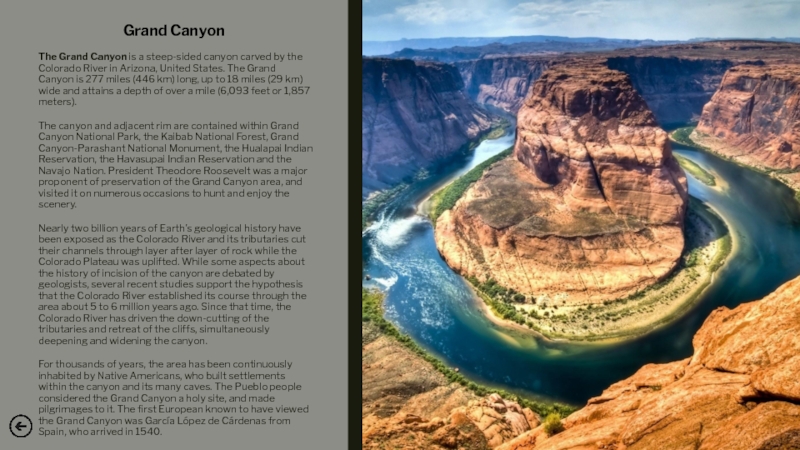
Слайд 7The Grand Canyon is a steep-sided canyon carved by the Colorado
River in Arizona, United States. The Grand Canyon is 277 miles (446 km) long, up to 18 miles (29 km) wide and attains a depth of over a mile (6,093 feet or 1,857 meters).
The canyon and adjacent rim are contained within Grand Canyon National Park, the Kaibab National Forest, Grand Canyon-Parashant National Monument, the Hualapai Indian Reservation, the Havasupai Indian Reservation and the Navajo Nation. President Theodore Roosevelt was a major proponent of preservation of the Grand Canyon area, and visited it on numerous occasions to hunt and enjoy the scenery.
Nearly two billion years of Earth's geological history have been exposed as the Colorado River and its tributaries cut their channels through layer after layer of rock while the Colorado Plateau was uplifted. While some aspects about the history of incision of the canyon are debated by geologists, several recent studies support the hypothesis that the Colorado River established its course through the area about 5 to 6 million years ago. Since that time, the Colorado River has driven the down-cutting of the tributaries and retreat of the cliffs, simultaneously deepening and widening the canyon.
For thousands of years, the area has been continuously inhabited by Native Americans, who built settlements within the canyon and its many caves. The Pueblo people considered the Grand Canyon a holy site, and made pilgrimages to it. The first European known to have viewed the Grand Canyon was García López de Cárdenas from Spain, who arrived in 1540.
The canyon and adjacent rim are contained within Grand Canyon National Park, the Kaibab National Forest, Grand Canyon-Parashant National Monument, the Hualapai Indian Reservation, the Havasupai Indian Reservation and the Navajo Nation. President Theodore Roosevelt was a major proponent of preservation of the Grand Canyon area, and visited it on numerous occasions to hunt and enjoy the scenery.
Nearly two billion years of Earth's geological history have been exposed as the Colorado River and its tributaries cut their channels through layer after layer of rock while the Colorado Plateau was uplifted. While some aspects about the history of incision of the canyon are debated by geologists, several recent studies support the hypothesis that the Colorado River established its course through the area about 5 to 6 million years ago. Since that time, the Colorado River has driven the down-cutting of the tributaries and retreat of the cliffs, simultaneously deepening and widening the canyon.
For thousands of years, the area has been continuously inhabited by Native Americans, who built settlements within the canyon and its many caves. The Pueblo people considered the Grand Canyon a holy site, and made pilgrimages to it. The first European known to have viewed the Grand Canyon was García López de Cárdenas from Spain, who arrived in 1540.
Grand Canyon
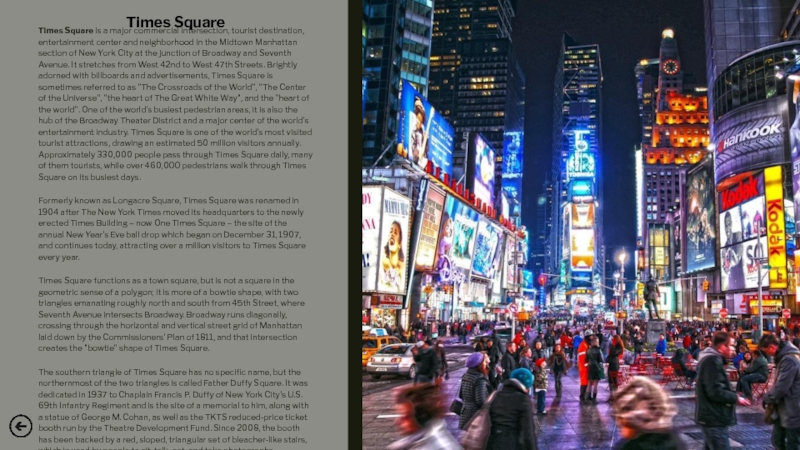
Слайд 8Times Square is a major commercial intersection, tourist destination, entertainment center
and neighborhood in the Midtown Manhattan section of New York City at the junction of Broadway and Seventh Avenue. It stretches from West 42nd to West 47th Streets. Brightly adorned with billboards and advertisements, Times Square is sometimes referred to as "The Crossroads of the World", "The Center of the Universe", "the heart of The Great White Way", and the "heart of the world". One of the world's busiest pedestrian areas, it is also the hub of the Broadway Theater District and a major center of the world's entertainment industry. Times Square is one of the world's most visited tourist attractions, drawing an estimated 50 million visitors annually. Approximately 330,000 people pass through Times Square daily, many of them tourists, while over 460,000 pedestrians walk through Times Square on its busiest days.
Formerly known as Longacre Square, Times Square was renamed in 1904 after The New York Times moved its headquarters to the newly erected Times Building – now One Times Square – the site of the annual New Year's Eve ball drop which began on December 31, 1907, and continues today, attracting over a million visitors to Times Square every year.
Times Square functions as a town square, but is not a square in the geometric sense of a polygon; it is more of a bowtie shape, with two triangles emanating roughly north and south from 45th Street, where Seventh Avenue intersects Broadway. Broadway runs diagonally, crossing through the horizontal and vertical street grid of Manhattan laid down by the Commissioners' Plan of 1811, and that intersection creates the "bowtie" shape of Times Square.
The southern triangle of Times Square has no specific name, but the northernmost of the two triangles is called Father Duffy Square. It was dedicated in 1937 to Chaplain Francis P. Duffy of New York City's U.S. 69th Infantry Regiment and is the site of a memorial to him, along with a statue of George M. Cohan, as well as the TKTS reduced-price ticket booth run by the Theatre Development Fund. Since 2008, the booth has been backed by a red, sloped, triangular set of bleacher-like stairs, which is used by people to sit, talk, eat, and take photographs.
Formerly known as Longacre Square, Times Square was renamed in 1904 after The New York Times moved its headquarters to the newly erected Times Building – now One Times Square – the site of the annual New Year's Eve ball drop which began on December 31, 1907, and continues today, attracting over a million visitors to Times Square every year.
Times Square functions as a town square, but is not a square in the geometric sense of a polygon; it is more of a bowtie shape, with two triangles emanating roughly north and south from 45th Street, where Seventh Avenue intersects Broadway. Broadway runs diagonally, crossing through the horizontal and vertical street grid of Manhattan laid down by the Commissioners' Plan of 1811, and that intersection creates the "bowtie" shape of Times Square.
The southern triangle of Times Square has no specific name, but the northernmost of the two triangles is called Father Duffy Square. It was dedicated in 1937 to Chaplain Francis P. Duffy of New York City's U.S. 69th Infantry Regiment and is the site of a memorial to him, along with a statue of George M. Cohan, as well as the TKTS reduced-price ticket booth run by the Theatre Development Fund. Since 2008, the booth has been backed by a red, sloped, triangular set of bleacher-like stairs, which is used by people to sit, talk, eat, and take photographs.
Times Square
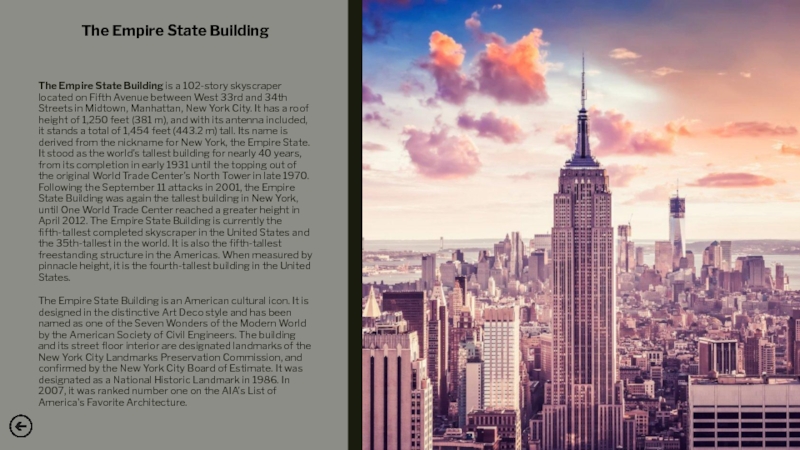
Слайд 9The Empire State Building is a 102-story skyscraper located on Fifth
Avenue between West 33rd and 34th Streets in Midtown, Manhattan, New York City. It has a roof height of 1,250 feet (381 m), and with its antenna included, it stands a total of 1,454 feet (443.2 m) tall. Its name is derived from the nickname for New York, the Empire State. It stood as the world's tallest building for nearly 40 years, from its completion in early 1931 until the topping out of the original World Trade Center's North Tower in late 1970. Following the September 11 attacks in 2001, the Empire State Building was again the tallest building in New York, until One World Trade Center reached a greater height in April 2012. The Empire State Building is currently the fifth-tallest completed skyscraper in the United States and the 35th-tallest in the world. It is also the fifth-tallest freestanding structure in the Americas. When measured by pinnacle height, it is the fourth-tallest building in the United States.
The Empire State Building is an American cultural icon. It is designed in the distinctive Art Deco style and has been named as one of the Seven Wonders of the Modern World by the American Society of Civil Engineers. The building and its street floor interior are designated landmarks of the New York City Landmarks Preservation Commission, and confirmed by the New York City Board of Estimate. It was designated as a National Historic Landmark in 1986. In 2007, it was ranked number one on the AIA's List of America's Favorite Architecture.
The Empire State Building is an American cultural icon. It is designed in the distinctive Art Deco style and has been named as one of the Seven Wonders of the Modern World by the American Society of Civil Engineers. The building and its street floor interior are designated landmarks of the New York City Landmarks Preservation Commission, and confirmed by the New York City Board of Estimate. It was designated as a National Historic Landmark in 1986. In 2007, it was ranked number one on the AIA's List of America's Favorite Architecture.
The Empire State Building
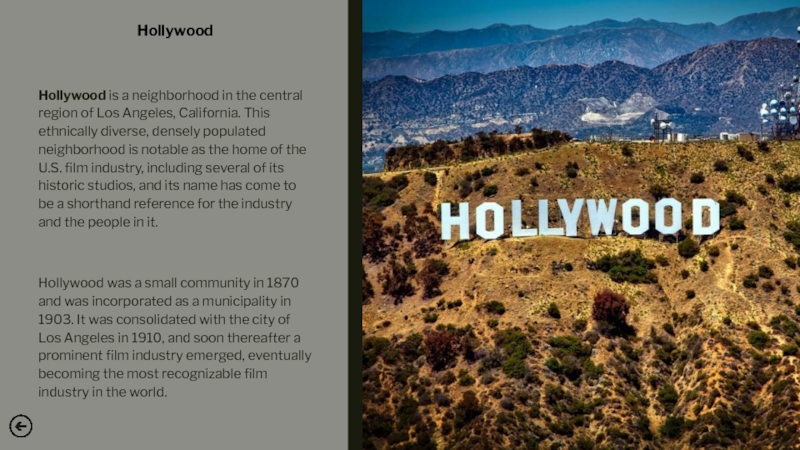
Слайд 10Hollywood is a neighborhood in the central region of Los Angeles,
California. This ethnically diverse, densely populated neighborhood is notable as the home of the U.S. film industry, including several of its historic studios, and its name has come to be a shorthand reference for the industry and the people in it.
Hollywood was a small community in 1870 and was incorporated as a municipality in 1903. It was consolidated with the city of Los Angeles in 1910, and soon thereafter a prominent film industry emerged, eventually becoming the most recognizable film industry in the world.
Hollywood was a small community in 1870 and was incorporated as a municipality in 1903. It was consolidated with the city of Los Angeles in 1910, and soon thereafter a prominent film industry emerged, eventually becoming the most recognizable film industry in the world.
Hollywood
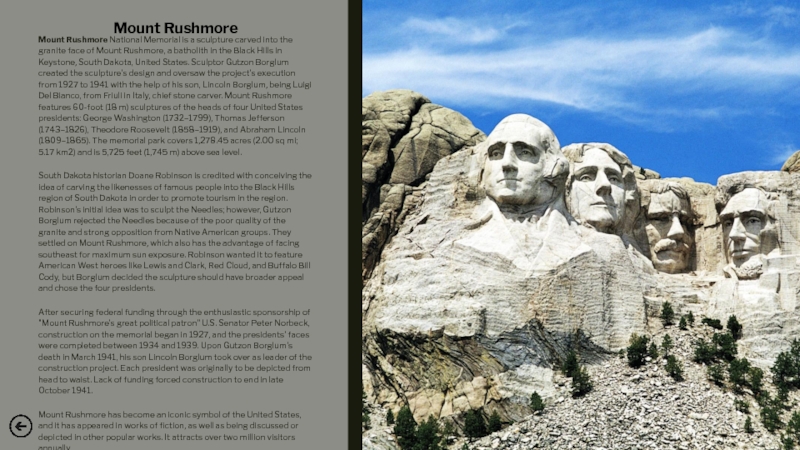
Слайд 11Mount Rushmore National Memorial is a sculpture carved into the granite
face of Mount Rushmore, a batholith in the Black Hills in Keystone, South Dakota, United States. Sculptor Gutzon Borglum created the sculpture's design and oversaw the project's execution from 1927 to 1941 with the help of his son, Lincoln Borglum, being Luigi Del Bianco, from Friuli in Italy, chief stone carver. Mount Rushmore features 60-foot (18 m) sculptures of the heads of four United States presidents: George Washington (1732–1799), Thomas Jefferson (1743–1826), Theodore Roosevelt (1858–1919), and Abraham Lincoln (1809–1865). The memorial park covers 1,278.45 acres (2.00 sq mi; 5.17 km2) and is 5,725 feet (1,745 m) above sea level.
South Dakota historian Doane Robinson is credited with conceiving the idea of carving the likenesses of famous people into the Black Hills region of South Dakota in order to promote tourism in the region. Robinson's initial idea was to sculpt the Needles; however, Gutzon Borglum rejected the Needles because of the poor quality of the granite and strong opposition from Native American groups. They settled on Mount Rushmore, which also has the advantage of facing southeast for maximum sun exposure. Robinson wanted it to feature American West heroes like Lewis and Clark, Red Cloud, and Buffalo Bill Cody, but Borglum decided the sculpture should have broader appeal and chose the four presidents.
After securing federal funding through the enthusiastic sponsorship of "Mount Rushmore's great political patron" U.S. Senator Peter Norbeck, construction on the memorial began in 1927, and the presidents' faces were completed between 1934 and 1939. Upon Gutzon Borglum's death in March 1941, his son Lincoln Borglum took over as leader of the construction project. Each president was originally to be depicted from head to waist. Lack of funding forced construction to end in late October 1941.
Mount Rushmore has become an iconic symbol of the United States, and it has appeared in works of fiction, as well as being discussed or depicted in other popular works. It attracts over two million visitors annually
South Dakota historian Doane Robinson is credited with conceiving the idea of carving the likenesses of famous people into the Black Hills region of South Dakota in order to promote tourism in the region. Robinson's initial idea was to sculpt the Needles; however, Gutzon Borglum rejected the Needles because of the poor quality of the granite and strong opposition from Native American groups. They settled on Mount Rushmore, which also has the advantage of facing southeast for maximum sun exposure. Robinson wanted it to feature American West heroes like Lewis and Clark, Red Cloud, and Buffalo Bill Cody, but Borglum decided the sculpture should have broader appeal and chose the four presidents.
After securing federal funding through the enthusiastic sponsorship of "Mount Rushmore's great political patron" U.S. Senator Peter Norbeck, construction on the memorial began in 1927, and the presidents' faces were completed between 1934 and 1939. Upon Gutzon Borglum's death in March 1941, his son Lincoln Borglum took over as leader of the construction project. Each president was originally to be depicted from head to waist. Lack of funding forced construction to end in late October 1941.
Mount Rushmore has become an iconic symbol of the United States, and it has appeared in works of fiction, as well as being discussed or depicted in other popular works. It attracts over two million visitors annually
Mount Rushmore
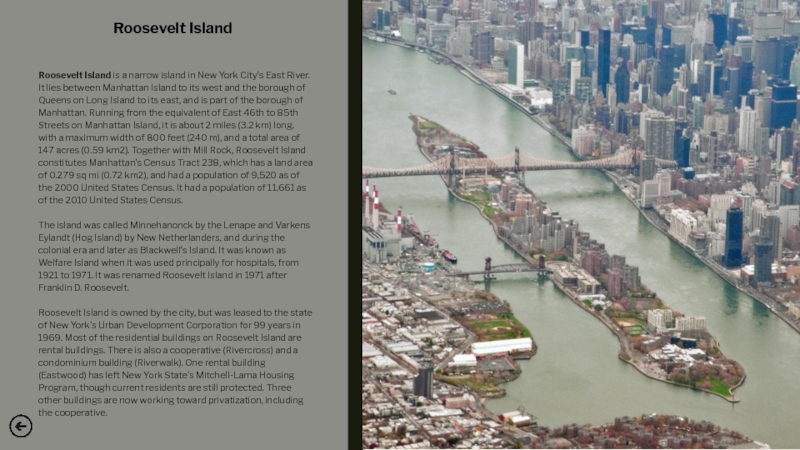
Слайд 12Roosevelt Island is a narrow island in New York City's East
River. It lies between Manhattan Island to its west and the borough of Queens on Long Island to its east, and is part of the borough of Manhattan. Running from the equivalent of East 46th to 85th Streets on Manhattan Island, it is about 2 miles (3.2 km) long, with a maximum width of 800 feet (240 m), and a total area of 147 acres (0.59 km2). Together with Mill Rock, Roosevelt Island constitutes Manhattan's Census Tract 238, which has a land area of 0.279 sq mi (0.72 km2), and had a population of 9,520 as of the 2000 United States Census. It had a population of 11,661 as of the 2010 United States Census.
The island was called Minnehanonck by the Lenape and Varkens Eylandt (Hog Island) by New Netherlanders, and during the colonial era and later as Blackwell's Island. It was known as Welfare Island when it was used principally for hospitals, from 1921 to 1971. It was renamed Roosevelt Island in 1971 after Franklin D. Roosevelt.
Roosevelt Island is owned by the city, but was leased to the state of New York's Urban Development Corporation for 99 years in 1969. Most of the residential buildings on Roosevelt Island are rental buildings. There is also a cooperative (Rivercross) and a condominium building (Riverwalk). One rental building (Eastwood) has left New York State's Mitchell-Lama Housing Program, though current residents are still protected. Three other buildings are now working toward privatization, including the cooperative.
The island was called Minnehanonck by the Lenape and Varkens Eylandt (Hog Island) by New Netherlanders, and during the colonial era and later as Blackwell's Island. It was known as Welfare Island when it was used principally for hospitals, from 1921 to 1971. It was renamed Roosevelt Island in 1971 after Franklin D. Roosevelt.
Roosevelt Island is owned by the city, but was leased to the state of New York's Urban Development Corporation for 99 years in 1969. Most of the residential buildings on Roosevelt Island are rental buildings. There is also a cooperative (Rivercross) and a condominium building (Riverwalk). One rental building (Eastwood) has left New York State's Mitchell-Lama Housing Program, though current residents are still protected. Three other buildings are now working toward privatization, including the cooperative.
Roosevelt Island
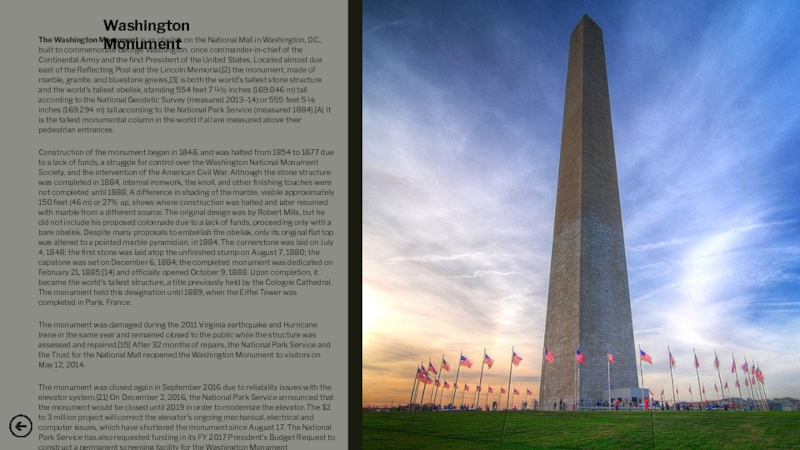
Слайд 13The Washington Monument is an obelisk on the National Mall in
Washington, D.C., built to commemorate George Washington, once commander-in-chief of the Continental Army and the first President of the United States. Located almost due east of the Reflecting Pool and the Lincoln Memorial,[2] the monument, made of marble, granite, and bluestone gneiss,[3] is both the world's tallest stone structure and the world's tallest obelisk, standing 554 feet 7 11⁄32 inches (169.046 m) tall according to the National Geodetic Survey (measured 2013–14) or 555 feet 5 1⁄8 inches (169.294 m) tall according to the National Park Service (measured 1884).[A] It is the tallest monumental column in the world if all are measured above their pedestrian entrances.
Construction of the monument began in 1848, and was halted from 1854 to 1877 due to a lack of funds, a struggle for control over the Washington National Monument Society, and the intervention of the American Civil War. Although the stone structure was completed in 1884, internal ironwork, the knoll, and other finishing touches were not completed until 1888. A difference in shading of the marble, visible approximately 150 feet (46 m) or 27% up, shows where construction was halted and later resumed with marble from a different source. The original design was by Robert Mills, but he did not include his proposed colonnade due to a lack of funds, proceeding only with a bare obelisk. Despite many proposals to embellish the obelisk, only its original flat top was altered to a pointed marble pyramidion, in 1884. The cornerstone was laid on July 4, 1848; the first stone was laid atop the unfinished stump on August 7, 1880; the capstone was set on December 6, 1884; the completed monument was dedicated on February 21, 1885;[14] and officially opened October 9, 1888. Upon completion, it became the world's tallest structure, a title previously held by the Cologne Cathedral. The monument held this designation until 1889, when the Eiffel Tower was completed in Paris, France.
The monument was damaged during the 2011 Virginia earthquake and Hurricane Irene in the same year and remained closed to the public while the structure was assessed and repaired.[15] After 32 months of repairs, the National Park Service and the Trust for the National Mall reopened the Washington Monument to visitors on May 12, 2014.
The monument was closed again in September 2016 due to reliability issues with the elevator system.[21] On December 2, 2016, the National Park Service announced that the monument would be closed until 2019 in order to modernize the elevator. The $2 to 3 million project will correct the elevator's ongoing mechanical, electrical and computer issues, which have shuttered the monument since August 17. The National Park Service has also requested funding in its FY 2017 President's Budget Request to construct a permanent screening facility for the Washington Monument
Construction of the monument began in 1848, and was halted from 1854 to 1877 due to a lack of funds, a struggle for control over the Washington National Monument Society, and the intervention of the American Civil War. Although the stone structure was completed in 1884, internal ironwork, the knoll, and other finishing touches were not completed until 1888. A difference in shading of the marble, visible approximately 150 feet (46 m) or 27% up, shows where construction was halted and later resumed with marble from a different source. The original design was by Robert Mills, but he did not include his proposed colonnade due to a lack of funds, proceeding only with a bare obelisk. Despite many proposals to embellish the obelisk, only its original flat top was altered to a pointed marble pyramidion, in 1884. The cornerstone was laid on July 4, 1848; the first stone was laid atop the unfinished stump on August 7, 1880; the capstone was set on December 6, 1884; the completed monument was dedicated on February 21, 1885;[14] and officially opened October 9, 1888. Upon completion, it became the world's tallest structure, a title previously held by the Cologne Cathedral. The monument held this designation until 1889, when the Eiffel Tower was completed in Paris, France.
The monument was damaged during the 2011 Virginia earthquake and Hurricane Irene in the same year and remained closed to the public while the structure was assessed and repaired.[15] After 32 months of repairs, the National Park Service and the Trust for the National Mall reopened the Washington Monument to visitors on May 12, 2014.
The monument was closed again in September 2016 due to reliability issues with the elevator system.[21] On December 2, 2016, the National Park Service announced that the monument would be closed until 2019 in order to modernize the elevator. The $2 to 3 million project will correct the elevator's ongoing mechanical, electrical and computer issues, which have shuttered the monument since August 17. The National Park Service has also requested funding in its FY 2017 President's Budget Request to construct a permanent screening facility for the Washington Monument
Washington Monument