- Главная
- Разное
- Образование
- Спорт
- Естествознание
- Природоведение
- Религиоведение
- Французский язык
- Черчение
- Английский язык
- Астрономия
- Алгебра
- Биология
- География
- Геометрия
- Детские презентации
- Информатика
- История
- Литература
- Математика
- Музыка
- МХК
- Немецкий язык
- ОБЖ
- Обществознание
- Окружающий мир
- Педагогика
- Русский язык
- Технология
- Физика
- Философия
- Химия
- Шаблоны, фоны, картинки для презентаций
- Экология
- Экономика
Презентация, доклад по литературе Англии Анализ литературного произведения (на примере произведения У. Шекспира Гамлет
Содержание
- 1. Презентация по литературе Англии Анализ литературного произведения (на примере произведения У. Шекспира Гамлет
- 2. Sample Answer Introduction 1. “Hamlet” is one
- 3. 2. “Hamlet is a philosophical narrative, the
- 4. 5. The tragedy is about the revenge
- 5. 7. The scene is laid in Denmark.
- 6. The King thinks of a plan to
- 7. 8. There are two conflicts in the
- 8. II. Interpretation Body1. “Hamlet’ is the product
- 9. 2. The exposition is the scene of
- 10. 3. The plot of the tragedy is
- 11. 4. Characters are presented in development, the
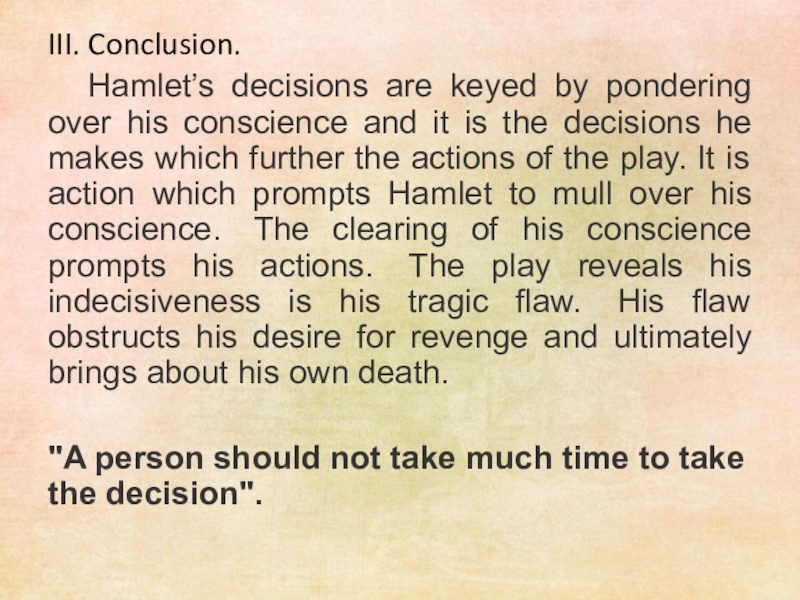
- 12. III. Conclusion. Hamlet’s decisions are keyed by pondering
Sample Answer Introduction 1. “Hamlet” is one of Shakespeare’s greatest tragedies written in the third period of his literary career. It is the most widely staged, read and discussed of all his tragedies. Shakespeare as a
Слайд 2Sample Answer
Introduction
1. “Hamlet” is one of Shakespeare’s greatest tragedies
written in the third period of his literary career. It is the most widely staged, read and discussed of all his tragedies. Shakespeare as a playwright presents great human problems and shows the social injustice and sufferings of a man at this period of time.
Слайд 32. “Hamlet is a philosophical narrative, the tragedy of a humanist.
3. It is a drama with the components of a tragedy.
4. The tone of the tragedy is dramatic and tragic. In some monologues it is sarcastic (e.g. debates od the soldiers on the post); in some parts it’s pathetic (Hamlet’s monologue “To be or not to be”); and in the end it’s pessimistic, bitter and gloomy (depicting the death of the main hero).
Слайд 45. The tragedy is about the revenge of Hamlet (the Prince
of Denmark) for his father’s murder done by his uncle Claudius. He delays doing it and as a result he dies himself at the end od the story.
6. The title itself points out the complex character of a protagonist. It conveys and self-orients the main psychological postures of the character – delicacy and determination, love and discontency.
6. The title itself points out the complex character of a protagonist. It conveys and self-orients the main psychological postures of the character – delicacy and determination, love and discontency.
Слайд 57. The scene is laid in Denmark. It is night. Several
soldiers are on guard. They are talking about the ghost that suddenly appears in front of them. They tell about it to Hamlet. Soon Hamlet comes and sees the ghost. The ghost tells of the treacherous murder of his father by Claudius, Hamlet’s uncle. Hamlet takes the oath to revenge for his death. Hamlet loves Ophelia, but he puts aside his love and simulates madness to conceal his plans. The king soon understands that Hamlet knows his secret.
Слайд 6The King thinks of a plan to do away with Hamlet.
He persuades Laertes to challenge Hamlet to a duel and advises Laertes to prepare poisoned weapon. In the duel Laertes inflicts a mortal wound on Hamlet. They exchange swords and then Hamlet wounds Laertes with poisoned sword. At that moment the Queen drinks out of a glass of poisoned wine the King prepared to Hamlet. She dies. Laertes tells Hamlet that the King is guilty in all troubles. With his last strength Hamlet kills the king and both of them die.
Слайд 78. There are two conflicts in the tragedy: external and internal
one. External conflict lies in the battle of Hamlet with the treacherous enemies – the king and the Queen, Laertes, Polonius). Internal conflict is being reflected in the problems of life and death, forgiveness and revenge, struggle and irresolution, love and hatred in Hamlets soul.
Слайд 8II. Interpretation Body
1. “Hamlet’ is the product of the environment and
history. It is one of the most difficult tragedies to interpret. The reason for it is Hamlet’s behavior. The portrait of the hero is given throughout the whole drama. The drama includes two plot lines – the revenge for the father’s murder and the love to Ophelia.
Слайд 92. The exposition is the scene of two soldiers watching a
ghost near the castle. Their conversation about it to Hamlet. Rising action is seen in the Hamlet’s dialogue with his dead father’s ghost and the oath to avenge for him. We can notice the climax at the scene of the duel of Laertes and Hamlet. The denouement lies in Hamlet’s death and his monologue devoted to the best friend.
Слайд 103. The plot of the tragedy is given through the first
person’s dialogues (as it is obvious for a drama). We may notice some interior monologues of the main hero that carry the definite symbolic meanings. We see no description and the characters are being opened through their words and actions. The atmosphere is dull, depressing and melancholic, in some scenes it’s pathetic and emotional.
Слайд 114. Characters are presented in development, the method of portrayal is
indirect (through the speaking). The conflict enables to understand the inner world of the main hero as it depicts all the virtues and deeds of him.
5. I would suggest that there are many "main messages" in Hamlet. However, a key theme is that indecision leads to personal tragedy, as Hamlet's inability to take decisive action ultimately results in many of the characters dying, including himself.
5. I would suggest that there are many "main messages" in Hamlet. However, a key theme is that indecision leads to personal tragedy, as Hamlet's inability to take decisive action ultimately results in many of the characters dying, including himself.
Слайд 12III. Conclusion.
Hamlet’s decisions are keyed by pondering over his conscience and
it is the decisions he makes which further the actions of the play. It is action which prompts Hamlet to mull over his conscience. The clearing of his conscience prompts his actions. The play reveals his indecisiveness is his tragic flaw. His flaw obstructs his desire for revenge and ultimately brings about his own death.
"A person should not take much time to take the decision".
"A person should not take much time to take the decision".