amazing and beautiful.
- Главная
- Разное
- Образование
- Спорт
- Естествознание
- Природоведение
- Религиоведение
- Французский язык
- Черчение
- Английский язык
- Астрономия
- Алгебра
- Биология
- География
- Геометрия
- Детские презентации
- Информатика
- История
- Литература
- Математика
- Музыка
- МХК
- Немецкий язык
- ОБЖ
- Обществознание
- Окружающий мир
- Педагогика
- Русский язык
- Технология
- Физика
- Философия
- Химия
- Шаблоны, фоны, картинки для презентаций
- Экология
- Экономика
Презентация, доклад по английскому языку Rainforests (10 класс)
Содержание
- 1. Презентация по английскому языку Rainforests (10 класс)
- 2. Sometimes I think of all the things
- 3. A Rainforest can be described as a
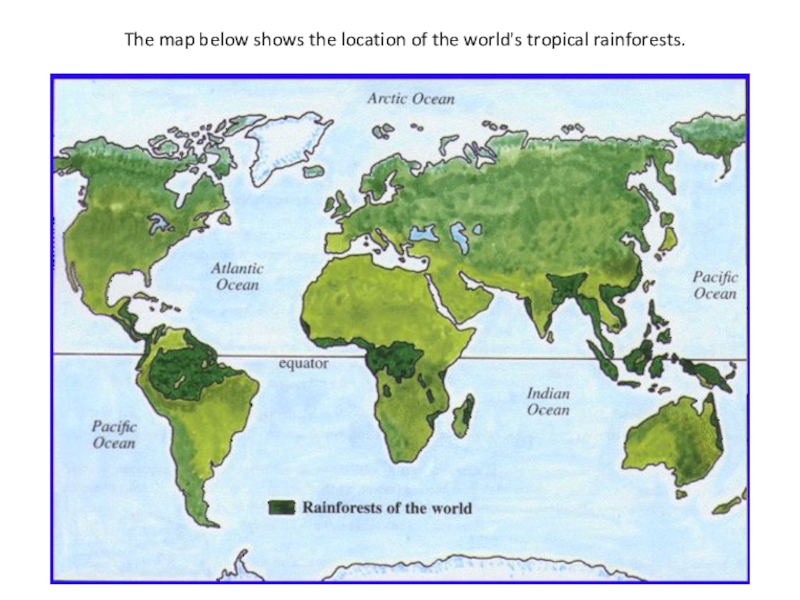
- 4. The map below shows the location of the world's tropical rainforests.
- 5. CENTRAL AMERICAThis region was once entirely covered
- 6. THE AMAZONThe Amazon jungle is the world's
- 7. AFRICACentral Africa holds the world's second largest
- 8. SOUTHERN ASIAThe rainforests of Asia stretch from
- 9. AUSTRALASIAUndergrowth Rainforest in AustraliaMillions of years ago,
- 10. Rainforests are essential to the health and
- 11. The first layer is the forest floor.
- 12. Above the ground surface the space is
- 13. The next layer is called the
- 14. The canopy is the dense ceiling of
- 15. Emergent is a layer of the tallest
- 16. Rainforests are the source of many items
- 17. Sap that is used to create rubber
- 18. As many as 30 million species of
- 19. At least two-thirds of the world's plant
- 20. PEOPLE OF THE RAINFORESTWe often overlook the
- 21. The Pygmies Mbuti and Baka Pygmies live in
- 22. The HuliThe Huli are one of the
- 23. The Yanomami One of the largest groups of
- 24. PRESERVING THE RAINFORESTSThe world's rainforests are currently
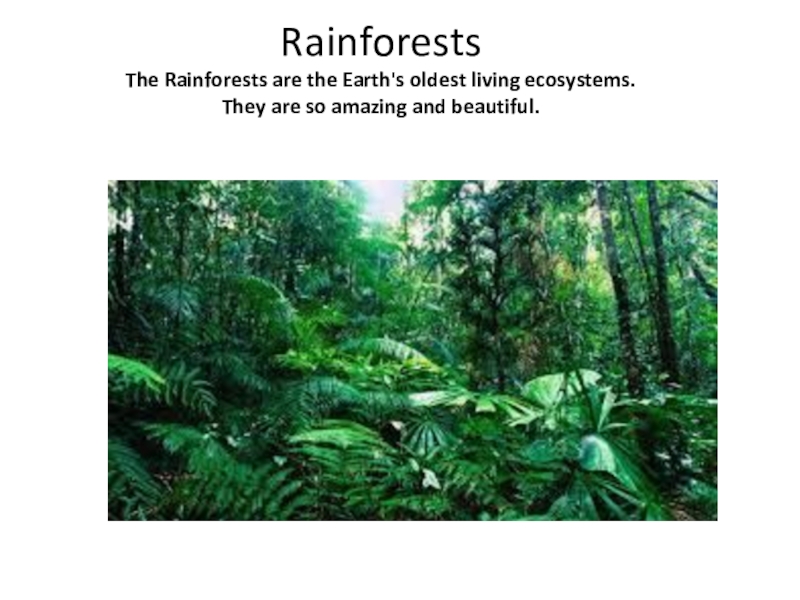
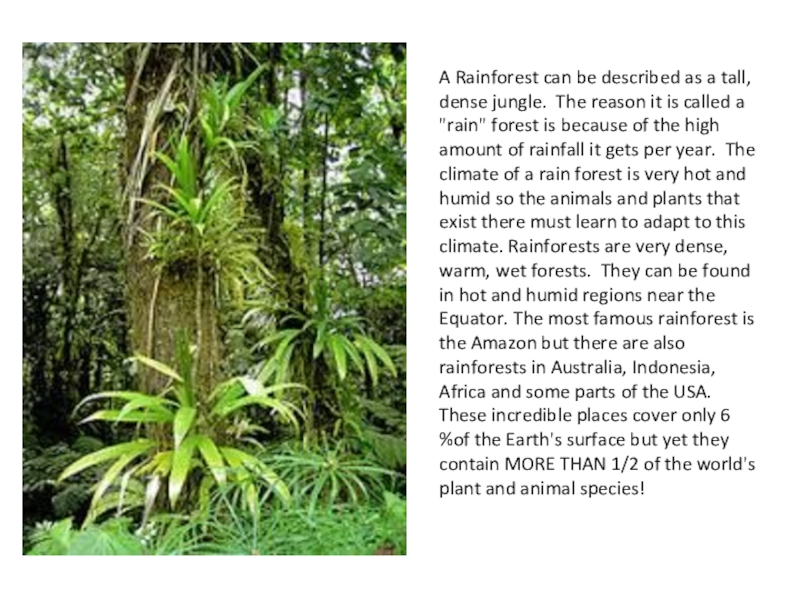
Sometimes I think of all the things That live within the rainforest The lovely bird that all day sings The parrot with its colourful crest With all the things the forest brings We need to take
Слайд 2Sometimes I think of all the things
That live within the
rainforest
The lovely bird that all day sings
The parrot with its colourful crest
With all the things the forest brings
We need to take good care
Because all these special things
Can’t be found just anywhere
So let’s look after the rainforest
And give it our protection
Then it’ll be there for all the rest
Of our future generations.
The lovely bird that all day sings
The parrot with its colourful crest
With all the things the forest brings
We need to take good care
Because all these special things
Can’t be found just anywhere
So let’s look after the rainforest
And give it our protection
Then it’ll be there for all the rest
Of our future generations.
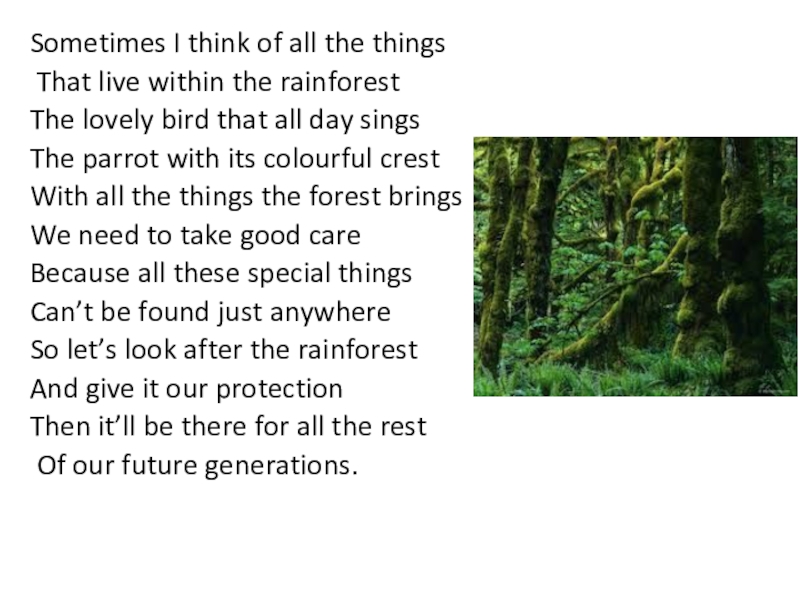
Слайд 3A Rainforest can be described as a tall, dense jungle. The
reason it is called a "rain" forest is because of the high amount of rainfall it gets per year. The climate of a rain forest is very hot and humid so the animals and plants that exist there must learn to adapt to this climate. Rainforests are very dense, warm, wet forests. They can be found in hot and humid regions near the Equator. The most famous rainforest is the Amazon but there are also rainforests in Australia, Indonesia, Africa and some parts of the USA. These incredible places cover only 6 %of the Earth's surface but yet they contain MORE THAN 1/2 of the world's plant and animal species!
Слайд 5CENTRAL AMERICA
This region was once entirely covered with rainforest, but large
areas have been cleared for cattle ranching and for sugar cane plantations.
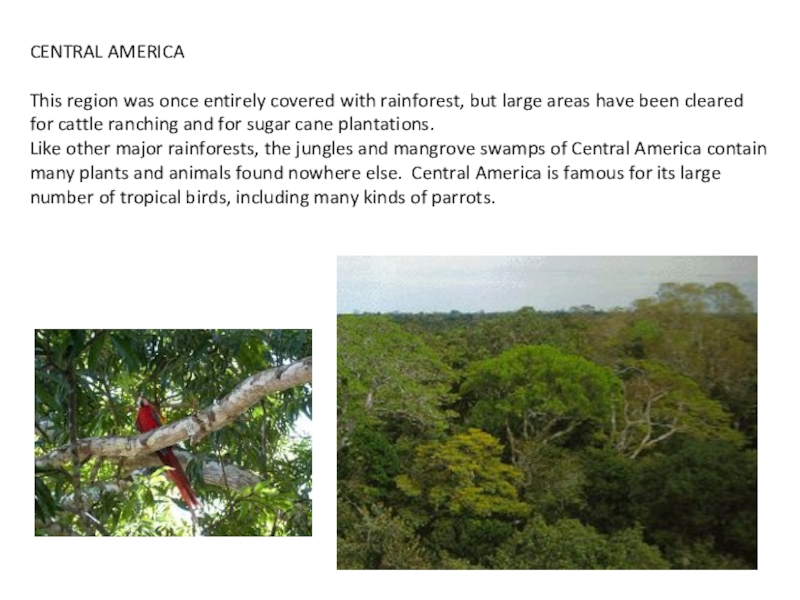
Like other major rainforests, the jungles and mangrove swamps of Central America contain many plants and animals found nowhere else. Central America is famous for its large number of tropical birds, including many kinds of parrots.
Like other major rainforests, the jungles and mangrove swamps of Central America contain many plants and animals found nowhere else. Central America is famous for its large number of tropical birds, including many kinds of parrots.
Слайд 6THE AMAZON
The Amazon jungle is the world's largest tropical rainforest. The
forest covers the basin of the Amazon, the world's second longest river.
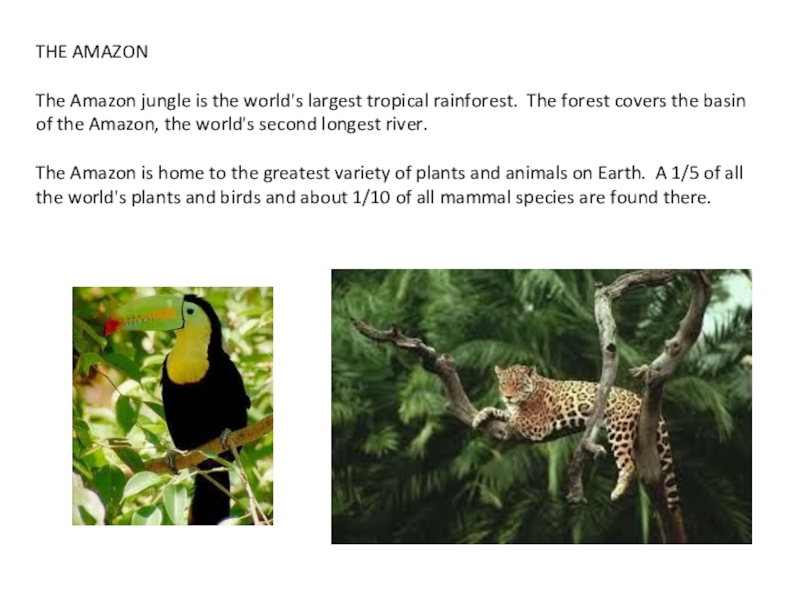
The Amazon is home to the greatest variety of plants and animals on Earth. A 1/5 of all the world's plants and birds and about 1/10 of all mammal species are found there.
The Amazon is home to the greatest variety of plants and animals on Earth. A 1/5 of all the world's plants and birds and about 1/10 of all mammal species are found there.
Слайд 7AFRICA
Central Africa holds the world's second largest rainforest. To the south
east, the large island of Madagascar was once intensively forested, but now much of it is gone.
Cloud Rainforest in Africa
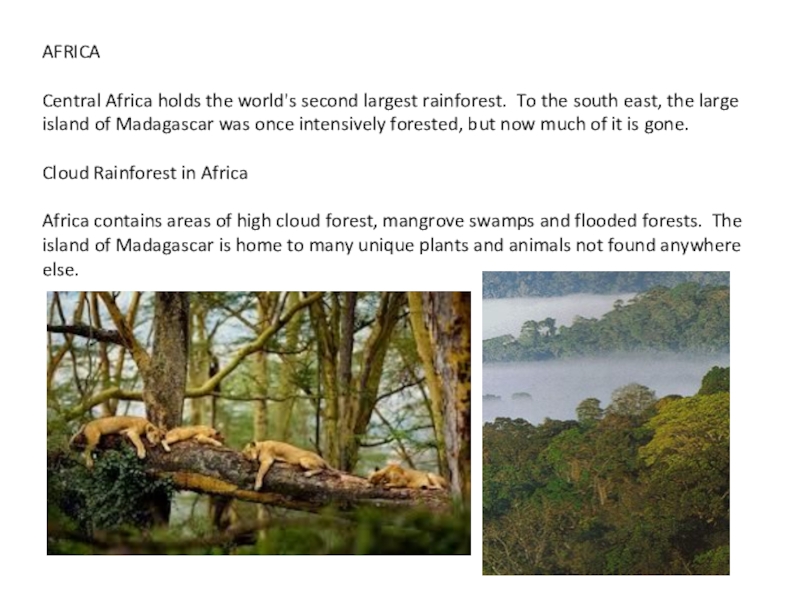
Africa contains areas of high cloud forest, mangrove swamps and flooded forests. The island of Madagascar is home to many unique plants and animals not found anywhere else.
Cloud Rainforest in Africa
Africa contains areas of high cloud forest, mangrove swamps and flooded forests. The island of Madagascar is home to many unique plants and animals not found anywhere else.
Слайд 8SOUTHERN ASIA
The rainforests of Asia stretch from India and Burma in
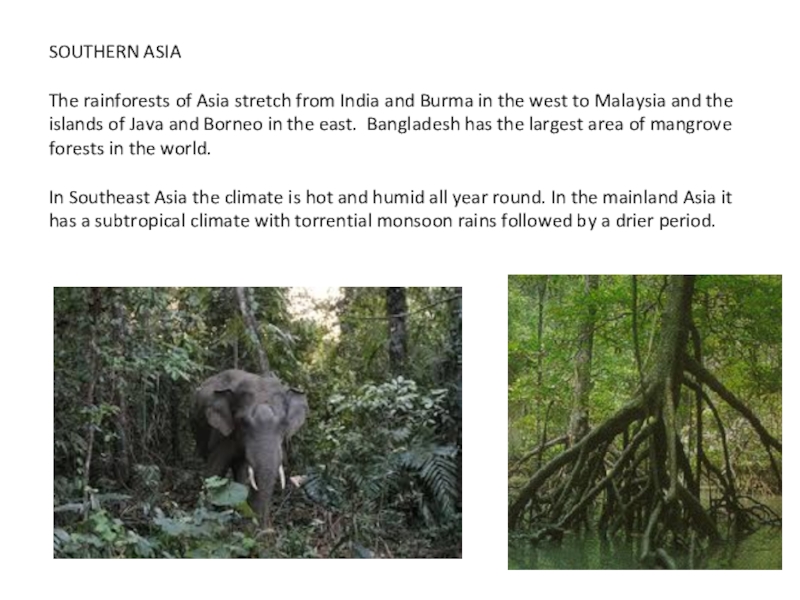
the west to Malaysia and the islands of Java and Borneo in the east. Bangladesh has the largest area of mangrove forests in the world.
In Southeast Asia the climate is hot and humid all year round. In the mainland Asia it has a subtropical climate with torrential monsoon rains followed by a drier period.
In Southeast Asia the climate is hot and humid all year round. In the mainland Asia it has a subtropical climate with torrential monsoon rains followed by a drier period.
Слайд 9AUSTRALASIA
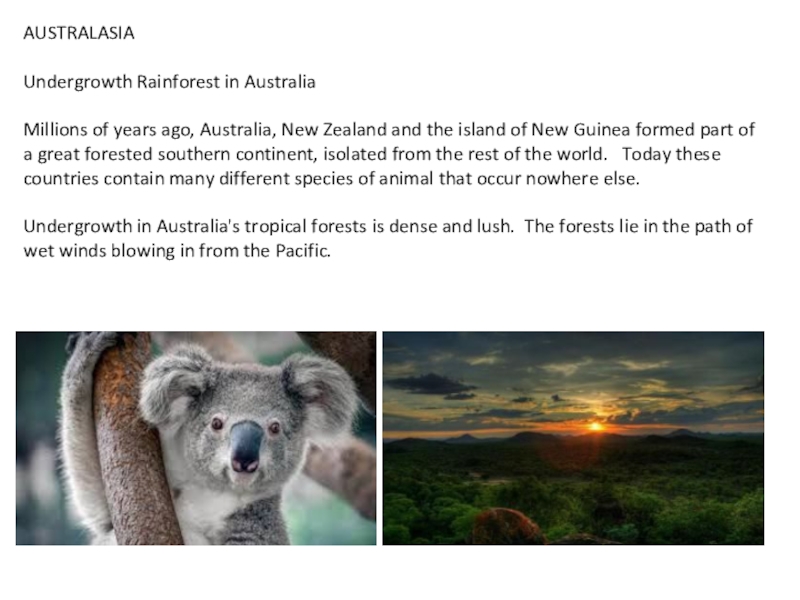
Undergrowth Rainforest in Australia
Millions of years ago, Australia, New Zealand and
the island of New Guinea formed part of a great forested southern continent, isolated from the rest of the world. Today these countries contain many different species of animal that occur nowhere else.
Undergrowth in Australia's tropical forests is dense and lush. The forests lie in the path of wet winds blowing in from the Pacific.
Undergrowth in Australia's tropical forests is dense and lush. The forests lie in the path of wet winds blowing in from the Pacific.
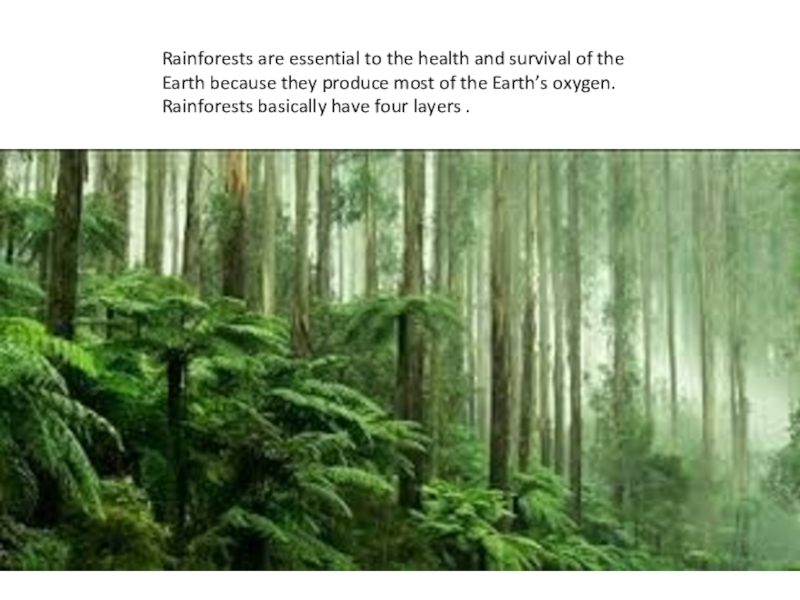
Слайд 10Rainforests are essential to the health and survival of the Earth
because they produce most of the Earth’s oxygen. Rainforests basically have four layers .
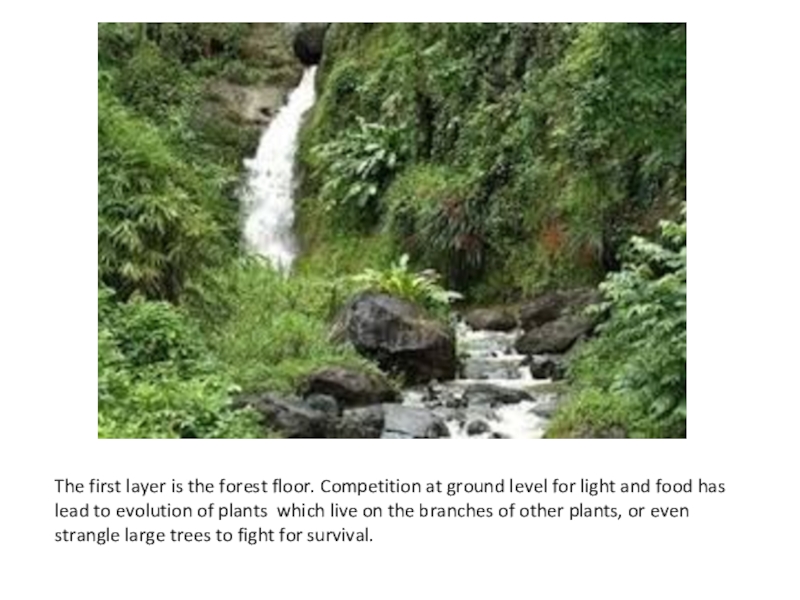
Слайд 11The first layer is the forest floor. Competition at ground level
for light and food has lead to evolution of plants which live on the branches of other plants, or even strangle large trees to fight for survival.
Слайд 12Above the ground surface the space is occupied by tree branches,
twigs, and foliage. Many species of animals run, flutter, hop, and climb in the undergrowth. Most of these animals live on insects and fruit, although a few are carnivorous. They tend to communicate more by sound than by sight in this dense forest strata.
Contrary to popular belief, the rainforest floor is not impassable. The ground surface is bare, except for a thin layer of humus and fallen leaves. The animals inhabiting this strata, such as rhinoceroses, chimpanzees, gorillas, elephants, deer, leopards, and bears, are adapted to walking and climbing short distances. Below the soil surface, burrowing animals, such as armadillos and caecilians, are found, as are microorganisms that help decompose and free much of the organic litter accumulated by other plants and animals from all strata.
The climate of the ground layer is unusually stable. The upper stories of tree canopies and the lower branches filter sunlight and heat radiation, as well as reduce wind speeds, so that the temperatures remain fairly even throughout the day and night.
Contrary to popular belief, the rainforest floor is not impassable. The ground surface is bare, except for a thin layer of humus and fallen leaves. The animals inhabiting this strata, such as rhinoceroses, chimpanzees, gorillas, elephants, deer, leopards, and bears, are adapted to walking and climbing short distances. Below the soil surface, burrowing animals, such as armadillos and caecilians, are found, as are microorganisms that help decompose and free much of the organic litter accumulated by other plants and animals from all strata.
The climate of the ground layer is unusually stable. The upper stories of tree canopies and the lower branches filter sunlight and heat radiation, as well as reduce wind speeds, so that the temperatures remain fairly even throughout the day and night.
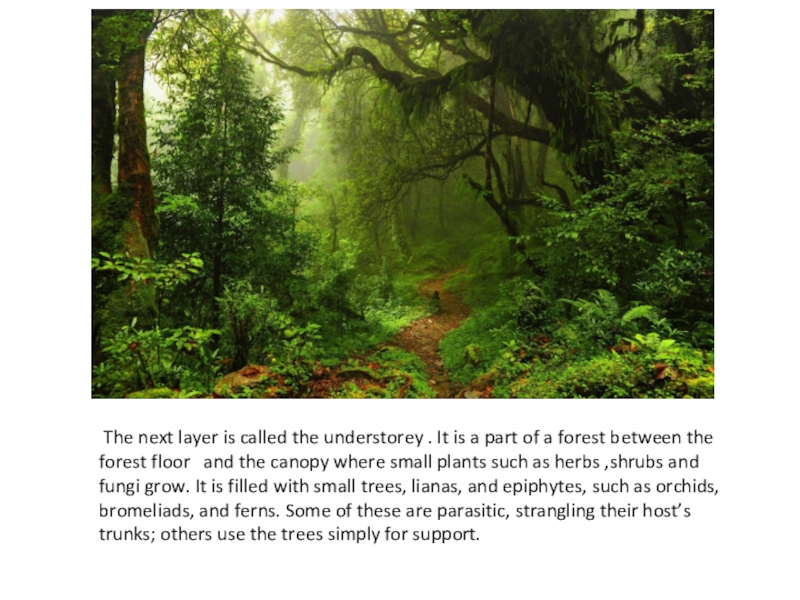
Слайд 13 The next layer is called the understorey . It is
a part of a forest between the forest floor and the canopy where small plants such as herbs ,shrubs and fungi grow. It is filled with small trees, lianas, and epiphytes, such as orchids, bromeliads, and ferns. Some of these are parasitic, strangling their host’s trunks; others use the trees simply for support.
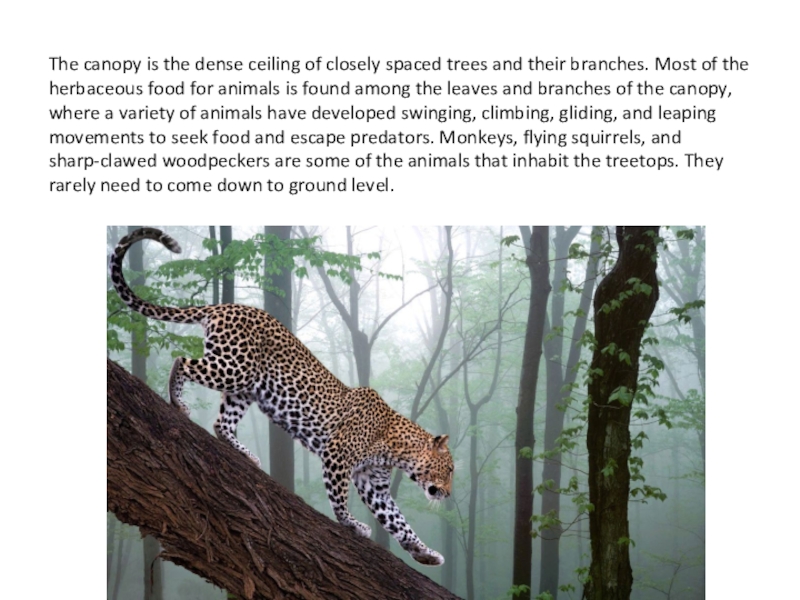
Слайд 14The canopy is the dense ceiling of closely spaced trees and
their branches. Most of the herbaceous food for animals is found among the leaves and branches of the canopy, where a variety of animals have developed swinging, climbing, gliding, and leaping movements to seek food and escape predators. Monkeys, flying squirrels, and sharp-clawed woodpeckers are some of the animals that inhabit the treetops. They rarely need to come down to ground level.
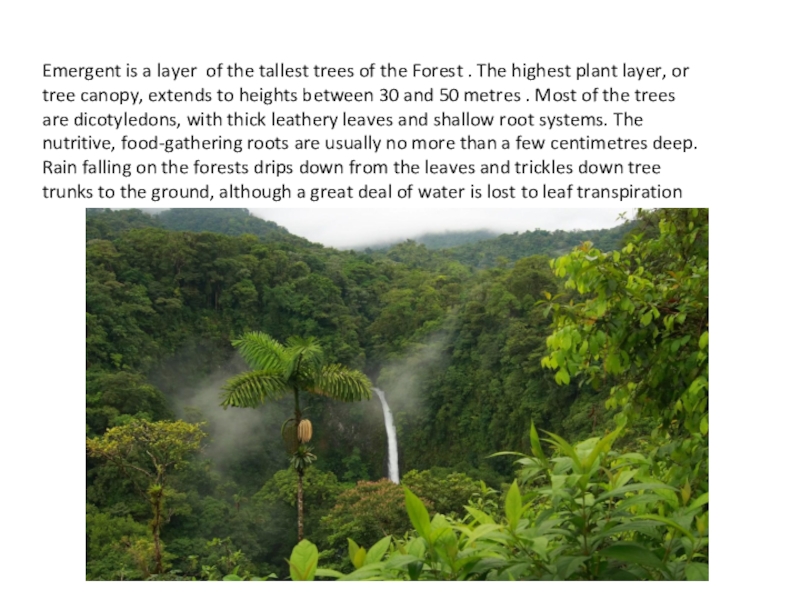
Слайд 15Emergent is a layer of the tallest trees of the Forest
. The highest plant layer, or tree canopy, extends to heights between 30 and 50 metres . Most of the trees are dicotyledons, with thick leathery leaves and shallow root systems. The nutritive, food-gathering roots are usually no more than a few centimetres deep. Rain falling on the forests drips down from the leaves and trickles down tree trunks to the ground, although a great deal of water is lost to leaf transpiration
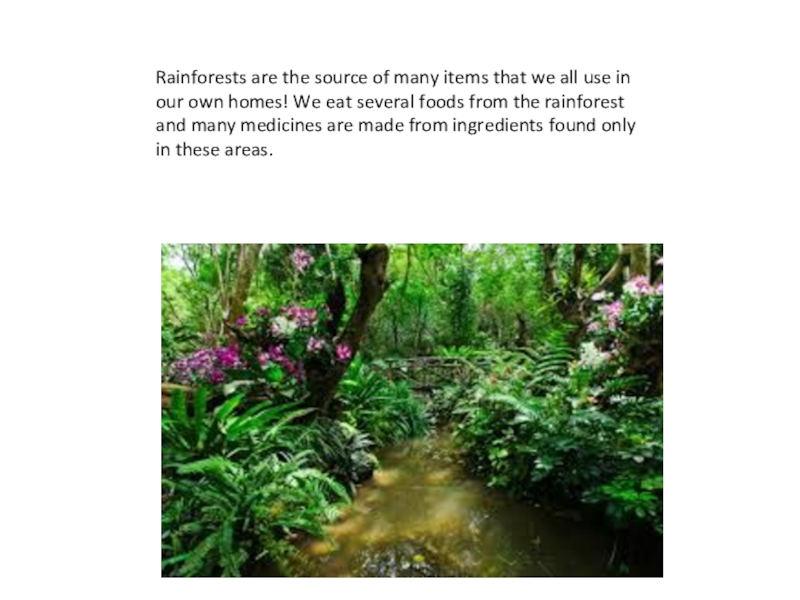
Слайд 16Rainforests are the source of many items that we all use
in our own homes! We eat several foods from the rainforest and many medicines are made from ingredients found only in these areas.
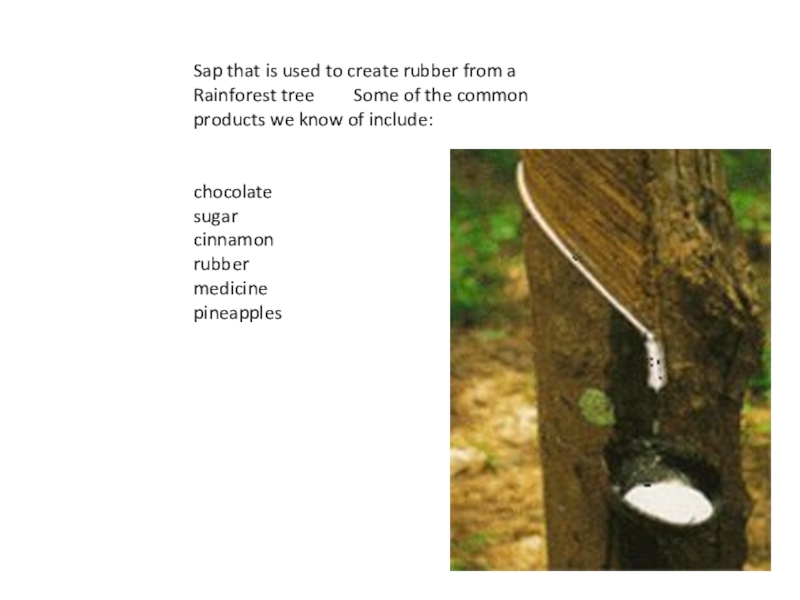
Слайд 17Sap that is used to create rubber from a Rainforest tree Some
of the common products we know of include:
chocolate
sugar
cinnamon
rubber
medicine
pineapples
chocolate
sugar
cinnamon
rubber
medicine
pineapples
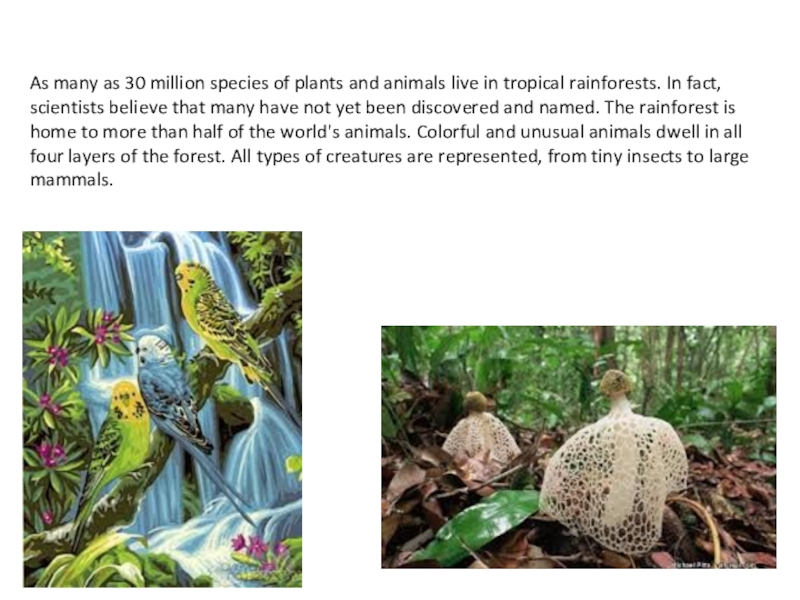
Слайд 18As many as 30 million species of plants and animals live
in tropical rainforests. In fact, scientists believe that many have not yet been discovered and named. The rainforest is home to more than half of the world's animals. Colorful and unusual animals dwell in all four layers of the forest. All types of creatures are represented, from tiny insects to large mammals.
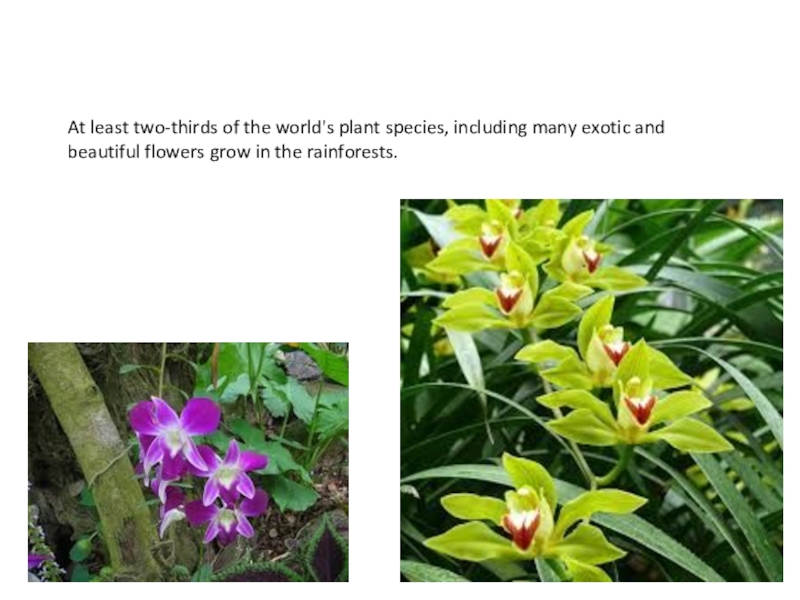
Слайд 19At least two-thirds of the world's plant species, including many exotic
and beautiful flowers grow in the rainforests.
Слайд 20PEOPLE OF THE RAINFOREST
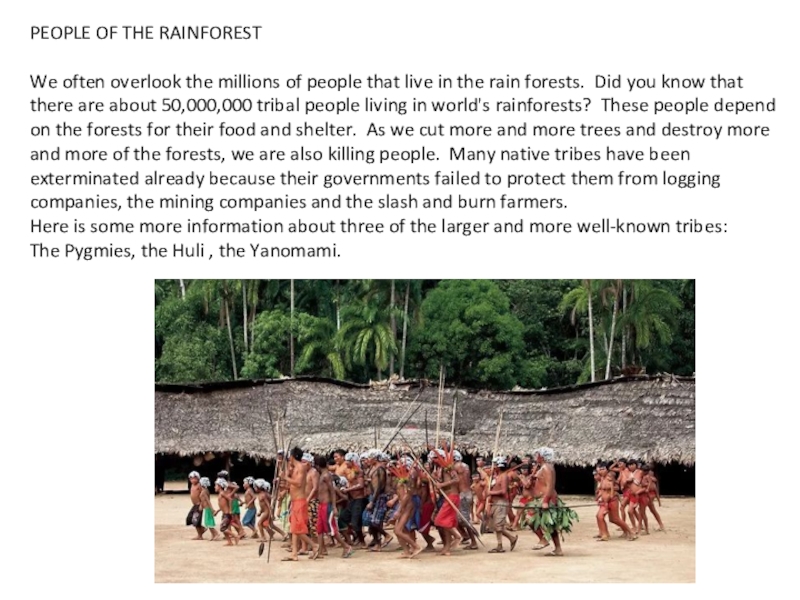
We often overlook the millions of people that
live in the rain forests. Did you know that there are about 50,000,000 tribal people living in world's rainforests? These people depend on the forests for their food and shelter. As we cut more and more trees and destroy more and more of the forests, we are also killing people. Many native tribes have been exterminated already because their governments failed to protect them from logging companies, the mining companies and the slash and burn farmers.
Here is some more information about three of the larger and more well-known tribes:
The Pygmies, the Huli , the Yanomami.
Here is some more information about three of the larger and more well-known tribes:
The Pygmies, the Huli , the Yanomami.
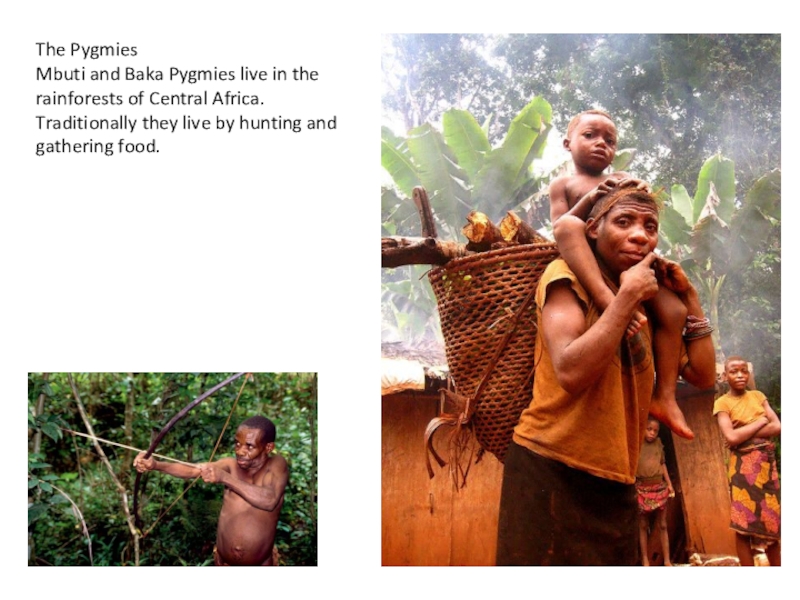
Слайд 21The Pygmies
Mbuti and Baka Pygmies live in the rainforests of Central
Africa. Traditionally they live by hunting and gathering food.
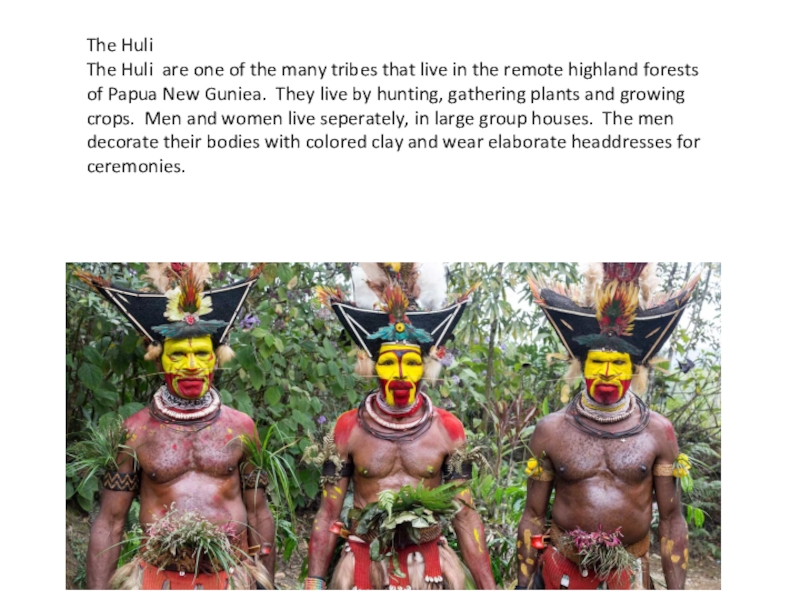
Слайд 22The Huli
The Huli are one of the many tribes that live
in the remote highland forests of Papua New Guniea. They live by hunting, gathering plants and growing crops. Men and women live seperately, in large group houses. The men decorate their bodies with colored clay and wear elaborate headdresses for ceremonies.
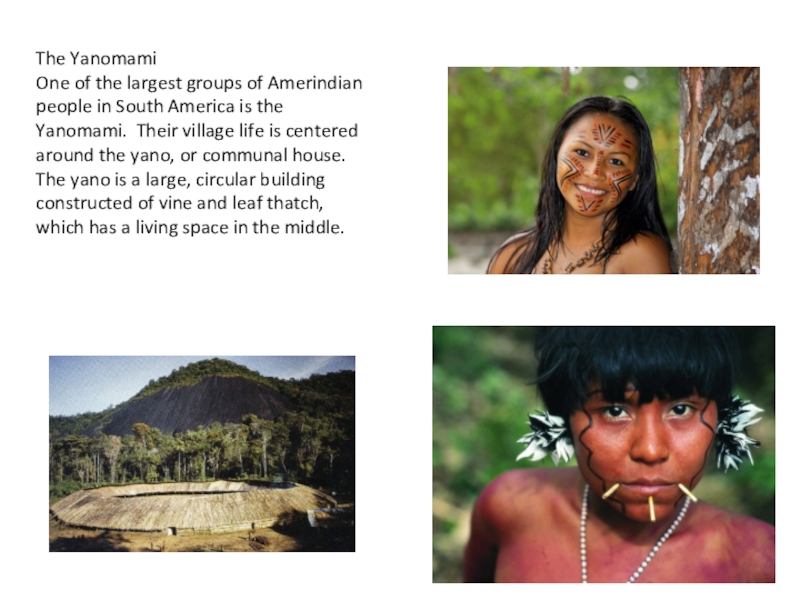
Слайд 23The Yanomami
One of the largest groups of Amerindian people in South
America is the Yanomami. Their village life is centered around the yano, or communal house. The yano is a large, circular building constructed of vine and leaf thatch, which has a living space in the middle.
Слайд 24PRESERVING THE RAINFORESTS
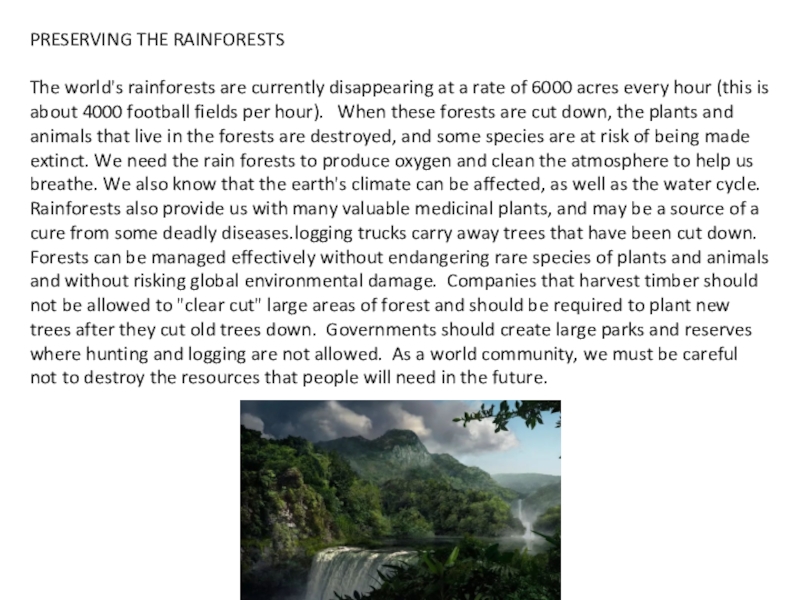
The world's rainforests are currently disappearing at a rate
of 6000 acres every hour (this is about 4000 football fields per hour). When these forests are cut down, the plants and animals that live in the forests are destroyed, and some species are at risk of being made extinct. We need the rain forests to produce oxygen and clean the atmosphere to help us breathe. We also know that the earth's climate can be affected, as well as the water cycle. Rainforests also provide us with many valuable medicinal plants, and may be a source of a cure from some deadly diseases.logging trucks carry away trees that have been cut down.
Forests can be managed effectively without endangering rare species of plants and animals and without risking global environmental damage. Companies that harvest timber should not be allowed to "clear cut" large areas of forest and should be required to plant new trees after they cut old trees down. Governments should create large parks and reserves where hunting and logging are not allowed. As a world community, we must be careful not to destroy the resources that people will need in the future.
Forests can be managed effectively without endangering rare species of plants and animals and without risking global environmental damage. Companies that harvest timber should not be allowed to "clear cut" large areas of forest and should be required to plant new trees after they cut old trees down. Governments should create large parks and reserves where hunting and logging are not allowed. As a world community, we must be careful not to destroy the resources that people will need in the future.