- Главная
- Разное
- Образование
- Спорт
- Естествознание
- Природоведение
- Религиоведение
- Французский язык
- Черчение
- Английский язык
- Астрономия
- Алгебра
- Биология
- География
- Геометрия
- Детские презентации
- Информатика
- История
- Литература
- Математика
- Музыка
- МХК
- Немецкий язык
- ОБЖ
- Обществознание
- Окружающий мир
- Педагогика
- Русский язык
- Технология
- Физика
- Философия
- Химия
- Шаблоны, фоны, картинки для презентаций
- Экология
- Экономика
Презентация, доклад по английскому языку на тему Passive (past)
Содержание
- 1. Презентация по английскому языку на тему Passive (past)
- 2. The Passive Voice:to be + Participle II
- 3. Past simple passive - positivepassive subject /'to
- 4. Past simple passive - negativepassive subject /'to
- 5. The Passive Voice образуется при помощи вспомогательного
- 6. Past continuous passive - positivepassive subject /'to
- 7. Past continuous passive - negativepassive subject /'to
- 8. Present perfect passive - positivepassive subject 'have'
- 9. Present perfect passive - negativepassive subject /'haven’t'
- 10. Present perfect passive - questions'to be' passive
- 11. Past tenses (passive)was/were writtenwas/were being writtenhad been written
- 12. Mary helps John.- Мэри помогает Джону.John is
- 13. Mary was helping John. - Мэри помогала
- 14. Отрицательная и вопросительная формы образуются по тем
- 15. При сложной форме вспомогательного глагола частица not
- 16. В вопросительной форме вспомогательный глагол (в сложной
- 17. Сказуемому в действительном залоге, выраженному сочетанием одного
- 18. Если в страдательной конструкции указывается исполнитель действия,
- 19. В английском языке есть глаголы, употребление которых
- 20. Если в конструкции указывается объект или материал,
- 21. Name three countries where Spanish is spoken
- 22. How often is the president of the USA elected?
- 23. Where are the next Olympic Games going to be held?
- 24. When was Pompeii destroyed?
- 25. What's the best thing you've ever been
- 26. Have you ever been punished for something
- 27. Where were you born?Do you think you'll
- 28. What tenses are they?am/are/is givenam/are/is being givenhas/have been given
- 29. What tenses are they?shall/will be given-shall/will have been given-
- 30. Put these sentences into the passive, beginning
- 31. Complete the sentences with by or with.
The Passive Voice:to be + Participle II
Слайд 3Past simple passive - positive
passive subject /'to be'/ past participle
The bridge
was opened in 1977.
The pyramids were built by the ancient Egyptians.
The pyramids were built by the ancient Egyptians.
Слайд 4Past simple passive - negative
passive subject /'to be'/ past participle
The bridge
wasn't opened in 1968.
The pyramids weren't built by the modern Egyptians.
The pyramids weren't built by the modern Egyptians.
Слайд 5The Passive Voice образуется при помощи вспомогательного глагола to be в
соответствующем времени, лице и числе и причастия прошедшего времени смыслового глагола Participle II:
Pompeii was destroyed.
When was Pompeii destroyed?
Pompeii was destroyed.
When was Pompeii destroyed?
Слайд 6Past continuous passive - positive
passive subject /'to be'/ being past participle
The
bridge was being painted last year.
The interviews were being held in the office.
The interviews were being held in the office.
Слайд 7Past continuous passive - negative
passive subject /'to be'/ being past participle
The
bridge wasn't being painted in 1968.
The interviews weren't being held in the canteen.
The interviews weren't being held in the canteen.
Слайд 8Present perfect passive - positive
passive subject 'have' been past participle
The house
has been painted this year.
The children have been given their medicine.
The children have been given their medicine.
Слайд 9Present perfect passive - negative
passive subject /'haven’t' been /past participle
The
house hasn't been painted yet.
The children haven't been given their medicine.
The children haven't been given their medicine.
Слайд 10Present perfect passive - questions
'to be' passive subject been past participle
Has
the house been painted this year ?
Have the children been given their medicine ?
Have the children been given their medicine ?
Слайд 12Mary helps John.- Мэри помогает Джону.
John is helped by Mary. -
Джону помогает Мэри.
Mary helped John. - Мэри помогла Джону.
John was helped by Mary. - Джону помогла Мэри.
Mary will help John. - Мэри поможет Джону.
John will be helped by Mary. - Джону поможет Мэри.
Mary is helping John. - Мэри помогает Джону.
John is being helped by Mary. - Джону (сейчас) помогает Мэри.
Mary helped John. - Мэри помогла Джону.
John was helped by Mary. - Джону помогла Мэри.
Mary will help John. - Мэри поможет Джону.
John will be helped by Mary. - Джону поможет Мэри.
Mary is helping John. - Мэри помогает Джону.
John is being helped by Mary. - Джону (сейчас) помогает Мэри.
Слайд 13Mary was helping John. - Мэри помогала Джону.
John was being helped
by Mary. - Джону помогала Мэри.
Mary has helped John. - Мэри помогла Джону.
John has been helped by Mary. - Джону помогла Мэри.
Mary had helped John before Mother came. - Мэри помогла Джону до прихода мамы.
John had been helped by Mary before Mother came. - Джону помогла Мэри до прихода мамы.
Mary will have helped John. - Мэри поможет Джону.
John will have been helped by Mary. - Джону поможет Мэри.
Mary has helped John. - Мэри помогла Джону.
John has been helped by Mary. - Джону помогла Мэри.
Mary had helped John before Mother came. - Мэри помогла Джону до прихода мамы.
John had been helped by Mary before Mother came. - Джону помогла Мэри до прихода мамы.
Mary will have helped John. - Мэри поможет Джону.
John will have been helped by Mary. - Джону поможет Мэри.
Слайд 14Отрицательная и вопросительная формы образуются по тем же правилам, что и
формы действительного залога:
в отрицательной форме частица подставится после вспомогательного глагола:
John isn't helped by Mary. - Джону Мэри не помогает.
в отрицательной форме частица подставится после вспомогательного глагола:
John isn't helped by Mary. - Джону Мэри не помогает.
Слайд 15При сложной форме вспомогательного глагола частица not ставится после первого вспомогательного
глагола:
John hasn't been helped by Mary. - Джону Мэри не помогла.
John hasn't been helped by Mary. - Джону Мэри не помогла.
Слайд 16В вопросительной форме вспомогательный глагол (в сложной форме первый по счету)
обычно ставится перед подлежащим:
Is John helped by Mary? - Джону Мэри помогает?
Has John been helped by Mary? - Джону Мэри помогла?
Is John helped by Mary? - Джону Мэри помогает?
Has John been helped by Mary? - Джону Мэри помогла?
Слайд 17Сказуемому в действительном залоге, выраженному сочетанием одного из модальных глаголов can
(could), may (might), should, ought и т.д. с инфинитивом действительного залога, в страдательном залоге соответствует сочетание того же модального глагола с инфинитивом страдательного залога:
We must finish our work as soon as possible. - Мы должны закончить работу как можно скорее.
Our work must be finished as soon as possible. - Наша работа должна быть закончена как можно скорее.
You ought to translate this article at once. - Тебе следует перевести эту статью сразу же.
This article ought to be translated at once. - Эту статью следует перевести сразу же.
We must finish our work as soon as possible. - Мы должны закончить работу как можно скорее.
Our work must be finished as soon as possible. - Наша работа должна быть закончена как можно скорее.
You ought to translate this article at once. - Тебе следует перевести эту статью сразу же.
This article ought to be translated at once. - Эту статью следует перевести сразу же.
Слайд 18Если в страдательной конструкции указывается исполнитель действия, выраженный одушевленным существительным или
местоимением, ему предшествует предлог by:
The book was written by O.Wilde. - Книга была написана О.Уайльдом
The book was written by O.Wilde. - Книга была написана О.Уайльдом
Слайд 19В английском языке есть глаголы, употребление которых в пассиве чаще всего
невозможно без by-phrase, т.е. фразы, указывающей на деятеля производимого действия: to follow, to overtake, to seize, to visit, to govern, to characterize, to attract, to control, to rule, to influence, to confront, to attend, to accompany, to join, to cause, to bring about, to mark и т.д.:
Не is followed by the police. - Его преследует полиция.
Не is followed by the police. - Его преследует полиция.
Слайд 20Если в конструкции указывается объект или материал, при помощи которого совершено
действие, употребляется предлог with:
The room was filled with smoke. - Комната была полна дыма.
The finger was cut with a knife. - Палец порезали ножом.
The room was filled with smoke. - Комната была полна дыма.
The finger was cut with a knife. - Палец порезали ножом.


Слайд 25What's the best thing you've ever been invited to?
Do you know
anyone who's been elected to an important position?
Have you ever been robbed?
When was the first time you were taken somewhere on holiday?
Have you ever been mistaken for someone else?
Where were your shoes made?
Do you like being photographed?
Have you ever been robbed?
When was the first time you were taken somewhere on holiday?
Have you ever been mistaken for someone else?
Where were your shoes made?
Do you like being photographed?
Слайд 26Have you ever been punished for something you didn't do?
When was
the last time you were kept waiting?
Have any of your valued possessions ever got broken?
What's the most exciting thing you've ever been involved in?
Can you think of a situation when you got left behind?
Do you mind being corrected when you speak English?
How do you react when you get asked questions you don't want to answer?
Have any of your valued possessions ever got broken?
What's the most exciting thing you've ever been involved in?
Can you think of a situation when you got left behind?
Do you mind being corrected when you speak English?
How do you react when you get asked questions you don't want to answer?
Слайд 27Where were you born?
Do you think you'll ever get married?
If you've
got a pet, what's it called, and why?
Слайд 30Put these sentences into the passive, beginning with the words given.
1. They showed Sarah the photographs. Sarah ------------------.
2. Normally, they pay me my salary every month. Normally, I ----------------.
3. I think that they have sent us the wrong tickets. I think that we------------.
4. I hope that someone will give Sally the message. I hope that Sally -------.
5. They didn’t ask me for my address. I-----------------.
6. They promised Robert an interview for the job. Robert ------------------.
7. I thought that someone had told you about the meeting. I thought that you------------------.
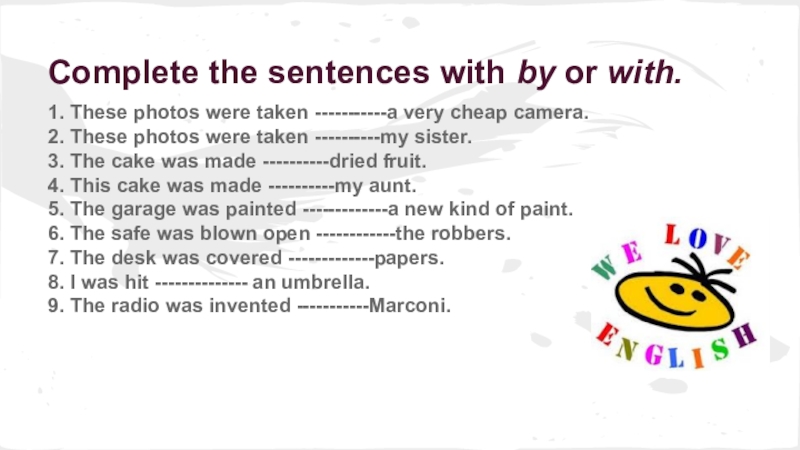
Слайд 31Complete the sentences with by or with.
1. These photos were
taken -----------a very cheap camera.
2. These photos were taken ----------my sister.
3. The cake was made ----------dried fruit.
4. This cake was made ----------my aunt.
5. The garage was painted -------------a new kind of paint.
6. The safe was blown open ------------the robbers.
7. The desk was covered -------------papers.
8. I was hit -------------- an umbrella.
9. The radio was invented -----------Marconi.
2. These photos were taken ----------my sister.
3. The cake was made ----------dried fruit.
4. This cake was made ----------my aunt.
5. The garage was painted -------------a new kind of paint.
6. The safe was blown open ------------the robbers.
7. The desk was covered -------------papers.
8. I was hit -------------- an umbrella.
9. The radio was invented -----------Marconi.