- Главная
- Разное
- Образование
- Спорт
- Естествознание
- Природоведение
- Религиоведение
- Французский язык
- Черчение
- Английский язык
- Астрономия
- Алгебра
- Биология
- География
- Геометрия
- Детские презентации
- Информатика
- История
- Литература
- Математика
- Музыка
- МХК
- Немецкий язык
- ОБЖ
- Обществознание
- Окружающий мир
- Педагогика
- Русский язык
- Технология
- Физика
- Философия
- Химия
- Шаблоны, фоны, картинки для презентаций
- Экология
- Экономика
Презентация, доклад по английскому языку на тему Art of Kazakhstan
Содержание
- 1. Презентация по английскому языку на тему Art of Kazakhstan
- 2. Слайд 2
- 3. Phonetic exercise Song “Let it be”
- 4. Let it be
- 5. Art of Kazakhstan
- 6. PrehistoryDuring period, Kazakhstan did not exist as
- 7. Later, this highly developed culture with a
- 8. Musical instruments. Music gives voice the
- 9. Folk singers. Great singers include Zhayau Musa,
- 10. Literature For a long period, the Kazakhs
- 11. Written Literature was started by Abai (1845-1904),
- 12. Visual Arts Ancient rock carvings (1st-2nd
- 13. Painting and graphic arts. A Kasteev (1904-73)
- 14. Monumental art. Among the monuments which are
- 15. Cinematography in Kazakhstan “Kazakhfilm” is
- 16. Слайд 16
- 17. Today, the culture of Kazakhstan represents a
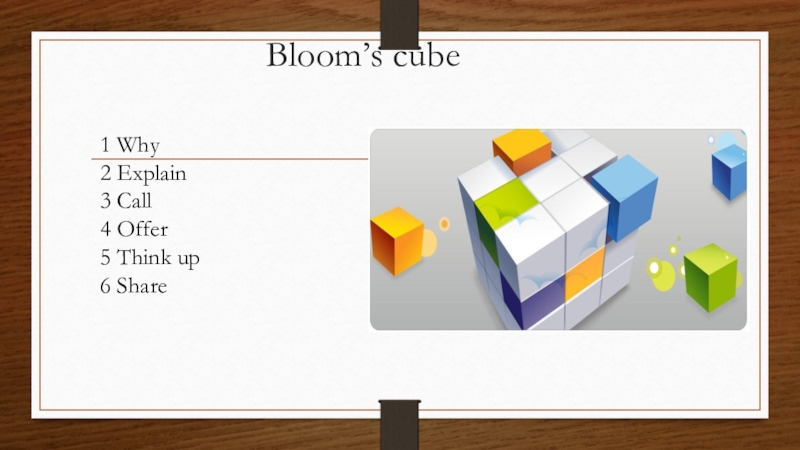
- 18. Bloom’s cube1 Why2 Explain3 Call4 Offer5 Think up6 Share
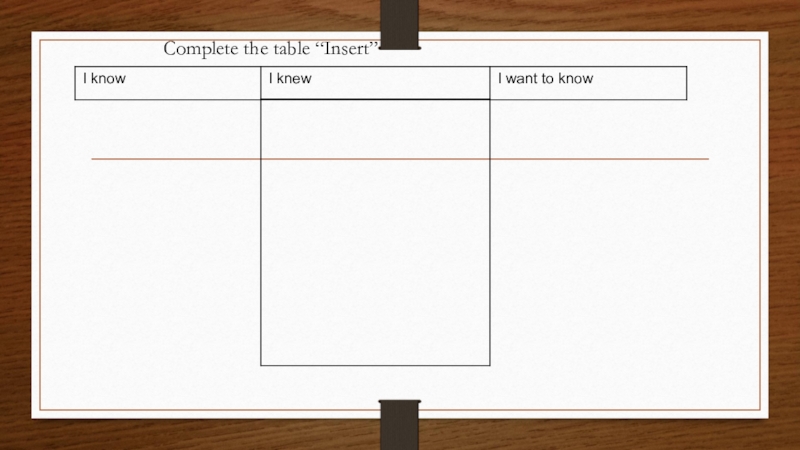
- 19. Complete the table “Insert”
- 20. Слайд 20
- 21. Слайд 21
- 22. Слайд 22
- 23. ReflectionWhat can you tell me about today’s lessons?What is sensible, useful…?
- 24. Home taskArt of Kazakhstan-retellingGrammar
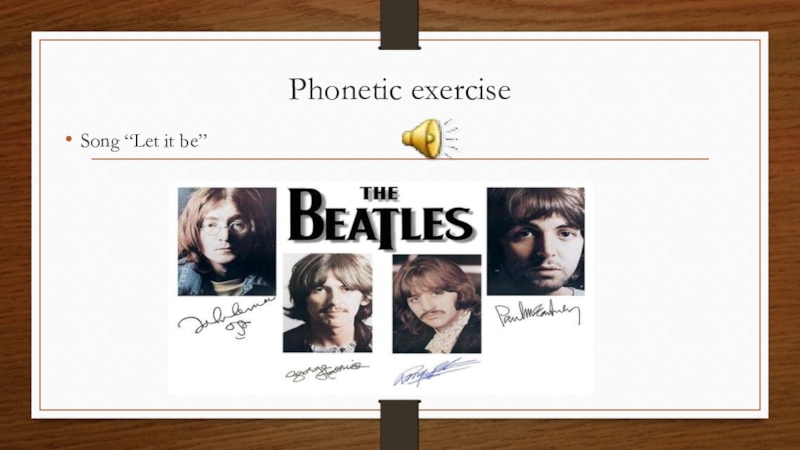
Phonetic exercise Song “Let it be”
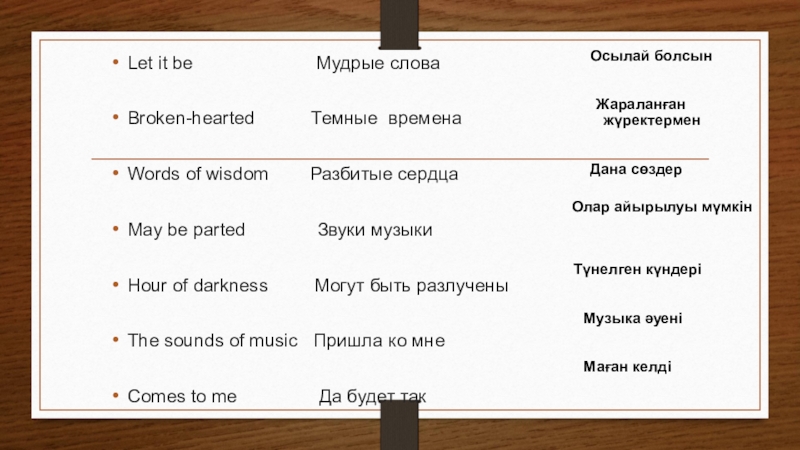
Слайд 4Let it be
Мудрые слова
Broken-hearted Темные времена
Words of wisdom Разбитые сердца
May be parted Звуки музыки
Hour of darkness Могут быть разлучены
The sounds of music Пришла ко мне
Comes to me Да будет так
Broken-hearted Темные времена
Words of wisdom Разбитые сердца
May be parted Звуки музыки
Hour of darkness Могут быть разлучены
The sounds of music Пришла ко мне
Comes to me Да будет так
Осылай болсын
Жараланған жүректермен
Дана сөздер
Олар айырылуы мүмкін
Түнелген күндері
Музыка әуені
Маған келді
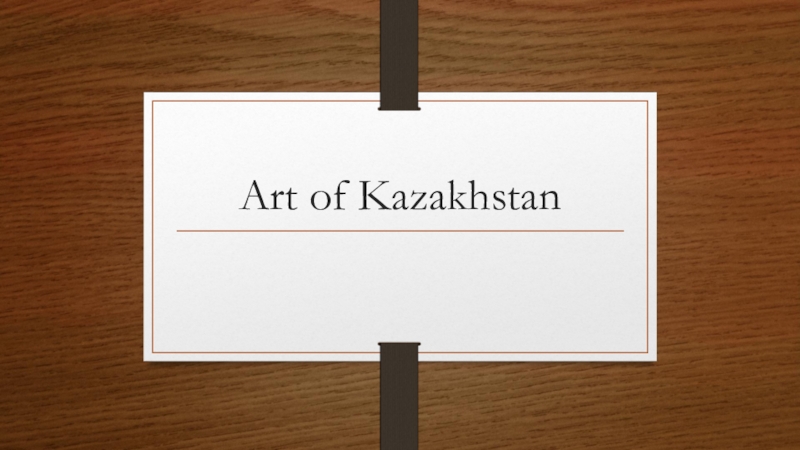
Слайд 6Prehistory
During period, Kazakhstan did not exist as a state. However, a
centuries-old cultural community had already been formed. The term “Kazakh”, which means “free”, appeared later in the 14th – 15th centuries.
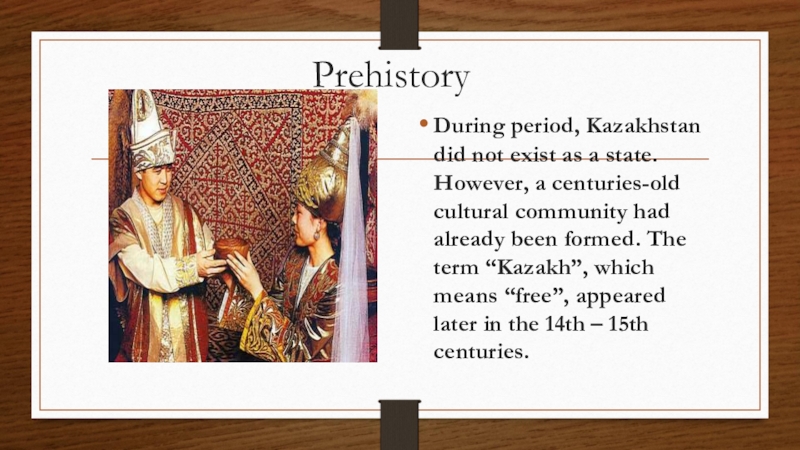
Слайд 7Later, this highly developed culture with a multilayered structure was enriched
with new knowledge and principles, which were typical of a settled lifestyle.
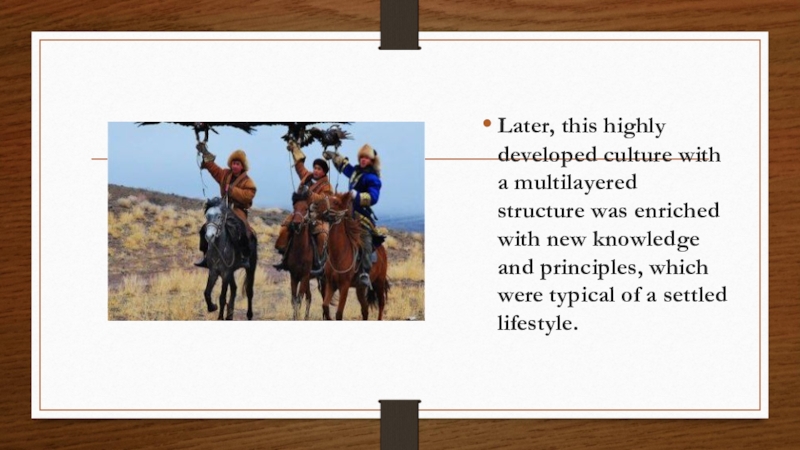
Слайд 8 Musical instruments. Music gives voice the soul of the people. Ancient
Kazakh musical instruments include the dombra and kobyz (stringed musical instruments played by plucking), the saz-syrnai, which is a clay flute and thesabyzgy, which is a cane flute. Korkyt is the creator of the kobyz and kyuy, a genre of music.
Musicians. Great Kazakh dombra players and Kyuy performers include Asan Kaygy (15th century), Tattimbet, Dauletkerey, and Kurmangazy, among kobyz players there is Ykylas (19th century), and Nurgisa Tlendiyev (20th century).
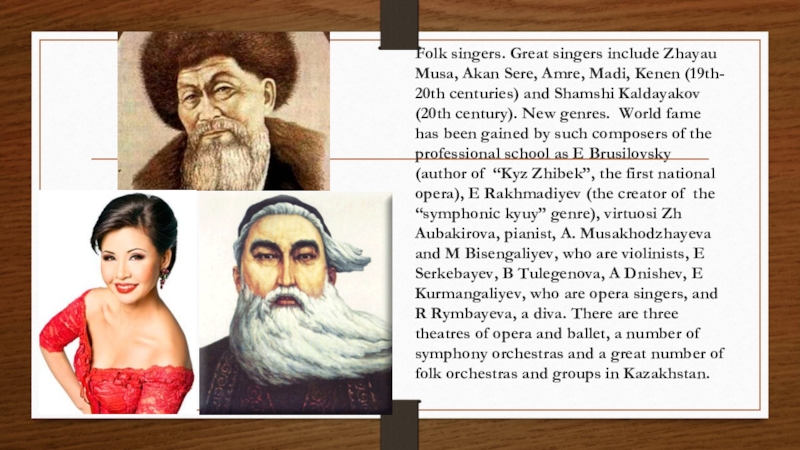
Слайд 9Folk singers. Great singers include Zhayau Musa, Akan Sere, Amre, Madi,
Kenen (19th- 20th centuries) and Shamshi Kaldayakov (20th century). New genres. World fame has been gained by such composers of the professional school as E Brusilovsky (author of “Kyz Zhibek”, the first national opera), E Rakhmadiyev (the creator of the “symphonic kyuy” genre), virtuosi Zh Aubakirova, pianist, A. Musakhodzhayeva and M Bisengaliyev, who are violinists, E Serkebayev, B Tulegenova, A Dnishev, E Kurmangaliyev, who are opera singers, and R Rymbayeva, a diva. There are three theatres of opera and ballet, a number of symphony orchestras and a great number of folk orchestras and groups in Kazakhstan.
Слайд 10Literature
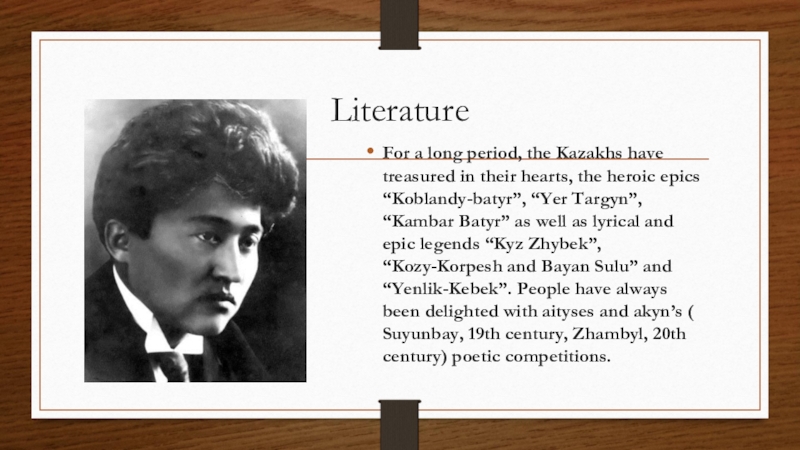
For a long period, the Kazakhs have treasured in their
hearts, the heroic epics “Koblandy-batyr”, “Yer Targyn”, “Kambar Batyr” as well as lyrical and epic legends “Kyz Zhybek”, “Kozy-Korpesh and Bayan Sulu” and “Yenlik-Kebek”. People have always been delighted with aityses and akyn’s ( Suyunbay, 19th century, Zhambyl, 20th century) poetic competitions.
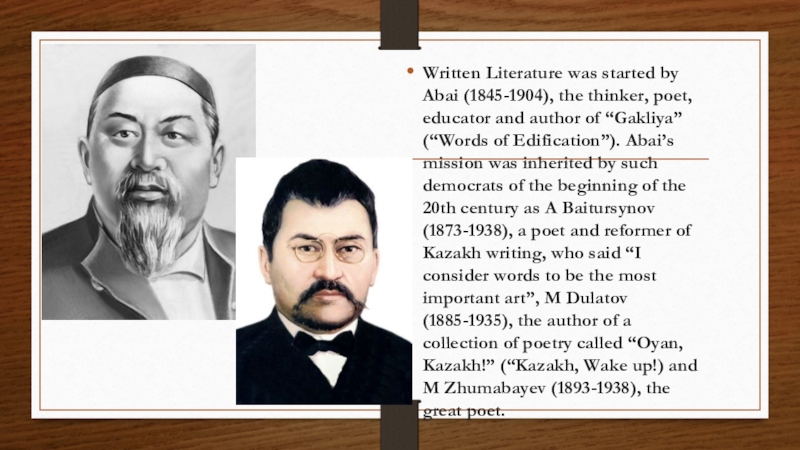
Слайд 11Written Literature was started by Abai (1845-1904), the thinker, poet, educator
and author of “Gakliya” (“Words of Edification”). Abai’s mission was inherited by such democrats of the beginning of the 20th century as A Baitursynov (1873-1938), a poet and reformer of Kazakh writing, who said “I consider words to be the most important art”, M Dulatov (1885-1935), the author of a collection of poetry called “Oyan, Kazakh!” (“Kazakh, Wake up!) and M Zhumabayev (1893-1938), the great poet.
Слайд 12Visual Arts
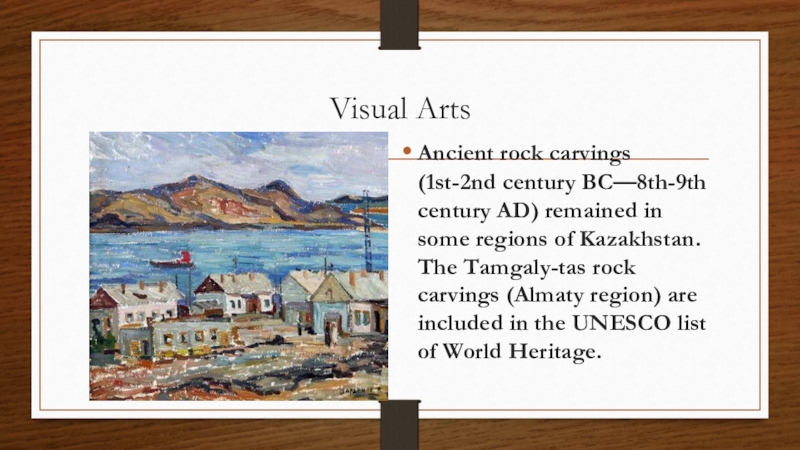
Ancient rock carvings (1st-2nd century BC—8th-9th century AD) remained
in some regions of Kazakhstan. The Tamgaly-tas rock carvings (Almaty region) are included in the UNESCO list of World Heritage.
Слайд 13Painting and graphic arts. A Kasteev (1904-73) was the first national
professional watercolour painter. N Khludov (1850-1935), his teacher was the author of ethnographically precise romantic paintings about the nomads’ life.

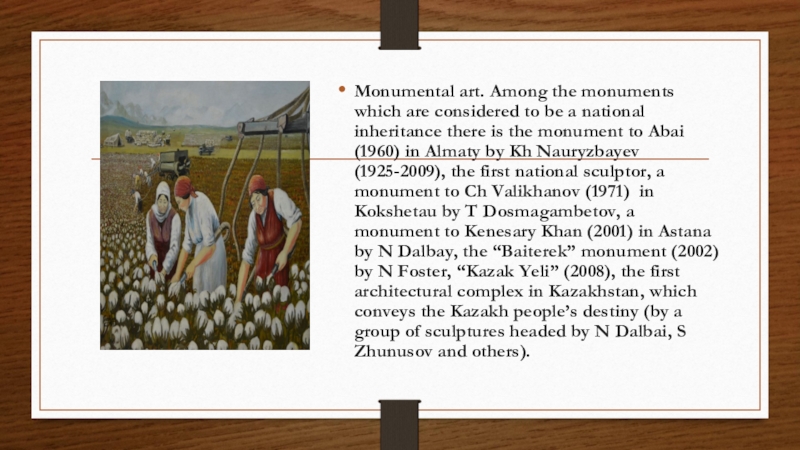
Слайд 14Monumental art. Among the monuments which are considered to be a
national inheritance there is the monument to Abai (1960) in Almaty by Kh Nauryzbayev (1925-2009), the first national sculptor, a monument to Ch Valikhanov (1971) in Kokshetau by T Dosmagambetov, a monument to Kenesary Khan (2001) in Astana by N Dalbay, the “Baiterek” monument (2002) by N Foster, “Kazak Yeli” (2008), the first architectural complex in Kazakhstan, which conveys the Kazakh people’s destiny (by a group of sculptures headed by N Dalbai, S Zhunusov and others).
Слайд 15Cinematography in Kazakhstan
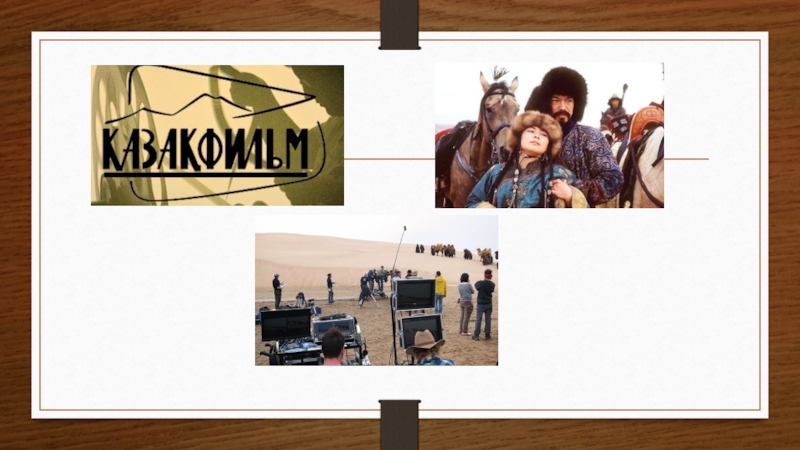
“Kazakhfilm” is the only film company in
Kazakhstan. It was created in 1960 as part of the Almaty Studio of Newsreels (1934). Now Kazakhstan makes 30-40 feature films, documentaries and cartoons annually.
In 2006, “Kazakhfilm” started the “People’s Choice: Golden Collection of Kazakh Cinema” campaign. Twenty films out of fifty that were chosen by the audience have been restored.
“Kazakhfilm” held “A New Documentary of Kazakhstan” festival dedicated to the 20th anniversary of the independence of Kazakhstan in Almaty in March 2011.
The “I’m 20 Years Old” film about the life of young people who are the same age as the independence of Kazakhstan, made by students of the T Zhurgenev Kazakh National Academy of Art in Almaty, will be of great importance.
There are about 70 states museums in Kazakhstan with exhibitions dedicated to culture, art and literature of Kazakhstan.
In 2006, “Kazakhfilm” started the “People’s Choice: Golden Collection of Kazakh Cinema” campaign. Twenty films out of fifty that were chosen by the audience have been restored.
“Kazakhfilm” held “A New Documentary of Kazakhstan” festival dedicated to the 20th anniversary of the independence of Kazakhstan in Almaty in March 2011.
The “I’m 20 Years Old” film about the life of young people who are the same age as the independence of Kazakhstan, made by students of the T Zhurgenev Kazakh National Academy of Art in Almaty, will be of great importance.
There are about 70 states museums in Kazakhstan with exhibitions dedicated to culture, art and literature of Kazakhstan.

Слайд 17Today, the culture of Kazakhstan represents a complex of aesthetic values
of the Kazakh people, conveyed in original and different spiritual and material forms.
As a result of its nature, the culture provides us with the development and enrichment of creative potential and with an individual place in the family of national cultures.
As a result of its nature, the culture provides us with the development and enrichment of creative potential and with an individual place in the family of national cultures.