- Главная
- Разное
- Образование
- Спорт
- Естествознание
- Природоведение
- Религиоведение
- Французский язык
- Черчение
- Английский язык
- Астрономия
- Алгебра
- Биология
- География
- Геометрия
- Детские презентации
- Информатика
- История
- Литература
- Математика
- Музыка
- МХК
- Немецкий язык
- ОБЖ
- Обществознание
- Окружающий мир
- Педагогика
- Русский язык
- Технология
- Физика
- Философия
- Химия
- Шаблоны, фоны, картинки для презентаций
- Экология
- Экономика
Презентация, доклад по английскому языку на тему Рождение ребенка
Содержание
- 1. Презентация по английскому языку на тему Рождение ребенка
- 2. ChildbirthAlso known as labour and delivery, is
- 3. The better way of childbirthThe common way
- 4. Signs and symptomsThe most prominent sign of
- 5. Onset of labourThere are various definitions of
- 6. Vaginal birthSix phases of a typical vertex
- 7. Labour induction and elective cesareanIn many cases
- 8. Multiple birthsIn cases of a head first-presenting
- 9. External monitoringFor monitoring of the fetus during
- 10. Labour complicationsThe second stage of labour may
- 11. Maternal complicationsVaginal birth injury with visible tears
- 12. Слайд 12
- 13. Society and cultureChildbirth routinely occurs in hospitals
- 14. Thanks For Attention
ChildbirthAlso known as labour and delivery, is the ending of a pregnancy by one or more babies leaving a woman's uterus by vaginal passage or c-section.
Слайд 1Childbirth
ГБПОУ НО НМК
Подготовила презентацию
преподаватель: Бытина Н.И.
Нижний Новгород 2018 г

Слайд 2Childbirth
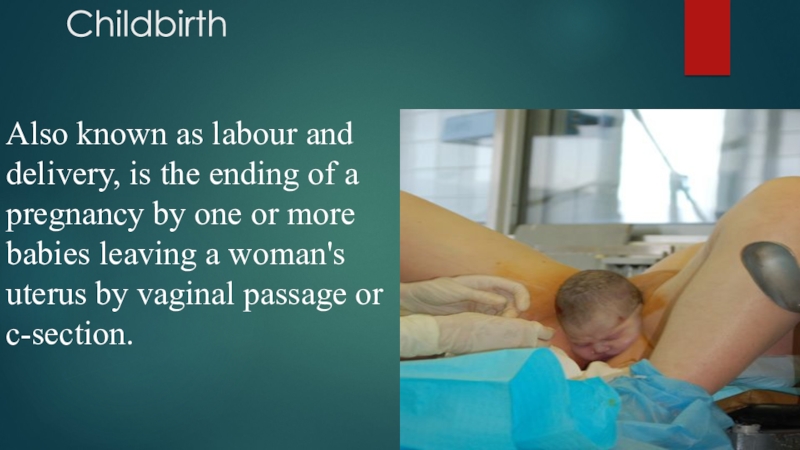
Also known as labour and delivery, is the ending of a
pregnancy by one or more babies leaving a woman's uterus by vaginal passage or c-section.
Слайд 3The better way of childbirth
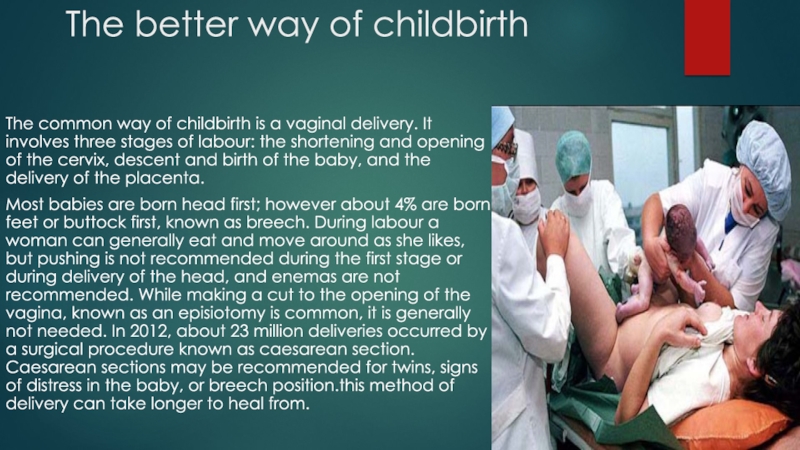
The common way of childbirth is a
vaginal delivery. It involves three stages of labour: the shortening and opening of the cervix, descent and birth of the baby, and the delivery of the placenta.
Most babies are born head first; however about 4% are born feet or buttock first, known as breech. During labour a woman can generally eat and move around as she likes, but pushing is not recommended during the first stage or during delivery of the head, and enemas are not recommended. While making a cut to the opening of the vagina, known as an episiotomy is common, it is generally not needed. In 2012, about 23 million deliveries occurred by a surgical procedure known as caesarean section. Caesarean sections may be recommended for twins, signs of distress in the baby, or breech position.this method of delivery can take longer to heal from.
Most babies are born head first; however about 4% are born feet or buttock first, known as breech. During labour a woman can generally eat and move around as she likes, but pushing is not recommended during the first stage or during delivery of the head, and enemas are not recommended. While making a cut to the opening of the vagina, known as an episiotomy is common, it is generally not needed. In 2012, about 23 million deliveries occurred by a surgical procedure known as caesarean section. Caesarean sections may be recommended for twins, signs of distress in the baby, or breech position.this method of delivery can take longer to heal from.
Слайд 4Signs and symptoms
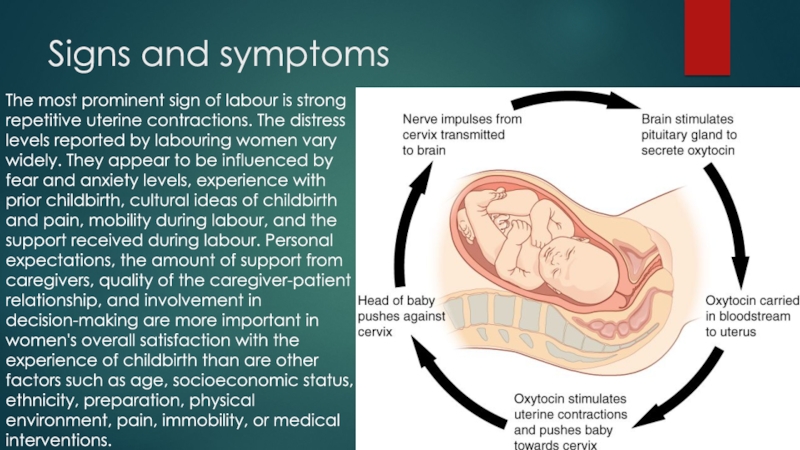
The most prominent sign of labour is strong repetitive
uterine contractions. The distress levels reported by labouring women vary widely. They appear to be influenced by fear and anxiety levels, experience with prior childbirth, cultural ideas of childbirth and pain, mobility during labour, and the support received during labour. Personal expectations, the amount of support from caregivers, quality of the caregiver-patient relationship, and involvement in decision-making are more important in women's overall satisfaction with the experience of childbirth than are other factors such as age, socioeconomic status, ethnicity, preparation, physical environment, pain, immobility, or medical interventions.
Слайд 5Onset of labour
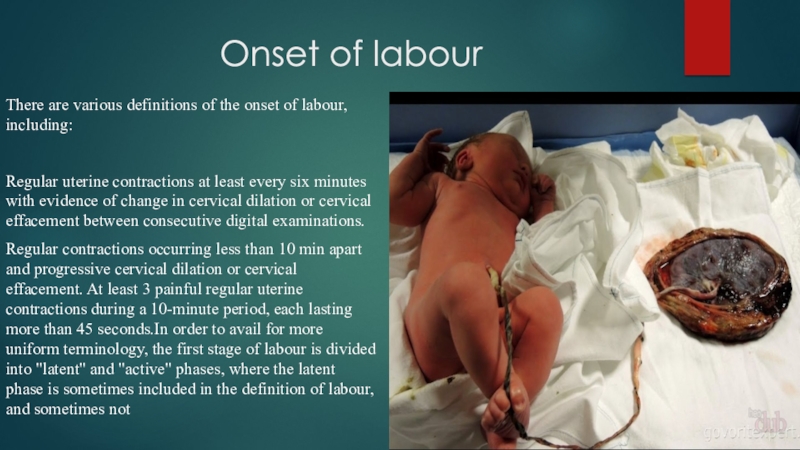
There are various definitions of the onset of labour,
including:
Regular uterine contractions at least every six minutes with evidence of change in cervical dilation or cervical effacement between consecutive digital examinations.
Regular contractions occurring less than 10 min apart and progressive cervical dilation or cervical effacement. At least 3 painful regular uterine contractions during a 10-minute period, each lasting more than 45 seconds.In order to avail for more uniform terminology, the first stage of labour is divided into "latent" and "active" phases, where the latent phase is sometimes included in the definition of labour, and sometimes not
Regular uterine contractions at least every six minutes with evidence of change in cervical dilation or cervical effacement between consecutive digital examinations.
Regular contractions occurring less than 10 min apart and progressive cervical dilation or cervical effacement. At least 3 painful regular uterine contractions during a 10-minute period, each lasting more than 45 seconds.In order to avail for more uniform terminology, the first stage of labour is divided into "latent" and "active" phases, where the latent phase is sometimes included in the definition of labour, and sometimes not
Слайд 6Vaginal birth
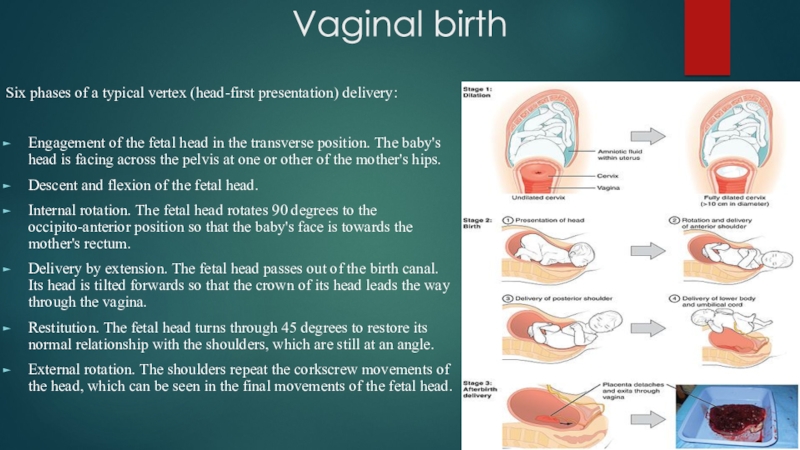
Six phases of a typical vertex (head-first presentation) delivery:
Engagement of
the fetal head in the transverse position. The baby's head is facing across the pelvis at one or other of the mother's hips.
Descent and flexion of the fetal head.
Internal rotation. The fetal head rotates 90 degrees to the occipito-anterior position so that the baby's face is towards the mother's rectum.
Delivery by extension. The fetal head passes out of the birth canal. Its head is tilted forwards so that the crown of its head leads the way through the vagina.
Restitution. The fetal head turns through 45 degrees to restore its normal relationship with the shoulders, which are still at an angle.
External rotation. The shoulders repeat the corkscrew movements of the head, which can be seen in the final movements of the fetal head.
Descent and flexion of the fetal head.
Internal rotation. The fetal head rotates 90 degrees to the occipito-anterior position so that the baby's face is towards the mother's rectum.
Delivery by extension. The fetal head passes out of the birth canal. Its head is tilted forwards so that the crown of its head leads the way through the vagina.
Restitution. The fetal head turns through 45 degrees to restore its normal relationship with the shoulders, which are still at an angle.
External rotation. The shoulders repeat the corkscrew movements of the head, which can be seen in the final movements of the fetal head.
Слайд 7Labour induction and elective cesarean
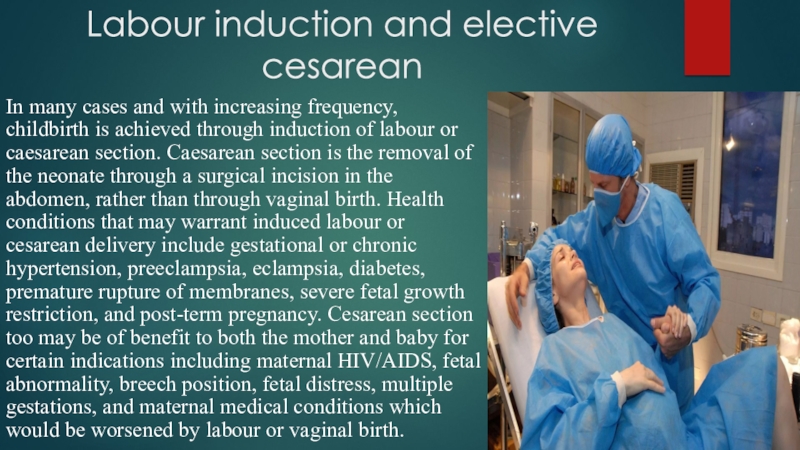
In many cases and with increasing frequency,
childbirth is achieved through induction of labour or caesarean section. Caesarean section is the removal of the neonate through a surgical incision in the abdomen, rather than through vaginal birth. Health conditions that may warrant induced labour or cesarean delivery include gestational or chronic hypertension, preeclampsia, eclampsia, diabetes, premature rupture of membranes, severe fetal growth restriction, and post-term pregnancy. Cesarean section too may be of benefit to both the mother and baby for certain indications including maternal HIV/AIDS, fetal abnormality, breech position, fetal distress, multiple gestations, and maternal medical conditions which would be worsened by labour or vaginal birth.
Слайд 8Multiple births
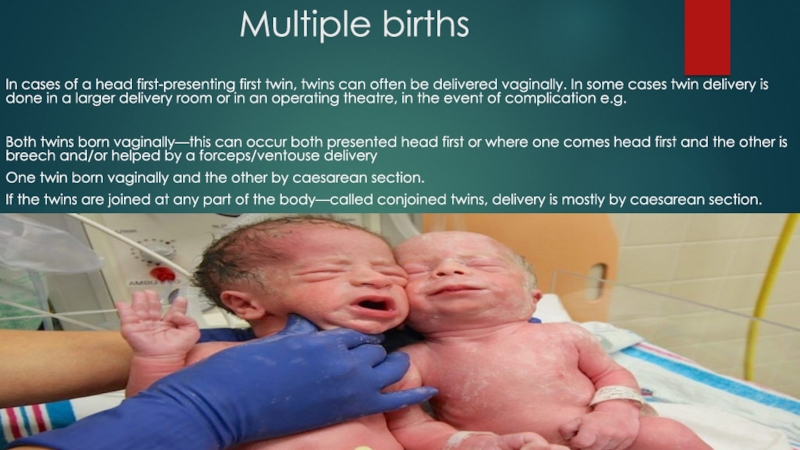
In cases of a head first-presenting first twin, twins can
often be delivered vaginally. In some cases twin delivery is done in a larger delivery room or in an operating theatre, in the event of complication e.g.
Both twins born vaginally—this can occur both presented head first or where one comes head first and the other is breech and/or helped by a forceps/ventouse delivery
One twin born vaginally and the other by caesarean section.
If the twins are joined at any part of the body—called conjoined twins, delivery is mostly by caesarean section.
Both twins born vaginally—this can occur both presented head first or where one comes head first and the other is breech and/or helped by a forceps/ventouse delivery
One twin born vaginally and the other by caesarean section.
If the twins are joined at any part of the body—called conjoined twins, delivery is mostly by caesarean section.
Слайд 9External monitoring
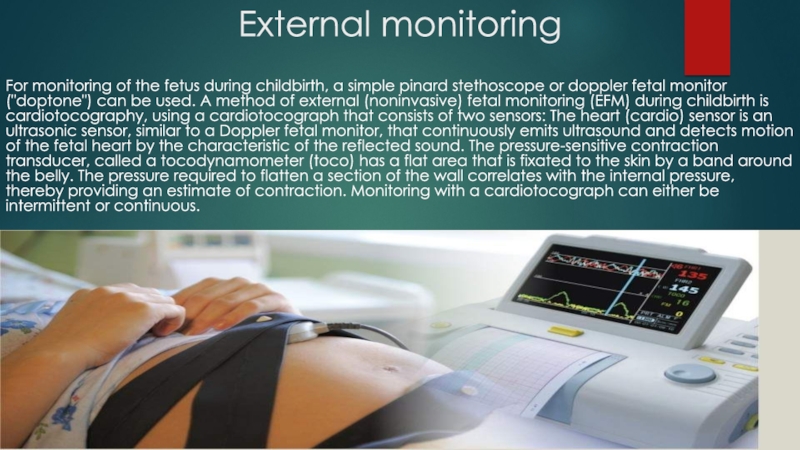
For monitoring of the fetus during childbirth, a simple pinard
stethoscope or doppler fetal monitor ("doptone") can be used. A method of external (noninvasive) fetal monitoring (EFM) during childbirth is cardiotocography, using a cardiotocograph that consists of two sensors: The heart (cardio) sensor is an ultrasonic sensor, similar to a Doppler fetal monitor, that continuously emits ultrasound and detects motion of the fetal heart by the characteristic of the reflected sound. The pressure-sensitive contraction transducer, called a tocodynamometer (toco) has a flat area that is fixated to the skin by a band around the belly. The pressure required to flatten a section of the wall correlates with the internal pressure, thereby providing an estimate of contraction. Monitoring with a cardiotocograph can either be intermittent or continuous.
Слайд 10Labour complications
The second stage of labour may be delayed or lengthy
due to:
malpresentation (breech birth (i.e. buttocks or feet first), face, brow, or other)
failure of descent of the fetal head through the pelvic brim or the interspinous diameter
poor uterine contraction strength
active phase arrest
cephalo-pelvic disproportion (CPD)
shoulder dystocia
Secondary changes may be observed: swelling of the tissues, maternal exhaustion, fetal heart rate abnormalities. Left untreated, severe complications include death of mother and/or baby, and genitovaginal fistula.
malpresentation (breech birth (i.e. buttocks or feet first), face, brow, or other)
failure of descent of the fetal head through the pelvic brim or the interspinous diameter
poor uterine contraction strength
active phase arrest
cephalo-pelvic disproportion (CPD)
shoulder dystocia
Secondary changes may be observed: swelling of the tissues, maternal exhaustion, fetal heart rate abnormalities. Left untreated, severe complications include death of mother and/or baby, and genitovaginal fistula.
Слайд 11Maternal complications
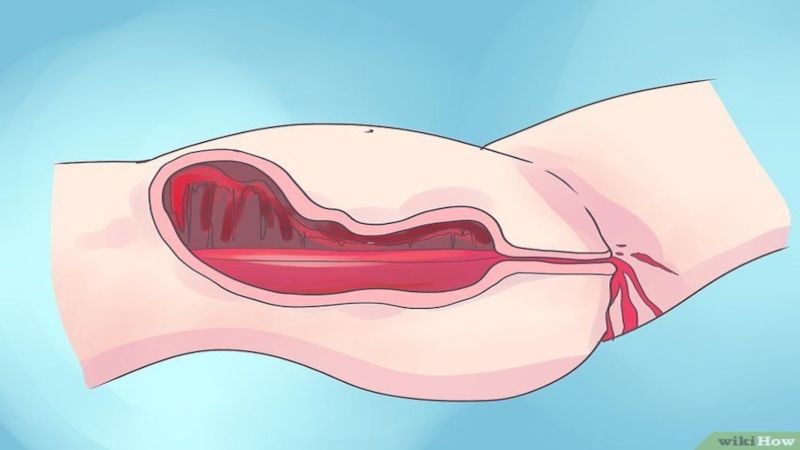
Vaginal birth injury with visible tears or episiotomies are common.
Internal tissue tearing as well as nerve damage to the pelvic structures lead in a proportion of women to problems with prolapse, incontinence of stool or urine and sexual dysfunction.
Pelvic girdle pain. Hormones and enzymes work together to produce ligamentous relaxation and widening of the symphysis pubis during the last trimester of pregnancy. Most girdle pain occurs before birthing, and is known as diastasis of the pubic symphysis. Predisposing factors for girdle pain include maternal obesity.
Infection remains a major cause of maternal mortality and morbidity in the developing world. The work of Ignaz Semmelweis was seminal in the pathophysiology and treatment of puerperal fever and saved many lives.
Hemorrhage, or heavy blood loss, is still the leading cause of death of birthing mothers in the world today, especially in the developing world. Heavy blood loss leads to hypovolemic shock, insufficient perfusion of vital organs and death if not rapidly treated. Blood transfusion may be life saving. Rare sequelae include Hypopituitarism Sheehan's syndrome.
Pelvic girdle pain. Hormones and enzymes work together to produce ligamentous relaxation and widening of the symphysis pubis during the last trimester of pregnancy. Most girdle pain occurs before birthing, and is known as diastasis of the pubic symphysis. Predisposing factors for girdle pain include maternal obesity.
Infection remains a major cause of maternal mortality and morbidity in the developing world. The work of Ignaz Semmelweis was seminal in the pathophysiology and treatment of puerperal fever and saved many lives.
Hemorrhage, or heavy blood loss, is still the leading cause of death of birthing mothers in the world today, especially in the developing world. Heavy blood loss leads to hypovolemic shock, insufficient perfusion of vital organs and death if not rapidly treated. Blood transfusion may be life saving. Rare sequelae include Hypopituitarism Sheehan's syndrome.
Слайд 13Society and culture
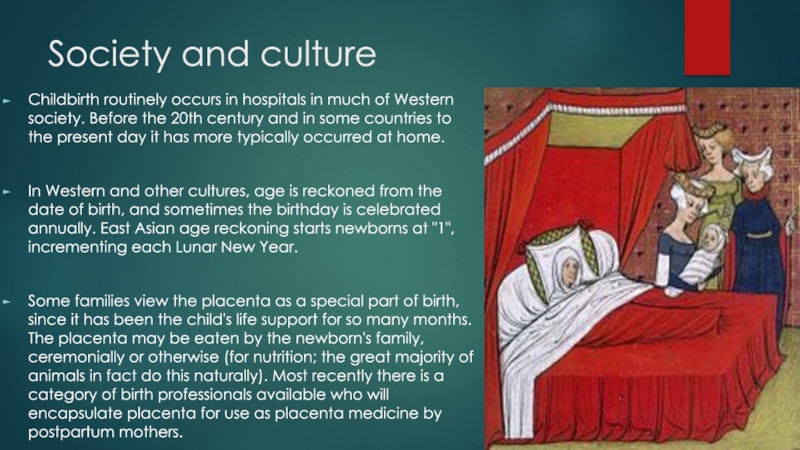
Childbirth routinely occurs in hospitals in much of Western
society. Before the 20th century and in some countries to the present day it has more typically occurred at home.
In Western and other cultures, age is reckoned from the date of birth, and sometimes the birthday is celebrated annually. East Asian age reckoning starts newborns at "1", incrementing each Lunar New Year.
Some families view the placenta as a special part of birth, since it has been the child's life support for so many months. The placenta may be eaten by the newborn's family, ceremonially or otherwise (for nutrition; the great majority of animals in fact do this naturally). Most recently there is a category of birth professionals available who will encapsulate placenta for use as placenta medicine by postpartum mothers.
In Western and other cultures, age is reckoned from the date of birth, and sometimes the birthday is celebrated annually. East Asian age reckoning starts newborns at "1", incrementing each Lunar New Year.
Some families view the placenta as a special part of birth, since it has been the child's life support for so many months. The placenta may be eaten by the newborn's family, ceremonially or otherwise (for nutrition; the great majority of animals in fact do this naturally). Most recently there is a category of birth professionals available who will encapsulate placenta for use as placenta medicine by postpartum mothers.