- Главная
- Разное
- Образование
- Спорт
- Естествознание
- Природоведение
- Религиоведение
- Французский язык
- Черчение
- Английский язык
- Астрономия
- Алгебра
- Биология
- География
- Геометрия
- Детские презентации
- Информатика
- История
- Литература
- Математика
- Музыка
- МХК
- Немецкий язык
- ОБЖ
- Обществознание
- Окружающий мир
- Педагогика
- Русский язык
- Технология
- Физика
- Философия
- Химия
- Шаблоны, фоны, картинки для презентаций
- Экология
- Экономика
Презентация, доклад по английскому языку на тему: Различие идиом Home, House
Содержание
- 1. Презентация по английскому языку на тему: Различие идиом Home, House
- 2. HOME / HOUSEEXERSISESTYPES OF HOUSESPROVERBSINTRESTING FACTS
- 3. HOME / HOUSEHome – the place where
- 4. TYPES OF HOUSESThere are many different types
- 5. TYPES OF HOUSESTerraced houses are usually found
- 6. TYPES OF HOUSESSemi-detached houses – each house
- 7. TYPES OF HOUSESDetached house stands by itself,
- 8. TYPES OF HOUSESBritain is famous for its
- 9. TYPES OF HOUSESA block of flats is
- 10. TYPES OF HOUSESA bungalow is a small
- 11. INTRESTING FACTSStreet NumberingStreet numbering was introduced by
- 12. INTRESTING FACTSWhy do we give our houses
- 13. INTRESTING FACTSTen Strange UK HousesBritain has some
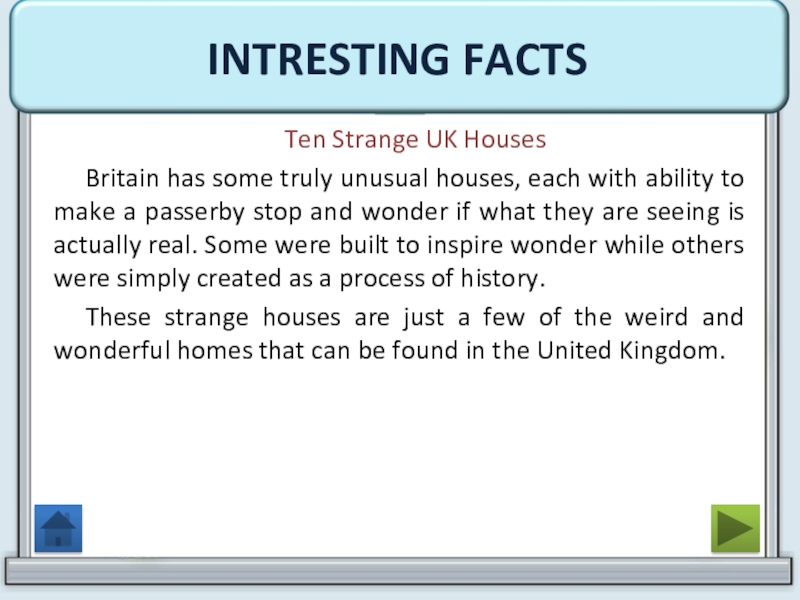
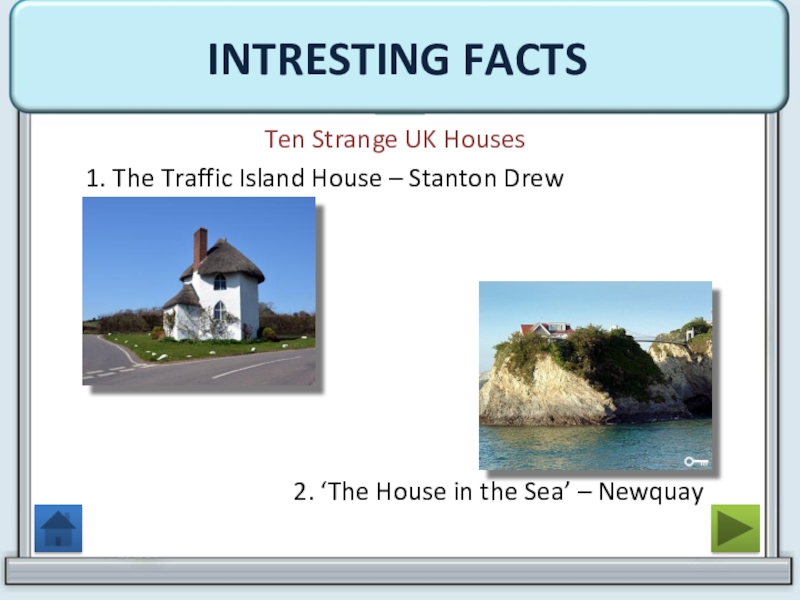
- 14. INTRESTING FACTSTen Strange UK Houses1. The Traffic
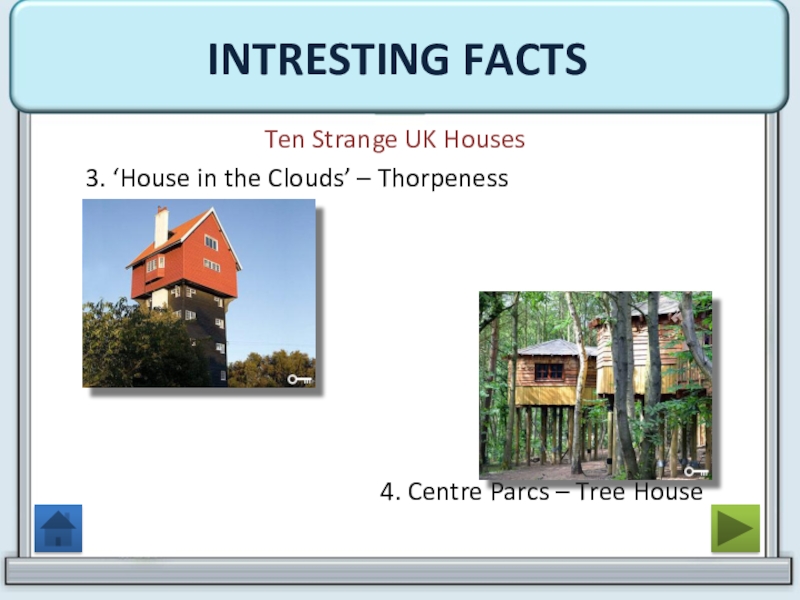
- 15. INTRESTING FACTSTen Strange UK Houses3. ‘House in the Clouds’ – Thorpeness4. Centre Parcs – Tree House
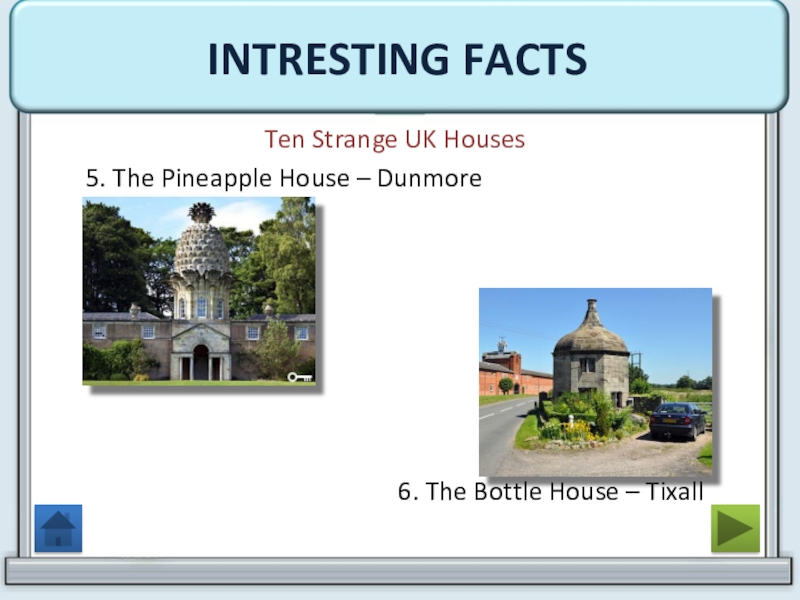
- 16. INTRESTING FACTSTen Strange UK Houses5. The Pineapple House – Dunmore6. The Bottle House – Tixall
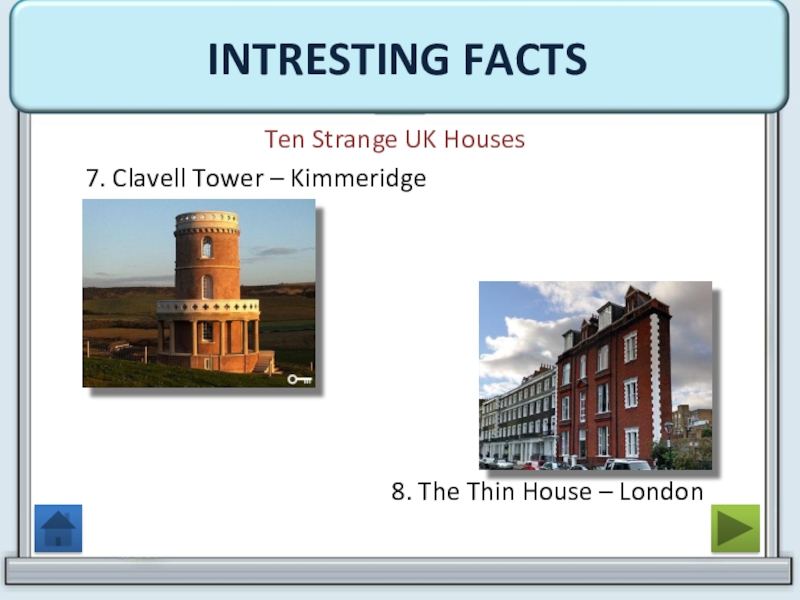
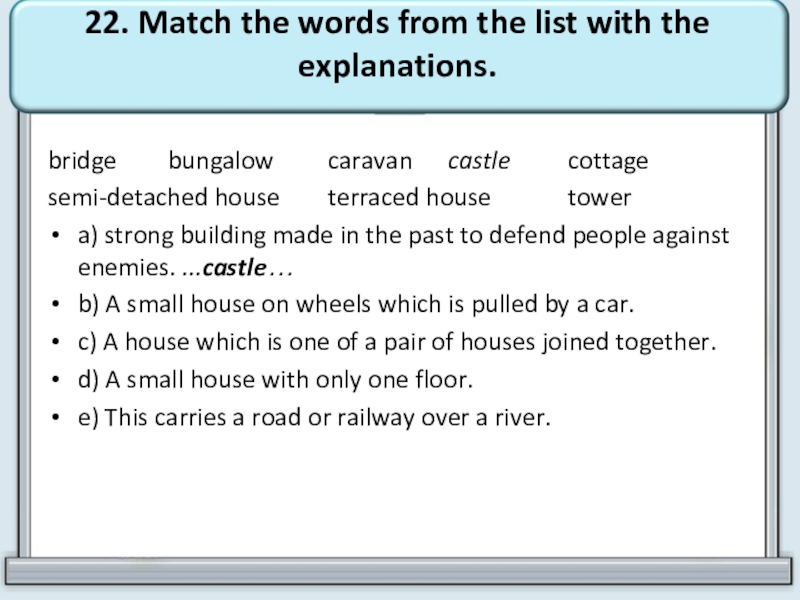
- 17. INTRESTING FACTSTen Strange UK Houses7. Clavell Tower – Kimmeridge8. The Thin House – London
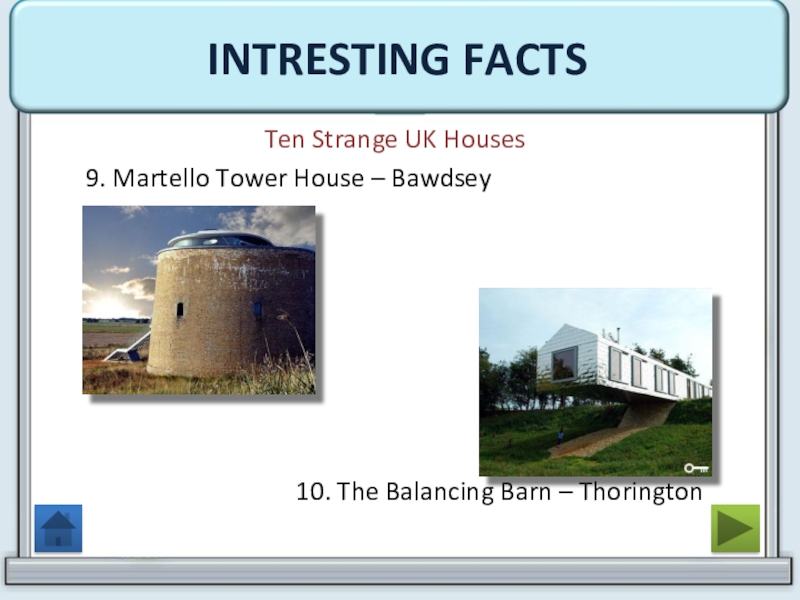
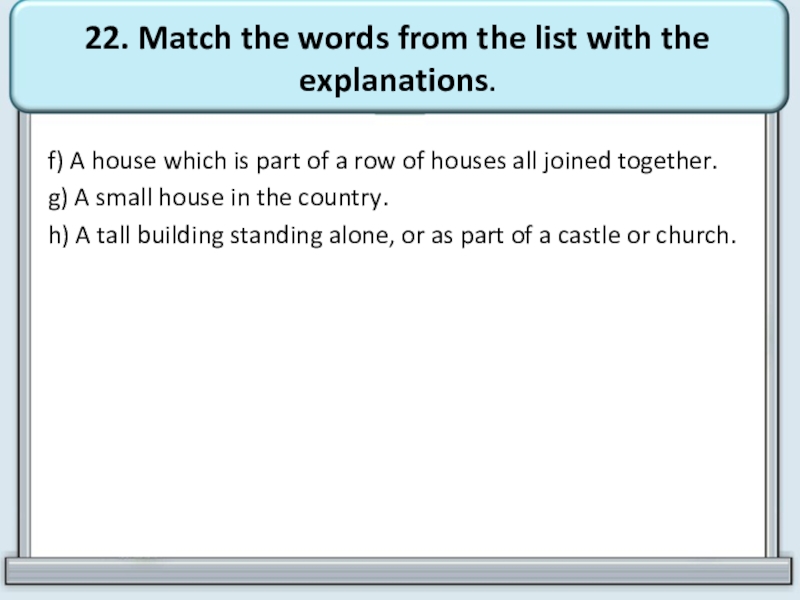
- 18. INTRESTING FACTSTen Strange UK Houses9. Martello Tower House – Bawdsey10. The Balancing Barn – Thorington
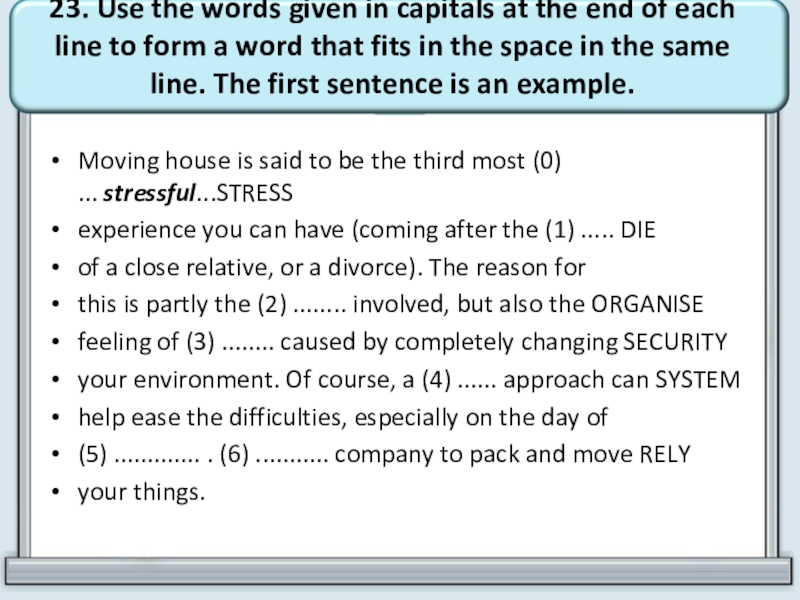
- 19. PROVERBS
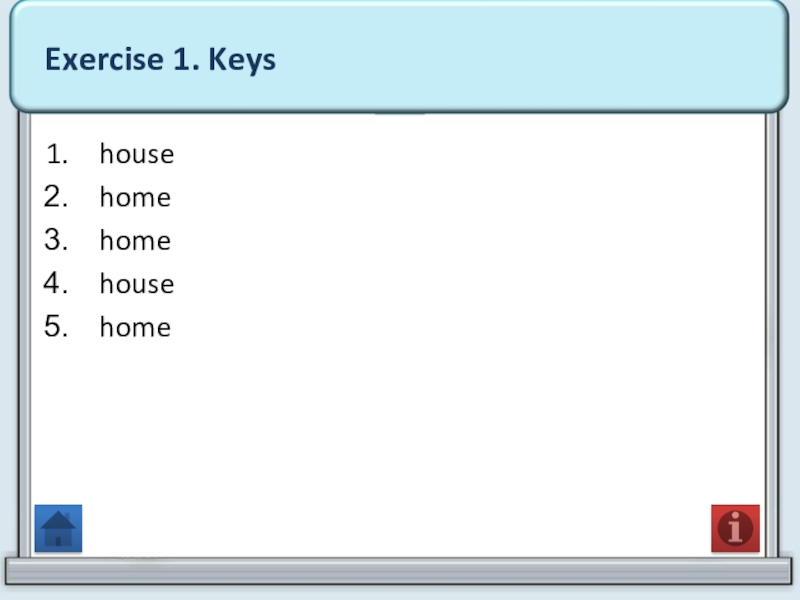
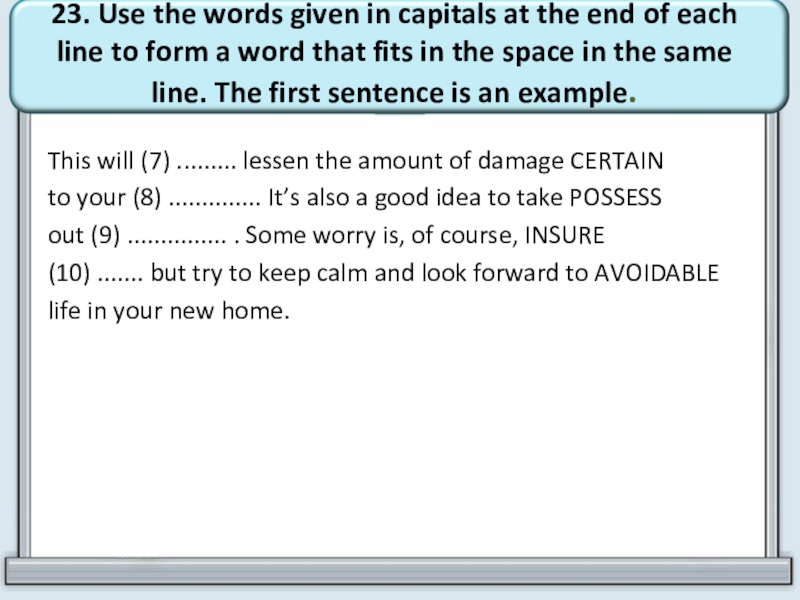
- 20. Exercise 1. Fill in the gaps with
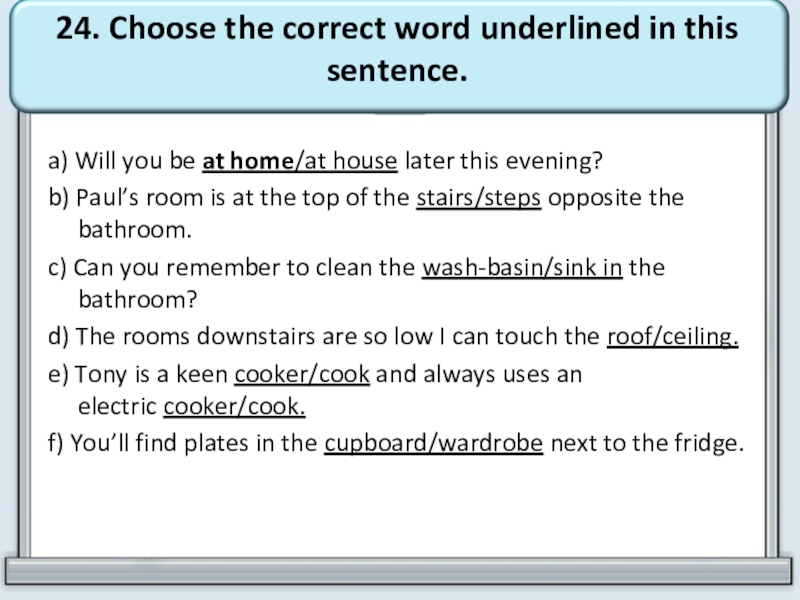
- 21. Exercise 1. Keyshousehomehomehousehome
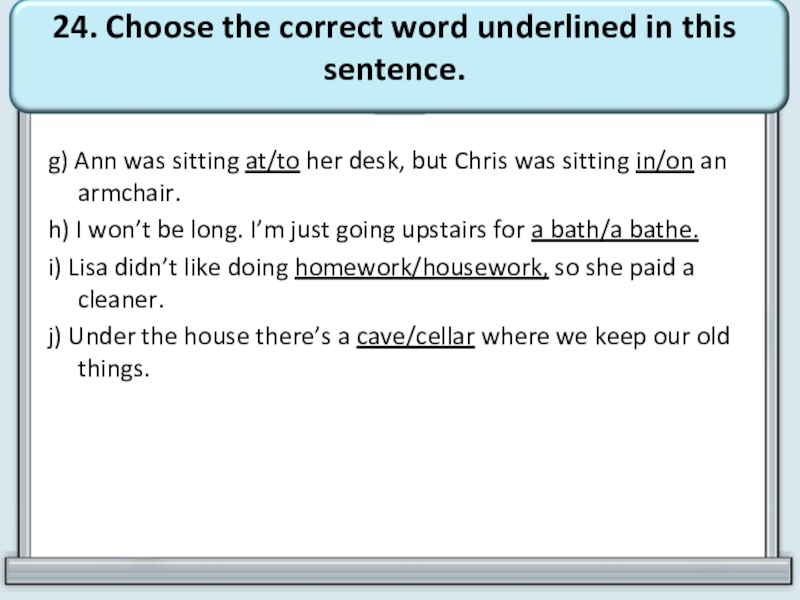
- 22. Exercise 2. Characterize the following types of houses. Use a dictionary if necessary.
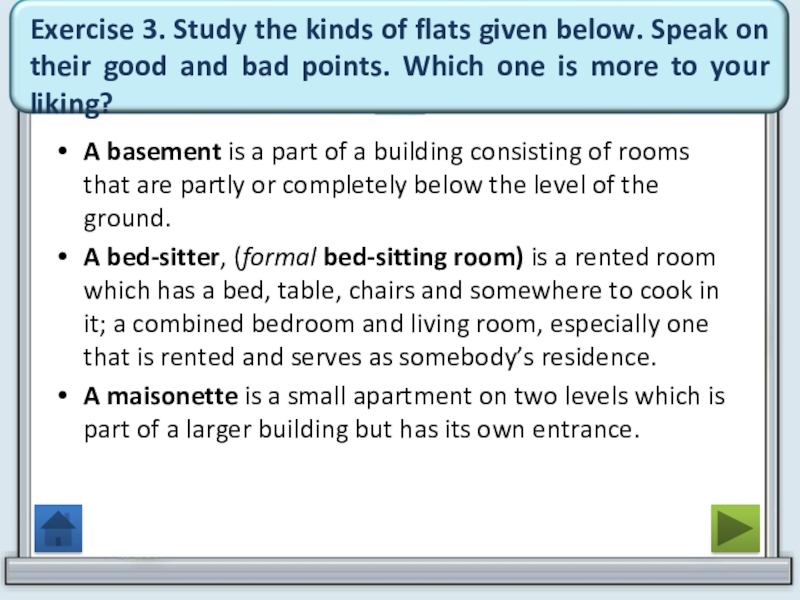
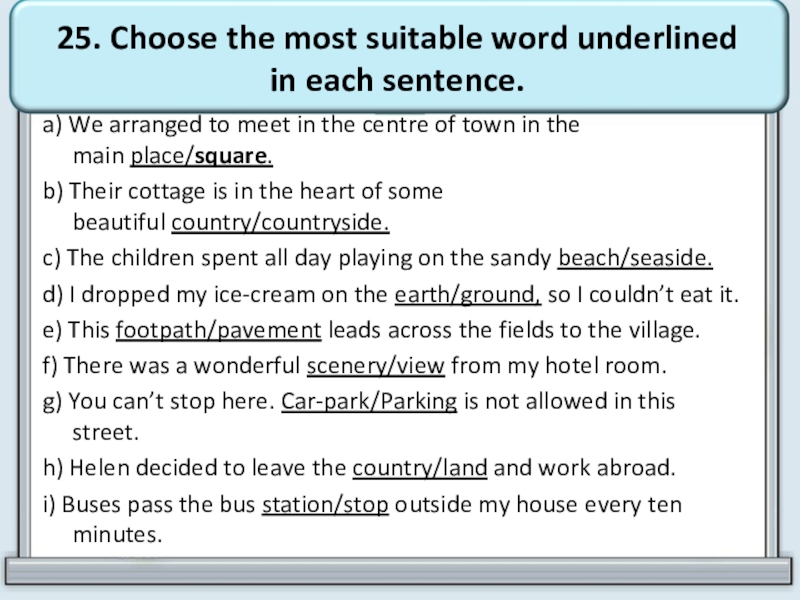
- 23. Exercise 3. Study the kinds of flats
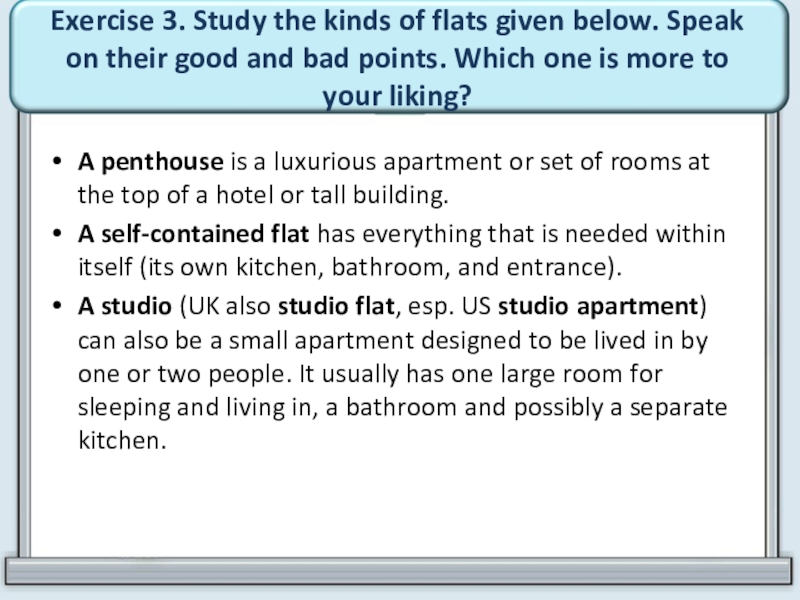
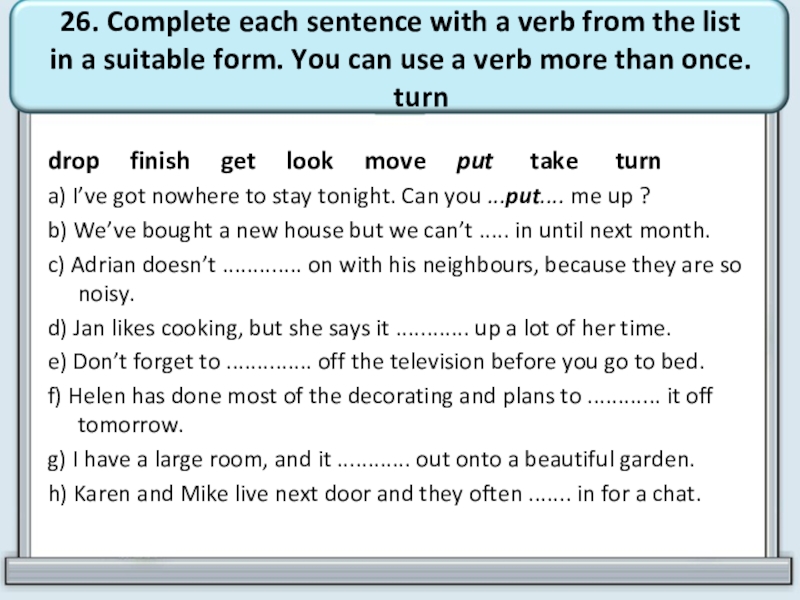
- 24. Exercise 3. Study the kinds of flats
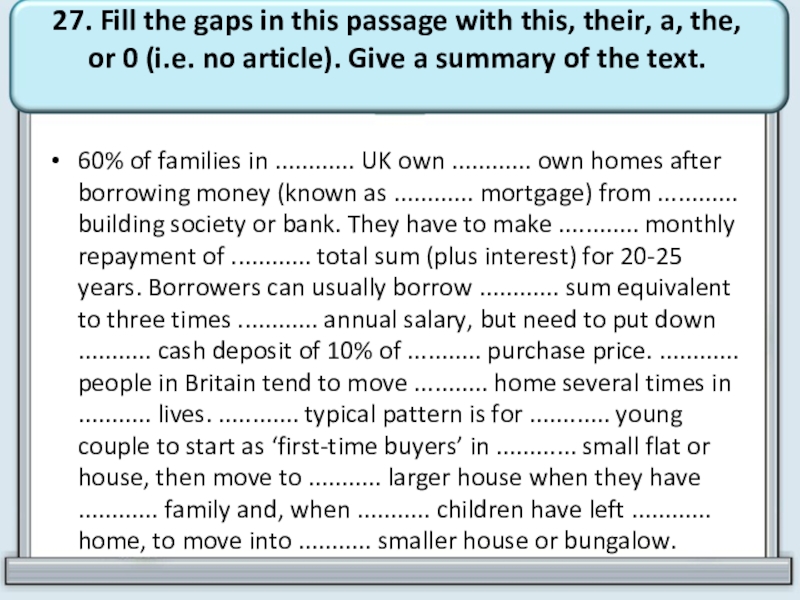
- 25. Exercise 4. Draw a plan of a
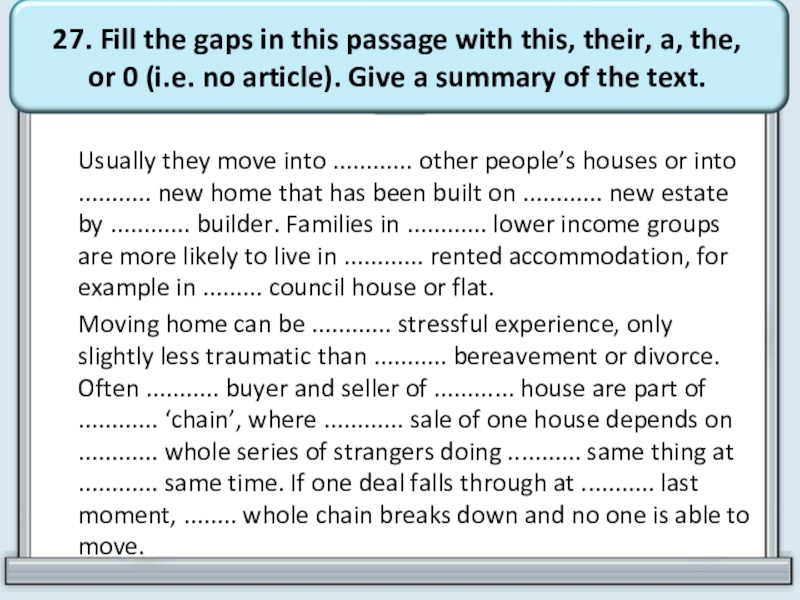
- 26. Exercise 5. All of the words below
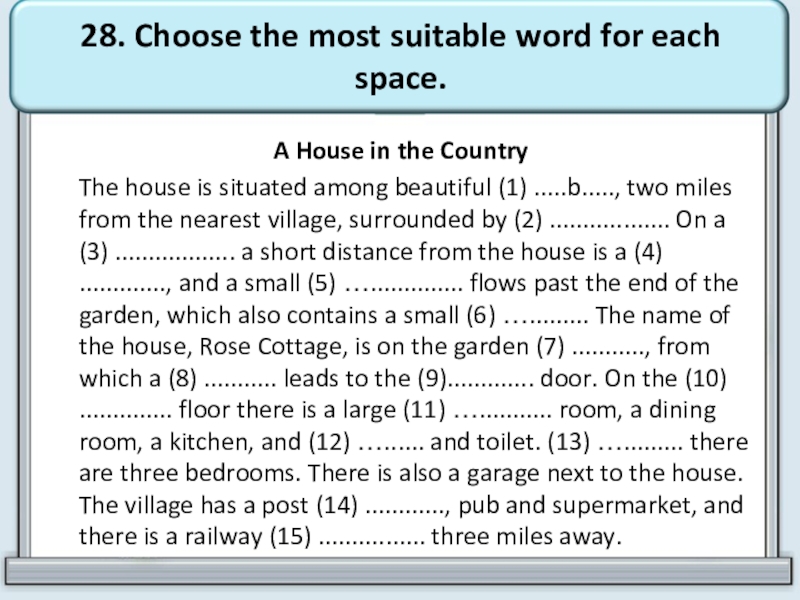
- 27. 6. Complete the following sentences with the
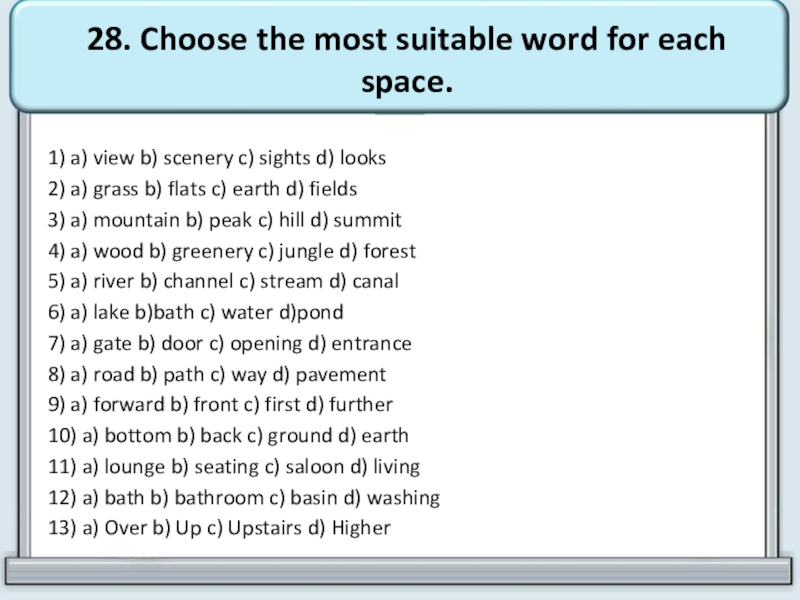
- 28. 6. Complete the following sentences with the
- 29. 7. Make two lists of words, word combinations
- 30. 8. Write down five sentences of your own using any items from the lists above.
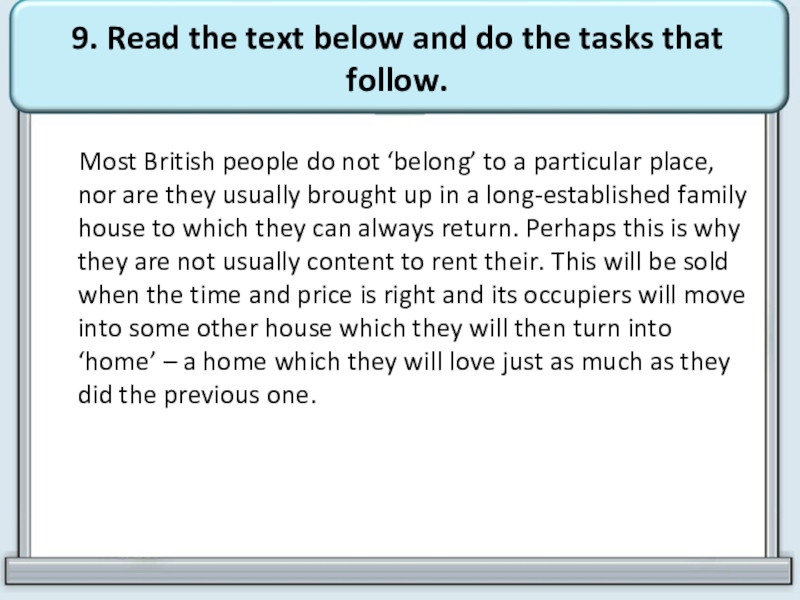
- 31. 9. Read the text below and do the
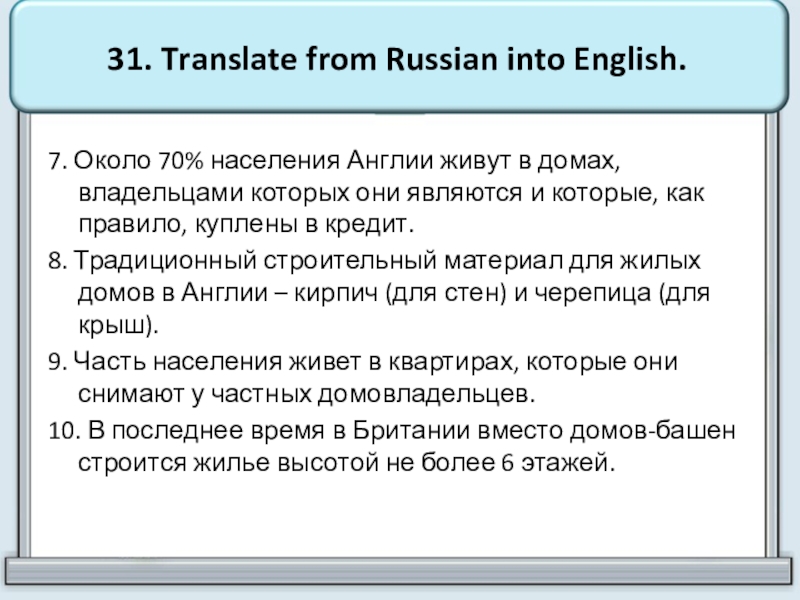
- 32. 9. Read the text below and do the
- 33. 9. Read the text below and do the
- 34. 9. Read the text below and do the
- 35. 9. Read the text below and do the
- 36. 10. Comment on the following English proverbs. Give
- 37. 11. Work in small groups and find out
- 38. 12. Which of the facilities in the list
- 39. 12. Which of the facilities in the list
- 40. 13. Describe the location of the house you
- 41. 13. Describe the location of the house you
- 42. 15. The Place of My Dream. Scan the
- 43. 15. The Place of My Dream. Scan the
- 44. 15. The Place of My Dream. Scan the
- 45. 16. Think about your dream (or
- 46. 17. What will the 21st century houses be like? Discuss it with your partners.
- 47. 18. People sell, buy houses and also let
- 48. 19. Read the following advertisements for homes taken
- 49. 19. Read the following advertisements for homes taken
- 50. 20. The following adjectives are all taken from
- 51. 21. Translate the following sentences into Russian paying
- 52. 21. Translate the following sentences into Russian paying
- 53. 22. Match the words from the list with
- 54. 22. Match the words from the list with
- 55. 23. Use the words given in capitals at
- 56. 23. Use the words given in capitals at
- 57. 24. Choose the correct word underlined in this
- 58. 24. Choose the correct word underlined in this
- 59. 25. Choose the most suitable word underlined
- 60. 26. Complete each sentence with a verb from
- 61. 27. Fill the gaps in this passage with this, their, a, the,
- 62. 27. Fill the gaps in this passage with this, their, a, the,
- 63. 28. Choose the most suitable word for each
- 64. 28. Choose the most suitable word for each
- 65. 29. Fill each space with a word from
- 66. 30. Choose the best alternative to fill the
- 67. 31. Translate from Russian into English. 1. Приехав
- 68. 31. Translate from Russian into English.7. Около 70%
Слайд 3HOME / HOUSE
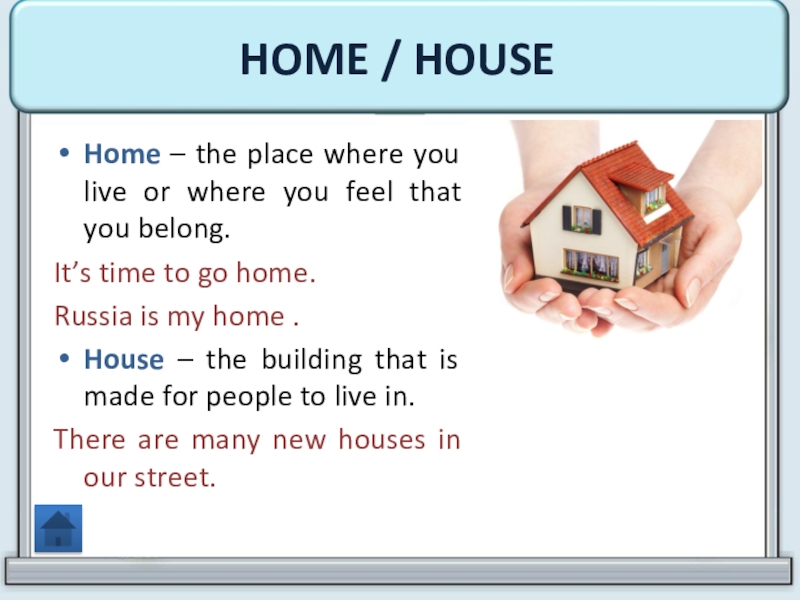
Home – the place where you live or where
It’s time to go home.
Russia is my home .
House – the building that is made for people to live in.
There are many new houses in our street.
Слайд 4TYPES OF HOUSES
There are many different types of housing in Britain,
Houses are often described by the period in which they were built (e.g., Georgian, Victorian, 1930s, or post-war) and whether they are terraced, semi-detached or detached. As well as preferring houses to flats, for many people a garden is also an important consideration. Although Britain is relatively small the areas where people live vary considerably: there are new towns and inner cities, suburbs, commuter belts and the open countryside.
Слайд 5TYPES OF HOUSES
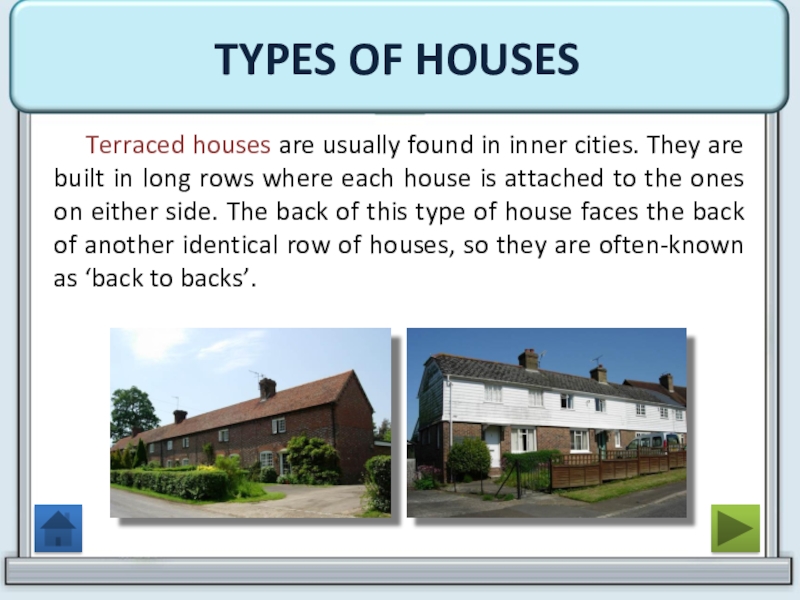
Terraced houses are usually found in inner cities. They
Слайд 6TYPES OF HOUSES
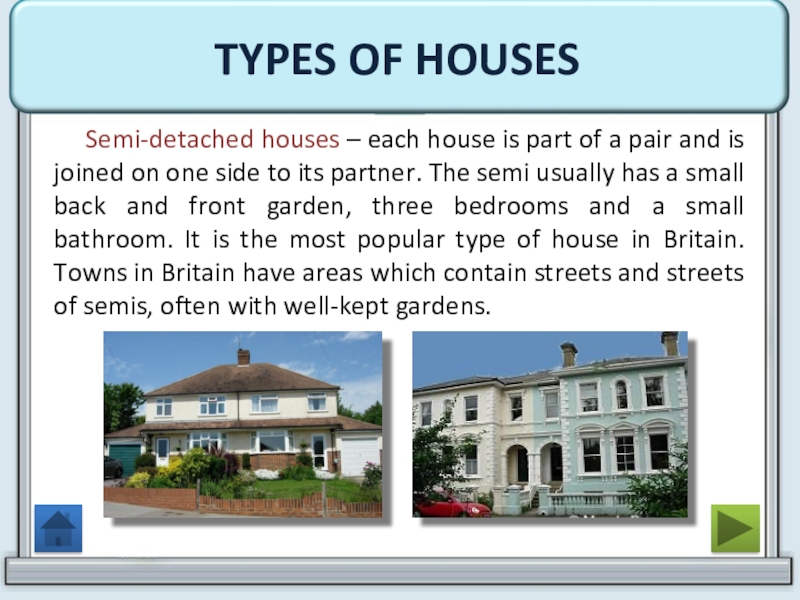
Semi-detached houses – each house is part of a
Слайд 7TYPES OF HOUSES
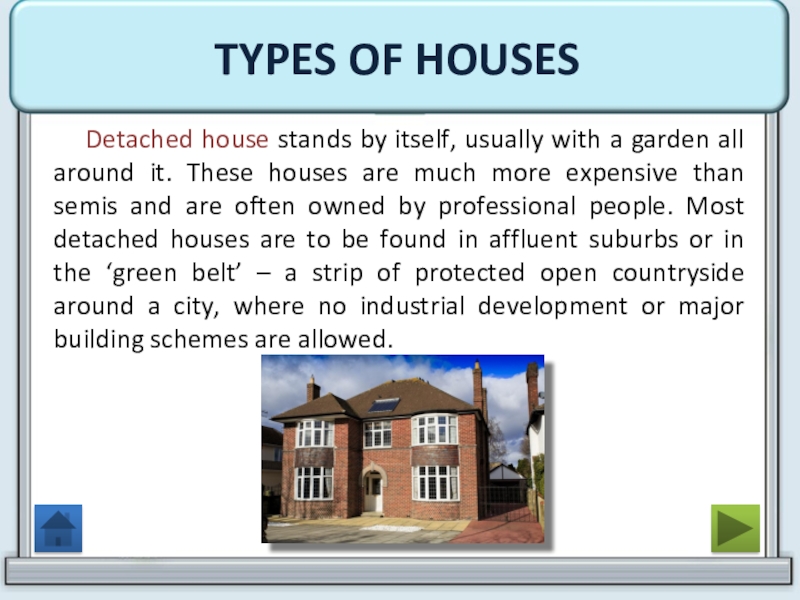
Detached house stands by itself, usually with a garden
Слайд 8TYPES OF HOUSES
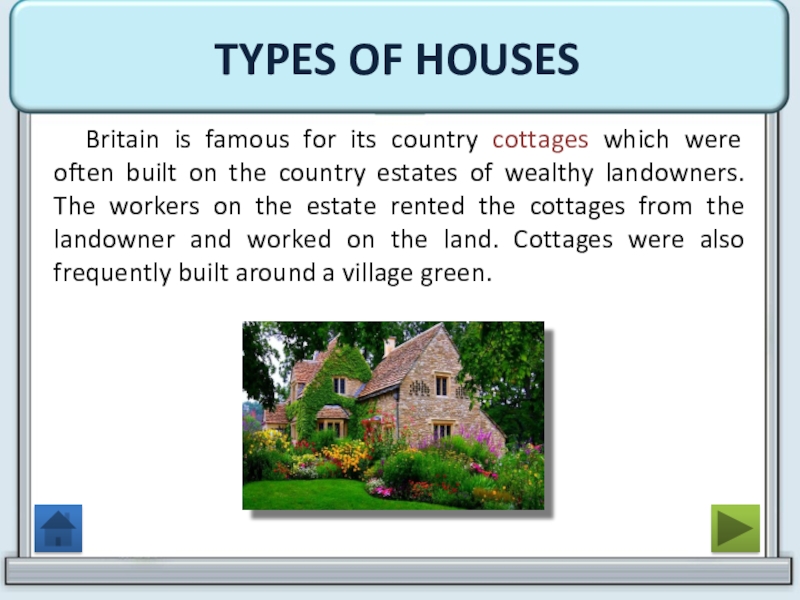
Britain is famous for its country cottages which were
Слайд 9TYPES OF HOUSES
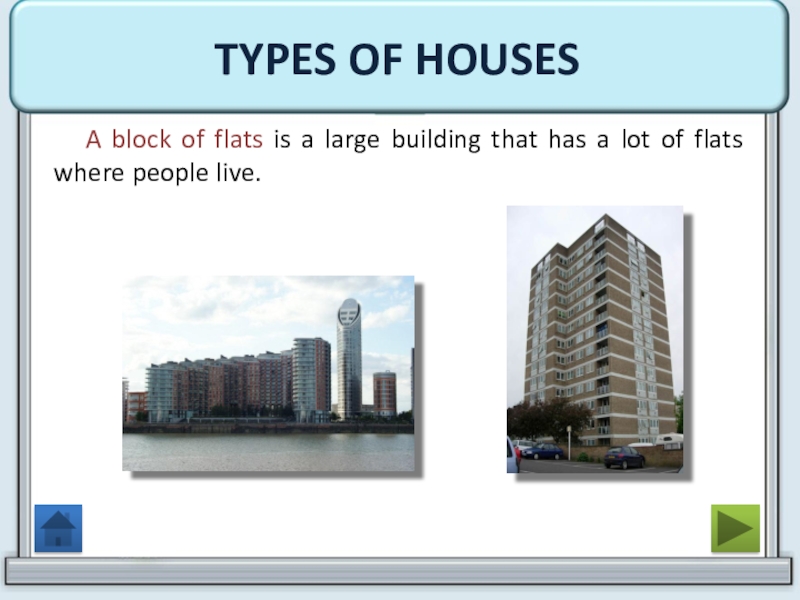
A block of flats is a large building that
Слайд 10TYPES OF HOUSES
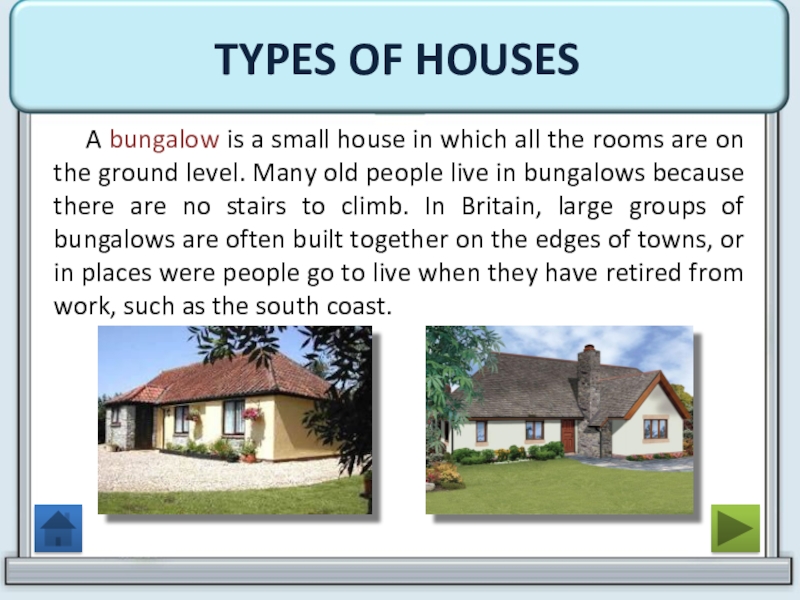
A bungalow is a small house in which all
Слайд 11INTRESTING FACTS
Street Numbering
Street numbering was introduced by act of Parliament in
Odd numbers are usually assigned to the left side of the street and even numbers to the right, as they head out of town.
Слайд 12INTRESTING FACTS
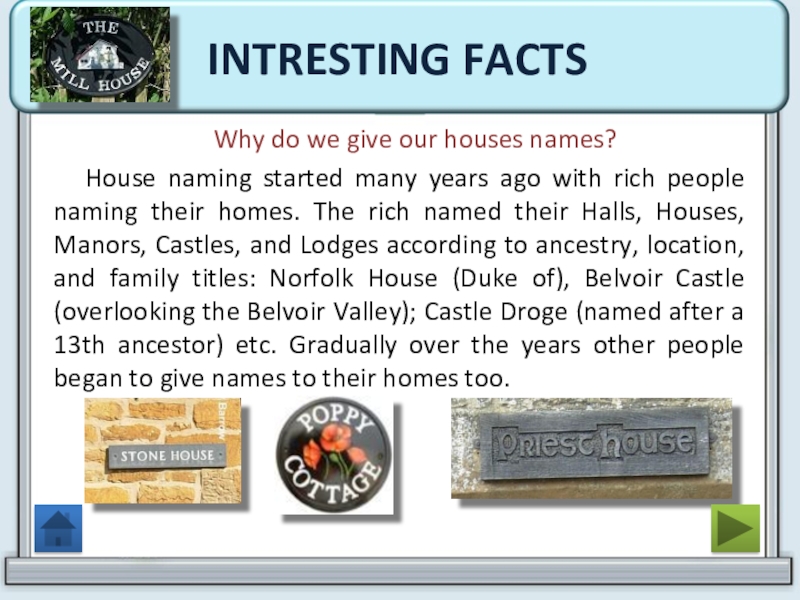
Why do we give our houses names?
House naming started many
Слайд 13INTRESTING FACTS
Ten Strange UK Houses
Britain has some truly unusual houses, each
These strange houses are just a few of the weird and wonderful homes that can be found in the United Kingdom.
Слайд 14INTRESTING FACTS
Ten Strange UK Houses
1. The Traffic Island House – Stanton
2. ‘The House in the Sea’ – Newquay
Слайд 15INTRESTING FACTS
Ten Strange UK Houses
3. ‘House in the Clouds’ – Thorpeness
4.
Слайд 16INTRESTING FACTS
Ten Strange UK Houses
5. The Pineapple House – Dunmore
6. The
Слайд 17INTRESTING FACTS
Ten Strange UK Houses
7. Clavell Tower – Kimmeridge
8. The Thin
Слайд 18INTRESTING FACTS
Ten Strange UK Houses
9. Martello Tower House – Bawdsey
10. The
Слайд 20Exercise 1. Fill in the gaps with the words “home” and
Is your _________ light or dark?
London is my _________ town.
Last year I stayed in Britain too long and I missed _________ very much.
I have a big _________ in the centre of the park.
Is Ann at _________ ?
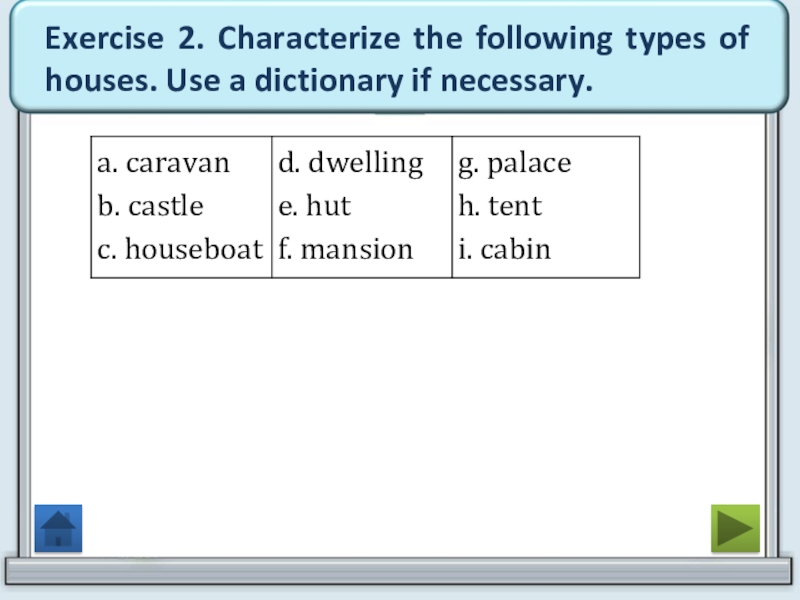
Слайд 23Exercise 3. Study the kinds of flats given below. Speak on
A basement is a part of a building consisting of rooms that are partly or completely below the level of the ground.
A bed-sitter, (formal bed-sitting room) is a rented room which has a bed, table, chairs and somewhere to cook in it; a combined bedroom and living room, especially one that is rented and serves as somebody’s residence.
A maisonette is a small apartment on two levels which is part of a larger building but has its own entrance.
Слайд 24Exercise 3. Study the kinds of flats given below. Speak on
A penthouse is a luxurious apartment or set of rooms at the top of a hotel or tall building.
A self-contained flat has everything that is needed within itself (its own kitchen, bathroom, and entrance).
A studio (UK also studio flat, esp. US studio apartment) can also be a small apartment designed to be lived in by one or two people. It usually has one large room for sleeping and living in, a bathroom and possibly a separate kitchen.
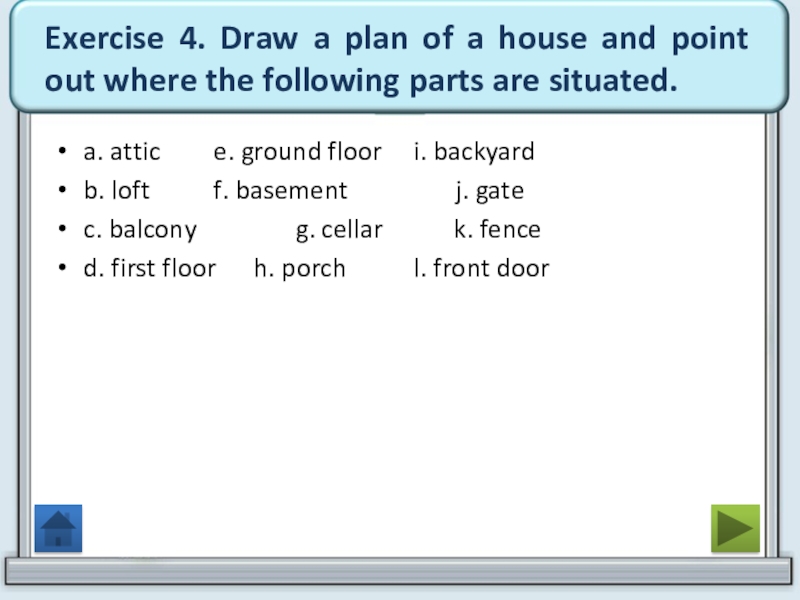
Слайд 25Exercise 4. Draw a plan of a house and point out
a. attic e. ground floor i. backyard
b. loft f. basement j. gate
c. balcony g. cellar k. fence
d. first floor h. porch l. front door
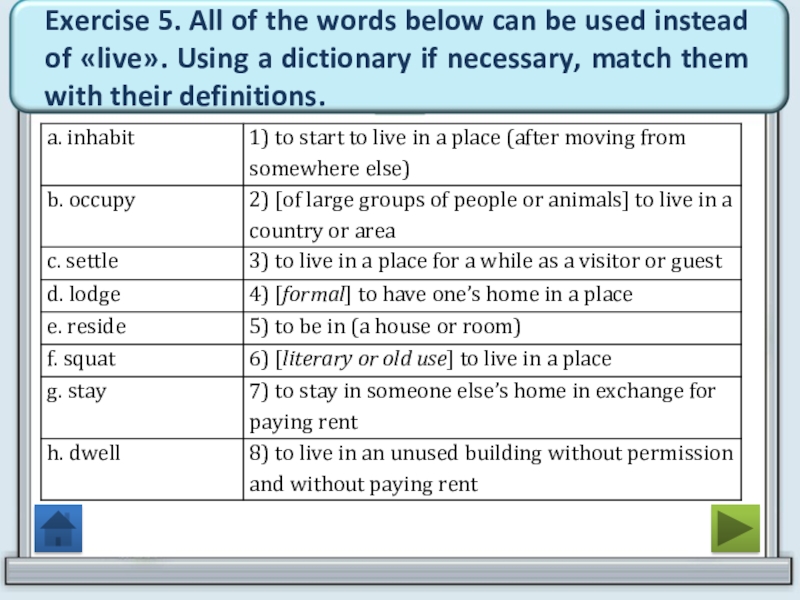
Слайд 26Exercise 5. All of the words below can be used instead
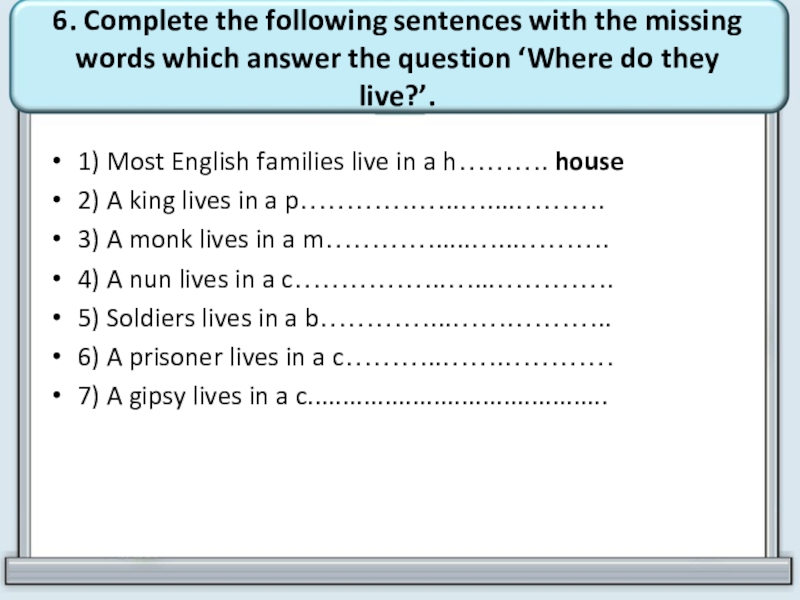
Слайд 276. Complete the following sentences with the missing words which answer
1) Most English families live in a h………. house
2) A king lives in a p………….…..…....……….
3) A monk lives in a m………….....…...……….
4) A nun lives in a c……………..…...………….
5) Soldiers lives in a b…………...…….………..
6) A prisoner lives in a c………..…….…………
7) A gipsy lives in a c...........................................
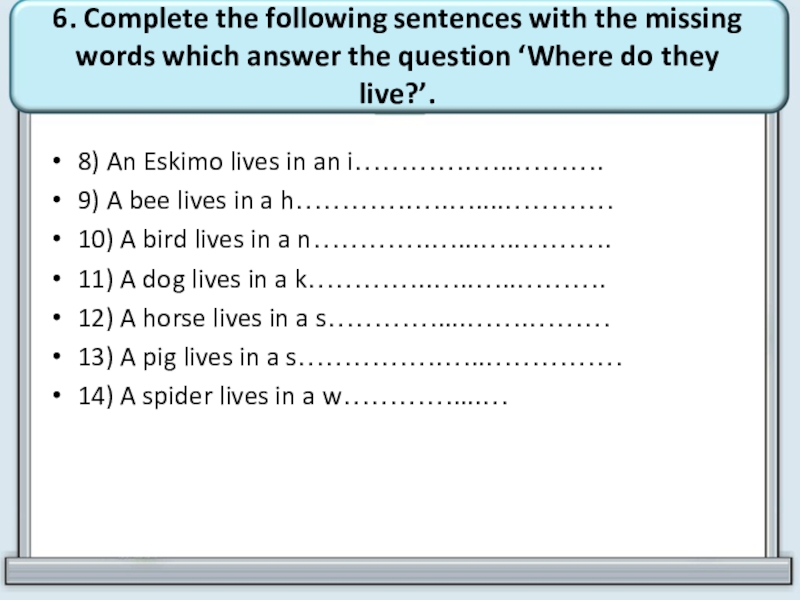
Слайд 286. Complete the following sentences with the missing words which answer
8) An Eskimo lives in an i………….…..……….
9) A bee lives in a h………….….…....…………
10) A bird lives in a n………….…...…..……….
11) A dog lives in a k…………..…..…..……….
12) A horse lives in a s…………....…….………
13) A pig lives in a s…………….…..……………
14) A spider lives in a w…………....…
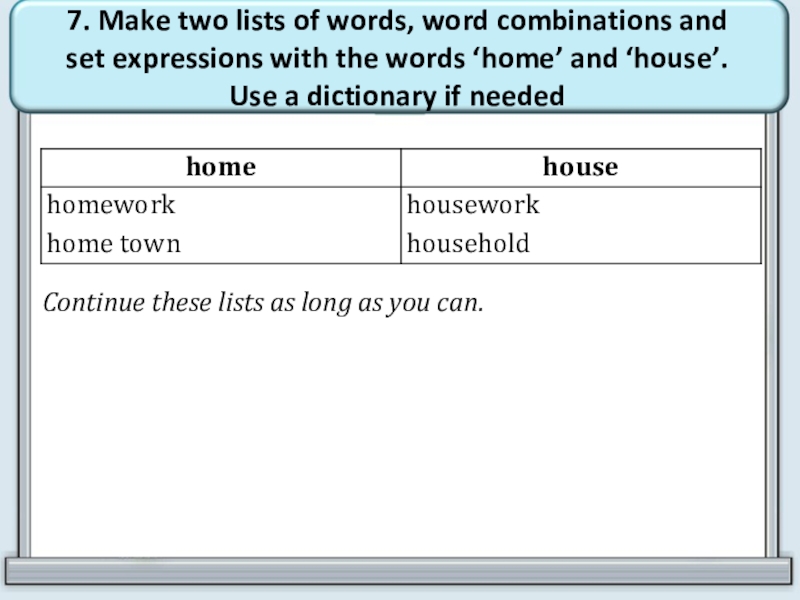
Слайд 297. Make two lists of words, word combinations and set expressions with
Continue these lists as long as you can.
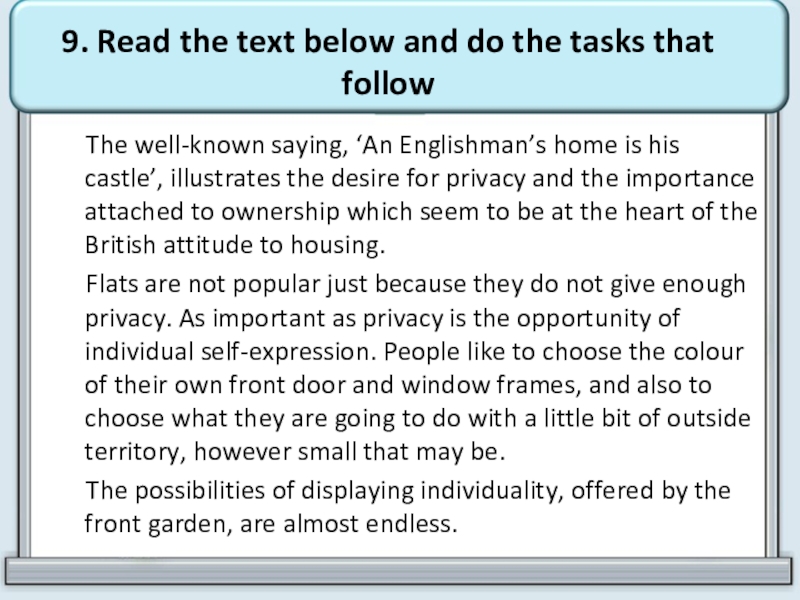
Слайд 319. Read the text below and do the tasks that follow
Flats are not popular just because they do not give enough privacy. As important as privacy is the opportunity of individual self-expression. People like to choose the colour of their own front door and window frames, and also to choose what they are going to do with a little bit of outside territory, however small that may be.
The possibilities of displaying individuality, offered by the front garden, are almost endless.
Слайд 329. Read the text below and do the tasks that follow.
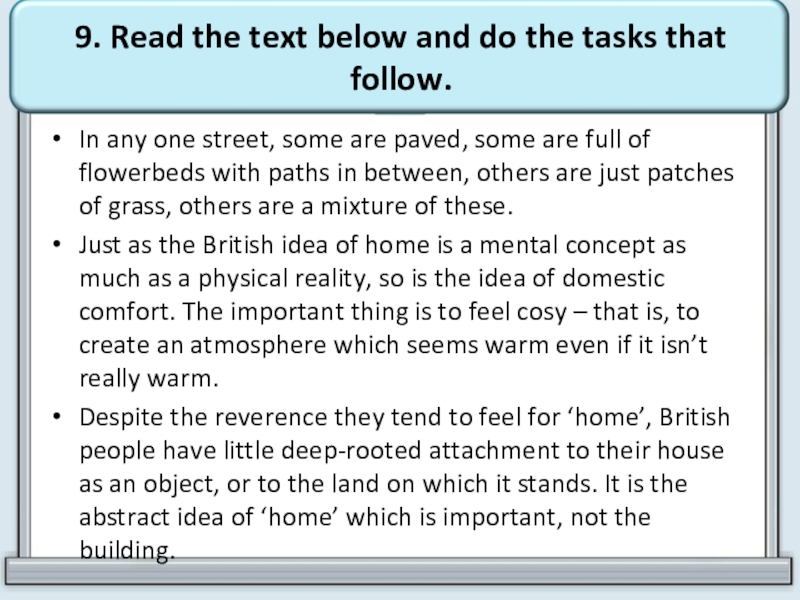
In any
Just as the British idea of home is a mental concept as much as a physical reality, so is the idea of domestic comfort. The important thing is to feel cosy – that is, to create an atmosphere which seems warm even if it isn’t really warm.
Despite the reverence they tend to feel for ‘home’, British people have little deep-rooted attachment to their house as an object, or to the land on which it stands. It is the abstract idea of ‘home’ which is important, not the building.
Слайд 339. Read the text below and do the tasks that follow.
Слайд 349. Read the text below and do the tasks that follow
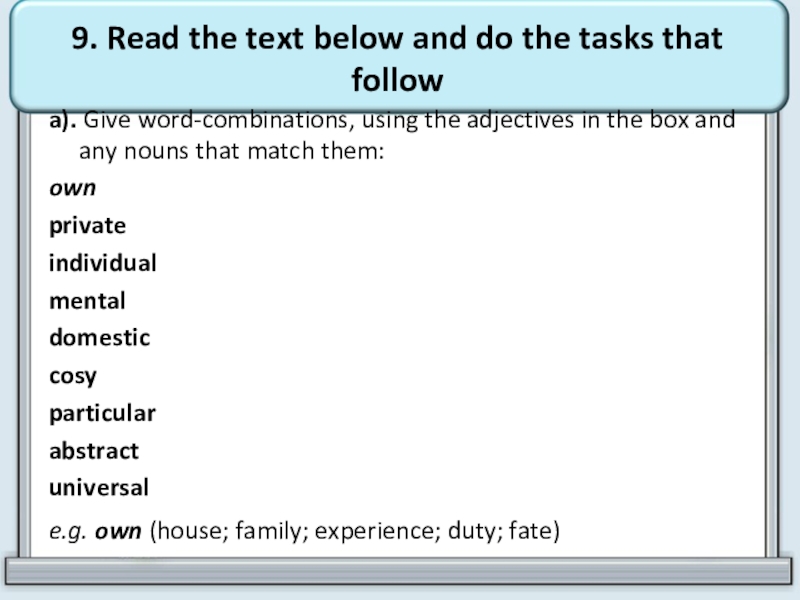
a). Give word-combinations,
own
private
individual
mental
domestic
cosy
particular
abstract
universal
e.g. own (house; family; experience; duty; fate)
Слайд 359. Read the text below and do the tasks that follow
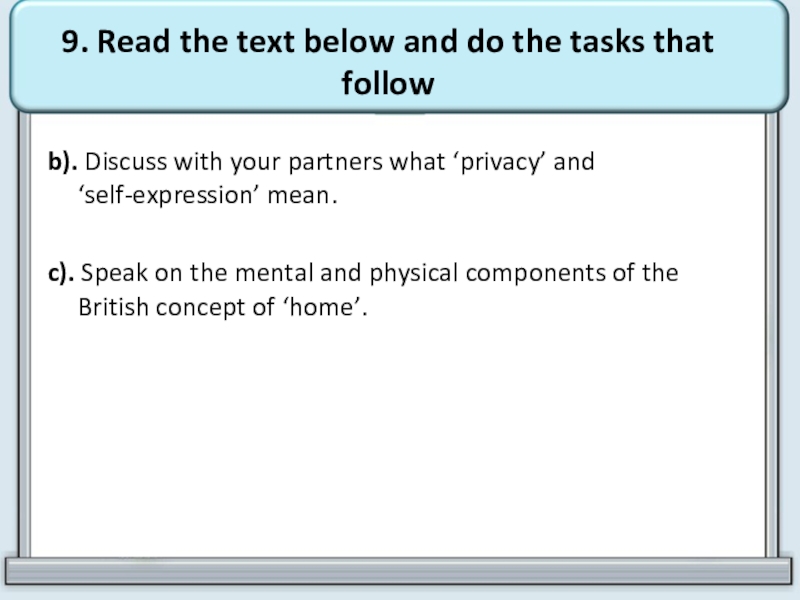
b). Discuss with
c). Speak on the mental and physical components of the British concept of ‘home’.
Слайд 3610. Comment on the following English proverbs. Give their Russian equivalents.
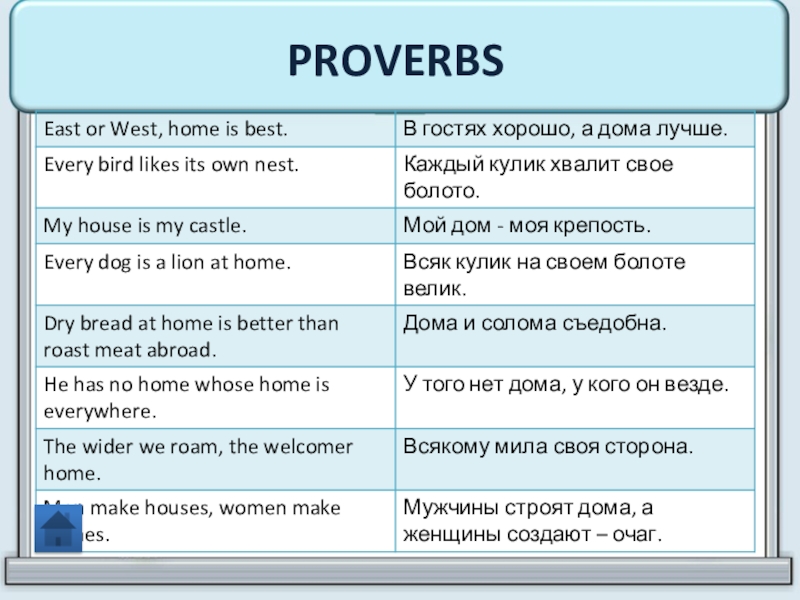
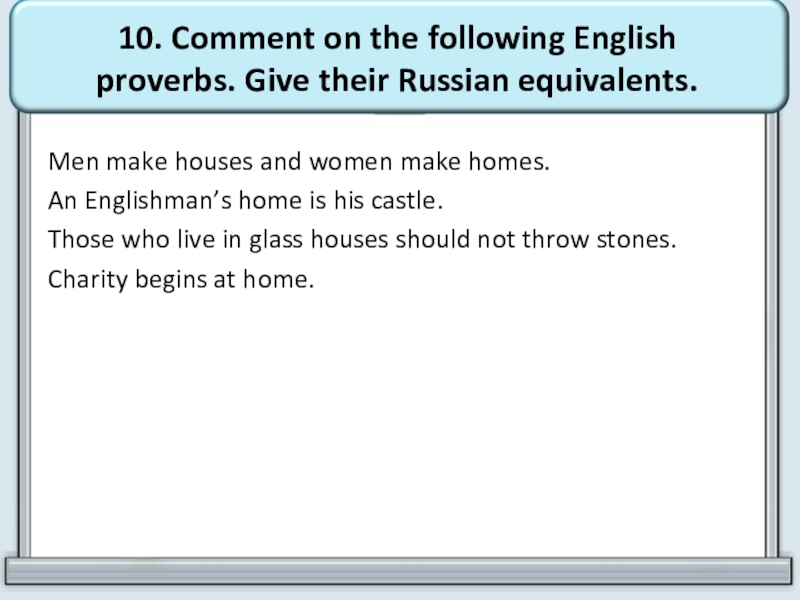
Men make
An Englishman’s home is his castle.
Those who live in glass houses should not throw stones.
Charity begins at home.
Слайд 3711. Work in small groups and find out from your partners:
If they
What differences between homes in their country and Britain are .
About the advantages and drawbacks of living with your (one’s) parents.
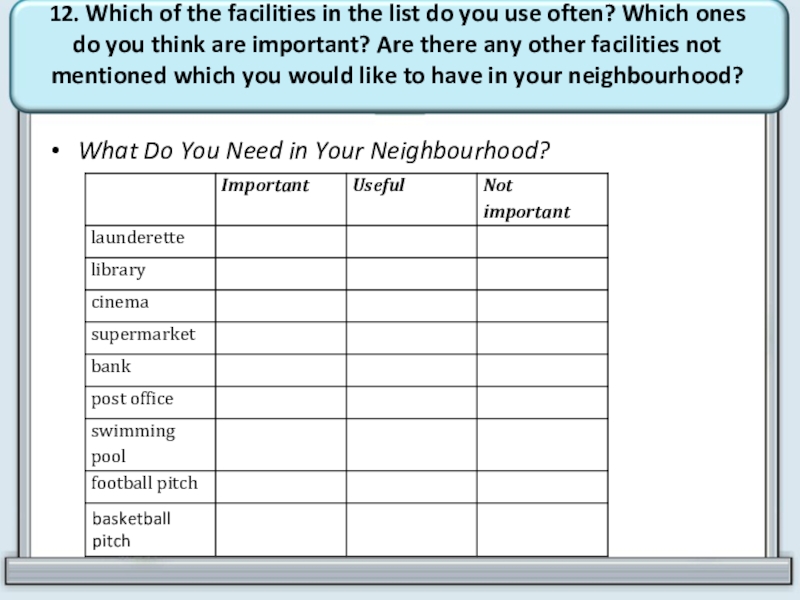
Слайд 3812. Which of the facilities in the list do you use often?
What Do You Need in Your Neighbourhood?
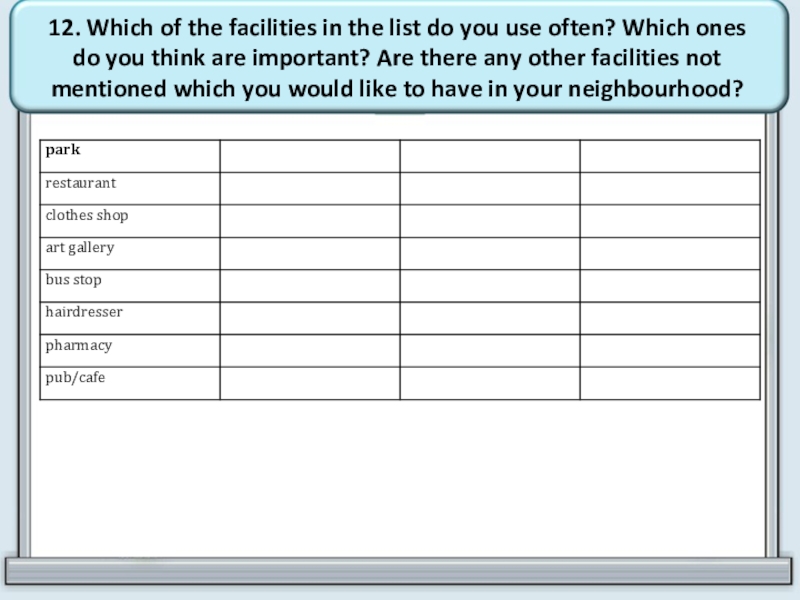
Слайд 3912. Which of the facilities in the list do you use often?
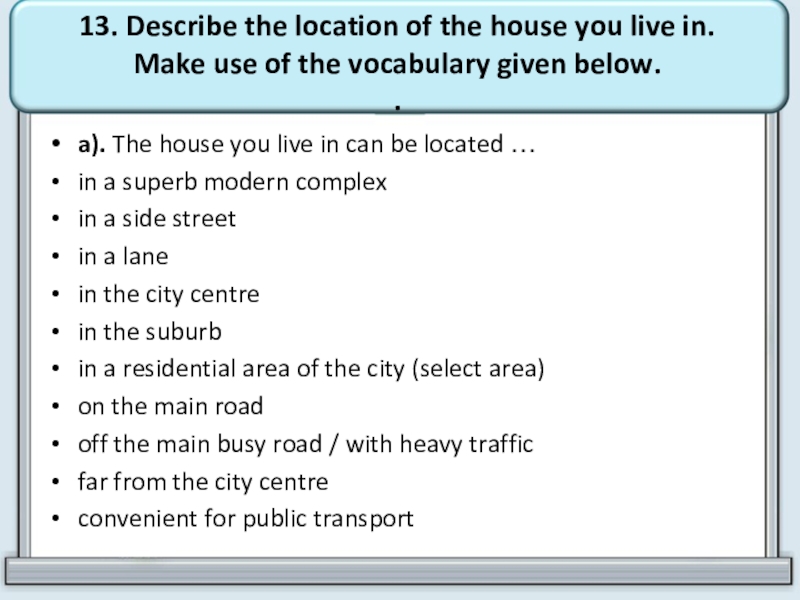
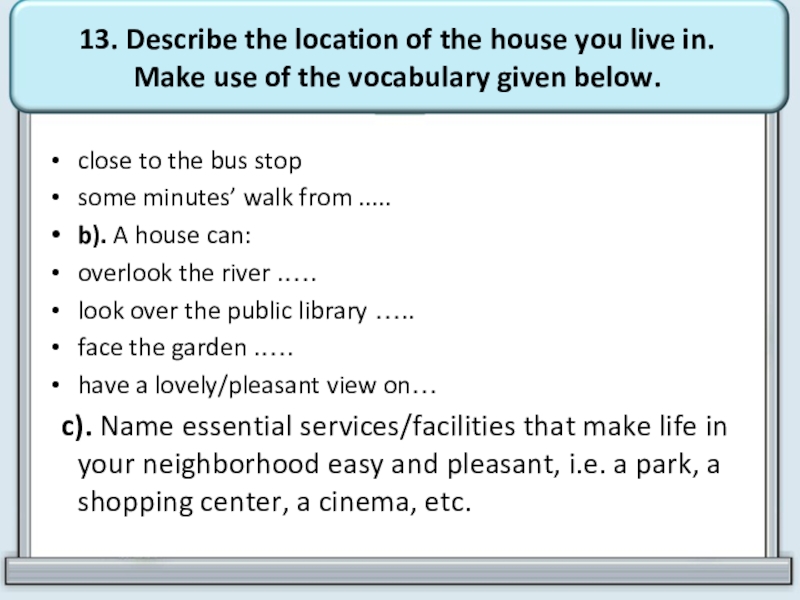
Слайд 4013. Describe the location of the house you live in. Make use
a). The house you live in can be located …
in a superb modern complex
in a side street
in a lane
in the city centre
in the suburb
in a residential area of the city (select area)
on the main road
off the main busy road / with heavy traffic
far from the city centre
convenient for public transport
Слайд 4113. Describe the location of the house you live in. Make use
close to the bus stop
some minutes’ walk from .....
b). A house can:
overlook the river .….
look over the public library …..
face the garden .….
have a lovely/pleasant view on…
c). Name essential services/facilities that make life in your neighborhood easy and pleasant, i.e. a park, a shopping center, a cinema, etc.
Слайд 4215. The Place of My Dream. Scan the three descriptions and underline
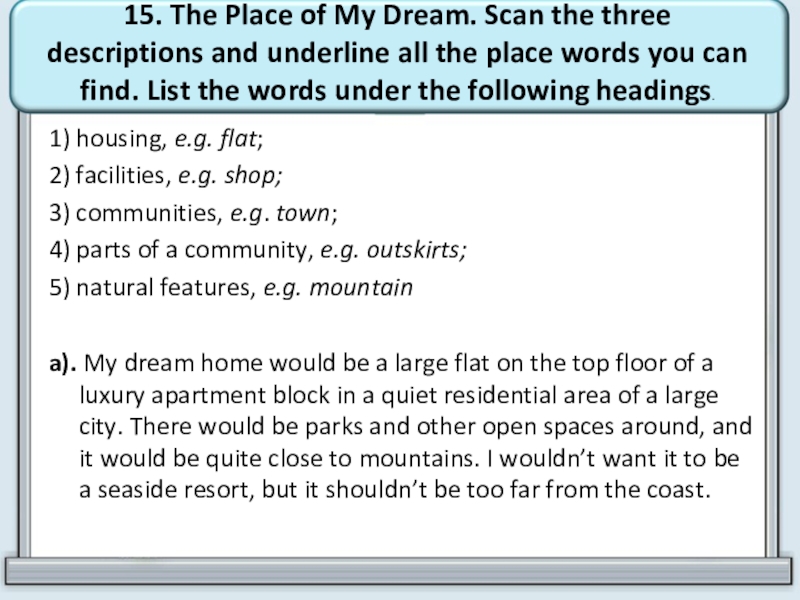
1) housing, e.g. flat;
2) facilities, e.g. shop;
3) communities, e.g. town;
4) parts of a community, e.g. outskirts;
5) natural features, e.g. mountain
a). My dream home would be a large flat on the top floor of a luxury apartment block in a quiet residential area of a large city. There would be parks and other open spaces around, and it would be quite close to mountains. I wouldn’t want it to be a seaside resort, but it shouldn’t be too far from the coast.
Слайд 4315. The Place of My Dream. Scan the three descriptions and underline
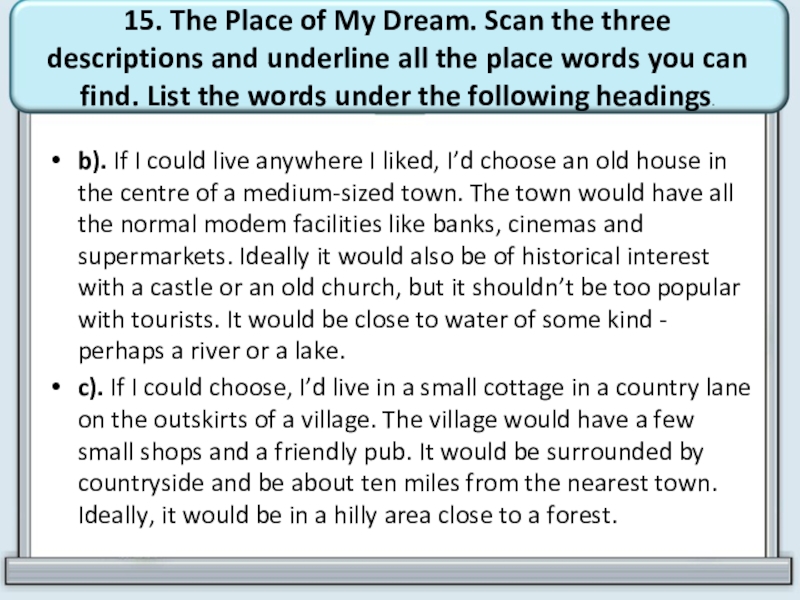
b). If I could live anywhere I liked, I’d choose an old house in the centre of a medium-sized town. The town would have all the normal modem facilities like banks, cinemas and supermarkets. Ideally it would also be of historical interest with a castle or an old church, but it shouldn’t be too popular with tourists. It would be close to water of some kind - perhaps a river or a lake.
c). If I could choose, I’d live in a small cottage in a country lane on the outskirts of a village. The village would have a few small shops and a friendly pub. It would be surrounded by countryside and be about ten miles from the nearest town. Ideally, it would be in a hilly area close to a forest.
Слайд 4415. The Place of My Dream. Scan the three descriptions and underline
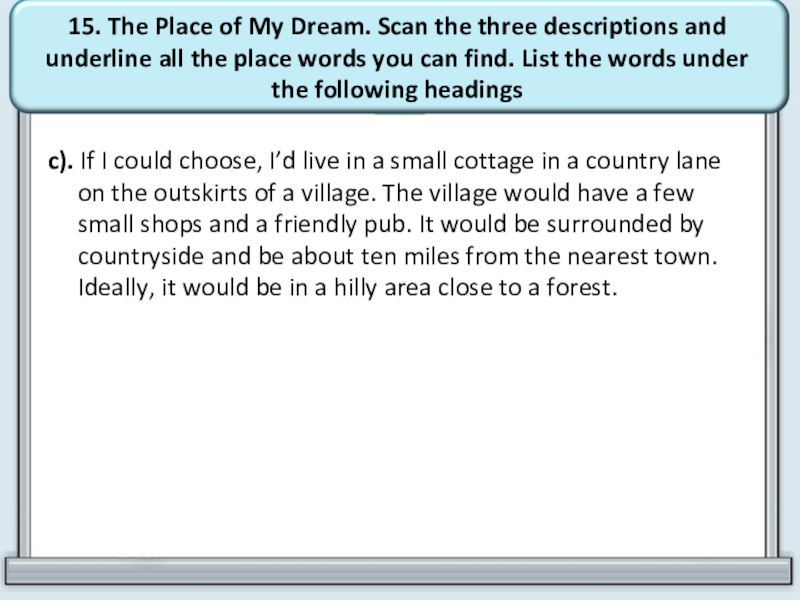
c). If I could choose, I’d live in a small cottage in a country lane on the outskirts of a village. The village would have a few small shops and a friendly pub. It would be surrounded by countryside and be about ten miles from the nearest town. Ideally, it would be in a hilly area close to a forest.
Слайд 4718. People sell, buy houses and also let them for rent. What do
Слайд 4819. Read the following advertisements for homes taken from a British estate
a). Spacious Victorian terraced house enjoying views across the city. Handy for local shops, buses, schools, etc. Porch, entrance hall, 2impressive reception rooms, kitchen/breakfast room, bathroom with shower, 3 bedrooms, gas central heating, small but delightful garden.
b). A purpose-built upper floor flat located in one of the city’s prime residential areas, some 10 minutes’ walk from the city centre and railway station. Close to local shops and canal path walks. Commanding superb views over the city and surrounding hills. Gas central heating, hall, 6m x 4m living room, bathroom, 2 double bedrooms with wardrobes, garage.
Слайд 4919. Read the following advertisements for homes taken from a British estate
c). Southern outskirts of the city: a double-fronted pre-war semi-detached 3 bed-roomed house in a quiet tree-lined road. Convenient for local shops and city buses. Period hall, good-sized lounge, dining room, utility room/storeroom, electric storage heaters, double-glazing, charming mature garden, garage.
c). Southern outskirts of the city: a double-fronted pre-war semi-detached 3 bed-roomed house in a quiet tree-lined road. Convenient for local shops and city buses. Period hall, good-sized lounge, dining room, utility room/storeroom, electric storage heaters, double-glazing, charming mature garden, garage.
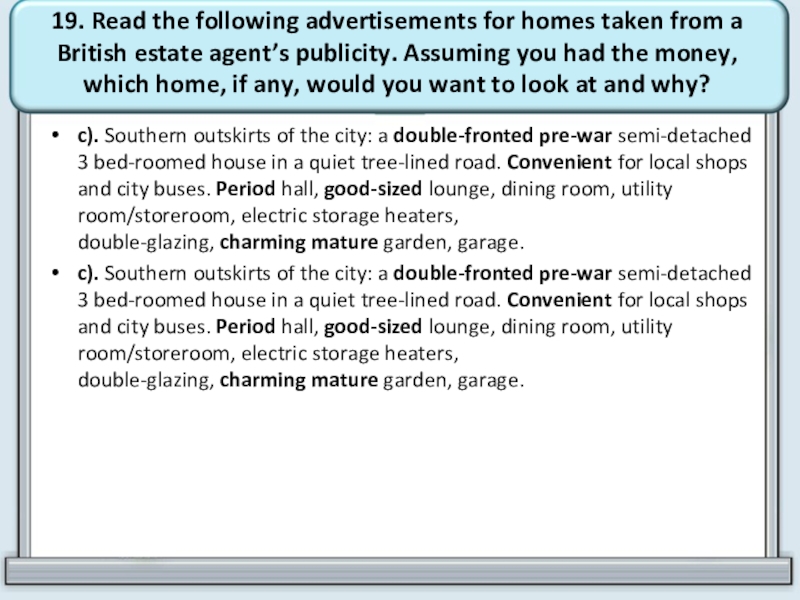
Слайд 5020. The following adjectives are all taken from the advertisements above. Put
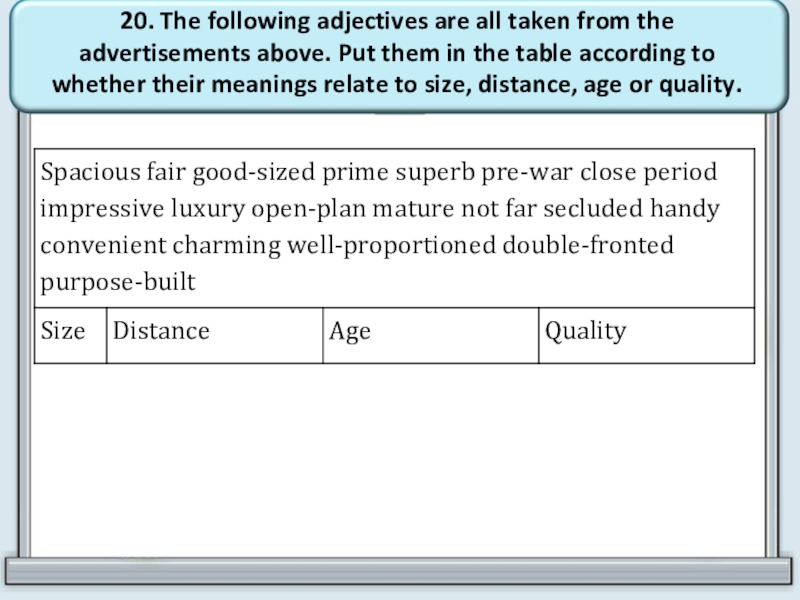
Слайд 5121. Translate the following sentences into Russian paying attention to the underlined
1) I live in a Council House.
2) Rents are quite reasonable in this part of the city.
3) I hope you’ve settled downcomfortably in your new home.
4) We’ve just moved in, that’s why our living room is in such a mess.
5) I like built-in furniture, it’s so practical.
6) Please, wipe your feet on the mat before you come in.
7) There’s plenty of room for a fridge next to this kitchen cabinet.
8) The kitchen smells of gas.
9) The tap is leaking. I’ll have to get the plumber in to have it repaired.
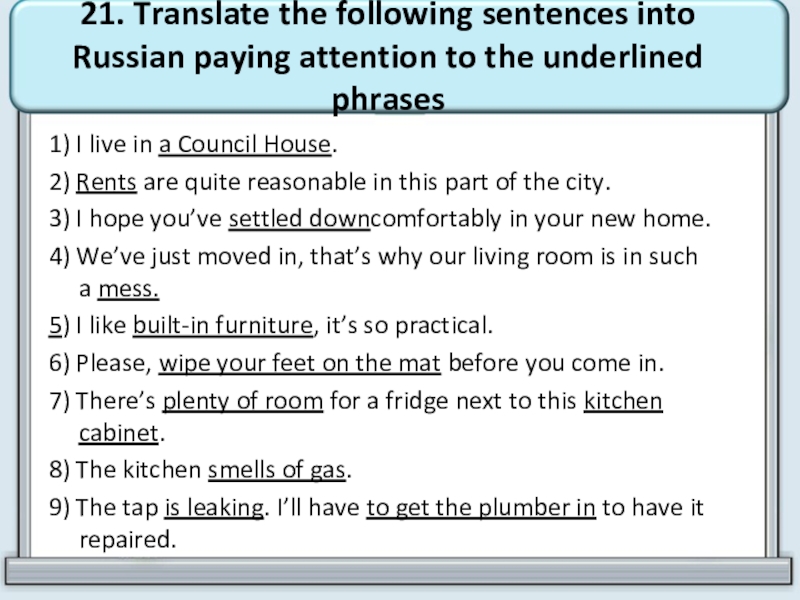
Слайд 5221. Translate the following sentences into Russian paying attention to the underlined
10) We’ve been looking for domestic help for quite a while.
11) I do some little repairs in the house, once in a while.
12) Is there a socket where I can plug in the tape-recorder?
13) The waste-bin is full again. I’ll empty it. Are there any more bin-liners?
14) We keep our skis up in the attic during the summer. They are out of the way up there.
15) The light-switch for the stairs is on the landing as you come out of your bedroom.
Слайд 5322. Match the words from the list with the explanations.
bridge bungalow caravan castle cottage
semi-detached
a) strong building made in the past to defend people against enemies. ...castle…
b) A small house on wheels which is pulled by a car.
c) A house which is one of a pair of houses joined together.
d) A small house with only one floor.
e) This carries a road or railway over a river.
Слайд 5422. Match the words from the list with the explanations.
f) A house
g) A small house in the country.
h) A tall building standing alone, or as part of a castle or church.
Слайд 5523. Use the words given in capitals at the end of each
Moving house is said to be the third most (0) ... stressful...STRESS
experience you can have (coming after the (1) ..... DIE
of a close relative, or a divorce). The reason for
this is partly the (2) ........ involved, but also the ORGANISE
feeling of (3) ........ caused by completely changing SECURITY
your environment. Of course, a (4) ...... approach can SYSTEM
help ease the difficulties, especially on the day of
(5) ............. . (6) ........... company to pack and move RELY
your things.
Слайд 5623. Use the words given in capitals at the end of each
This will (7) ......... lessen the amount of damage CERTAIN
to your (8) .............. It’s also a good idea to take POSSESS
out (9) ............... . Some worry is, of course, INSURE
(10) ....... but try to keep calm and look forward to AVOIDABLE
life in your new home.
Слайд 5724. Choose the correct word underlined in this sentence.
a) Will you be at home/at
b) Paul’s room is at the top of the stairs/steps opposite the bathroom.
c) Can you remember to clean the wash-basin/sink in the bathroom?
d) The rooms downstairs are so low I can touch the roof/ceiling.
e) Tony is a keen cooker/cook and always uses an electric cooker/cook.
f) You’ll find plates in the cupboard/wardrobe next to the fridge.
Слайд 5824. Choose the correct word underlined in this sentence.
g) Ann was sitting at/to her
h) I won’t be long. I’m just going upstairs for a bath/a bathe.
i) Lisa didn’t like doing homework/housework, so she paid a cleaner.
j) Under the house there’s a cave/cellar where we keep our old things.
Слайд 59
25. Choose the most suitable word underlined in each sentence.
a) We arranged
b) Their cottage is in the heart of some beautiful country/countryside.
c) The children spent all day playing on the sandy beach/seaside.
d) I dropped my ice-cream on the earth/ground, so I couldn’t eat it.
e) This footpath/pavement leads across the fields to the village.
f) There was a wonderful scenery/view from my hotel room.
g) You can’t stop here. Car-park/Parking is not allowed in this street.
h) Helen decided to leave the country/land and work abroad.
i) Buses pass the bus station/stop outside my house every ten minutes.
Слайд 6026. Complete each sentence with a verb from the list in a
drop finish get look move put take turn
a) I’ve got nowhere to stay tonight. Can you ...put.... me up ?
b) We’ve bought a new house but we can’t ..... in until next month.
c) Adrian doesn’t ............. on with his neighbours, because they are so noisy.
d) Jan likes cooking, but she says it ............ up a lot of her time.
e) Don’t forget to .............. off the television before you go to bed.
f) Helen has done most of the decorating and plans to ............ it off tomorrow.
g) I have a large room, and it ............ out onto a beautiful garden.
h) Karen and Mike live next door and they often ....... in for a chat.
Слайд 6127. Fill the gaps in this passage with this, their, a, the, or 0 (i.e. no article). Give
60% of families in ............ UK own ............ own homes after borrowing money (known as ............ mortgage) from ............ building society or bank. They have to make ............ monthly repayment of ............ total sum (plus interest) for 20-25 years. Borrowers can usually borrow ............ sum equivalent to three times ............ annual salary, but need to put down ........... cash deposit of 10% of ........... purchase price. ............ people in Britain tend to move ........... home several times in ........... lives. ............ typical pattern is for ............ young couple to start as ‘first-time buyers’ in ............ small flat or house, then move to ........... larger house when they have ............ family and, when ........... children have left ............ home, to move into ........... smaller house or bungalow.
Слайд 6227. Fill the gaps in this passage with this, their, a, the, or 0 (i.e. no article). Give
Usually they move into ............ other people’s houses or into ........... new home that has been built on ............ new estate by ............ builder. Families in ............ lower income groups are more likely to live in ............ rented accommodation, for example in ......... council house or flat.
Moving home can be ............ stressful experience, only slightly less traumatic than ........... bereavement or divorce. Often ........... buyer and seller of ............ house are part of ............ ‘chain’, where ............ sale of one house depends on ............ whole series of strangers doing ........... same thing at ............ same time. If one deal falls through at ........... last moment, ........ whole chain breaks down and no one is able to move.
Слайд 6328. Choose the most suitable word for each space.
A House in the
The house is situated among beautiful (1) .....b....., two miles from the nearest village, surrounded by (2) .................. On a (3) .................. a short distance from the house is a (4) ............., and a small (5) ….............. flows past the end of the garden, which also contains a small (6) …......... The name of the house, Rose Cottage, is on the garden (7) ..........., from which a (8) ........... leads to the (9)............. door. On the (10) .............. floor there is a large (11) …........... room, a dining room, a kitchen, and (12) …...... and toilet. (13) …......... there are three bedrooms. There is also a garage next to the house. The village has a post (14) ............, pub and supermarket, and there is a railway (15) ................ three miles away.
Слайд 6428. Choose the most suitable word for each space.
1) a) view b)
2) a) grass b) flats c) earth d) fields
3) a) mountain b) peak c) hill d) summit
4) a) wood b) greenery c) jungle d) forest
5) a) river b) channel c) stream d) canal
6) a) lake b)bath c) water d)pond
7) a) gate b) door c) opening d) entrance
8) a) road b) path c) way d) pavement
9) a) forward b) front c) first d) further
10) a) bottom b) back c) ground d) earth
11) a) lounge b) seating c) saloon d) living
12) a) bath b) bathroom c) basin d) washing
13) a) Over b) Up c) Upstairs d) Higher
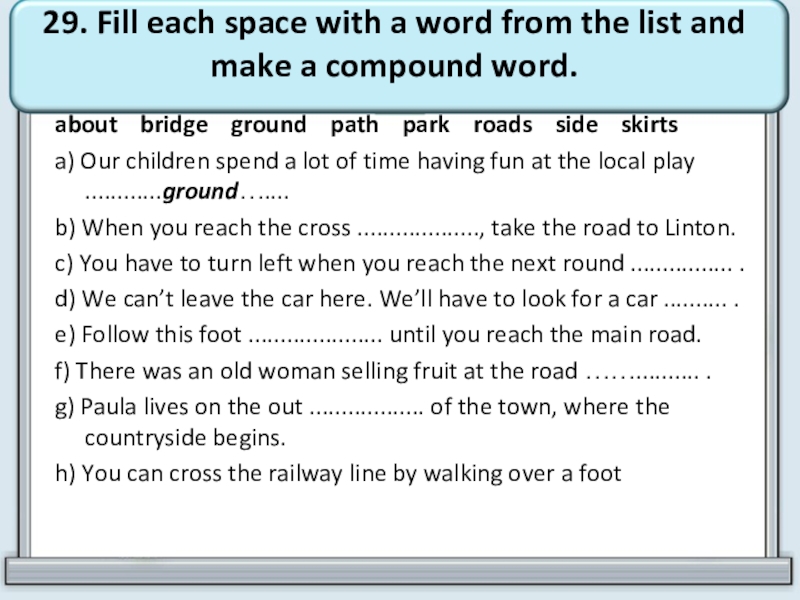
Слайд 6529. Fill each space with a word from the list and make
about bridge ground path park roads side skirts
a) Our children spend a lot of time having fun at the local play ............ground…....
b) When you reach the cross ..................., take the road to Linton.
c) You have to turn left when you reach the next round ................ .
d) We can’t leave the car here. We’ll have to look for a car .......... .
e) Follow this foot ..................... until you reach the main road.
f) There was an old woman selling fruit at the road …….......... .
g) Paula lives on the out .................. of the town, where the countryside begins.
h) You can cross the railway line by walking over a foot
Слайд 6630. Choose the best alternative to fill the gaps in these sentences.
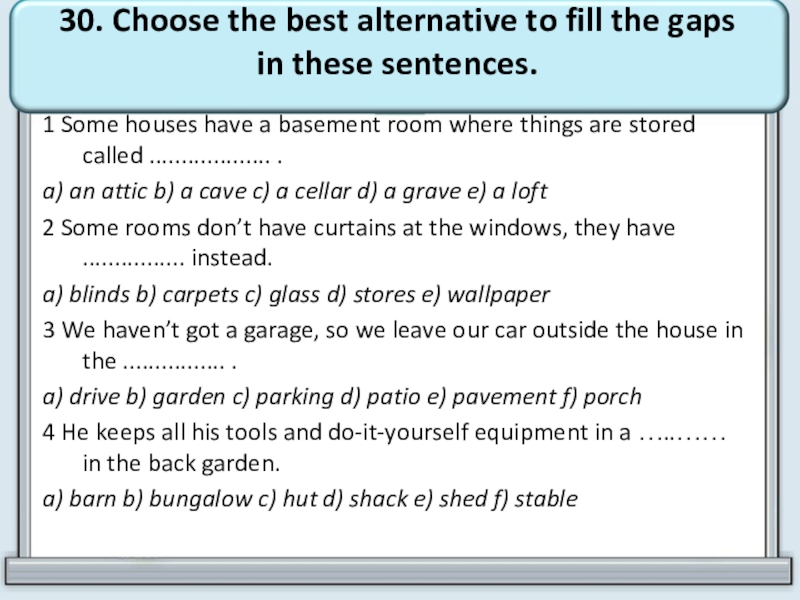
1
a) an attic b) a cave c) a cellar d) a grave e) a loft
2 Some rooms don’t have curtains at the windows, they have ................ instead.
a) blinds b) carpets c) glass d) stores e) wallpaper
3 We haven’t got a garage, so we leave our car outside the house in the ................ .
a) drive b) garden c) parking d) patio e) pavement f) porch
4 He keeps all his tools and do-it-yourself equipment in a …..…… in the back garden.
a) barn b) bungalow c) hut d) shack e) shed f) stable
Слайд 6731. Translate from Russian into English.
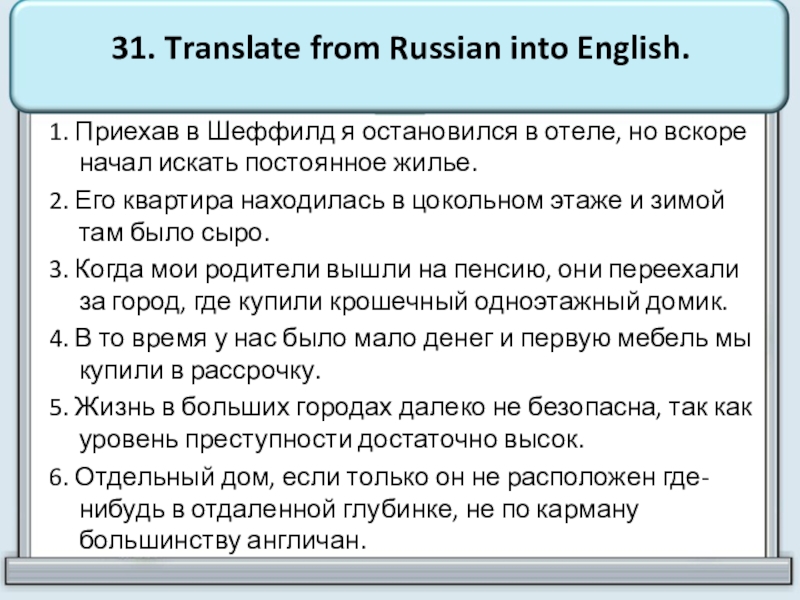
1. Приехав в Шеффилд я остановился в
2. Его квартира находилась в цокольном этаже и зимой там было сыро.
3. Когда мои родители вышли на пенсию, они переехали за город, где купили крошечный одноэтажный домик.
4. В то время у нас было мало денег и первую мебель мы купили в рассрочку.
5. Жизнь в больших городах далеко не безопасна, так как уровень преступности достаточно высок.
6. Отдельный дом, если только он не расположен где-нибудь в отдаленной глубинке, не по карману большинству англичан.
Слайд 6831. Translate from Russian into English.
7. Около 70% населения Англии живут в
8. Традиционный строительный материал для жилых домов в Англии – кирпич (для стен) и черепица (для крыш).
9. Часть населения живет в квартирах, которые они снимают у частных домовладельцев.
10. В последнее время в Британии вместо домов-башен строится жилье высотой не более 6 этажей.