- Главная
- Разное
- Образование
- Спорт
- Естествознание
- Природоведение
- Религиоведение
- Французский язык
- Черчение
- Английский язык
- Астрономия
- Алгебра
- Биология
- География
- Геометрия
- Детские презентации
- Информатика
- История
- Литература
- Математика
- Музыка
- МХК
- Немецкий язык
- ОБЖ
- Обществознание
- Окружающий мир
- Педагогика
- Русский язык
- Технология
- Физика
- Философия
- Химия
- Шаблоны, фоны, картинки для презентаций
- Экология
- Экономика
Презентация, доклад по английскому языку на тему Руслан и Людмила (7 класс)
Содержание
- 1. Презентация по английскому языку на тему Руслан и Людмила (7 класс)
- 2. "Ruslan and Lyudmila" — the first finished
- 3. § Creation history The poem is written
- 4. The poem contains parody elements in relation
- 5. I. Ya. Bilibin's illustration (1917). I. Ya.
- 6. Bilibin's illustration (1917). The epilog ("So, the
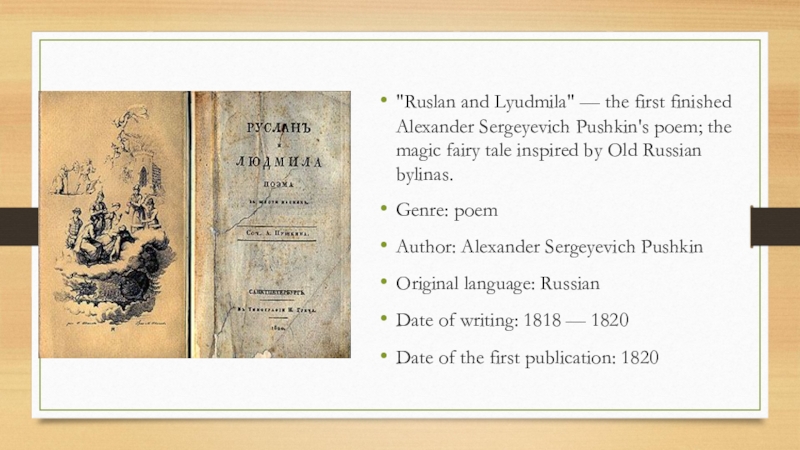
"Ruslan and Lyudmila" — the first finished Alexander Sergeyevich Pushkin's poem; the magic fairy tale inspired by Old Russian bylinas.Genre: poemAuthor: Alexander Sergeyevich PushkinOriginal language: RussianDate of writing: 1818 — 1820Date of the first publication: 1820
Слайд 2"Ruslan and Lyudmila" — the first finished Alexander Sergeyevich Pushkin's poem;
the magic fairy tale inspired by Old Russian bylinas.
Genre: poem
Author: Alexander Sergeyevich Pushkin
Original language: Russian
Date of writing: 1818 — 1820
Date of the first publication: 1820
Genre: poem
Author: Alexander Sergeyevich Pushkin
Original language: Russian
Date of writing: 1818 — 1820
Date of the first publication: 1820
Слайд 3§ Creation history
The poem is written in 1818 — 1820, after
an exit from Lyceum; Pushkin sometimes specified that started writing the poem in Lyceum, but, apparently, only the most general plans, hardly the text belong by this time. Conducting after an exit from Lyceum in St. Petersburg life "the most scattered", Pushkin worked on the poem generally during diseases.
Pushkin put a task to create the "powerful" fantastic poem in the spirit of known to him on French translations of "Violent Roland" of Ariosto (critics called this genre "romantic" that it isn't necessary to confuse to romanticism in modern understanding). He was inspired also by Voltaire ("The Orleans virgin", "That is pleasant to ladies") and the Russian literary fairy tales (such as basten story about Eruslana Lazarevich, "Bakhariyana" of Heraskov, "Ilya Muromets" of Karamzin or especially "Alyosha Popovic" of Nikolay Radishchev). The exit in February, 1818 of the first volumes Karamzin "To history of the state Russian" became direct incentive by the beginning of work on the poem, many details and names of all three rivals of Ruslan from where are borrowed (Ragday, Ratmir and Farlaf).
Pushkin put a task to create the "powerful" fantastic poem in the spirit of known to him on French translations of "Violent Roland" of Ariosto (critics called this genre "romantic" that it isn't necessary to confuse to romanticism in modern understanding). He was inspired also by Voltaire ("The Orleans virgin", "That is pleasant to ladies") and the Russian literary fairy tales (such as basten story about Eruslana Lazarevich, "Bakhariyana" of Heraskov, "Ilya Muromets" of Karamzin or especially "Alyosha Popovic" of Nikolay Radishchev). The exit in February, 1818 of the first volumes Karamzin "To history of the state Russian" became direct incentive by the beginning of work on the poem, many details and names of all three rivals of Ruslan from where are borrowed (Ragday, Ratmir and Farlaf).
Слайд 4The poem contains parody elements in relation to the ballad of
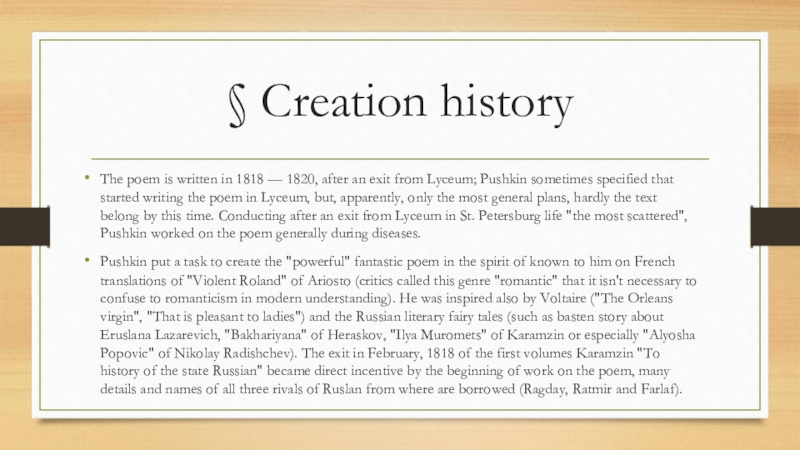
Zhukovsky "Twelve sleeping maidens". Pushkin consistently ironically reduces sublime images of Zhukovsky, sates a plot with comic erotic elements, a grotesque fantasy (an episode with the Head), uses "demotic" lexicon (I "will strangle", I "sneezed"). Pushkin "parodying" of Zhukovsky initially has no negative shade and has rather friendly character; it is known that Zhukovsky "warmly rejoiced" to a Pushkin joke, and after a release of the poem presented to Pushkin the portrait with an inscription to "The winner pupil from the won teacher". Subsequently, at the beginning of the 1830th years, the mature Pushkin inclined critically to overestimate the youthful experiences, was distressed that parodied "Twelve sleeping maidens" "to please common people".
Слайд 5I. Ya. Bilibin's illustration (1917).
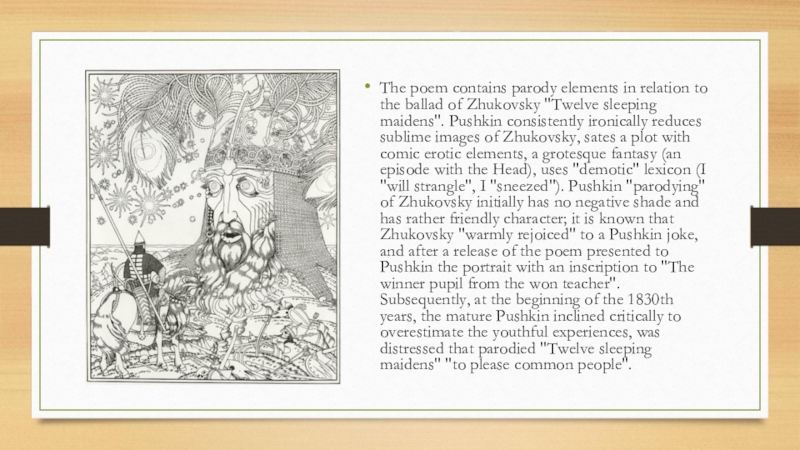
I. Ya. Bilibin's illustration (1917).
The poem started
being printed in "The son of the fatherland" in the spring of 1820 in fragments, the first separate edition appeared in May of the same year (just in days of a Pushkin's exile to the south) and caused the indignant responses of many critics who saw in it "immorality" and "impropriety" (A. F. Voyeykov who began was the journal publication of neutral and benevolent analysis of the poem, in the last part of a response under the influence of I. I. Dmitriyev scarified it). The special position was taken by P. A. Katenin reproaching Pushkin, on the contrary in an insufficient nationality and excessive of the Russian fairy tales in the spirit of the French saloon stories. The considerable part of the reading public accepted the poem enthusiastically, the All-Russian glory of Pushkin began with its emergence.
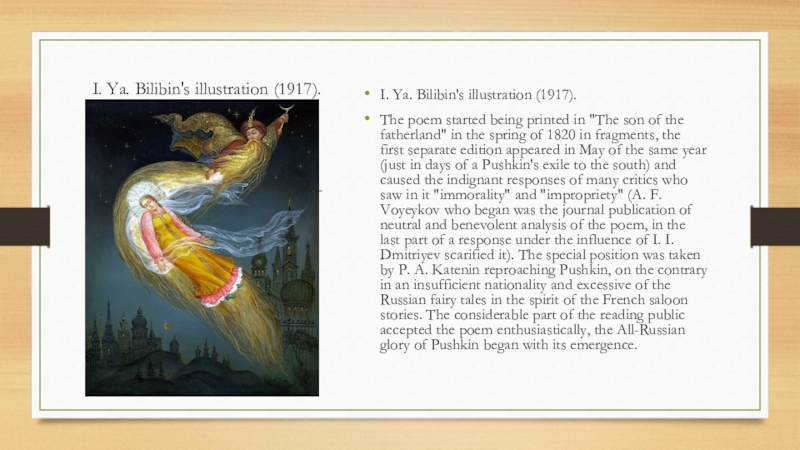
Слайд 6Bilibin's illustration (1917).
The epilog ("So, the world the inhabitant indifferent …")
is written by Pushkin later, during the link to the Caucasus. In 1828 Pushkin prepared the second edition of the poem, added an epilog and again written well-known so-called "prolog" — formally part of the Song of the first ("At a curved seashore an oak green …"), strengthened conditional and folklore coloring of the text, and also reduced many erotic episodes and lyrical digressions. As the preface Pushkin reprinted some critical responses on the edition of 1820 which became in a new literary situation already frankly ridiculous, for example, the critique of the little-known critic who about the poem "Ruslan and Lyudmila" wrote: present supposedly the man in bast shoes, I intruded in some "nobility assemly" and I cried: "Fine, children!", concerning this case the literary critic Vadim Kozhinov noted: "Has to tell: happens that appreciation is given to the person not by friends, but enemies". In 1830, taking away old charges of immorality in "A denial on criticism" again, the poet emphasized that now in the poem it doesn't accept, on the contrary, absence of original feeling: "Nobody noticed even that it is cold".