- Главная
- Разное
- Образование
- Спорт
- Естествознание
- Природоведение
- Религиоведение
- Французский язык
- Черчение
- Английский язык
- Астрономия
- Алгебра
- Биология
- География
- Геометрия
- Детские презентации
- Информатика
- История
- Литература
- Математика
- Музыка
- МХК
- Немецкий язык
- ОБЖ
- Обществознание
- Окружающий мир
- Педагогика
- Русский язык
- Технология
- Физика
- Философия
- Химия
- Шаблоны, фоны, картинки для презентаций
- Экология
- Экономика
Презентация, доклад по английскому языку на тему Акценты в английском языке
Содержание
- 1. Презентация по английскому языку на тему Акценты в английском языке
- 2. Today I’m going to be talking about
- 3. The difference between American and English 1/3It’s
- 4. The difference between American and English 2/3Vocabulary
- 5. The difference between American and English 3/3
- 6. Received Pronunciation A.K.A Queen’s English/Oxford/PoshReceived Pronunciation is
- 7. CockneyCockney is probably the second most famous
- 8. Estuary English (Southeast British) Estuary is an
- 9. West Country West Country refers to a
- 10. Midlands EnglishMidlands English is one of the
- 11. Northern England EnglishThese are the accents and
- 12. GeordieGeordie usually refers to both the people
- 13. Welsh EnglishThis refers to the accents and
- 14. Scottish EnglishThis is the broad definition used
Today I’m going to be talking about accents in English, mainly accents from the UK. The United Kingdom is probably the most dialect-obsessed nation in the world. With countless accents shaped by thousands of years of history,
Слайд 2Today I’m going to be talking about accents in English, mainly
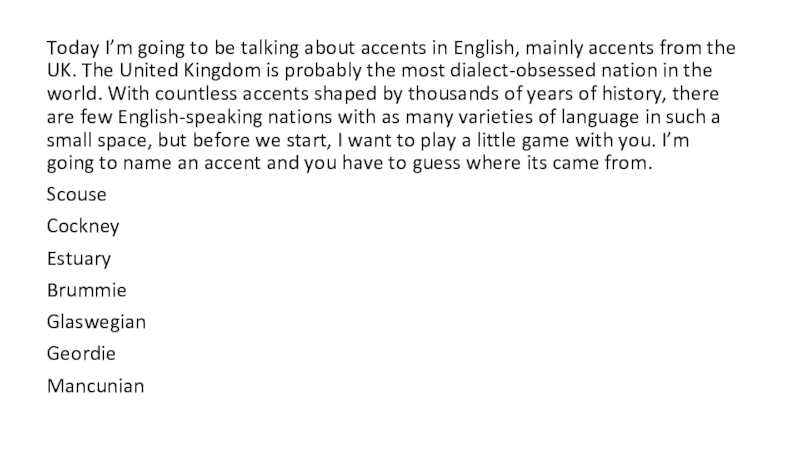
accents from the UK. The United Kingdom is probably the most dialect-obsessed nation in the world. With countless accents shaped by thousands of years of history, there are few English-speaking nations with as many varieties of language in such a small space, but before we start, I want to play a little game with you. I’m going to name an accent and you have to guess where its came from.
Scouse
Cockney
Estuary
Brummie
Glaswegian
Geordie
Mancunian
Scouse
Cockney
Estuary
Brummie
Glaswegian
Geordie
Mancunian
Слайд 3The difference between American and English 1/3
It’s difficult to make clear
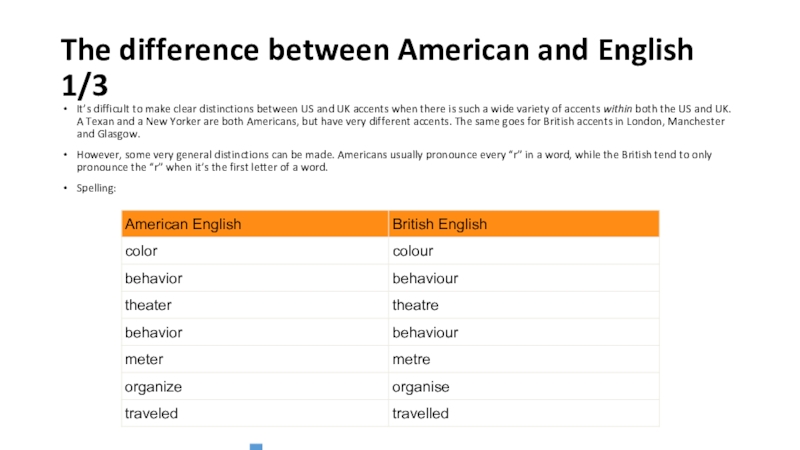
distinctions between US and UK accents when there is such a wide variety of accents within both the US and UK. A Texan and a New Yorker are both Americans, but have very different accents. The same goes for British accents in London, Manchester and Glasgow.
However, some very general distinctions can be made. Americans usually pronounce every “r” in a word, while the British tend to only pronounce the “r” when it’s the first letter of a word.
Spelling:
However, some very general distinctions can be made. Americans usually pronounce every “r” in a word, while the British tend to only pronounce the “r” when it’s the first letter of a word.
Spelling:
Слайд 5The difference between American and English 3/3
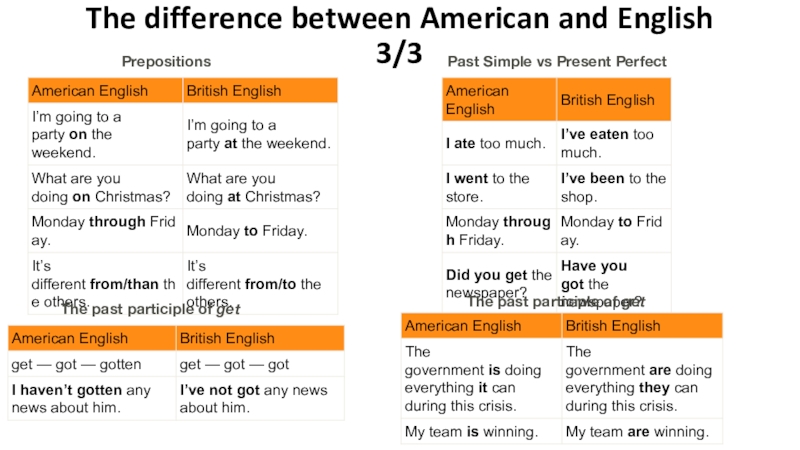
Past Simple vs Present Perfect
The
past participle of get
Prepositions
The past participle of get
Слайд 6Received Pronunciation A.K.A Queen’s English/Oxford/Posh
Received Pronunciation is the closest to a
“standard accent” that has ever existed in the UK. Although it originally derives from London English, it is non-regional. RP enjoys high social prestige in Britain, being thought of as the accent of those with power, money, and influence
Non-rhoticity, meaning the r at the ends of words isn’t pronounced(mother sounds like “muhthuh”).
Trap-bath split, meaning that certain a words, like bath, can’t, and dance are pronounced with the broad-a in father. (This differs from most American accents, in which these words are pronounced with the short-a like in cat.
The vowels tend to be a bit more conservative than other accents in Southern England, which have undergone significant vowel shifting over the past century.
Non-rhoticity, meaning the r at the ends of words isn’t pronounced(mother sounds like “muhthuh”).
Trap-bath split, meaning that certain a words, like bath, can’t, and dance are pronounced with the broad-a in father. (This differs from most American accents, in which these words are pronounced with the short-a like in cat.
The vowels tend to be a bit more conservative than other accents in Southern England, which have undergone significant vowel shifting over the past century.
Слайд 7Cockney
Cockney is probably the second most famous British accent. It originated
in the East End of London, but shares many features with and influences other dialects in that region.
Raised vowel in words like trap and cat so these sounds like “trep” and “cet.”
Non-rhoticity and Trap-bath split like in RP
London vowel shift: The vowel sounds are shifted around so that Cockney “day” sounds is pronounced like die in American and Cockney buy verges near boy
Glottal Stopping: the letter t is pronounced with the back of the throat in between vowels; hence better becomes be’uh.
L-vocalization: The l at the end of words often becomes a vowel sound Hence pal can seem to sound like “pow.”
Th-Fronting: The th in words like think or this is pronounced with a more forward consonant depending on the word: thing becomes “fing,” this becomes “dis,” and mother becomes “muhvah.”
H-dropping. Ex his, house, who.
Raised vowel in words like trap and cat so these sounds like “trep” and “cet.”
Non-rhoticity and Trap-bath split like in RP
London vowel shift: The vowel sounds are shifted around so that Cockney “day” sounds is pronounced like die in American and Cockney buy verges near boy
Glottal Stopping: the letter t is pronounced with the back of the throat in between vowels; hence better becomes be’uh.
L-vocalization: The l at the end of words often becomes a vowel sound Hence pal can seem to sound like “pow.”
Th-Fronting: The th in words like think or this is pronounced with a more forward consonant depending on the word: thing becomes “fing,” this becomes “dis,” and mother becomes “muhvah.”
H-dropping. Ex his, house, who.
Слайд 8Estuary English (Southeast British)
Estuary is an accent derived from London English
which has achieved a status slightly similar to “General American” in the US. Features of the accent can be heard around Southeast England, East Anglia, and perhaps further afield. It is arguably creeping into the Midlands and North.
Similar to Cockney, but in general Estuary speakers don’t front th words or raise the vowel in trap. There are few hard-and-fast rules, however.
Glottal stopping of ‘t’ and l-vocalization are markers of this accent, but there is some debate about their frequency.
Similar to Cockney, but in general Estuary speakers don’t front th words or raise the vowel in trap. There are few hard-and-fast rules, however.
Glottal stopping of ‘t’ and l-vocalization are markers of this accent, but there is some debate about their frequency.
Слайд 9West Country
West Country refers to a large swath of accents
heard in the South of England, starting about fifty miles West of London and extending to the Welsh border.
Rhoticity, meaning that the letter r is pronounced after vowels. So, for example, whereas somebody from London would pronounce mother as “muthah,” somebody from Bristol would say “mutherrr“. (in other words the way people pronounce the word in America or Ireland).
Otherwise, this is a huge dialect area, so there’s tons of variation.
Rhoticity, meaning that the letter r is pronounced after vowels. So, for example, whereas somebody from London would pronounce mother as “muthah,” somebody from Bristol would say “mutherrr“. (in other words the way people pronounce the word in America or Ireland).
Otherwise, this is a huge dialect area, so there’s tons of variation.
Слайд 10Midlands English
Midlands English is one of the more stigmatized of Englishes.
Technically, this can be divided into East Midlands and West Midlands, but I won’t get into the differences between the two just now. The most famous of these dialects is Brummie (Birmingham English).
A system of vowels otherwise vaguely reminiscent of Australian accents, with short i in kit sometimes verging toward kit (“keet”) and extremely open “loose” dipthongs.
A variety of unusual vocabulary: some East Midlands dialects still feature a variant of the word “thou!”
A system of vowels otherwise vaguely reminiscent of Australian accents, with short i in kit sometimes verging toward kit (“keet”) and extremely open “loose” dipthongs.
A variety of unusual vocabulary: some East Midlands dialects still feature a variant of the word “thou!”
Слайд 11Northern England English
These are the accents and dialect spoken north of
the midlands, in cities like Manchester, Leeds, and Liverpool. Related accents also found in Yorkshire, although there are some unique dialect features there that I won’t get into now.
Слайд 12Geordie
Geordie usually refers to both the people and dialect of Newcastle-Upon-Tyne,
in Northeast England. The word may also refer to accents and dialects in Northeast England in general. I would classify this as a separate region from the rest of Northern England because it’s so radically different from the language spoken in nearby cities.
Слайд 13Welsh English
This refers to the accents and dialects spoken in the
country of Wales. The speech of this region is heavily influenced by the Welsh language, which remained more widely spoken in modern times than the other Celtic languages.
Слайд 14Scottish English
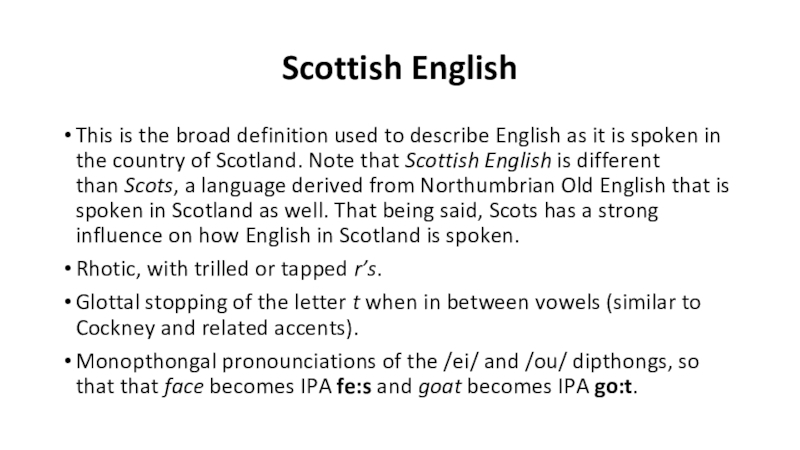
This is the broad definition used to describe English as
it is spoken in the country of Scotland. Note that Scottish English is different than Scots, a language derived from Northumbrian Old English that is spoken in Scotland as well. That being said, Scots has a strong influence on how English in Scotland is spoken.
Rhotic, with trilled or tapped r’s.
Glottal stopping of the letter t when in between vowels (similar to Cockney and related accents).
Monopthongal pronounciations of the /ei/ and /ou/ dipthongs, so that that face becomes IPA fe:s and goat becomes IPA go:t.
Rhotic, with trilled or tapped r’s.
Glottal stopping of the letter t when in between vowels (similar to Cockney and related accents).
Monopthongal pronounciations of the /ei/ and /ou/ dipthongs, so that that face becomes IPA fe:s and goat becomes IPA go:t.