- Главная
- Разное
- Образование
- Спорт
- Естествознание
- Природоведение
- Религиоведение
- Французский язык
- Черчение
- Английский язык
- Астрономия
- Алгебра
- Биология
- География
- Геометрия
- Детские презентации
- Информатика
- История
- Литература
- Математика
- Музыка
- МХК
- Немецкий язык
- ОБЖ
- Обществознание
- Окружающий мир
- Педагогика
- Русский язык
- Технология
- Физика
- Философия
- Химия
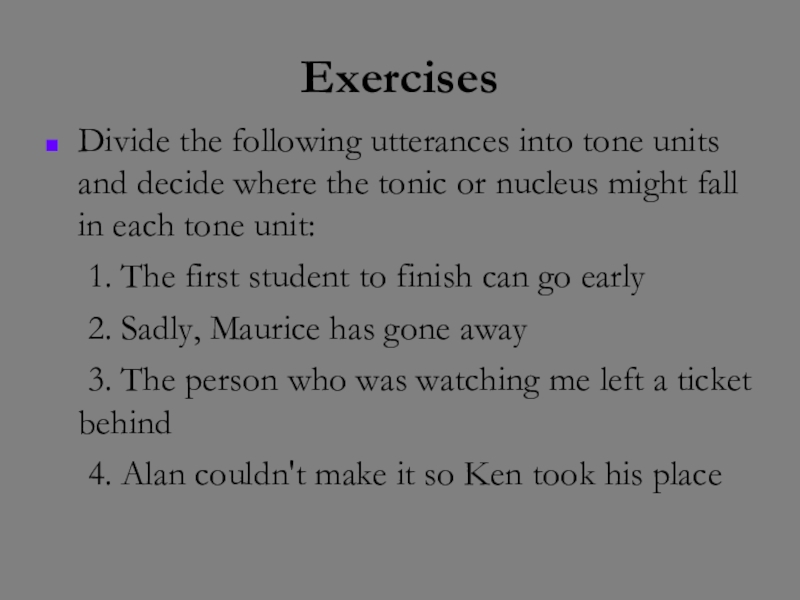
- Шаблоны, фоны, картинки для презентаций
- Экология
- Экономика
Презентация, доклад по английскому языку на тему Intonation
Содержание
- 1. Презентация по английскому языку на тему Intonation
- 2. What is intonation?Intonation is a term used
- 3. Two common examples of one-syllable utterances
- 4. If the same utterance is produced with
- 5. Suprasegmental phonologyStress : applied to units larger
- 6. PitchDefined in terms of high and low
- 7. Necessary conditions for pitch differences to be
- 8. Form and function of intonationIn the shortest
- 9. ToneIt is the term used for the
- 10. Tone and tone languagesTone is marked before
- 11. The pre-head is composed of all the
- 12. Any syllables between the tonic syllable and
- 13. Complex tones and pitch heightEach of these
- 14. Fall: neutral statement, conclusionE.g. Have you seen
- 15. Rise: questioning, doubt, desire to continue conversationE.g.
- 16. Rise-Fall: emphatic statement, irritation, command Do I really have to clean my room?Yes!
- 17. Fall-Rise: surprise, scepticismAnn and Peter were on good terms at the party?Yes!
- 18. Level: boredom, lack of interestCan you remember
- 19. We shall begin by considering the fall:
- 20. Things become more complicated when we add syllables
- 21. In this case there are no stressed syllables before the tonic: ‘I said’ is the pre-head
- 22. Here we have added a stressed syllable,
- 23. Here we have added syllables after the
- 24. This is obviously not the only possible
- 25. In a similar way a rising tonic
- 26. Again when we come to complex tone
- 27. No matter how many syllables there are in the tail, the rise finishes on the last
- 28. While diagrams are immediate and clear, a
- 29. Stressed syllables in the head are noted
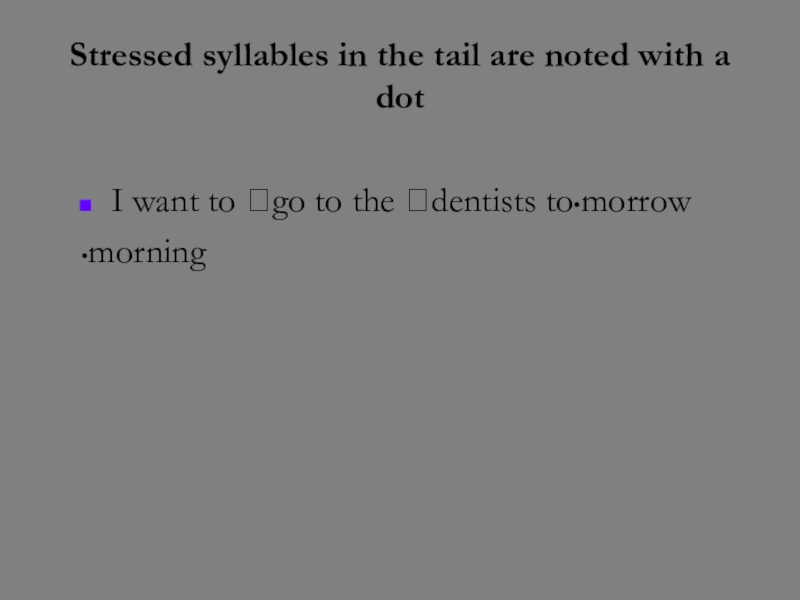
- 30. Stressed syllables in the tail are noted
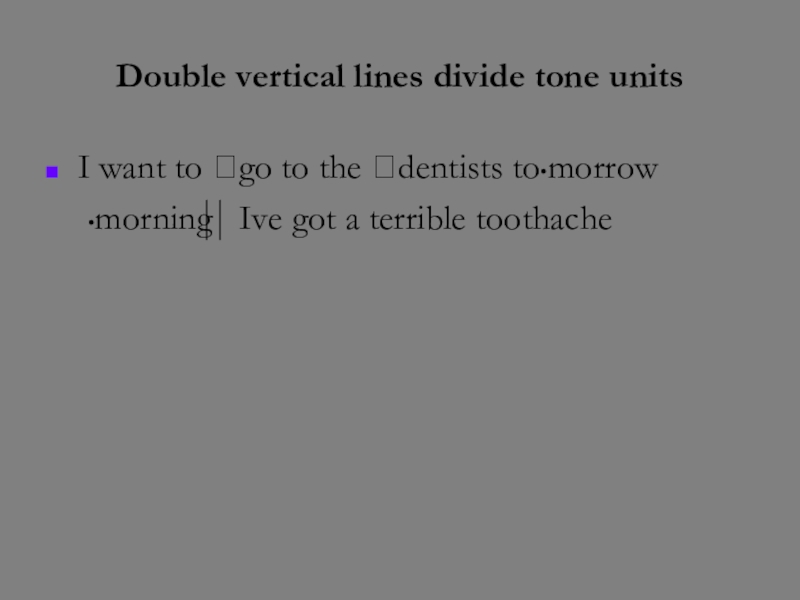
- 31. Double vertical lines divide tone unitsI want
- 32. ExercisesDivide the following utterances into tone units
- 33. Thank you very much for your attention!!!
What is intonation?Intonation is a term used to refer to the distinctive use of different patterns of pitch that carry meaningful information. Pitch is the rate of vibration of the vocal folds. When we speak, normally

Слайд 2
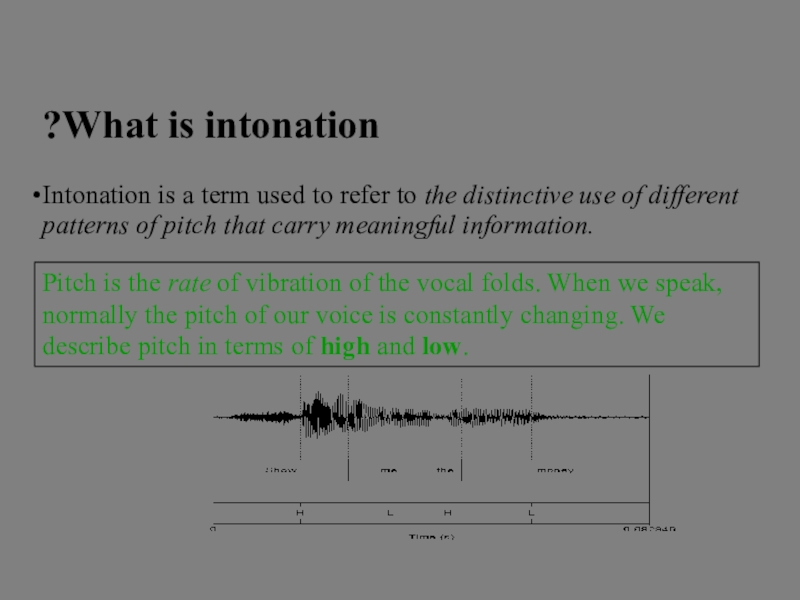
What is intonation?
Intonation is a term used to refer to the
distinctive use of different patterns of pitch that carry meaningful information.
Pitch is the rate of vibration of the vocal folds. When we speak, normally the pitch of our voice is constantly changing. We describe pitch in terms of high and low.
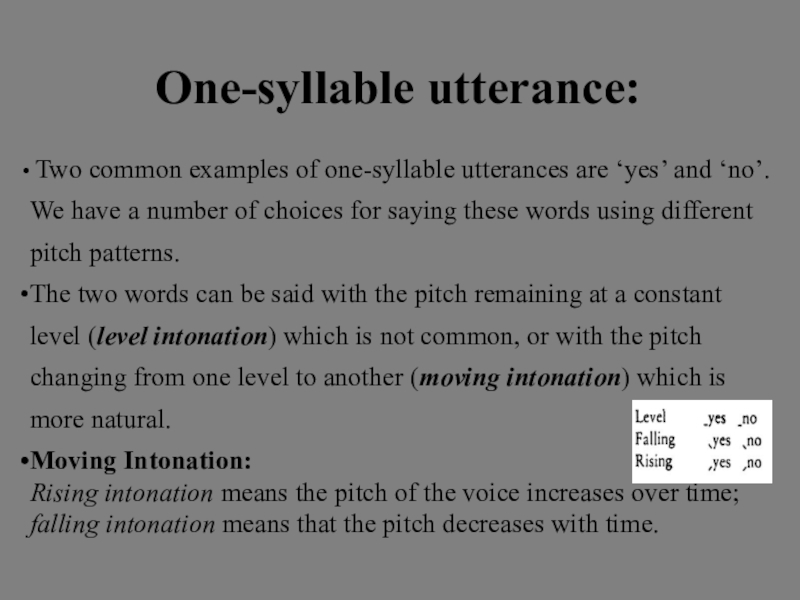
Слайд 3 Two common examples of one-syllable utterances are ‘yes’ and ‘no’.
We have a number of choices for saying these words using different pitch patterns.
The two words can be said with the pitch remaining at a constant level (level intonation) which is not common, or with the pitch changing from one level to another (moving intonation) which is more natural.
Moving Intonation:
Rising intonation means the pitch of the voice increases over time;
falling intonation means that the pitch decreases with time.
The two words can be said with the pitch remaining at a constant level (level intonation) which is not common, or with the pitch changing from one level to another (moving intonation) which is more natural.
Moving Intonation:
Rising intonation means the pitch of the voice increases over time;
falling intonation means that the pitch decreases with time.
One-syllable utterance:
Слайд 4If the same utterance is produced with different intonation, the meaning
conveyed will be different. This difference is signaled by intonation patterns.
In English, such different intonation patterns have different syntactic functions. One sentence can be a question, a declarative statement, an expression of surprise, or an expression of doubt. Compare:
‘right?’ with a rising tone
and
‘right.’ with a falling tone
In English, the utterance ‘It is a cat’ will be regarded as a statement when there is a fall in pitch, and the same utterance will be regarded as a question if the pitch rises.
In English, such different intonation patterns have different syntactic functions. One sentence can be a question, a declarative statement, an expression of surprise, or an expression of doubt. Compare:
‘right?’ with a rising tone
and
‘right.’ with a falling tone
In English, the utterance ‘It is a cat’ will be regarded as a statement when there is a fall in pitch, and the same utterance will be regarded as a question if the pitch rises.
Syntactic Function

Слайд 5Suprasegmental phonology
Stress : applied to units larger than phonemes (->
segmental phonology), i.e. syllables
Intonation : pitch of voice plays an important part; it is constantly changing during speech; analysing intonation refers to listening to the speaker´s pitch and recognising what it is doing
Intonation : pitch of voice plays an important part; it is constantly changing during speech; analysing intonation refers to listening to the speaker´s pitch and recognising what it is doing
Слайд 6Pitch
Defined in terms of high and low (arbitrary choices for end-points
of the pitch scale)
Auditory sensation experienced by the hearer
We are not interested in all aspects of a speaker´s pitch, but in those that carry some linguistic information
Speakers have control over their own pitch of voice, and the possibility of choice (this may have linguistic significance)
Auditory sensation experienced by the hearer
We are not interested in all aspects of a speaker´s pitch, but in those that carry some linguistic information
Speakers have control over their own pitch of voice, and the possibility of choice (this may have linguistic significance)
Слайд 7Necessary conditions for pitch differences to be linguistically relevant
Being under speaker´s
control
Pitch differences must be perceptible (great enough to be heard by a listener as differences in pitch)
Significance in linguistics lies in contrasts (a set of items a unit contrasts with)
Pitch differences must be perceptible (great enough to be heard by a listener as differences in pitch)
Significance in linguistics lies in contrasts (a set of items a unit contrasts with)
Слайд 8Form and function of intonation
In the shortest piece of speech –
single syllable
A continuous piece of speech beginning and ending with a pause – utterance
One syllable utterances like “yes” and “no”
Even in one syllable words we can either remain at a constant pitch level or change it
A continuous piece of speech beginning and ending with a pause – utterance
One syllable utterances like “yes” and “no”
Even in one syllable words we can either remain at a constant pitch level or change it
Слайд 9Tone
It is the term used for the overall behaviour of the
pitch
It can be level or moving
The latter is more common
Level tone does not sound natural
When saying yes or no in a final manner, falling tone is usually used
Whereas for questioning rising tone is used (compare yes/no and yes/no?)
It can be level or moving
The latter is more common
Level tone does not sound natural
When saying yes or no in a final manner, falling tone is usually used
Whereas for questioning rising tone is used (compare yes/no and yes/no?)
Слайд 10Tone and tone languages
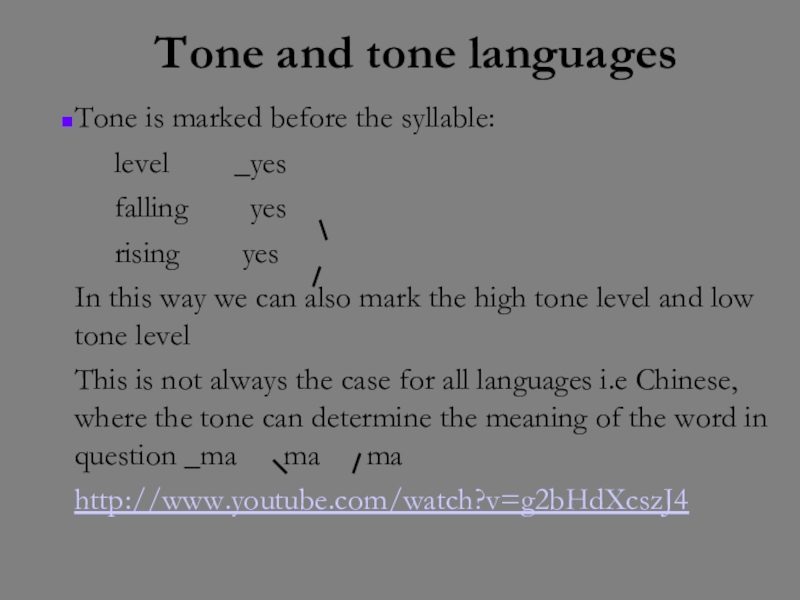
Tone is marked before the syllable:
level
_yes
falling yes
rising yes
In this way we can also mark the high tone level and low tone level
This is not always the case for all languages i.e Chinese, where the tone can determine the meaning of the word in question _ma ma ma
http://www.youtube.com/watch?v=g2bHdXcszJ4
falling yes
rising yes
In this way we can also mark the high tone level and low tone level
This is not always the case for all languages i.e Chinese, where the tone can determine the meaning of the word in question _ma ma ma
http://www.youtube.com/watch?v=g2bHdXcszJ4
Слайд 11
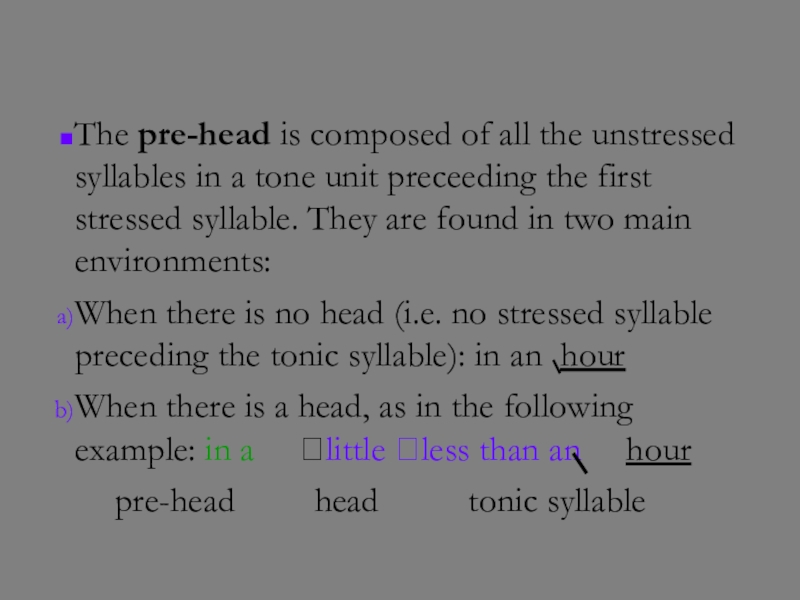
The pre-head is composed of all the unstressed syllables in a
tone unit preceeding the first stressed syllable. They are found in two main environments:
When there is no head (i.e. no stressed syllable preceding the tonic syllable): in an hour
When there is a head, as in the following example: in a little less than an hour
pre-head head tonic syllable
When there is no head (i.e. no stressed syllable preceding the tonic syllable): in an hour
When there is a head, as in the following example: in a little less than an hour
pre-head head tonic syllable
Слайд 12
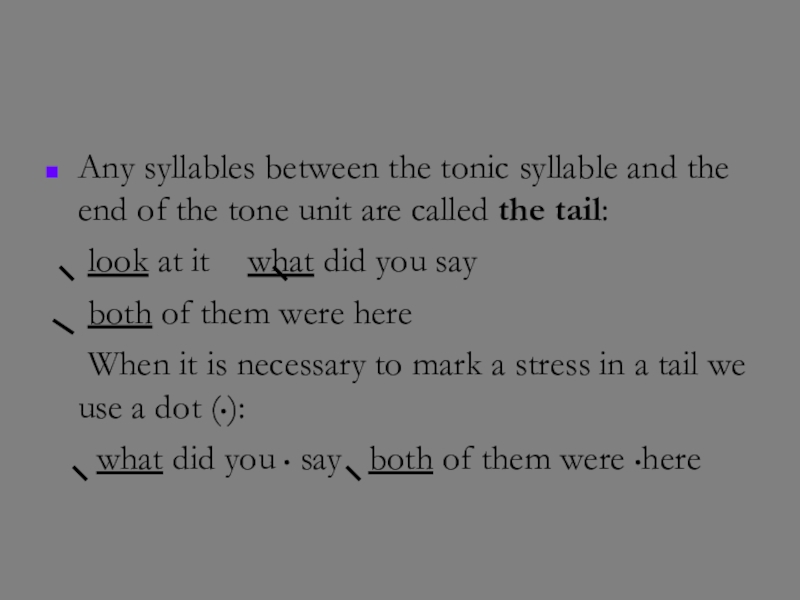
Any syllables between the tonic syllable and the end of the
tone unit are called the tail:
look at it what did you say
both of them were here
When it is necessary to mark a stress in a tail we use a dot (•):
what did you • say both of them were •here
look at it what did you say
both of them were here
When it is necessary to mark a stress in a tail we use a dot (•):
what did you • say both of them were •here
Слайд 13Complex tones and pitch height
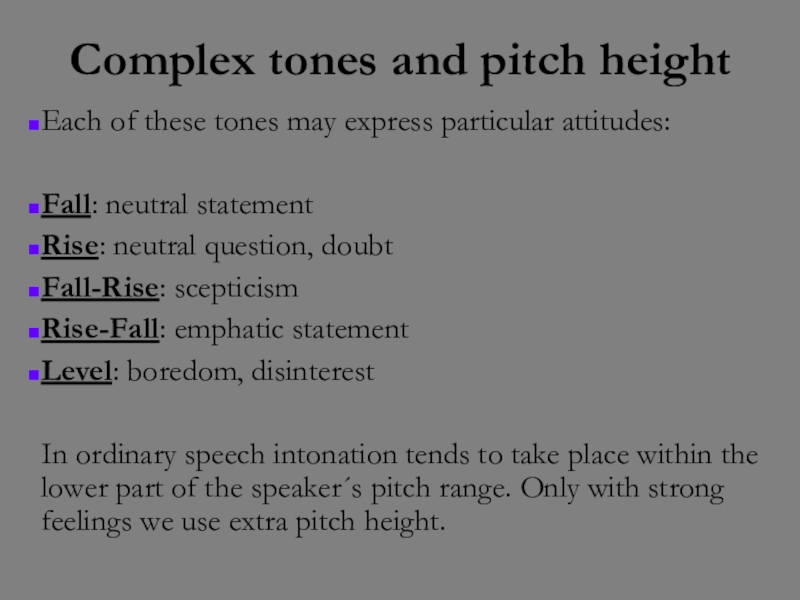
Each of these tones may express particular
attitudes:
Fall: neutral statement
Rise: neutral question, doubt
Fall-Rise: scepticism
Rise-Fall: emphatic statement
Level: boredom, disinterest
In ordinary speech intonation tends to take place within the lower part of the speaker´s pitch range. Only with strong feelings we use extra pitch height.
Fall: neutral statement
Rise: neutral question, doubt
Fall-Rise: scepticism
Rise-Fall: emphatic statement
Level: boredom, disinterest
In ordinary speech intonation tends to take place within the lower part of the speaker´s pitch range. Only with strong feelings we use extra pitch height.
Слайд 14Fall: neutral statement, conclusion
E.g. Have you seen Ann?
Yes. (Falling intonation indicates
‘I have answered your question and do not intend to add anything else’)
Слайд 15Rise: questioning, doubt, desire to continue conversation
E.g. Have you seen Ann
lately?
Yes… (Rising intonation indicates ‘I want to continue the conversation, I am curious’)
Yes… (Rising intonation indicates ‘I want to continue the conversation, I am curious’)
Слайд 18Level: boredom, lack of interest
Can you remember Peter Jackson, the cost
consultant for our company in Taiwan? The other day in the office I invited him for dinner, he’ll be coming tomorrow.
Yes.
Yes.
Слайд 19We shall begin by considering the fall: here is a tone
unit solely composed of a tonic syllable
Слайд 22Here we have added a stressed syllable, ‘told’, before the tonic,
which is called the head. Notice how the intonation rises from the pre-head
Слайд 23Here we have added syllables after the tonic, this is called
the tail. Note how it tends to follow the intonation pattern of the tonic.
Слайд 24This is obviously not the only possible realisation of this sentence.
If we put the main stress on ‘told’, it changes the pattern completely
Слайд 25In a similar way a rising tonic syllable will condition its
tail: here ‘when’ is the tonic syllable
Слайд 26Again when we come to complex tone we find the tail
following the tonic syllable: for a fall-rise the fall occurs on the tonic and the rise at the end of the tail
Слайд 28While diagrams are immediate and clear, a more practical system of
symbols has been developed to denote innotation
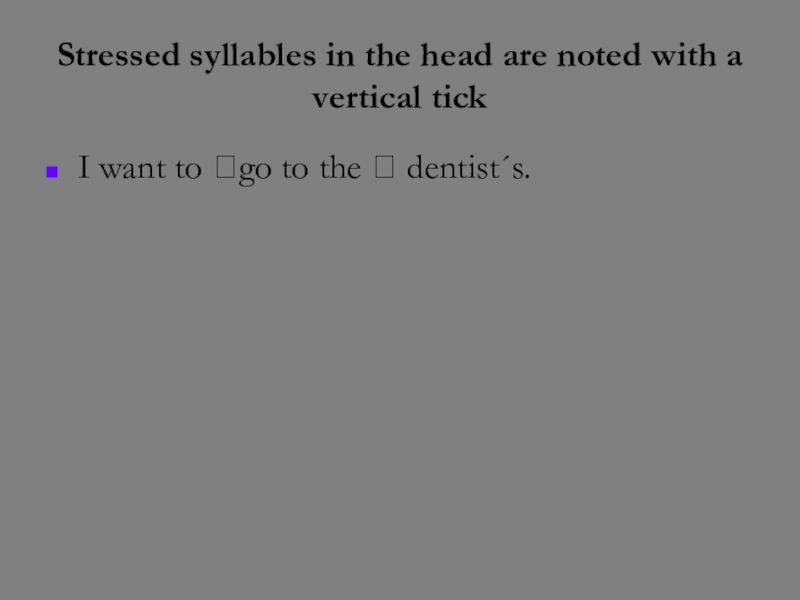
Слайд 29Stressed syllables in the head are noted with a vertical tick
I
want to go to the dentist´s.
Слайд 30Stressed syllables in the tail are noted with a dot
I want
to go to the dentists to•morrow
•morning
•morning
Слайд 31Double vertical lines divide tone units
I want to go to the
dentists to•morrow
•morning Ive got a terrible toothache
•morning Ive got a terrible toothache
Слайд 32Exercises
Divide the following utterances into tone units and decide where the
tonic or nucleus might fall in each tone unit:
1. The first student to finish can go early
2. Sadly, Maurice has gone away
3. The person who was watching me left a ticket behind
4. Alan couldn't make it so Ken took his place
1. The first student to finish can go early
2. Sadly, Maurice has gone away
3. The person who was watching me left a ticket behind
4. Alan couldn't make it so Ken took his place