Орехова Елена Викторовна, учитель английского языка МОУ «СОШ №1 г. Строитель Яковлевского района»
- Главная
- Разное
- Образование
- Спорт
- Естествознание
- Природоведение
- Религиоведение
- Французский язык
- Черчение
- Английский язык
- Астрономия
- Алгебра
- Биология
- География
- Геометрия
- Детские презентации
- Информатика
- История
- Литература
- Математика
- Музыка
- МХК
- Немецкий язык
- ОБЖ
- Обществознание
- Окружающий мир
- Педагогика
- Русский язык
- Технология
- Физика
- Философия
- Химия
- Шаблоны, фоны, картинки для презентаций
- Экология
- Экономика
Презентация, доклад по английскому языку на тему Мои увлечения
Содержание
- 1. Презентация по английскому языку на тему Мои увлечения
- 2. Цели урока: Повторение грамматического материала «Present Indefinite
- 3. 1. Подготовительный этап1. Организационный момент.Good morning, boys
- 4. 2. Основной этап. 1. Повторение правил
- 5. P: The first sentence is passive.
- 6. Ученики с помощью учителя формулируют следующие правила:P:
- 7. Слайд 7
- 8. Слайд 8
- 9. 3. Тренировка в употреблении глаголов в страдательном
- 10. Do you know… …where coffee is grown?
- 11. Do you know……what warm winter sweaters are
- 12. 4. Повторение лексики по теме «Hobbies».Т: What
- 13. 5. T: Now look
- 14. 6. Work in pairs,
- 15. 7. Контроль навыков монологической речи Let’s control
- 16. Long-haired, short-haired, fluffy, pretty, lovely, bright, coloured,
- 17. 8. Итоги урока:Т: Well, I see you love
- 18. Использованная литература: 1. Учебник «English» О. В.
Цели урока: Повторение грамматического материала «Present Indefinite Passive, Past Indefinite Passive».Активизация лексики по темам: « Free Time», «Hobbies».Контроль навыков устной речи по теме: «Keeping Pets»Задача урока: обеспечить отработку лексико-грамматического материала в серии языковых
Слайд 1УМК «English», О. В. Афанасьева, И. Н. Верещагина для школ с
углубленным изучением английского языка.
6 класс
Слайд 2Цели урока:
Повторение грамматического материала «Present Indefinite Passive, Past Indefinite Passive».
Активизация
лексики по темам: « Free Time», «Hobbies».
Контроль навыков устной речи по теме:
«Keeping Pets»
Задача урока: обеспечить отработку лексико-грамматического материала в серии языковых и речевых упражнений.
Оборудование: Мультимедийный проектор, компьютер и экран.
Контроль навыков устной речи по теме:
«Keeping Pets»
Задача урока: обеспечить отработку лексико-грамматического материала в серии языковых и речевых упражнений.
Оборудование: Мультимедийный проектор, компьютер и экран.
Слайд 31. Подготовительный этап
1. Организационный момент.
Good morning, boys and girls. I’m glad
to see you. How are you?
- What’s the weather like today?
- What’s the temperature?
- What type of weather is good for planting flowers? (skating, walking, sailing, fishing, playing chess, playing football, playing computer games, reading, going to the cinema)
2. Сообщение цели урока: I’m planning three things for the lesson. First, we’re revising how to use the passive voice. Then I’d like you to compare Russian and British traditional hobbies. Near the end of the lesson we’re going to talk about keeping pets. You’ll tell us about your own pets.
- What’s the weather like today?
- What’s the temperature?
- What type of weather is good for planting flowers? (skating, walking, sailing, fishing, playing chess, playing football, playing computer games, reading, going to the cinema)
2. Сообщение цели урока: I’m planning three things for the lesson. First, we’re revising how to use the passive voice. Then I’d like you to compare Russian and British traditional hobbies. Near the end of the lesson we’re going to talk about keeping pets. You’ll tell us about your own pets.
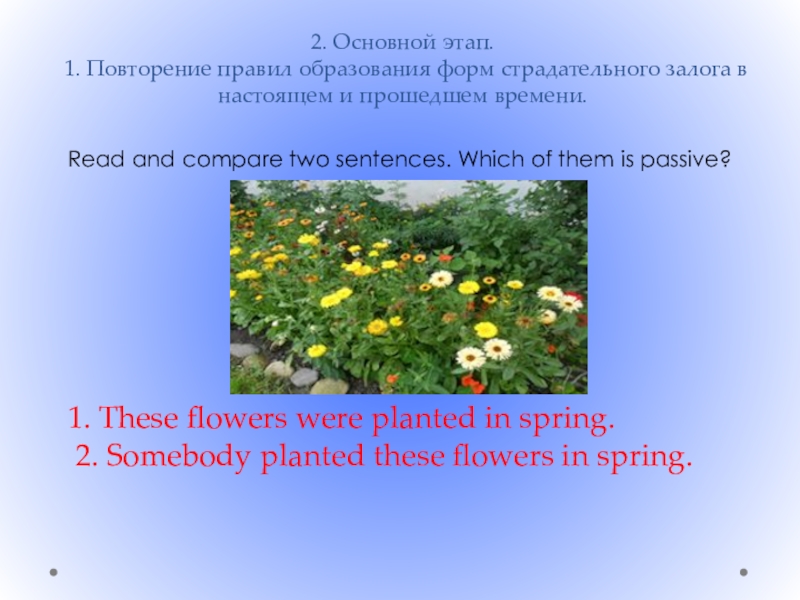
Слайд 42. Основной этап. 1. Повторение правил образования форм страдательного залога в
настоящем и прошедшем времени.
Read and compare two sentences. Which of them is passive?
1. These flowers were planted in spring.
2. Somebody planted these flowers in spring.
Слайд 5 P: The first sentence is passive. T: That's right. We often
prefer the passive when it is not so important who or what did the action.
In this example, it is not so important who planted the flowers.
T: How do we form the passive?
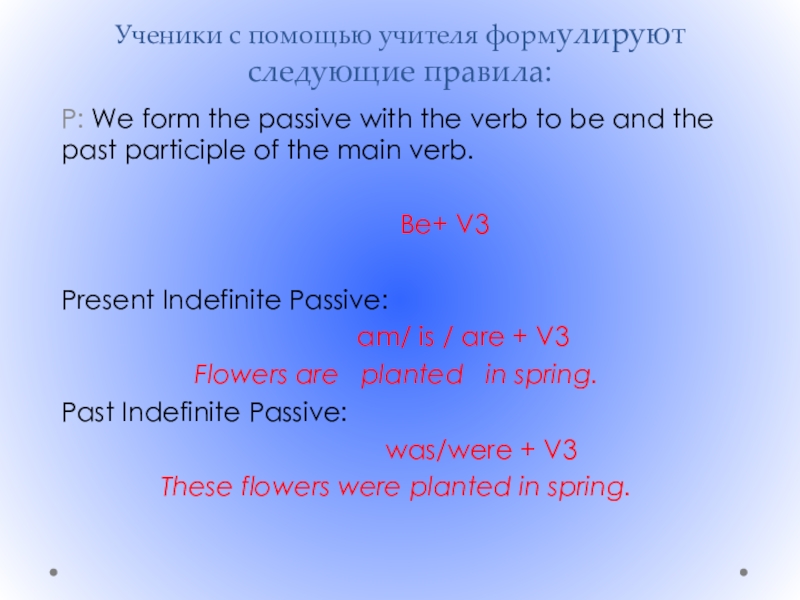
Слайд 6Ученики с помощью учителя формулируют следующие правила:
P: We form the passive
with the verb to be and the past participle of the main verb.
Be+ V3
Present Indefinite Passive:
am/ is / are + V3
Flowers are planted in spring.
Past Indefinite Passive:
was/were + V3
These flowers were planted in spring.
Be+ V3
Present Indefinite Passive:
am/ is / are + V3
Flowers are planted in spring.
Past Indefinite Passive:
was/were + V3
These flowers were planted in spring.
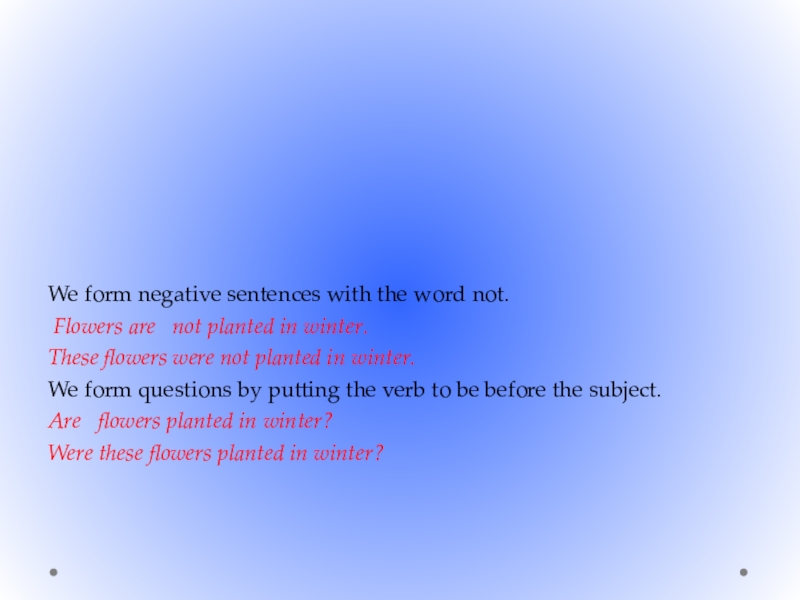
Слайд 7 We form negative sentences with the word not. Flowers are
not planted in winter.
These flowers were not planted in winter.
We form questions by putting the verb to be before the subject.
Are flowers planted in winter?
Were these flowers planted in winter?
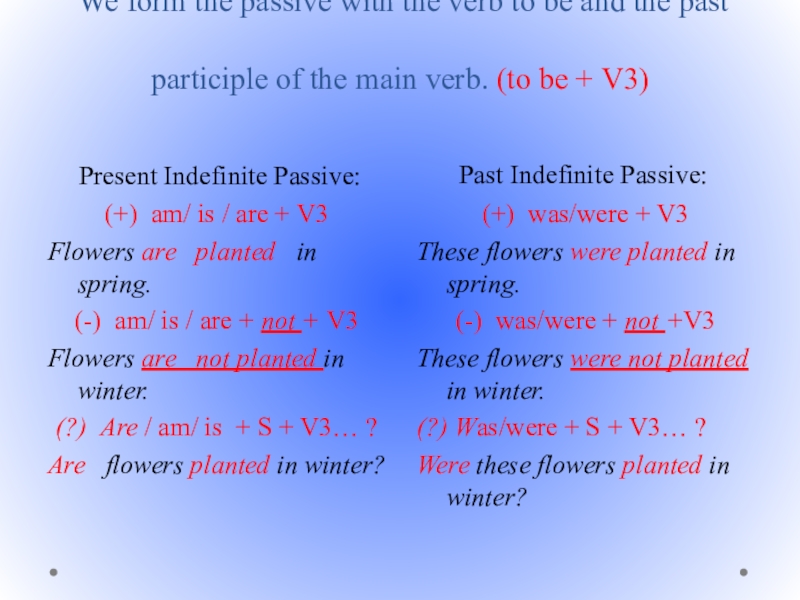
Слайд 8 We form the passive with the verb to be
and the past participle of the main verb. (to be + V3)
Present Indefinite Passive:
(+) am/ is / are + V3
Flowers are planted in spring.
(-) am/ is / are + not + V3
Flowers are not planted in winter.
(?) Are / am/ is + S + V3… ?
Are flowers planted in winter?
(+) was/were + V3
These flowers were planted in spring.
(-) was/were + not +V3
These flowers were not planted in winter.
(?) Was/were + S + V3… ?
Were these flowers planted in winter?
Past Indefinite Passive:
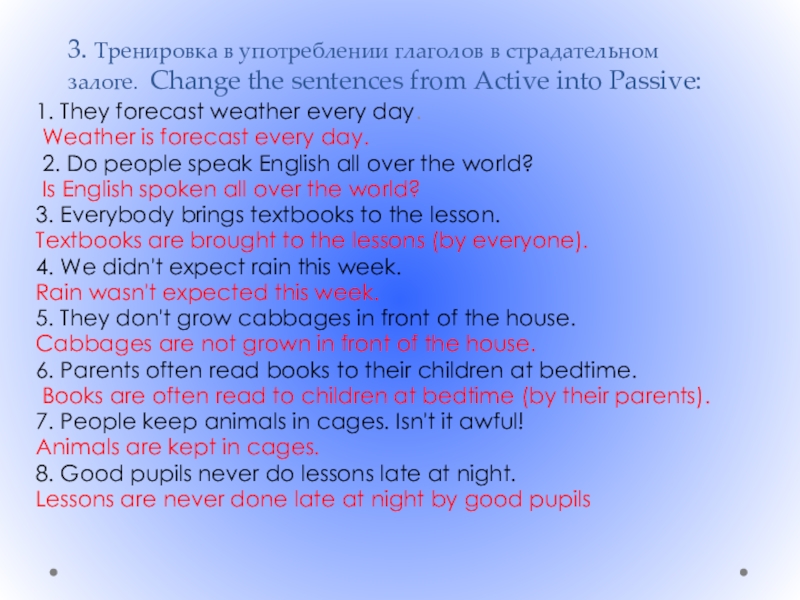
Слайд 93. Тренировка в употреблении глаголов в страдательном залоге. Сhange the sentences
from Active into Passive:
1. They forecast weather every day.
Weather is forecast every day.
2. Do people speak English all over the world?
Is English spoken all over the world?
3. Everybody brings textbooks to the lesson.
Textbooks are brought to the lessons (by everyone).
4. We didn't expect rain this week.
Rain wasn't expected this week.
5. They don't grow cabbages in front of the house.
Cabbages are not grown in front of the house.
6. Parents often read books to their children at bedtime.
Books are often read to children at bedtime (by their parents).
7. People keep animals in cages. Isn't it awful!
Animals are kept in cages.
8. Good pupils never do lessons late at night.
Lessons are never done late at night by good pupils
Слайд 10Do you know…
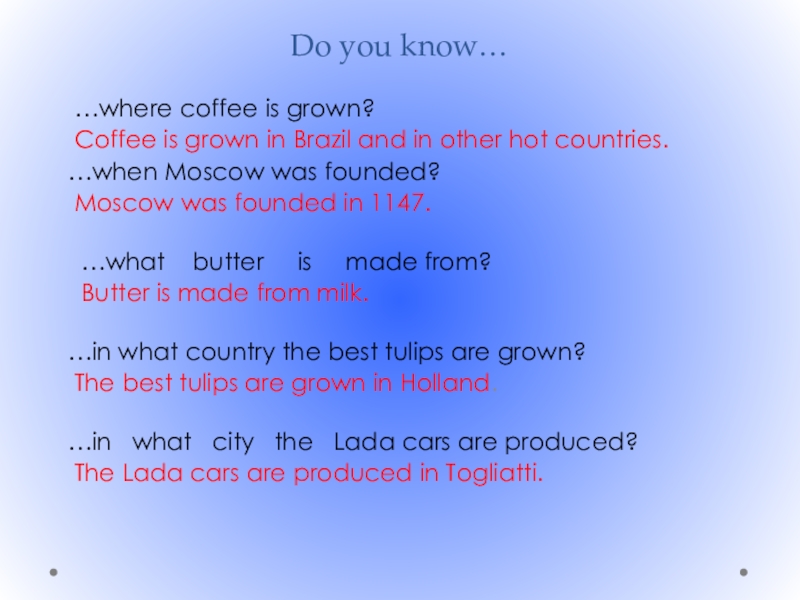
…where coffee is grown?
Coffee is grown
in Brazil and in other hot countries.
…when Moscow was founded?
Moscow was founded in 1147.
…what butter is made from?
Butter is made from milk.
…in what country the best tulips are grown?
The best tulips are grown in Holland.
…in what city the Lada cars are produced?
The Lada cars are produced in Togliatti.
…when Moscow was founded?
Moscow was founded in 1147.
…what butter is made from?
Butter is made from milk.
…in what country the best tulips are grown?
The best tulips are grown in Holland.
…in what city the Lada cars are produced?
The Lada cars are produced in Togliatti.
Слайд 11Do you know…
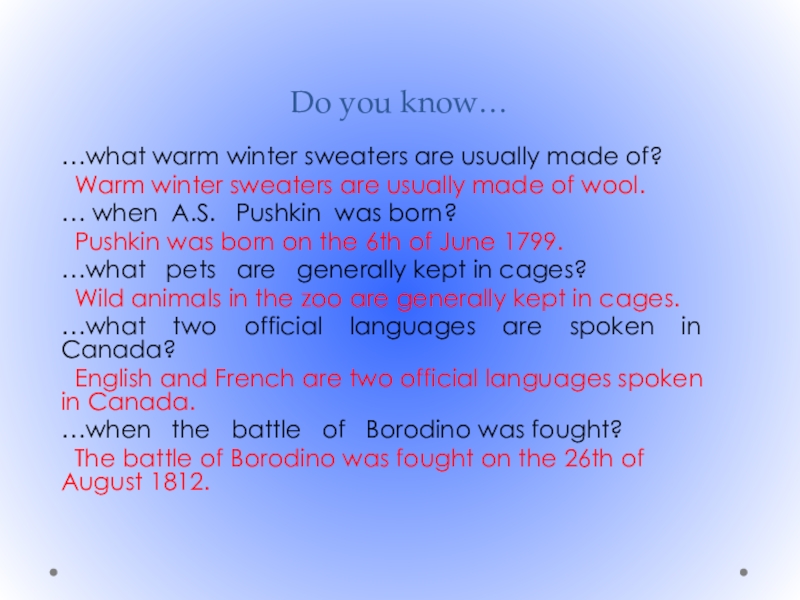
…what warm winter sweaters are usually made of?
Warm
winter sweaters are usually made of wool.
… when A.S. Pushkin was born?
Pushkin was born on the 6th of June 1799.
…what pets are generally kept in cages?
Wild animals in the zoo are generally kept in cages.
…what two official languages are spoken in Canada?
English and French are two official languages spoken in Canada.
…when the battle of Borodino was fought?
The battle of Borodino was fought on the 26th of August 1812.
… when A.S. Pushkin was born?
Pushkin was born on the 6th of June 1799.
…what pets are generally kept in cages?
Wild animals in the zoo are generally kept in cages.
…what two official languages are spoken in Canada?
English and French are two official languages spoken in Canada.
…when the battle of Borodino was fought?
The battle of Borodino was fought on the 26th of August 1812.
Слайд 124. Повторение лексики по теме «Hobbies».
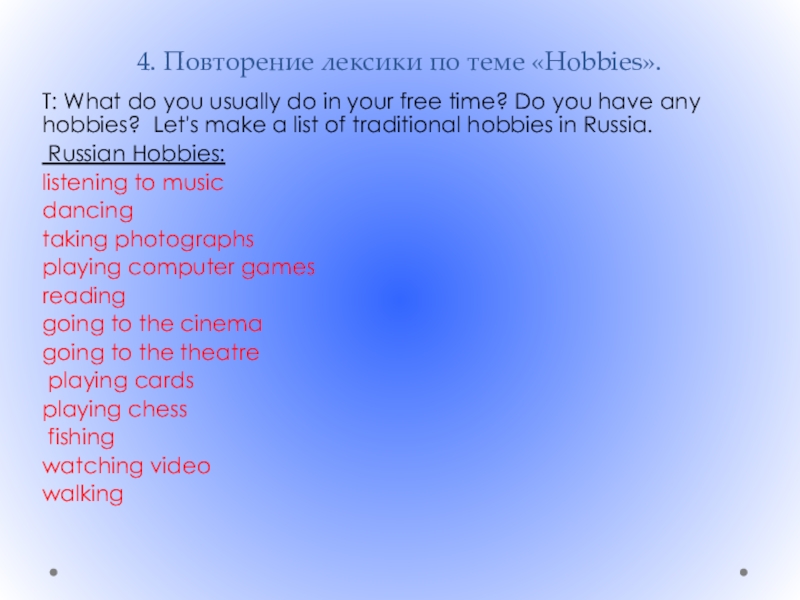
Т: What do you usually do
in your free time? Do you have any hobbies? Let's make a list of traditional hobbies in Russia.
Russian Hobbies:
listening to music
dancing
taking photographs
playing computer games
reading
going to the cinema
going to the theatre
playing cards
playing chess
fishing
watching video
walking
Russian Hobbies:
listening to music
dancing
taking photographs
playing computer games
reading
going to the cinema
going to the theatre
playing cards
playing chess
fishing
watching video
walking
Слайд 13 5. T: Now look at the list of traditional British hobbies.
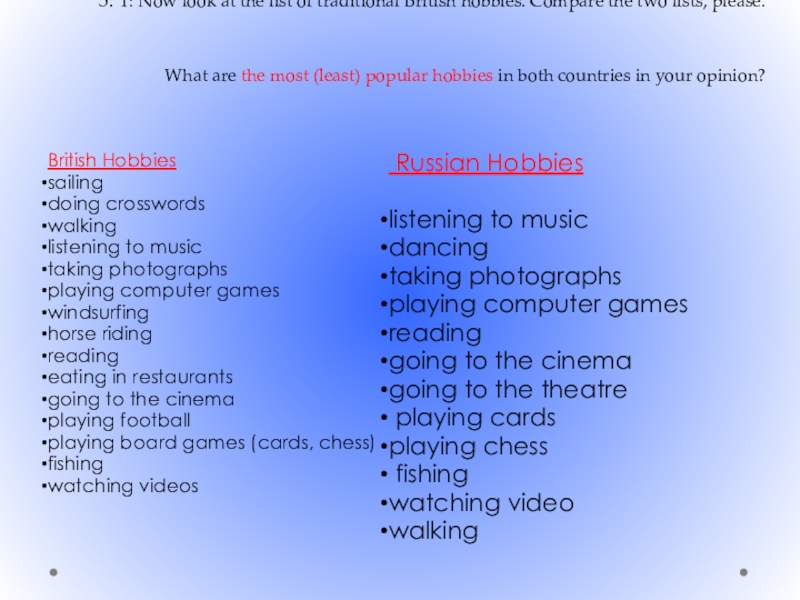
Compare the two lists, please. What are the most (least) popular hobbies in both countries in your opinion?
British Hobbies
sailing
doing crosswords
walking
listening to music
taking photographs
playing computer games
windsurfing
horse riding
reading
eating in restaurants
going to the cinema
playing football
playing board games (cards, chess)
fishing
watching videos
Russian Hobbies
listening to music
dancing
taking photographs
playing computer games
reading
going to the cinema
going to the theatre
playing cards
playing chess
fishing
watching video
walking
Слайд 14 6. Work in pairs, please. Look at the list of hobbies
and discuss what you like or dislike doing.
First, read the example, please.
-I don’t like going to the cinema but I like reading very much.
- Oh, really? What do you read?
I read a lot of detective stories.
listening to music, dancing, taking photographs, playing computer games, reading, going to the cinema,
going to the theatre, playing cards, playing chess,
fishing, watching video, walking.
Слайд 157. Контроль навыков монологической речи
Let’s control your home task. I'd
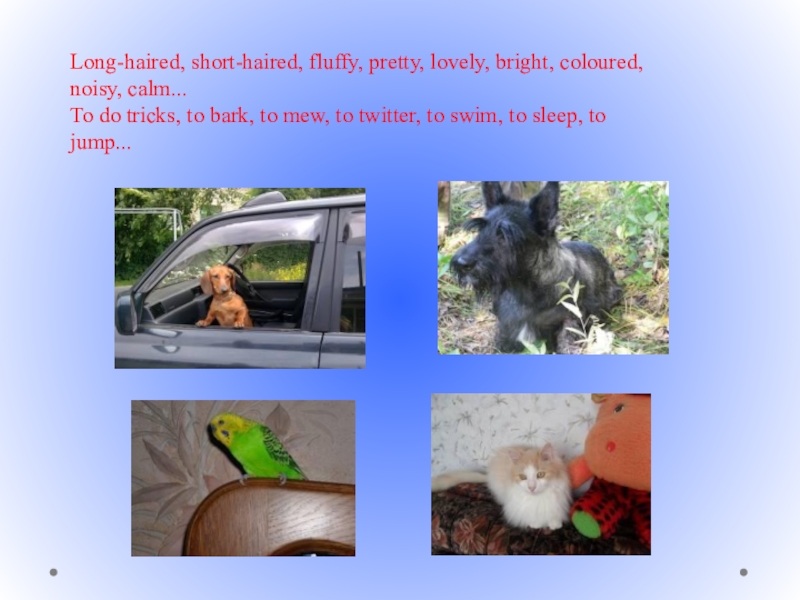
like you to describe your pets. I think you need some words for it. Look at the board and choose the words to describe dogs, cats, birds and fish.
Long-haired, short-haired, fluffy, pretty, lovely, bright, coloured, noisy, calm...
To do tricks, to bark, to mew, to twitter, to swim, to sleep, to jump...
Long-haired, short-haired, fluffy, pretty, lovely, bright, coloured, noisy, calm...
To do tricks, to bark, to mew, to twitter, to swim, to sleep, to jump...
Слайд 16Long-haired, short-haired, fluffy, pretty, lovely, bright, coloured, noisy, calm...
To do tricks,
to bark, to mew, to twitter, to swim, to sleep, to jump...
Слайд 178. Итоги урока:
Т: Well, I see you love your pets very much.
Your stories were very interesting.
Учитель подводит итоги урока и оценивает работу учеников.
Your home task is: L3 ex. 8, page 35; ex. 4, page 15 in the work-book. Change the sentences using passive structures.
Учитель подводит итоги урока и оценивает работу учеников.
Your home task is: L3 ex. 8, page 35; ex. 4, page 15 in the work-book. Change the sentences using passive structures.
Слайд 18Использованная литература:
1. Учебник «English» О. В. Афанасьева, И. В. Михеева
для 6 класса для школ с углубленным изучением английского языка.
О. В. Наговицына «Поурочные разработки по английскому языку» к УМК «English» О. В. Афанасьева, И. В. Михеева для 6 класса для школ с углубленным изучением английского языка.
Личные фотографии животных учащихся.
О. В. Наговицына «Поурочные разработки по английскому языку» к УМК «English» О. В. Афанасьева, И. В. Михеева для 6 класса для школ с углубленным изучением английского языка.
Личные фотографии животных учащихся.