- Главная
- Разное
- Образование
- Спорт
- Естествознание
- Природоведение
- Религиоведение
- Французский язык
- Черчение
- Английский язык
- Астрономия
- Алгебра
- Биология
- География
- Геометрия
- Детские презентации
- Информатика
- История
- Литература
- Математика
- Музыка
- МХК
- Немецкий язык
- ОБЖ
- Обществознание
- Окружающий мир
- Педагогика
- Русский язык
- Технология
- Физика
- Философия
- Химия
- Шаблоны, фоны, картинки для презентаций
- Экология
- Экономика
Презентация, доклад по английскому языку на тему Правила этикета в Англии (7 класс)
Содержание
- 1. Презентация по английскому языку на тему Правила этикета в Англии (7 класс)
- 2. GOAL:(1. To know the origin of etiquette.(2. Modern etiquette.(3. Summary
- 3. How etiquette has began.
- 4. In former times the tribe leaders gathered
- 5. The word "etiquette" came from the French
- 6. Modern etiquette
- 7. Modern standards of behavior went beyond a
- 8. Etiquette at the table
- 9. Etiquette at the table in England observed
- 10. The UK ladies and gentlemen often dine
- 11. . The relations between people
- 12. The British made respectable ladies. Men stand
- 13. The British are known as very polite
- 14. If you get on the bus or
- 15. How to greet and say goodbye to the British?
- 16. In England there are greetings depending on
- 17. ✓"Bye" is the most common English farewell.
- 18. Clothing
- 19. Students wear casual clothing during daytime schooling.
- 20. Оther
- 21. In the bathrooms of hotel rooms is
- 22. Summary (1.We learned, as was the etiquette.(2.We
- 23. Thank you for your attention)
GOAL:(1. To know the origin of etiquette.(2. Modern etiquette.(3. Summary
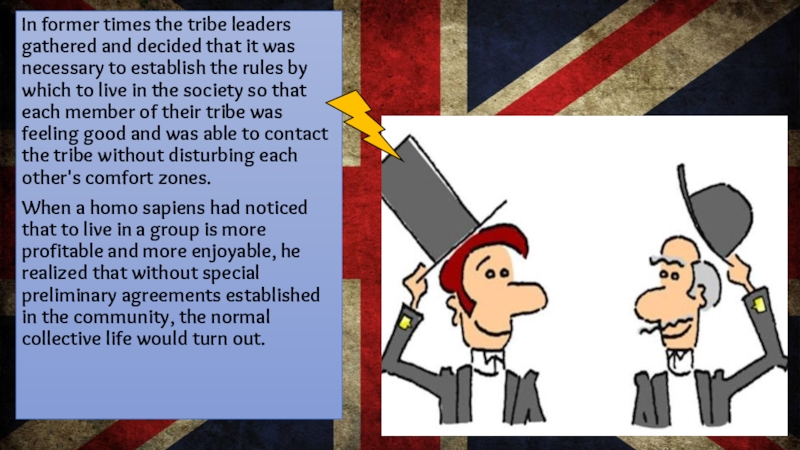
Слайд 4In former times the tribe leaders gathered and decided that it
was necessary to establish the rules by which to live in the society so that each member of their tribe was feeling good and was able to contact the tribe without disturbing each other's comfort zones.
When a homo sapiens had noticed that to live in a group is more profitable and more enjoyable, he realized that without special preliminary agreements established in the community, the normal collective life would turn out.
When a homo sapiens had noticed that to live in a group is more profitable and more enjoyable, he realized that without special preliminary agreements established in the community, the normal collective life would turn out.
Слайд 5The word "etiquette" came from the French language where it meant
a "label, note." That was the name of the card, which described how one should conduct at the court of the French King Louis XIV. They had been handed out to the guests of the king before they visited the monarch.
Слайд 7Modern standards of behavior went beyond a single protocol document. The
rules of etiquette differ greatly depending on the social, cultural, professional, and even situational environment. Thus, all rules of etiquette are composed of two factors of behavior:
(1. Moral and ethical behavior, that is a manifestation of public morality, the expression of premeditate care, protection and respect.
(2. Aesthetic, that means the grace and beauty of behavioral forms.
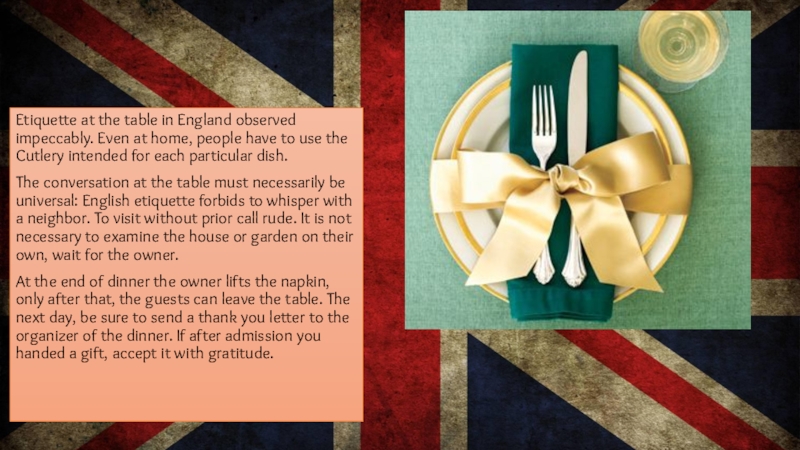
Слайд 9Etiquette at the table in England observed impeccably. Even at home,
people have to use the Cutlery intended for each particular dish.
The conversation at the table must necessarily be universal: English etiquette forbids to whisper with a neighbor. To visit without prior call rude. It is not necessary to examine the house or garden on their own, wait for the owner.
At the end of dinner the owner lifts the napkin, only after that, the guests can leave the table. The next day, be sure to send a thank you letter to the organizer of the dinner. If after admission you handed a gift, accept it with gratitude.
The conversation at the table must necessarily be universal: English etiquette forbids to whisper with a neighbor. To visit without prior call rude. It is not necessary to examine the house or garden on their own, wait for the owner.
At the end of dinner the owner lifts the napkin, only after that, the guests can leave the table. The next day, be sure to send a thank you letter to the organizer of the dinner. If after admission you handed a gift, accept it with gratitude.
Слайд 10The UK ladies and gentlemen often dine in different rooms. In the
UK there is an unwritten rule: the dinner in the restaurant the inviting pays. The British are very polite to waiters in restaurants. If you want the waiter went to your table, you have to raise your hand, but not snapping your fingers. If you want to interrupt the meal, but not finished eating, place the knife and fork on the sides of their plates. A good server will never remove anything from the table until, until it's all finished. In England it is considered very bad manners to put your elbows on the table and talking with his mouth full. Impolite to sniff noses while eating, loud chewing is in England a sign of bad upbringing.
It is customary to leave 10% of the account value at the end of the meal, in that case, if the account is not written, included. Food in public places in England is considered acceptable to eat, drink and chew gum in the street or in public transport. You don't need, there are shops, banks, offices and post offices.
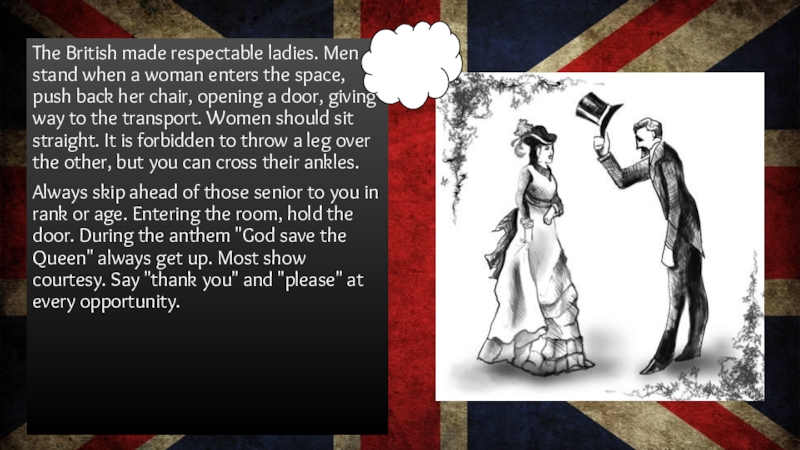
Слайд 12The British made respectable ladies. Men stand when a woman enters
the space, push back her chair, opening a door, giving way to the transport. Women should sit straight. It is forbidden to throw a leg over the other, but you can cross their ankles.
Always skip ahead of those senior to you in rank or age. Entering the room, hold the door. During the anthem "God save the Queen" always get up. Most show courtesy. Say "thank you" and "please" at every opportunity.
Always skip ahead of those senior to you in rank or age. Entering the room, hold the door. During the anthem "God save the Queen" always get up. Most show courtesy. Say "thank you" and "please" at every opportunity.
Слайд 13The British are known as very polite people. Always Wake up
in the tail of the queue and wait your turn: to buy a ticket, Bank, postal office, for boarding a bus or train. If you "prentice in turn," these people in England called "jumpers", although no you will not say anything, the sounds, expressing hostility, you are guaranteed. If there is some doubt about the existence of one or more queues to different booths, you should wait and stand for those who came before you. The British did not try to break first, they are very fair people. You will often hear: "Who's next?" The General rule is that you next, if you are the first, which appeared in the queue!
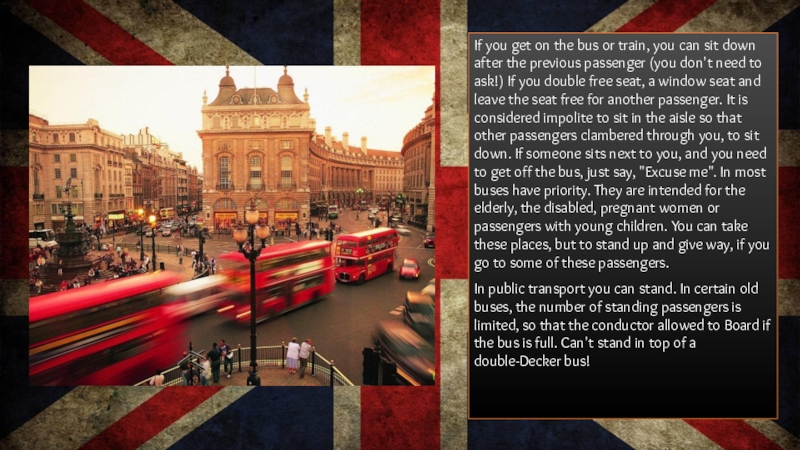
Слайд 14If you get on the bus or train, you can sit
down after the previous passenger (you don't need to ask!) If you double free seat, a window seat and leave the seat free for another passenger. It is considered impolite to sit in the aisle so that other passengers clambered through you, to sit down. If someone sits next to you, and you need to get off the bus, just say, "Excuse me". In most buses have priority. They are intended for the elderly, the disabled, pregnant women or passengers with young children. You can take these places, but to stand up and give way, if you go to some of these passengers.
In public transport you can stand. In certain old buses, the number of standing passengers is limited, so that the conductor allowed to Board if the bus is full. Can't stand in top of a double-Decker bus!
In public transport you can stand. In certain old buses, the number of standing passengers is limited, so that the conductor allowed to Board if the bus is full. Can't stand in top of a double-Decker bus!
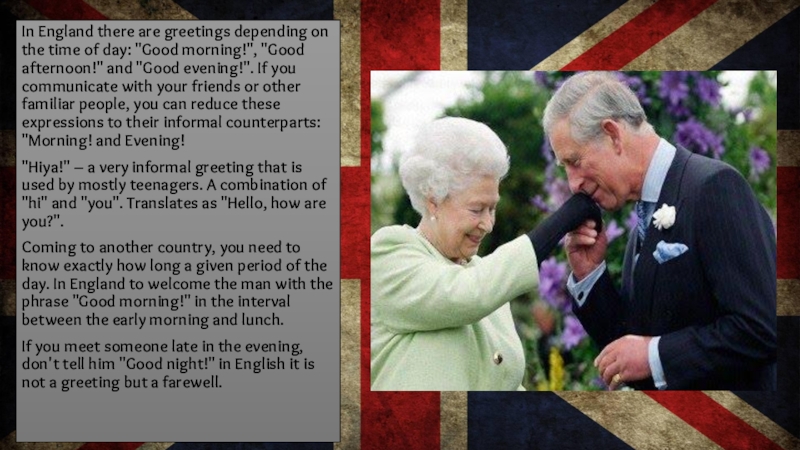
Слайд 16In England there are greetings depending on the time of day:
"Good morning!", "Good afternoon!" and "Good evening!". If you communicate with your friends or other familiar people, you can reduce these expressions to their informal counterparts: "Morning! and Evening!
"Hiya!" – a very informal greeting that is used by mostly teenagers. A combination of "hi" and "you". Translates as "Hello, how are you?".
Coming to another country, you need to know exactly how long a given period of the day. In England to welcome the man with the phrase "Good morning!" in the interval between the early morning and lunch.
If you meet someone late in the evening, don't tell him "Good night!" in English it is not a greeting but a farewell.
"Hiya!" – a very informal greeting that is used by mostly teenagers. A combination of "hi" and "you". Translates as "Hello, how are you?".
Coming to another country, you need to know exactly how long a given period of the day. In England to welcome the man with the phrase "Good morning!" in the interval between the early morning and lunch.
If you meet someone late in the evening, don't tell him "Good night!" in English it is not a greeting but a farewell.
Слайд 17✓"Bye" is the most common English farewell. It is universal and
applicable in almost any situation.
✓"Have a good day"(translated as "good day") – so you can say goodbye to business partners and colleagues, polite and courteous farewell.
✓"Keep in touch"– as is usually forgiven when I know that I will see them some time. Literally "stay in touch", that is, write, call, stand by.
✓"I'm out!" – farewell to the subtext that implies that you rejoice that you leave. In Russian language this phrase can be translated as "I'm outta here".
✓"Remember me to your wife"– this kind of farewell can be heard among the older generation. Translation: "Give my regards to your wife".

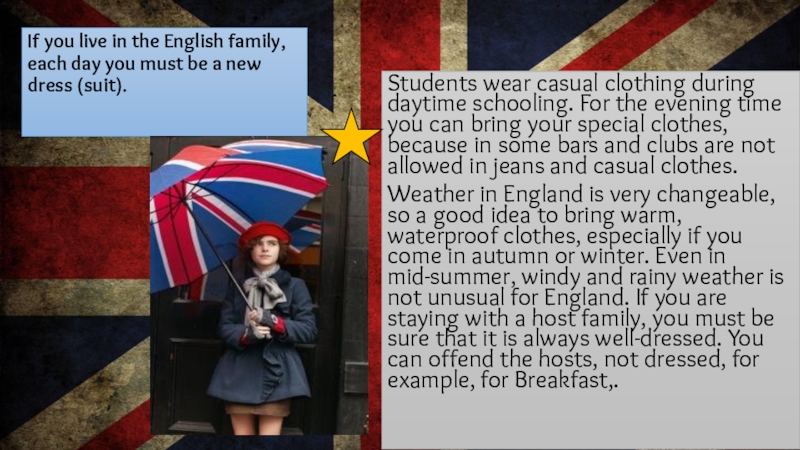
Слайд 19Students wear casual clothing during daytime schooling. For the evening time
you can bring your special clothes, because in some bars and clubs are not allowed in jeans and casual clothes.
Weather in England is very changeable, so a good idea to bring warm, waterproof clothes, especially if you come in autumn or winter. Even in mid-summer, windy and rainy weather is not unusual for England. If you are staying with a host family, you must be sure that it is always well-dressed. You can offend the hosts, not dressed, for example, for Breakfast,.
Weather in England is very changeable, so a good idea to bring warm, waterproof clothes, especially if you come in autumn or winter. Even in mid-summer, windy and rainy weather is not unusual for England. If you are staying with a host family, you must be sure that it is always well-dressed. You can offend the hosts, not dressed, for example, for Breakfast,.
If you live in the English family, each day you must be a new dress (suit).
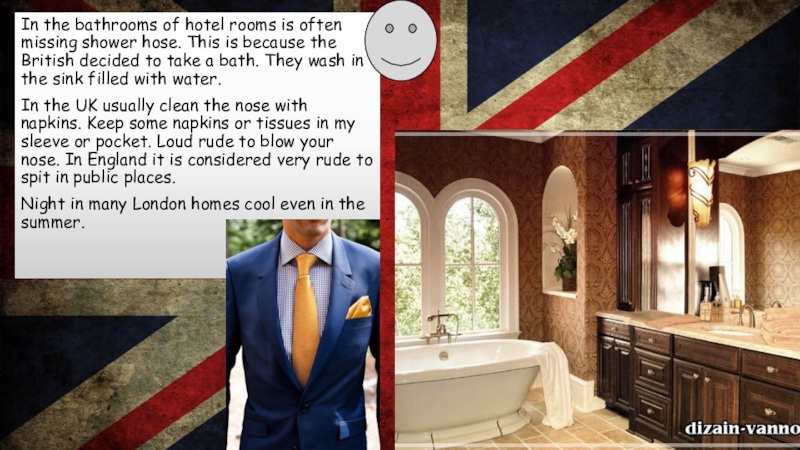
Слайд 21In the bathrooms of hotel rooms is often missing shower hose.
This is because the British decided to take a bath. They wash in the sink filled with water.
In the UK usually clean the nose with napkins. Keep some napkins or tissues in my sleeve or pocket. Loud rude to blow your nose. In England it is considered very rude to spit in public places.
Night in many London homes cool even in the summer.
In the UK usually clean the nose with napkins. Keep some napkins or tissues in my sleeve or pocket. Loud rude to blow your nose. In England it is considered very rude to spit in public places.
Night in many London homes cool even in the summer.
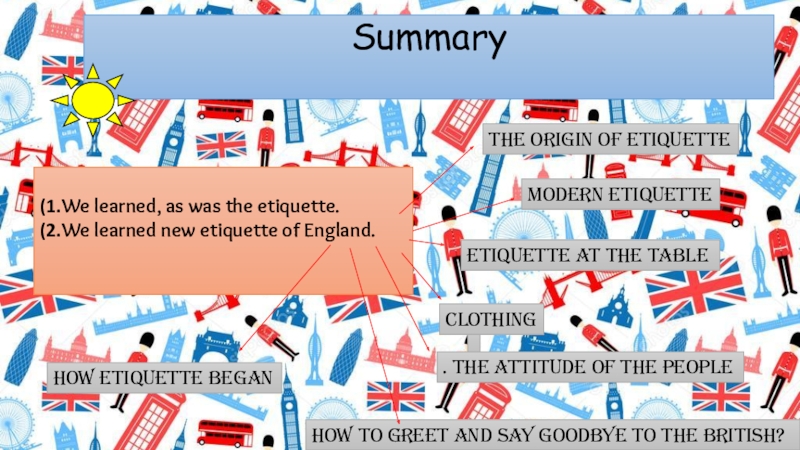
Слайд 22Summary
(1.We learned, as was the etiquette.
(2.We learned new etiquette of England.
The
origin of etiquette
Modern etiquette
Etiquette at the table
Clothing
. The attitude of the people
How to greet and say goodbye to the British?
How etiquette began