- Главная
- Разное
- Образование
- Спорт
- Естествознание
- Природоведение
- Религиоведение
- Французский язык
- Черчение
- Английский язык
- Астрономия
- Алгебра
- Биология
- География
- Геометрия
- Детские презентации
- Информатика
- История
- Литература
- Математика
- Музыка
- МХК
- Немецкий язык
- ОБЖ
- Обществознание
- Окружающий мир
- Педагогика
- Русский язык
- Технология
- Физика
- Философия
- Химия
- Шаблоны, фоны, картинки для презентаций
- Экология
- Экономика
Презентация, доклад по английскому языку на тему Соединенные Штаты Америки
Содержание
- 1. Презентация по английскому языку на тему Соединенные Штаты Америки
- 2. The United States of America is a federal
- 3. At 3.79 million square miles (9.83 million
- 4. The U.S. economyThe U.S. economy is the world's largest national
- 5. The United States was founded by thirteen British
- 6. Contemporary era Under President George H. W. BushUnder
- 7. On November 4, 2008, amid a
- 8. Science and technology The United States has
- 9. In the early 20th century, the automobile
- 10. The United States leads the world in
- 11. AppleFortune magazine named Apple the most admired company
- 12. ProductsOn January 27, 2010, Apple introduced their
- 13. On October 23, 2001, Apple introduced the iPod digital
- 14. At the Macworld Conference & ExpoAt the Macworld Conference
- 15. EducationThe United States has many competitive private
- 16. Crime and law enforcement Among developed nationsAmong developed nations,
- 17. Americans are the heaviest television viewers in
- 18. The rhythmic and lyrical styles of African American
- 19. SportsSince the late 19th century, baseballSince the late
- 20. While most major U.S. sports have evolved
- 21. Слайд 21
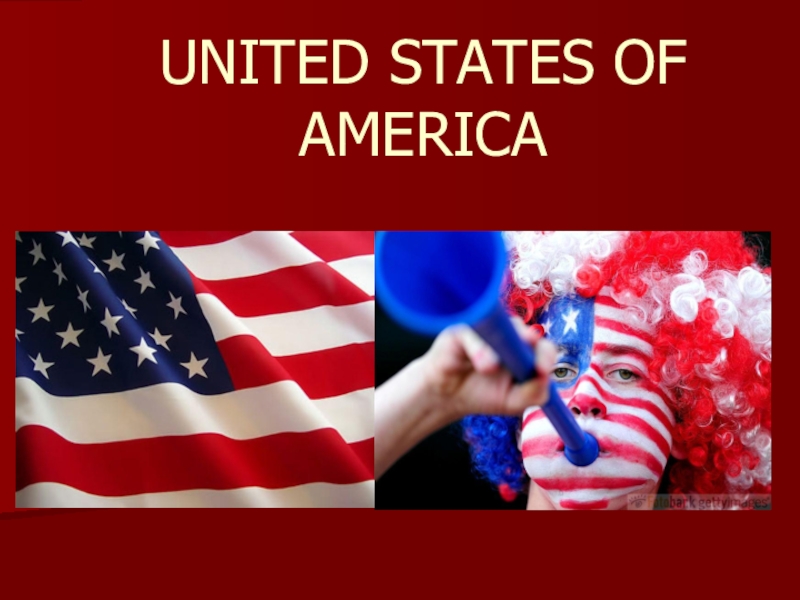
The United States of America is a federal The United States of America is a federal constitutional republic The United States of America is a federal constitutional republic comprising fifty states The United States of America is a federal constitutional republic comprising fifty states and a federal district The United States of
Слайд 2 The United States of America is a federal The United States of
America is a federal constitutional republic The United States of America is a federal constitutional republic comprising fifty states The United States of America is a federal constitutional republic comprising fifty states and a federal district The United States of America is a federal constitutional republic comprising fifty states and a federal district. The country is situated mostly in central North America The United States of America is a federal constitutional republic comprising fifty states and a federal district. The country is situated mostly in central North America, where its forty-eight contiguous states The United States of America is a federal constitutional republic comprising fifty states and a federal district. The country is situated mostly in central North America, where its forty-eight contiguous states and Washington, D.C. The United States of America is a federal constitutional republic comprising fifty states and a federal district. The country is situated mostly in central North America, where its forty-eight contiguous states and Washington, D.C., the capital district The United States of America is a federal constitutional republic comprising fifty states and a federal district. The country is situated mostly in central North America, where its forty-eight contiguous states and Washington, D.C., the capital district, lie between the Pacific The United States of America is a federal constitutional republic comprising fifty states and a federal district. The country is situated mostly in central North America, where its forty-eight contiguous states and Washington, D.C., the capital district, lie between the Pacific and Atlantic Oceans The United States of America is a federal constitutional republic comprising fifty states and a federal district. The country is situated mostly in central North America, where its forty-eight contiguous states and Washington, D.C., the capital district, lie between the Pacific and Atlantic Oceans, bordered by Canada The United States of America is a federal constitutional republic comprising fifty states and a federal district. The country is situated mostly in central North America, where its forty-eight contiguous states and Washington, D.C., the capital district, lie between the Pacific and Atlantic Oceans, bordered by Canada to the north and Mexico to the south.

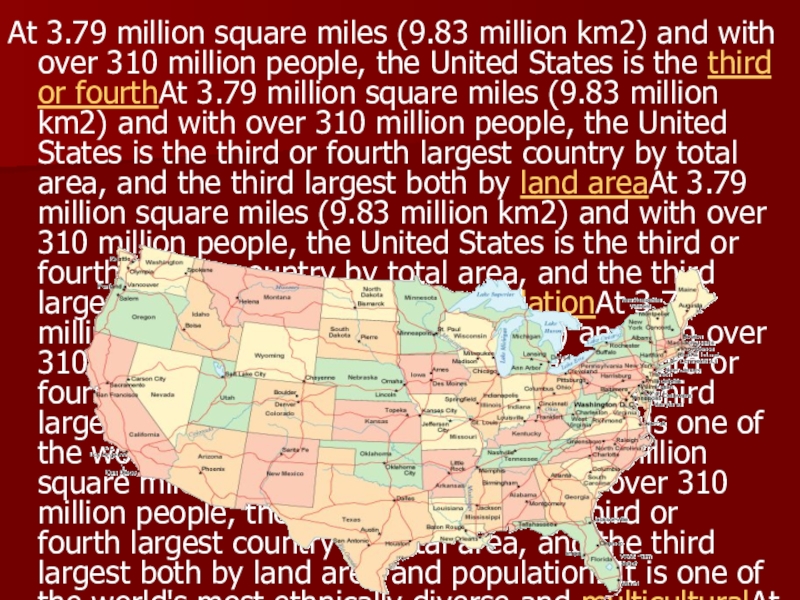
Слайд 3At 3.79 million square miles (9.83 million km2) and with over
310 million people, the United States is the third or fourthAt 3.79 million square miles (9.83 million km2) and with over 310 million people, the United States is the third or fourth largest country by total area, and the third largest both by land areaAt 3.79 million square miles (9.83 million km2) and with over 310 million people, the United States is the third or fourth largest country by total area, and the third largest both by land area and populationAt 3.79 million square miles (9.83 million km2) and with over 310 million people, the United States is the third or fourth largest country by total area, and the third largest both by land area and population. It is one of the world's most ethnically diverseAt 3.79 million square miles (9.83 million km2) and with over 310 million people, the United States is the third or fourth largest country by total area, and the third largest both by land area and population. It is one of the world's most ethnically diverse and multiculturalAt 3.79 million square miles (9.83 million km2) and with over 310 million people, the United States is the third or fourth largest country by total area, and the third largest both by land area and population. It is one of the world's most ethnically diverse and multicultural nations, the product of large-scale immigration from many countries.
Слайд 4The U.S. economyThe U.S. economy is the world's largest national economy, with an estimated
2009 GDPThe U.S. economy is the world's largest national economy, with an estimated 2009 GDP of $14.3 trillion (a quarter of nominal global GDPThe U.S. economy is the world's largest national economy, with an estimated 2009 GDP of $14.3 trillion (a quarter of nominal global GDP and a fifth of global GDP at purchasing power parity).

Слайд 5The United States was founded by thirteen British coloniesThe United States was
founded by thirteen British colonies located along the Atlantic seaboardThe United States was founded by thirteen British colonies located along the Atlantic seaboard. On July 4, 1776, they issued the Declaration of IndependenceThe United States was founded by thirteen British colonies located along the Atlantic seaboard. On July 4, 1776, they issued the Declaration of Independence, which proclaimed their right to self-determinationThe United States was founded by thirteen British colonies located along the Atlantic seaboard. On July 4, 1776, they issued the Declaration of Independence, which proclaimed their right to self-determination and their establishment of a cooperative union. The rebellious states defeated the British EmpireThe United States was founded by thirteen British colonies located along the Atlantic seaboard. On July 4, 1776, they issued the Declaration of Independence, which proclaimed their right to self-determination and their establishment of a cooperative union. The rebellious states defeated the British Empire in the American RevolutionThe United States was founded by thirteen British colonies located along the Atlantic seaboard. On July 4, 1776, they issued the Declaration of Independence, which proclaimed their right to self-determination and their establishment of a cooperative union. The rebellious states defeated the British Empire in the American Revolution, the first successful colonial war of independence

Слайд 6Contemporary era
Under President George H. W. BushUnder President George H. W. Bush, the
United States took a lead role in the UN–sanctioned Gulf WarUnder President George H. W. Bush, the United States took a lead role in the UN–sanctioned Gulf War. The longest economic expansion in modern U.S. history—from March 1991 to March 2001—encompassed the Bill ClintonUnder President George H. W. Bush, the United States took a lead role in the UN–sanctioned Gulf War. The longest economic expansion in modern U.S. history—from March 1991 to March 2001—encompassed the Bill Clinton administration and the dot-com bubbleUnder President George H. W. Bush, the United States took a lead role in the UN–sanctioned Gulf War. The longest economic expansion in modern U.S. history—from March 1991 to March 2001—encompassed the Bill Clinton administration and the dot-com bubble. A civil lawsuitUnder President George H. W. Bush, the United States took a lead role in the UN–sanctioned Gulf War. The longest economic expansion in modern U.S. history—from March 1991 to March 2001—encompassed the Bill Clinton administration and the dot-com bubble. A civil lawsuit and sex scandalUnder President George H. W. Bush, the United States took a lead role in the UN–sanctioned Gulf War. The longest economic expansion in modern U.S. history—from March 1991 to March 2001—encompassed the Bill Clinton administration and the dot-com bubble. A civil lawsuit and sex scandal led to Clinton's impeachmentUnder President George H. W. Bush, the United States took a lead role in the UN–sanctioned Gulf War. The longest economic expansion in modern U.S. history—from March 1991 to March 2001—encompassed the Bill Clinton administration and the dot-com bubble. A civil lawsuit and sex scandal led to Clinton's impeachment in 1998, but he remained in office. The 2000 presidential electionUnder President George H. W. Bush, the United States took a lead role in the UN–sanctioned Gulf War. The longest economic expansion in modern U.S. history—from March 1991 to March 2001—encompassed the Bill Clinton administration and the dot-com bubble. A civil lawsuit and sex scandal led to Clinton's impeachment in 1998, but he remained in office. The 2000 presidential election, one of the closest in American history, was resolved by a U.S. Supreme Court decisionUnder President George H. W. Bush, the United States took a lead role in the UN–sanctioned Gulf War. The longest economic expansion in modern U.S. history—from March 1991 to March 2001—encompassed the Bill Clinton administration and the dot-com bubble. A civil lawsuit and sex scandal led to Clinton's impeachment in 1998, but he remained in office. The 2000 presidential election, one of the closest in American history, was resolved by a U.S. Supreme Court decision—George W. Bush, son of George H. W. Bush, became president.

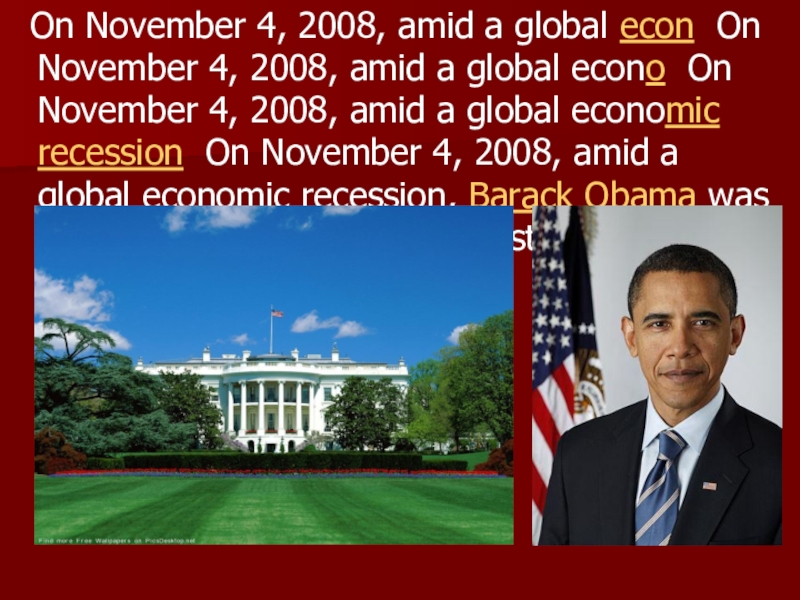
Слайд 7 On November 4, 2008, amid a global econ On November 4,
2008, amid a global econo On November 4, 2008, amid a global economic recession On November 4, 2008, amid a global economic recession, Barack Obama was elected president. He is the first African American to hold the office.
Слайд 8Science and technology
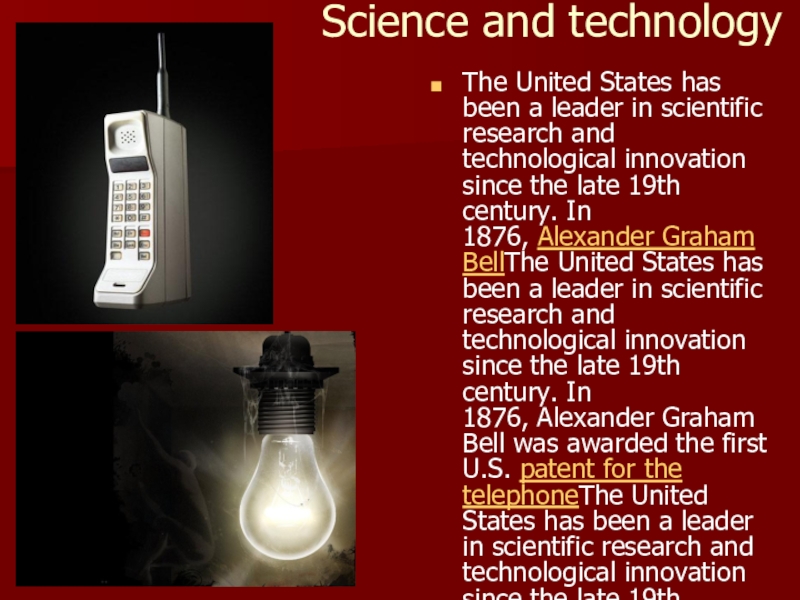
The United States has been a leader in scientific
research and technological innovation since the late 19th century. In 1876, Alexander Graham BellThe United States has been a leader in scientific research and technological innovation since the late 19th century. In 1876, Alexander Graham Bell was awarded the first U.S. patent for the telephoneThe United States has been a leader in scientific research and technological innovation since the late 19th century. In 1876, Alexander Graham Bell was awarded the first U.S. patent for the telephone. Thomas EdisonThe United States has been a leader in scientific research and technological innovation since the late 19th century. In 1876, Alexander Graham Bell was awarded the first U.S. patent for the telephone. Thomas Edison's laboratory developed the phonographThe United States has been a leader in scientific research and technological innovation since the late 19th century. In 1876, Alexander Graham Bell was awarded the first U.S. patent for the telephone. Thomas Edison's laboratory developed the phonograph, the first long-lasting light bulbThe United States has been a leader in scientific research and technological innovation since the late 19th century. In 1876, Alexander Graham Bell was awarded the first U.S. patent for the telephone. Thomas Edison's laboratory developed the phonograph, the first long-lasting light bulb, and the first viable movie cameraThe United States has been a leader in scientific research and technological innovation since the late 19th century. In 1876, Alexander Graham Bell was awarded the first U.S. patent for the telephone. Thomas Edison's laboratory developed the phonograph, the first long-lasting light bulb, and the first viable movie camera.Nikola TeslaThe United States has been a leader in scientific research and technological innovation since the late 19th century. In 1876, Alexander Graham Bell was awarded the first U.S. patent for the telephone. Thomas Edison's laboratory developed the phonograph, the first long-lasting light bulb, and the first viable movie camera.Nikola Tesla pioneered alternating currentThe United States has been a leader in scientific research and technological innovation since the late 19th century. In 1876, Alexander Graham Bell was awarded the first U.S. patent for the telephone. Thomas Edison's laboratory developed the phonograph, the first long-lasting light bulb, and the first viable movie camera.Nikola Tesla pioneered alternating current, the AC motorThe United States has been a leader in scientific research and technological innovation since the late 19th century. In 1876, Alexander Graham Bell was awarded the first U.S. patent for the telephone. Thomas Edison's laboratory developed the phonograph, the first long-lasting light bulb, and the first viable movie camera.Nikola Tesla pioneered alternating current, the AC motor, and radio.
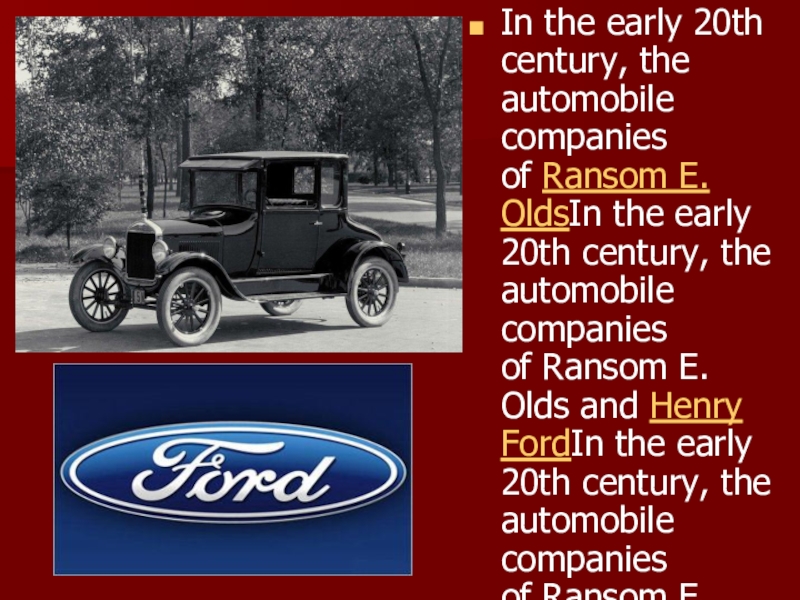
Слайд 9In the early 20th century, the automobile companies of Ransom E. OldsIn
the early 20th century, the automobile companies of Ransom E. Olds and Henry FordIn the early 20th century, the automobile companies of Ransom E. Olds and Henry Ford promoted the assembly lineIn the early 20th century, the automobile companies of Ransom E. Olds and Henry Ford promoted the assembly line. The Wright brothers, in 1903, made the first sustained and controlled heavier-than-air powered flight.
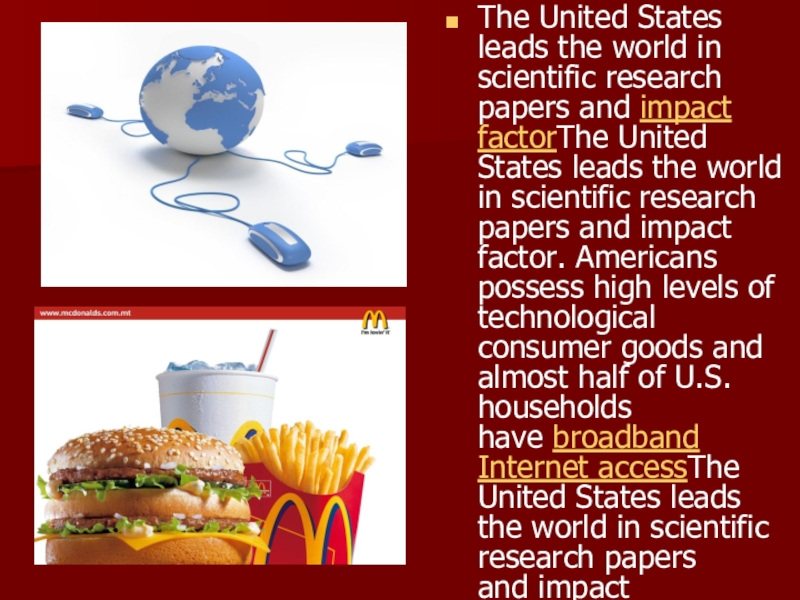
Слайд 10The United States leads the world in scientific research papers and impact
factorThe United States leads the world in scientific research papers and impact factor. Americans possess high levels of technological consumer goods and almost half of U.S. households have broadband Internet accessThe United States leads the world in scientific research papers and impact factor. Americans possess high levels of technological consumer goods and almost half of U.S. households have broadband Internet access. The country is the primary developer and grower of genetically modified food, representing half of the world's biotech crops.
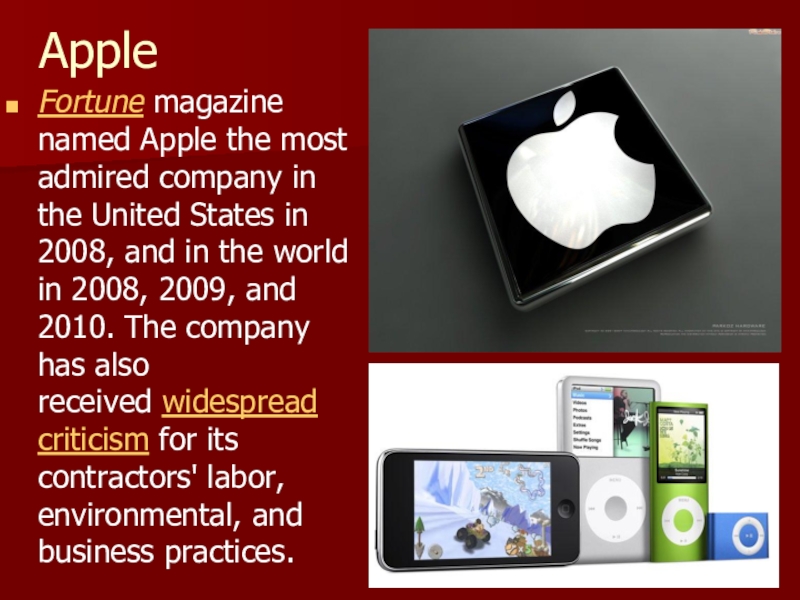
Слайд 11Apple
Fortune magazine named Apple the most admired company in the United States
in 2008, and in the world in 2008, 2009, and 2010. The company has also received widespread criticism for its contractors' labor, environmental, and business practices.
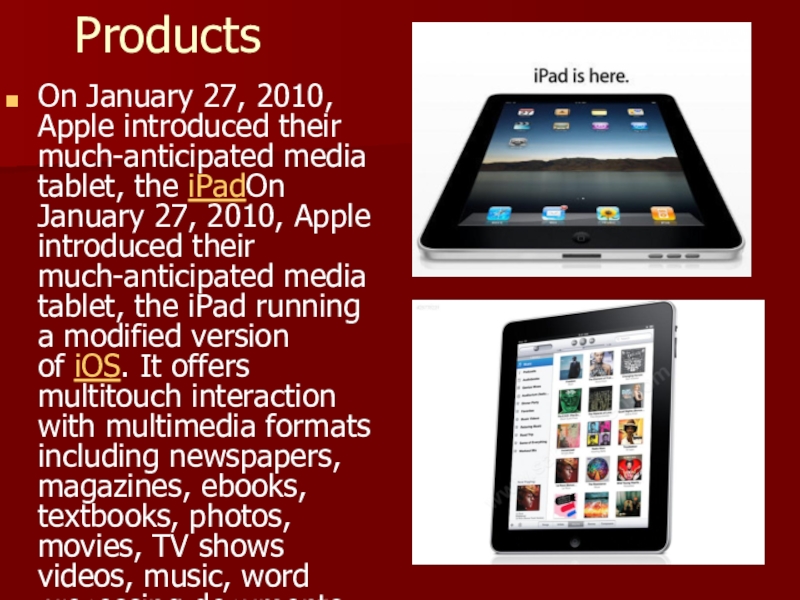
Слайд 12Products
On January 27, 2010, Apple introduced their much-anticipated media tablet, the iPadOn
January 27, 2010, Apple introduced their much-anticipated media tablet, the iPad running a modified version of iOS. It offers multitouch interaction with multimedia formats including newspapers, magazines, ebooks, textbooks, photos, movies, TV shows videos, music, word processing documents, spreadsheets, video games, and most existing iPhone apps
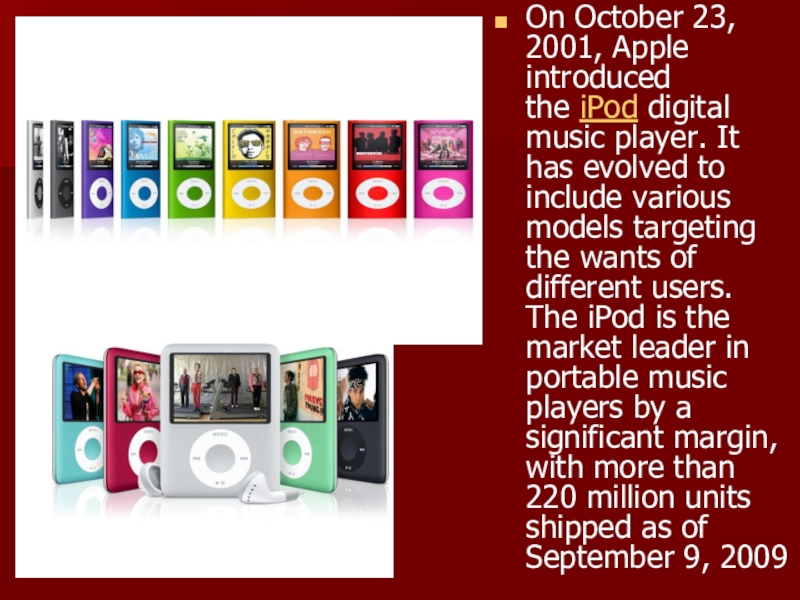
Слайд 13On October 23, 2001, Apple introduced the iPod digital music player. It has
evolved to include various models targeting the wants of different users. The iPod is the market leader in portable music players by a significant margin, with more than 220 million units shipped as of September 9, 2009
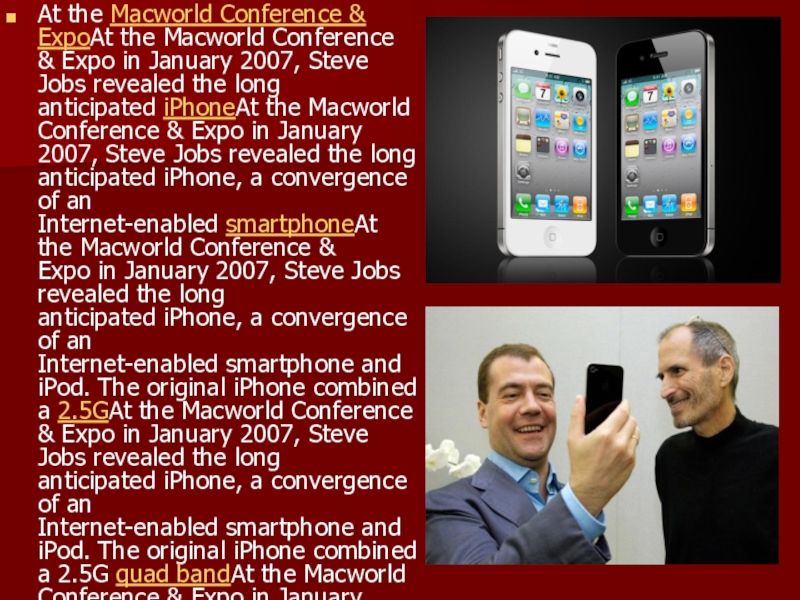
Слайд 14At the Macworld Conference & ExpoAt the Macworld Conference & Expo in January 2007,
Steve Jobs revealed the long anticipated iPhoneAt the Macworld Conference & Expo in January 2007, Steve Jobs revealed the long anticipated iPhone, a convergence of an Internet-enabled smartphoneAt the Macworld Conference & Expo in January 2007, Steve Jobs revealed the long anticipated iPhone, a convergence of an Internet-enabled smartphone and iPod. The original iPhone combined a 2.5GAt the Macworld Conference & Expo in January 2007, Steve Jobs revealed the long anticipated iPhone, a convergence of an Internet-enabled smartphone and iPod. The original iPhone combined a 2.5G quad bandAt the Macworld Conference & Expo in January 2007, Steve Jobs revealed the long anticipated iPhone, a convergence of an Internet-enabled smartphone and iPod. The original iPhone combined a 2.5G quad band GSMAt the Macworld Conference & Expo in January 2007, Steve Jobs revealed the long anticipated iPhone, a convergence of an Internet-enabled smartphone and iPod. The original iPhone combined a 2.5G quad band GSM and EDGEAt the Macworld Conference & Expo in January 2007, Steve Jobs revealed the long anticipated iPhone, a convergence of an Internet-enabled smartphone and iPod. The original iPhone combined a 2.5G quad band GSM and EDGE cellular phone with features found in hand held devices, running scaled-down versions of Apple's Mac OS X (dubbed iOSAt the Macworld Conference & Expo in January 2007, Steve Jobs revealed the long anticipated iPhone, a convergence of an Internet-enabled smartphone and iPod. The original iPhone combined a 2.5G quad band GSM and EDGE cellular phone with features found in hand held devices, running scaled-down versions of Apple's Mac OS X (dubbed iOS, formerly iPhone OS), with various Mac OS X applications such as SafariAt the Macworld Conference & Expo in January 2007, Steve Jobs revealed the long anticipated iPhone, a convergence of an Internet-enabled smartphone and iPod. The original iPhone combined a 2.5G quad band GSM and EDGE cellular phone with features found in hand held devices, running scaled-down versions of Apple's Mac OS X (dubbed iOS, formerly iPhone OS), with various Mac OS X applications such as Safari and MailAt the Macworld Conference & Expo in January 2007, Steve Jobs revealed the long anticipated iPhone, a convergence of an Internet-enabled smartphone and iPod. The original iPhone combined a 2.5G quad band GSM and EDGE cellular phone with features found in hand held devices, running scaled-down versions of Apple's Mac OS X (dubbed iOS, formerly iPhone OS), with various Mac OS X applications such as Safari and Mail. It also includes web-based and Dashboardapps such as Google Maps and Weather and Weather. The iPhone features a 3.5-inch (89 mm) touch screen display, 4, 8, or 16 GB of memory, Bluetooth and Weather. The iPhone features a 3.5-inch (89 mm) touch screen display, 4, 8, or 16 GB of memory, Bluetooth, and Wi-Fi and Weather. The iPhone features a 3.5-inch (89 mm) touch screen display, 4, 8, or 16 GB of memory, Bluetooth, and Wi-Fi. The iPhone first became available on June 29, 2007 for $499 (4 GB) and $599 (8 GB) with an AT&T contract
Слайд 15Education
The United States has many competitive private and public institutions of higher
educationThe United States has many competitive private and public institutions of higher education, as well as local community collegesThe United States has many competitive private and public institutions of higher education, as well as local community colleges with open admission policies. Of Americans twenty-five and older, 84.6% graduated from high school, 52.6% attended some college, 27.2% earned a bachelor's degreeThe United States has many competitive private and public institutions of higher education, as well as local community colleges with open admission policies. Of Americans twenty-five and older, 84.6% graduated from high school, 52.6% attended some college, 27.2% earned a bachelor's degree, and 9.6% earned graduate degrees. The basic literacy rate is approximately 99%. The United Nations assigns the United States an Education Index of 0.97, tying it for 12th in the world.

Слайд 16Crime and law enforcement
Among developed nationsAmong developed nations, the United States has above-average
levels of violent crime and particularly high levels of gun violenceAmong developed nations, the United States has above-average levels of violent crime and particularly high levels of gun violence andhomicideAmong developed nations, the United States has above-average levels of violent crime and particularly high levels of gun violence andhomicide. In 2007, there were 5.6 murders per 100,000 persons, three times the rate in neighboring Canada. The U.S. homicide rate, which decreased by 42% between 1991 and 1999, has been roughly steady since. Gun ownership rightsAmong developed nations, the United States has above-average levels of violent crime and particularly high levels of gun violence andhomicide. In 2007, there were 5.6 murders per 100,000 persons, three times the rate in neighboring Canada. The U.S. homicide rate, which decreased by 42% between 1991 and 1999, has been roughly steady since. Gun ownership rights are the subject of contentious political debate.

Слайд 17Americans are the heaviest television viewers in the world, and the average
viewing time continues to rise, reaching five hours a day in 2006. The four major broadcast networks are all commercial entities. Americans listen to radio programming, also largely commercialized, on average just over two-and-a-half hours a day. Aside from web portalsAmericans are the heaviest television viewers in the world, and the average viewing time continues to rise, reaching five hours a day in 2006. The four major broadcast networks are all commercial entities. Americans listen to radio programming, also largely commercialized, on average just over two-and-a-half hours a day. Aside from web portals and search enginesAmericans are the heaviest television viewers in the world, and the average viewing time continues to rise, reaching five hours a day in 2006. The four major broadcast networks are all commercial entities. Americans listen to radio programming, also largely commercialized, on average just over two-and-a-half hours a day. Aside from web portals and search engines, the most popular websites are FacebookAmericans are the heaviest television viewers in the world, and the average viewing time continues to rise, reaching five hours a day in 2006. The four major broadcast networks are all commercial entities. Americans listen to radio programming, also largely commercialized, on average just over two-and-a-half hours a day. Aside from web portals and search engines, the most popular websites are Facebook, YouTubeAmericans are the heaviest television viewers in the world, and the average viewing time continues to rise, reaching five hours a day in 2006. The four major broadcast networks are all commercial entities. Americans listen to radio programming, also largely commercialized, on average just over two-and-a-half hours a day. Aside from web portals and search engines, the most popular websites are Facebook, YouTube, WikipediaAmericans are the heaviest television viewers in the world, and the average viewing time continues to rise, reaching five hours a day in 2006. The four major broadcast networks are all commercial entities. Americans listen to radio programming, also largely commercialized, on average just over two-and-a-half hours a day. Aside from web portals and search engines, the most popular websites are Facebook, YouTube, Wikipedia, BloggerAmericans are the heaviest television viewers in the world, and the average viewing time continues to rise, reaching five hours a day in 2006. The four major broadcast networks are all commercial entities. Americans listen to radio programming, also largely commercialized, on average just over two-and-a-half hours a day. Aside from web portals and search engines, the most popular websites are Facebook, YouTube, Wikipedia, Blogger, eBayAmericans are the heaviest television viewers in the world, and the average viewing time continues to rise, reaching five hours a day in 2006. The four major broadcast networks are all commercial entities. Americans listen to radio programming, also largely commercialized, on average just over two-and-a-half hours a day. Aside from web portals and search engines, the most popular websites are Facebook, YouTube, Wikipedia, Blogger, eBay, and Craigslist.
Popular media
Слайд 18The rhythmic and lyrical styles of African American musicThe rhythmic and lyrical
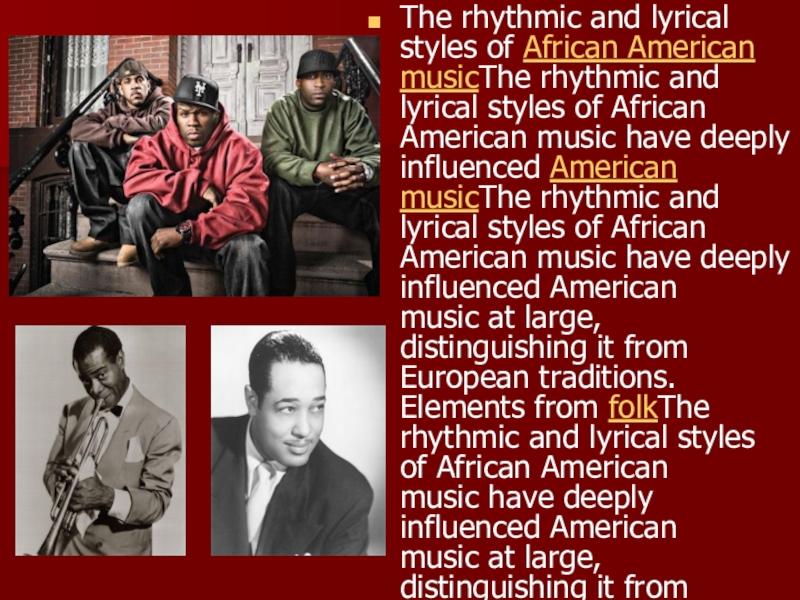
styles of African American music have deeply influenced American musicThe rhythmic and lyrical styles of African American music have deeply influenced American music at large, distinguishing it from European traditions. Elements from folkThe rhythmic and lyrical styles of African American music have deeply influenced American music at large, distinguishing it from European traditions. Elements from folk idioms such as the bluesThe rhythmic and lyrical styles of African American music have deeply influenced American music at large, distinguishing it from European traditions. Elements from folk idioms such as the blues and what is now known as old-time musicThe rhythmic and lyrical styles of African American music have deeply influenced American music at large, distinguishing it from European traditions. Elements from folk idioms such as the blues and what is now known as old-time music were adopted and transformed into popular genresThe rhythmic and lyrical styles of African American music have deeply influenced American music at large, distinguishing it from European traditions. Elements from folk idioms such as the blues and what is now known as old-time music were adopted and transformed into popular genres with global audiences. JazzThe rhythmic and lyrical styles of African American music have deeply influenced American music at large, distinguishing it from European traditions. Elements from folk idioms such as the blues and what is now known as old-time music were adopted and transformed into popular genres with global audiences. Jazz was developed by innovators such as Louis ArmstrongThe rhythmic and lyrical styles of African American music have deeply influenced American music at large, distinguishing it from European traditions. Elements from folk idioms such as the blues and what is now known as old-time music were adopted and transformed into popular genres with global audiences. Jazz was developed by innovators such as Louis Armstrong and Duke Ellington early in the 20th century.
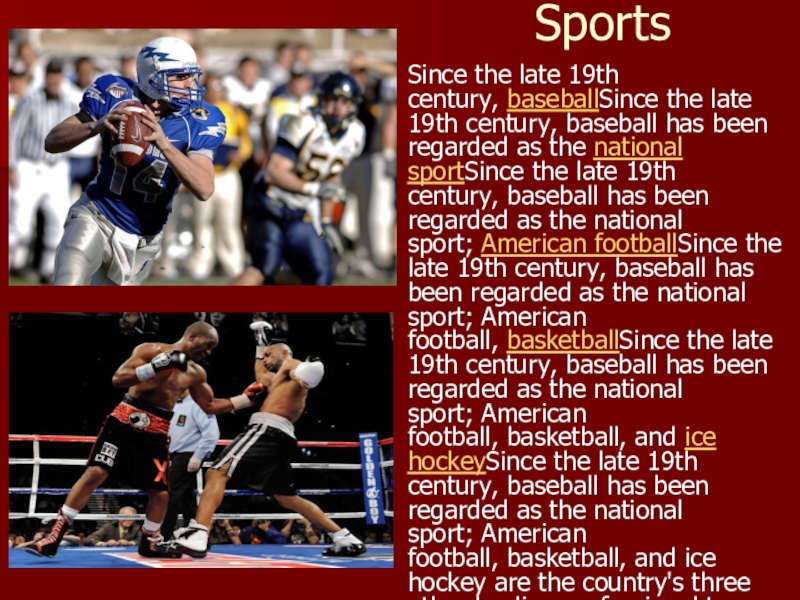
Слайд 19Sports
Since the late 19th century, baseballSince the late 19th century, baseball has been regarded
as the national sportSince the late 19th century, baseball has been regarded as the national sport; American footballSince the late 19th century, baseball has been regarded as the national sport; American football, basketballSince the late 19th century, baseball has been regarded as the national sport; American football, basketball, and ice hockeySince the late 19th century, baseball has been regarded as the national sport; American football, basketball, and ice hockey are the country's three other leading professional team sports. College footballSince the late 19th century, baseball has been regarded as the national sport; American football, basketball, and ice hockey are the country's three other leading professional team sports. College football and basketballSince the late 19th century, baseball has been regarded as the national sport; American football, basketball, and ice hockey are the country's three other leading professional team sports. College football and basketball attract large audiences. Football is now by several measures the most popular spectator sportSince the late 19th century, baseball has been regarded as the national sport; American football, basketball, and ice hockey are the country's three other leading professional team sports. College football and basketball attract large audiences. Football is now by several measures the most popular spectator sport. BoxingSince the late 19th century, baseball has been regarded as the national sport; American football, basketball, and ice hockey are the country's three other leading professional team sports. College football and basketball attract large audiences. Football is now by several measures the most popular spectator sport. Boxing and horse racingSince the late 19th century, baseball has been regarded as the national sport; American football, basketball, and ice hockey are the country's three other leading professional team sports. College football and basketball attract large audiences. Football is now by several measures the most popular spectator sport. Boxing and horse racing were once the most watched individual sports, but they have been eclipsed by golfSince the late 19th century, baseball has been regarded as the national sport; American football, basketball, and ice hockey are the country's three other leading professional team sports. College football and basketball attract large audiences. Football is now by several measures the most popular spectator sport. Boxing and horse racing were once the most watched individual sports, but they have been eclipsed by golf and auto racingSince the late 19th century, baseball has been regarded as the national sport; American football, basketball, and ice hockey are the country's three other leading professional team sports. College football and basketball attract large audiences. Football is now by several measures the most popular spectator sport. Boxing and horse racing were once the most watched individual sports, but they have been eclipsed by golf and auto racing, particularly NASCARSince the late 19th century, baseball has been regarded as the national sport; American football, basketball, and ice hockey are the country's three other leading professional team sports. College football and basketball attract large audiences. Football is now by several measures the most popular spectator sport. Boxing and horse racing were once the most watched individual sports, but they have been eclipsed by golf and auto racing, particularly NASCAR. SoccerSince the late 19th century, baseball has been regarded as the national sport; American football, basketball, and ice hockey are the country's three other leading professional team sports. College football and basketball attract large audiences. Football is now by several measures the most popular spectator sport. Boxing and horse racing were once the most watched individual sports, but they have been eclipsed by golf and auto racing, particularly NASCAR. Soccer is played widely at the youth and amateur levels. Tennis and many outdoor sports are popular as well.
Слайд 20While most major U.S. sports have evolved out of European practices,
basketball, volleyballWhile most major U.S. sports have evolved out of European practices, basketball, volleyball, skateboardingWhile most major U.S. sports have evolved out of European practices, basketball, volleyball, skateboarding, snowboardingWhile most major U.S. sports have evolved out of European practices, basketball, volleyball, skateboarding, snowboarding, and cheerleading are American inventions. Lacrosse and surfing and surfing arose from Native American and Native Hawaiian activities that predate Western contact. Eight Olympic Games and surfing arose from Native American and Native Hawaiian activities that predate Western contact. Eight Olympic Games have taken place in the United States. and surfing arose from Native American and Native Hawaiian activities that predate Western contact. Eight Olympic Games have taken place in the United States. The United States has won 2,301 medals at the Summer Olympic Games and surfing arose from Native American and Native Hawaiian activities that predate Western contact. Eight Olympic Games have taken place in the United States. The United States has won 2,301 medals at the Summer Olympic Games, more than any other country,[206] and surfing arose from Native American and Native Hawaiian activities that predate Western contact. Eight Olympic Games have taken place in the United States. The United States has won 2,301 medals at the Summer Olympic Games, more than any other country,[206] and 253 in the Winter Olympic Games, the second most.