- Главная
- Разное
- Образование
- Спорт
- Естествознание
- Природоведение
- Религиоведение
- Французский язык
- Черчение
- Английский язык
- Астрономия
- Алгебра
- Биология
- География
- Геометрия
- Детские презентации
- Информатика
- История
- Литература
- Математика
- Музыка
- МХК
- Немецкий язык
- ОБЖ
- Обществознание
- Окружающий мир
- Педагогика
- Русский язык
- Технология
- Физика
- Философия
- Химия
- Шаблоны, фоны, картинки для презентаций
- Экология
- Экономика
Презентация, доклад по английскому языку на тему Употребление инфинитива, герундия
Содержание
- 1. Презентация по английскому языку на тему Употребление инфинитива, герундия
- 2. V-ing1. As a noun in the function
- 3. 4. After: be busy, it’s no use,
- 4. V-ing7. After prepositions: on, after, of, for,
- 5. To Vto V is used to express
- 6. 4. After adjectives which describe feelings /
- 7. 7. After be + first, second, last,
- 8. 10. After certain nouns: e.g. It’s my
- 9. 13. Dare to V/dare V - сметь,
- 10. V1. After modal verbs (can/could, may/might, must,
- 11. Differences in meaning between to V and
- 12. To V and V-ingMean + to V
- 13. To V and V-ingTry + to V
- 14. To V and V-ingGo on + to
- 15. To V and V-ingBe sorry + to
- 16. To V and V-ingBe afraid + to
V-ing1. As a noun in the function of the subject e.g. Exercising is good for your health.2. After the verbs: admit, appreciate, avoid, consider, continue, deny, fancy, go skiing, imagine, mind, miss,
Слайд 2V-ing
1. As a noun in the function of the subject e.g.
Exercising is good for your health.
2. After the verbs:
admit, appreciate, avoid, consider, continue, deny, fancy, go skiing, imagine, mind, miss, practice, prevent, quit, save, suggest.
e.g. You should avoid eating junk food.
3. After:
love, like, enjoy, prefer, dislike, hate
to express general preference.
2. After the verbs:
admit, appreciate, avoid, consider, continue, deny, fancy, go skiing, imagine, mind, miss, practice, prevent, quit, save, suggest.
e.g. You should avoid eating junk food.
3. After:
love, like, enjoy, prefer, dislike, hate
to express general preference.
Слайд 34. After:
be busy, it’s no use, it’s no good, it’s
worth, what’s the use of, can’t help, there’s no point, can’t stand, have difficulty (in), have trouble
e.g. I have difficulty (in) understanding what he says.
5. After: spend, lose, waste (time, money)
e.g. He spends hours playing the guitar every day.
6. After: look forward to, be used to, in addition to, object to, prefer V-ing to V-ing
e.g. She prefers walking to driving to work.
e.g. I have difficulty (in) understanding what he says.
5. After: spend, lose, waste (time, money)
e.g. He spends hours playing the guitar every day.
6. After: look forward to, be used to, in addition to, object to, prefer V-ing to V-ing
e.g. She prefers walking to driving to work.
Слайд 4V-ing
7. After prepositions: on, after, of, for, from, to, etc. e.g.
He apologized for being late.
8. After the verbs: hear, listen to, notice, see, watch, feel to describe an incomplete action.
e.g. I saw Paul waiting for the bus.
8. After the verbs: hear, listen to, notice, see, watch, feel to describe an incomplete action.
e.g. I saw Paul waiting for the bus.
Слайд 5To V
to V is used to express purpose.
e.g. She went
to the supermarket to buy some sweets.
2. After: agree, appear, decide, expect, hope, plan, promise, refuse, want, offer
e.g. I expect him to be here.
3. After: would like, would prefer, would love to express specific preference.
e.g. I would love to come to your party.
2. After: agree, appear, decide, expect, hope, plan, promise, refuse, want, offer
e.g. I expect him to be here.
3. After: would like, would prefer, would love to express specific preference.
e.g. I would love to come to your party.
Слайд 64. After adjectives which describe feelings / emotions (happy, glad, sad),
express willingness/unwillingness (eager, reluctant, willing), refer to a person’s character and the adjectives (lucky, fortunate, clever, kind).
e.g. It was kind of you to lend me your laptop.
5. After: too, enough
e.g. She is old enough to watch the film.
6. With it+ be+ adj/noun
e.g. It was moving to see him again after so many years.
e.g. It was kind of you to lend me your laptop.
5. After: too, enough
e.g. She is old enough to watch the film.
6. With it+ be+ adj/noun
e.g. It was moving to see him again after so many years.
Слайд 77. After be + first, second, last, next.
e.g. She was the
first person to call me on my birthday.
8. After verbs, expressions: ask, decide, explain, find out, learn, want, want to know when they are followed by a question word.
e.g. She asked me when to get the tickets.
9. In the expressions to tell you the truth, to be honest, to sum up, to begin with etc.
e.g. To sum up the government needs to take measures to deal with unemployment more effectively.
8. After verbs, expressions: ask, decide, explain, find out, learn, want, want to know when they are followed by a question word.
e.g. She asked me when to get the tickets.
9. In the expressions to tell you the truth, to be honest, to sum up, to begin with etc.
e.g. To sum up the government needs to take measures to deal with unemployment more effectively.
Слайд 810. After certain nouns: e.g. It’s my honour to take part
in this festival.
11. With so + adj. + as: e.g. Would you be so kind as to help me with the door?
12. With “only” expressing an unsatisfactory result. E.g. She drove all the way to the mall only to find it closed.
13. In the expression for + noun/pronoun + to V
e.g. It was unusual for John to speak so rudely.
11. With so + adj. + as: e.g. Would you be so kind as to help me with the door?
12. With “only” expressing an unsatisfactory result. E.g. She drove all the way to the mall only to find it closed.
13. In the expression for + noun/pronoun + to V
e.g. It was unusual for John to speak so rudely.
Слайд 913. Dare to V/dare V - сметь, отваживаться
e.g. I don’t
dare to tell you the truth.
dare V – посметь
e.g. Don’t you dare talk with me like that.
Dare smb to V – вызывать, подзадоривать
e.g. I dare you to dive into the sea from the cliff.
dare V – посметь
e.g. Don’t you dare talk with me like that.
Dare smb to V – вызывать, подзадоривать
e.g. I dare you to dive into the sea from the cliff.
Слайд 10V
1. After modal verbs (can/could, may/might, must, shall/should, will/would)
e.g. Sally
can speak Portuguese fluently.
2. After the verbs: let, make, see, hear, feel
e.g. They let him travel on his own.
But: after be made, be heard, be seen -
to V
e.g. She was seen to steal goods from the greengrocer’s.
3. After had better, would rather
e.g. You had better put on a jacket.
2. After the verbs: let, make, see, hear, feel
e.g. They let him travel on his own.
But: after be made, be heard, be seen -
to V
e.g. She was seen to steal goods from the greengrocer’s.
3. After had better, would rather
e.g. You had better put on a jacket.
Слайд 11Differences in meaning between to V and V-ing
Forget + to V
– забыть, не помнить (что сделать). e.g. She forgot to buy milk.
Forget + V-ing - забывать о событии в прошлом. e.g. I’ll never forget visiting London for the first time.
Remember + to V – помнить, не забывать (что сделать). e.g .Did you remember to call Maria?
Remember + V-ing – помнить о событии в прошлом. e.g. I remember meeting her in Paris.
Forget + V-ing - забывать о событии в прошлом. e.g. I’ll never forget visiting London for the first time.
Remember + to V – помнить, не забывать (что сделать). e.g .Did you remember to call Maria?
Remember + V-ing – помнить о событии в прошлом. e.g. I remember meeting her in Paris.
Слайд 12To V and V-ing
Mean + to V – намереваться, собираться.
e.g. I
apologize. I didn’t mean to upset you.
Mean + V-ing – подразумевать, предполагать.
e.g. Being a good doctor means devoting your life to helping others.
Regret + to V – сожалеть о том, что приходится сообщать что-то неприятное. e.g. I regret to inform you that your application has been rejected.
Regret + V-ing – сожалеть о чем-либо, что уже произошло. e.g. I regret hurting your feelings.
Mean + V-ing – подразумевать, предполагать.
e.g. Being a good doctor means devoting your life to helping others.
Regret + to V – сожалеть о том, что приходится сообщать что-то неприятное. e.g. I regret to inform you that your application has been rejected.
Regret + V-ing – сожалеть о чем-либо, что уже произошло. e.g. I regret hurting your feelings.
Слайд 13To V and V-ing
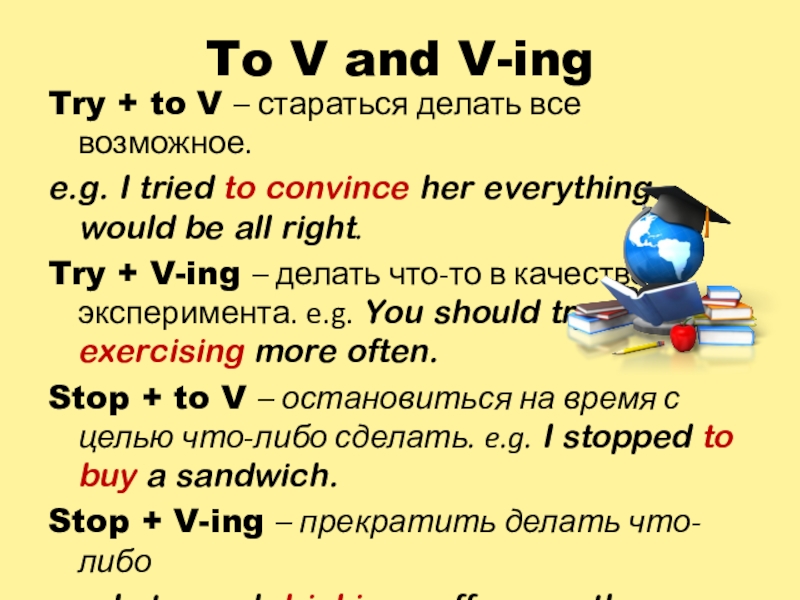
Try + to V – стараться делать все
возможное.
e.g. I tried to convince her everything would be all right.
Try + V-ing – делать что-то в качестве эксперимента. e.g. You should try exercising more often.
Stop + to V – остановиться на время с целью что-либо сделать. e.g. I stopped to buy a sandwich.
Stop + V-ing – прекратить делать что-либо
e.g. I stopped drinking coffee months ago.
e.g. I tried to convince her everything would be all right.
Try + V-ing – делать что-то в качестве эксперимента. e.g. You should try exercising more often.
Stop + to V – остановиться на время с целью что-либо сделать. e.g. I stopped to buy a sandwich.
Stop + V-ing – прекратить делать что-либо
e.g. I stopped drinking coffee months ago.
Слайд 14To V and V-ing
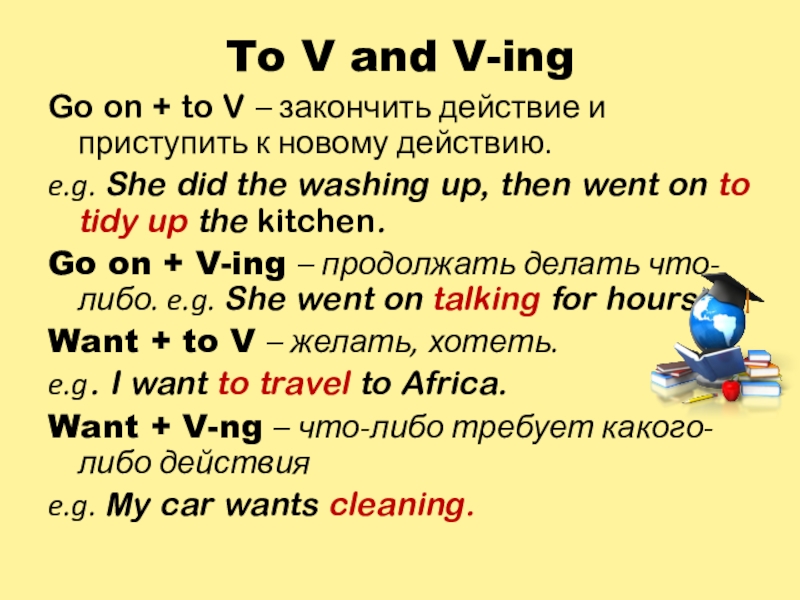
Go on + to V – закончить действие
и приступить к новому действию.
e.g. She did the washing up, then went on to tidy up the kitchen.
Go on + V-ing – продолжать делать что-либо. e.g. She went on talking for hours.
Want + to V – желать, хотеть.
e.g. I want to travel to Africa.
Want + V-ng – что-либо требует какого-либо действия
e.g. My car wants cleaning.
e.g. She did the washing up, then went on to tidy up the kitchen.
Go on + V-ing – продолжать делать что-либо. e.g. She went on talking for hours.
Want + to V – желать, хотеть.
e.g. I want to travel to Africa.
Want + V-ng – что-либо требует какого-либо действия
e.g. My car wants cleaning.
Слайд 15To V and V-ing
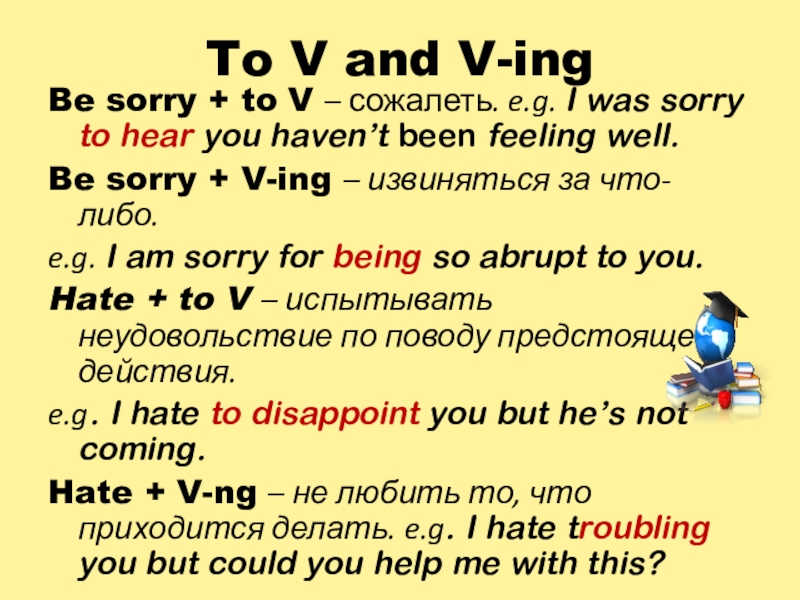
Be sorry + to V – сожалеть. e.g.
I was sorry to hear you haven’t been feeling well.
Be sorry + V-ing – извиняться за что-либо.
e.g. I am sorry for being so abrupt to you.
Hate + to V – испытывать неудовольствие по поводу предстоящего действия.
e.g. I hate to disappoint you but he’s not coming.
Hate + V-ng – не любить то, что приходится делать. e.g. I hate troubling you but could you help me with this?
Be sorry + V-ing – извиняться за что-либо.
e.g. I am sorry for being so abrupt to you.
Hate + to V – испытывать неудовольствие по поводу предстоящего действия.
e.g. I hate to disappoint you but he’s not coming.
Hate + V-ng – не любить то, что приходится делать. e.g. I hate troubling you but could you help me with this?
Слайд 16To V and V-ing
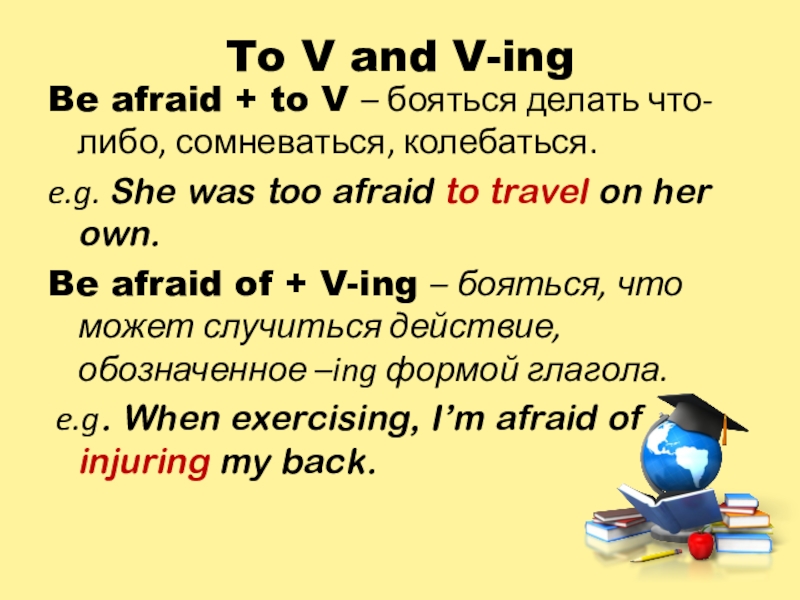
Be afraid + to V – бояться делать
что-либо, сомневаться, колебаться.
e.g. She was too afraid to travel on her own.
Be afraid of + V-ing – бояться, что может случиться действие, обозначенное –ing формой глагола.
e.g. When exercising, I’m afraid of injuring my back.
e.g. She was too afraid to travel on her own.
Be afraid of + V-ing – бояться, что может случиться действие, обозначенное –ing формой глагола.
e.g. When exercising, I’m afraid of injuring my back.