- Главная
- Разное
- Образование
- Спорт
- Естествознание
- Природоведение
- Религиоведение
- Французский язык
- Черчение
- Английский язык
- Астрономия
- Алгебра
- Биология
- География
- Геометрия
- Детские презентации
- Информатика
- История
- Литература
- Математика
- Музыка
- МХК
- Немецкий язык
- ОБЖ
- Обществознание
- Окружающий мир
- Педагогика
- Русский язык
- Технология
- Физика
- Философия
- Химия
- Шаблоны, фоны, картинки для презентаций
- Экология
- Экономика
Презентация, доклад по английскому языку на тему Сын тұрғысынан ойлау әдістері
Содержание
- 1. Презентация по английскому языку на тему Сын тұрғысынан ойлау әдістері
- 2. Defining Critical ThinkingAsking pertinent questionsEvaluates statements &
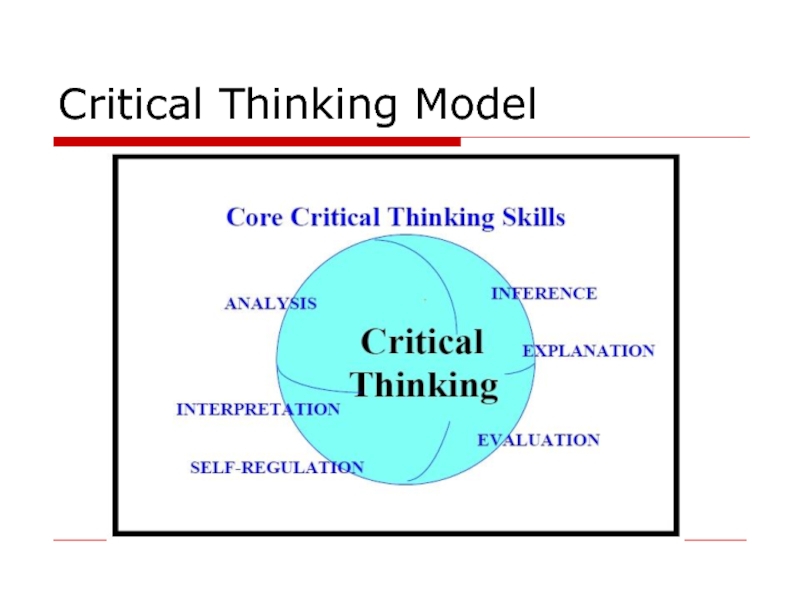
- 3. Critical Thinking Model
- 4. Defining Critical Thinking & Describing Critical Thinkers“Critical
- 5. Perspectives on Critical ThinkingCritical thinking is based
- 6. Why is Critical Thinking Important?To learn is
- 7. Why Critical Thinking is ImportantUnderlies reading, writing,
- 8. Questions & Critical ThinkingWhat do you mean
- 9. Enabling Learners to Become Quality Critical ThinkersCATS
- 10. Enabling Learners to Become Quality Critical ThinkersUse
- 11. Enabling Learners to Become Quality Critical ThinkersWriting
- 12. Enabling Learners to Become Quality Critical ThinkersDialogues/Debates:
- 13. Enabling Learners to Become Quality Critical ThinkersExperiments
- 14. Enabling Learners to Become Quality Critical ThinkersAmbiguity:
- 15. Enabling Learners to Become Quality Critical ThinkersIDEALS
- 16. What do you think can we use
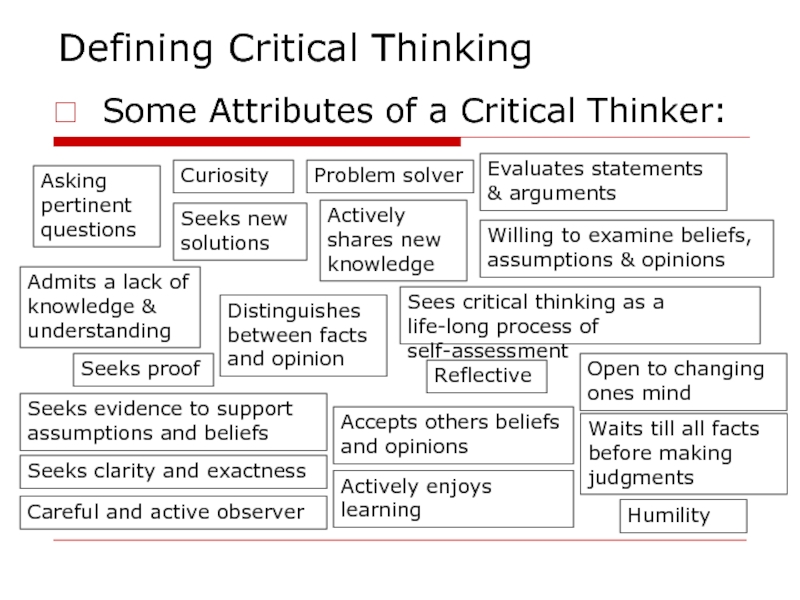
Defining Critical ThinkingAsking pertinent questionsEvaluates statements & argumentsAdmits a lack of knowledge & understandingCuriositySeeks new solutionsActively shares new knowledgeWilling to examine beliefs, assumptions & opinionsSome Attributes of a Critical Thinker:Distinguishes between facts and opinionSees critical thinking
Слайд 2Defining Critical Thinking
Asking pertinent questions
Evaluates statements & arguments
Admits a lack of
knowledge & understanding
Curiosity
Seeks new solutions
Actively shares new knowledge
Willing to examine beliefs, assumptions & opinions
Some Attributes of a Critical Thinker:
Distinguishes between facts and opinion
Sees critical thinking as a life-long process of self-assessment
Seeks evidence to support assumptions and beliefs
Open to changing ones mind
Reflective
Seeks proof
Seeks clarity and exactness
Accepts others beliefs and opinions
Waits till all facts before making judgments
Actively enjoys learning
Problem solver
Careful and active observer
Humility
Слайд 4Defining Critical Thinking & Describing Critical Thinkers
“Critical thinking is the disciplined
mental activity of evaluating arguments [information] or propositions and making judgments that can guide the development of beliefs and taking action.” Ennis (1992)
Critical thinking is both a frame of mind and a set of mental capabilities.
“Critical thinkers: distinguish between fact and opinion; ask questions; make detailed observations; uncover assumptions and define their terms; and make assertions based on sound logic and solid evidence. Ellis, D. Becoming a Master Student, 1997
Critical thinking is both a frame of mind and a set of mental capabilities.
“Critical thinkers: distinguish between fact and opinion; ask questions; make detailed observations; uncover assumptions and define their terms; and make assertions based on sound logic and solid evidence. Ellis, D. Becoming a Master Student, 1997
![Defining Critical Thinking & Describing Critical Thinkers“Critical thinking is the disciplined mental activity of evaluating arguments [information]](/img/tmb/2/153866/df039281bc46f49bae6f0c14a87dacbe-800x.jpg "Презентация по английскому языку на тему Сын тұрғысынан ойлау әдістері Defining Critical Thinking & Describing Critical Thinkers“Critical thinking is the disciplined")
Слайд 5Perspectives on Critical Thinking
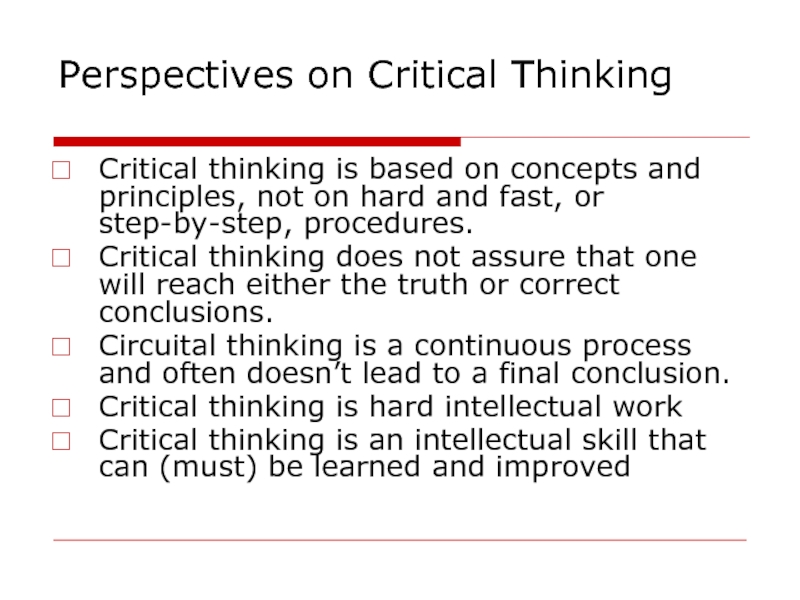
Critical thinking is based on concepts and principles,
not on hard and fast, or step-by-step, procedures.
Critical thinking does not assure that one will reach either the truth or correct conclusions.
Circuital thinking is a continuous process and often doesn’t lead to a final conclusion.
Critical thinking is hard intellectual work
Critical thinking is an intellectual skill that can (must) be learned and improved
Critical thinking does not assure that one will reach either the truth or correct conclusions.
Circuital thinking is a continuous process and often doesn’t lead to a final conclusion.
Critical thinking is hard intellectual work
Critical thinking is an intellectual skill that can (must) be learned and improved
Слайд 6Why is Critical Thinking Important?
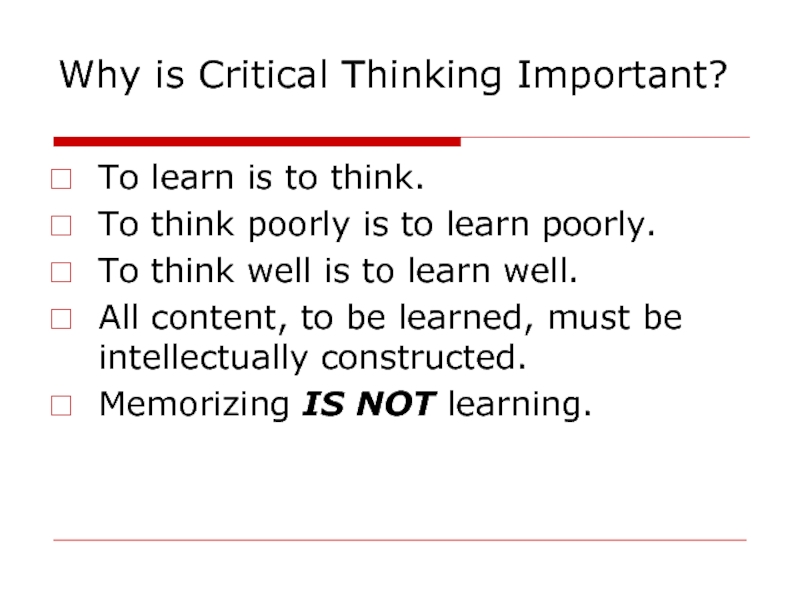
To learn is to think.
To think
poorly is to learn poorly.
To think well is to learn well.
All content, to be learned, must be intellectually constructed.
Memorizing IS NOT learning.
To think well is to learn well.
All content, to be learned, must be intellectually constructed.
Memorizing IS NOT learning.
Слайд 7Why Critical Thinking is Important
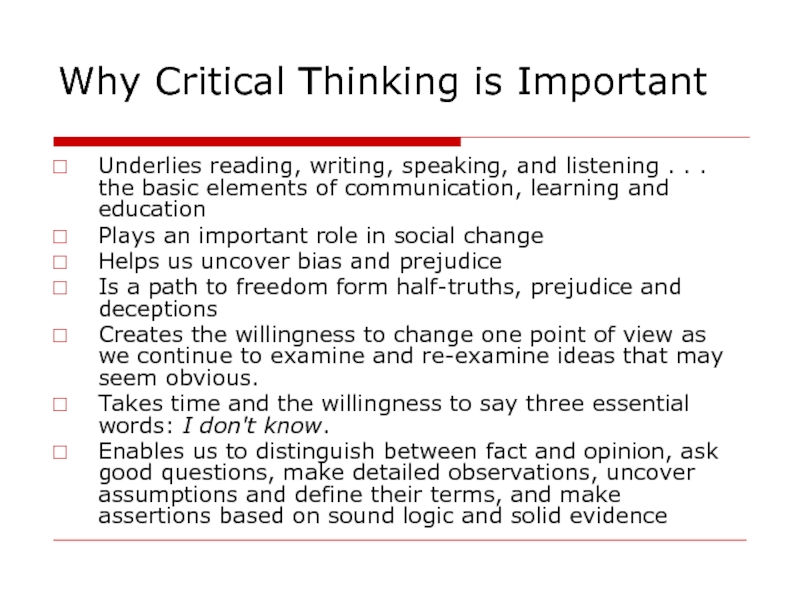
Underlies reading, writing, speaking, and listening .
. . the basic elements of communication, learning and education
Plays an important role in social change
Helps us uncover bias and prejudice
Is a path to freedom form half-truths, prejudice and deceptions
Creates the willingness to change one point of view as we continue to examine and re-examine ideas that may seem obvious.
Takes time and the willingness to say three essential words: I don't know.
Enables us to distinguish between fact and opinion, ask good questions, make detailed observations, uncover assumptions and define their terms, and make assertions based on sound logic and solid evidence
Plays an important role in social change
Helps us uncover bias and prejudice
Is a path to freedom form half-truths, prejudice and deceptions
Creates the willingness to change one point of view as we continue to examine and re-examine ideas that may seem obvious.
Takes time and the willingness to say three essential words: I don't know.
Enables us to distinguish between fact and opinion, ask good questions, make detailed observations, uncover assumptions and define their terms, and make assertions based on sound logic and solid evidence
Слайд 8Questions & Critical Thinking
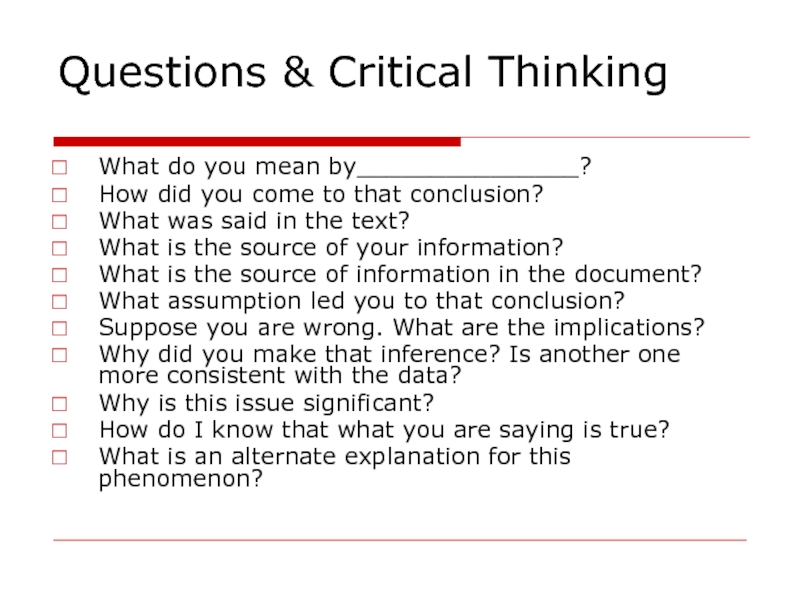
What do you mean by_______________?
How did you come
to that conclusion?
What was said in the text?
What is the source of your information?
What is the source of information in the document?
What assumption led you to that conclusion?
Suppose you are wrong. What are the implications?
Why did you make that inference? Is another one more consistent with the data?
Why is this issue significant?
How do I know that what you are saying is true?
What is an alternate explanation for this phenomenon?
What was said in the text?
What is the source of your information?
What is the source of information in the document?
What assumption led you to that conclusion?
Suppose you are wrong. What are the implications?
Why did you make that inference? Is another one more consistent with the data?
Why is this issue significant?
How do I know that what you are saying is true?
What is an alternate explanation for this phenomenon?
Слайд 9Enabling Learners to Become Quality Critical Thinkers
CATS (Classroom Assessment Techniques): use
of ongoing classroom assessment and reflection to monitor and facilitate students' critical thinking.
Ask students to write a "Minute Paper" responding to specific questions such as:
What was the most important thing you learned in today's class?
What one question related to this lesson remains uppermost in your mind?
How is what you learned today relevant to other classes or life outside of school?
Ask students to write a "Minute Paper" responding to specific questions such as:
What was the most important thing you learned in today's class?
What one question related to this lesson remains uppermost in your mind?
How is what you learned today relevant to other classes or life outside of school?
Слайд 10Enabling Learners to Become Quality Critical Thinkers
Use Questions: Learning to formulate
a series of quality questions is key to critical thinking and becoming a good critical thinker:
Reciprocal Peer Questioning: Following a lesson, present a list of question stems to guide students in writing responses in small groups. Then, the whole class discusses some of the questions from some or all of the small groups.
Reader's Questions: Require learners to write questions on assigned reading and turn them in at the beginning of class. Select a few of the questions as the impetus for class discussion.
Blue Sky Questions:
Extended Learning Questions:
Learners’ exam questions:
Blooms taxonomy questions:
Reciprocal Peer Questioning: Following a lesson, present a list of question stems to guide students in writing responses in small groups. Then, the whole class discusses some of the questions from some or all of the small groups.
Reader's Questions: Require learners to write questions on assigned reading and turn them in at the beginning of class. Select a few of the questions as the impetus for class discussion.
Blue Sky Questions:
Extended Learning Questions:
Learners’ exam questions:
Blooms taxonomy questions:
Слайд 11Enabling Learners to Become Quality Critical Thinkers
Writing Assignments: writing for others
demands that learners think clearly to communicate clearly.
can be based on questions
can be done in small groups or individually
can use different structures: compare & contrast, cause & effect, explanation, argument, persuasion, etc.
Letter to the editors (teams of learners become editors at different news papers and readers)
Lab / experimental reports
can be based on questions
can be done in small groups or individually
can use different structures: compare & contrast, cause & effect, explanation, argument, persuasion, etc.
Letter to the editors (teams of learners become editors at different news papers and readers)
Lab / experimental reports
Слайд 12Enabling Learners to Become Quality Critical Thinkers
Dialogues/Debates: stimulates useful discussions in
the classroom:
Written dialogues: Small groups of learners analyze written dialogues (plays, news paper articles, etc.) and identify different viewpoints in the dialogue, look for biases, presence or exclusion of important evidence, alternative interpretations, misstatement of facts, and errors in reasoning. Each group decides which view is the most reasonable and must defend this position. After coming to a conclusion, each group acts out their dialogue and explains their analysis of it.
Spontaneous Group Dialogue/Debate: Students in one group are assigned roles (often what they don’t believe in) to play in a discussion (such as leader, information giver, opinion seeker, and disagreer). Observer groups must determine what roles are being played by whom, identifying biases and errors in thinking, evaluating reasoning skills, and examining ethical implications of the content.
Written dialogues: Small groups of learners analyze written dialogues (plays, news paper articles, etc.) and identify different viewpoints in the dialogue, look for biases, presence or exclusion of important evidence, alternative interpretations, misstatement of facts, and errors in reasoning. Each group decides which view is the most reasonable and must defend this position. After coming to a conclusion, each group acts out their dialogue and explains their analysis of it.
Spontaneous Group Dialogue/Debate: Students in one group are assigned roles (often what they don’t believe in) to play in a discussion (such as leader, information giver, opinion seeker, and disagreer). Observer groups must determine what roles are being played by whom, identifying biases and errors in thinking, evaluating reasoning skills, and examining ethical implications of the content.
Слайд 13Enabling Learners to Become Quality Critical Thinkers
Experiments and Collecting Data (critical
thinking in science & math)
Discovering relationships in math and science – pie ∏; prime numbers; area and volume calculations; geometry; temperature and color; height, arm span and head size; genetics; flight and air pressure; etc.
Statistics and presenting information
Discovering relationships in math and science – pie ∏; prime numbers; area and volume calculations; geometry; temperature and color; height, arm span and head size; genetics; flight and air pressure; etc.
Statistics and presenting information
Слайд 14Enabling Learners to Become Quality Critical Thinkers
Ambiguity: Rather than provide all
the information as fact, produce as much ambiguity in the classroom as possible.
Don't give students clear cut material.
Give them conflicting information that they must think their way through.
Present content as a detective story that they must solve by answering a set of questions.
Don't give students clear cut material.
Give them conflicting information that they must think their way through.
Present content as a detective story that they must solve by answering a set of questions.
Слайд 15Enabling Learners to Become Quality Critical Thinkers
IDEALS -- Six Steps to
Effective Thinking
Identify the problem. — “What’s the real question we’re facing here?”
Define the context. — “What are the facts and circumstances that frame this problem?”
Enumerate choices. — “What are our most plausible three or four options?”
Analyze options. — “What is our best course of action, all things considered?”
List reasons explicitly. — “Let’s be clear: Why we are making this particular choice?”
Self-correct. — “Okay, let’s look at it again. What did we miss?”
Identify the problem. — “What’s the real question we’re facing here?”
Define the context. — “What are the facts and circumstances that frame this problem?”
Enumerate choices. — “What are our most plausible three or four options?”
Analyze options. — “What is our best course of action, all things considered?”
List reasons explicitly. — “Let’s be clear: Why we are making this particular choice?”
Self-correct. — “Okay, let’s look at it again. What did we miss?”
Слайд 16What do you think can we use such kind of tasks
for developing critical thinking?
Is it useful to use group work at all English lesson?
Is it useful to use group work at all English lesson?