- Главная
- Разное
- Образование
- Спорт
- Естествознание
- Природоведение
- Религиоведение
- Французский язык
- Черчение
- Английский язык
- Астрономия
- Алгебра
- Биология
- География
- Геометрия
- Детские презентации
- Информатика
- История
- Литература
- Математика
- Музыка
- МХК
- Немецкий язык
- ОБЖ
- Обществознание
- Окружающий мир
- Педагогика
- Русский язык
- Технология
- Физика
- Философия
- Химия
- Шаблоны, фоны, картинки для презентаций
- Экология
- Экономика
Презентация, доклад по английскому языку. Electricity (parts 1-3)
Содержание
- 1. Презентация по английскому языку. Electricity (parts 1-3)
- 2. Concepts CoveredElectricity basicselectricity vocabularysources of electricityCircuitsbasic definition series and parallelbreak in the circuit
- 3. Concepts CoveredPower Gridbasic parts of the power
- 4. Electricity – Part IAn Introduction
- 5. What is Electricity? Electricity is generated from the
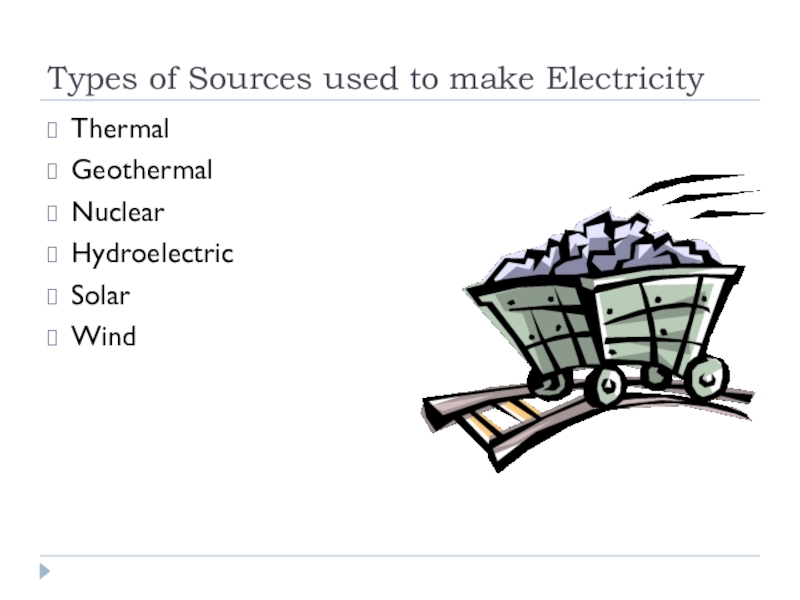
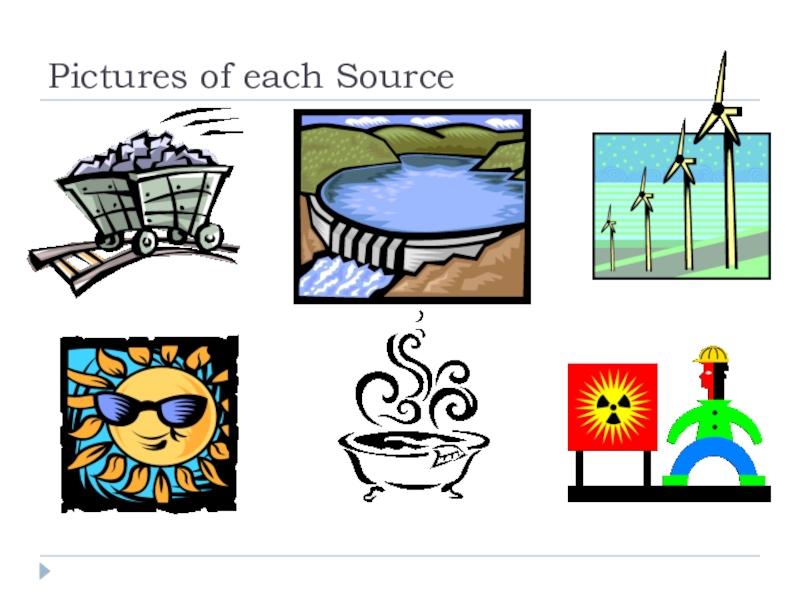
- 6. Types of Sources used to make ElectricityThermalGeothermalNuclearHydroelectricSolarWind
- 7. Pictures of each Source
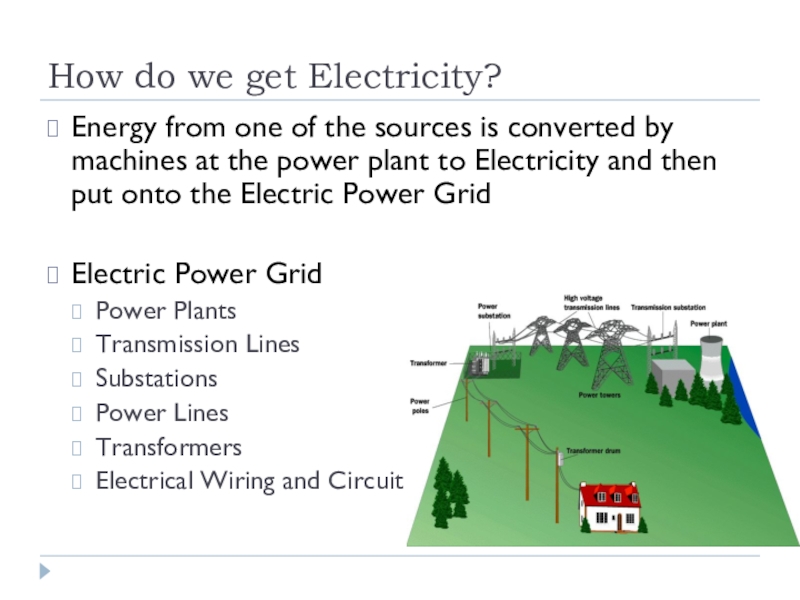
- 8. How do we get Electricity? Energy from one
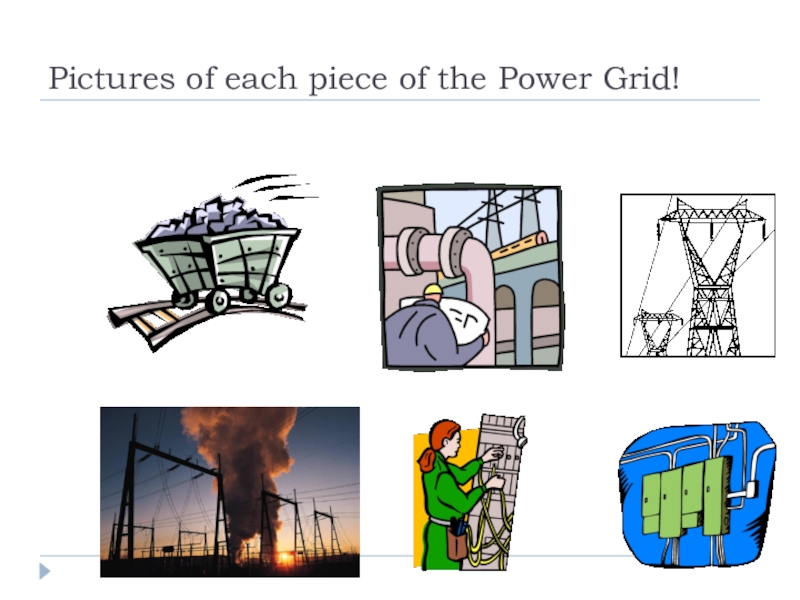
- 9. Pictures of each piece of the Power Grid!
- 10. Your Electric VocabularyCircuitTransformerSeries CircuitParallel CircuitInsulatorConductorProtonElectron
- 11. Life without Electricity---!!! How would you prepare your
- 12. Inventors and Inventions1752 – Lightning Rod 1879 –
- 13. More Inventors and Inventions 1927 – Television 1973 –
- 14. Electricity – Part IIFun Fun Fun with Activities….
- 15. Station # 1 - MagnetsMaterials: 1 set of
- 16. Station # 1 - Follow DirectionsFirst, rub
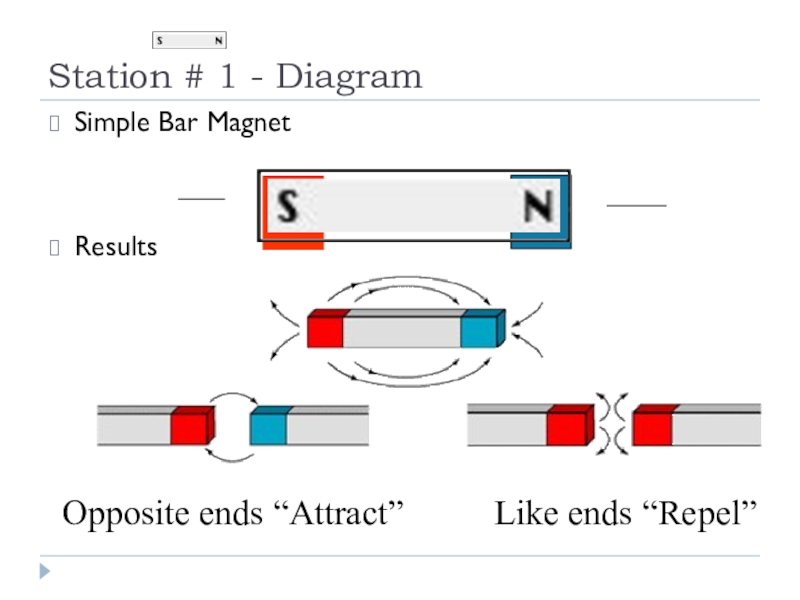
- 17. Station # 1 - DiagramSimple Bar MagnetResultsOpposite ends “Attract”Like ends “Repel”
- 18. Station # 2 - Static ElectricityMaterials: 1 balloon10 small pieces of paper1 light bulb
- 19. Station # 2 - Follow DirectionsPlace the
- 20. Station # 2 - DiagramStatic ElectricityAfter rubbing both ofthese items, they now have a CHARGE!Like chargesattract
- 21. Station # 3 - Insulators and
- 22. Station # 3 - Follow DirectionsBefore putting
- 23. Station # 3 - DiagramInsulators and Conductors
- 24. Station # 4 - Circuit TriviaMaterials:1 pre-made
- 25. Station # 4 - Follow DirectionsThis is
- 26. Station # 4 - Diagram++__Salt Water MixTap WaterBatteryBattery+++++______++_LightLightPaper clips
- 27. Electricity – Part IIIElectricity costs money!Safety tips!Guest speaker tells all!
- 28. Слайд 28
- 29. How you can save electricity and money?Light
- 30. Always play it safe! Safety rules1 – Never
- 31. Safety in a storm!Stay away from tall
- 32. Electricity Trivia How does a bird stand on
- 33. Lightning and how to be safeClouds move
- 34. Referenceshttp://www.ed.uiuc.edu/YLP/96-97/96-97_curriculum_units/Electricity_KPelak/table_content.htmlhttp://www.powerhousetv.com/kids/energy_basics_words.htmlhttp://www.brainpop.com/science/electricity/http://www.weberelectricsupply.com/sfty.htmlhttp://www.clarkpublicutilities.com/electric.htmhttp://www.sciencemadesimple.com/static.htmlhttp://www.cln.org/themes/electricity.htmlhttp://www.rp-l.com/rplkids.htmhttp://library.thinkquest.org/28032/cgi-bin/psparse.cgi?src=homehttp://www.concord.k12.nh.us/schools/kimball/classes/MITCHELL/elect.htm
- 35. More Referenceshttp://www.energizer.com/learning/default.asphttp://www.code-electrical.com/historyofelectricity.htmlhttp://www.howstuffworks.com/battery.htm/printablehttp://www.howstuffworks.com/power.htm/printablehttp://www.howstuffworks.com/framed.htm?parent=link445.htm&url=http://www.techlib.com/electronics/http://www.edisonkids.com/http://www.eia.doe.gov/kids/electricity.htmlhttp://www.yeg.co.uk/fun/http://home.nycap.rr.com/useless/lightbulbs/
- 36. THE END
Concepts CoveredElectricity basicselectricity vocabularysources of electricityCircuitsbasic definition series and parallelbreak in the circuit
Слайд 2Concepts Covered
Electricity basics
electricity vocabulary
sources of electricity
Circuits
basic definition
series and parallel
break in
the circuit
Слайд 3Concepts Covered
Power Grid
basic parts of the power grid
definition of the parts
Electricity
and Solar Energy Fun
electricity kit for playing with circuits (inquiry)
solar power kits and car (how it works)
electricity kit for playing with circuits (inquiry)
solar power kits and car (how it works)
Слайд 5What is Electricity?
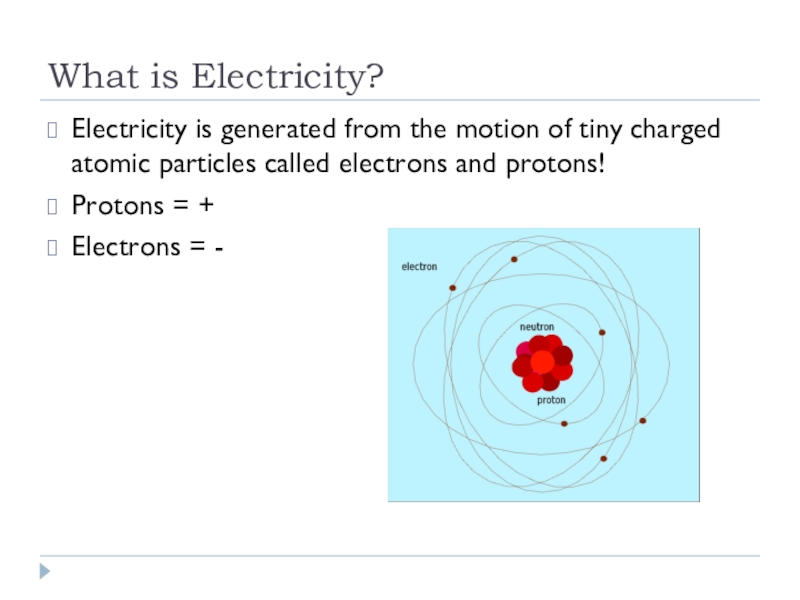
Electricity is generated from the motion of tiny charged
atomic particles called electrons and protons!
Protons = +
Electrons = -
Protons = +
Electrons = -
Слайд 8How do we get Electricity?
Energy from one of the sources is
converted by machines at the power plant to Electricity and then put onto the Electric Power Grid
Electric Power Grid
Power Plants
Transmission Lines
Substations
Power Lines
Transformers
Electrical Wiring and Circuit Box
Electric Power Grid
Power Plants
Transmission Lines
Substations
Power Lines
Transformers
Electrical Wiring and Circuit Box
Слайд 10Your Electric Vocabulary
Circuit
Transformer
Series Circuit
Parallel Circuit
Insulator
Conductor
Proton
Electron
Слайд 11Life without Electricity---!!!
How would you prepare your lunch?
How would you wash
clothes?
When would you go to bed?
Think about all the luxuries the discovery of Electricity has brought us!
No Television
No Radio
No Lights
When would you go to bed?
Think about all the luxuries the discovery of Electricity has brought us!
No Television
No Radio
No Lights
Слайд 12Inventors and Inventions
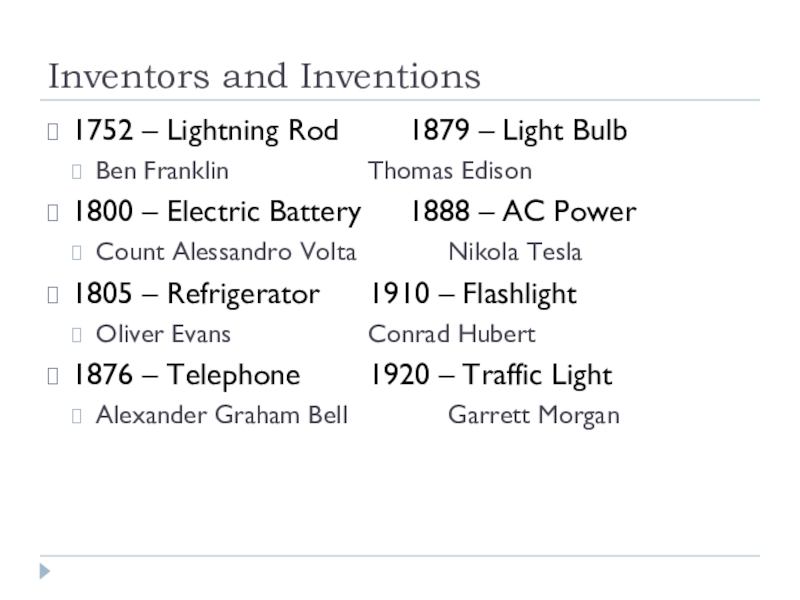
1752 – Lightning Rod 1879 – Light Bulb
Ben Franklin Thomas Edison
1800
– Electric Battery 1888 – AC Power
Count Alessandro Volta Nikola Tesla
1805 – Refrigerator 1910 – Flashlight
Oliver Evans Conrad Hubert
1876 – Telephone 1920 – Traffic Light
Alexander Graham Bell Garrett Morgan
Count Alessandro Volta Nikola Tesla
1805 – Refrigerator 1910 – Flashlight
Oliver Evans Conrad Hubert
1876 – Telephone 1920 – Traffic Light
Alexander Graham Bell Garrett Morgan
Слайд 13More Inventors and Inventions
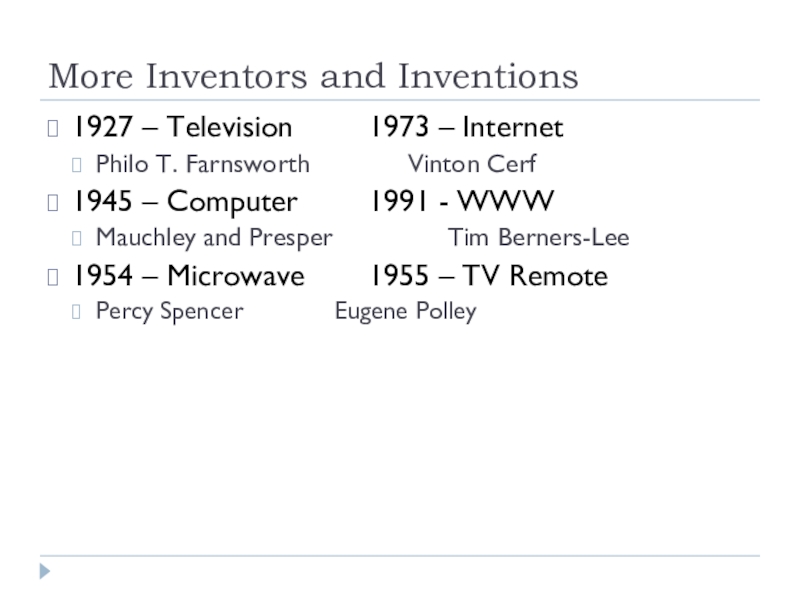
1927 – Television 1973 – Internet
Philo T. Farnsworth Vinton Cerf
1945
– Computer 1991 - WWW
Mauchley and Presper Tim Berners-Lee
1954 – Microwave 1955 – TV Remote
Percy Spencer Eugene Polley
Mauchley and Presper Tim Berners-Lee
1954 – Microwave 1955 – TV Remote
Percy Spencer Eugene Polley
Слайд 15Station # 1 - Magnets
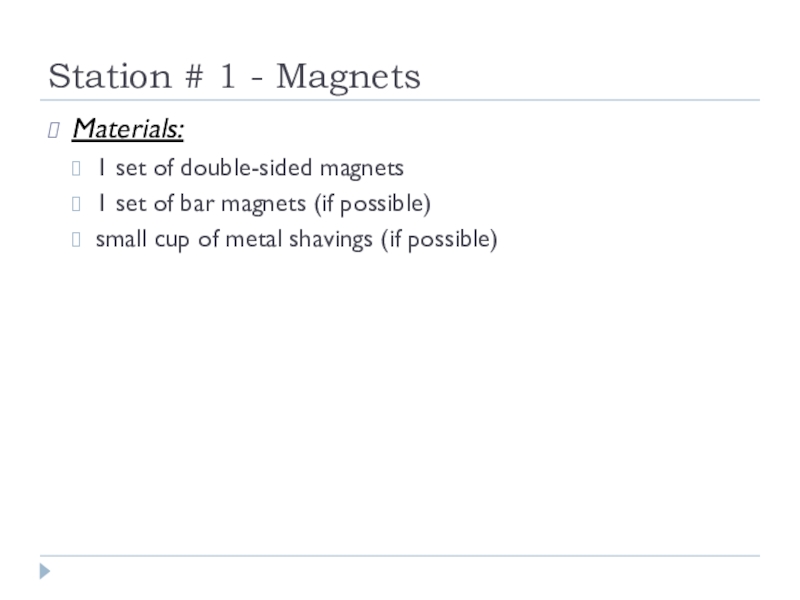
Materials:
1 set of double-sided magnets
1 set
of bar magnets (if possible)
small cup of metal shavings (if possible)
small cup of metal shavings (if possible)
Слайд 16Station # 1 - Follow Directions
First, rub the balloon on your
head and describe what it does when you bring it near your hair (It is best to let the group member with the longest hair do this). Answer: It makes the hair stand on end.
If the balloon is positively charged (+), then which charge is in your hair? Answer: negatively charged because they attract.
If you rub the balloon on your head for 5 seconds (have a group member time you), how many pieces of paper can you pick up? If you rub the balloon on your head for 10 seconds, can more pieces of paper be picked up? Answer: More pieces get picked up because there is more charge.
What do you think…? Can this balloon be used to make a light bulb light up? Answer: Yes, but it will only light up for a split second.
If the balloon is positively charged (+), then which charge is in your hair? Answer: negatively charged because they attract.
If you rub the balloon on your head for 5 seconds (have a group member time you), how many pieces of paper can you pick up? If you rub the balloon on your head for 10 seconds, can more pieces of paper be picked up? Answer: More pieces get picked up because there is more charge.
What do you think…? Can this balloon be used to make a light bulb light up? Answer: Yes, but it will only light up for a split second.
Слайд 19Station # 2 - Follow Directions
Place the magnets together. Then turn
one of them over on its other side and see what happens when you bring the magnets close together.
Describe what you see and why what you see happens? Answer: The magnets will stick to each other when you have their opposite charged sides facing each other, and they will repel each other when the sides with like charges are facing each other.
Describe what you see and why what you see happens? Answer: The magnets will stick to each other when you have their opposite charged sides facing each other, and they will repel each other when the sides with like charges are facing each other.
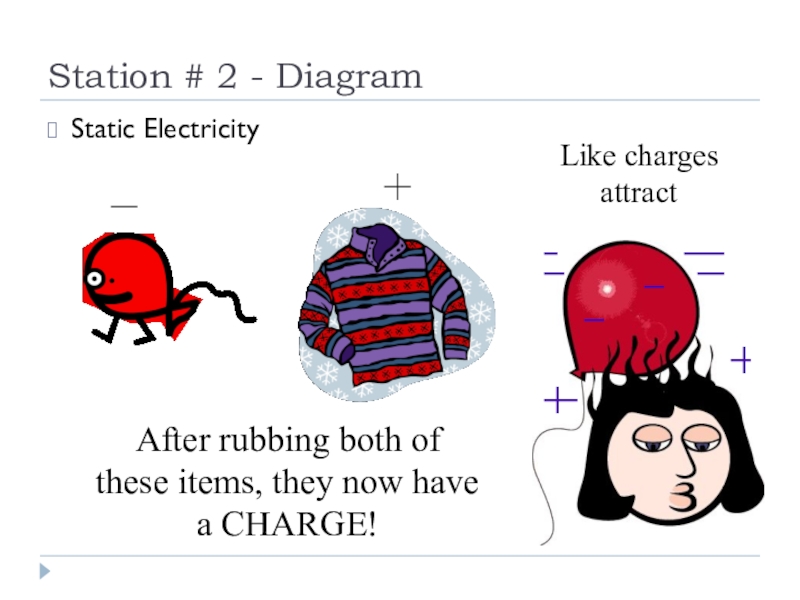
Слайд 20Station # 2 - Diagram
Static Electricity
After rubbing both of
these items, they
now have
a CHARGE!
a CHARGE!
Like charges
attract
Слайд 21Station # 3 - Insulators and
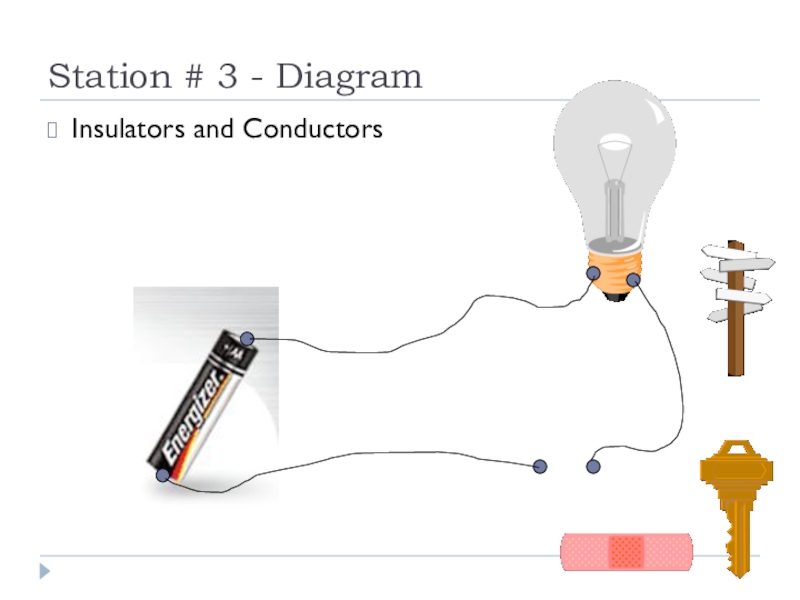
Conductors
Materials:
1 Circuit with a 9-volt
battery
1 pencil and piece of paper
1 nail
1 match stick
1 paper clip
1 penny
1 eraser
1 pencil and piece of paper
1 nail
1 match stick
1 paper clip
1 penny
1 eraser
Слайд 22Station # 3 - Follow Directions
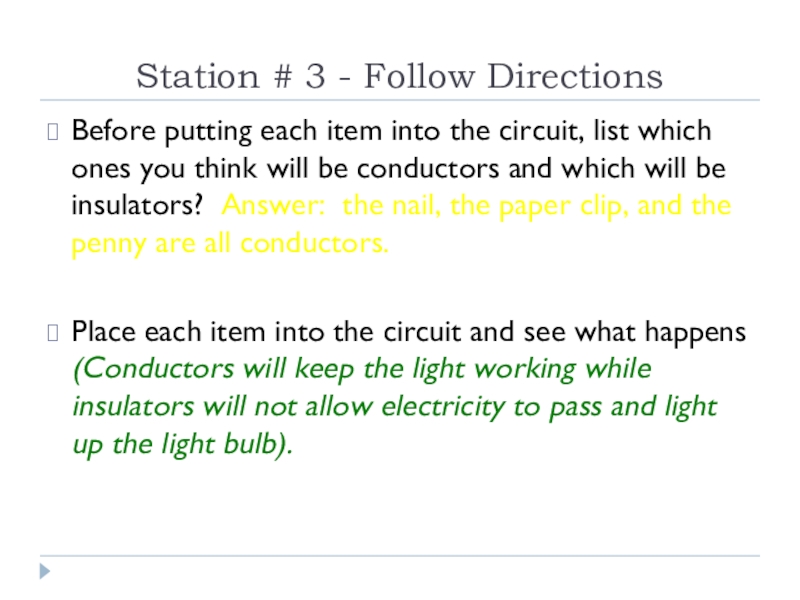
Before putting each item into the
circuit, list which ones you think will be conductors and which will be insulators? Answer: the nail, the paper clip, and the penny are all conductors.
Place each item into the circuit and see what happens (Conductors will keep the light working while insulators will not allow electricity to pass and light up the light bulb).
Place each item into the circuit and see what happens (Conductors will keep the light working while insulators will not allow electricity to pass and light up the light bulb).
Слайд 24Station # 4 - Circuit Trivia
Materials:
1 pre-made circuit (with wires and
battery)
two styrophone cups
4 paper clips
one cup of salt water
one cup of regular tap water
two styrophone cups
4 paper clips
one cup of salt water
one cup of regular tap water
Слайд 25Station # 4 - Follow Directions
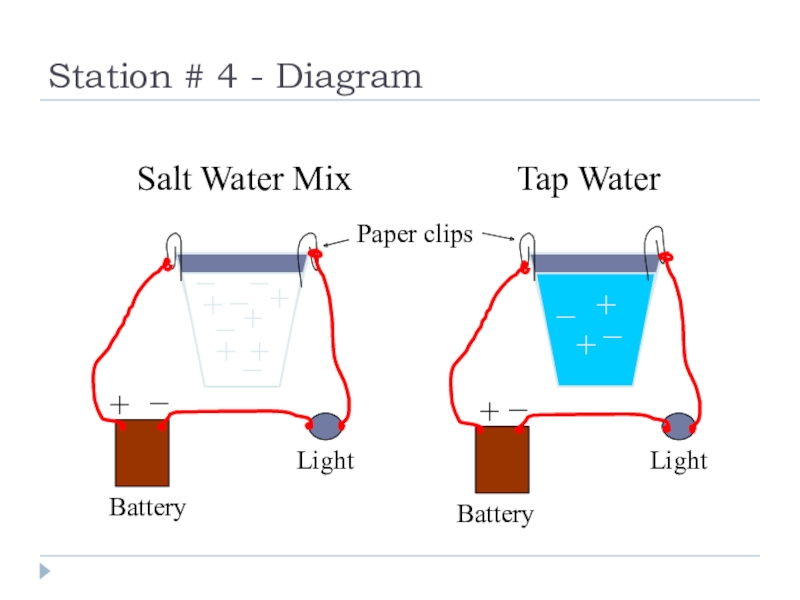
This is a circuit like the
one at Station #3. Instead of using one of the items like a paper clip or an eraser, a cup of both fresh water and salt water is used. Do you think both of them will allow the light to keep working or just one? Answer: Both cups of water conduct electricity, but salt water has more floating charges called “ions.” The light will be brighter when hooked up to this cup.
Explain what you think? Answer: ???????
Explain what you think? Answer: ???????
Слайд 26Station # 4 - Diagram
+
+
_
_
Salt Water Mix
Tap Water
Battery
Battery
+
+
+
+
+
_
_
_
_
_
_
+
+
_
Light
Light
Paper clips
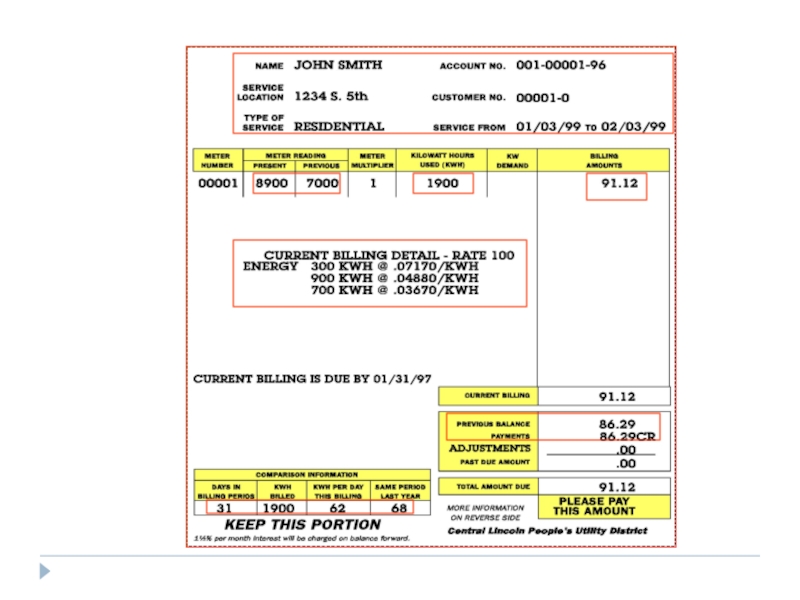
Слайд 29How you can save electricity and money?
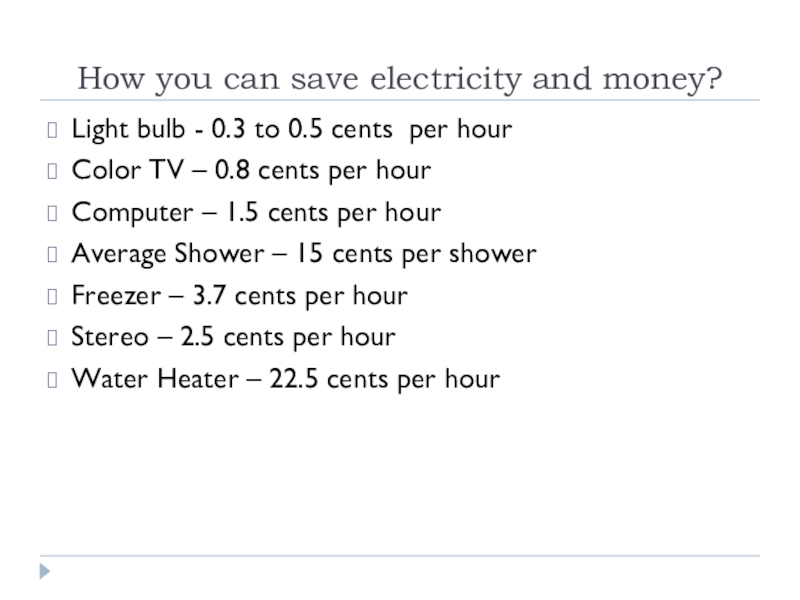
Light bulb - 0.3 to
0.5 cents per hour
Color TV – 0.8 cents per hour
Computer – 1.5 cents per hour
Average Shower – 15 cents per shower
Freezer – 3.7 cents per hour
Stereo – 2.5 cents per hour
Water Heater – 22.5 cents per hour
Color TV – 0.8 cents per hour
Computer – 1.5 cents per hour
Average Shower – 15 cents per shower
Freezer – 3.7 cents per hour
Stereo – 2.5 cents per hour
Water Heater – 22.5 cents per hour
Слайд 30Always play it safe!
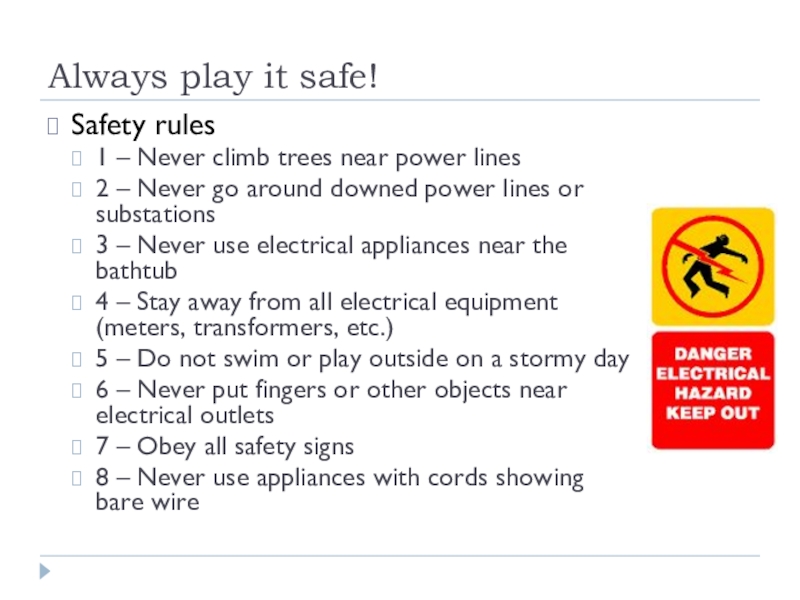
Safety rules
1 – Never climb trees near power
lines
2 – Never go around downed power lines or substations
3 – Never use electrical appliances near the bathtub
4 – Stay away from all electrical equipment (meters, transformers, etc.)
5 – Do not swim or play outside on a stormy day
6 – Never put fingers or other objects near electrical outlets
7 – Obey all safety signs
8 – Never use appliances with cords showing bare wire
2 – Never go around downed power lines or substations
3 – Never use electrical appliances near the bathtub
4 – Stay away from all electrical equipment (meters, transformers, etc.)
5 – Do not swim or play outside on a stormy day
6 – Never put fingers or other objects near electrical outlets
7 – Obey all safety signs
8 – Never use appliances with cords showing bare wire
Слайд 31Safety in a storm!
Stay away from tall objects such as trees
Stay
out of open fields or areas where YOU are the tallest thing
If your hair stands on end, crouch low to the ground with as little of your body in contact with the ground as possible
If your hair stands on end, crouch low to the ground with as little of your body in contact with the ground as possible
Слайд 32Electricity Trivia
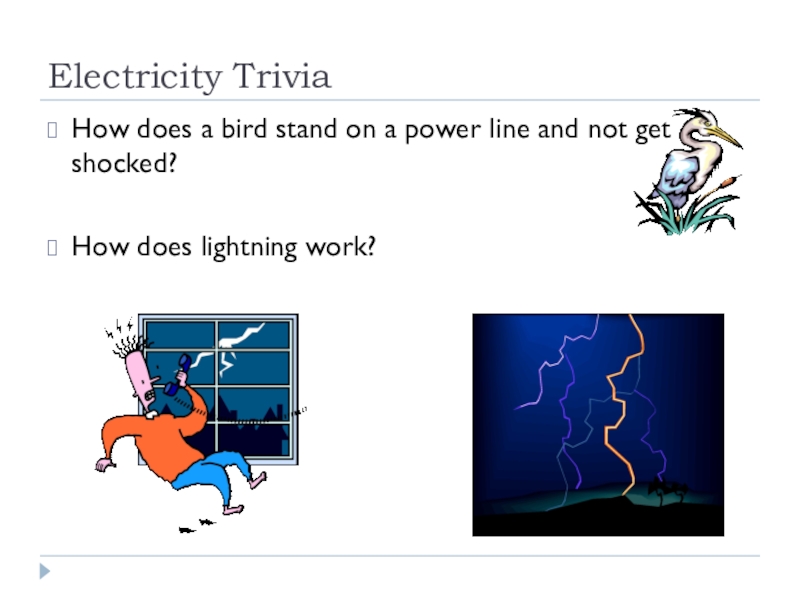
How does a bird stand on a power line and
not get shocked?
How does lightning work?
How does lightning work?
Слайд 33Lightning and how to be safe
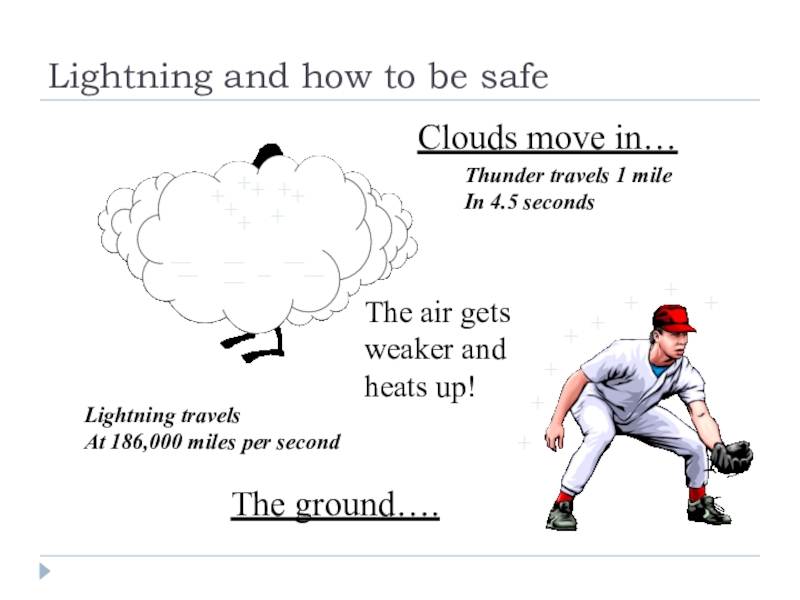
Clouds move in…
The ground….
The air gets
weaker
and
heats up!
heats up!
Lightning travels
At 186,000 miles per second
Thunder travels 1 mile
In 4.5 seconds
Слайд 34References
http://www.ed.uiuc.edu/YLP/96-97/96-97_curriculum_units/Electricity_KPelak/table_content.html
http://www.powerhousetv.com/kids/energy_basics_words.html
http://www.brainpop.com/science/electricity/
http://www.weberelectricsupply.com/sfty.html
http://www.clarkpublicutilities.com/electric.htm
http://www.sciencemadesimple.com/static.html
http://www.cln.org/themes/electricity.html
http://www.rp-l.com/rplkids.htm
http://library.thinkquest.org/28032/cgi-bin/psparse.cgi?src=home
http://www.concord.k12.nh.us/schools/kimball/classes/MITCHELL/elect.htm
Слайд 35More References
http://www.energizer.com/learning/default.asp
http://www.code-electrical.com/historyofelectricity.html
http://www.howstuffworks.com/battery.htm/printable
http://www.howstuffworks.com/power.htm/printable
http://www.howstuffworks.com/framed.htm?parent=link445.htm&url=http://www.techlib.com/electronics/
http://www.edisonkids.com/
http://www.eia.doe.gov/kids/electricity.html
http://www.yeg.co.uk/fun/
http://home.nycap.rr.com/useless/lightbulbs/