- Главная
- Разное
- Образование
- Спорт
- Естествознание
- Природоведение
- Религиоведение
- Французский язык
- Черчение
- Английский язык
- Астрономия
- Алгебра
- Биология
- География
- Геометрия
- Детские презентации
- Информатика
- История
- Литература
- Математика
- Музыка
- МХК
- Немецкий язык
- ОБЖ
- Обществознание
- Окружающий мир
- Педагогика
- Русский язык
- Технология
- Физика
- Философия
- Химия
- Шаблоны, фоны, картинки для презентаций
- Экология
- Экономика
Презентация, доклад по английскому языку Canada
Содержание
- 1. Презентация по английскому языку Canada
- 2. Geography.CLIMATE. Aboriginal population.Government and politics. ECONOMY.POPULATION.Languages of Canada.OTTAWA.THE
- 3. Geography.Canada occupies a major northern portion of
- 4. CLIMATE.Average winter and summer high temperatures across Canada
- 5. Aboriginal population..In spite of the fact that
- 6. Government and politics. The monarchy of Canada is
- 7. ECONOMY. However, Canada is unusual among developed
- 8. POPULATION. In common with many other developed
- 9. Languages of Canada.Canada's two official languages are
- 10. OTTAWA.Ottawa is the capital of Canada. It
- 11. THE MAPLE LEAF.The maple leaf is the
- 12. Hockey.Hockey is a national pastime and the
- 13. Great Lakes.Great Lakes is the largest concentration of fresh water on
- 14. Niagara Falls. One of the most famous waterfalls
- 15. The longest street. On the waterfront of
- 16. The highest inclined tower .The highest inclined tower of the world is not in
- 17. Lake Manikuagan.Annular lake Manikuagan for its original form, perfectly visible in satellite images ,
- 18. Слайд 18
Geography.CLIMATE. Aboriginal population.Government and politics. ECONOMY.POPULATION.Languages of Canada.OTTAWA.THE MAPLE LEAF.Hockey.Great Lakes. Niagara Falls. The longest street.The highest inclined tower .Lake Manikuagan.
Слайд 2
Geography.
CLIMATE.
Aboriginal population.
Government and politics.
ECONOMY.
POPULATION.
Languages of Canada.
OTTAWA.
THE MAPLE LEAF.
Hockey.
Great Lakes.
Niagara
Falls.
The longest street.
The highest inclined tower .
Lake Manikuagan.
The longest street.
The highest inclined tower .
Lake Manikuagan.
Слайд 3Geography.
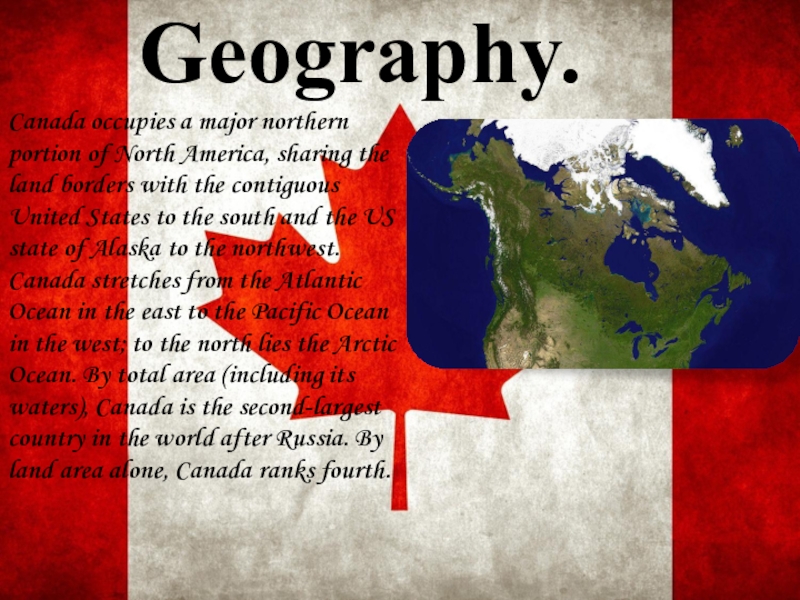
Canada occupies a major northern portion of North America, sharing the
land borders with the contiguous United States to the south and the US state of Alaska to the northwest. Canada stretches from the Atlantic Ocean in the east to the Pacific Ocean in the west; to the north lies the Arctic Ocean. By total area (including its waters), Canada is the second-largest country in the world after Russia. By land area alone, Canada ranks fourth.
Слайд 4CLIMATE.
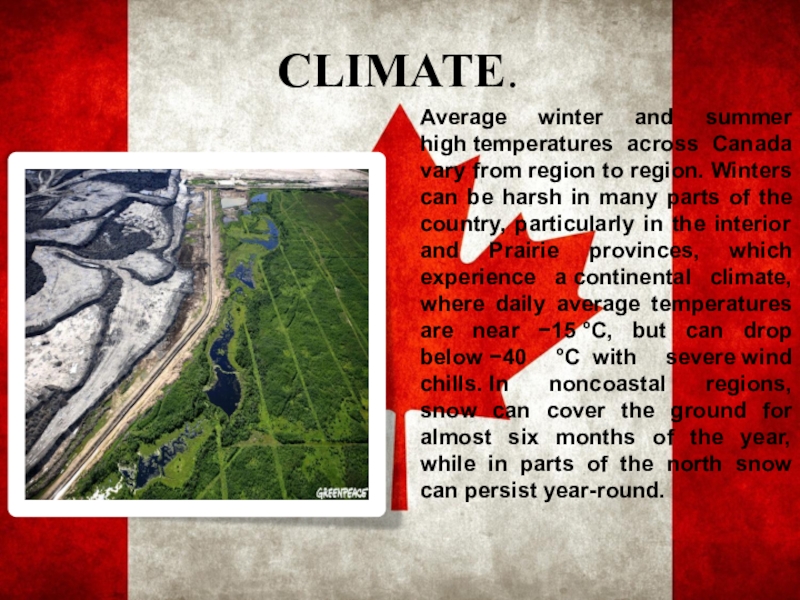
Average winter and summer high temperatures across Canada vary from region to
region. Winters can be harsh in many parts of the country, particularly in the interior and Prairie provinces, which experience a continental climate, where daily average temperatures are near −15 °C, but can drop below −40 °C with severe wind chills. In noncoastal regions, snow can cover the ground for almost six months of the year, while in parts of the north snow can persist year-round.
Слайд 5 Aboriginal population.
.
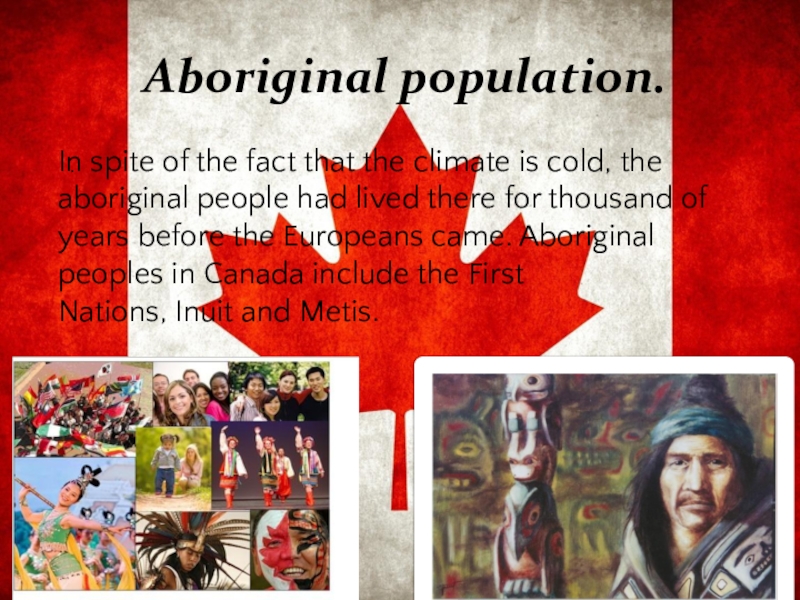
In spite of the fact that the climate is cold,
the aboriginal people had lived there for thousand of years before the Europeans came. Aboriginal peoples in Canada include the First Nations, Inuit and Metis.
Слайд 6Government and politics.
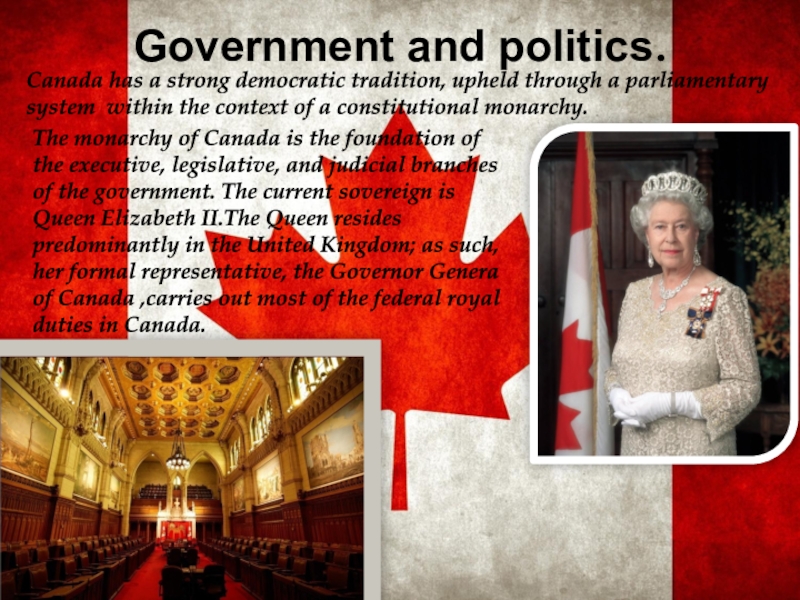
The monarchy of Canada is the foundation of the executive, legislative, and judicial branches
of the government. The current sovereign is Queen Elizabeth II.The Queen resides predominantly in the United Kingdom; as such, her formal representative, the Governor Genera of Canada ,carries out most of the federal royal duties in Canada.
Canada has a strong democratic tradition, upheld through a parliamentary system within the context of a constitutional monarchy.
Слайд 7ECONOMY.
However, Canada is unusual among developed countries in the importance
of its primary sector, in which the logging and petroleum industries are two of the most prominent elements.
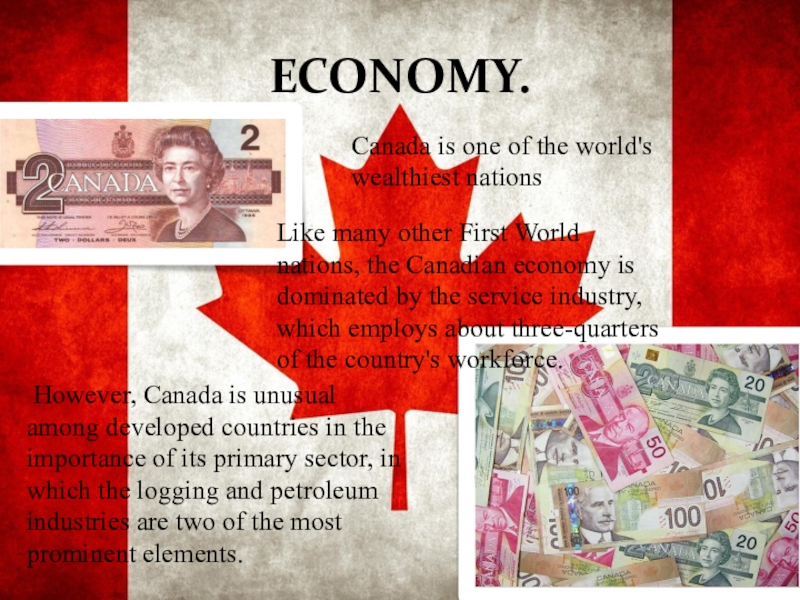
Canada is one of the world's wealthiest nations
Like many other First World nations, the Canadian economy is dominated by the service industry, which employs about three-quarters of the country's workforce.
Слайд 8POPULATION.
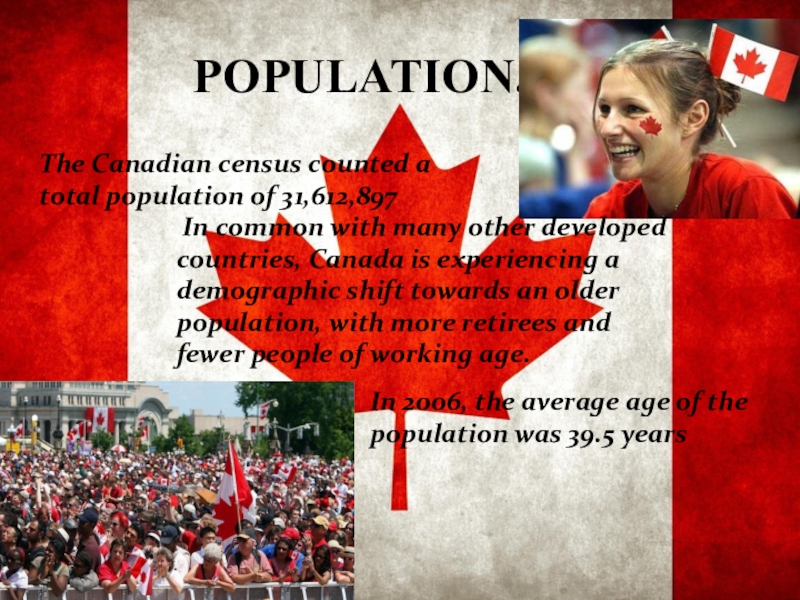
In common with many other developed countries, Canada is experiencing
a demographic shift towards an older population, with more retirees and fewer people of working age.
The Canadian census counted a total population of 31,612,897
In 2006, the average age of the population was 39.5 years
Слайд 9Languages of Canada.
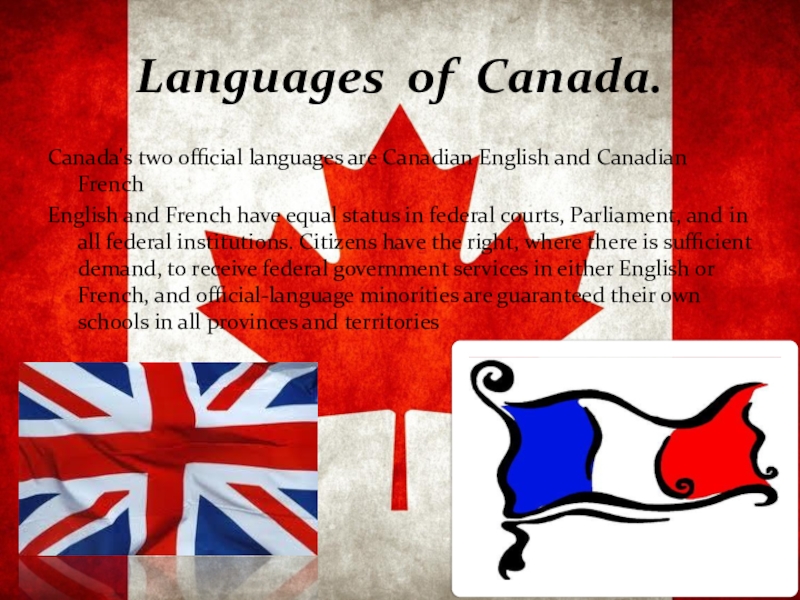
Canada's two official languages are Canadian English and Canadian
French
English and French have equal status in federal courts, Parliament, and in all federal institutions. Citizens have the right, where there is sufficient demand, to receive federal government services in either English or French, and official-language minorities are guaranteed their own schools in all provinces and territories
English and French have equal status in federal courts, Parliament, and in all federal institutions. Citizens have the right, where there is sufficient demand, to receive federal government services in either English or French, and official-language minorities are guaranteed their own schools in all provinces and territories
Слайд 10OTTAWA.
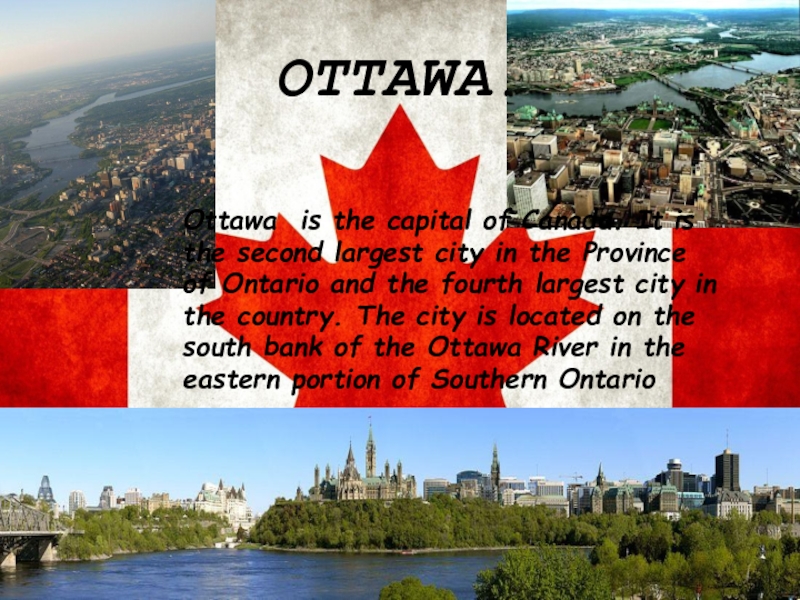
Ottawa is the capital of Canada. It is the second largest
city in the Province of Ontario and the fourth largest city in the country. The city is located on the south bank of the Ottawa River in the eastern portion of Southern Ontario
Слайд 11THE MAPLE LEAF.
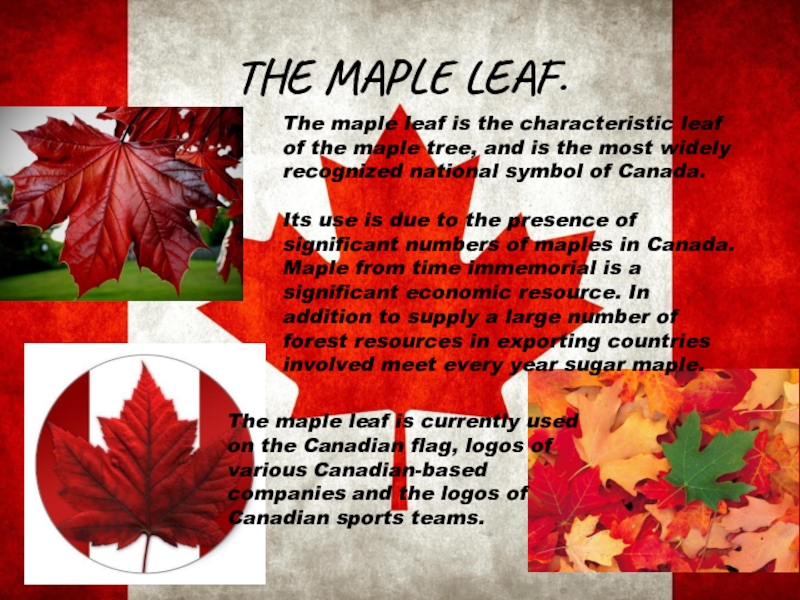
The maple leaf is the characteristic leaf of the
maple tree, and is the most widely recognized national symbol of Canada.
Its use is due to the presence of significant numbers of maples in Canada. Maple from time immemorial is a significant economic resource. In addition to supply a large number of forest resources in exporting countries involved meet every year sugar maple.
Its use is due to the presence of significant numbers of maples in Canada. Maple from time immemorial is a significant economic resource. In addition to supply a large number of forest resources in exporting countries involved meet every year sugar maple.
The maple leaf is currently used on the Canadian flag, logos of various Canadian-based companies and the logos of Canadian sports teams.
Слайд 12Hockey.
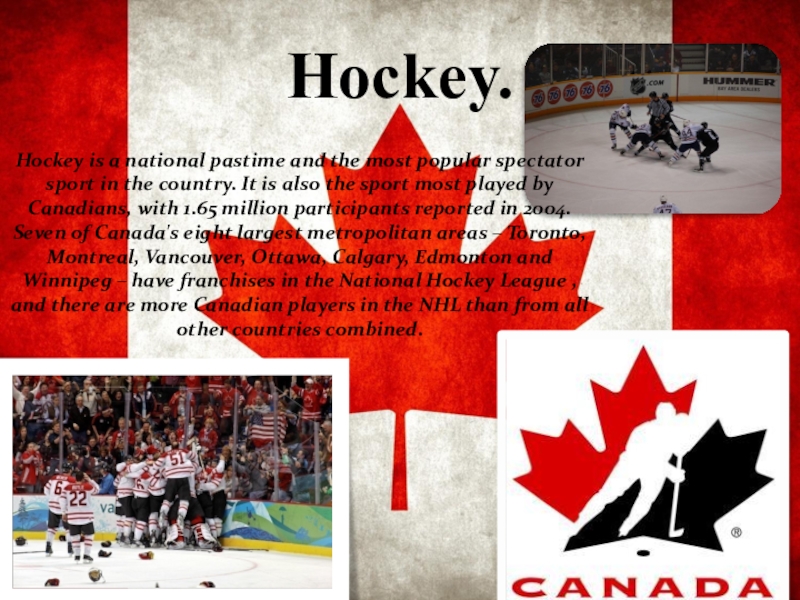
Hockey is a national pastime and the most popular spectator sport
in the country. It is also the sport most played by Canadians, with 1.65 million participants reported in 2004. Seven of Canada's eight largest metropolitan areas – Toronto, Montreal, Vancouver, Ottawa, Calgary, Edmonton and Winnipeg – have franchises in the National Hockey League , and there are more Canadian players in the NHL than from all other countries combined.
Слайд 13Great Lakes.
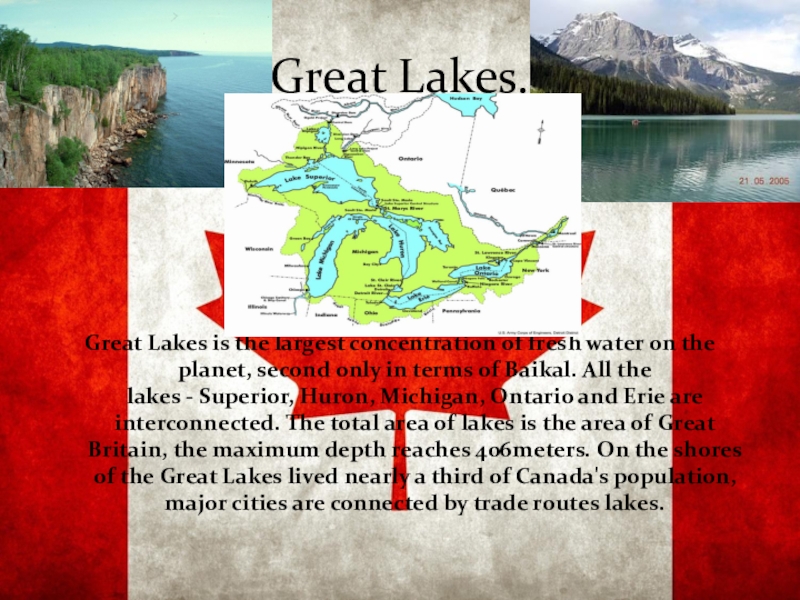
Great Lakes is the largest concentration of fresh water on the planet, second only in terms
of Baikal. All the lakes - Superior, Huron, Michigan, Ontario and Erie are interconnected. The total area of lakes is the area of Great Britain, the maximum depth reaches 406meters. On the shores of the Great Lakes lived nearly a third of Canada's population, major cities are connected by trade routes lakes.
Слайд 14
Niagara Falls.
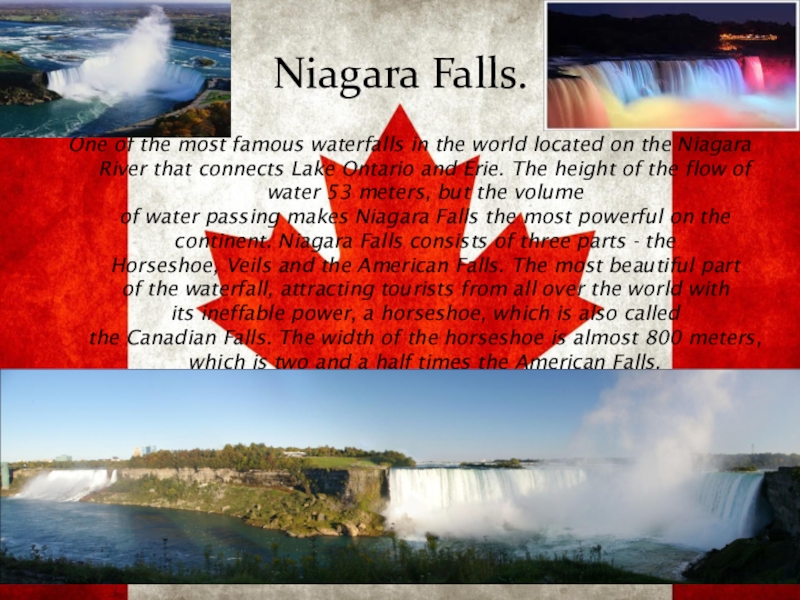
One of the most famous waterfalls in the world located on the Niagara River that
connects Lake Ontario and Erie. The height of the flow of water 53 meters, but the volume of water passing makes Niagara Falls the most powerful on the continent. Niagara Falls consists of three parts - the Horseshoe, Veils and the American Falls. The most beautiful part of the waterfall, attracting tourists from all over the world with its ineffable power, a horseshoe, which is also called the Canadian Falls. The width of the horseshoe is almost 800 meters, which is two and a half times the American Falls.
Слайд 15The longest street.
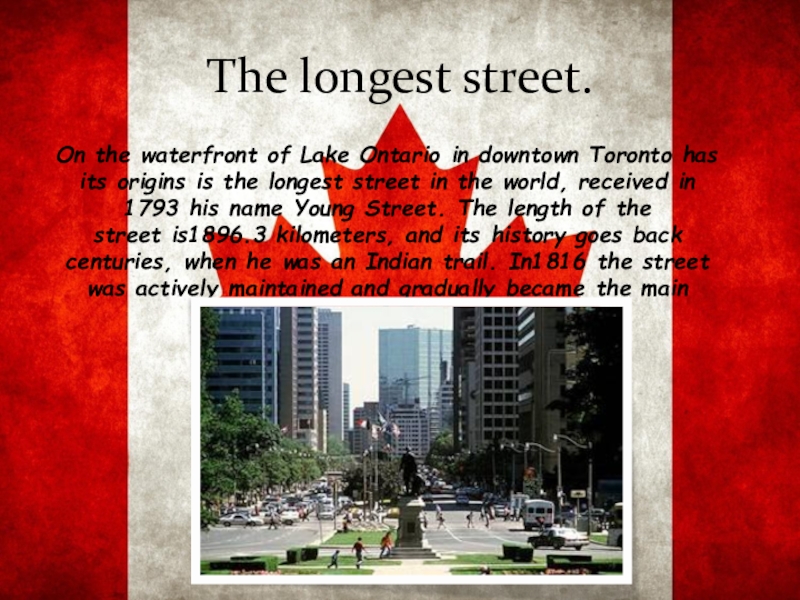
On the waterfront of Lake Ontario in downtown Toronto has its
origins is the longest street in the world, received in 1793 his name Young Street. The length of the street is1896.3 kilometers, and its history goes back centuries, when he was an Indian trail. In1816 the street was actively maintained and gradually became the main street of Toronto.
Слайд 16The highest inclined tower .
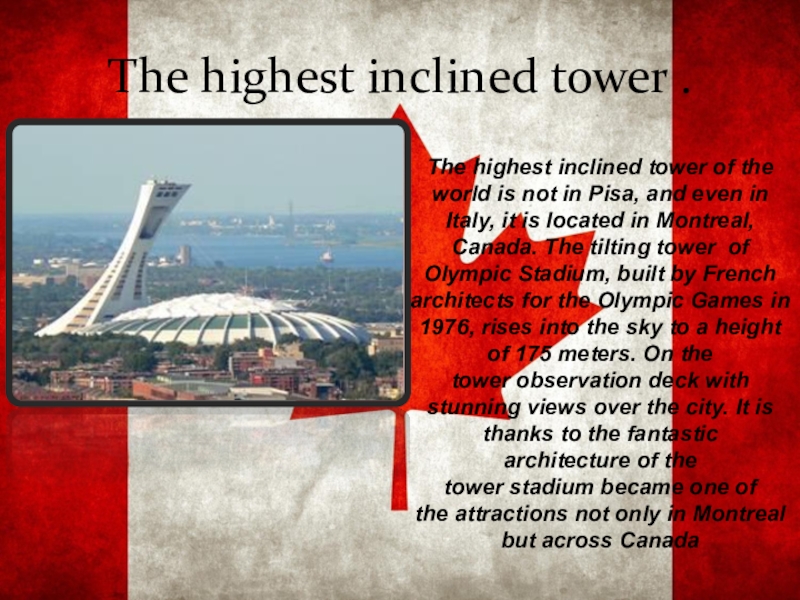
The highest inclined tower of the world is not in Pisa, and even in Italy, it is
located in Montreal, Canada. The tilting tower of Olympic Stadium, built by French architects for the Olympic Games in 1976, rises into the sky to a height of 175 meters. On the tower observation deck with stunning views over the city. It is thanks to the fantastic architecture of the tower stadium became one of the attractions not only in Montreal but across Canada
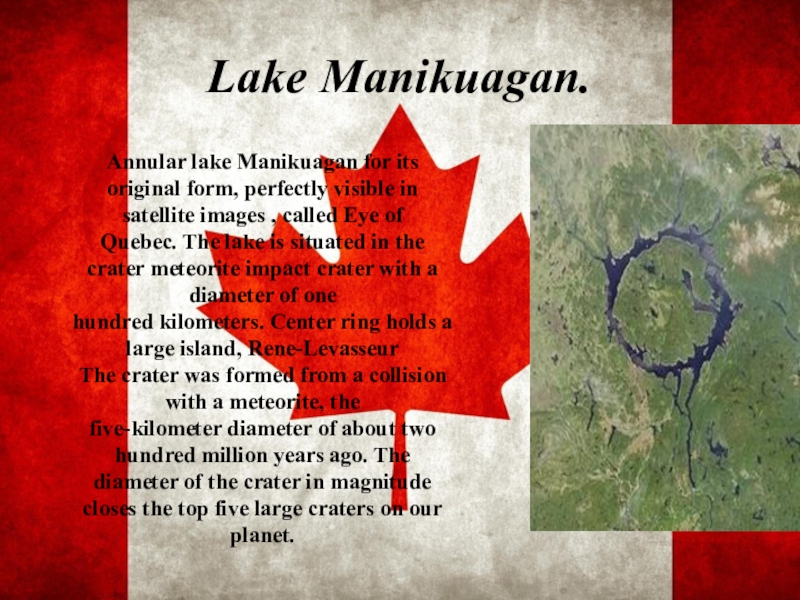
Слайд 17Lake Manikuagan.
Annular lake Manikuagan for its original form, perfectly visible in satellite images , called Eye of Quebec. The lake is
situated in the crater meteorite impact crater with a diameter of one hundred kilometers. Center ring holds a large island, Rene-Levasseur
The crater was formed from a collision with a meteorite, the five-kilometer diameter of about two hundred million years ago. The diameter of the crater in magnitude closes the top five large craters on our planet.