- Главная
- Разное
- Образование
- Спорт
- Естествознание
- Природоведение
- Религиоведение
- Французский язык
- Черчение
- Английский язык
- Астрономия
- Алгебра
- Биология
- География
- Геометрия
- Детские презентации
- Информатика
- История
- Литература
- Математика
- Музыка
- МХК
- Немецкий язык
- ОБЖ
- Обществознание
- Окружающий мир
- Педагогика
- Русский язык
- Технология
- Физика
- Философия
- Химия
- Шаблоны, фоны, картинки для презентаций
- Экология
- Экономика
Презентация, доклад по английскому языку: American Traditions and Holidays
Содержание
- 1. Презентация по английскому языку: American Traditions and Holidays
- 2. New Year – January 1New Years Eve
- 3. New Years Eve is a major social
- 4. Martin Luther King Day 2nd Monday in January
- 5. I Have A Dream" I have a
- 6. Martin Luther King DayEach year on the
- 7. Martin Luther King DayIt is a time
- 8. February 1stIn 1723, the Delaware Indians
- 9. Groundhog DayWhen German settlers arrived in the
- 10. Groundhog DayThe earliest American reference to Groundhog
- 11. Слайд 11
- 12. Valentines DayFebruary 14
- 13. Valentine’s DayEvery February, across the USA, candy,
- 14. Valentine’s DayThe holiday of Valentine's Day probably
- 15. Valentine’s DayOne of the customs of the
- 16. Valentine’s DayLegend has it that the holiday
- 17. Valentine’s DayValentine was beheaded on February 14th,
- 18. President’s DayUntil the mid-1970s, the February 22
- 19. Arbor Day First Friday in AprilArbor Day
- 20. In the United States Mother's Day was
- 21. In 1907 Ana Jarvis, from Philadelphia, began
- 22. Mother’s DayMs. Jarvis and her supporters began
- 23. Mother’s DayIn the United States Mother's Day
- 24. Mother’s DayIn 1907 Ana Jarvis, from Philadelphia,
- 25. Mother’s DayMs. Jarvis and her supporters began
- 26. Memorial Day 4th Monday of MayThis holiday,
- 27. Memorial DayOn Memorial Day, the President or
- 28. Memorial DayIn 1971, along with other holidays,
- 29. Father’s Day 3rd Sunday of JuneFather's
- 30. Father’s DayThe first Father's Day was observed
- 31. Father’s DayFather's Day has become a day
- 32. BirthdaysThe tradition of birthday parties started in
- 33. BirthdaysCake, candles and song. A cake is
- 34. Mardi Gras (Fat Tuesday) Tuesday Before Lent
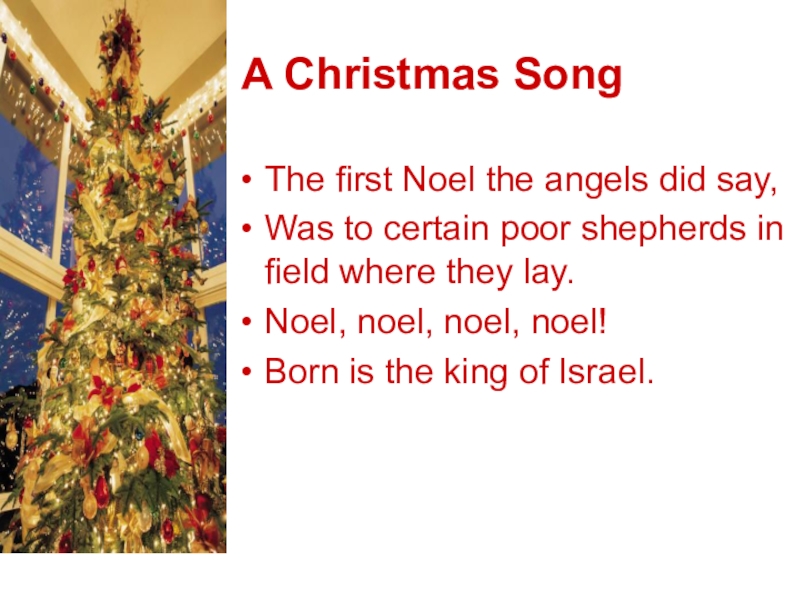
- 35. Easter is a major Christian holiday that
- 36. Besides the religious aspects of Easter, people
- 37. Children receive Easter baskets filled with candy
- 38. Слайд 38
- 39. Independence Day July 4thIndependence Day (fourthof
- 40. Independence Day July 4thParades, patriotic speeches, fireworks
- 41. Labor DayLabor Day is a legal holiday
- 42. Columbus DayOn October 12, 1492, Italian
- 43. The Story of HalloweenHalloween is one of
- 44. The Story of HalloweenHundreds of years ago
- 45. The Story of HalloweenThe Celts celebrated their
- 46. The Story of HalloweenOn October 31st after
- 47. The Story of HalloweenWhen the morning arrived
- 48. The Story of HalloweenThe November 1st festival
- 49. The Story of HalloweenDuring the first century
- 50. The Story of HalloweenThe next influence came
- 51. The Story of HalloweenBut the spread of
- 52. The Story of Halloween The Halloween we
- 53. Слайд 53
- 54. The Story of HalloweenThe history of "Trick'O'Treating"
- 55. The Story of HalloweenOver time the custom
- 56. The Story of HalloweenDuring the Pioneer days
- 57. The First ThanksgivingSquanto's importance to the Pilgrims
- 58. The First ThanksgivingThe harvest in October was
- 59. The First ThanksgivingThe Pilgrims had much to
- 60. The First ThanksgivingThe Pilgrim Governor William Bradford
- 61. Thanksgiving Becomes A CustomThe custom of an
- 62. Thanksgiving Becomes OfficialIn 1817 New York
- 63. Thanksgiving Becomes a National HolidayIn 1863 President
- 64. Слайд 64
- 65. Christmas TraditionsSanta Claus was born in US
- 66. CHRISTMAS THINGS Candy Canes: These are really
- 67. CHRISTMAS THINGSChristmas stockings by the fireplace: And
- 68. CHRISTMAS THINGSOrange or tangerine in the toe
- 69. CHRISTMAS THINGSGift-giving in secret, during the night:
- 70. CHRISTMAS THINGSSeasonal concern for the needy: St.
- 71. CHRISTMAS TREESThe custom of the Christmas tree
- 72. Christmas TreesCharles Minnegrode introduced the custom of
- 73. A Christmas Song The first Noel the angels
New Year – January 1New Years Eve and New Years Day New Years Day is the first day of the year, January 1st. It is a celebration of the old year and the new one
Слайд 2New Year – January 1
New Years Eve and New Years Day
New Years Day is the first day of the year, January 1st. It is a celebration of the old year and the new one to come. People make New Years Resolutions each New Years and promise themselves that they will keep this resolution until next year.
Слайд 3New Years Eve is a major social event. Clubs everywhere are
packed with party-goers who stay out all night and go nuts at midnight. At midnight it is a tradition to make lots of noise. The traditional New Years Ball is dropped every year in Times Square in New York City at 12 o’clock. This event can be seen all over the world on television.
New Year
Слайд 5I Have A Dream
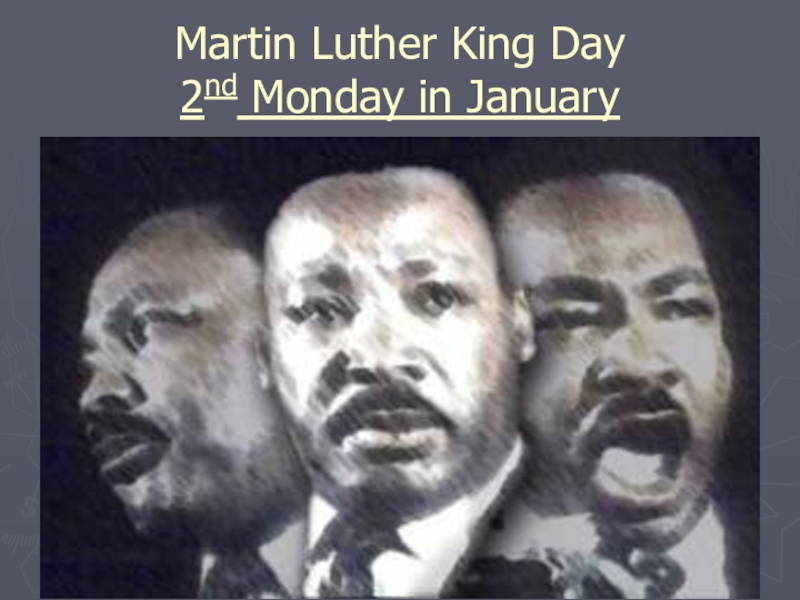
" I have a dream... I have a
dream that one day little black boys and black girls will be able to join hands with little white boys and white girls as sisters and brothers . . . I have a dream today"
Слайд 6Martin Luther King Day
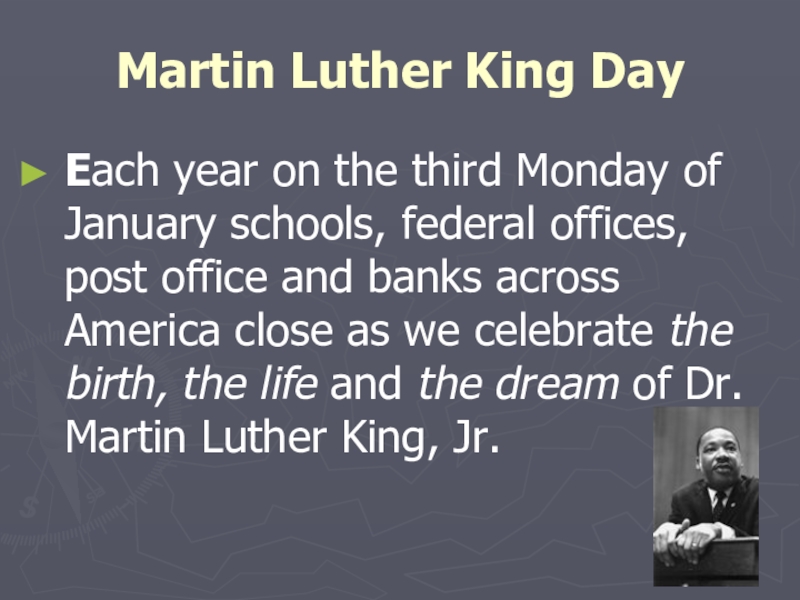
Each year on the third Monday of January
schools, federal offices, post office and banks across America close as we celebrate the birth, the life and the dream of Dr. Martin Luther King, Jr.
Слайд 7Martin Luther King Day
It is a time for the nation to
remember the injustices that Dr. King fought. A time to remember his fight for the freedom, equality, and dignity of all races and peoples. A time to remember the message of change through nonviolence.
Слайд 8
February 1st
In 1723, the Delaware Indians settled Punxsutawney, Pennsylvania as a
campsite halfway between the Allegheny and the Susquehanna Rivers. The town is 90 miles northeast of Pittsburgh, at the intersection of Route 36 and Route 119. The Delaware Indians considered groundhogs honorable ancestors.
According to the original creation beliefs of the Delaware Indians, their forebears began life as animals in "Mother Earth" and emerged centuries later to hunt and live as men.
According to the original creation beliefs of the Delaware Indians, their forebears began life as animals in "Mother Earth" and emerged centuries later to hunt and live as men.
Слайд 9Groundhog Day
When German settlers arrived in the 1700s, they brought a
tradition known as Candlemas Day, which has an early origin in the pagan celebration of Imbolc. It came at the mid-point between the Winter Solstice and the Spring equinox.
Superstition held that if the weather was fair, the second half of Winter would be stormy and cold. For the early Christians in Europe, it was the custom on Candlemas Day for clergy to bless candles and distribute them to the people in the dark of Winter.
A lighted candle was placed in each window of the home. The day's weather continued to be important. If the sun came out February 2, halfway between Winter and Spring, it meant six more weeks of wintry weather.
Superstition held that if the weather was fair, the second half of Winter would be stormy and cold. For the early Christians in Europe, it was the custom on Candlemas Day for clergy to bless candles and distribute them to the people in the dark of Winter.
A lighted candle was placed in each window of the home. The day's weather continued to be important. If the sun came out February 2, halfway between Winter and Spring, it meant six more weeks of wintry weather.
Слайд 10Groundhog Day
The earliest American reference to Groundhog Day can be found
at the Pennsylvania Dutch Folklore Center at Franklin and Marshall College:
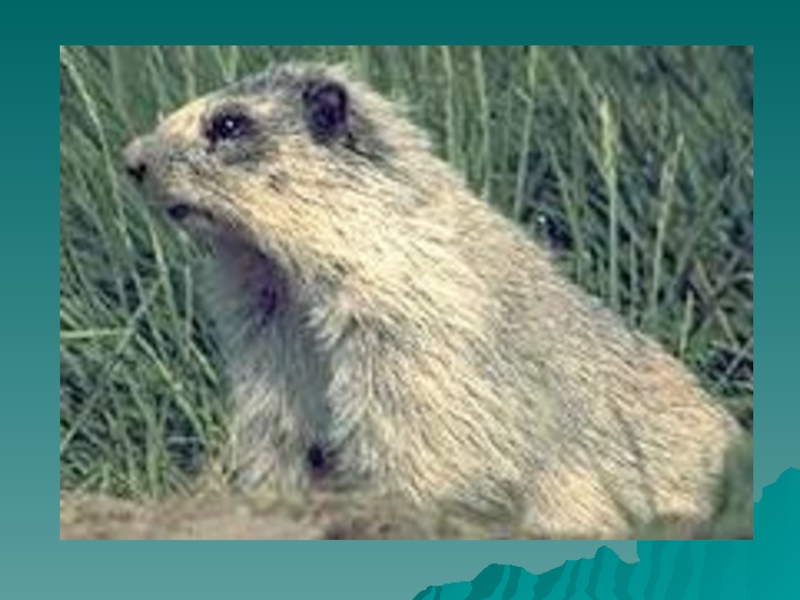
February 4, 1841 - from Morgantown, Berks County (Pennsylvania) storekeeper James Morris' diary..."Last Tuesday, the 2nd, was Candlemas day, the day on which, according to the Germans, the Groundhog peeps out of his winter quarters and if he sees his shadow he pops back for another six weeks nap, but if the day be cloudy he remains out, as the weather is to be moderate."
February 4, 1841 - from Morgantown, Berks County (Pennsylvania) storekeeper James Morris' diary..."Last Tuesday, the 2nd, was Candlemas day, the day on which, according to the Germans, the Groundhog peeps out of his winter quarters and if he sees his shadow he pops back for another six weeks nap, but if the day be cloudy he remains out, as the weather is to be moderate."
Слайд 13Valentine’s Day
Every February, across the USA, candy, flowers, and gifts are
exchanged between loved ones, all in the name of St. Valentine.
Слайд 14Valentine’s Day
The holiday of Valentine's Day probably derives its origins from
the ancient Roman feast of Lupercalia. In the early days of Rome, fierce wolves roamed the woods nearby. The Romans called upon one of their gods, Lupercus, to keep the wolves away. A festival held in honor of Lupercus was celebrated February 15th. The festival was celebrated as a spring festival. Their calendar was different at that time, with February falling in early springtime.
Слайд 15Valentine’s Day
One of the customs of the young people was name-drawing.
On the eve of the festival of Lupercalia the names of Roman girls were written on slips of paper and placed into jars. Each young man drew a slip. The girl whose name was chosen was to be his sweetheart for the year
Слайд 16Valentine’s Day
Legend has it that the holiday became Valentine's Day after
a priest named Valentine. Valentine was a priest in Rome at the time Christianity was a new religion. The Emperor at that time, Claudius II, ordered the Roman soldiers NOT to marry or become engaged. Claudius believed that as married men, his soldiers would want to stay home with their families rather than fight his wars. Valentine defied the Emperor's decree and secretly married the young couples. He was eventually arrested, imprisoned, and put to death
Слайд 17Valentine’s Day
Valentine was beheaded on February 14th, the eve of the
Roman holiday Lupercalia. After his death, Valentine was named a saint. As Rome became more Christian, the priests moved the spring holiday from the 15th of February to the 14th - Valentine's Day. Now the holiday honored Saint Valentine instead of Lupercus
Слайд 18President’s Day
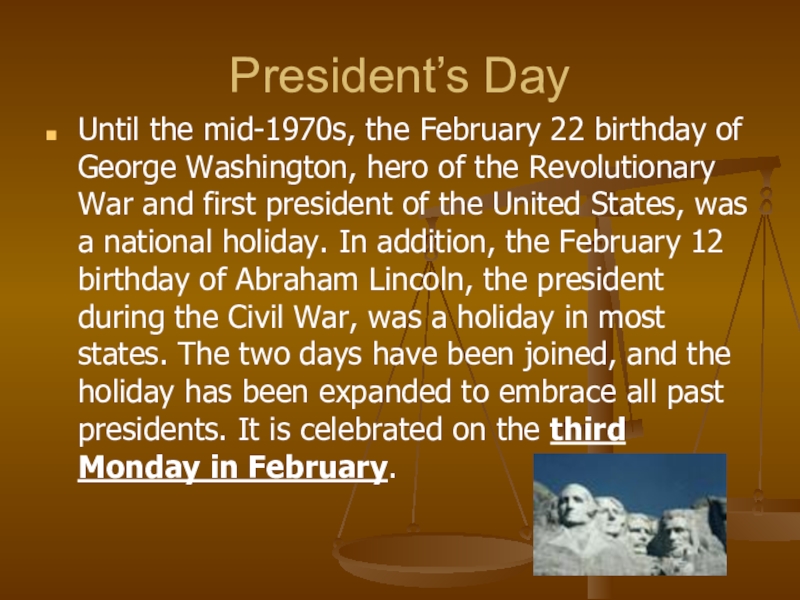
Until the mid-1970s, the February 22 birthday of George Washington,
hero of the Revolutionary War and first president of the United States, was a national holiday. In addition, the February 12 birthday of Abraham Lincoln, the president during the Civil War, was a holiday in most states. The two days have been joined, and the holiday has been expanded to embrace all past presidents. It is celebrated on the third Monday in February.
Слайд 19Arbor Day
First Friday in April
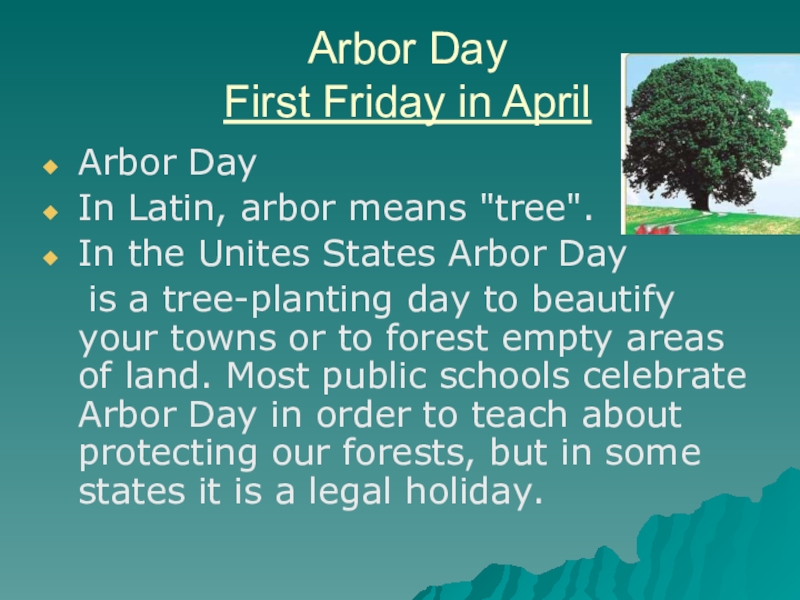
Arbor Day
In Latin, arbor means "tree".
In the Unites States Arbor Day
is a tree-planting day to beautify your towns or to forest empty areas of land. Most public schools celebrate Arbor Day in order to teach about protecting our forests, but in some states it is a legal holiday.
Слайд 20In the United States Mother's Day was first suggested in 1872
by Julia Ward Howe (who wrote the words to the Battle Hymn of the Republic) as a day dedicated to peace. Ms. Howe would hold organized Mother's Day meetings in Boston, Mass ever year.
Mother’s Day
Слайд 21In 1907 Ana Jarvis, from Philadelphia, began a campaign to establish
a national Mother's Day. Ms. Jarvis persuaded her mother's church in Grafton, West Virginia to celebrate Mother's Day on the second anniversary of her mother's death, the 2nd Sunday of May. By the next year Mother's Day was also celebrated in Philadelphia.
Слайд 22Mother’s Day
Ms. Jarvis and her supporters began to write to ministers,
businessman, and politicians in their quest to establish a national Mother's Day. It was successful as by 1911 Mother's Day was celebrated in almost every state. President Woodrow Wilson, in 1914, made the official announcement proclaiming Mother's Day as a national holiday that was to be held each year on the 2nd Sunday of May.
Слайд 23Mother’s Day
In the United States Mother's Day was first suggested in
1872 by Julia Ward Howe (who wrote the words to the Battle hymn of the Republic) as a day dedicated to peace. Ms. Howe would hold organized Mother's Day meetings in Boston, Mass ever year.
Слайд 24Mother’s Day
In 1907 Ana Jarvis, from Philadelphia, began a campaign to
establish a national Mother's Day. Ms. Jarvis persuaded her mother's church in Grafton, West Virginia to celebrate Mother's Day on the second anniversary of her mother's death, the 2nd Sunday of May. By the next year Mother's Day was also celebrated in Philadelphia.
Слайд 25Mother’s Day
Ms. Jarvis and her supporters began to write to ministers,
businessman, and politicians in their quest to establish a national Mother's Day. It was successful as by 1911 Mother's Day was celebrated in almost every state. President Woodrow Wilson, in 1914, made the official announcement proclaiming Mother's Day as a national holiday that was to be held each year on the 2nd Sunday of May.
Слайд 26Memorial Day
4th Monday of May
This holiday, on the fourth Monday of
every May, is a day on which Americans honor the fallen soldiers. Originally a day on which flags and flowers were placed on graves of soldiers who died in the American Civil War, it has become a day on which the dead of all wars are remembered the same way.
Слайд 27Memorial Day
On Memorial Day, the President or Vice President of the
United States gives a speech and lays a wreath on the tombs. Members of the armed forces shoot a rifle salute in the air. Veterans and families come to lay their own wreaths and say prayers. It is a day of reflection.
Слайд 28Memorial Day
In 1971, along with other holidays, President Richard Nixon declared
Memorial Day a federal holiday on the last Monday in May. Cities all around the United States hold their own ceremonies on the last Monday in May to pay respect to the men and women who have died in wars or in the service of their country.
Слайд 29Father’s Day
3rd Sunday of June
Father's Day is a day of
commemoration and celebration of Dad. It is a day to not only honor your father, but all men who have acted as a father figure in your life - whether as Stepfathers, Uncles, Grandfathers, or "Big Brothers."
Слайд 30Father’s Day
The first Father's Day was observed on June 19, 1910
in Spokane Washington. At about the same time in various towns and cities across American other people were beginning to celebrate a "father's day." In 1924 President Calvin Coolidge supported the idea of a national Father's Day. Finally in 1966 President Lyndon Johnson signed a presidential proclamation declaring the 3rd Sunday of June as Father's Day.
Слайд 31Father’s Day
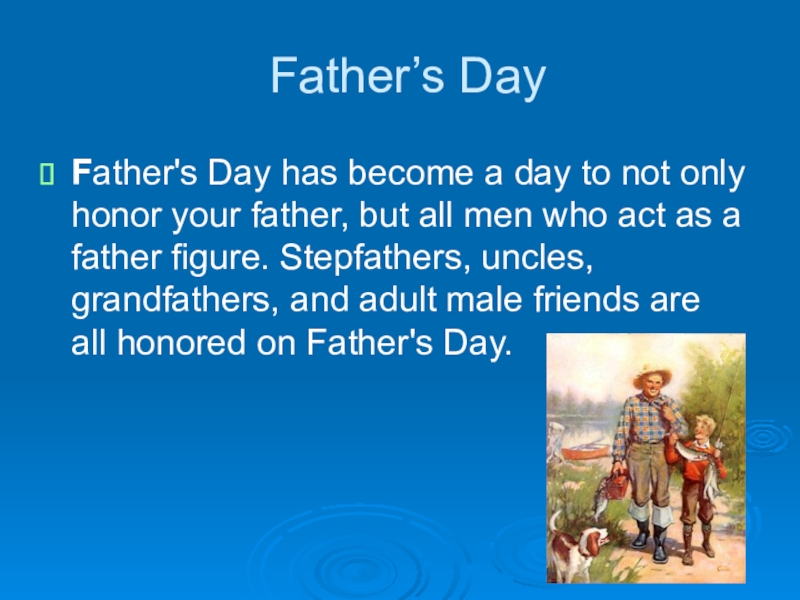
Father's Day has become a day to not only honor
your father, but all men who act as a father figure. Stepfathers, uncles, grandfathers, and adult male friends are all honored on Father's Day.
Слайд 32Birthdays
The tradition of birthday parties started in Europe a long time
ago. It was feared that evil spirits were particularly attracted to people on their birthdays. To protect them from harm, friends and family would to come be with the birthday person and bring good thoughts and wishes. Giving gifts brought even more good cheer to ward off the evil spirits. This is how birthday parties began.
Слайд 33Birthdays
Cake, candles and song.
A cake is made, and candles are
put on top based on how old the person is.
Then everyone sings the "happy birthday" song, and at the end of the song, the birthday child blows out the candles.
If they blow them all out with one blow, their birthday wishes will come true
Then everyone sings the "happy birthday" song, and at the end of the song, the birthday child blows out the candles.
If they blow them all out with one blow, their birthday wishes will come true
Слайд 34Mardi Gras (Fat Tuesday)
Tuesday Before Lent (Feb/March)
The celebration of Mardi Gras
-- the day before the Christian season of Lent begins in late winter -- is a big occasion in New Orleans, Louisiana, where huge parades and wild revels take place. As its French name implies (Mardi Gras means "Fat Tuesday," the last day of hearty eating before the penitential season of Lent), the tradition goes back to the city's settlement by French immigrants. There are many other such ethnic celebrations, and New York City is particularly rich in them.
Слайд 35Easter is a major Christian holiday that commemorates the resurrection of
Jesus Christ. It is celebrated on a Sunday between March 22 and April 25. The 40 days leading up to Easter are observed as Lent.
March/April
Слайд 36Besides the religious aspects of Easter, people also celebrate spring or
the signs of new life. Flowers are seen everywhere. There are often Easter Parades such as the one in New York City where people dress up in their new spring clothes.
Слайд 37Children receive Easter baskets filled with candy Easter eggs, chocolate bunnies
and jelly beans! The dying of eggs with food color is also an Easter tradition in many American families.
Слайд 39Independence Day
July 4th
Independence Day (fourth
of July) is celebrated
every year
in the U.S. on
July 4th. It commemorates the
signing of the Declaration of
Independence. The first
Independence Day was
celebrated in Philadelphia on
July 8, 1776. This is when the
declaration was read aloud.
July 4th. It commemorates the
signing of the Declaration of
Independence. The first
Independence Day was
celebrated in Philadelphia on
July 8, 1776. This is when the
declaration was read aloud.
Слайд 40Independence Day
July 4th
Parades, patriotic
speeches, fireworks
and pageants are all
ways
of celebrating today.
Many families celebrate the Fourth
Of July by having picnics and
going to the beach.
You will also find fireworks
being displayed in many towns
and cities across America on the Fourth of July!
Many families celebrate the Fourth
Of July by having picnics and
going to the beach.
You will also find fireworks
being displayed in many towns
and cities across America on the Fourth of July!
Слайд 41Labor Day
Labor Day is a legal holiday celebrated on the first
Monday in September. The celebration of Labor Day is in honor of the working class. Parades are held throughout the cities and towns of the United States. Generally, Labor Day is the last day of summer celebrations. It is a signal to students across the country that school is ready to begin again!
Слайд 42Columbus Day
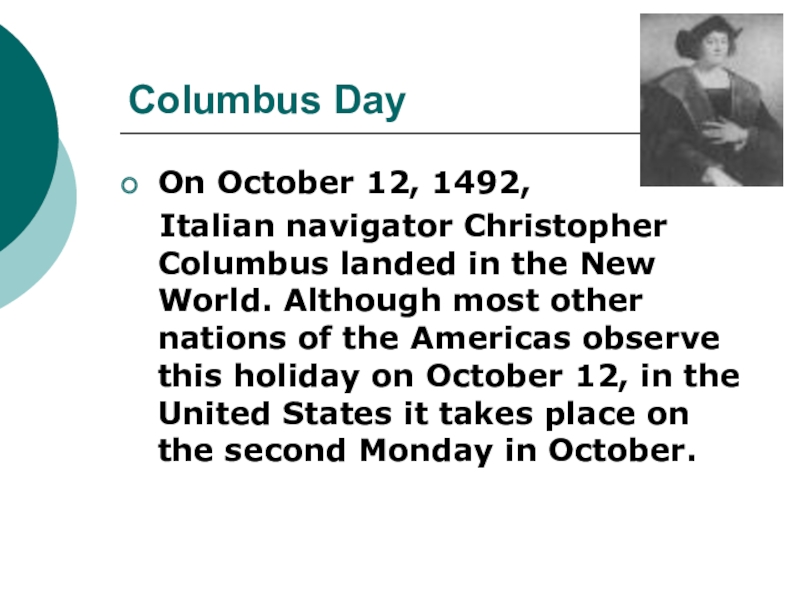
On October 12, 1492,
Italian navigator Christopher Columbus landed
in the New World. Although most other nations of the Americas observe this holiday on October 12, in the United States it takes place on the second Monday in October.
Слайд 43The Story of Halloween
Halloween is one of the with origins going
back thousands of years. The holiday we know as Halloween has had many influences from many cultures over the centuries. From the Roman's Pomona Day, to the Celtic festival of Samhain, to the Christian holidays of All Saints and All Souls Days.
Слайд 44The Story of Halloween
Hundreds of years ago in what is now
Great Britain and Northern , lived the Celts. The Celts worshipped nature and had many gods, with the sun god as their favorite. It was "he" who commanded their work and their rest times, and who made the earth beautiful and the crops grow.
Слайд 45The Story of Halloween
The Celts celebrated their on November 1st. It
was celebrated every year with a festival and marked the end of the "season of the sun" and the beginning of "the season of darkness and cold."
Слайд 46The Story of Halloween
On October 31st after the crops were all
harvested and stored for the long winter the cooking fires in the homes would be extinguished. The Druids, the Celtic priests, would meet in the hilltop in the dark oak forest (oak trees were considered sacred). The Druids would light new fires and offer sacrifices of crops and animals. As they danced around the the fires, the season of the sun passed and the season of darkness would begin.
Слайд 47The Story of Halloween
When the morning arrived the Druids would give
an ember from their fires to each family who would then take them home to start new cooking fires. These fires would keep the homes warm and free from evil spirits.
Слайд 48The Story of Halloween
The November 1st festival was called Samhain (pronounced
"sow-en"). The festival would last for 3 days. Many people would parade in made from the skins and heads of their animals. This festival would become the first Halloween.
Слайд 49The Story of Halloween
During the first century the Romans invaded Britain.
They brought with them many of their festivals and customs. One of these was the festival know as Pomona Day, named for their goddess of fruits and gardens. It was also celebrated around the 1st of November. After hundreds of years of Roman rule the customs of the Celtic's Sowen festival and the Roman Pomona Day mixed becoming 1 major fall holiday.
Слайд 50The Story of Halloween
The next influence came with the spread of
the new Christian religion throughout Europe and Britain. In the year 835 AD the Roman Catholic Church would make November 1st a church holiday to honor all the saints. This day was called All Saint's Day, or Hallowmas, or All Hallows. Years later the Church would make November 2nd a . It was called All Souls Day and was to honor the dead. It was celebrated with big bonfires, parades, and people saints, angels and devils.
Слайд 51The Story of Halloween
But the spread of Christianity did not make
people forget their early customs. On the eve of All Hallows, Oct. 31, people continued to celebrate the festivals of Sowen and Pomona Day. Over the years the customs from all these holidays mixed. October 31st became known as All Hallow Even, eventually All Hallow's Eve, , and then - Halloween.
Слайд 52The Story of Halloween
The Halloween we celebrate today includes all
of these influences, Pomona Day's apples, , and harvest, the Festival of Sowen’s black cats, magic, evil spirits and death, and the ghosts, skeletons and skulls from All Saint's Day and All Soul's Day.
Слайд 54The Story of Halloween
The history of "Trick'O'Treating" can be traced back
to the early celebrations of All Soul's Day in Britain. The poor would go begging and the housewives would give them special treats called "soulcakes". This was called "going a-souling", and the "soulers" would promise to say a prayer for the dead
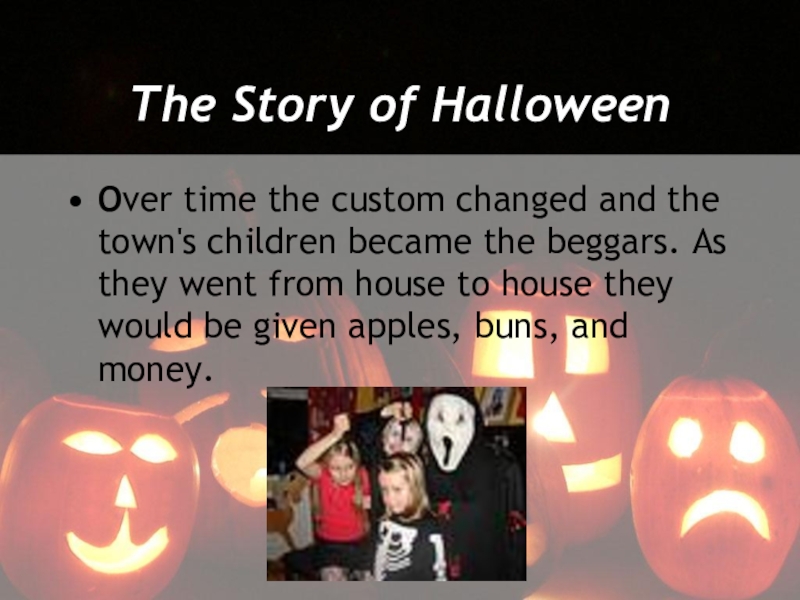
Слайд 55The Story of Halloween
Over time the custom changed and the town's
children became the beggars. As they went from house to house they would be given apples, buns, and money.
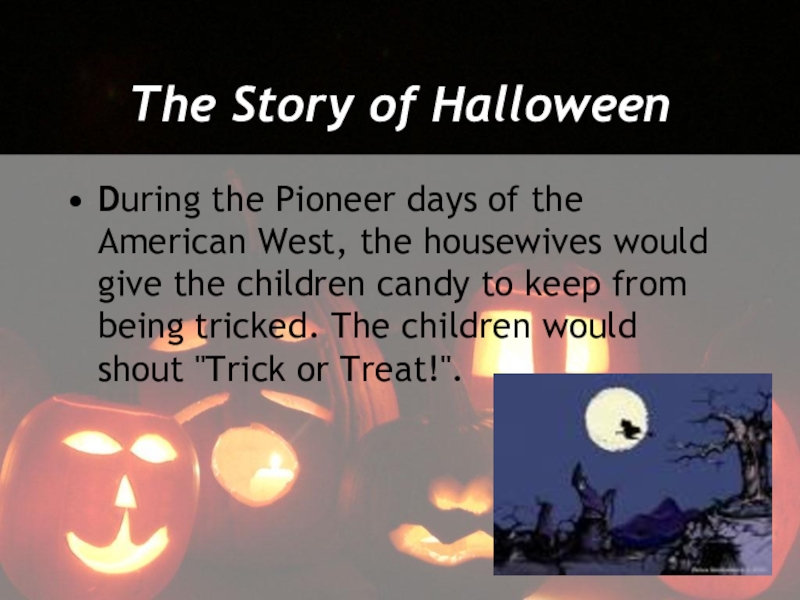
Слайд 56The Story of Halloween
During the Pioneer days of the American West,
the housewives would give the children candy to keep from being tricked. The children would shout "Trick or Treat!".
Слайд 57The First Thanksgiving
Squanto's importance to the Pilgrims was enormous and it
can be said that they would not have survived without his help. It was Squanto who taught the Pilgrims how to tap the maple trees for sap. He taught them which plants were poisonous and which had medicinal powers. He taught them how to plant the Indian corn by heaping the earth into low mounds with several seeds and fish in each mound. The decaying fish fertilized the corn. He also taught them to plant other crops with the corn.
Слайд 58The First Thanksgiving
The harvest in October was very successful and the
Pilgrims found themselves with enough food to put away for the winter. There was corn, fruits and vegetables, fish to be packed in salt, and meat to be cured over smoky fires.
Слайд 59The First Thanksgiving
The Pilgrims had much to celebrate, they had built
homes in the wilderness, they had raised enough crops to keep them alive during the long coming winter, they were at peace with their Indian neighbors. They had beaten the odds and it was time to celebrate.
Слайд 60The First Thanksgiving
The Pilgrim Governor William Bradford proclaimed a day of
thanksgiving to be shared by all the colonists and the neighboring Native Americans. They invited Squanto and the other Indians to join them in their celebration. Their chief, Massasoit, and 90 braves came to the celebration which lasted for 3 days. They played games, ran races, marched and played drums. The Indians demonstrated their skills with the bow and arrow and the Pilgrims demonstrated their musket skills. Exactly when the festival took place is uncertain, but it is believed the celebration took place in mid-October.
Слайд 61Thanksgiving Becomes A Custom
The custom of an annually celebrated thanksgiving, held
after the harvest, continued through the years. During the American Revolution (late 1770's) a day of national thanksgiving was suggested by the Continental Congress.
Слайд 62Thanksgiving
Becomes Official
In 1817 New York State had adopted Thanksgiving Day
as an annual custom. By the middle of the 19th century many other states also celebrated a Thanksgiving Day.
Слайд 63Thanksgiving Becomes a National Holiday
In 1863 President Abraham Lincoln appointed a
national day of thanksgiving. Since then each president has issued a Thanksgiving Day proclamation, usually designating the fourth Thursday of each November as the holiday.
Слайд 65Christmas Traditions
Santa Claus was born in US in the 1860's he
was named this as he had a white beard and a belly, so he was named Santa Claus as this was the Dutch word for St Nicholas, Sintaklaas. Although the Dutch had bought him with them in the 17th century, he did not become an important person at Christmas until the Novelist Washington Irving put him in a novel that he wrote in 1809. This first Santa Claus was still known as St. Nicholas, he did smoke a pipe, and fly around in a wagon without any reindeer, but he did not have
his red suit or live at the North Pole, he did
however bring presents to children every year.
In 1863 He was given the name Santa Claus
and bore the red suit, pipe, and his reindeer
and sleigh.
his red suit or live at the North Pole, he did
however bring presents to children every year.
In 1863 He was given the name Santa Claus
and bore the red suit, pipe, and his reindeer
and sleigh.
Слайд 66CHRISTMAS THINGS
Candy Canes:
These are really candy , one of St.
Nicholas' symbols. All carry staffs, hooked at the top like a shepherd's crook, showing they are the shepherds who care for, or tend, their people.
Слайд 67CHRISTMAS THINGS
Christmas stockings by the fireplace:
And the stockings were hung by
the chimney with care in hopes that St. Nicholas soon would be there, goes the oft repeated Christmas rhyme. In the story of Nicholas rescuing the poor maidens from being sold into slavery, the gold money, tossed in through the chimney or window, is said to have landed in stockings left to dry before the fire.
Слайд 68CHRISTMAS THINGS
Orange or tangerine in the toe of filled Christmas stockings:
The
gold Nicholas threw to provide the dowry money is often shown as gold balls. These are symbolized by oranges or even apples. So the orange in the toe of the stocking is a reminder of Nicholas' gift.
Слайд 69CHRISTMAS THINGS
Gift-giving in secret, during the night:
Stockings are filled while children
are sleeping. Nicholas did his gift giving secretly, under cover of darkness. He didn't want to be seen and recognized as he wanted those he helped to give thanks to God.
Слайд 70CHRISTMAS THINGS
Seasonal concern for the needy:
St. Nicholas gave gifts to those
in greatest need—the young and the most vulnerable. Christmas gifts and baskets given to those in need, along with other seasonal contributions to charity, reflect St. Nicholas' unselfish concern for others. He never wanted or expected anything in return.
Слайд 71CHRISTMAS TREES
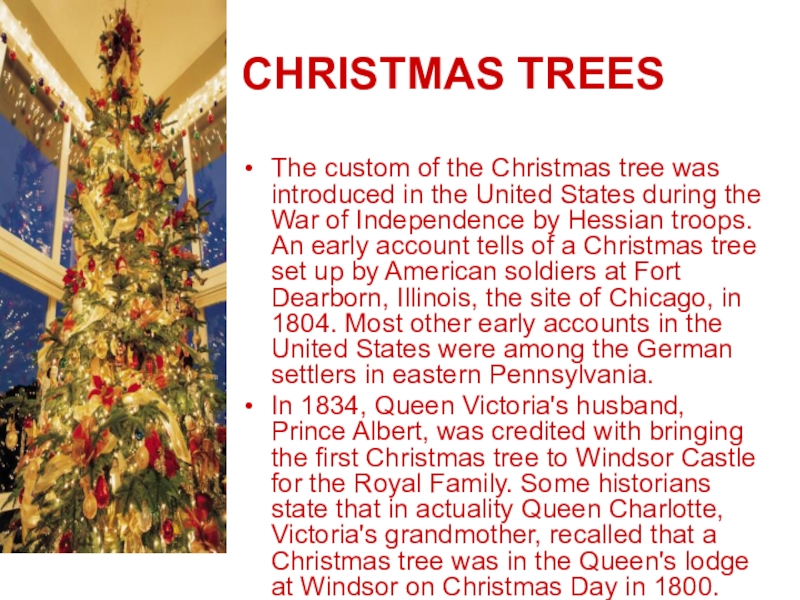
The custom of the Christmas tree was introduced in the
United States during the War of Independence by Hessian troops. An early account tells of a Christmas tree set up by American soldiers at Fort Dearborn, Illinois, the site of Chicago, in 1804. Most other early accounts in the United States were among the German settlers in eastern Pennsylvania.
In 1834, Queen Victoria's husband, Prince Albert, was credited with bringing the first Christmas tree to Windsor Castle for the Royal Family. Some historians state that in actuality Queen Charlotte, Victoria's grandmother, recalled that a Christmas tree was in the Queen's lodge at Windsor on Christmas Day in 1800.
In 1834, Queen Victoria's husband, Prince Albert, was credited with bringing the first Christmas tree to Windsor Castle for the Royal Family. Some historians state that in actuality Queen Charlotte, Victoria's grandmother, recalled that a Christmas tree was in the Queen's lodge at Windsor on Christmas Day in 1800.
Слайд 72Christmas Trees
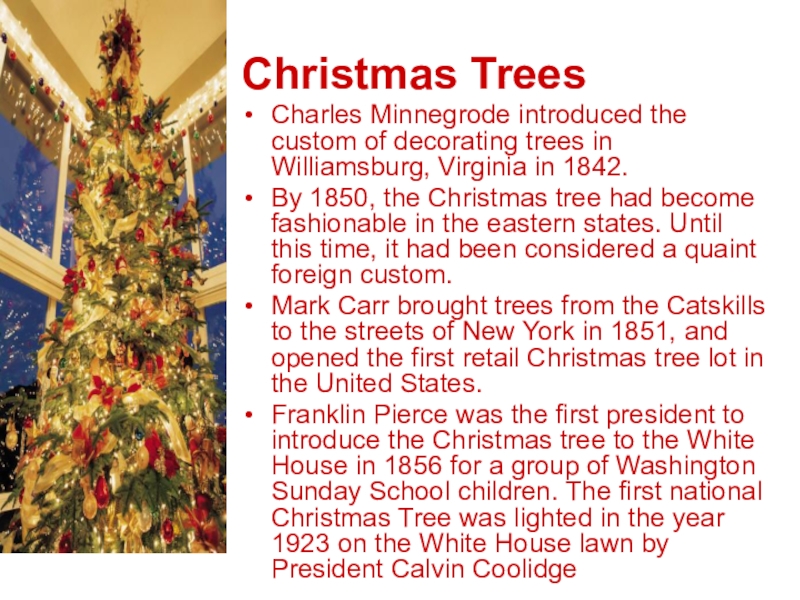
Charles Minnegrode introduced the custom of decorating trees in Williamsburg,
Virginia in 1842.
By 1850, the Christmas tree had become fashionable in the eastern states. Until this time, it had been considered a quaint foreign custom.
Mark Carr brought trees from the Catskills to the streets of New York in 1851, and opened the first retail Christmas tree lot in the United States.
Franklin Pierce was the first president to introduce the Christmas tree to the White House in 1856 for a group of Washington Sunday School children. The first national Christmas Tree was lighted in the year 1923 on the White House lawn by President Calvin Coolidge
By 1850, the Christmas tree had become fashionable in the eastern states. Until this time, it had been considered a quaint foreign custom.
Mark Carr brought trees from the Catskills to the streets of New York in 1851, and opened the first retail Christmas tree lot in the United States.
Franklin Pierce was the first president to introduce the Christmas tree to the White House in 1856 for a group of Washington Sunday School children. The first national Christmas Tree was lighted in the year 1923 on the White House lawn by President Calvin Coolidge
Слайд 73A Christmas Song
The first Noel the angels did say,
Was to certain
poor shepherds in field where they lay.
Noel, noel, noel, noel!
Born is the king of Israel.
Noel, noel, noel, noel!
Born is the king of Israel.