- Главная
- Разное
- Образование
- Спорт
- Естествознание
- Природоведение
- Религиоведение
- Французский язык
- Черчение
- Английский язык
- Астрономия
- Алгебра
- Биология
- География
- Геометрия
- Детские презентации
- Информатика
- История
- Литература
- Математика
- Музыка
- МХК
- Немецкий язык
- ОБЖ
- Обществознание
- Окружающий мир
- Педагогика
- Русский язык
- Технология
- Физика
- Философия
- Химия
- Шаблоны, фоны, картинки для презентаций
- Экология
- Экономика
Презентация, доклад по английскому языку
Содержание
- 1. Презентация по английскому языку
- 2. English is taught
- 3. We’d like to introduce you some methods
- 4. EXAMPLESMy house
- 5. Слайд 5
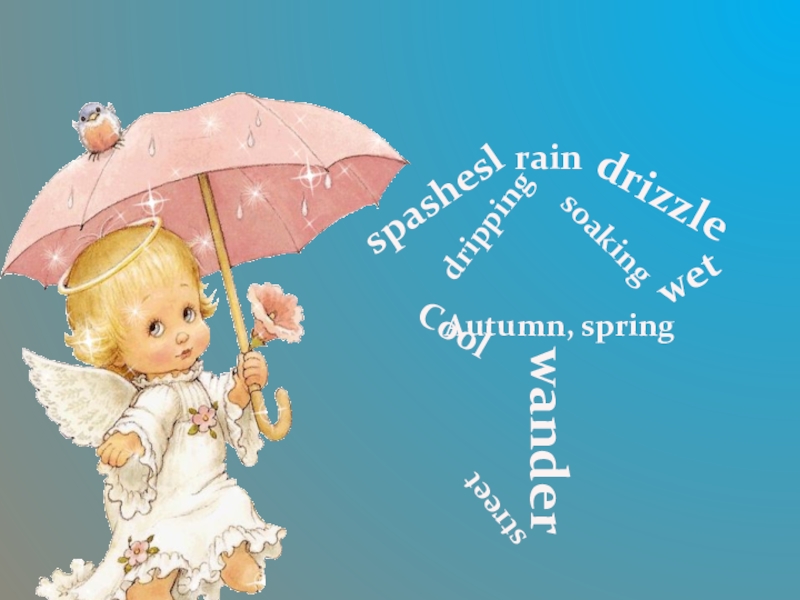
- 6. spasheslraindrizzledrippingsoakingCool wetAutumn, springwanderstreet
- 7. Diamond poems.Such poem has seven lines in
- 8. Слайд 8
- 9. My parents
- 10. Phonetic poemsAsk the learners to make up
- 11. Listen. Choose. Read.1. а)tree — three
- 12. Young designers (group work)Show the learners a
- 13. ReadingDivide the class into groups.Divide the text
- 14. FurnitureNew language ‘Furniture vocabulary area (for example, chair,
- 15. 1. Put up the plan of
- 16. opposite, etc. * Take down, or
- 17.
- 18. When your learners want to answer they
- 19. Ask your learners to give more
- 20. Thank you for your attention !!!
English is taught all over the world, by all sorts of teachers to all sorts of learners. Schools and classrooms enormously in their different forms from place to place . But,

Слайд 2
English is taught all over the world, by all sorts of
teachers to all sorts of learners. Schools and classrooms enormously in their
different forms from place to place . But, whatever the conditions you are working, there is one resource which is universal and unlimited: the human mind and imagination. This is probably the one single most valuable teaching and learning resource we have . Nothing can change it .
Слайд 3We’d like to introduce you some methods we consider very useful
and interesting. They help to increase students vocabulary , imagination and to improve the learners knowledge
CONCRETE POEMS:
1.Show the learners a subject.
2.ask them to write all words associating with it.
3.ask the learners to write the associating words in a shape of the subject.
:
Слайд 4EXAMPLES
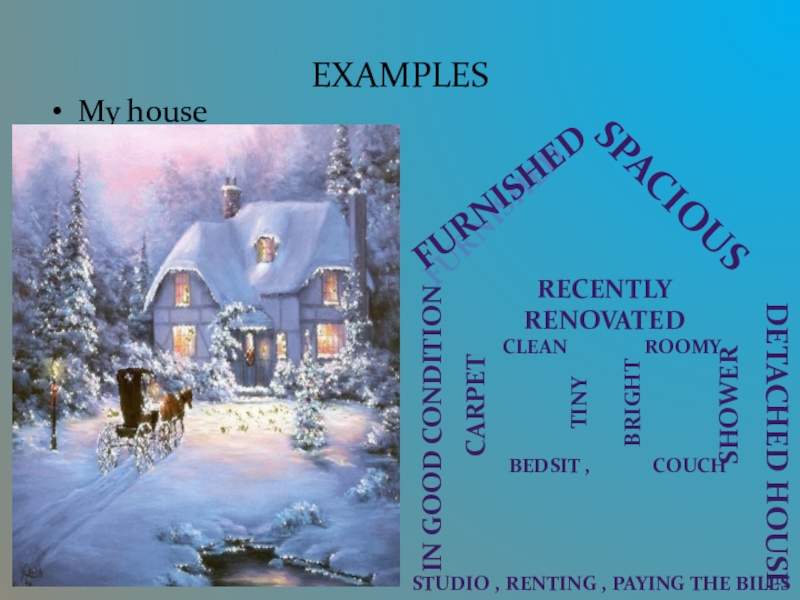
My house
Furnished
Furnished
Spacious
Recently renovated
Detached
house
In good condition
Studio , renting , paying the bills
clean roomy
Tiny
bright
bedsit , couch
carpet
shower

Слайд 7Diamond poems.
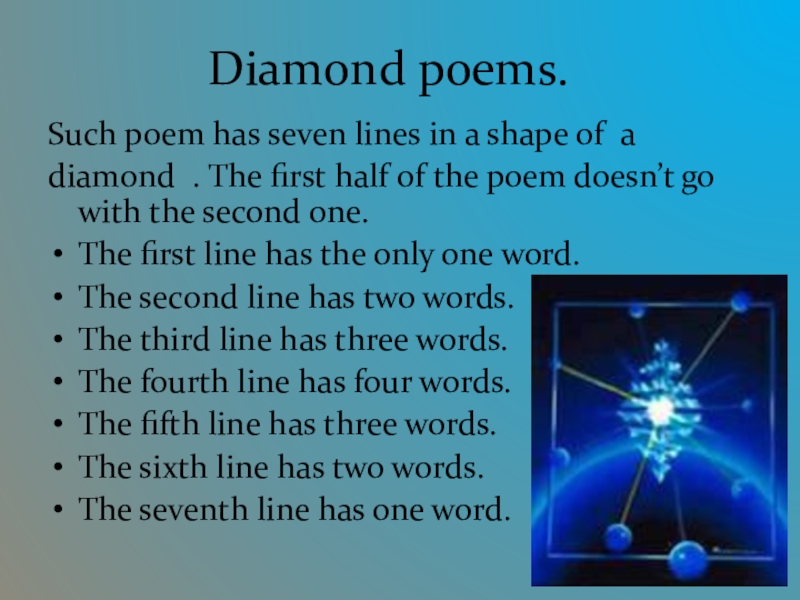
Such poem has seven lines in a shape of a
diamond
. The first half of the poem doesn’t go with the second one.
The first line has the only one word.
The second line has two words.
The third line has three words.
The fourth line has four words.
The fifth line has three words.
The sixth line has two words.
The seventh line has one word.
The first line has the only one word.
The second line has two words.
The third line has three words.
The fourth line has four words.
The fifth line has three words.
The sixth line has two words.
The seventh line has one word.
Слайд 8
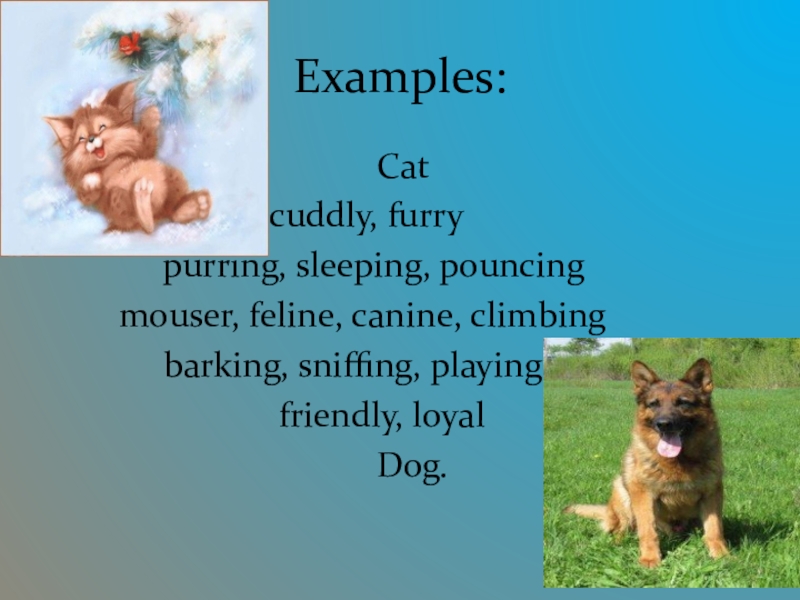
Cat
cuddly, furry
purring, sleeping, pouncing
mouser, feline, canine, climbing
barking, sniffing, playing
friendly, loyal
Dog.
cuddly, furry
purring, sleeping, pouncing
mouser, feline, canine, climbing
barking, sniffing, playing
friendly, loyal
Dog.
Examples:
Слайд 9
My parents
Mother
kind , careful
cooking ,helping, kissing
young, patient, strict , strong
brave, handsome, tall
hardworking, reliable
Father
kind , careful
cooking ,helping, kissing
young, patient, strict , strong
brave, handsome, tall
hardworking, reliable
Father
Обои дня:
Обои дня:

Слайд 10Phonetic poems
Ask the learners to make up a rhyming sentence using
different words with one common vowel sound.
Examples :
Mike took my bright tie. [ ai ]
You see me swimming in the sea. [ I: ]
Examples :
Mike took my bright tie. [ ai ]
You see me swimming in the sea. [ I: ]
Слайд 11Listen. Choose. Read.
1. а)tree — three
б) three — tree
2.
а) man — men
б) men — man
3. а) cheap — chip
б) chip - cheap
б) men — man
3. а) cheap — chip
б) chip - cheap
4.а) bet - bed - bad
б) bed - bad - bet
5.а) cut - cat -
caught
б) cat - caught –
cut
6.а) hat -hard-
heard
б) hat- heard -
hard

Слайд 12Young designers (group work)
Show the learners a toy.
Divide the learners into
groups.
Ask the learners to improve and modernize it.
Ask the learners to write down all steps of their work and draw the toy before and after their work.
After work each group must choose a representative who will be protect their work.
The learners can use notes during their answer.
Ask the learners to improve and modernize it.
Ask the learners to write down all steps of their work and draw the toy before and after their work.
After work each group must choose a representative who will be protect their work.
The learners can use notes during their answer.
Слайд 13Reading
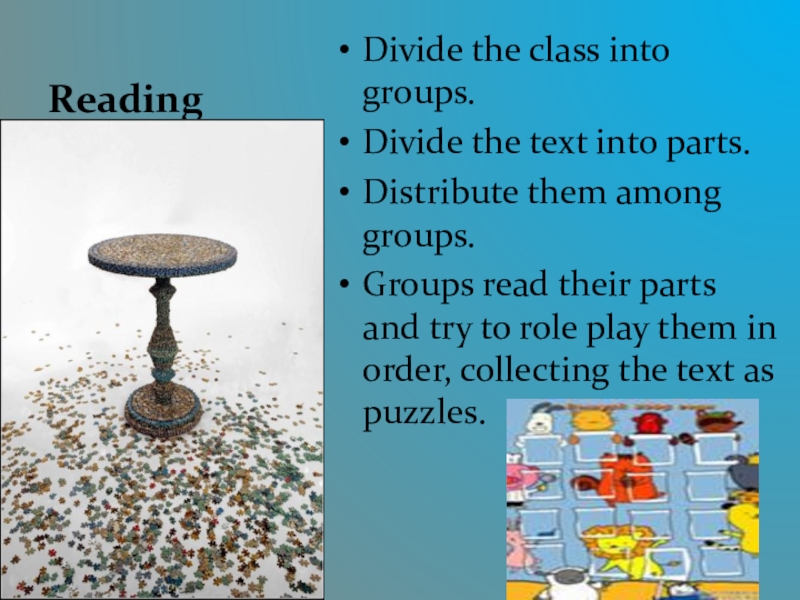
Divide the class into groups.
Divide the text into parts.
Distribute them among
groups.
Groups read their parts and try to role play them in order, collecting the text as puzzles.
Groups read their parts and try to role play them in order, collecting the text as puzzles.
Слайд 14Furniture
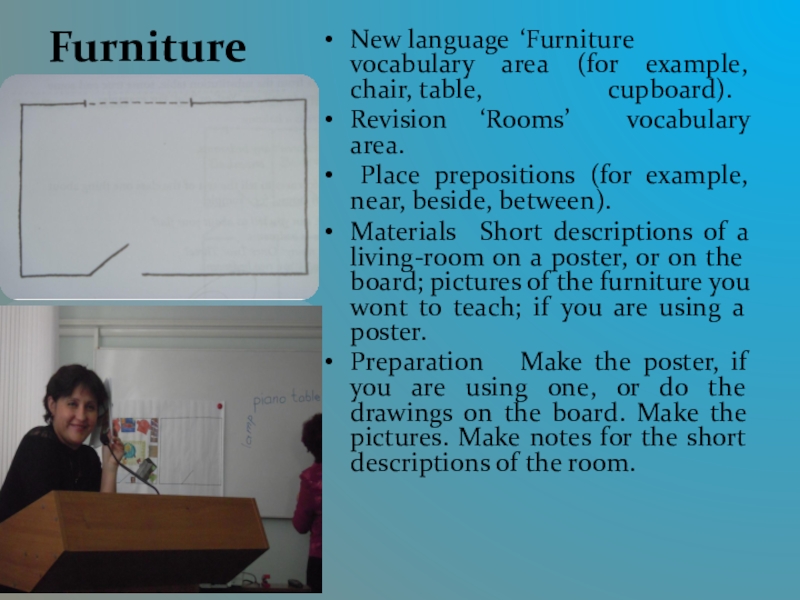
New language ‘Furniture vocabulary area (for example, chair, table,
cupboard).
Revision ‘Rooms’ vocabulary area.
Place prepositions (for example, near, beside, between).
Materials Short descriptions of a living-room on a poster, or on the board; pictures of the furniture you wont to teach; if you are using a poster.
Preparation Make the poster, if you are using one, or do the drawings on the board. Make the pictures. Make notes for the short descriptions of the room.
Revision ‘Rooms’ vocabulary area.
Place prepositions (for example, near, beside, between).
Materials Short descriptions of a living-room on a poster, or on the board; pictures of the furniture you wont to teach; if you are using a poster.
Preparation Make the poster, if you are using one, or do the drawings on the board. Make the pictures. Make notes for the short descriptions of the room.
Слайд 15 1. Put up the plan of the living- room. Tell
the class ‘I’m moving house. This is my new living-room. It’s empty now. I’ve got to
move in all the furniture’. Show them the sofa and ask ‘Where shall I put the sofa?’
Prompt them with suggestions, for example:
Teacher Where shall I put the sofa? Here, by the window? Or over here, next to the door?
Learners Next door, next door!
Teacher Next to the door. O.K. Let’s put the sofa next to the door (pins picture to plan).
What about the armchair? (etc).
2. When all the furniture is in position, pretend to be on the phone to
a friend telling her about the new room and how you have arranged it; for example:
I’ve just moved in. The living-room’s really nice. I’ve put the sofa next to the door.
And next to the sofa there’s an armchair… etc.
3. Ask a learner to come up to the board. Ask him or her to point the pieces of furniture as
you repeat your description.
4. Write the names of the pieces of furniture on the board. Below them, write the list of
prepositions, leaving space on both sides. Get the learners to repeat the words in chorus.
If necessary, practice pronunciation.
5. Make the list of prepositions into a substitution table like this:
There’s a ________ near the ___________
an next to
Слайд 16 opposite, etc. * Take down, or rub out, the pictures of furniture
on the plan.
* Tell the learners that they are going to work in pairs. Give each pair two pieces of paper.
* Get one learner in each pair to copy the plan of the room onto one piece of paper. Meanwhile, the other learner should tear up the other piece of paper and write a name of a piece of furniture on
* Repeat your descriptions of the room. The learners should arrange the small pieces of paper in the right position on their plans.
* Ask learners to make sentences to describe their rooms.

Слайд 17 What do I spy? LANGUAGE Revision of colours, shapes ,and sizes ,and
the name of things your learners use in the
classroom ,for example: a pencil, a brush, e.t.c.
Things in pictures around the classroom: a star ,the moon ,etc.
Rhyme: ‘What do I spy?’
RESOURCES AND PREPARATION everything you have in the classroom including the pictures on the walls. Be prepared to describe the size, shape, and colour of what your learners can see.
……………………………………………..
Tell your class that you are going to describe six different items in the room. You can tell them the size, shape, and colour of each item. They have to guess what you are describing. Say this short rhyme before you describe a new thing in the room:
What do I spy?
What do I spy?
Way down low
Or way up high.
Can you tell me
What I see?
It’s near you
And it’s near me.
…
It’s in this room.
It’s small and round and red.
What is it?
Слайд 18When your learners want to answer they should put up their
hands.
Okay …do you know what I am describing? ...Yes, …you have your hand up … Yes…the pencil sharpener…on my desk …
Very good.
When your learners have guessed your six items ask them to get into groups. Tell them to pick four things and prepare to answer questions from the other groups’ objects and to guess what the other groups’ objects are.
When they are ready tell them that
each group has to say the rhyme before one learner says the clue
the team that guesses correctly gives the next description
if no one guesses a description from the size, shape, or colour, the team can give the extra clues.

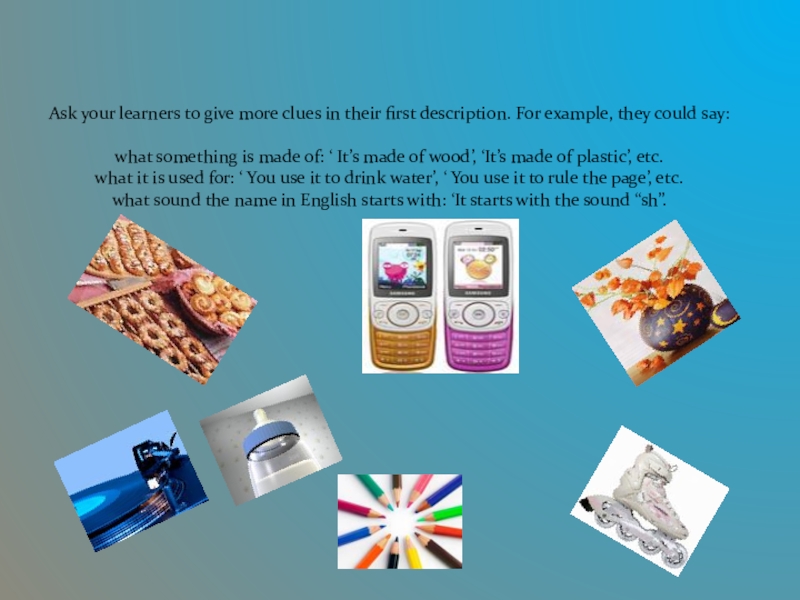
Слайд 19 Ask your learners to give more clues in their first description.
For example, they could say:
what something is made of: ‘ It’s made of wood’, ‘It’s made of plastic’, etc.
what it is used for: ‘ You use it to drink water’, ‘ You use it to rule the page’, etc.
what sound the name in English starts with: ‘It starts with the sound “sh”.