Презентация, доклад на Английском языке: Tokyo

The city that would become one of the world’s largest metropolises started out as a small fishing village, first settled around 3,000 B.C. Known as Edo, or “estuary” it was first fortified in the 12th

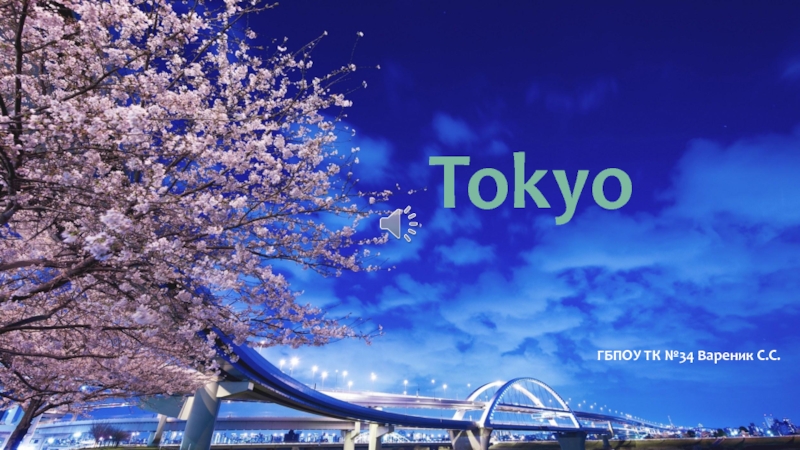
Слайд 1Tokyo
ГБПОУ ТК №34 Вареник С.С.

TokyoГБПОУ ТК №34 Вареник С.С.

Слайд 2 The city that would become one of the world’s largest metropolises

started out as a small fishing village, first settled around 3,000 B.C. Known as Edo, or “estuary” it was first fortified in the 12th century and became home to Edo Castle (now the site of the Imperial Palace) in the 1450s. Edo’s influence and growing importance in Japanese society was due to its role as the base of power for the Tokugawa shogunate, which ruled the country for more than 250 years until its overthrow in 1868.

Tokyo began life as
a village known as Edo
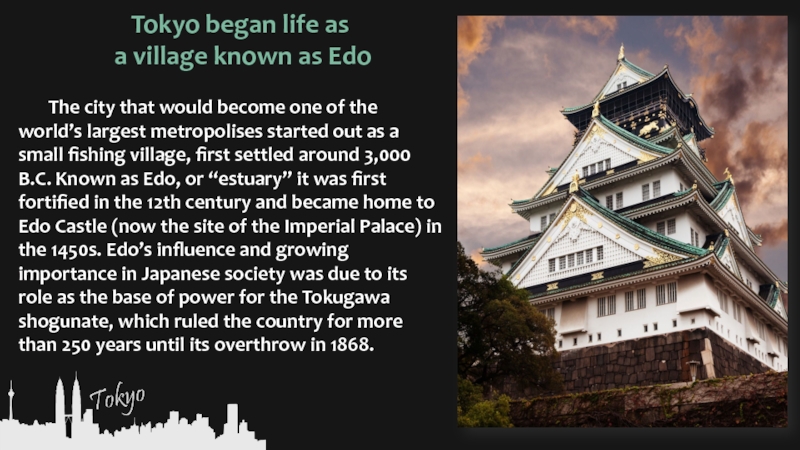
The city that would become one of the world’s largest metropolises started out as a small

Слайд 3 During this era, known as the Edo period, the city
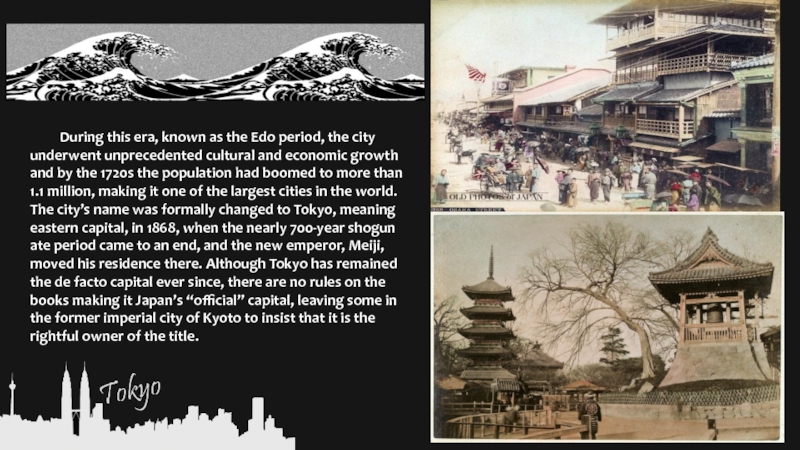
underwent unprecedented cultural and economic growth and by the 1720s the population had boomed to more than 1.1 million, making it one of the largest cities in the world. The city’s name was formally changed to Tokyo, meaning eastern capital, in 1868, when the nearly 700-year shogun ate period came to an end, and the new emperor, Meiji, moved his residence there. Although Tokyo has remained the de facto capital ever since, there are no rules on the books making it Japan’s “official” capital, leaving some in the former imperial city of Kyoto to insist that it is the rightful owner of the title.

During this era, known as the Edo period, the city underwent unprecedented cultural and economic growth

Слайд 4A massive earthquake destroyed nearly
half of Tokyo in 1923.
Just
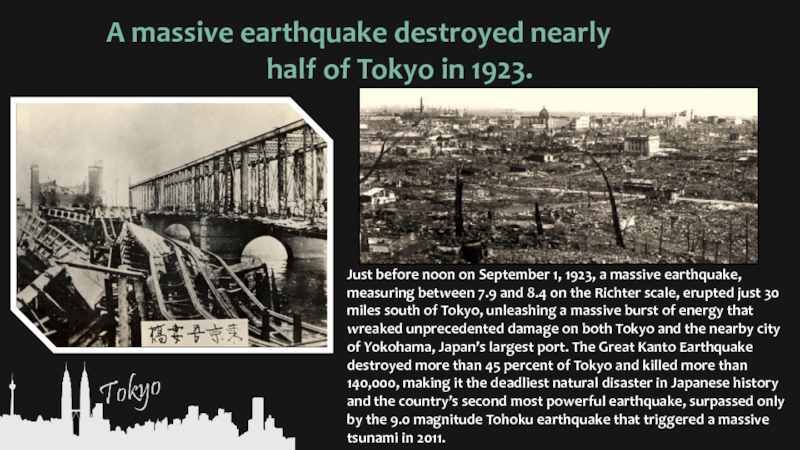
before noon on September 1, 1923, a massive earthquake, measuring between 7.9 and 8.4 on the Richter scale, erupted just 30 miles south of Tokyo, unleashing a massive burst of energy that wreaked unprecedented damage on both Tokyo and the nearby city of Yokohama, Japan’s largest port. The Great Kanto Earthquake destroyed more than 45 percent of Tokyo and killed more than 140,000, making it the deadliest natural disaster in Japanese history and the country’s second most powerful earthquake, surpassed only by the 9.0 magnitude Tohoku earthquake that triggered a massive tsunami in 2011.
A massive earthquake destroyed nearly half of Tokyo in 1923. Just before noon on September 1, 1923,

Слайд 5Tokyo has the world’s busiest metro system.
First opened in 1927 and
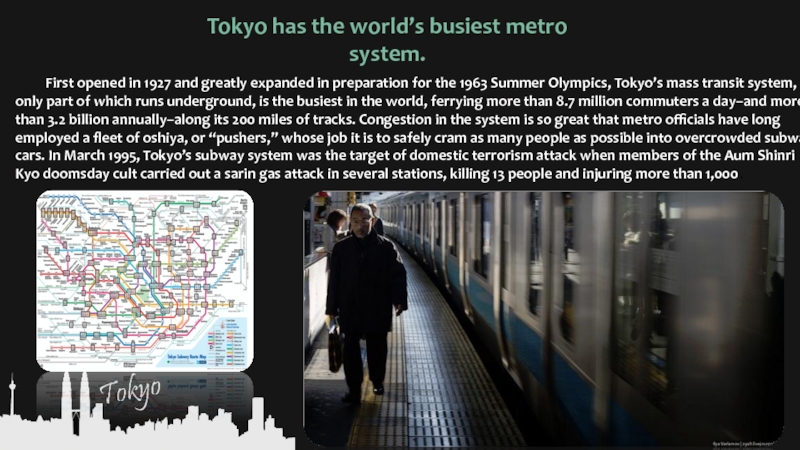
greatly expanded in preparation for the 1963 Summer Olympics, Tokyo’s mass transit system, only part of which runs underground, is the busiest in the world, ferrying more than 8.7 million commuters a day–and more than 3.2 billion annually–along its 200 miles of tracks. Congestion in the system is so great that metro officials have long employed a fleet of oshiya, or “pushers,” whose job it is to safely cram as many people as possible into overcrowded subway cars. In March 1995, Tokyo’s subway system was the target of domestic terrorism attack when members of the Aum Shinri Kyo doomsday cult carried out a sarin gas attack in several stations, killing 13 people and injuring more than 1,000.
Tokyo has the world’s busiest metro system.	First opened in 1927 and greatly expanded in preparation for the

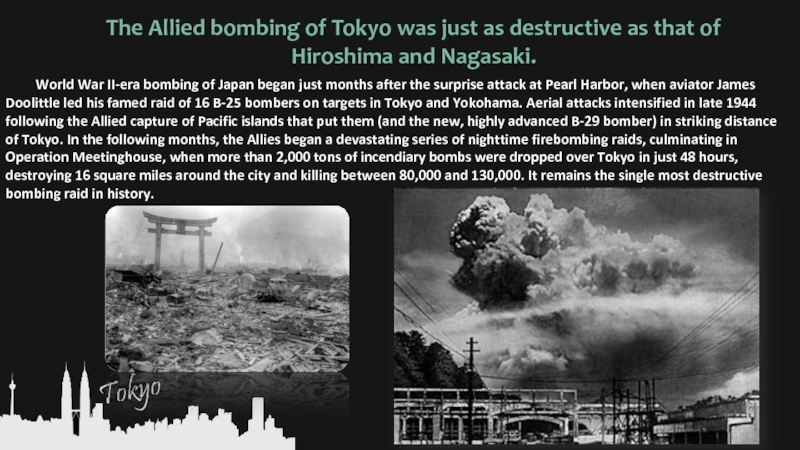
Слайд 6The Allied bombing of Tokyo was just as destructive as that

of Hiroshima and Nagasaki.

World War II-era bombing of Japan began just months after the surprise attack at Pearl Harbor, when aviator James Doolittle led his famed raid of 16 B-25 bombers on targets in Tokyo and Yokohama. Aerial attacks intensified in late 1944 following the Allied capture of Pacific islands that put them (and the new, highly advanced B-29 bomber) in striking distance of Tokyo. In the following months, the Allies began a devastating series of nighttime firebombing raids, culminating in Operation Meetinghouse, when more than 2,000 tons of incendiary bombs were dropped over Tokyo in just 48 hours, destroying 16 square miles around the city and killing between 80,000 and 130,000. It remains the single most destructive bombing raid in history.
The Allied bombing of Tokyo was just as destructive as that of Hiroshima and Nagasaki.	World War II-era

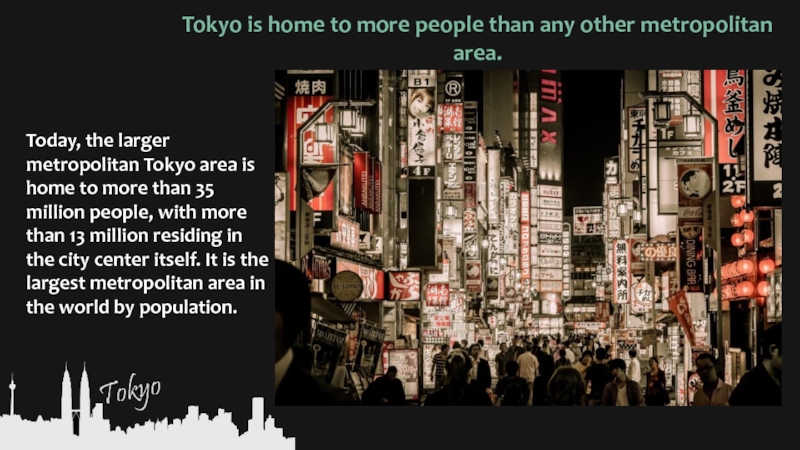
Слайд 7Tokyo is home to more people than any other metropolitan area.


Today, the larger metropolitan Tokyo area is home to more than 35 million people, with more than 13 million residing in the city center itself. It is the largest metropolitan area in the world by population.
Tokyo is home to more people than any other metropolitan area. Today, the larger metropolitan Tokyo area

Слайд 8As the city has continued its sprawl over more than 5,200
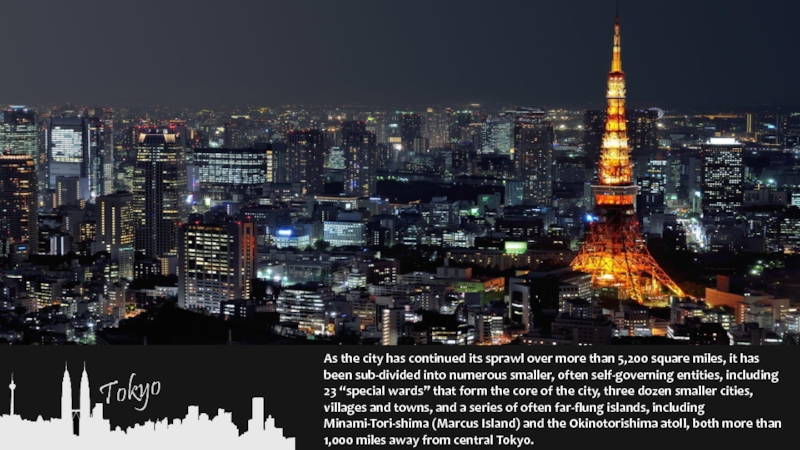
square miles, it has been sub-divided into numerous smaller, often self-governing entities, including 23 “special wards” that form the core of the city, three dozen smaller cities, villages and towns, and a series of often far-flung islands, including Minami-Tori-shima (Marcus Island) and the Okinotorishima atoll, both more than 1,000 miles away from central Tokyo.
As the city has continued its sprawl over more than 5,200 square miles, it has been sub-divided

Слайд 9And though it has earned well-deserved recognition as one of the
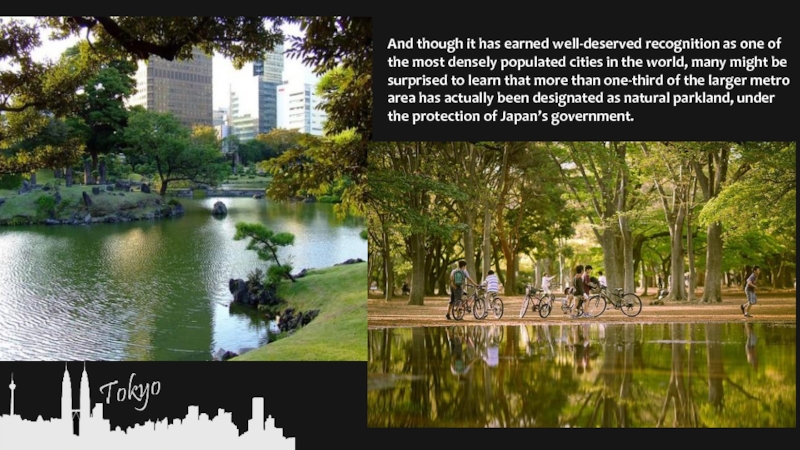
most densely populated cities in the world, many might be surprised to learn that more than one-third of the larger metro area has actually been designated as natural parkland, under the protection of Japan’s government.
And though it has earned well-deserved recognition as one of the most densely populated cities in the

Слайд 1011 things you might not know about Tokyo
1.Tokyo was originally set
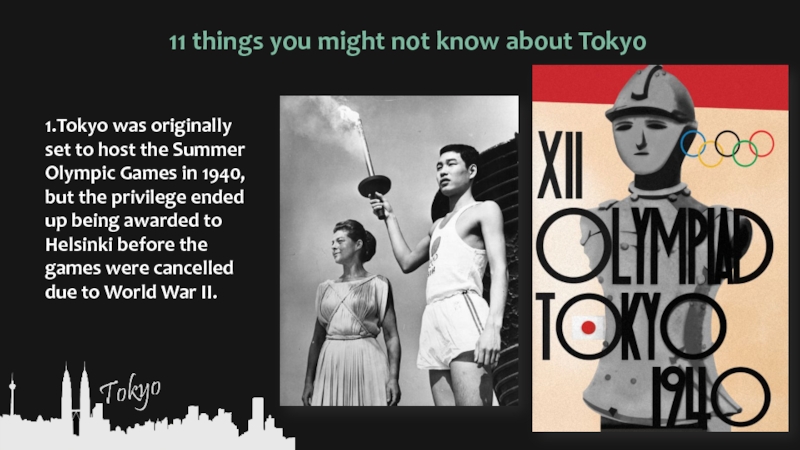
to host the Summer Olympic Games in 1940, but the privilege ended up being awarded to Helsinki before the games were cancelled due to World War II.
11 things you might not know about Tokyo1.Tokyo was originally set to host the Summer Olympic Games

Слайд 11
2.Tokyo Disneyland was Disney’s first park outside the US. The resort

employs over 20,000 people.

3.As the annual Cherry Blossom Festival nears, television and radio reports include information on the "cherry blossom front" (sakura zensen), or the advance of the cherry blossoms across the different regions of Japan.
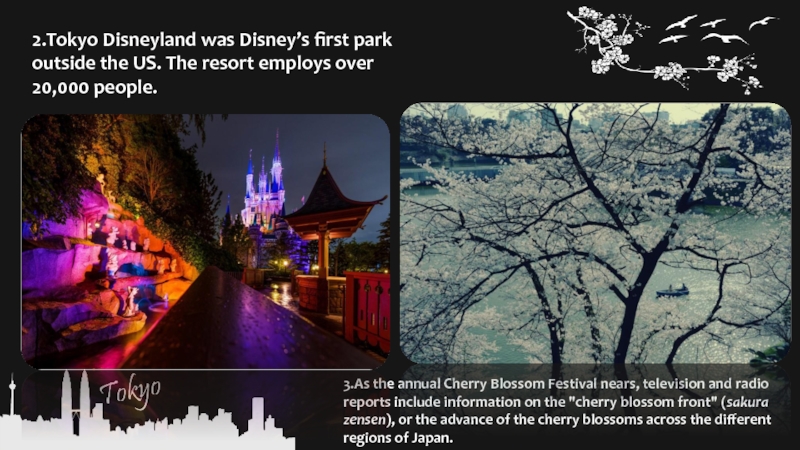
2.Tokyo Disneyland was Disney’s first park outside the US. The resort employs over 20,000 people. 3.As the

Слайд 12
4.The Eiffel Tower was the inspiration for the Tokyo Tower. The

tower is repainted every five years, a process that takes 12 months each time.

5. or “pushers,” are employed in some of Tokyo’s railway stations. These station attendants literally push people onto crowded trains during rush hour.
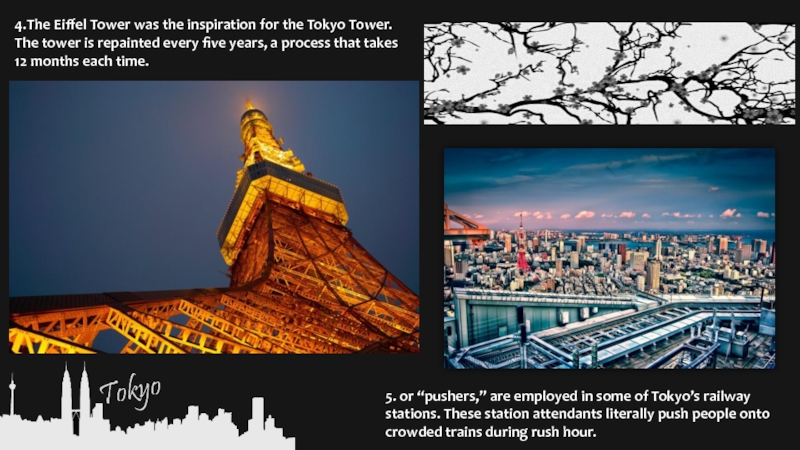
4.The Eiffel Tower was the inspiration for the Tokyo Tower. The tower is repainted every five years,

Слайд 13
6.Tokyo’s Imperial Palace is generally closed to the public (the Imperial

Household Agency and the East Gardens are accessible), except on the Emperor’s birthday and New Year.

7.With an average of 3.64 million people passing through daily, Shinjuku Station is the world’s busiest rail station, according to the Guinness World Records. The streets of this district see their fair share of traffic as well.
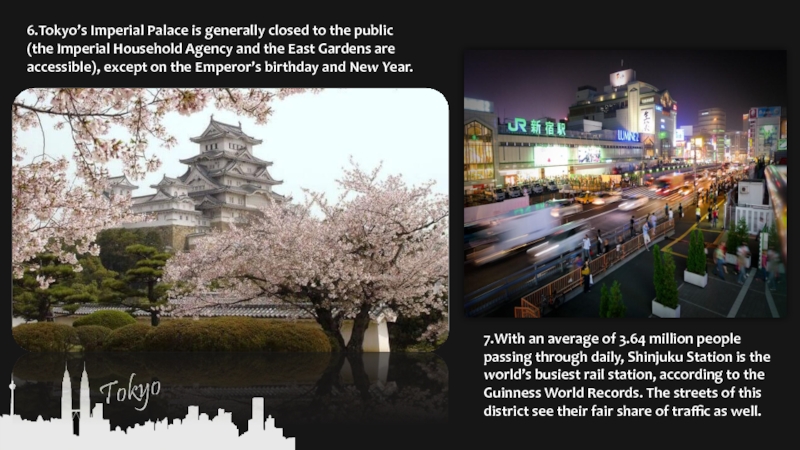
6.Tokyo’s Imperial Palace is generally closed to the public (the Imperial Household Agency and the East Gardens

Слайд 148.Five million pounds of seafood, worth roughly 28 million USD, are

sold daily at Tsukiji Fish Market (a complex that covers 57 acres).


9.Traditional Tokyo-style ramen includes thin, curly noodles in a soy-flavored chicken broth. The typical toppings are chopped scallion, sliced pork, menma, egg, nori, spinach, and kamaboko.
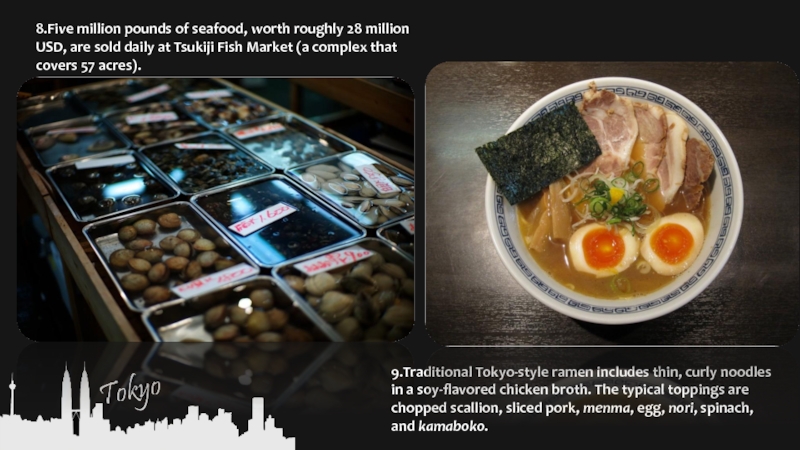
8.Five million pounds of seafood, worth roughly 28 million USD, are sold daily at Tsukiji Fish Market

Слайд 15
10. In 1962, Tokyo became the first city in history to
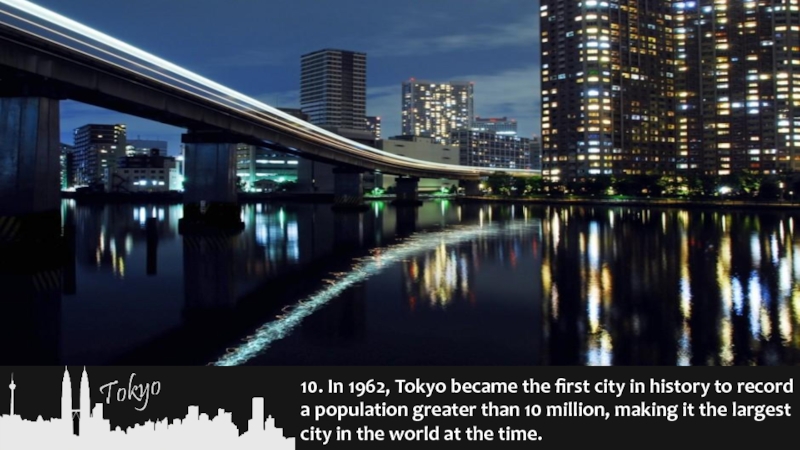
record a population greater than 10 million, making it the largest city in the world at the time.
10. In 1962, Tokyo became the first city in history to record a population greater than 10

Слайд 16
11.Tokyo contains over 100 universities and colleges, giving it the world’s
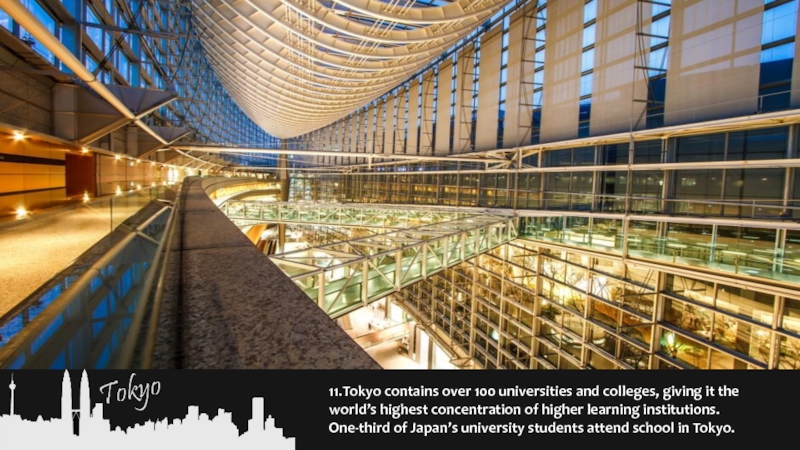
highest concentration of higher learning institutions. One-third of Japan’s university students attend school in Tokyo.
11.Tokyo contains over 100 universities and colleges, giving it the world’s highest concentration of higher learning institutions.
Слайд 17Thank you for your attention!!!

Thank you for your attention!!!

Что такое shareslide.ru?

Это сайт презентаций, где можно хранить и обмениваться своими презентациями, докладами, проектами, шаблонами в формате PowerPoint с другими пользователями. Мы помогаем школьникам, студентам, учителям, преподавателям хранить и обмениваться учебными материалами.


Для правообладателей

Яндекс.Метрика

Обратная связь

Email: Нажмите что бы посмотреть