- Главная
- Разное
- Образование
- Спорт
- Естествознание
- Природоведение
- Религиоведение
- Французский язык
- Черчение
- Английский язык
- Астрономия
- Алгебра
- Биология
- География
- Геометрия
- Детские презентации
- Информатика
- История
- Литература
- Математика
- Музыка
- МХК
- Немецкий язык
- ОБЖ
- Обществознание
- Окружающий мир
- Педагогика
- Русский язык
- Технология
- Физика
- Философия
- Химия
- Шаблоны, фоны, картинки для презентаций
- Экология
- Экономика
Презентация, доклад на Английском языке: Representative money
Содержание
- 1. Презентация на Английском языке: Representative money
- 2. The use of money is as old
- 3. Bartering and Commodity MoneyIn the beginning, people
- 4. A commodity is a basic item used
- 5. Coins and Paper MoneyMetals objects were introduced
- 6. Representative MoneyWith the introduction of paper currency
- 7. Representative moneyRepresentative money was backed by a
- 8. Representative moneyFor most of the nineteenth and
- 9. Слайд 9
- 10. Fiat MoneyRepresentative money has now been replaced
- 11. $$$The origin of the "$" money sign
- 12. U.S. Money TriviaOn March 10, 1862 the
- 13. Electronic BankingERMA began as a project for
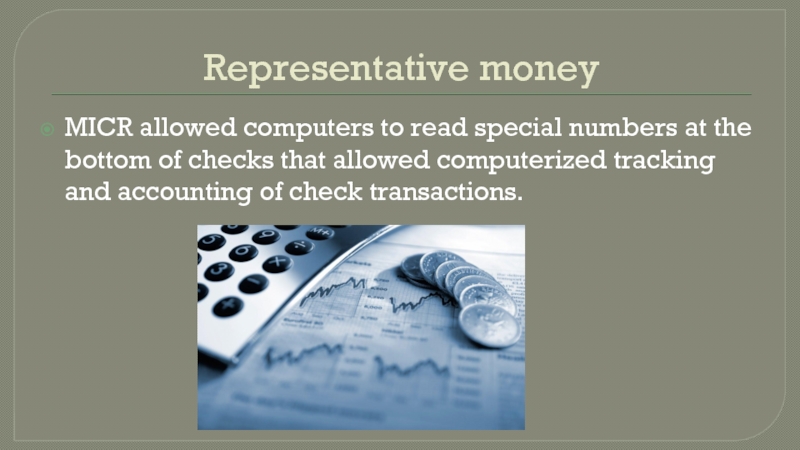
- 14. Representative moneyMICR allowed computers to read special
- 15. THE END…
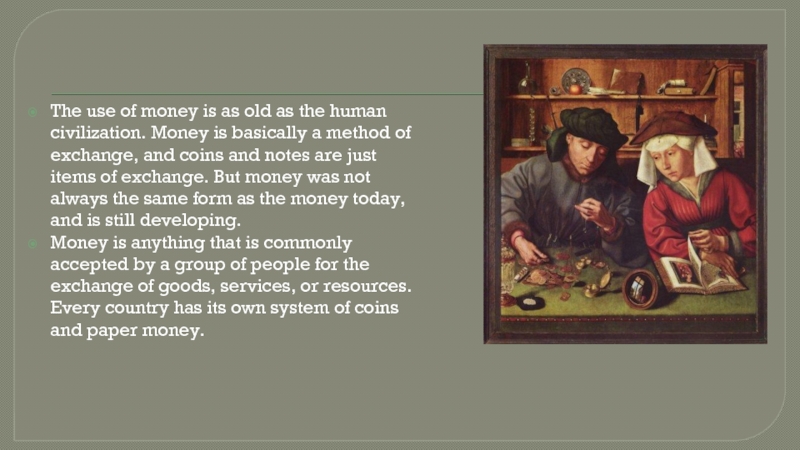
The use of money is as old as the human civilization. Money is basically a method of exchange, and coins and notes are just items of exchange. But money was not always the same form as
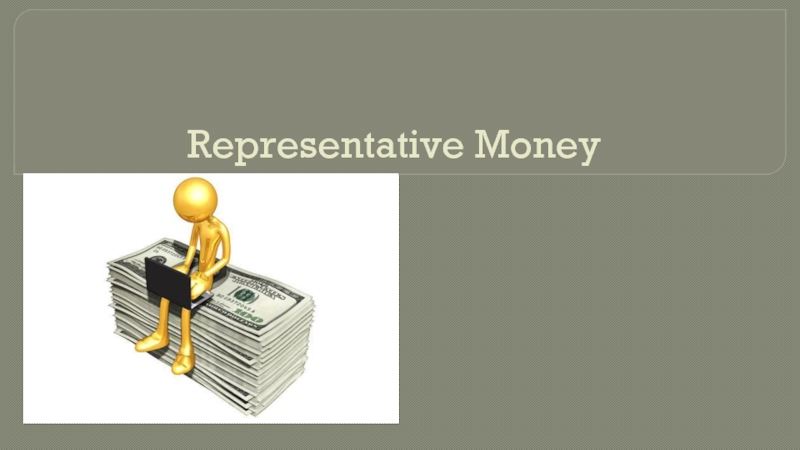
Слайд 2The use of money is as old as the human civilization.
Money is basically a method of exchange, and coins and notes are just items of exchange. But money was not always the same form as the money today, and is still developing.
Money is anything that is commonly accepted by a group of people for the exchange of goods, services, or resources. Every country has its own system of coins and paper money.
Money is anything that is commonly accepted by a group of people for the exchange of goods, services, or resources. Every country has its own system of coins and paper money.
Слайд 3Bartering and Commodity Money
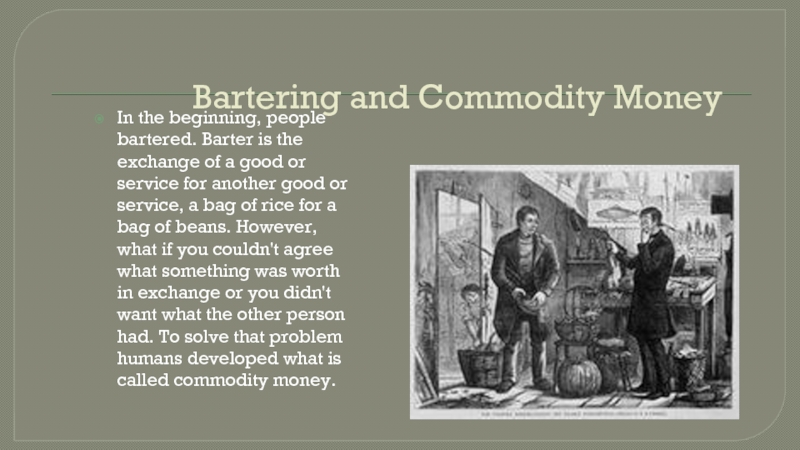
In the beginning, people bartered. Barter is the
exchange of a good or service for another good or service, a bag of rice for a bag of beans. However, what if you couldn't agree what something was worth in exchange or you didn't want what the other person had. To solve that problem humans developed what is called commodity money.
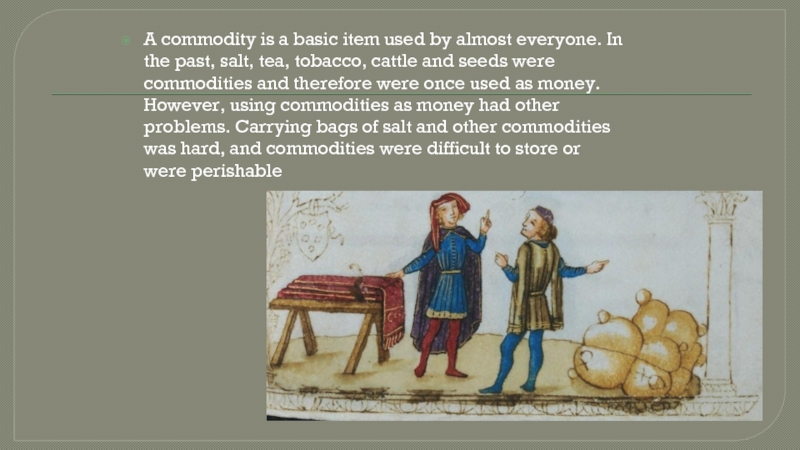
Слайд 4A commodity is a basic item used by almost everyone. In
the past, salt, tea, tobacco, cattle and seeds were commodities and therefore were once used as money. However, using commodities as money had other problems. Carrying bags of salt and other commodities was hard, and commodities were difficult to store or were perishable
Слайд 5Coins and Paper Money
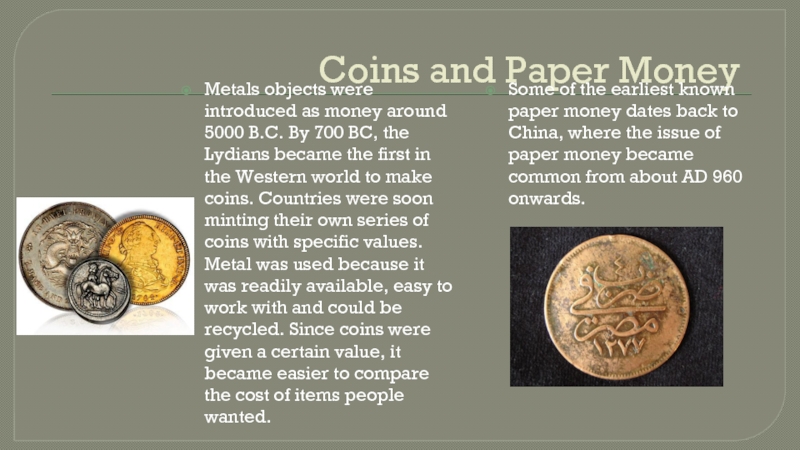
Metals objects were introduced as money around 5000
B.C. By 700 BC, the Lydians became the first in the Western world to make coins. Countries were soon minting their own series of coins with specific values. Metal was used because it was readily available, easy to work with and could be recycled. Since coins were given a certain value, it became easier to compare the cost of items people wanted.
Some of the earliest known paper money dates back to China, where the issue of paper money became common from about AD 960 onwards.
Слайд 6Representative Money
With the introduction of paper currency and non-precious coinage, commodity
money evolved into representative money. This meant that what money itself was made of no longer had to be very valuable.
Слайд 7Representative money
Representative money was backed by a government or bank's promise
to exchange it for a certain amount of silver or gold. For example, the old British Pound bill or Pound Sterling was once guaranteed to be redeemable for a pound of sterling silver.
Слайд 8Representative money
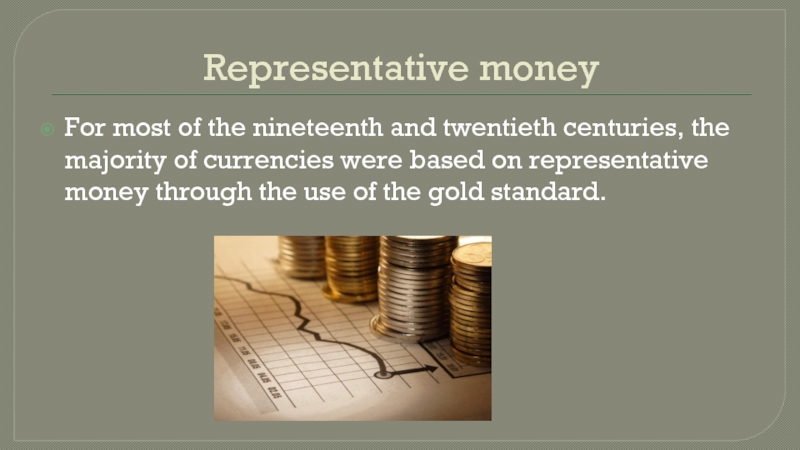
For most of the nineteenth and twentieth centuries, the majority
of currencies were based on representative money through the use of the gold standard.
Слайд 10Fiat Money
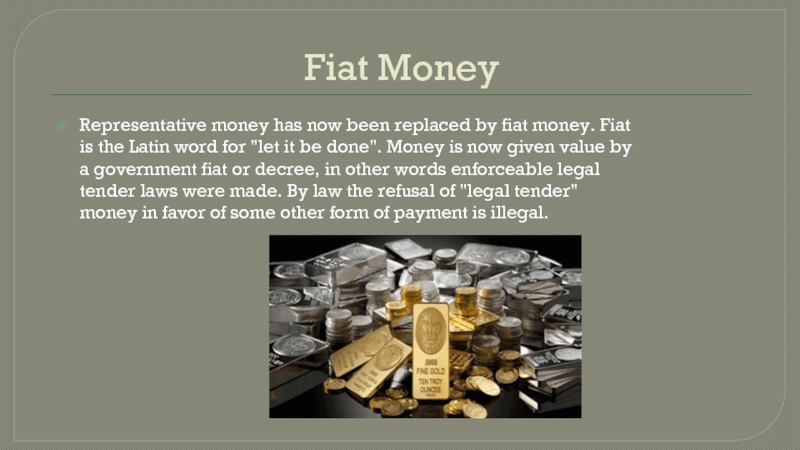
Representative money has now been replaced by fiat money. Fiat
is the Latin word for "let it be done". Money is now given value by a government fiat or decree, in other words enforceable legal tender laws were made. By law the refusal of "legal tender" money in favor of some other form of payment is illegal.
Слайд 11$$$
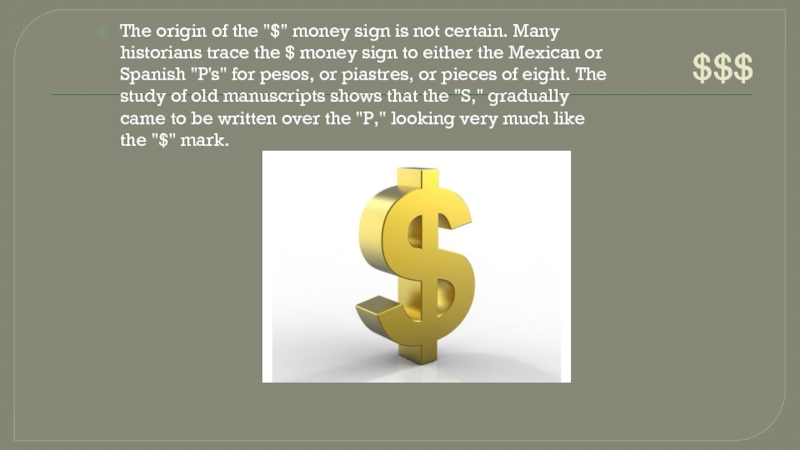
The origin of the "$" money sign is not certain. Many
historians trace the $ money sign to either the Mexican or Spanish "P's" for pesos, or piastres, or pieces of eight. The study of old manuscripts shows that the "S," gradually came to be written over the "P," looking very much like the "$" mark.
Слайд 12U.S. Money Trivia
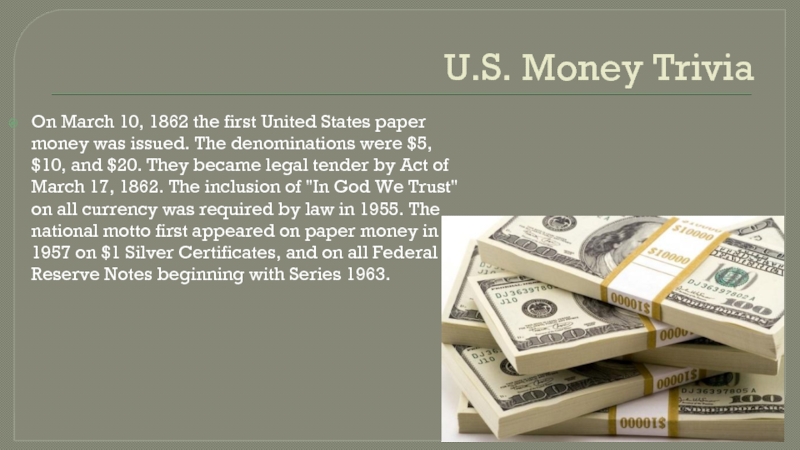
On March 10, 1862 the first United States paper
money was issued. The denominations were $5, $10, and $20. They became legal tender by Act of March 17, 1862. The inclusion of "In God We Trust" on all currency was required by law in 1955. The national motto first appeared on paper money in 1957 on $1 Silver Certificates, and on all Federal Reserve Notes beginning with Series 1963.
Слайд 13Electronic Banking
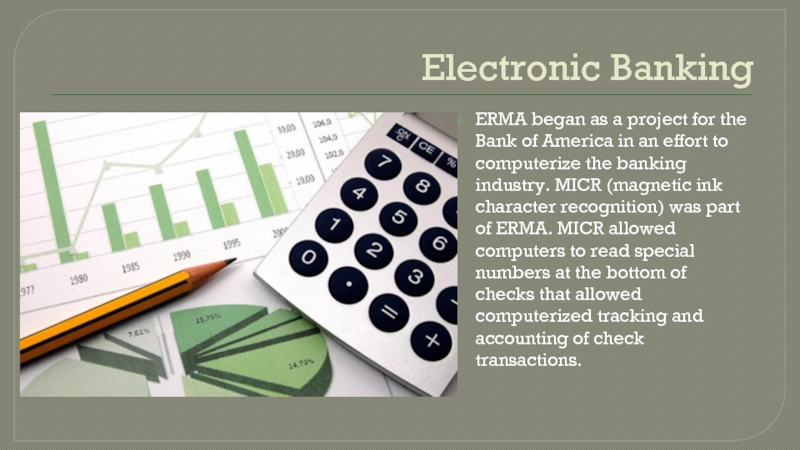
ERMA began as a project for the Bank of America
in an effort to computerize the banking industry. MICR (magnetic ink character recognition) was part of ERMA. MICR allowed computers to read special numbers at the bottom of checks that allowed computerized tracking and accounting of check transactions.
Слайд 14Representative money
MICR allowed computers to read special numbers at the bottom
of checks that allowed computerized tracking and accounting of check transactions.