- Главная
- Разное
- Образование
- Спорт
- Естествознание
- Природоведение
- Религиоведение
- Французский язык
- Черчение
- Английский язык
- Астрономия
- Алгебра
- Биология
- География
- Геометрия
- Детские презентации
- Информатика
- История
- Литература
- Математика
- Музыка
- МХК
- Немецкий язык
- ОБЖ
- Обществознание
- Окружающий мир
- Педагогика
- Русский язык
- Технология
- Физика
- Философия
- Химия
- Шаблоны, фоны, картинки для презентаций
- Экология
- Экономика
Презентация, доклад на Английском языке: Old advertising cars.
Содержание
- 1. Презентация на Английском языке: Old advertising cars.
- 2. The Volkswagen, which in German means “People’s car ”
- 3. When Hitler met with automotive designer Ferdinand
- 4. So what was then happening with the
- 5. The advertisements were visually colorful; you can’t
- 6. Слайд 6
- 7. Слайд 7
- 8. Every automobile ad then began saying the
- 9. Going, going…The ad campaign however generated favorable
- 10. A reader of that time, flipping through
- 11. That's how many times we inspect a Volkswagen
- 12. The famous Italian designer suggested one change
- 13. The advertisements were brilliant on a visual
- 14. 33 years later, he got the bug
- 15. Don't laughThis was Bernbach’s approach – simplicity
- 16. END
The Volkswagen, which in German means “People’s car ” was essentially a political promise by Adolf Hitler to win the goodwill of the German public in the 1930s. Before Hitler came to power, Germany was suffering the economic effects
Слайд 2The Volkswagen, which in German means “People’s car ” was essentially a political
promise by Adolf Hitler to win the goodwill of the German public in the 1930s. Before Hitler came to power, Germany was suffering the economic effects of the Great Depression with unemployment rising to 3,000,000 by September 1930. The situation was dismal, the manufacturing industry was badly hit and everyone was suffering. Cars cost more than what most people earned in a year.

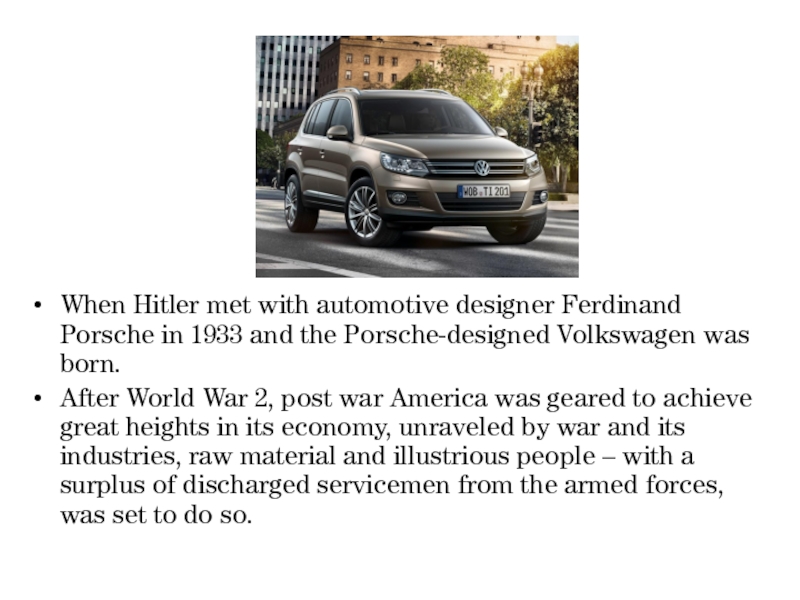
Слайд 3When Hitler met with automotive designer Ferdinand Porsche in 1933 and
the Porsche-designed Volkswagen was born.
After World War 2, post war America was geared to achieve great heights in its economy, unraveled by war and its industries, raw material and illustrious people – with a surplus of discharged servicemen from the armed forces, was set to do so.
After World War 2, post war America was geared to achieve great heights in its economy, unraveled by war and its industries, raw material and illustrious people – with a surplus of discharged servicemen from the armed forces, was set to do so.
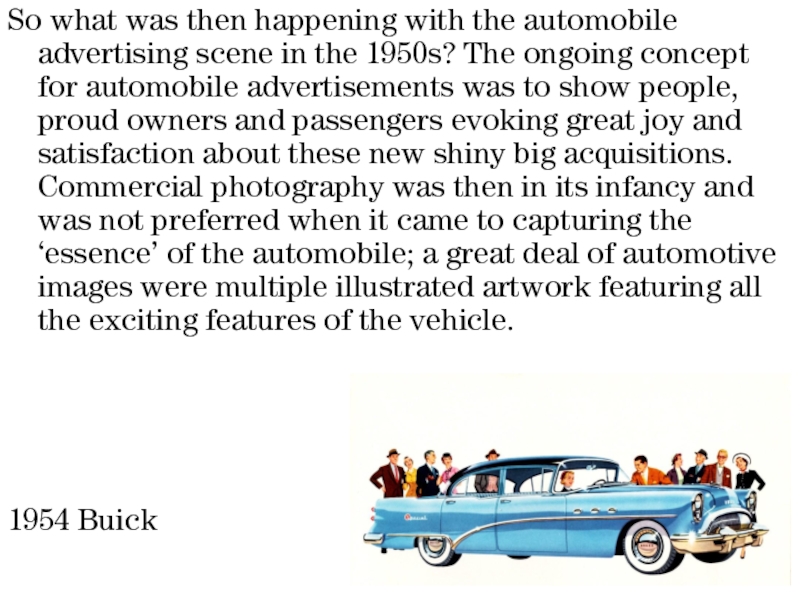
Слайд 4So what was then happening with the automobile advertising scene in
the 1950s? The ongoing concept for automobile advertisements was to show people, proud owners and passengers evoking great joy and satisfaction about these new shiny big acquisitions. Commercial photography was then in its infancy and was not preferred when it came to capturing the ‘essence’ of the automobile; a great deal of automotive images were multiple illustrated artwork featuring all the exciting features of the vehicle.
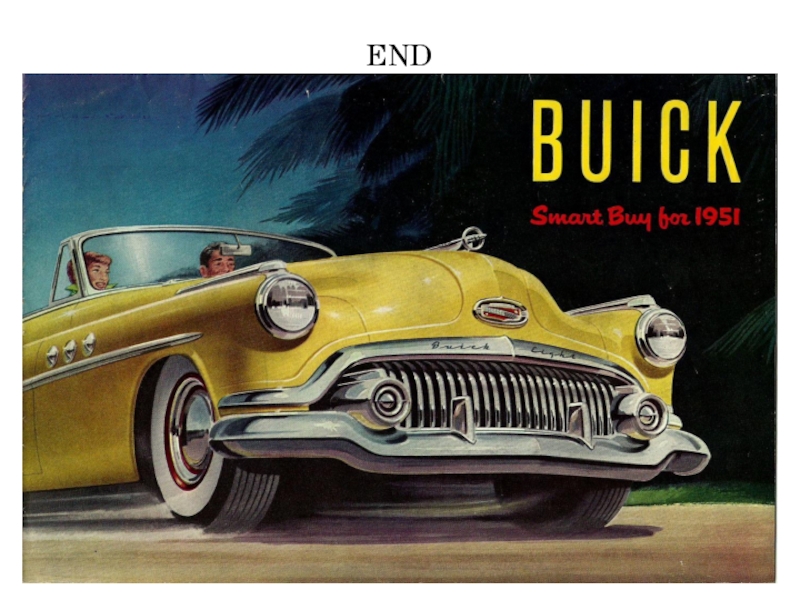
1954 Buick
1954 Buick
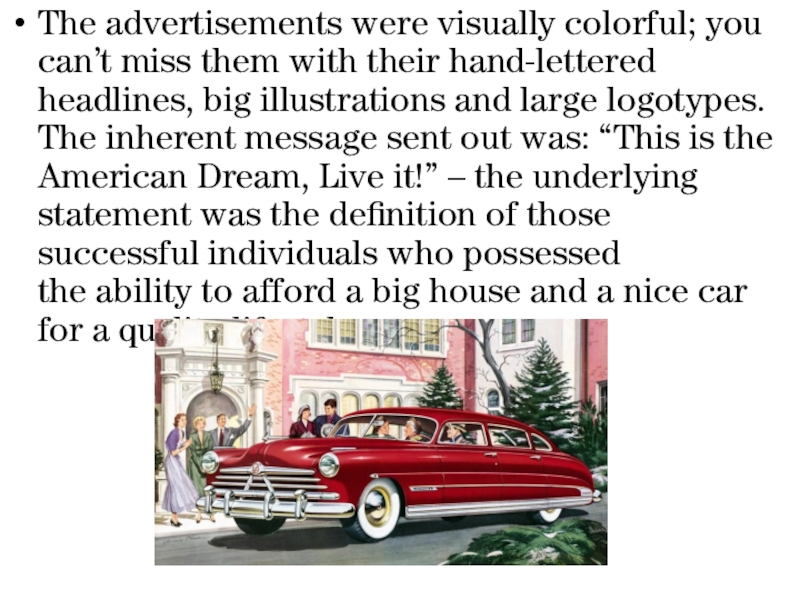
Слайд 5The advertisements were visually colorful; you can’t miss them with their
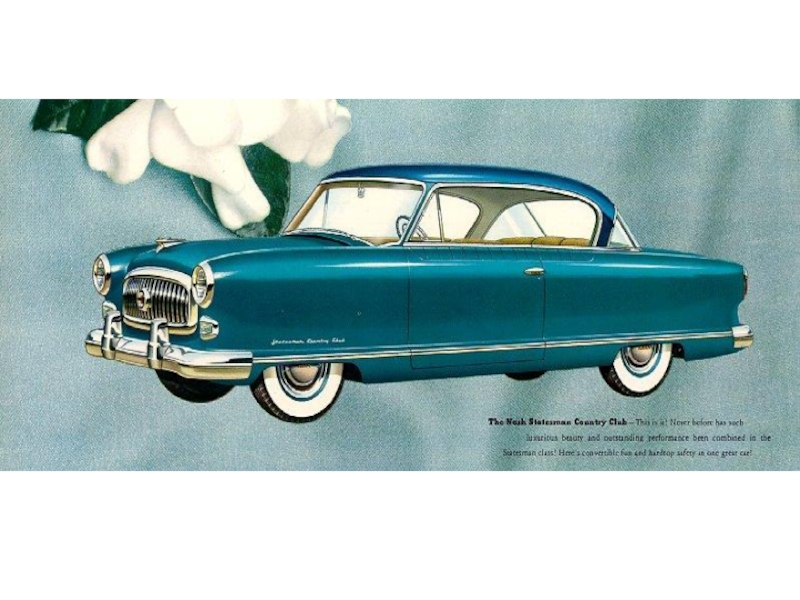
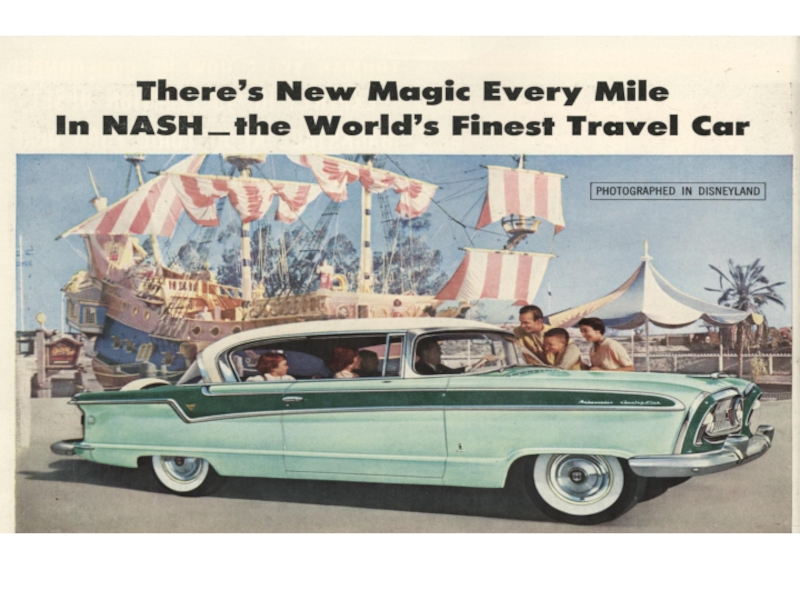
hand-lettered headlines, big illustrations and large logotypes. The inherent message sent out was: “This is the American Dream, Live it!” – the underlying statement was the definition of those successful individuals who possessed the ability to afford a big house and a nice car for a quality lifestyle.
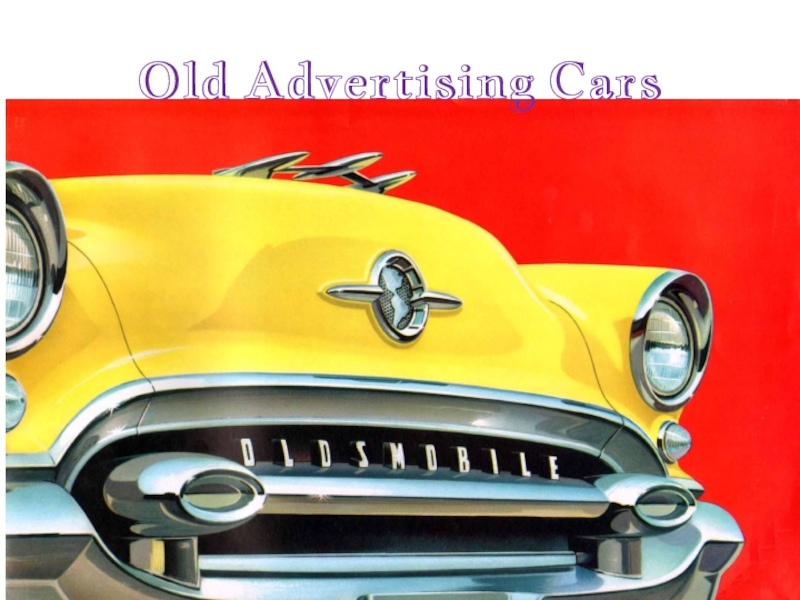
Слайд 8Every automobile ad then began saying the same thing: Oldsmobile proudly
proclaimed," You've got to drive it to believe it!” Chevrolet, expounded “Filled with grace and great new things,” while Buick promised, “You can make your ‘someday’ come true now.” The catch words were: “New, Shiny, Big and Great Features!”
But Volkswagen’s “Think small” advertisement had lots of white space, the product advertised was miniscule, the headline lacked news value and worse of all… it was in black and white!
But Volkswagen’s “Think small” advertisement had lots of white space, the product advertised was miniscule, the headline lacked news value and worse of all… it was in black and white!

Слайд 9Going, going…
The ad campaign however generated favorable publicity because the advertisements
were brilliantly written, for instead of marketing it to consumers as a luxurious, spacious vehicle as all its competitors were doing, it focused on the benefits of its compact size and affordability.

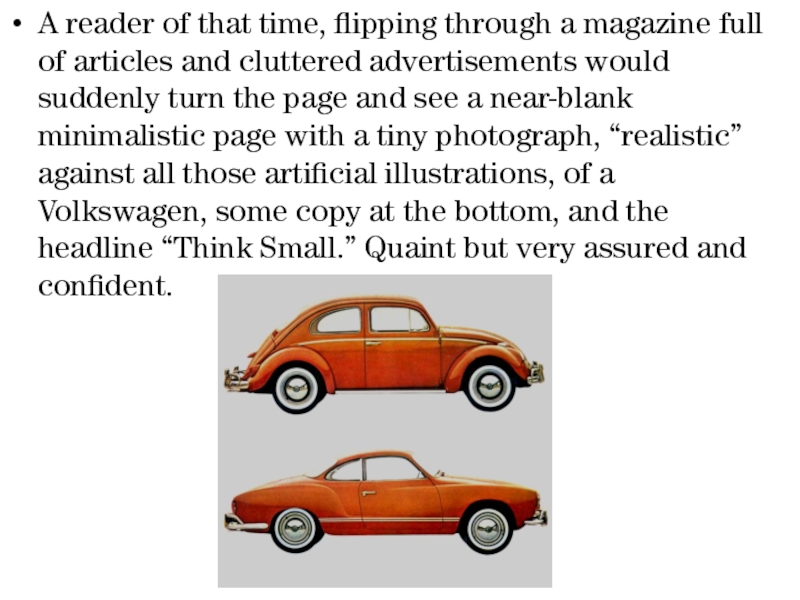
Слайд 10A reader of that time, flipping through a magazine full of
articles and cluttered advertisements would suddenly turn the page and see a near-blank minimalistic page with a tiny photograph, “realistic” against all those artificial illustrations, of a Volkswagen, some copy at the bottom, and the headline “Think Small.” Quaint but very assured and confident.


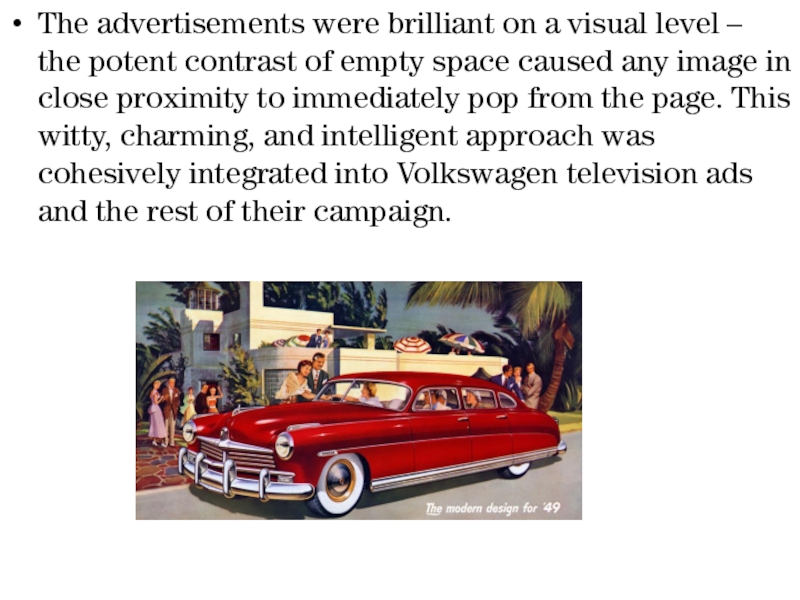
Слайд 13The advertisements were brilliant on a visual level – the potent
contrast of empty space caused any image in close proximity to immediately pop from the page. This witty, charming, and intelligent approach was cohesively integrated into Volkswagen television ads and the rest of their campaign.
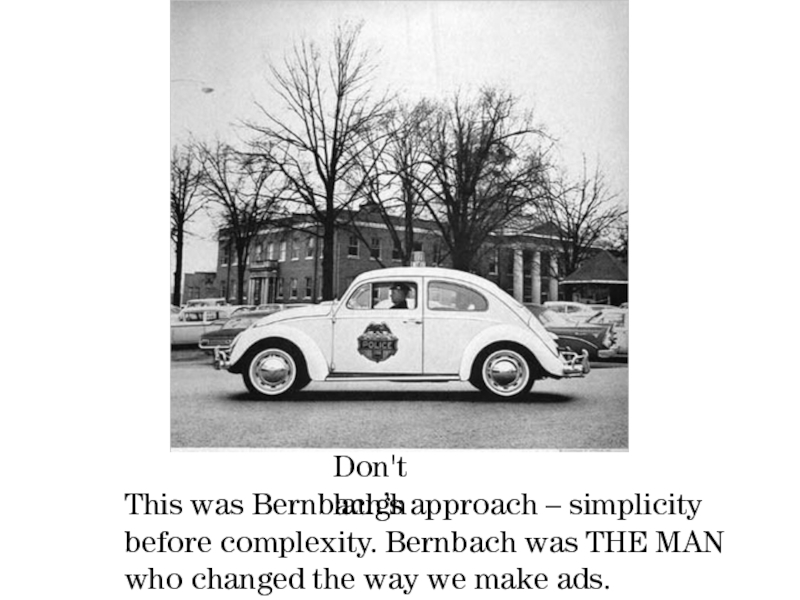
Слайд 15Don't laugh
This was Bernbach’s approach – simplicity before complexity. Bernbach was
THE MAN who changed the way we make ads.