Преградная».
- Главная
- Разное
- Образование
- Спорт
- Естествознание
- Природоведение
- Религиоведение
- Французский язык
- Черчение
- Английский язык
- Астрономия
- Алгебра
- Биология
- География
- Геометрия
- Детские презентации
- Информатика
- История
- Литература
- Математика
- Музыка
- МХК
- Немецкий язык
- ОБЖ
- Обществознание
- Окружающий мир
- Педагогика
- Русский язык
- Технология
- Физика
- Философия
- Химия
- Шаблоны, фоны, картинки для презентаций
- Экология
- Экономика
Презентация, доклад Метро Лондона. Подготовлена Глоовой Ангелиной, ученицей 10 класса МКОУ СОШ №1 ст. Преградная при прохождении темы Метро Лондона. История и современность
Содержание
- 1. Презентация Метро Лондона. Подготовлена Глоовой Ангелиной, ученицей 10 класса МКОУ СОШ №1 ст. Преградная при прохождении темы Метро Лондона. История и современность
- 2. The London Underground The London Underground is
- 3. It was, on the face of it,
- 4. The story began with Charles Pearson, the first in a succession of underground visionaries. It was he who first proposed the notion of ‘trains in drains’ in 1845, when the railway was a relatively new invention (the first steam passenger service only opened in 1830). Pearson, instrumental in the removal of the antiCatholic inscription on the foot of the Monument, was a progressive and a pioneer – his persistence helped persuade the House of Commons to approve a bill in 1853 to build a subterranean railway between Paddington and Farringdon.
- 5. Слайд 5
- 6. World War II The bombing of London during the war and especially The Blitz led to the use of many tube stations as airraid shelters. Closed stations and unfinished sections of new line were also used. The shelters were well suited to their purpose, but some stations could still be breached by a direct hit; a small number of attacks did result in serious loss of life, most notably at Balham and Bounds Green in October 1940 and Bank in January 1941. A still worse disaster was a crowd crush accident at the unfinished Bethnal Green in March 1943. As well as public shelters, stations and sections of line were given other similar uses: An unfinished stretch of the Central Line extension, between Redbridge and Gants Hill, was turned into an underground aircraft factory. The closed Brompton Road station was used as an antiaircraft control centre. The closed Down Street station was used by Winston Churchill until the Cabinet War Rooms were built, after which it was used by the Railway Emergency Committee.
- 7. Metronet was placed into administration on 18 July 2007.TfL has taken over Metronet's outstanding commitments. The UK government has made concerted efforts to find another private firm to fill the vacuum left by the liquidation of Metronet. However only TfL has expressed a viable interest in taking over Metronet's responsibilities so far. Even though Tube Lines appears to be stable, this has put the longterm future of the PPP scheme in doubt. The case for PPP was also weakened in 2008 when it was revealed that the demise of Metronet had cost the UK government £2bn. The five private companies that made up the Metronet alliance had to pay £70m each towards paying off the debts acquired by the consortium. But due to a deal struck with the government in 2003, when the PPP scheme began operating, the companies were protected from any further liability. The UK taxpayer therefore had to foot the rest of the bill. This undermined the argument that PPP would place the risks involved in running the network into the hands of the private sector.Future
- 8. Flooding is an increasing problem for the system. The ground water of London has been rising since the 1960s, after the closing of industries such as breweries and paper mills that had previously extracted large volumes of water. By mid 2001, London Underground was pumping 30,000 cubic metres of water out of its tunnels each day. Until the completion of the Thames flood barrier in 1986, there was also a strong danger of flooding from the Thames itself. A series of floodgates were erected in the tunnels such that they would seal the affected sections of tunnel, allowing services to continue to run either side. The floodgates are not thought necessary since the Thames flood barrier came into service, but they remain in place and are tested three times a year. Many stations have to be shut for a day due to flooding from cloudbursts.
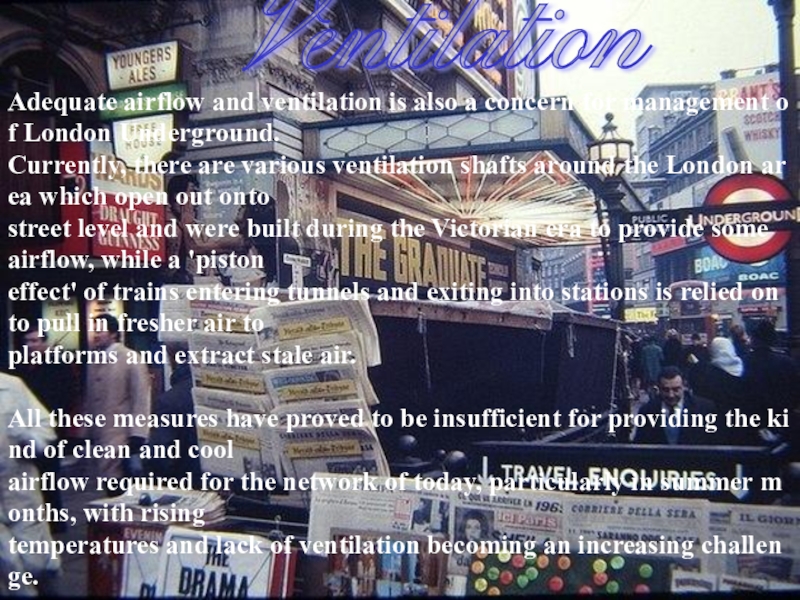
- 9. Adequate airflow and ventilation is also a concern for management of London Underground. Currently, there are various ventilation shafts around the London area which open out onto street level and were built during the Victorian era to provide some airflow, while a 'piston effect' of trains entering tunnels and exiting into stations is relied on to pull in fresher air to platforms and extract stale air. All these measures have proved to be insufficient for providing the kind of clean and cool airflow required for the network of today, particularly in summer months, with rising temperatures and lack of ventilation becoming an increasing challenge. Ventilation
- 10. Слайд 10
- 11. Слайд 11
- 12. The End.
The London Underground The London Underground is a metro system serving a large part of Great London and neighbouring areas of Essex, Hertfordshire and Buckinghamshire in England. It is both the world’s oldest underground railway and
Слайд 2The London Underground
The London Underground is a metro system serving
a large part of Great London and neighbouring areas of Essex, Hertfordshire and Buckinghamshire in England. It is both the world’s oldest underground railway and the oldest rapid transit system. It was also the first underground railway to operate electric trains.
Слайд 3It was, on the face of it, a stupid idea. Running
trains, and steam trains at that, in tunnels underneath the London streets. In 1862, the Times described it as an ‘insult to common sense’ and it was probably right. But the London Underground turned out to be one of the great engineering feats of modern times, the world’s only steam-driven underground railway and the first electrified underground railway. A socially egalitarian and liberating phenomenon, it helped drive London’s rapid expansion and got people to work on time, while providing the city with a bold new identity through impeccable branding that incorporated iconic typography, cartography and architecture.
London Underground's history.
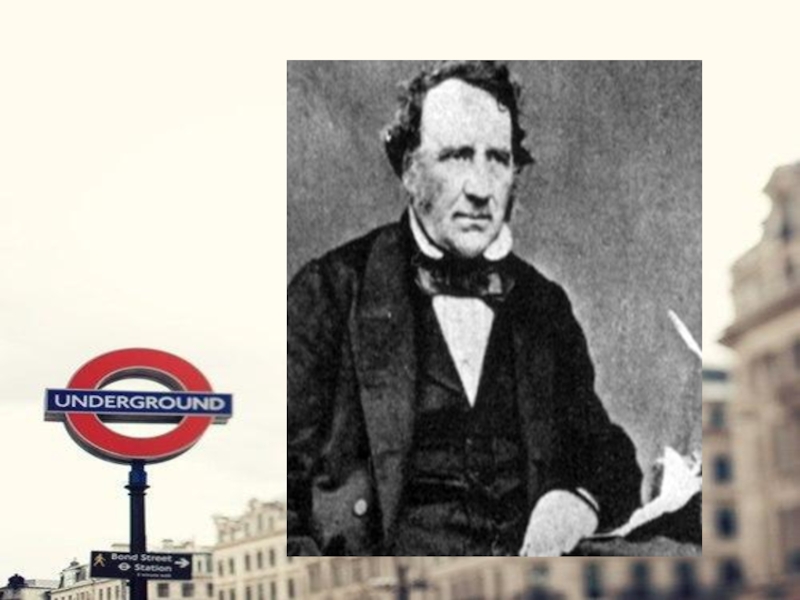
Слайд 4The story began with Charles Pearson, the first in a succession of underground visionaries. It
was he who first proposed the notion of ‘trains in drains’ in 1845, when the railway was a
relatively new invention (the first steam passenger service only opened in 1830). Pearson,
instrumental in the removal of the antiCatholic inscription on the foot of the Monument, was a
progressive and a pioneer – his persistence helped persuade the House of Commons to
approve a bill in 1853 to build a subterranean railway between Paddington and Farringdon.
Слайд 6World War II
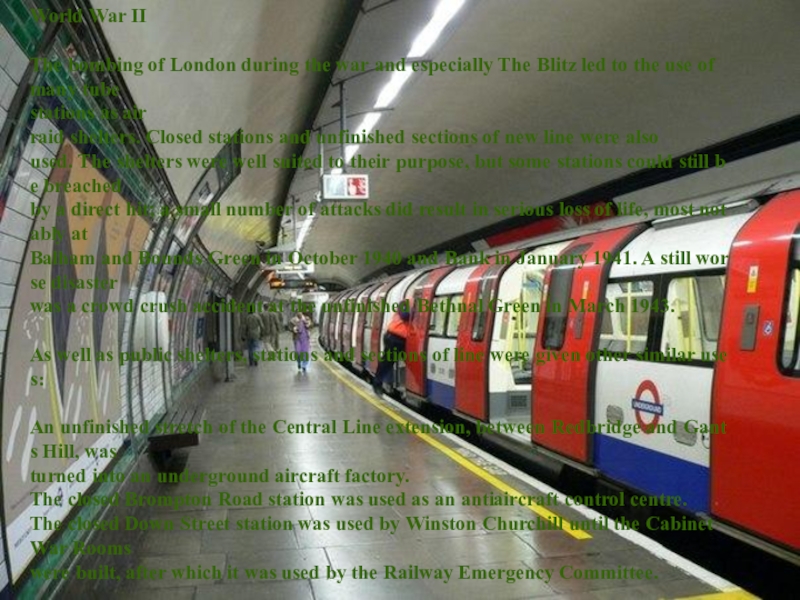
The bombing of London during the war and especially The Blitz led to the use of many tube
stations as airraid shelters. Closed stations and unfinished sections of new line were also
used. The shelters were well suited to their purpose, but some stations could still be breached
by a direct hit; a small number of attacks did result in serious loss of life, most notably at
Balham and Bounds Green in October 1940 and Bank in January 1941. A still worse disaster
was a crowd crush accident at the unfinished Bethnal Green in March 1943.
As well as public shelters, stations and sections of line were given other similar uses:
An unfinished stretch of the Central Line extension, between Redbridge and Gants Hill, was
turned into an underground aircraft factory.
The closed Brompton Road station was used as an antiaircraft control centre.
The closed Down Street station was used by Winston Churchill until the Cabinet War Rooms
were built, after which it was used by the Railway Emergency Committee.
Слайд 7
Metronet was placed into administration on 18 July 2007.TfL has taken over Metronet's
outstanding commitments.
The UK government has made concerted efforts to find another private firm to fill the vacuum left by the liquidation of Metronet. However only TfL has expressed a viable interest in taking
over Metronet's responsibilities so far. Even though Tube Lines appears to be stable, this has
put the longterm future of the PPP scheme in doubt. The case for PPP was also weakened in
2008 when it was revealed that the demise of Metronet had cost the UK government £2bn.
The five private companies that made up the Metronet alliance had to pay £70m each towards
paying off the debts acquired by the consortium. But due to a deal struck with the government
in 2003, when the PPP scheme began operating, the companies were protected from any
further liability. The UK taxpayer therefore had to foot the rest of the bill. This undermined the
argument that PPP would place the risks involved in running the network into the hands of the
private sector.
Future
Слайд 8
Flooding is an increasing problem for the system. The ground water of London has been
rising since the 1960s, after the closing of industries such as breweries and paper mills that
had previously extracted large volumes of water. By mid 2001, London Underground was
pumping 30,000 cubic metres of water out of its tunnels each day.
Until the completion of the Thames flood barrier in 1986, there was also a strong danger of
flooding from the Thames itself. A series of floodgates were erected in the tunnels such that
they would seal the affected sections of tunnel, allowing services to continue to run either
side. The floodgates are not thought necessary since the Thames flood barrier came into
service, but they remain in place and are tested three times a year.
Many stations have to be shut for a day due to flooding from cloudbursts.
Слайд 9Adequate airflow and ventilation is also a concern for management of London Underground.
Currently, there are various ventilation shafts around the London area which open out onto
street level and were built during the Victorian era to provide some airflow, while a 'piston
effect' of trains entering tunnels and exiting into stations is relied on to pull in fresher air to
platforms and extract stale air.
All these measures have proved to be insufficient for providing the kind of clean and cool
airflow required for the network of today, particularly in summer months, with rising
temperatures and lack of ventilation becoming an increasing challenge.
Ventilation