Слайд 1Some British
Kings
and
Queens in brief.
Слайд 2Boadicea.
Boudica , also known as Boadicea and
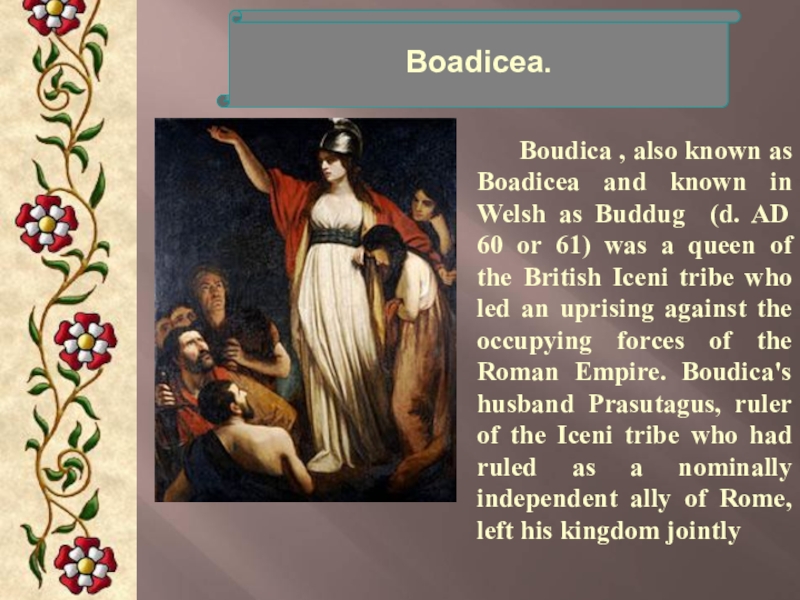
known in Welsh as Buddug (d. AD 60 or 61) was а queen of the British Iceni tribe who led an uprising against the occupying forces of the Roman Empire. Boudica's husband Prasutagus, ruler of the Iceni tribe who had ruled as a nominally independent ally of Rome, left his kingdom jointly
Слайд 3Boadicea.
to his daughters and the Roman Emperor in his will.
However, when he died, his will was ignored — the kingdom was annexed as if conquered, Boudica was flogged and her daughters were raped, and Roman financiers called in their loans.
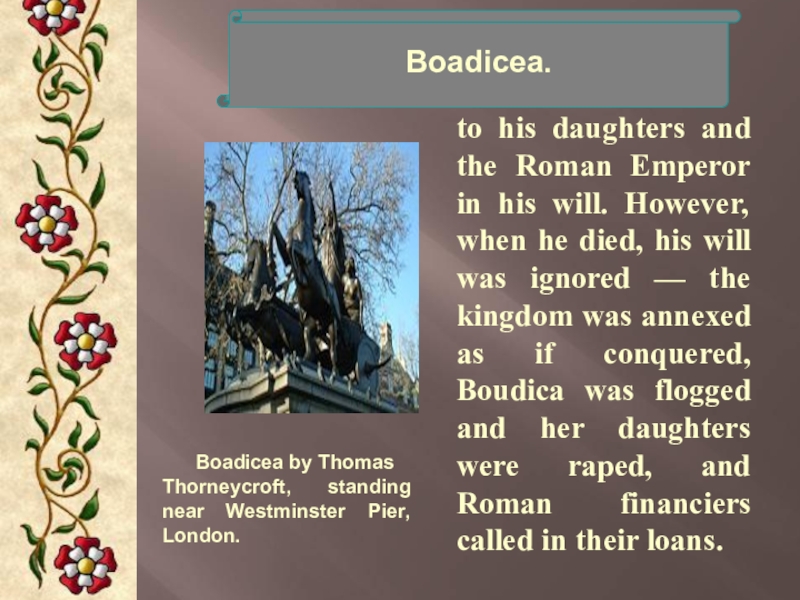
Boadicea by Thomas
Thorneycroft, standing near Westminster Pier, London.
Слайд 4King Arthur.
King Arthur is a legendary British
leader of the late 5th and early 6th centuries, who, according to Medieval histories and romances, led the defence of Britain against Saxon invaders in the early 6th century. The details of Arthur's
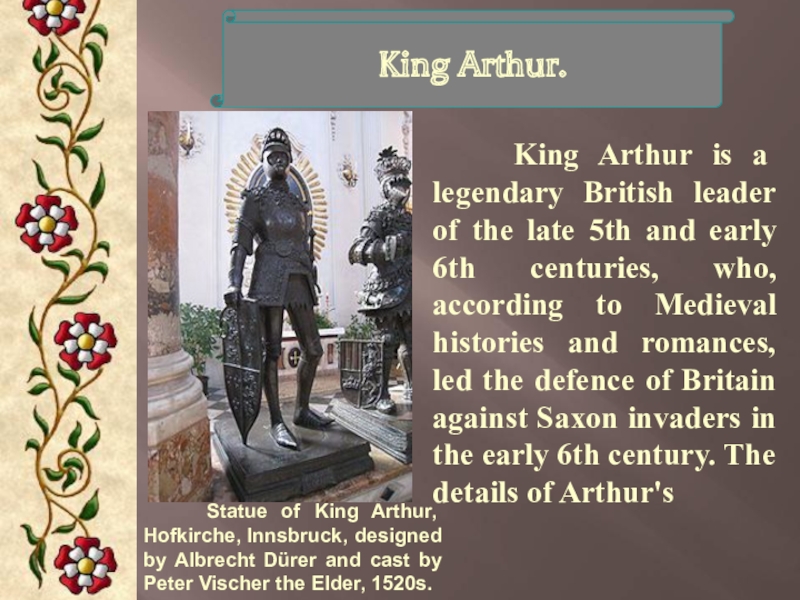
Statue of King Arthur, Hofkirche, Innsbruck, designed by Albrecht Dürer and cast by Peter Vischer the Elder, 1520s.
Слайд 5King Arthur.
story are mainly composed of folklore and literary invention,
and his historical existence is debated and disputed by modern historians. The sparse historical background of Arthur is gleaned from various sources, including the Annales Cambriae, the Historia Brittonum, and the writings of Gildas. Arthur's name also occurs in early poetic sources such as Y Gododdin.
Слайд 6Alfred the Great.
Alfred the Great ( 849 –
26 October 899) was King of Wessex from 871 to 899. Alfred is noted for his defence of the Anglo-Saxon kingdoms of southern England against the Danes, becoming the only English monarch still to be accorded the epithet "the Great". Alfred was the first King of the West Saxons to style himself "King of the Anglo-Saxons". Details of his life are described in a work by
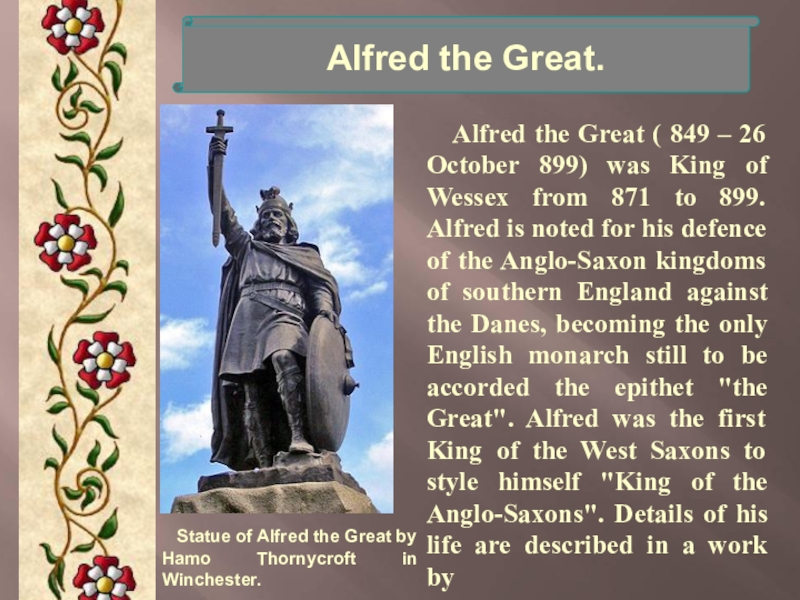
Statue of Alfred the Great by Hamo Thornycroft in Winchester.
Слайд 7Alfred the Great.
the 10th century Welsh scholar and bishop Asser.
Alfred was a learned man who encouraged education and improved his kingdom's legal system and military structure. He is regarded as a saint by some Catholics, but has never been officially canonised. The Anglican Communion venerates him as a Christian hero, with a feast day of 26 October, and he may often be found depicted in stained glass in Church of England.
Слайд 8William the Conqueror.
William I (c. 1028 – 9 September
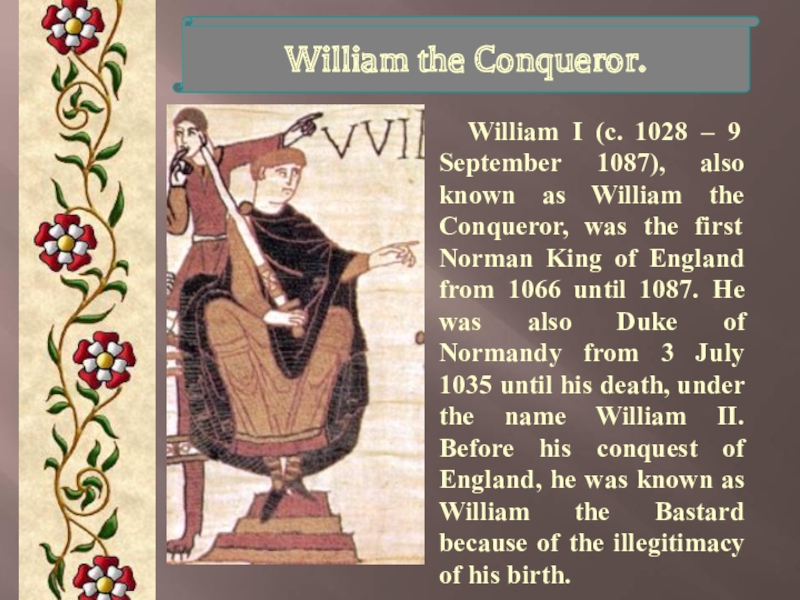
1087), also known as William the Conqueror, was the first Norman King of England from 1066 until 1087. He was also Duke of Normandy from 3 July 1035 until his death, under the name William II. Before his conquest of England, he was known as William the Bastard because of the illegitimacy of his birth.
Слайд 9William the Conqueror.
To press his claim to the English crown,
William invaded England in 1066, leading an army of Normans, Bretons, Flemings, and Frenchmen (from Paris and Île-de-France) to victory over the English forces of King Harold Godwinson at the Battle of Hastings, and suppressed subsequent English revolts in what has become known as the Norman Conquest.
Слайд 10Henry VIII.
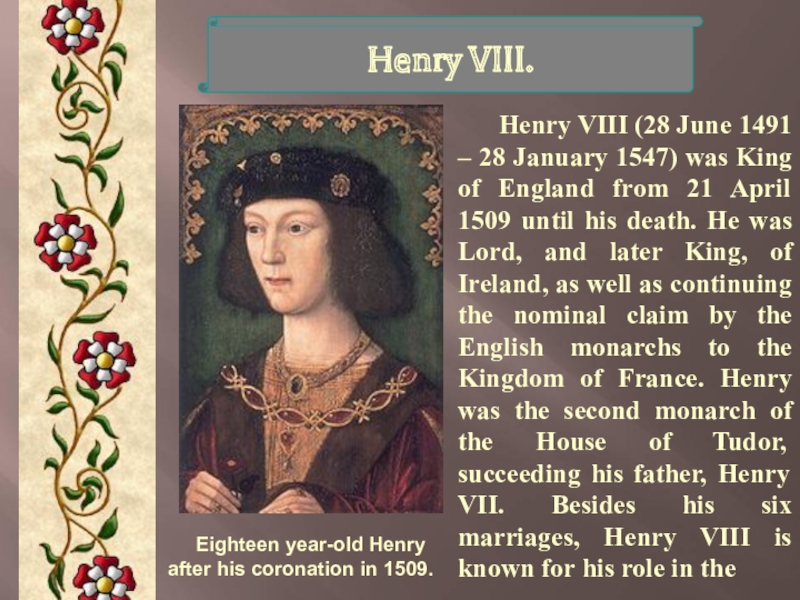
Eighteen year-old Henry after his coronation
in 1509.
Henry VIII (28 June 1491 – 28 January 1547) was King of England from 21 April 1509 until his death. He was Lord, and later King, of Ireland, as well as continuing the nominal claim by the English monarchs to the Kingdom of France. Henry was the second monarch of the House of Tudor, succeeding his father, Henry VII. Besides his six marriages, Henry VIII is known for his role in the
Слайд 11Henry VIII.
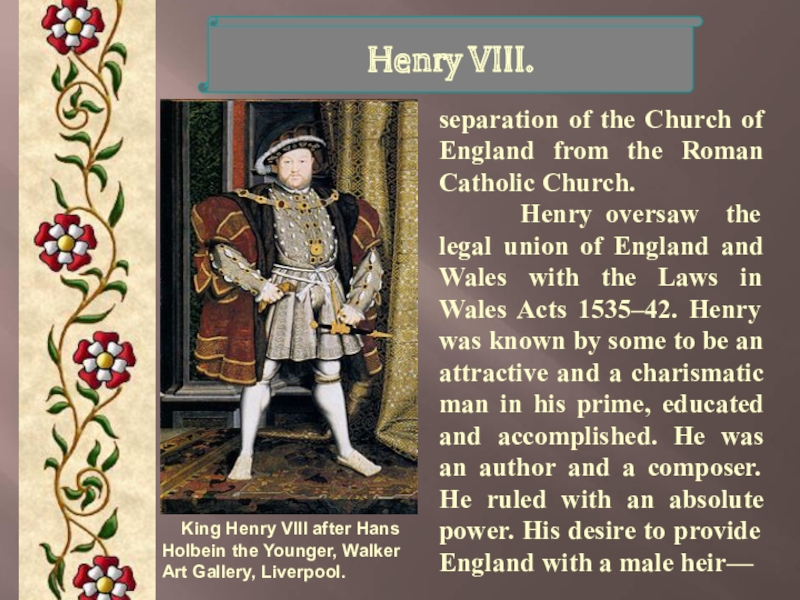
King Henry VIII after Hans Holbein the
Younger, Walker Art Gallery, Liverpool.
separation of the Church of England from the Roman Catholic Church.
Henry oversaw the legal union of England and Wales with the Laws in Wales Acts 1535–42. Henry was known by some to be an attractive and а charismatic man in his prime, educated and accomplished. He was an author and a composer. He ruled with an absolute power. His desire to provide England with a male heir—
Слайд 12Henry VIII.
which stemmed partly from personal vanity and partly because
he believed a daughter would be unable to consolidate the Tudor Dynasty and the fragile peace that existed following the Wars of the Roses—led to the two things that Henry is remembered for: his six marriages, and the English Reformation, which made England a mostly Protestant nation. In later life he became morbidly obese and his health suffered; his public image is frequently depicted as one of a lustful, egotistical, harsh, and insecure king. Henry VIII took control of the English clergy and had himself appointed the head of the Church of England.
Слайд 13Henry VIII
and his wives .
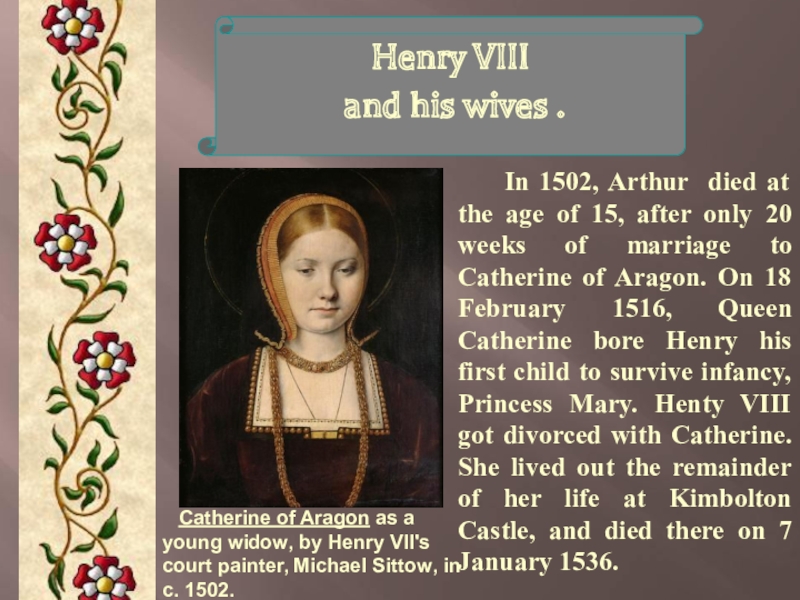
Catherine of Aragon
as a young widow, by Henry VII's court painter, Michael Sittow, in c. 1502.
In 1502, Arthur died at the age of 15, after only 20 weeks of marriage to Catherine of Aragon. On 18 February 1516, Queen Catherine bore Henry his first child to survive infancy, Princess Mary. Henty VIII got divorced with Catherine. She lived out the remainder of her life at Kimbolton Castle, and died there on 7 January 1536.
Слайд 14Henry VIII
and his wives .
Anne Boleyn.
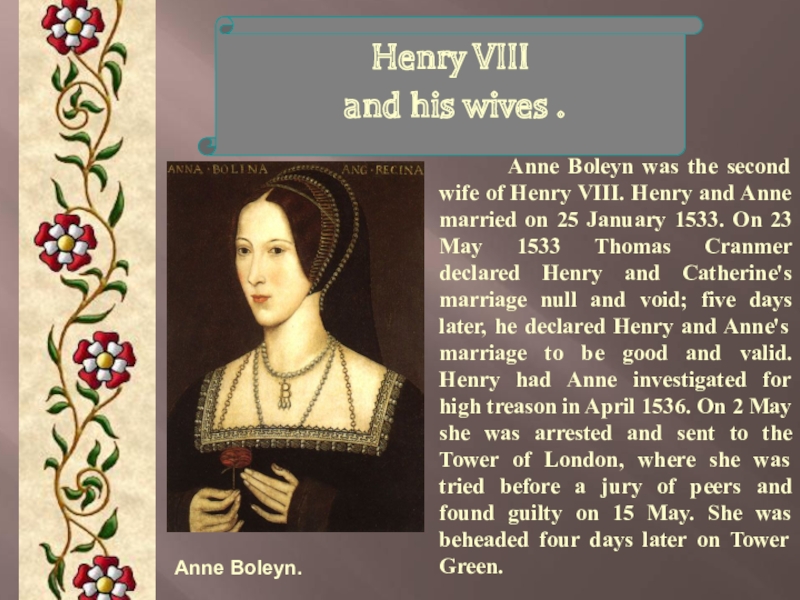
Anne Boleyn was the second wife of Henry VIII. Henry and Anne married on 25 January 1533. On 23 May 1533 Thomas Cranmer declared Henry and Catherine's marriage null and void; five days later, he declared Henry and Anne's marriage to be good and valid. Henry had Anne investigated for high treason in April 1536. On 2 May she was arrested and sent to the Tower of London, where she was tried before a jury of peers and found guilty on 15 May. She was beheaded four days later on Tower Green.
Слайд 15Henry VIII
and his wives .
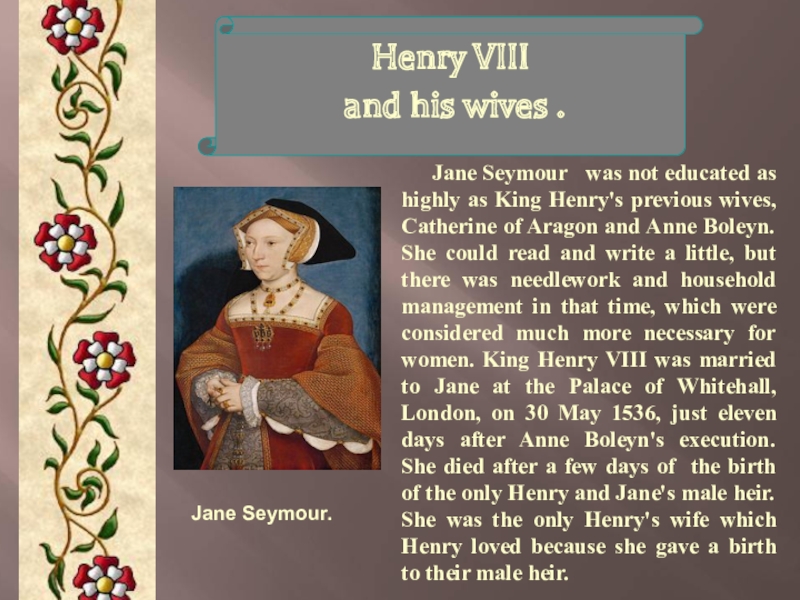
Jane Seymour
was not educated as highly as King Henry's previous wives, Catherine of Aragon and Anne Boleyn. She could read and write a little, but there was needlework and household management in that time, which were considered much more necessary for women. King Henry VIII was married to Jane at the Palace of Whitehall, London, on 30 May 1536, just eleven days after Anne Boleyn's execution. She died after a few days of the birth of the only Henry and Jane's male heir. She was the only Henry's wife which Henry loved because she gave a birth to their male heir.
Jane Seymour.
Слайд 16Henry VIII
and his wives .
Anne of Cleves.
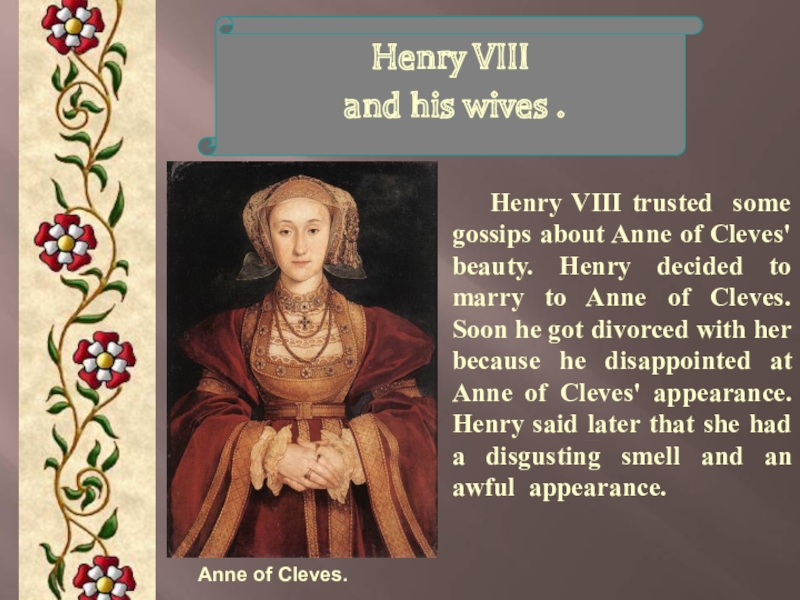
Henry VIII trusted some gossips about Anne of Cleves' beauty. Henry decided to marry to Anne of Cleves. Soon he got divorced with her because he disappointed at Anne of Cleves' appearance. Henry said later that she had a disgusting smell and an awful appearance.
Слайд 17Henry VIII
and his wives .
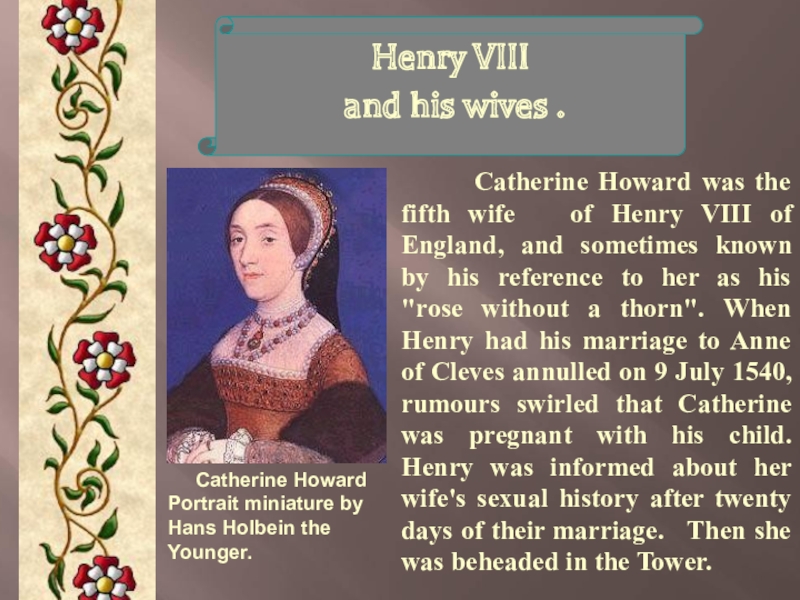
Catherine Howard
Portrait
miniature by
Hans Holbein the
Younger.
Catherine Howard was the fifth wife of Henry VIII of England, and sometimes known by his reference to her as his "rose without a thorn". When Henry had his marriage to Anne of Cleves annulled on 9 July 1540, rumours swirled that Catherine was pregnant with his child. Henry was informed about her wife's sexual history after twenty days of their marriage. Then she was beheaded in the Tower.
Слайд 18Henry VIII
and his wives .
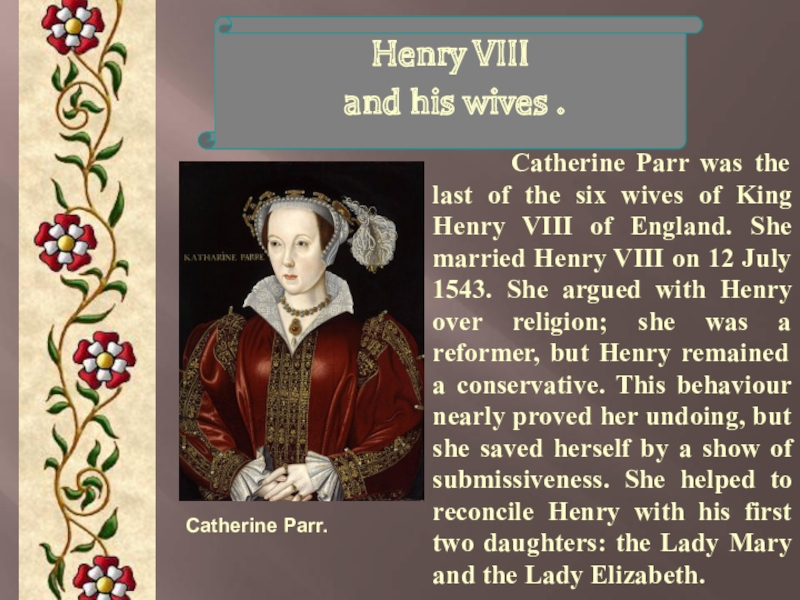
Catherine Parr was the last of the six wives of King Henry VIII of England. She married Henry VIII on 12 July 1543. She argued with Henry over religion; she was a reformer, but Henry remained a conservative. This behaviour nearly proved her undoing, but she saved herself by a show of submissiveness. She helped to reconcile Henry with his first two daughters: the Lady Mary and the Lady Elizabeth.
Catherine Parr.
Слайд 19Henry VIII.
Hampton Court Palace was originally built
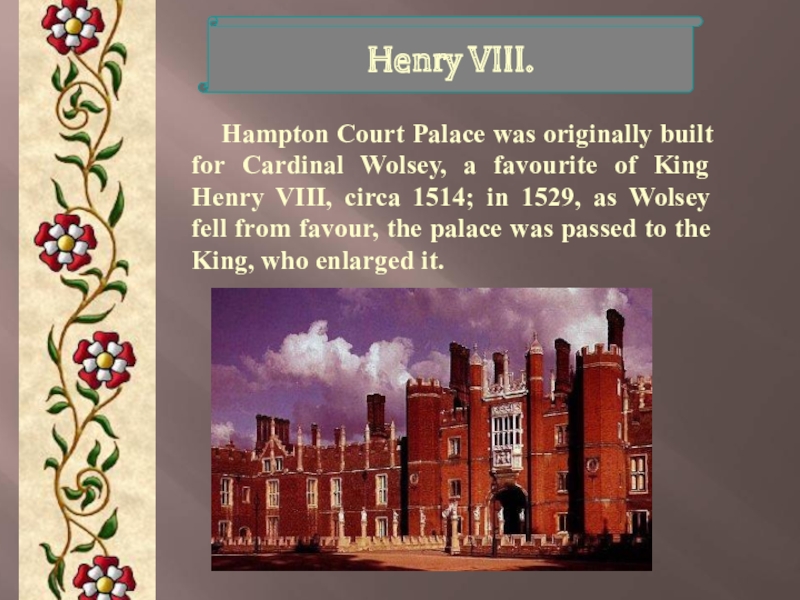
for Cardinal Wolsey, a favourite of King Henry VIII, circa 1514; in 1529, as Wolsey fell from favour, the palace was passed to the King, who enlarged it.
Слайд 20
Mary I or
Mary the Bloody.
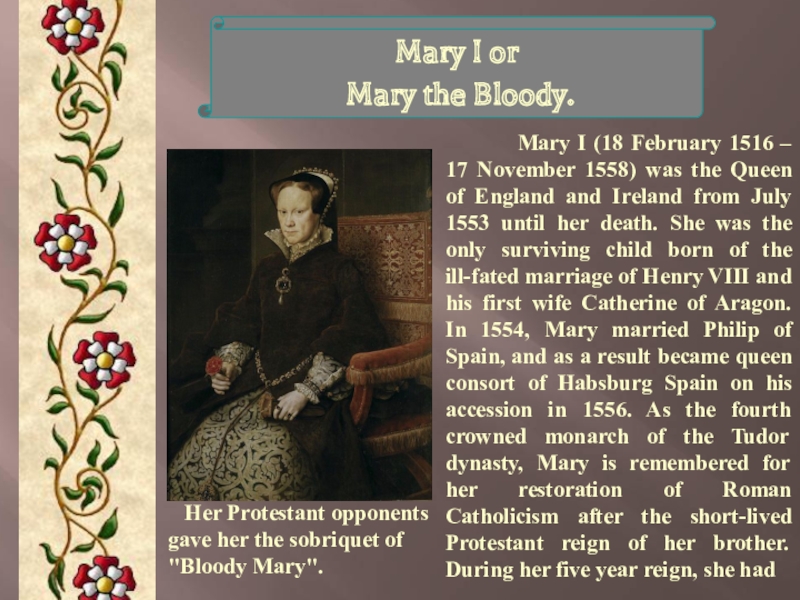
Mary I (18 February 1516 – 17 November 1558) was the Queen of England and Ireland from July 1553 until her death. She was the only surviving child born of the ill-fated marriage of Henry VIII and his first wife Catherine of Aragon. In 1554, Mary married Philip of Spain, and as a result became queen consort of Habsburg Spain on his accession in 1556. As the fourth crowned monarch of the Tudor dynasty, Mary is remembered for her restoration of Roman Catholicism after the short-lived Protestant reign of her brother. During her five year reign, she had
Her Protestant opponents gave her the sobriquet of "Bloody Mary".
Слайд 21Mary I or
Mary the Bloody.
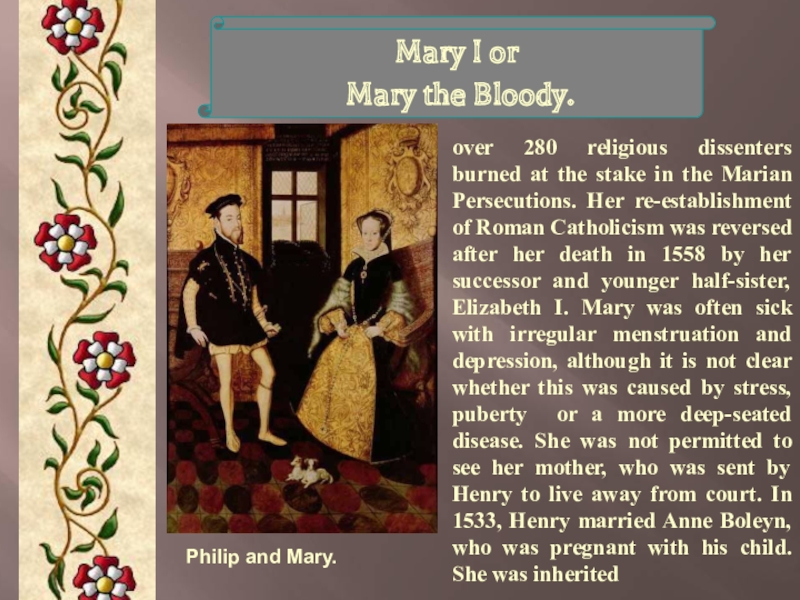
Philip and Mary.
over 280 religious
dissenters burned at the stake in the Marian Persecutions. Her re-establishment of Roman Catholicism was reversed after her death in 1558 by her successor and younger half-sister, Elizabeth I. Mary was often sick with irregular menstruation and depression, although it is not clear whether this was caused by stress, puberty or a more deep-seated disease. She was not permitted to see her mother, who was sent by Henry to live away from court. In 1533, Henry married Anne Boleyn, who was pregnant with his child. She was inherited
Слайд 22venereal diseases from her farther. One of Mary's first actions as
Queen was to order the release of the Roman Catholic Duke of Norfolk and Stephen Gardiner from imprisonment in the Tower of London, as well as her kinsman Edward Courtenay. Mary understood that the young Lady Jane was essentially a pawn in Dudley's scheme, and Dudley was the only conspirator of rank executed for high treason in the immediate aftermath of the coup. Lady Jane and her husband, Lord Guildford Dudley, though found guilty, were kept under guard in the Tower rather than executed, while Lady Jane's father, Henry Grey, 1st Duke of Suffolk, was released. Mary was weak and ill from May 1558, and died aged 42 at St. James's Palace during an influenza epidemic that claimed the life of Reginald Pole later the same day, 17 November 1558. She was in pain, possibly from ovarian cysts or uterine cancer.
Mary I or
Mary the Bloody.
Слайд 23
Elizabeth I.
Elizabeth I , "Darnley Portrait", c. 1575.
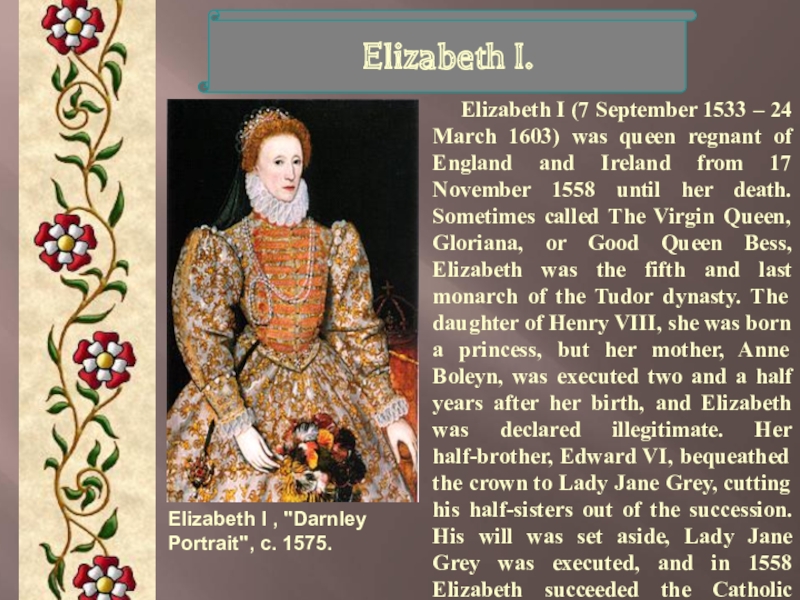
Elizabeth I (7 September 1533 – 24 March 1603) was queen regnant of England and Ireland from 17 November 1558 until her death. Sometimes called The Virgin Queen, Gloriana, or Good Queen Bess, Elizabeth was the fifth and last monarch of the Tudor dynasty. The daughter of Henry VIII, she was born a princess, but her mother, Anne Boleyn, was executed two and a half years after her birth, and Elizabeth was declared illegitimate. Her half-brother, Edward VI, bequeathed the crown to Lady Jane Grey, cutting his half-sisters out of the succession. His will was set aside, Lady Jane Grey was executed, and in 1558 Elizabeth succeeded the Catholic Mary I,
Слайд 24
Elizabeth I.
during whose reign she had been imprisoned for nearly
a year on suspicion of supporting Protestant rebels.
Elizabeth set out to rule by good counsel, and she depended heavily on a group of trusted advisers led by William Cecil, Baron Burghley. One of her first moves as queen was the establishing of an English Protestant church, of which she became the Supreme Governor. This Elizabethan Religious Settlement later evolved into today's Church of England. It was expected that Elizabeth would marry and produce an heir so as to continue the Tudor line. She never did, however, despite numerous courtships. As she grew older, Elizabeth became famous for her virginity, and a cult grew up around her which was celebrated in the portraits, pageants, and literature of the day. In government, Elizabeth was more moderate than her father and half-siblings had been. One of her mottoes was "video et taceo" ("I see, and say nothing"). Elizabeth's reign is known as the Elizabethan era, famous above all for the flourishing of English drama, led by playwrights such as William Shakespeare and Christopher Marlowe, and for the seafaring prowess of English adventurers such as Sir Francis Drake.
Слайд 25
Charles I.
Portrait by Anthony
van Dyck, 1636.
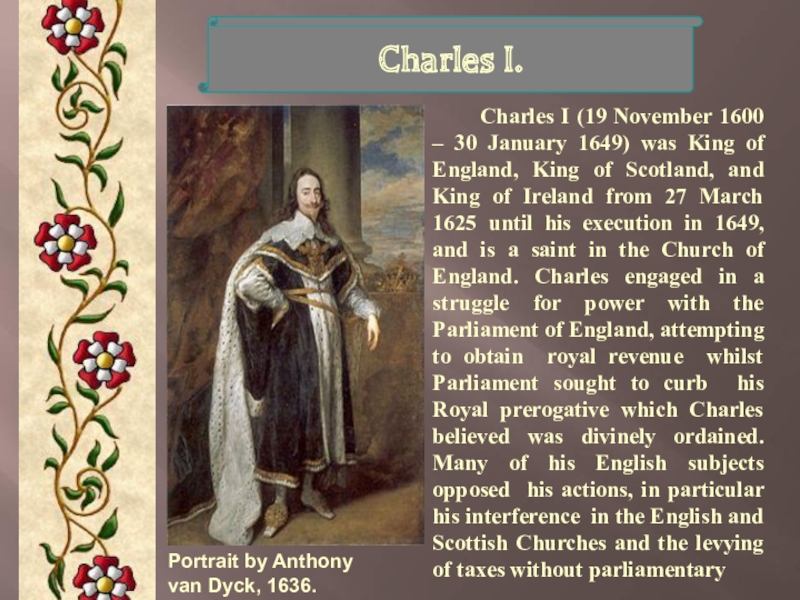
Charles I (19 November 1600 – 30 January 1649) was King of England, King of Scotland, and King of Ireland from 27 March 1625 until his execution in 1649, and is a saint in the Church of England. Charles engaged in a struggle for power with the Parliament of England, attempting to obtain royal revenue whilst Parliament sought to curb his Royal prerogative which Charles believed was divinely ordained. Many of his English subjects opposed his actions, in particular his interference in the English and Scottish Churches and the levying of taxes without parliamentary
Слайд 26consent which grew to be seen as those of a tyrannical
absolute monarch. Religious conflicts permeated Charles's reign.
His failure to successfully aid Protestant forces during the Thirty Years' War, coupled with such actions as marrying a Catholic princess, generated deep mistrust concerning the king's dogma. Charles further allied himself with controversial religious figures, such as the ecclesiastic Richard Montagu, and William Laud, whom Charles appointed Archbishop of Canterbury. Many of Charles' subjects felt this brought the Church of England too close to the Catholic Church. Charles' later attempts to force religious reforms upon Scotland led to the Bishops' Wars, strengthened the position of the English and Scottish Parliaments and helped precipitate the king's downfall. Charles' last years were marked by the English Civil War, in which he fought the forces of the English and Scottish Parliaments, which challenged the king's attempts to overrule and negate Parliamentary authority, whilst simultaneously using his position as the Head of the English Church to pursue religious
Charles I.
Слайд 27Charles I.
policies which generated the antipathy of reformed groups such
as the Puritans.
Charles was defeated in the First Civil War (1642–45), after which Parliament expected him to accept its demands for a constitutional monarchy. He instead remained defiant by attempting to forge an alliance with Scotland and escaping to the Isle of Wight. This provoked the Second Civil War (1648–49) and a second defeat for Charles, who was subsequently captured, tried, convicted, and executed for high treason. The monarchy was then abolished and a republic called the Commonwealth of England, also referred to as the Cromwellian Interregnum, was declared. Charles' son, Charles II, who dated his accession from the death of his father, did not take up the reins of government until the restoration of the monarchy in 1660.
Слайд 28James II.
King of England, Scotland and Ireland.
James
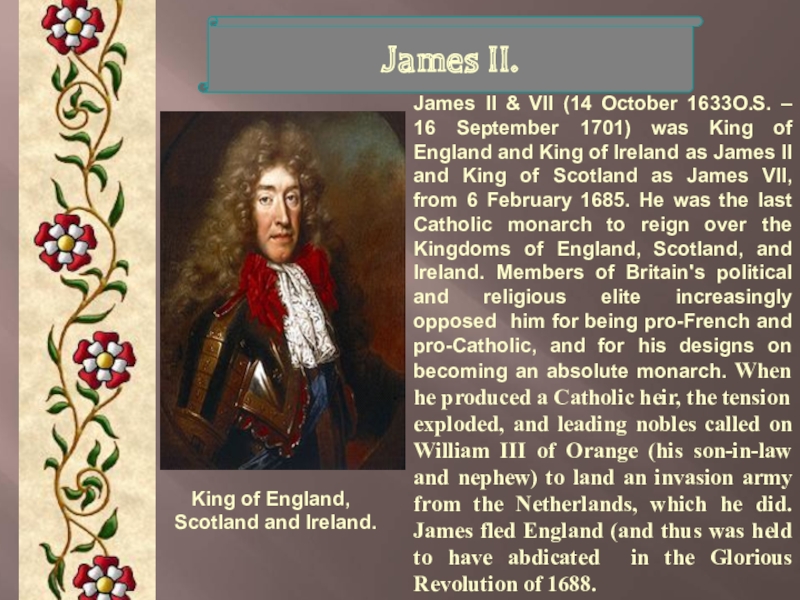
II & VII (14 October 1633O.S. – 16 September 1701) was King of England and King of Ireland as James II and King of Scotland as James VII, from 6 February 1685. He was the last Catholic monarch to reign over the Kingdoms of England, Scotland, and Ireland. Members of Britain's political and religious elite increasingly opposed him for being pro-French and pro-Catholic, and for his designs on becoming an absolute monarch. When he produced a Catholic heir, the tension exploded, and leading nobles called on William III of Orange (his son-in-law and nephew) to land an invasion army from the Netherlands, which he did. James fled England (and thus was held to have abdicated in the Glorious Revolution of 1688.
Слайд 29James II.
He was replaced by William of
Orange who became king as William III, ruling jointly with his wife (James's daughter) Mary II. Thus William and Mary, both Protestants, became joint rulers in 1689. James made one serious attempt to recover his crowns, when he landed in Ireland in 1689 but, after the defeat of the Jacobite forces by the Williamite forces at the Battle of the Boyne in the summer of 1690, James returned to France. He lived out the rest of his life as a pretender at a court sponsored by his cousin and ally, King Louis XIV. James is best known for his belief in the Divine Right of Kings and his attempts to create religious liberty for English Roman Catholics against the wishes of the English Parliament. Parliament, opposed to the growth of absolutism that was occurring in other European countries, as well as to the loss of legal supremacy for the Church of England, saw their opposition as a way to preserve what they regarded as traditional English liberties. This tension made James's four-year reign a struggle for supremacy between the English Parliament and the Crown, resulting in his deposition, the passage of the English Bill of Rights, and the Hanoverian succession.
Слайд 30Queen Victoria.
Coronation portrait by George Hayter.
Queen Victoria
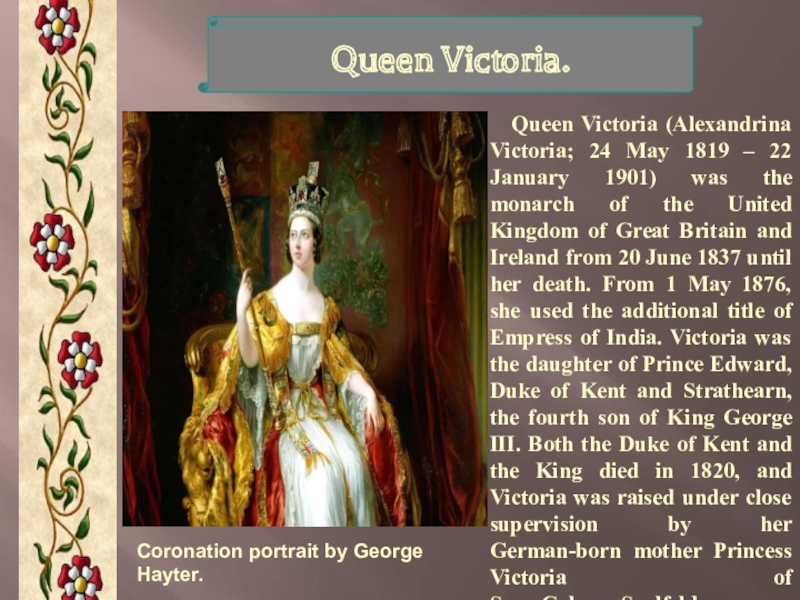
(Alexandrina Victoria; 24 May 1819 – 22 January 1901) was the monarch of the United Kingdom of Great Britain and Ireland from 20 June 1837 until her death. From 1 May 1876, she used the additional title of Empress of India. Victoria was the daughter of Prince Edward, Duke of Kent and Strathearn, the fourth son of King George III. Both the Duke of Kent and the King died in 1820, and Victoria was raised under close supervision by her German-born mother Princess Victoria of Saxe-Coburg-Saalfeld.
Слайд 31 Queen Victoria's family in 1846 by Franz Xaver
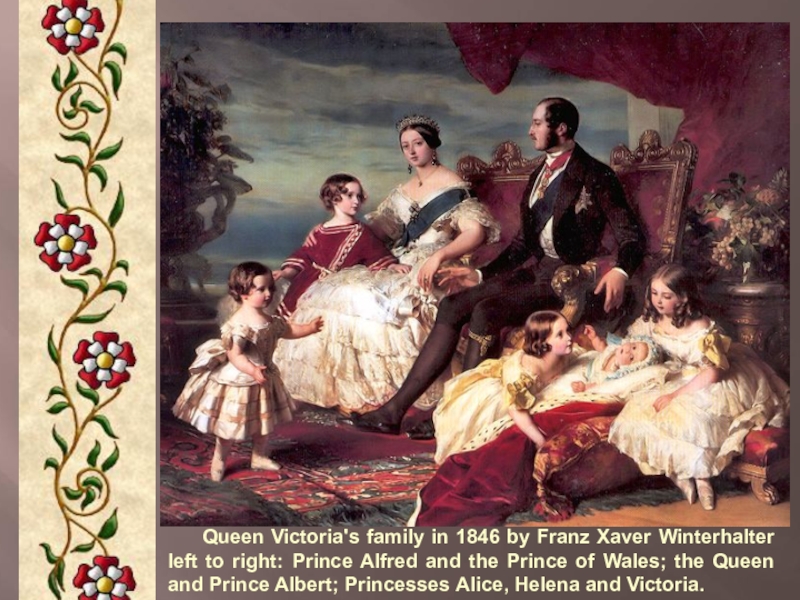
Winterhalter left to right: Prince Alfred and the Prince of Wales; the Queen and Prince Albert; Princesses Alice, Helena and Victoria.
Слайд 32Queen Victoria.
She inherited the throne at the
age of 18 after her father's three elder brothers died without surviving legitimate issue. The United Kingdom was already an established constitutional monarchy, in which the Sovereign held relatively few direct political powers. Privately, she attempted to influence government policy and ministerial appointments. Publicly, she became a national icon, and was identified with strict standards of personal morality. She married her first cousin, Prince Albert of Saxe-Coburg and Gotha, in 1840. Their nine children and 26 of their 34 grandchildren who survived childhood married into royal and noble families across the continent, tying them together and earning her the nickname "the grandmother of Europe". After Albert's death in 1861, Victoria plunged into deep mourning and avoided public appearances. As a result of her seclusion , republicanism temporarily gained strength, but in the latter half of her reign, her popularity recovered.
Слайд 33Queen Victoria.
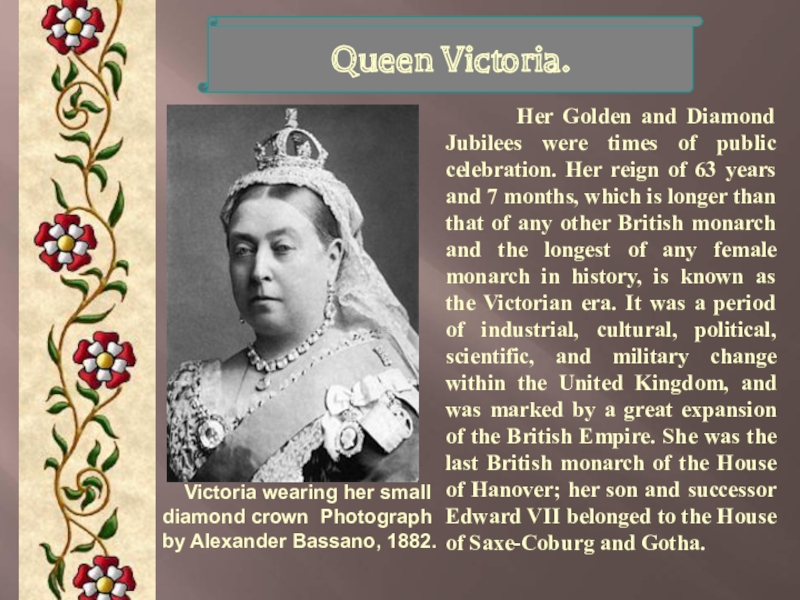
Victoria wearing her small diamond crown Photograph
by Alexander Bassano, 1882.
Her Golden and Diamond Jubilees were times of public celebration. Her reign of 63 years and 7 months, which is longer than that of any other British monarch and the longest of any female monarch in history, is known as the Victorian era. It was a period of industrial, cultural, political, scientific, and military change within the United Kingdom, and was marked by a great expansion of the British Empire. She was the last British monarch of the House of Hanover; her son and successor Edward VII belonged to the House of Saxe-Coburg and Gotha.
Слайд 34Edward VIII.
Edward in Canada, 1919.
Edward VIII
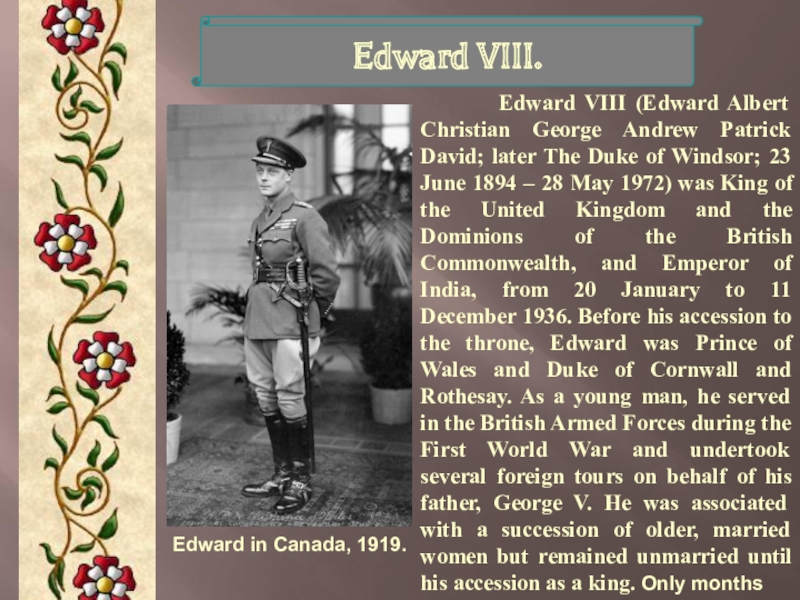
(Edward Albert Christian George Andrew Patrick David; later The Duke of Windsor; 23 June 1894 – 28 May 1972) was King of the United Kingdom and the Dominions of the British Commonwealth, and Emperor of India, from 20 January to 11 December 1936. Before his accession to the throne, Edward was Prince of Wales and Duke of Cornwall and Rothesay. As a young man, he served in the British Armed Forces during the First World War and undertook several foreign tours on behalf of his father, George V. He was associated with a succession of older, married women but remained unmarried until his accession as a king. Only months
Слайд 35Edward VIII.
into his reign, he caused a constitutional crisis by proposing
marriage to the American socialite Wallis Simpson, who had divorced her first husband and was seeking a divorce from her second. The prime ministers of the United Kingdom and the Dominions opposed the marriage, arguing that the people would never accept a divorced woman with two living ex-husbands as queen. Additionally, such a marriage would have conflicted with Edward's status as head of the Church of England, which opposed the remarriage of divorced people if their former spouses were still alive. Edward knew that the government led by British Prime Minister Stanley Baldwin would resign if the marriage went ahead, which could have dragged the king into a general election and would ruin his status as a politically neutral constitutional monarch. Rather than end his relationship with Simpson, Edward abdicated. He was succeeded by his younger brother Albert. With a reign of 326 days, Edward was one of the shortest-reigning monarchs in British and Commonwealth history. He was never crowned. After his abdication, he was created Duke of Windsor. He married Wallis Simpson in France on 3 June 1937, after her second divorce became final. Later that year, the couple toured Germany. During the Second World War, he was at first stationed with the British Military Mission to France but, after private accusations that he held Nazi sympathies, moved to the Bahamas after his appointment as Governor. After the war, he was never given another official appointment and spent the remainder of his life in retirement in France.
Слайд 36Elizabeth II.
Elizabeth II (Elizabeth Alexandra Mary; born
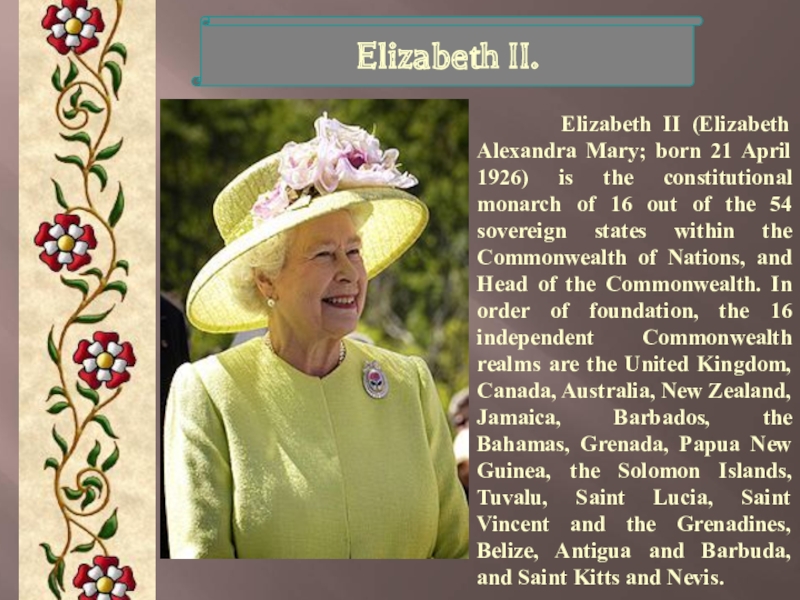
21 April 1926) is the constitutional monarch of 16 out of the 54 sovereign states within the Commonwealth of Nations, and Head of the Commonwealth. In order of foundation, the 16 independent Commonwealth realms are the United Kingdom, Canada, Australia, New Zealand, Jamaica, Barbados, the Bahamas, Grenada, Papua New Guinea, the Solomon Islands, Tuvalu, Saint Lucia, Saint Vincent and the Grenadines, Belize, Antigua and Barbuda, and Saint Kitts and Nevis.
Слайд 37Elizabeth II.
As the British monarch,
she is the Supreme Governor of the Church of England. Elizabeth was born in London, and educated privately at home. Her father acceded to the throne as George VI in 1936 on the abdication of his brother Edward VIII. Elizabeth met her future husband, Prince Philip of Greece and Denmark, in 1934 and 1937. She began to undertake public duties during the Second World War, in which she served in the Auxiliary Territorial Service. After another meeting at the Royal Naval College in Dartmouth in July 1939, Elizabeth – though only 13 years old – fell in love with Philip, and they began to exchange letters. They married on 20 November 1947 at Westminster Abbey. Elizabeth and Philip received 2500 wedding gifts from around the world. When her father died in 1952, she became Head of the Commonwealth and queen regnant of seven independent Commonwealth countries: the United Kingdom, Canada, Australia, New Zealand, South Africa, Pakistan, and Ceylon. Her coronation service in 1953 was the first to be televised. Between 1956 and 1992, the number of her realms varied as territories gained independence and realms including South
Слайд 38Africa, Pakistan, and Ceylon (renamed Sri Lanka), became republics. She has
four children: Charles, Anne, Andrew, and Edward. In 1992, which Elizabeth termed her “horrible year", Charles and Andrew separated from their wives, Anne divorced, and a severe fire destroyed part of Windsor Castle. Revelations continued on the state of Charles's marriage to Diana, Princess of Wales, and they divorced in 1996. The following year, Diana died in a Paris car crash, and the media criticized the royal family for remaining in seclusion in the days before her funeral. Elizabeth's personal popularity rebounded after she appeared in public and has subsequently remained high. Her reign of 59 years is the second-longest for a British monarch; only Queen Victoria has reigned longer. Her Silver and Golden Jubilees were celebrated in 1977 and 2002; her Diamond Jubilee is planned for 2012.
Elizabeth II.
Слайд 39Princess Elizabeth aged 3, 1929.
Princess Elizabeth aged 7,
1933 painting by Philip de László.
Personal Flag of Queen Elizabeth II.
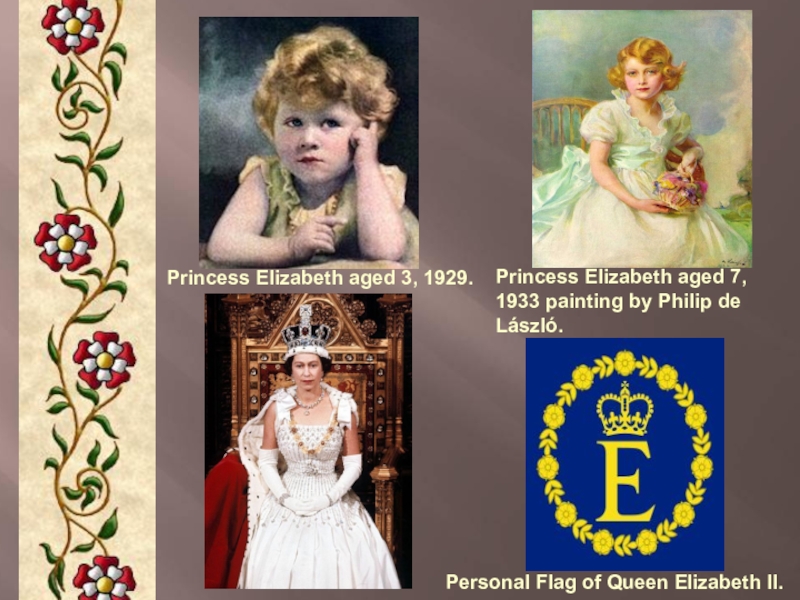
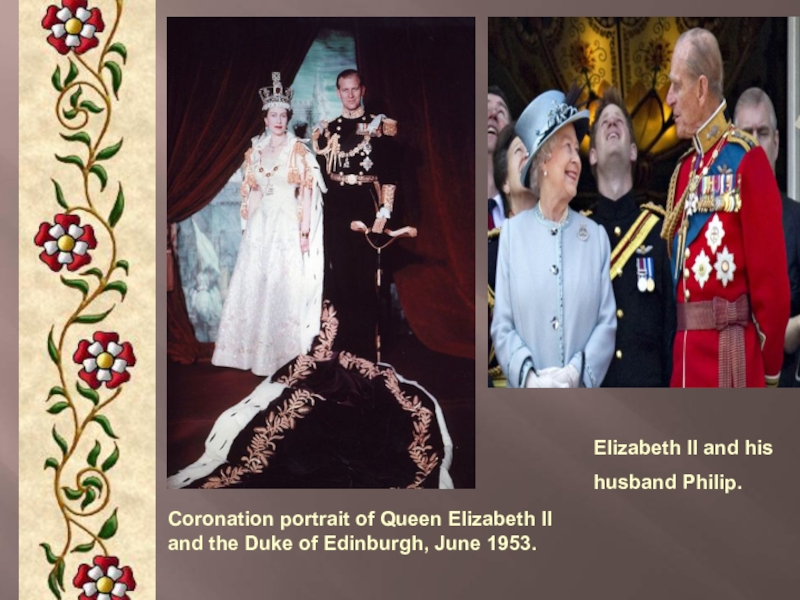
Слайд 40Coronation portrait of Queen Elizabeth II and the Duke of Edinburgh,
June 1953.
Elizabeth II and his
husband Philip.
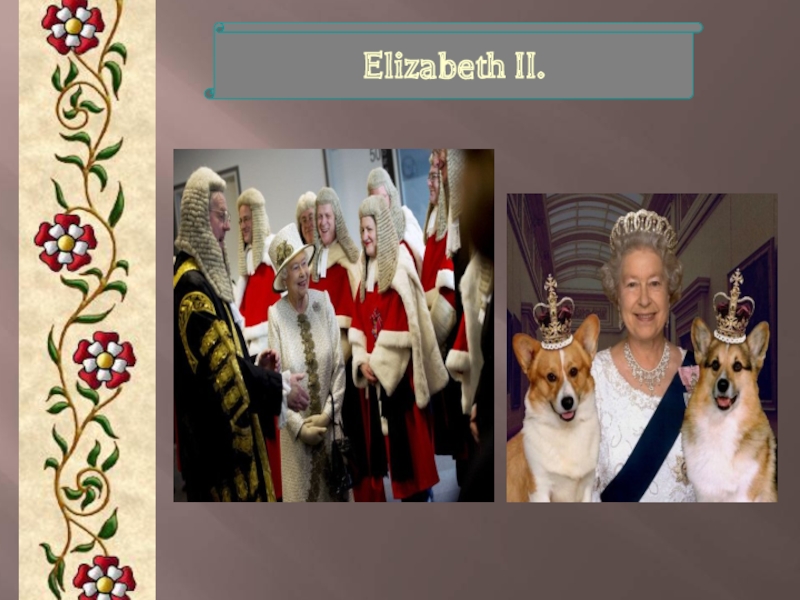
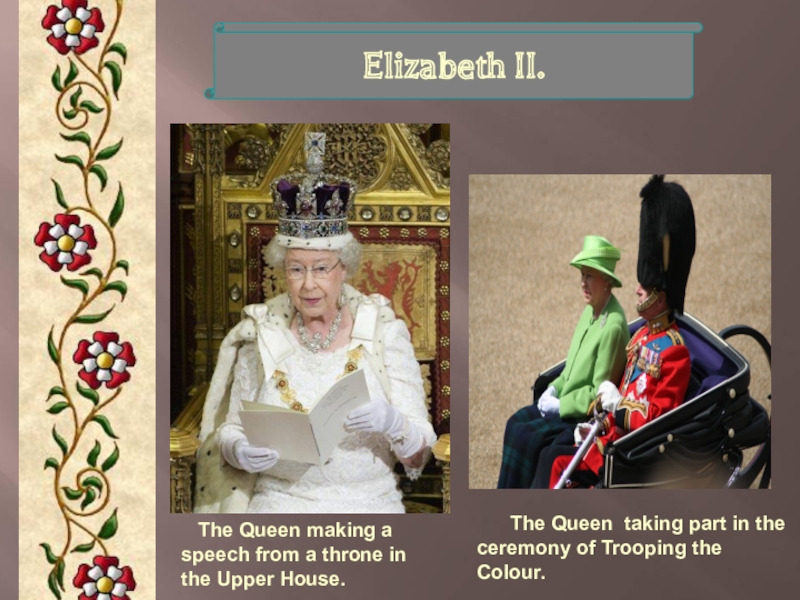
Слайд 41 The Queen making a speech from a throne in
the Upper House.
Elizabeth II.
The Queen taking part in the
ceremony of Trooping the Colour.
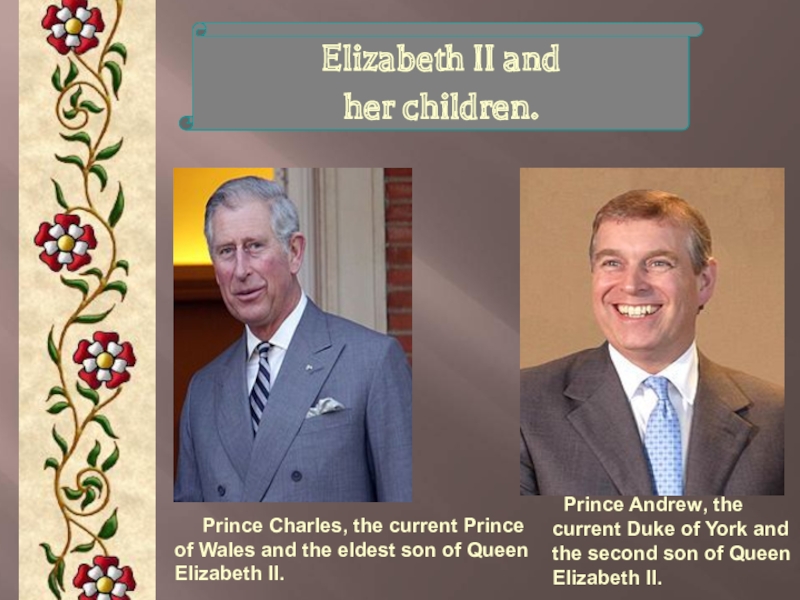
Слайд 43Elizabeth II and
her children.
Prince Charles, the current
Prince
of Wales and the eldest son of Queen Elizabeth II.
Prince Andrew, the current Duke of York and the second son of Queen Elizabeth II.
Слайд 44Elizabeth II and
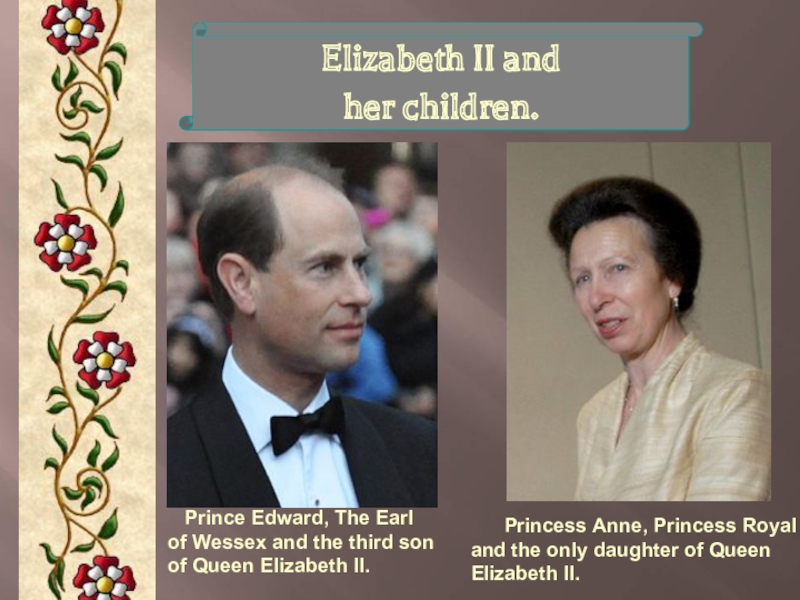
her children.
Prince Edward, The Earl of
Wessex and the third son of Queen Elizabeth II.
Princess Anne, Princess Royal
and the only daughter of Queen
Elizabeth II.
Слайд 45Elizabeth II.
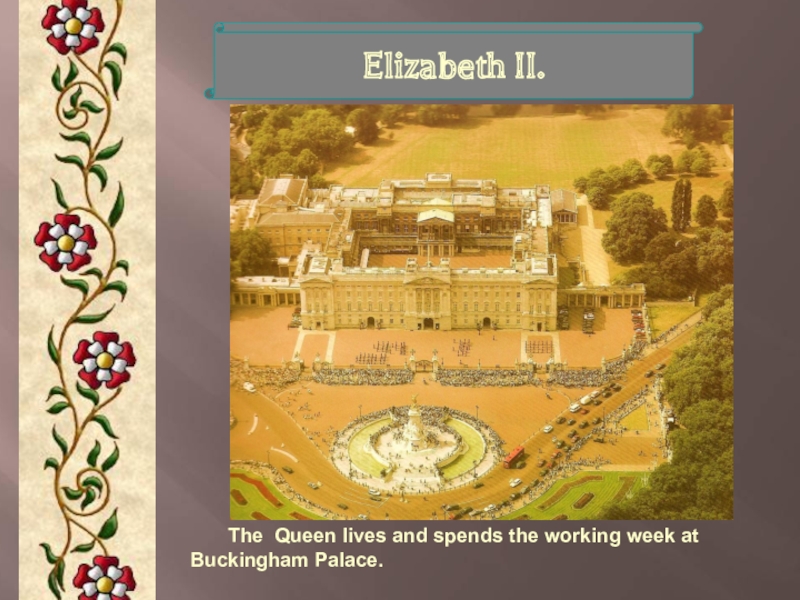
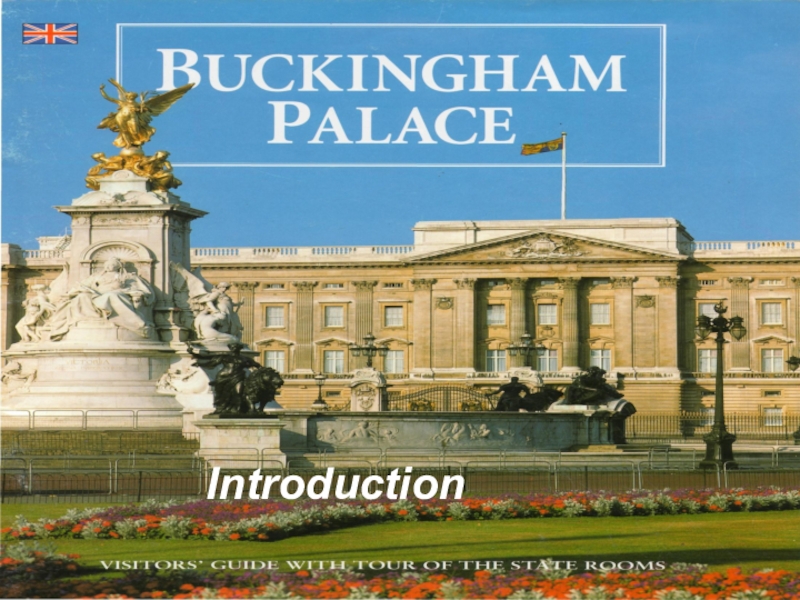
The Queen lives and
spends the working week at
Buckingham Palace.
Слайд 46Elizabeth II.
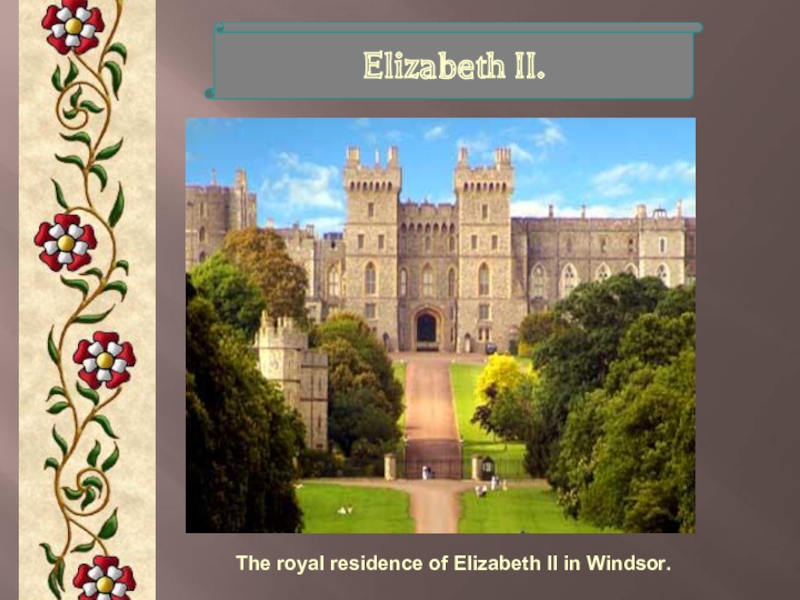
The royal residence of Elizabeth II in Windsor.