- Главная
- Разное
- Образование
- Спорт
- Естествознание
- Природоведение
- Религиоведение
- Французский язык
- Черчение
- Английский язык
- Астрономия
- Алгебра
- Биология
- География
- Геометрия
- Детские презентации
- Информатика
- История
- Литература
- Математика
- Музыка
- МХК
- Немецкий язык
- ОБЖ
- Обществознание
- Окружающий мир
- Педагогика
- Русский язык
- Технология
- Физика
- Философия
- Химия
- Шаблоны, фоны, картинки для презентаций
- Экология
- Экономика
Презентация, доклад к уроку английского языка на тему Christmas Traditions in Great Britain
Содержание
- 1. Презентация к уроку английского языка на тему Christmas Traditions in Great Britain
- 2. Christmas Christmas Day , December 25,
- 3. History of Christmas The history of
- 4. This date was probably chosen because the
- 5. St Augustine was the person who really
- 6. Boxing Day Boxing Day takes place on
- 7. If we are to find the roots
- 8. Stockings Christmas is a holiday
- 9. Christmas TreeThe first Christmas Trees came to
- 10. Holly, Ivy and other greenery such as
- 11. Holly became the recognized symbol of Christmas.
- 12. Ivy It has to cling to something
- 13. MistletoeThe practice of hanging it in the
- 14. The custom of kissing under Mistletoe comes
- 15. Carols were first sung in Europe thousands
- 16. Carols Carols used to be written and
- 17. Dashing through the snow, In a one-horse
- 18. Christmas is Coming Christmas is coming, the
- 19. Candles One of the main
- 20. The Christmas log Nowadays the
- 21. Santa Claus is often connected with the
- 22. Santa Claus Santa Claus, also called
- 23. In Finland, they say that he lives
- 24. Christmas Cards People around the world
- 25. Слайд 25
- 26. Christmas Dinner The typical dinner consists of
- 27. Candycane Parents treat children for Christmas
- 28. Cookies for Santa Children leave on
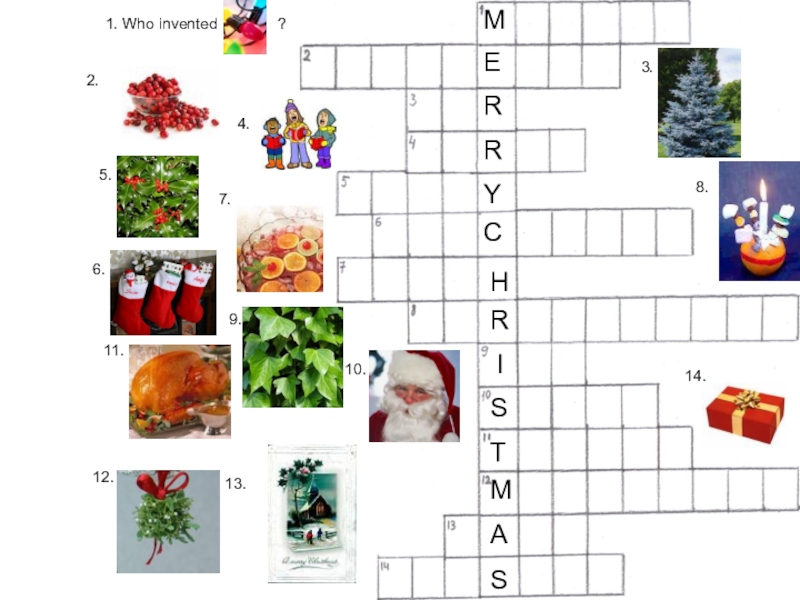
- 29. 1. Who invented ?2.3.4.5.6.7.8.9.10.11. 12.13.14.MERRRYCHISTMAS
- 30. Слайд 30
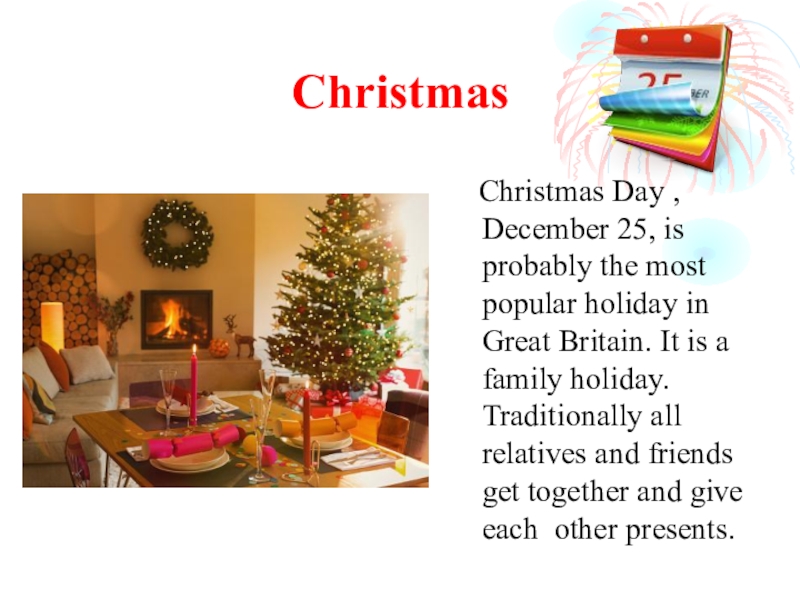
Christmas Christmas Day , December 25, is probably the most popular holiday in Great Britain. It is a family holiday. Traditionally all relatives and friends get together and give each other presents.
Слайд 2Christmas
Christmas Day , December 25, is probably the most
popular holiday in Great Britain. It is a family holiday. Traditionally all relatives and friends get together and give each other presents.
Слайд 3History of Christmas
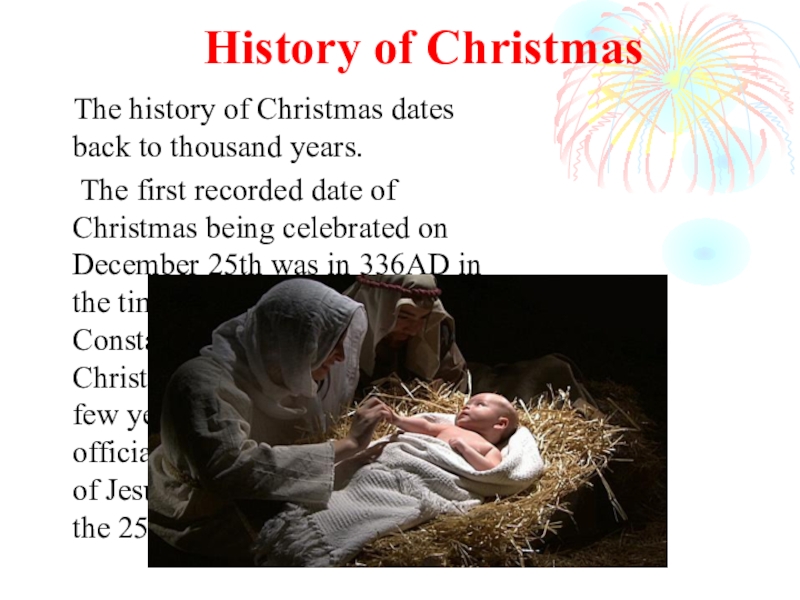
The history of Christmas dates back to
thousand years.
The first recorded date of Christmas being celebrated on December 25th was in 336AD in the time of the Roman Emperor Constantine (he was the first Christian Roman Emperor). A few years later Pope Julius I officially declared that the birth of Jesus would be celebrated on the 25th December.
The first recorded date of Christmas being celebrated on December 25th was in 336AD in the time of the Roman Emperor Constantine (he was the first Christian Roman Emperor). A few years later Pope Julius I officially declared that the birth of Jesus would be celebrated on the 25th December.
Слайд 4This date was probably chosen because
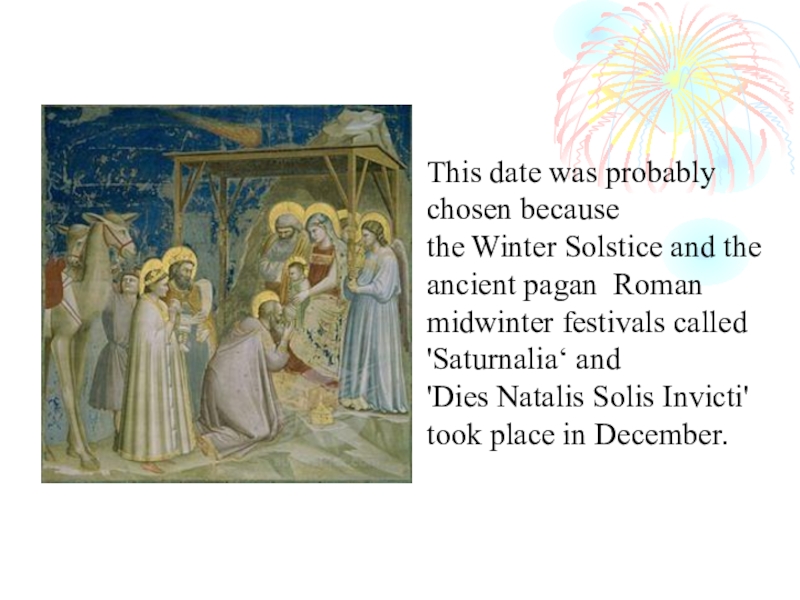
the Winter Solstice and the
ancient pagan Roman midwinter festivals called
'Saturnalia‘ and
'Dies Natalis Solis Invicti' took place in December.
'Saturnalia‘ and
'Dies Natalis Solis Invicti' took place in December.
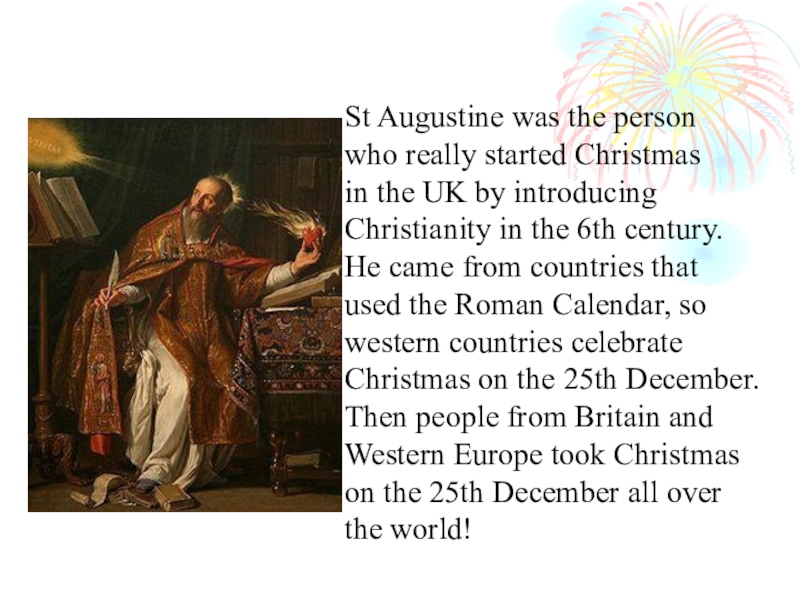
Слайд 5St Augustine was the person
who really started Christmas
in the
UK by introducing
Christianity in the 6th century.
He came from countries that
used the Roman Calendar, so
western countries celebrate
Christmas on the 25th December.
Then people from Britain and
Western Europe took Christmas on the 25th December all over the world!
Christianity in the 6th century.
He came from countries that
used the Roman Calendar, so
western countries celebrate
Christmas on the 25th December.
Then people from Britain and
Western Europe took Christmas on the 25th December all over the world!
Слайд 6Boxing Day
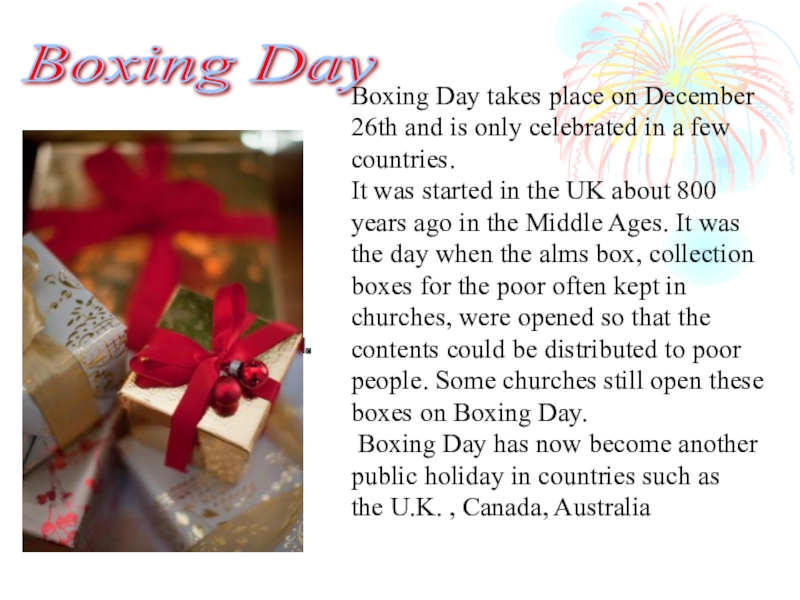
Boxing Day takes place on December 26th and is
only celebrated in a few countries.
It was started in the UK about 800 years ago in the Middle Ages. It was the day when the alms box, collection boxes for the poor often kept in churches, were opened so that the contents could be distributed to poor people. Some churches still open these boxes on Boxing Day.
Boxing Day has now become another
public holiday in countries such as
the U.K. , Canada, Australia
It was started in the UK about 800 years ago in the Middle Ages. It was the day when the alms box, collection boxes for the poor often kept in churches, were opened so that the contents could be distributed to poor people. Some churches still open these boxes on Boxing Day.
Boxing Day has now become another
public holiday in countries such as
the U.K. , Canada, Australia
and New Zealand.
Слайд 7If we are to find the roots of the Christmas traditions,
we may need to go back to the age of Mesopotamian
culture which had the tradition of celebrating New Year.
The same kind of tradition was also the part of
the Persian and Babylonian culture. They had the festival called the ‘Sacaea’. On the other hand, there was alsoa festival in Scandinavia known as ‘Yule’, which was celebrated during the winter months.
All these festivals have had
great impact on the present day
Christmas.
Слайд 8Stockings
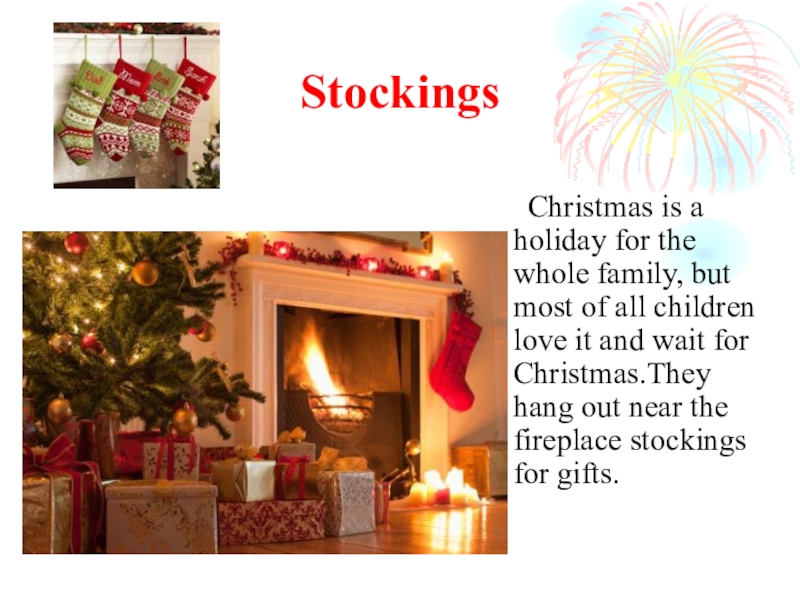
Christmas is a holiday for the whole family,
but most of all children love it and wait for Christmas.They hang out near the fireplace stockings for gifts.
Слайд 9Christmas Tree
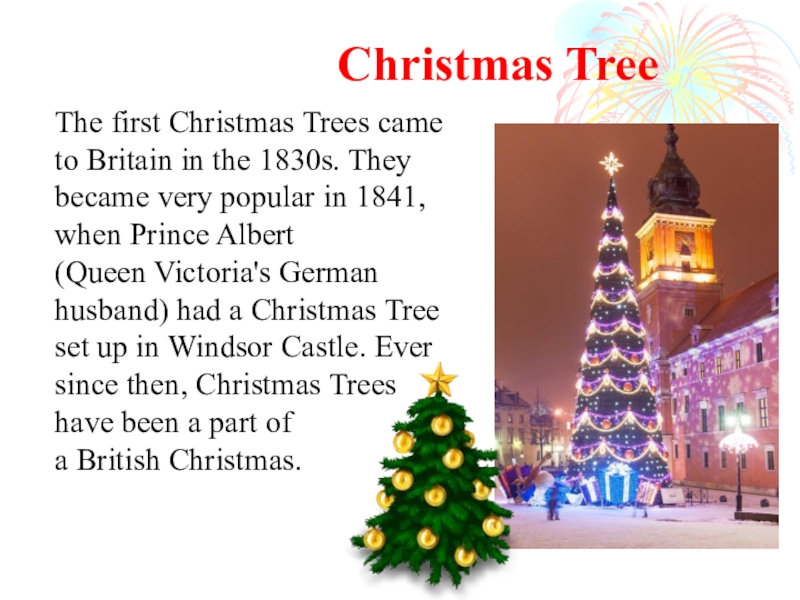
The first Christmas Trees came to Britain in the 1830s.
They became very popular in 1841, when Prince Albert (Queen Victoria's German husband) had a Christmas Tree set up in Windsor Castle. Ever since then, Christmas Trees
have been a part of
a British Christmas.
have been a part of
a British Christmas.
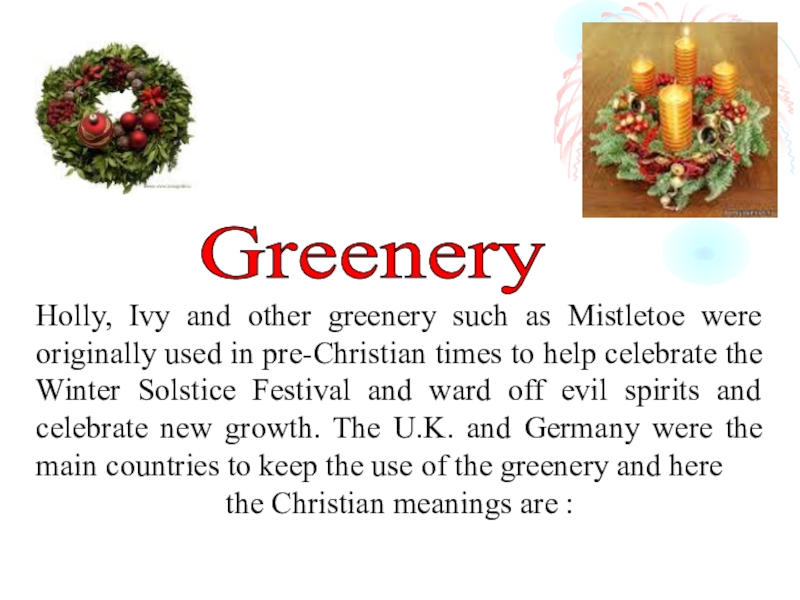
Слайд 10Holly, Ivy and other greenery such as Mistletoe were originally used
in pre-Christian times to help celebrate the Winter Solstice Festival and ward off evil spirits and celebrate new growth. The U.K. and Germany were the main countries to keep the use of the greenery and here
the Christian meanings are :
the Christian meanings are :
Greenery
Слайд 11Holly became the recognized symbol of Christmas.
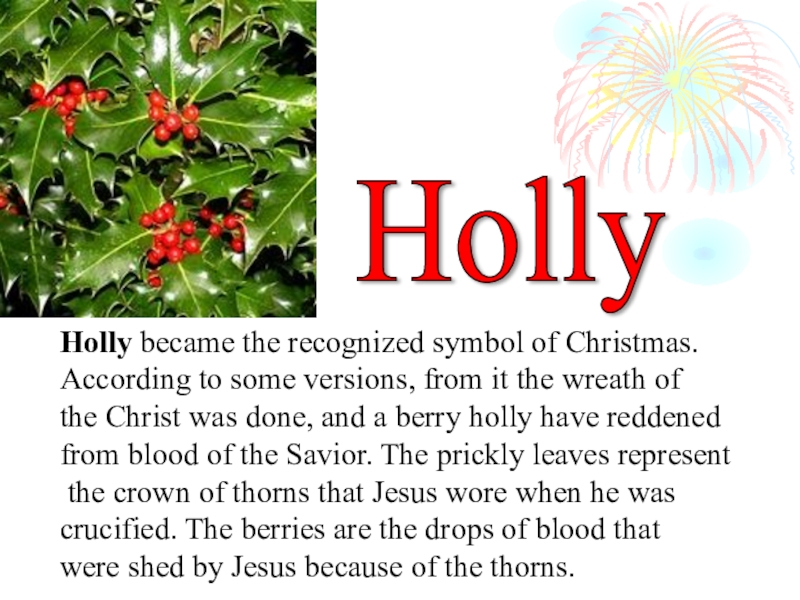
According to some versions,
from it the wreath of
the Christ was done, and a berry holly have reddened
from blood of the Savior. The prickly leaves represent
the crown of thorns that Jesus wore when he was
crucified. The berries are the drops of blood that
were shed by Jesus because of the thorns.
the Christ was done, and a berry holly have reddened
from blood of the Savior. The prickly leaves represent
the crown of thorns that Jesus wore when he was
crucified. The berries are the drops of blood that
were shed by Jesus because of the thorns.
Holly
Слайд 12Ivy
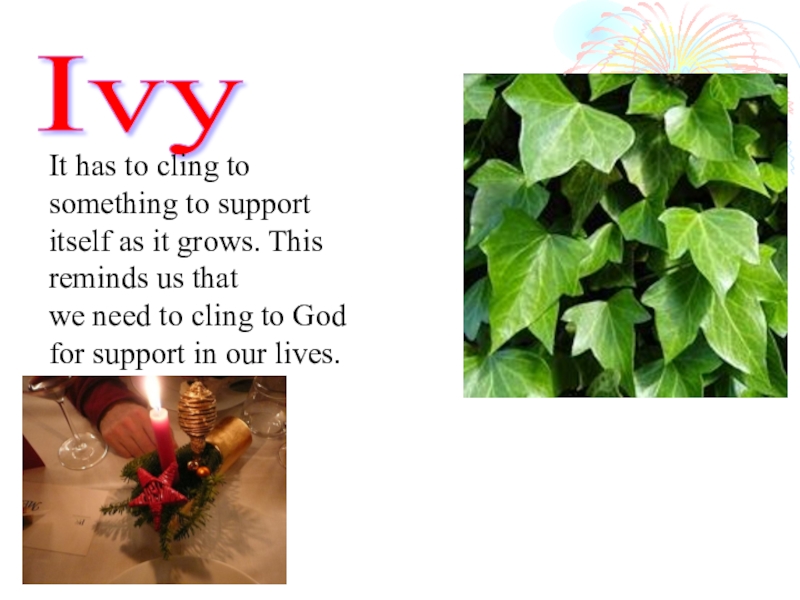
It has to cling to something to support itself as
it grows. This reminds us that
we need to cling to God
for support in our lives.
we need to cling to God
for support in our lives.
Слайд 13Mistletoe
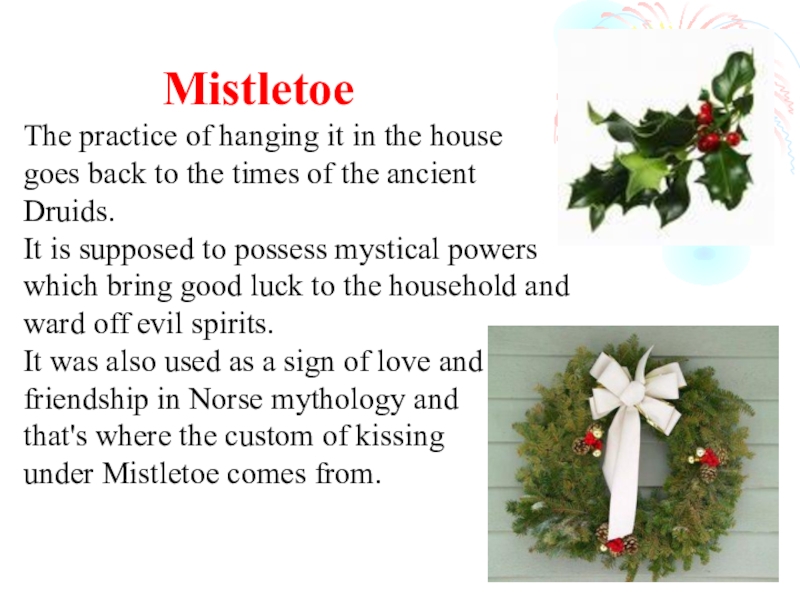
The practice of hanging it in the house
goes back to
the times of the ancient
Druids.
It is supposed to possess mystical powers which bring good luck to the household and ward off evil spirits.
It was also used as a sign of love and friendship in Norse mythology and
that's where the custom of kissing
under Mistletoe comes from.
Druids.
It is supposed to possess mystical powers which bring good luck to the household and ward off evil spirits.
It was also used as a sign of love and friendship in Norse mythology and
that's where the custom of kissing
under Mistletoe comes from.
Слайд 14The custom of kissing
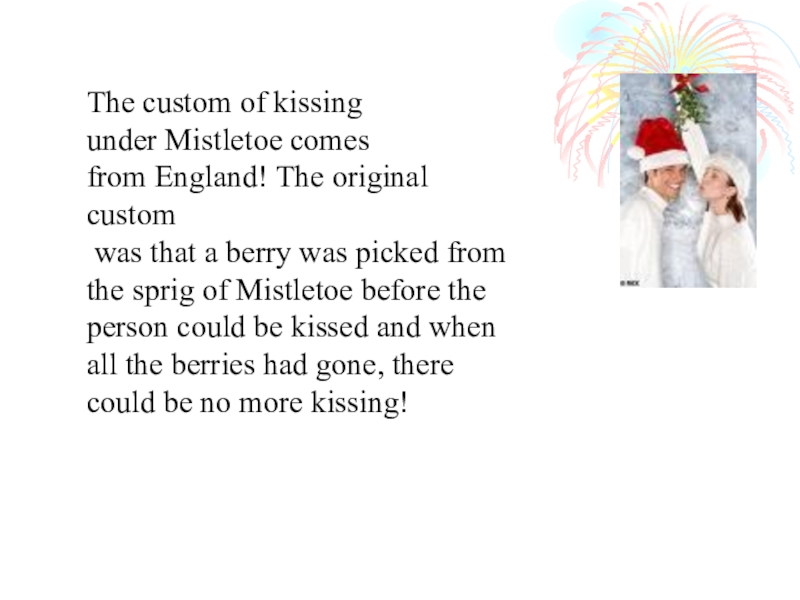
under Mistletoe comes
from England! The original
custom
was that a berry was picked from
the sprig of Mistletoe before the person could be kissed and when all the berries had gone, there could be no more kissing!
was that a berry was picked from
the sprig of Mistletoe before the person could be kissed and when all the berries had gone, there could be no more kissing!
Слайд 15Carols were first sung in
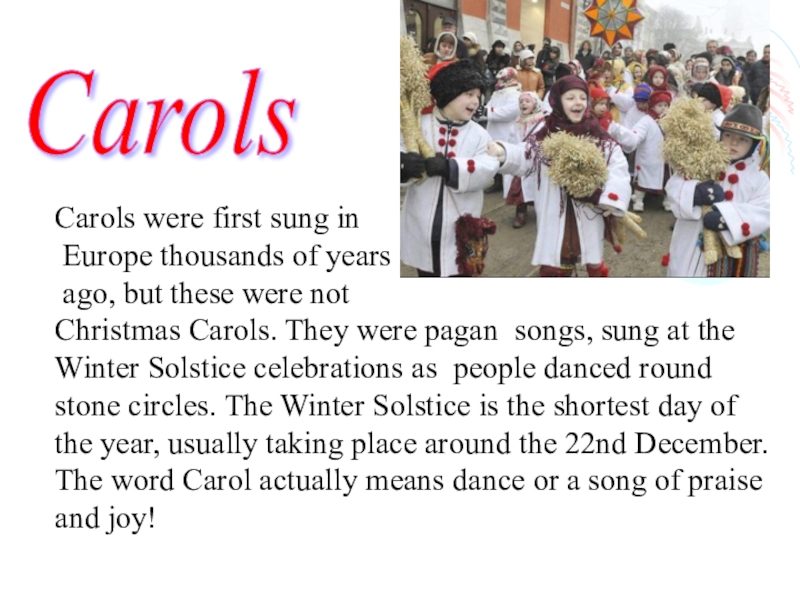
Europe thousands of years
ago, but
these were not
Christmas Carols. They were pagan songs, sung at the Winter Solstice celebrations as people danced round stone circles. The Winter Solstice is the shortest day of the year, usually taking place around the 22nd December. The word Carol actually means dance or a song of praise and joy!
Christmas Carols. They were pagan songs, sung at the Winter Solstice celebrations as people danced round stone circles. The Winter Solstice is the shortest day of the year, usually taking place around the 22nd December. The word Carol actually means dance or a song of praise and joy!
Carols
Слайд 16Carols
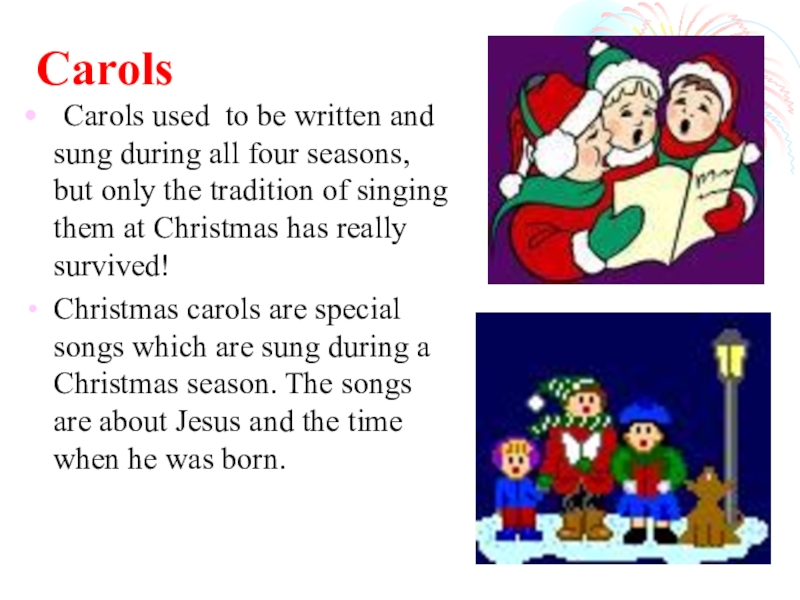
Carols used to be written and sung during all four
seasons, but only the tradition of singing them at Christmas has really survived!
Christmas carols are special songs which are sung during а Christmas season. The songs are about Jesus and the time when he was born.
Christmas carols are special songs which are sung during а Christmas season. The songs are about Jesus and the time when he was born.
Слайд 17Dashing through the snow, In a one-horse open sleigh, O'er the fields we
go,
Laughing all the way.
Bells on bobtail ring,
Making spirits bright.
What fun it is to ride and sing,
A sleighing song tonight.
Oh, jingle bells, jingle bells,
Jingle all the way,
Oh, what fun it is to ride
In a one-horse open sleigh.
Jingle bells, jingle bells,
Jingle all the way,
Oh, what fun it is to ride
In a one-horse open sleigh.
Jingle bells
Слайд 18Christmas is Coming
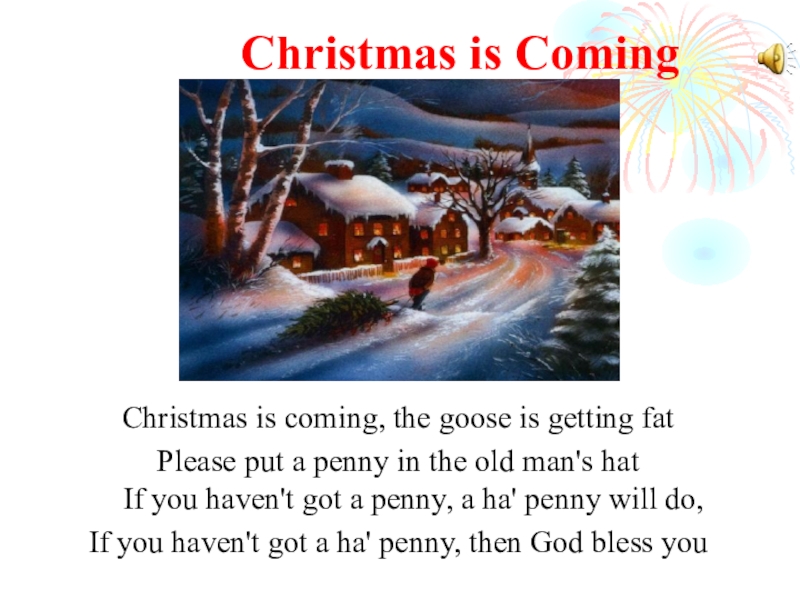
Christmas is coming, the goose is getting fat
Please put
a penny in the old man's hat
If you haven't got a penny, a ha' penny will do,
If you haven't got a ha' penny, then God bless you
If you haven't got a ha' penny, then God bless you
Слайд 19Candles
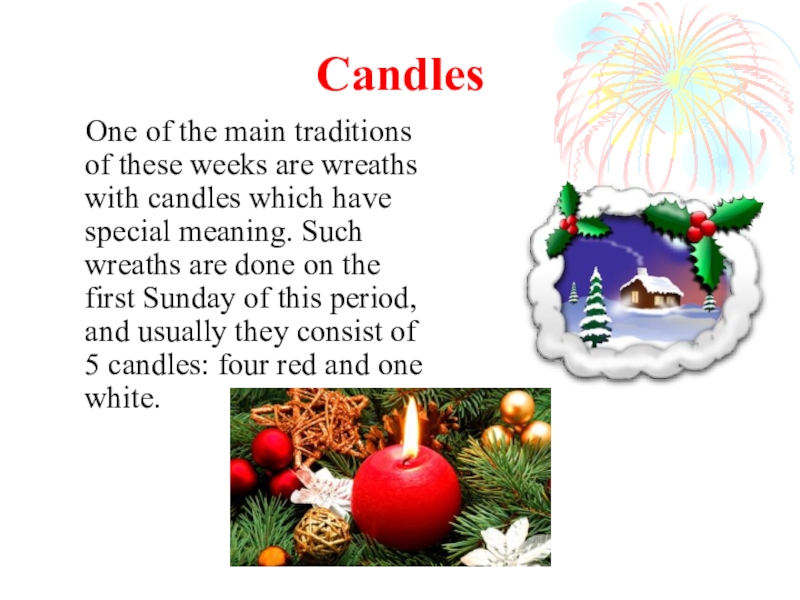
One of the main traditions of these weeks
are wreaths with candles which have special meaning. Such wreaths are done on the first Sunday of this period, and usually they consist of 5 candles: four red and one white.
Слайд 20The Christmas log
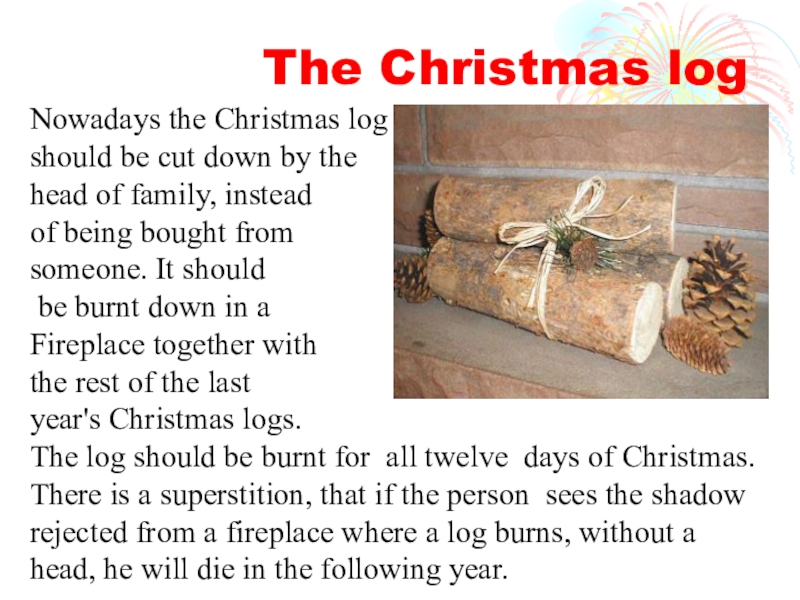
Nowadays the Christmas log
should be
cut down by the
head of family, instead
of being bought from
someone. It should
be burnt down in a
Fireplace together with
the rest of the last
year's Christmas logs.
The log should be burnt for all twelve days of Christmas. There is a superstition, that if the person sees the shadow rejected from a fireplace where a log burns, without a head, he will die in the following year.
head of family, instead
of being bought from
someone. It should
be burnt down in a
Fireplace together with
the rest of the last
year's Christmas logs.
The log should be burnt for all twelve days of Christmas. There is a superstition, that if the person sees the shadow rejected from a fireplace where a log burns, without a head, he will die in the following year.
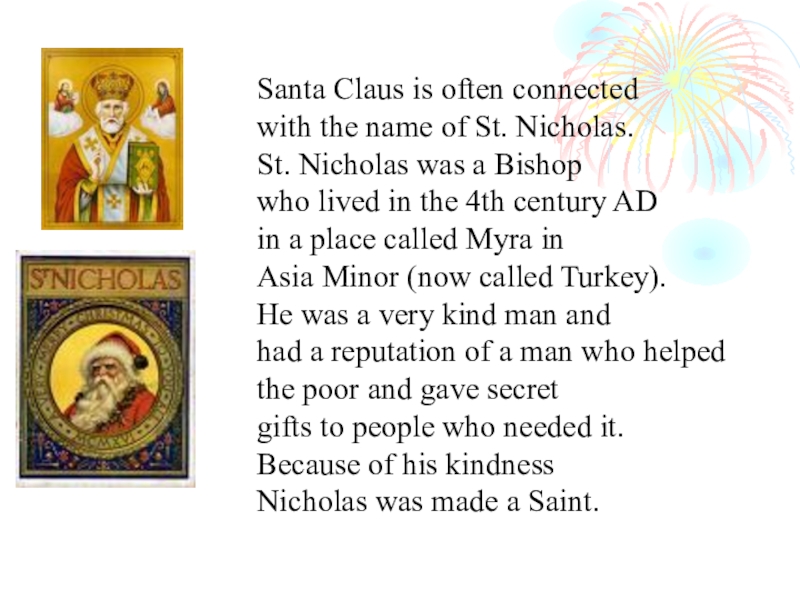
Слайд 21Santa Claus is often connected
with the name of St. Nicholas.
St. Nicholas was a Bishop
who lived in the 4th century AD
in a place called Myra in
Asia Minor (now called Turkey).
He was a very kind man and
had a reputation of a man who helped
the poor and gave secret
gifts to people who needed it.
Because of his kindness
Nicholas was made a Saint.
Слайд 22Santa Claus
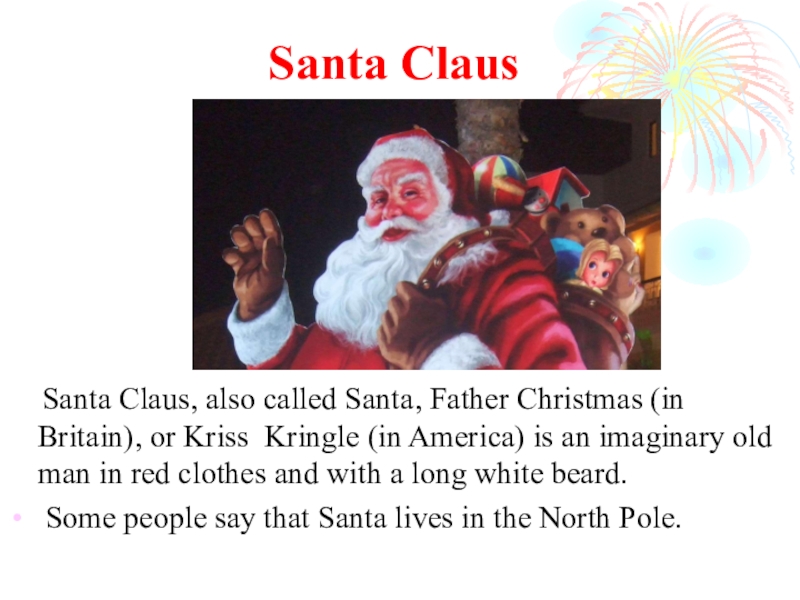
Santa Claus, also called Santa, Father Christmas (in
Britain), or Kriss Kringle (in America) is an imaginary old man in red clothes and with a long white beard.
Some people say that Santa lives in the North Pole.
Some people say that Santa lives in the North Pole.
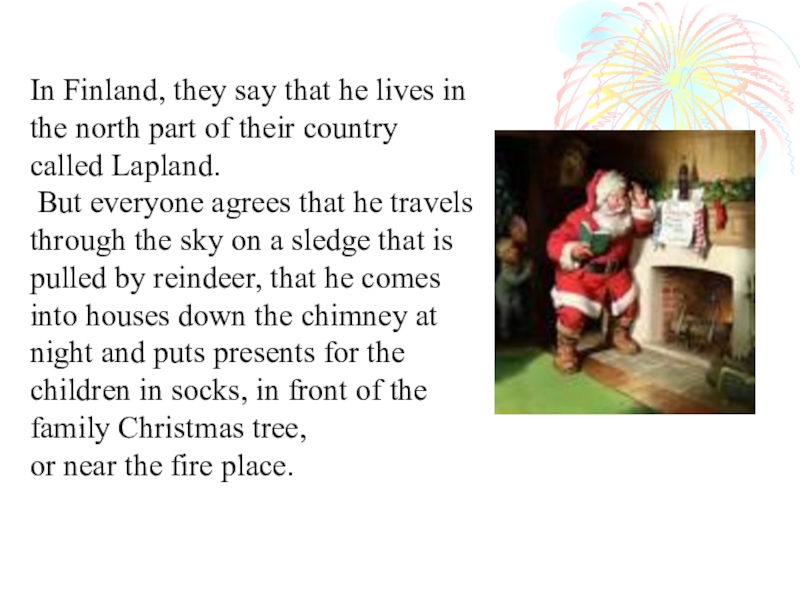
Слайд 23In Finland, they say that he lives in the north part
of their country called Lapland.
But everyone agrees that he travels through the sky on a sledge that is pulled by reindeer, that he comes into houses down the chimney at night and puts presents for the children in socks, in front of the family Christmas tree,
or near the fire place.
But everyone agrees that he travels through the sky on a sledge that is pulled by reindeer, that he comes into houses down the chimney at night and puts presents for the children in socks, in front of the family Christmas tree,
or near the fire place.
Слайд 24Christmas Cards
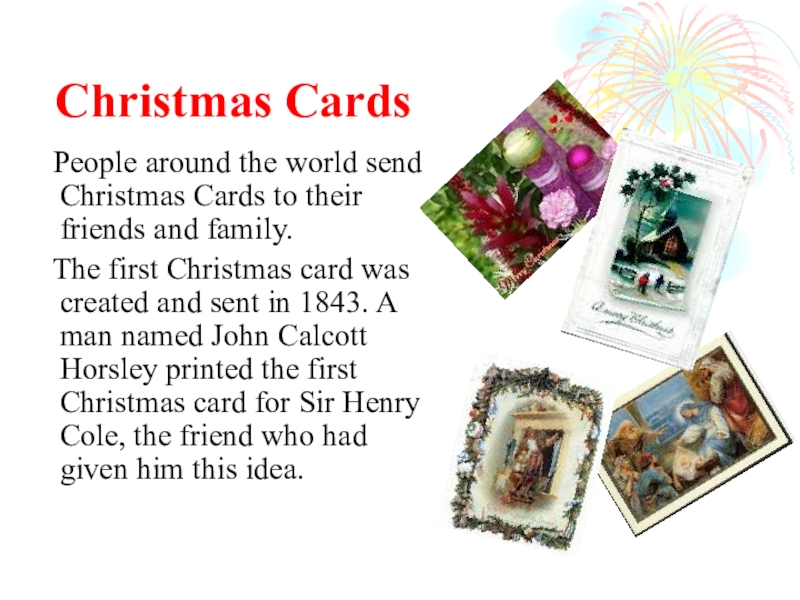
People around the world send Christmas Cards
to their friends and family.
The first Christmas card was created and sent in 1843. A man named John Calcott Horsley printed the first Christmas card for Sir Henry Cole, the friend who had given him this idea.
The first Christmas card was created and sent in 1843. A man named John Calcott Horsley printed the first Christmas card for Sir Henry Cole, the friend who had given him this idea.
Слайд 26Christmas Dinner
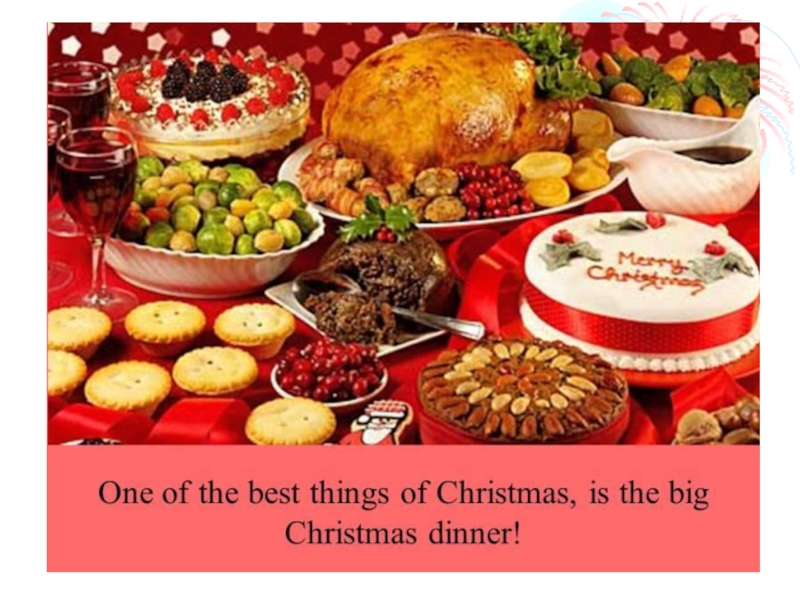
The typical dinner consists of turkey
with potatoes and
other vegetables
such as carrots and sprouts.
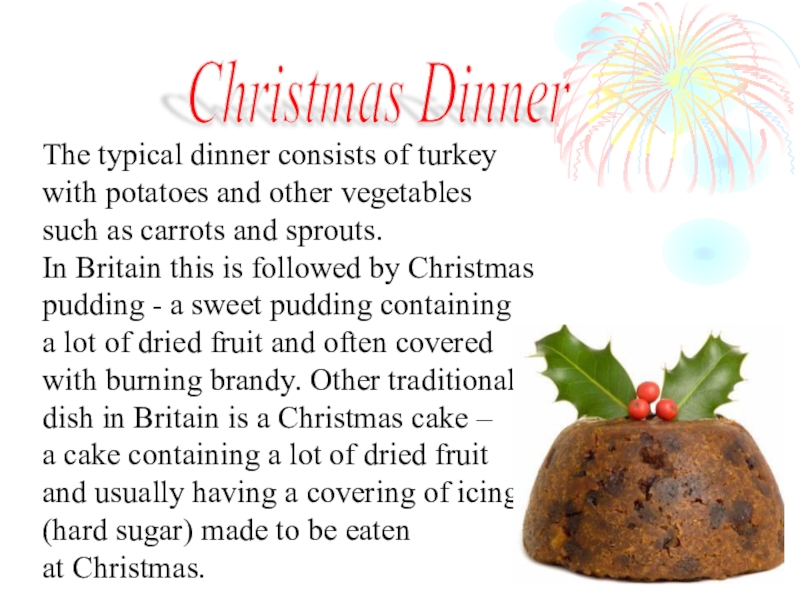
In Britain this is followed by Christmas
pudding - a sweet pudding containing
a lot of dried fruit and often covered
with burning brandy. Other traditional
dish in Britain is a Christmas cake –
a cake containing a lot of dried fruit
and usually having a covering of icing
(hard sugar) made to be eaten
at Christmas.
such as carrots and sprouts.
In Britain this is followed by Christmas
pudding - a sweet pudding containing
a lot of dried fruit and often covered
with burning brandy. Other traditional
dish in Britain is a Christmas cake –
a cake containing a lot of dried fruit
and usually having a covering of icing
(hard sugar) made to be eaten
at Christmas.
Слайд 27Candycane
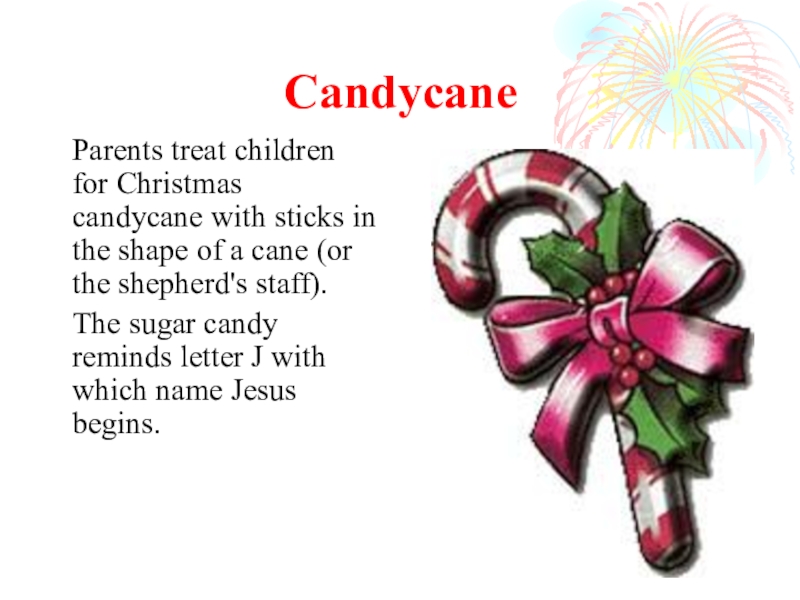
Parents treat children for Christmas candycane with sticks in
the shape of a cane (or the shepherd's staff).
The sugar candy reminds letter J with which name Jesus begins.
The sugar candy reminds letter J with which name Jesus begins.
Слайд 28Cookies for Santa
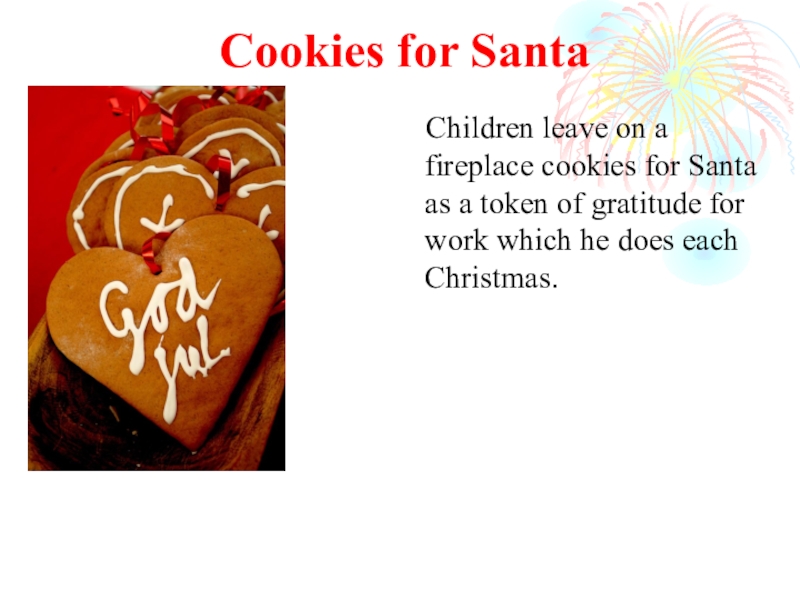
Children leave on a fireplace cookies for
Santa as a token of gratitude for work which he does each Christmas.