Презентация, доклад к уроку английского языка .Федор Михайлович Достоевский

Ancestry Dostoevsky's parents were part of a multi-ethnic and multi-denominational noble family, its branches including Russian Orthodox Christians, Polish Roman Catholics and Ukrainian Eastern Catholics.Dostoevsky's immediate ancestors on his mother's side were merchants; the male line

Слайд 1Biography of Fyodor Mikhailovich Dostoevsky
11 November 1821 Moscow, Moscow

Governorate, Russian Empire - 9 February 1881 (aged 59) Saint Petersburg.
Russian Empire

Подготовила:
Учитель английского языка
МБОУ «СШ №13», г.Евпатории
Матросова Ирина Витальевна
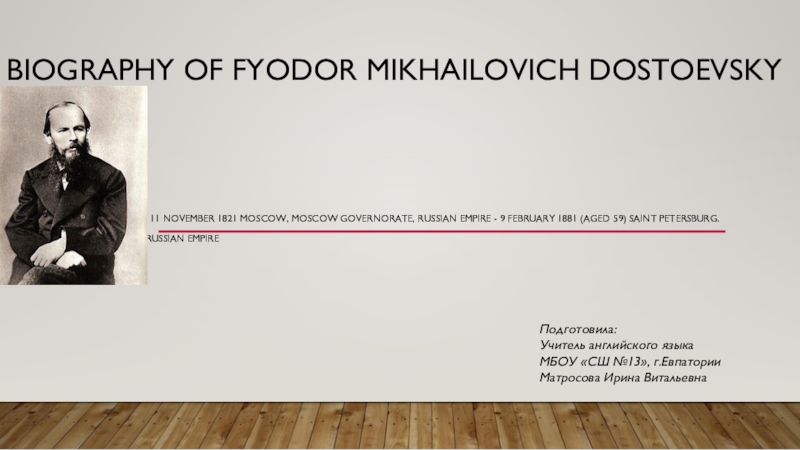
Biography of Fyodor Mikhailovich Dostoevsky  11 November 1821 Moscow, Moscow Governorate, Russian Empire - 9 February

Слайд 2Ancestry
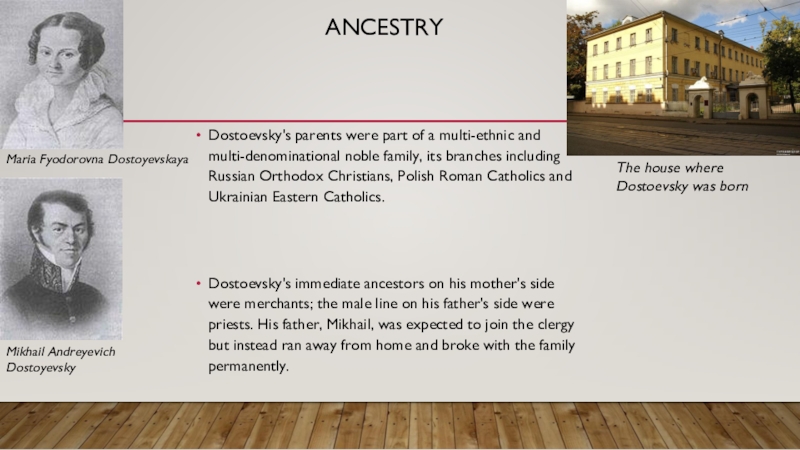
Dostoevsky's parents were part of a multi-ethnic and multi-denominational noble family,

its branches including Russian Orthodox Christians, Polish Roman Catholics and Ukrainian Eastern Catholics.


Dostoevsky's immediate ancestors on his mother's side were merchants; the male line on his father's side were priests. His father, Mikhail, was expected to join the clergy but instead ran away from home and broke with the family permanently.


Maria Fyodorovna Dostoyevskaya

Mikhail Andreyevich Dostoyevsky

The house where Dostoevsky was born
Ancestry Dostoevsky's parents were part of a multi-ethnic and multi-denominational noble family, its branches including Russian Orthodox

Слайд 3Childhood (1821–1835)
Fyodor Dostoevsky was the second child of Dr. Mikhail Dostoevsky

and Maria Dostoevskaya (born Nechayeva). He was raised in the family home in the grounds of the Mariinsky Hospital for the Poor, which was in a lower class district on the edges of Moscow.

Dostoevsky was introduced to literature at an early age. From the age of three, he was read heroic sagas, fairy tales and legends by his nanny, Alena Frolovna, an especially influential figure in his upbringing and love for fictional stories. When he was four his mother used the Bible to teach him to read and write. His parents introduced him to a wide range of literature, including Russian writers Karamzin, Pushkin and Derzhavin; Although his father's approach to education has been described as strict and harsh, Dostoevsky himself reports that his imagination was brought alive by nightly readings by his parents.

Some of his childhood experiences found their way into his writings.

Although Dostoevsky had a delicate physical constitution, his parents described him as hot-headed, stubborn and cheeky.In 1833, Dostoevsky's father, who was profoundly religious, sent him to a French boarding school and then to the Chermak boarding school. He was described as a pale, introverted dreamer and an over-excitable romantic. To pay the school fees, his father borrowed money and extended his private medical practice. Dostoevsky felt out of place among his aristocratic classmates at the Moscow school, and the experience was later reflected in some of his works, notably The Adolescent.
Childhood (1821–1835) Fyodor Dostoevsky was the second child of Dr. Mikhail Dostoevsky and Maria Dostoevskaya (born Nechayeva).

Слайд 4Youth (1836–1843)
On 27 September 1837 Dostoevsky's mother died of tuberculosis. The

previous May, his parents had sent Dostoevsky and his brother Mikhail to St Petersburg to attend the free Nikolayev Military Engineering Institute, forcing the brothers to abandon their academic studies for military careers. Dostoevsky entered the academy in January 1838, but only with the help of family members.

Dostoevsky disliked the academy, primarily because of his lack of interest in science, mathematics and military engineering and his preference for drawing and architecture. Although he was solitary and inhabited his own literary world, he was respected by his classmates. His reclusiveness and interest in religion earned him the nickname "Monk Photius"

Signs of Dostoevsky's epilepsy may have first appeared on learning of the death of his father on 16 June 1839. After his father's death, Dostoevsky continued his studies, passed his exams and obtained the rank of engineer cadet, entitling him to live away from the academy. He visited Mikhail in Reval, and frequently attended concerts, operas, plays and ballets. During this time, two of his friends introduced him to gambling.

On 12 August 1843 Dostoevsky took a job as a lieutenant engineer and lived with Adolph Totleben in an apartment owned by Dr. Rizenkampf, a friend of Mikhail. Dostoevsky's first completed literary work, a translation of Honoré de Balzac's novel Eugénie Grandet, was published in June and July 1843 in the 6th and 7th volume of the journal Repertoire and Pantheon, followed by several other translations. None were successful, and his financial difficulties led him to write a novel.

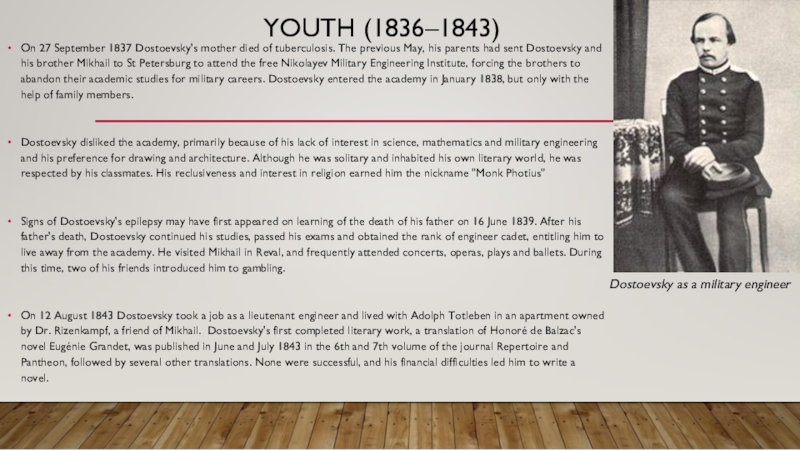
Dostoevsky as a military engineer

Youth (1836–1843)On 27 September 1837 Dostoevsky's mother died of tuberculosis. The previous May, his parents had sent

Слайд 5Early career (1844–1849)
Dostoevsky completed his first novel, Poor Folk, in May

1845.
After that, he waited for failure
In 1849, the first parts of Netochka Nezvanova, a novel Dostoevsky had been planning since 1846, were published in Annals of the Fatherland, but his banishment ended the project. Dostoevsky never attempted to complete it.

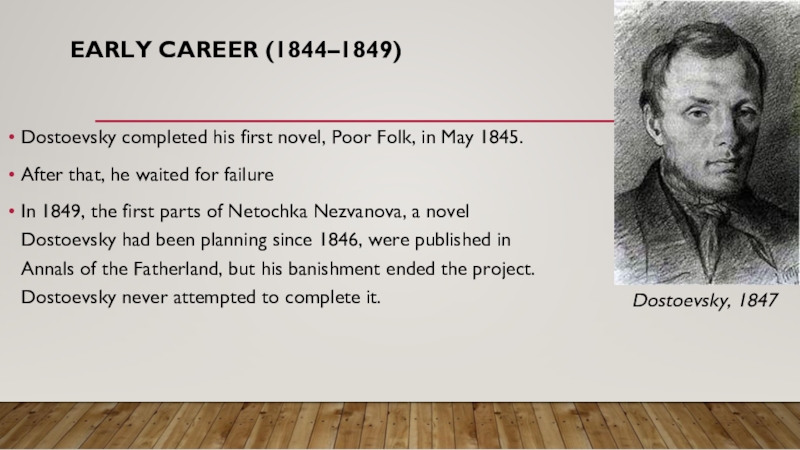
Dostoevsky, 1847

Early career (1844–1849) Dostoevsky completed his first novel, Poor Folk, in May 1845. After that, he waited

Слайд 6Siberian exile (1849–1854)

The members of the Petrashevsky Circle were denounced to

Liprandi, an official at the Ministry of Internal Affairs. Dostoevsky was accused of reading works by Belinsky, including the banned Letter to Gogol, and of circulating copies of these and other works. He and his fellow "conspirators" were arrested on 23 April 1849 at the request of Count A. Orlov and Tsar Nicolas I.
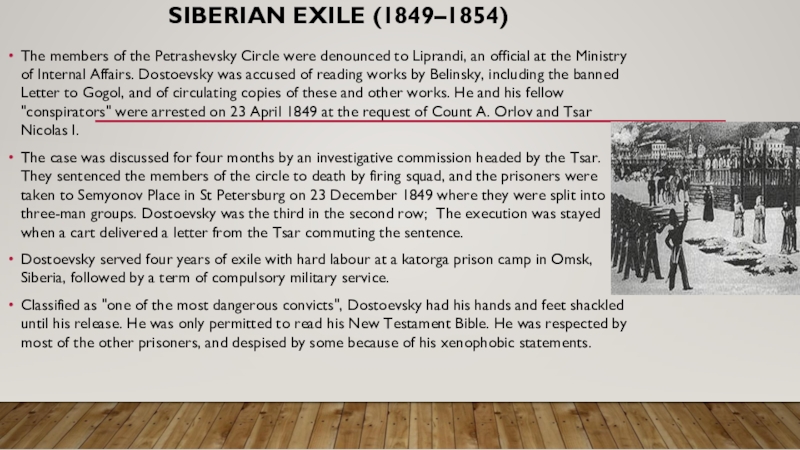
The case was discussed for four months by an investigative commission headed by the Tsar. They sentenced the members of the circle to death by firing squad, and the prisoners were taken to Semyonov Place in St Petersburg on 23 December 1849 where they were split into three-man groups. Dostoevsky was the third in the second row; The execution was stayed when a cart delivered a letter from the Tsar commuting the sentence.
Dostoevsky served four years of exile with hard labour at a katorga prison camp in Omsk, Siberia, followed by a term of compulsory military service.
Classified as "one of the most dangerous convicts", Dostoevsky had his hands and feet shackled until his release. He was only permitted to read his New Testament Bible. He was respected by most of the other prisoners, and despised by some because of his xenophobic statements.
Siberian exile (1849–1854) The members of the Petrashevsky Circle were denounced to Liprandi, an official at the

Слайд 7Release from prison and first marriage (1854–1866)
After his release on 14

February 1854, Dostoevsky asked Mikhail to help him financially and to send him books
n Semipalatinsk, Dostoevsky tutored several schoolchildren and came into contact with upper-class families, including that of Lieutenant-Colonel Belikhov, who used to invite him to read passages from newspapers and magazines. During a visit to Belikhov, Dostoevsky met the family of Alexander Ivanovich Isaev and Maria Dmitrievna Isaeva and fell in love with the latter. Alexander Isaev took a new post in Kuznetsk, where he died in August 1855. Maria and her son then moved with Dostoevsky to Barnaul. In 1856 Dostoevsky sent a letter through Wrangel to General Eduard Totleben, apologising for his activity in several utopian circles. As a result, he obtained the right to publish books and to marry, although he remained under police surveillance for the rest of his life. Maria married Dostoevsky in Semipalatinsk on 7 February 1857, even though she had initially refused his marriage proposal, stating that they were not meant for each other and that his poor financial situation precluded marriage. Their family life was unhappy and she found it difficult to cope with his seizures. Describing their relationship, he wrote: "Because of her strange, suspicious and fantastic character, we were definitely not happy together, but we could not stop loving each other; and the more unhappy we were, the more attached to each other we became". They mostly lived apart. In 1859 he was released from military service because of deteriorating health and was granted permission to return to Russia, first to Tver, where he met his brother for the first time in ten years, and then to St Petersburg.

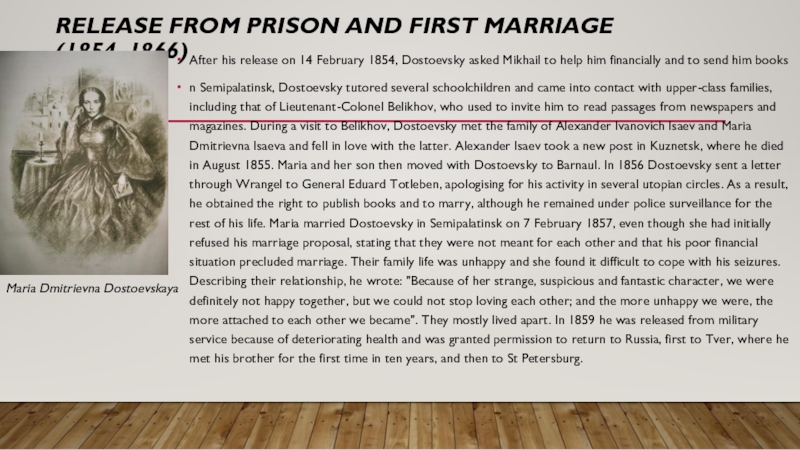
Maria Dmitrievna Dostoevskaya

Release from prison and first marriage (1854–1866) After his release on 14 February 1854, Dostoevsky asked Mikhail

Слайд 8Last years (1876–1881)
Dostoevsky's health was rapidly deteriorating.
On 3 February 1880 Dostoevsky

was elected vice-president of the Slavic Benevolent Society, and he was invited to speak at the unveiling of the Pushkin memorial in Moscow. On 8 June he delivered his speech, giving an impressive performance that had a significant emotional impact on his audience. His speech was met with thunderous applause, and even his long-time rival Turgenev embraced him. Konstantin Staniukovich praised the speech in his essay The speech was criticised later by liberal political scientist Alexander Gradovsky, who thought that Dostoevsky idolised "the people",]and by conservative thinker Konstantin Leontiev, who, in his essay "On Universal Love", compared the speech to French utopian socialism.The attacks led to a further deterioration in his health.
In the summer of 1876, Dostoevsky began experiencing shortness of breath again.
Dostoevsky's health declined further, and in March 1877 he had four epileptic seizures. Rather than returning to Ems, he visited Maly Prikol, a manor near Kursk. While returning to St Petersburg to finalise his Diary, he visited Darovoye, where he had spent much of his childhood. In December he attended Nekrasov's funeral and gave a speech. He was appointed an honorary member of the Russian Academy of Sciences, from which he received an honorary certificate in February 1879. He declined an invitation to an international congress on copyright in Paris after his son Alyosha had a severe epileptic seizure and died on 16 May. The family later moved to the apartment where Dostoevsky had written his first works. Around this time, he was elected to the board of directors of the Slavic Benevolent Society in Saint Petersburg. He was diagnosed with early-stage pulmonary emphysema, which his doctor believed could be successfully managed, but not cured.

Last years (1876–1881) Dostoevsky's health was rapidly deteriorating.On 3 February 1880 Dostoevsky was elected vice-president of the

Слайд 9Death
On 25 January 1881, while searching for members of the terrorist

organisation Narodnaya Volya who would soon assassinate Tsar Alexander II, the Tsar's secret police executed a search warrant in the apartment of one of Dostoevsky's neighbours. On the following day, Dostoevsky suffered a pulmonary haemorrhage. Anna denied that the search had caused it, saying that the haemorrhage had occurred after her husband had been looking for a dropped pen holder. After another haemorrhage, Anna called the doctors, who gave a poor prognosis. A third haemorrhage followed shortly afterwards.

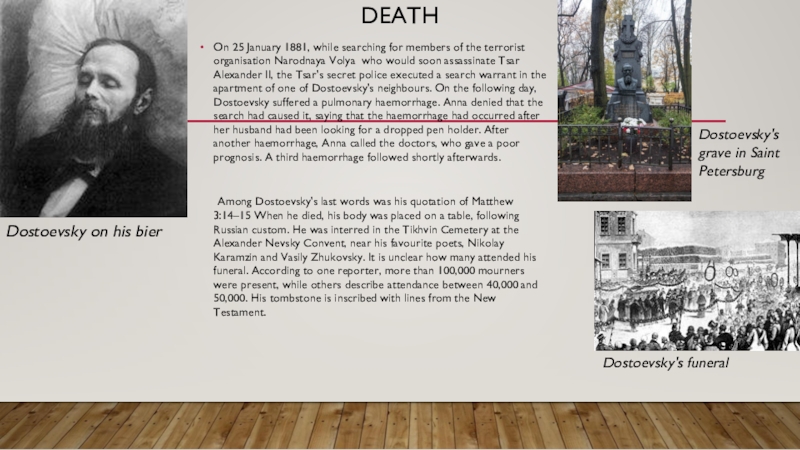
Among Dostoevsky's last words was his quotation of Matthew 3:14–15 When he died, his body was placed on a table, following Russian custom. He was interred in the Tikhvin Cemetery at the Alexander Nevsky Convent, near his favourite poets, Nikolay Karamzin and Vasily Zhukovsky. It is unclear how many attended his funeral. According to one reporter, more than 100,000 mourners were present, while others describe attendance between 40,000 and 50,000. His tombstone is inscribed with lines from the New Testament.

Dostoevsky on his bier

Dostoevsky's grave in Saint Petersburg

Dostoevsky's funeral
Death On 25 January 1881, while searching for members of the terrorist organisation Narodnaya Volya who would

Слайд 10Famous works of Dostoevsky
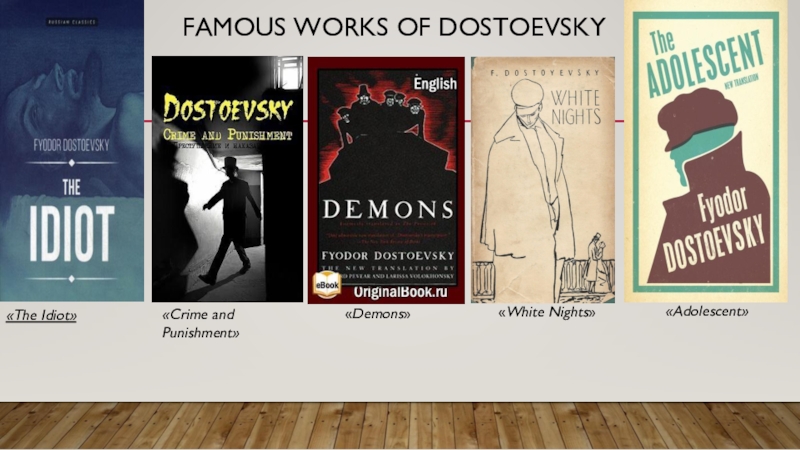
«The Idiot»
«Crime and Punishment»
«Demons»
«White Nights»
«Adolescent»

Famous works of Dostoevsky«The Idiot»«Crime and Punishment»  «Demons» «White Nights»«Adolescent»

Что такое shareslide.ru?

Это сайт презентаций, где можно хранить и обмениваться своими презентациями, докладами, проектами, шаблонами в формате PowerPoint с другими пользователями. Мы помогаем школьникам, студентам, учителям, преподавателям хранить и обмениваться учебными материалами.


Для правообладателей

Яндекс.Метрика

Обратная связь

Email: Нажмите что бы посмотреть