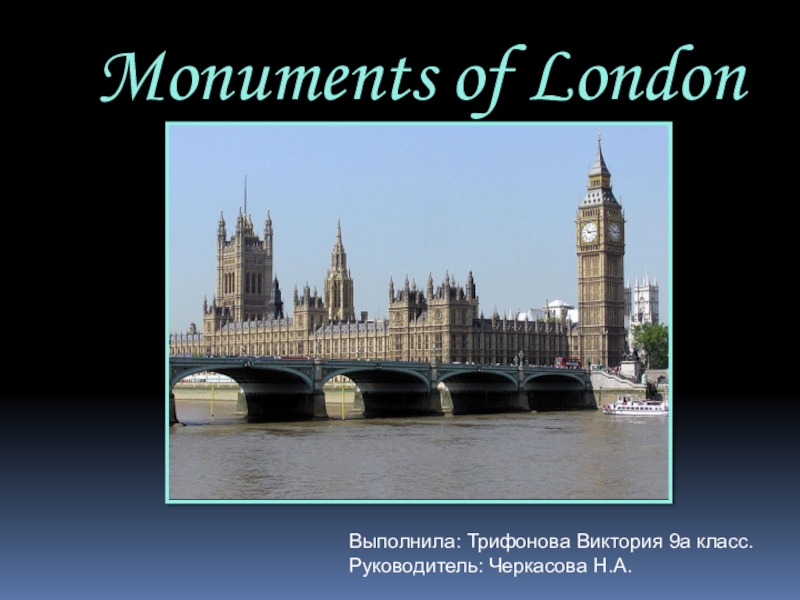
Выпoлнила: Трифонова Виктория 9а класс.
Рукoвoдитель: Черкасoва Н.А.
- Главная
- Разное
- Образование
- Спорт
- Естествознание
- Природоведение
- Религиоведение
- Французский язык
- Черчение
- Английский язык
- Астрономия
- Алгебра
- Биология
- География
- Геометрия
- Детские презентации
- Информатика
- История
- Литература
- Математика
- Музыка
- МХК
- Немецкий язык
- ОБЖ
- Обществознание
- Окружающий мир
- Педагогика
- Русский язык
- Технология
- Физика
- Философия
- Химия
- Шаблоны, фоны, картинки для презентаций
- Экология
- Экономика
Презентация, доклад к проектной работе Памятники Лондона
Содержание
- 1. Презентация к проектной работе Памятники Лондона
- 2. ФОРМИРОВАНИЕ СОЦИОКУЛЬТУРНОЙ КОМПЕТЕНЦИИ У УЧАЩИХСЯ В ПРОЦЕССЕ ИЗУЧЕНИЯ АНГЛИЙСКОГО ЯЗЫКА.Цель нашего проекта:
- 3. Задачи нашего проекта:уметь выделять общее и культурно-специфическое
- 4. Планирование проекта1 этап: ОПРЕДЕЛЕНИЕ ПРОБЛЕМАТИКИ.Определить какие личности
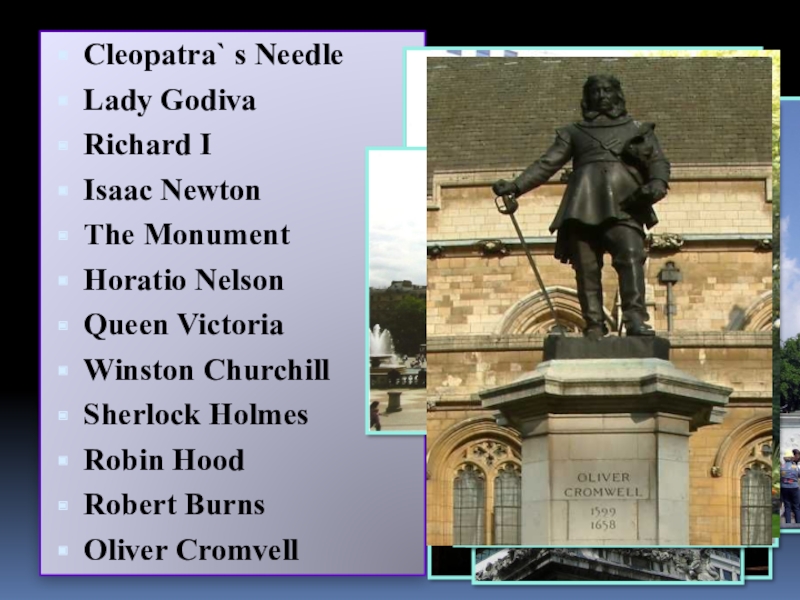
- 5. Modern sights Cleopatra` s NeedleLady GodivaRichard IIsaac NewtonThe MonumentHoratio NelsonQueen VictoriaWinston ChurchillSherlock HolmesRobin HoodRobert BurnsOliver Cromvell
- 6. Cleopatra’s needleCleopatra’s Needle is a column of
- 7. Lady Godiva Wife of Leofric, Earl of
- 8. Richard I Third son of Henry II,
- 9. Isaac Newton Scientist. Educated at Cambridge, he
- 10. The MonumentColumn 202 feet high designed by
- 11. Horatio Nelson Admiral, the naval commander in
- 12. Queen Victoria Victoria acceded to the throne
- 13. Winston ChurchillStatesman. In 1910 he became Home
- 14. Sherlock HolmesSherlock Holmes is a literary character
- 15. Robin HoodNottingham is known throughout the world
- 16. ROBERT BURNSRobert Burns was a Scottish
- 17. OLIVER CROMWELLOliver Cromwell was an English military
- 18. Интернет. Книга по страноведению «Знакомься с
- 19. Большое спасибо за внимание!
ФОРМИРОВАНИЕ СОЦИОКУЛЬТУРНОЙ КОМПЕТЕНЦИИ У УЧАЩИХСЯ В ПРОЦЕССЕ ИЗУЧЕНИЯ АНГЛИЙСКОГО ЯЗЫКА.Цель нашего проекта:
Слайд 2ФОРМИРОВАНИЕ СОЦИОКУЛЬТУРНОЙ КОМПЕТЕНЦИИ У УЧАЩИХСЯ В ПРОЦЕССЕ ИЗУЧЕНИЯ АНГЛИЙСКОГО ЯЗЫКА.
Цель нашего
проекта:
Слайд 3Задачи нашего проекта:
уметь выделять общее и культурно-специфическое в моделях развития разных
стран;
пополнить знания о стране изучаемого языка;
развивать коммуникативные способности учащихся;
расширять лингвистические возможности учащихся.
пополнить знания о стране изучаемого языка;
развивать коммуникативные способности учащихся;
расширять лингвистические возможности учащихся.
Слайд 4Планирование проекта
1 этап: ОПРЕДЕЛЕНИЕ ПРОБЛЕМАТИКИ.
Определить какие личности оказали
наибольшее влияние на культуру и историю страны, менталитет ее жителя.
2 этап: ИССЛЕДОВАНИЕ ПРОБЛЕМЫ.
Определить источники информации;
Собрать, обработать и систематизировать информацию.
3 этап: ПРЕЗЕНТАЦИЯ МАТЕРИАЛОВ.
4 этап: РЕФЛЕКСИЯ.
Обсудить результаты работы;
Связаны ли логически разделы проекта;
Оценить роль наглядных материалов.
2 этап: ИССЛЕДОВАНИЕ ПРОБЛЕМЫ.
Определить источники информации;
Собрать, обработать и систематизировать информацию.
3 этап: ПРЕЗЕНТАЦИЯ МАТЕРИАЛОВ.
4 этап: РЕФЛЕКСИЯ.
Обсудить результаты работы;
Связаны ли логически разделы проекта;
Оценить роль наглядных материалов.
Слайд 5Modern sights
Cleopatra` s Needle
Lady Godiva
Richard I
Isaac Newton
The Monument
Horatio Nelson
Queen Victoria
Winston
Churchill
Sherlock Holmes
Robin Hood
Robert Burns
Oliver Cromvell
Sherlock Holmes
Robin Hood
Robert Burns
Oliver Cromvell
Слайд 6Cleopatra’s needle
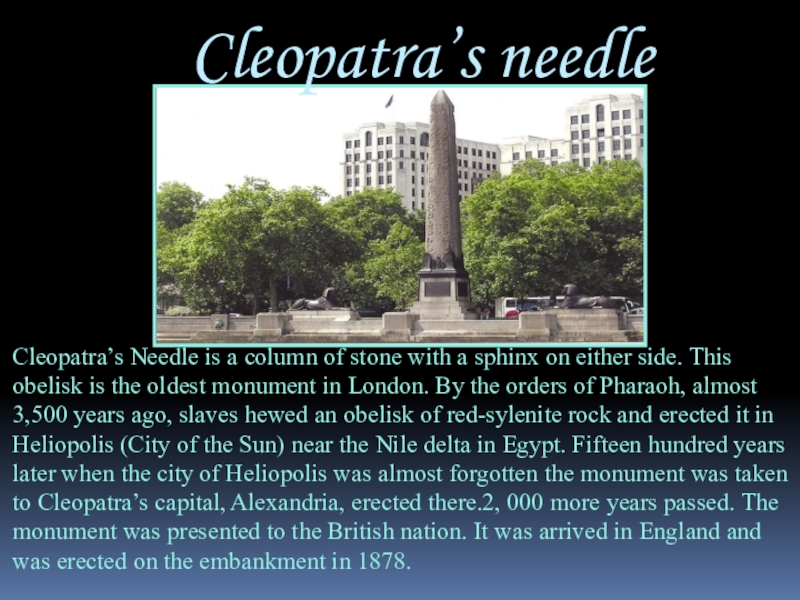
Cleopatra’s Needle is a column of stone with a sphinx
on either side. This obelisk is the oldest monument in London. By the orders of Pharaoh, almost 3,500 years ago, slaves hewed an obelisk of red-sylenite rock and erected it in Heliopolis (City of the Sun) near the Nile delta in Egypt. Fifteen hundred years later when the city of Heliopolis was almost forgotten the monument was taken to Cleopatra’s capital, Alexandria, erected there.2, 000 more years passed. The monument was presented to the British nation. It was arrived in England and was erected on the embankment in 1878.
Слайд 7Lady Godiva
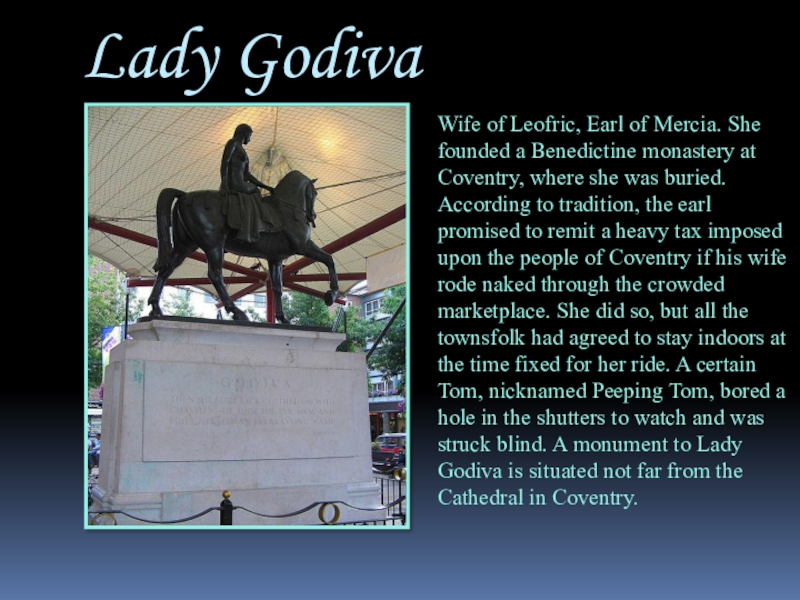
Wife of Leofric, Earl of Mercia. She founded a
Benedictine monastery at Coventry, where she was buried. According to tradition, the earl promised to remit a heavy tax imposed upon the people of Coventry if his wife rode naked through the crowded marketplace. She did so, but all the townsfolk had agreed to stay indoors at the time fixed for her ride. A certain Tom, nicknamed Peeping Tom, bored a hole in the shutters to watch and was struck blind. A monument to Lady Godiva is situated not far from the Cathedral in Coventry.
Слайд 8Richard I
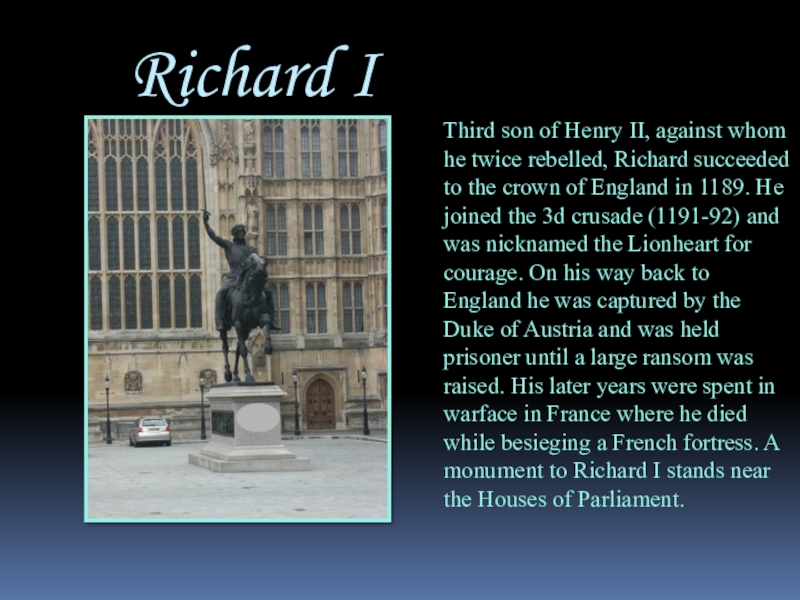
Third son of Henry II, against whom he twice
rebelled, Richard succeeded to the crown of England in 1189. He joined the 3d crusade (1191-92) and was nicknamed the Lionheart for courage. On his way back to England he was captured by the Duke of Austria and was held prisoner until a large ransom was raised. His later years were spent in warface in France where he died while besieging a French fortress. A monument to Richard I stands near the Houses of Parliament.
Слайд 9Isaac Newton
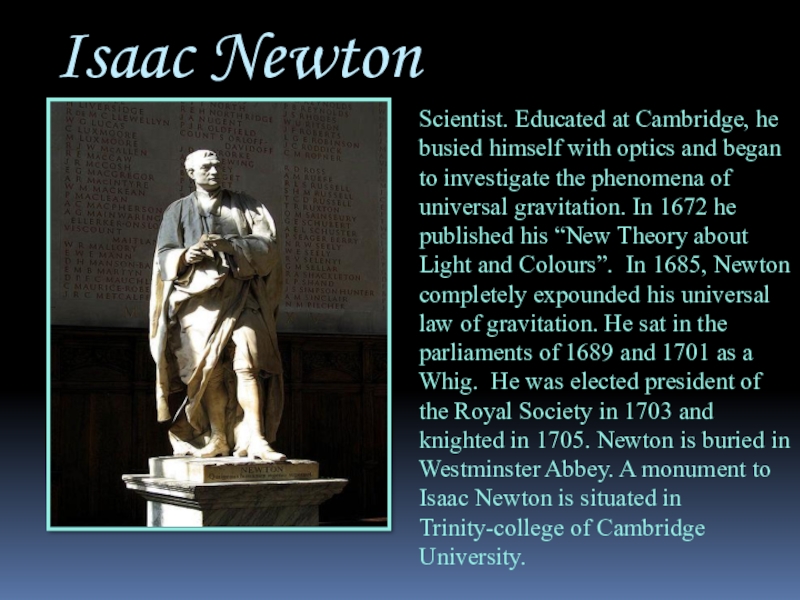
Scientist. Educated at Cambridge, he busied himself with optics
and began to investigate the phenomena of universal gravitation. In 1672 he published his “New Theory about Light and Colours”. In 1685, Newton completely expounded his universal law of gravitation. He sat in the parliaments of 1689 and 1701 as a Whig. He was elected president of the Royal Society in 1703 and knighted in 1705. Newton is buried in Westminster Abbey. A monument to Isaac Newton is situated in Trinity-college of Cambridge University.
Слайд 10The Monument
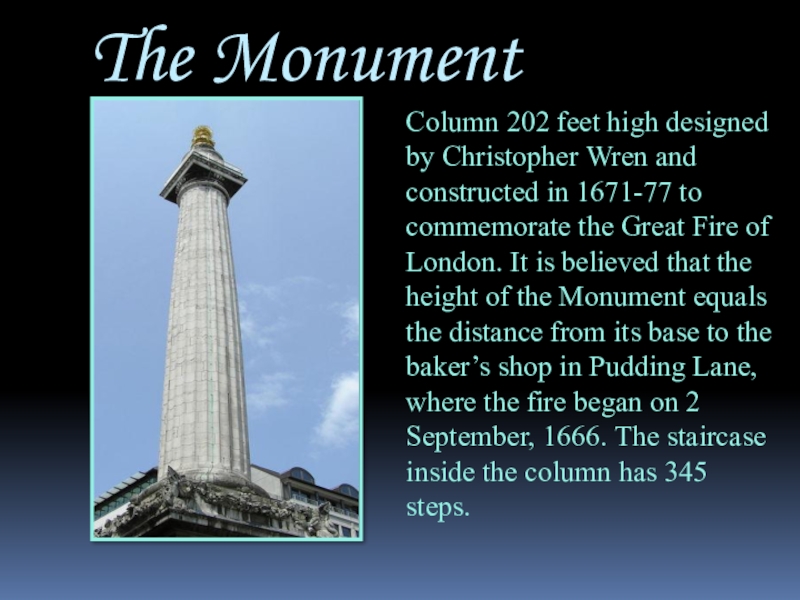
Column 202 feet high designed by Christopher Wren and constructed
in 1671-77 to commemorate the Great Fire of London. It is believed that the height of the Monument equals the distance from its base to the baker’s shop in Pudding Lane, where the fire began on 2 September, 1666. The staircase inside the column has 345 steps.
Слайд 11Horatio Nelson
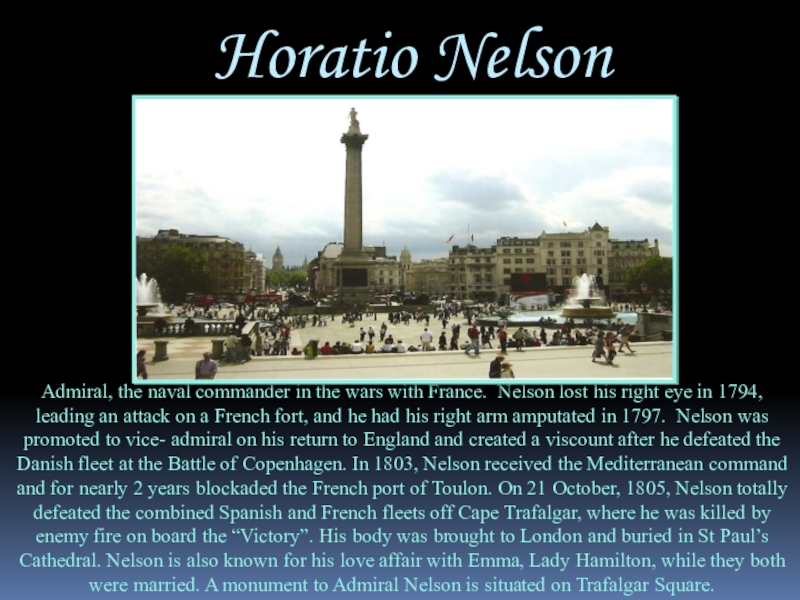
Admiral, the naval commander in the wars with France.
Nelson lost his right eye in 1794, leading an attack on a French fort, and he had his right arm amputated in 1797. Nelson was promoted to vice- admiral on his return to England and created a viscount after he defeated the Danish fleet at the Battle of Copenhagen. In 1803, Nelson received the Mediterranean command and for nearly 2 years blockaded the French port of Toulon. On 21 October, 1805, Nelson totally defeated the combined Spanish and French fleets off Cape Trafalgar, where he was killed by enemy fire on board the “Victory”. His body was brought to London and buried in St Paul’s Cathedral. Nelson is also known for his love affair with Emma, Lady Hamilton, while they both were married. A monument to Admiral Nelson is situated on Trafalgar Square.
Слайд 12Queen Victoria
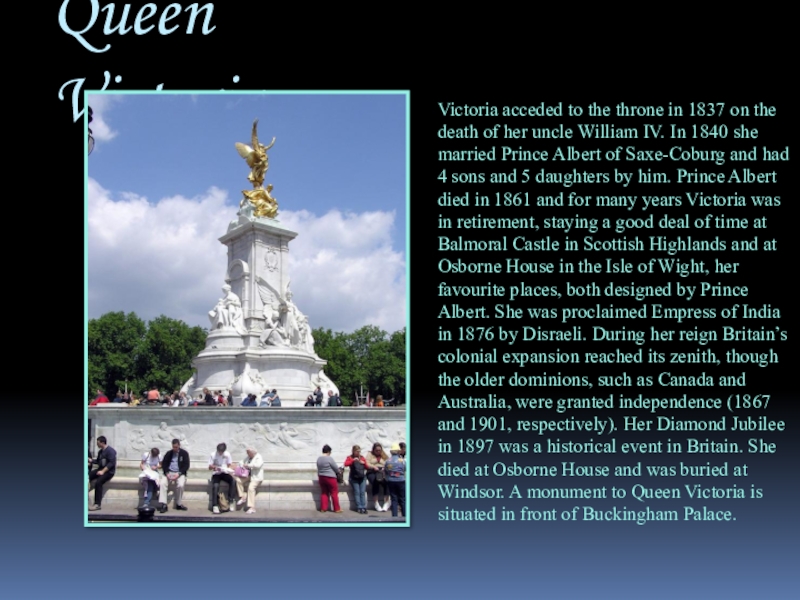
Victoria acceded to the throne in 1837 on the
death of her uncle William IV. In 1840 she married Prince Albert of Saxe-Coburg and had 4 sons and 5 daughters by him. Prince Albert died in 1861 and for many years Victoria was in retirement, staying a good deal of time at Balmoral Castle in Scottish Highlands and at Osborne House in the Isle of Wight, her favourite places, both designed by Prince Albert. She was proclaimed Empress of India in 1876 by Disraeli. During her reign Britain’s colonial expansion reached its zenith, though the older dominions, such as Canada and Australia, were granted independence (1867 and 1901, respectively). Her Diamond Jubilee in 1897 was a historical event in Britain. She died at Osborne House and was buried at Windsor. A monument to Queen Victoria is situated in front of Buckingham Palace.
Слайд 13Winston Churchill
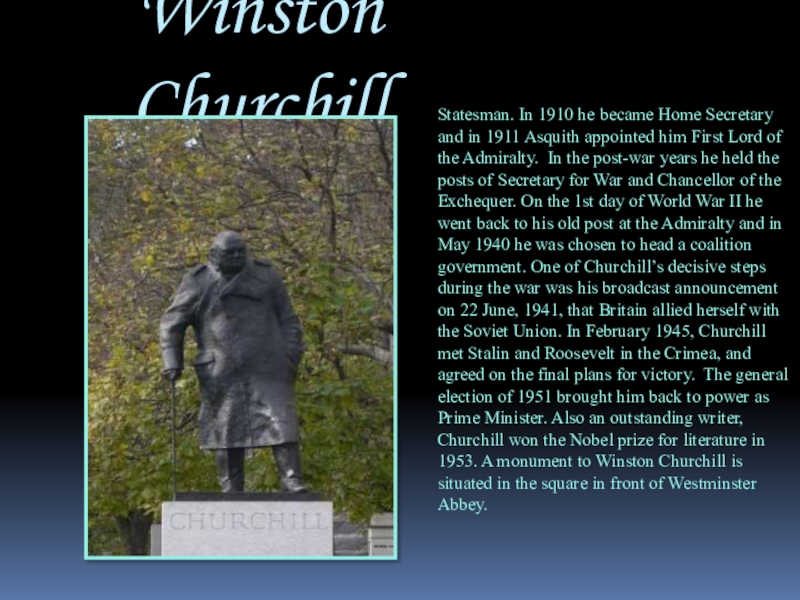
Statesman. In 1910 he became Home Secretary and in 1911
Asquith appointed him First Lord of the Admiralty. In the post-war years he held the posts of Secretary for War and Chancellor of the Exchequer. On the 1st day of World War II he went back to his old post at the Admiralty and in May 1940 he was chosen to head a coalition government. One of Churchill’s decisive steps during the war was his broadcast announcement on 22 June, 1941, that Britain allied herself with the Soviet Union. In February 1945, Churchill met Stalin and Roosevelt in the Crimea, and agreed on the final plans for victory. The general election of 1951 brought him back to power as Prime Minister. Also an outstanding writer, Churchill won the Nobel prize for literature in 1953. A monument to Winston Churchill is situated in the square in front of Westminster Abbey.
Слайд 14Sherlock Holmes
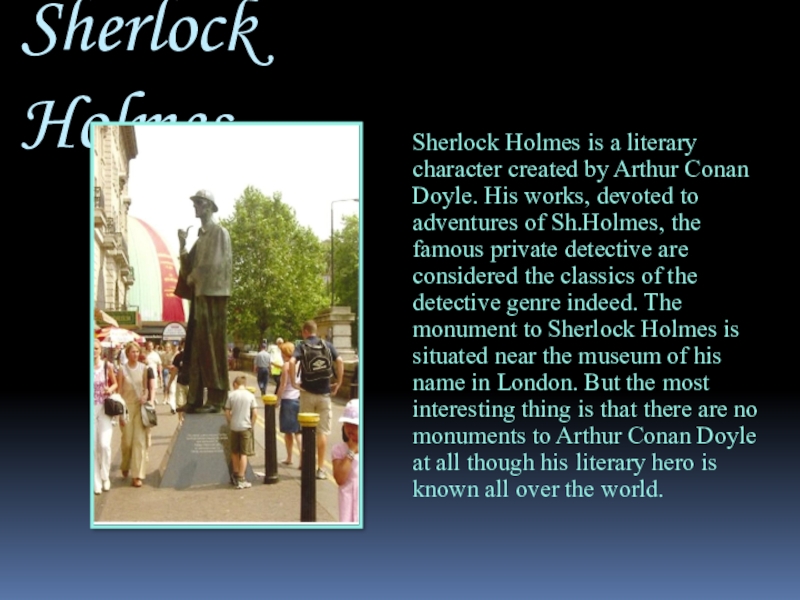
Sherlock Holmes is a literary character created by Arthur Conan
Doyle. His works, devoted to adventures of Sh.Holmes, the famous private detective are considered the classics of the detective genre indeed. The monument to Sherlock Holmes is situated near the museum of his name in London. But the most interesting thing is that there are no monuments to Arthur Conan Doyle at all though his literary hero is known all over the world.
Слайд 15Robin Hood
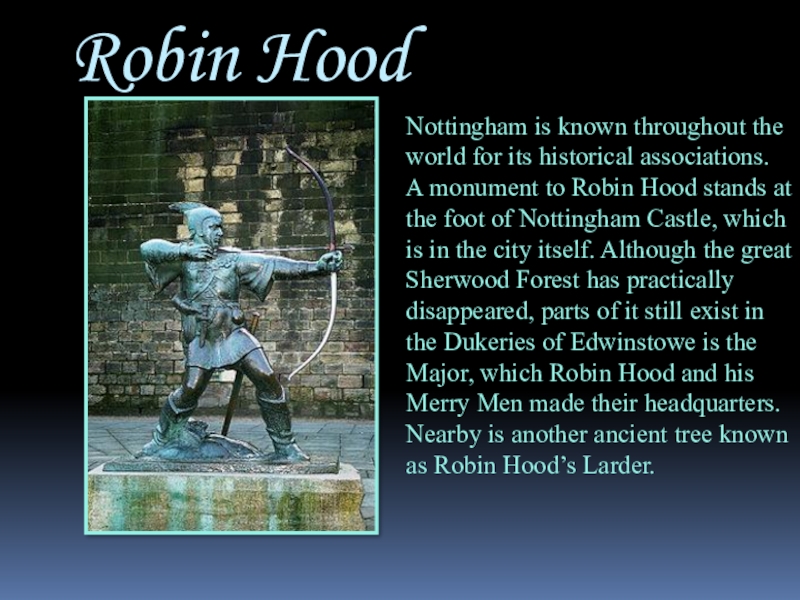
Nottingham is known throughout the world for its historical associations.
A monument to Robin Hood stands at the foot of Nottingham Castle, which is in the city itself. Although the great Sherwood Forest has practically disappeared, parts of it still exist in the Dukeries of Edwinstowe is the Major, which Robin Hood and his Merry Men made their headquarters. Nearby is another ancient tree known as Robin Hood’s Larder.
Слайд 16ROBERT BURNS
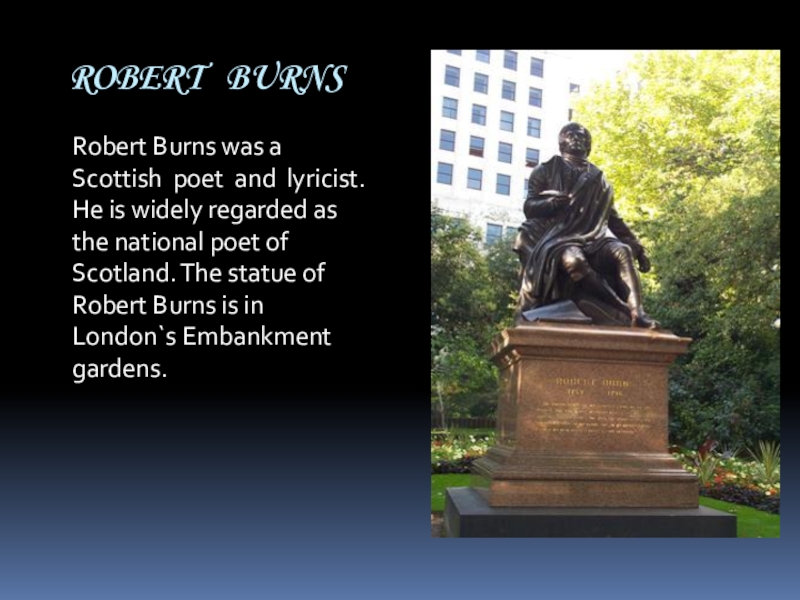
Robert Burns was a Scottish poet and lyricist. He
is widely regarded as the national poet of Scotland. The statue of Robert Burns is in London`s Embankment gardens.
Слайд 17OLIVER CROMWELL
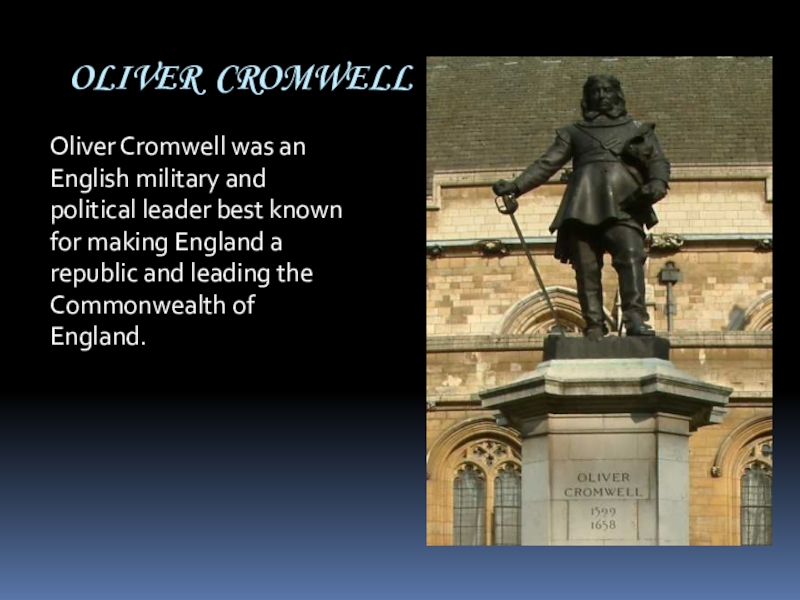
Oliver Cromwell was an English military and political leader best
known for making England a republic and leading the Commonwealth of England.
Слайд 18 Интернет.
Книга по страноведению «Знакомься с Британией» В.М.Павлоцкий . Москва
2000 г., издательство «Базис».
Лингвистическое пособие по английскому языку «Английский наставник. Книга1» К.Б.Васильев. Москва 2002 г., издательство «Интеллект-Центр».
Лингвистическое пособие по английскому языку «Английский наставник. Книга1» К.Б.Васильев. Москва 2002 г., издательство «Интеллект-Центр».
Источники информации: