- Главная
- Разное
- Образование
- Спорт
- Естествознание
- Природоведение
- Религиоведение
- Французский язык
- Черчение
- Английский язык
- Астрономия
- Алгебра
- Биология
- География
- Геометрия
- Детские презентации
- Информатика
- История
- Литература
- Математика
- Музыка
- МХК
- Немецкий язык
- ОБЖ
- Обществознание
- Окружающий мир
- Педагогика
- Русский язык
- Технология
- Физика
- Философия
- Химия
- Шаблоны, фоны, картинки для презентаций
- Экология
- Экономика
Презентация, доклад из цикла уроков элективного курса Business English (Unit 7 Useful expressions in business language)
Содержание
- 1. Презентация из цикла уроков элективного курса Business English (Unit 7 Useful expressions in business language)
- 2. Plan of the lesson:Phonetic drill2. Making up
- 3. ASKING FOR AND EXPRESSING
- 4. ASKING FOR INFORMATIONSuch requests are usually
- 5. ASKING FOR AND GIVING EXAMPLESIf
- 6. ASKING IF SOMEBODY IS INTERESTED-—
- 7. ASKING AWKWARD OR EMBARRASSING QUESTIONSYou can
- 8. ASKING ABOUT PREFERENCES — Do
- 9. ASKING HOW SOMEONE FEELS AFTER ANEVENT—
- 10. EXPRESSING AGREEMENT OR POLITE DISAGREEMENTIf you
- 11. EXPRESSING ASTONISHMENT AND SURPRISEThese can be
- 12. EXPRESSING CERTAINTY AND UNCERTAINTYIf you want
- 13. EXPRESSING DOUBTIf you want to express
- 14. EXPRESSING REGRET AND HOPETo express regret,
- 15. EXPRESSING WORRY AND RELIEFIf you want
- 16. BEING PLEASED OR DISPLEASEDYou can use sentences
- 17. PROBABILITY AND IMPROBABILITYVarious degrees from probability
- 18. CLARIFICATIONIf something is not quite clear
- 19. MAKING SUGGESTIONS— Do you feel like
- 20. OFFERING SOMETHINGHere are some useful ways
- 21. SOME MORE PHRASES FOR DISCUSSIONWhen you want
- 22. GIVING POSITIVE OR TENTATIVE ADVICEProblems: I've lost
- 23. GIVING YOURSELF TIME TO THINK OR CHANGING
- 24. PROPOSING A TOAST— Cheers! (This is
- 25. MAKING A COMPLIMENTIf you want to compliment
- 26. ENDING A CONVERSATION, DINNER, ETC.— Well, I'm
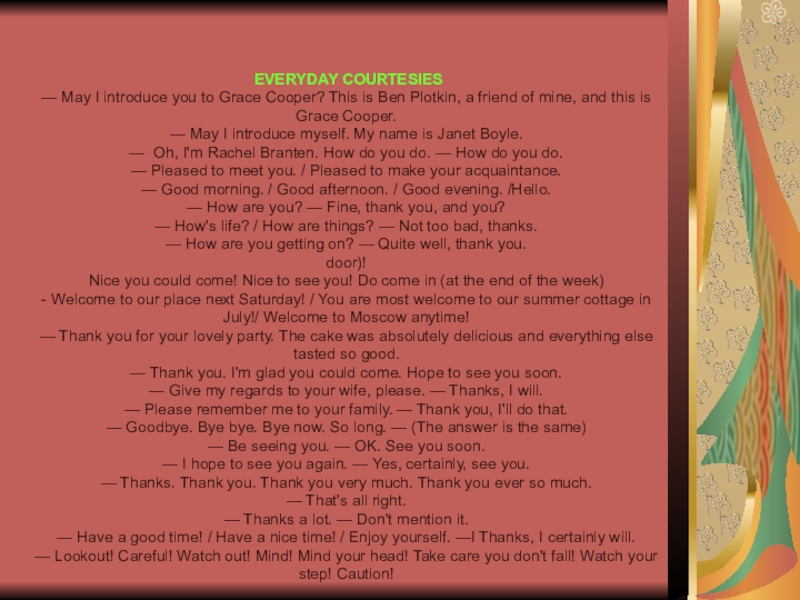
- 27. EVERYDAY COURTESIES— May I introduce you
- 28. — Thank you for your help. —
- 29. Home task:Exercises ( документ « Tексты и тесты» Unit 7)
Plan of the lesson:Phonetic drill2. Making up and acting out the dialogs with using of business language expressions.

Слайд 2Plan of the lesson:
Phonetic drill
2. Making up and acting out the
dialogs with using of
business language expressions.
business language expressions.

Слайд 3 ASKING FOR AND EXPRESSING AN OPINION
If you want
to ask for an opinion, you can use:
— What do you think of...?
— Could you give (me) your opinion / views / ideas on ...?
You can introduce your opinion with phrases like:
— I think / feel / believe that...
— In my opinion / view ...
— I'd like to say / point out / stress that...
If you cannot or do not want to give an opinion, you can say:
— I'm sorry, but I don't know so much about...
— I don't think I can say anything about...
— What can I say? I don't have the faintest idea
— What do you think of...?
— Could you give (me) your opinion / views / ideas on ...?
You can introduce your opinion with phrases like:
— I think / feel / believe that...
— In my opinion / view ...
— I'd like to say / point out / stress that...
If you cannot or do not want to give an opinion, you can say:
— I'm sorry, but I don't know so much about...
— I don't think I can say anything about...
— What can I say? I don't have the faintest idea

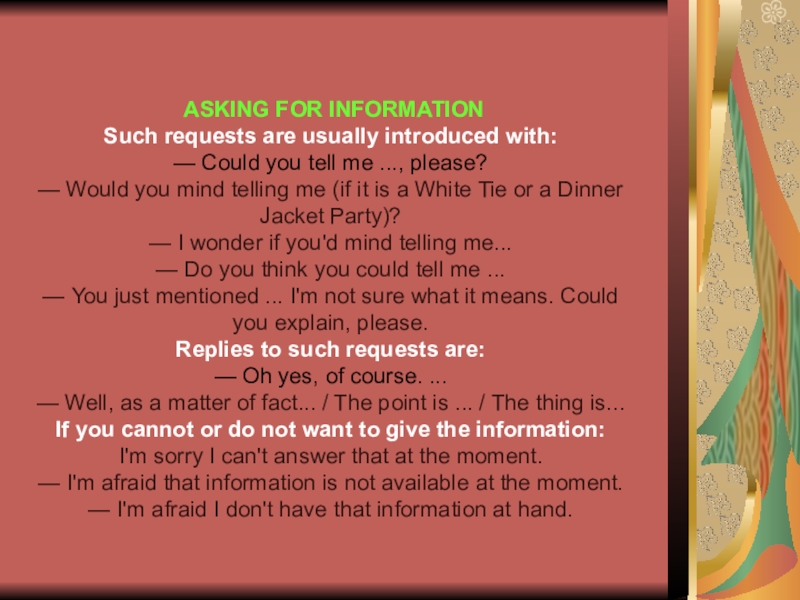
Слайд 4 ASKING FOR INFORMATION
Such requests are usually introduced with:
— Could you
tell me ..., please?
— Would you mind telling me (if it is a White Tie or a Dinner Jacket Party)?
— I wonder if you'd mind telling me...
— Do you think you could tell me ...
— You just mentioned ... I'm not sure what it means. Could you explain, please.
Replies to such requests are:
— Oh yes, of course. ...
— Well, as a matter of fact... / The point is ... / The thing is...
If you cannot or do not want to give the information:
I'm sorry I can't answer that at the moment.
— I'm afraid that information is not available at the moment.
— I'm afraid I don't have that information at hand.
— Would you mind telling me (if it is a White Tie or a Dinner Jacket Party)?
— I wonder if you'd mind telling me...
— Do you think you could tell me ...
— You just mentioned ... I'm not sure what it means. Could you explain, please.
Replies to such requests are:
— Oh yes, of course. ...
— Well, as a matter of fact... / The point is ... / The thing is...
If you cannot or do not want to give the information:
I'm sorry I can't answer that at the moment.
— I'm afraid that information is not available at the moment.
— I'm afraid I don't have that information at hand.
Слайд 5 ASKING FOR AND GIVING EXAMPLES
If during a talk or
discussion the speaker makes a point you want to be illustrated, you can say:
— Could you illustrate this point?
— I'd be grateful if you could give us an example.
— I'm not sure if I understand ... What is the point?
The answer could be:
— Take .... for instance.
— To give you an example (of what I mean), take ...
— To illustrate this point let us consider ...
— Could you illustrate this point?
— I'd be grateful if you could give us an example.
— I'm not sure if I understand ... What is the point?
The answer could be:
— Take .... for instance.
— To give you an example (of what I mean), take ...
— To illustrate this point let us consider ...

Слайд 6 ASKING IF SOMEBODY IS INTERESTED
-— Are you interested in
...?
— I wonder if you have any interest in ...?
If you are interested, you can say:
— Oh yes, I'm very interested in ...
— I find ... extremely interesting / fascinating.
If you are not, you say:
— Oh, I'm sorry, but... / Actually, I don't have much / any interest in ...
— I can't say I find ... so very interesting / fascinating.
— I wonder if you have any interest in ...?
If you are interested, you can say:
— Oh yes, I'm very interested in ...
— I find ... extremely interesting / fascinating.
If you are not, you say:
— Oh, I'm sorry, but... / Actually, I don't have much / any interest in ...
— I can't say I find ... so very interesting / fascinating.

Слайд 7 ASKING AWKWARD OR EMBARRASSING QUESTIONS
You can ask like this:
— I
hope you don't mind me asking this, but hasn't your firm been connected with this scandal?
— I don't know how to put it, but...
— Perhaps I shouldn't really ask this, but...
If the person addressed does not wish to give a reply:
— I'd rather not answer that, if you don't mind.
—You don't really expect me to answer that, do you? I
— I'm not really sure I want to answer that.
— I don't know how to put it, but...
— Perhaps I shouldn't really ask this, but...
If the person addressed does not wish to give a reply:
— I'd rather not answer that, if you don't mind.
—You don't really expect me to answer that, do you? I
— I'm not really sure I want to answer that.
Слайд 8 ASKING ABOUT PREFERENCES
— Do you prefer American literature
to English literature?
— No, I don't.
— Do you prefer playing basketball yourself or watching it on
TV?
— Well, actually I don't like either.
— Well, I'd rather watch it on TV.
— Why do you prefer being single to being married?
— Well, I'd rather be single, because ...
— No, I don't.
— Do you prefer playing basketball yourself or watching it on
TV?
— Well, actually I don't like either.
— Well, I'd rather watch it on TV.
— Why do you prefer being single to being married?
— Well, I'd rather be single, because ...

Слайд 9 ASKING HOW SOMEONE FEELS AFTER AN
EVENT
— Did you like /enjoy
... (it)?
— How did you feel about... (that)?
Replying that you are impressed:
— I am / was really impressed by ...
— What struck me most was ...
Replying that you liked it very much:
— What I really liked was ...
— It was exciting / thrilling / lovely / marvellous, etc.
Replying that you were disappointed:
— Oh, I'm disappointed. I thought..., but...
— I must say I had hoped ...
— The .. .was too bad / dreadful / appalling
Replying that you were bored:
— I didn't find ... very interesting. - I'm sorry, but...
it rather bored me.
— How did you feel about... (that)?
Replying that you are impressed:
— I am / was really impressed by ...
— What struck me most was ...
Replying that you liked it very much:
— What I really liked was ...
— It was exciting / thrilling / lovely / marvellous, etc.
Replying that you were disappointed:
— Oh, I'm disappointed. I thought..., but...
— I must say I had hoped ...
— The .. .was too bad / dreadful / appalling
Replying that you were bored:
— I didn't find ... very interesting. - I'm sorry, but...
it rather bored me.
Слайд 10 EXPRESSING AGREEMENT OR POLITE DISAGREEMENT
If you wish to express your
agreement, you can use:
— You are right. / Oh yes, that's right. /I fully agree with you.
-— Yes, 1 definitely share your view / idea that...
— Oh yes, there can be no doubt about... / that... ,
If you wish to express polite disagreement, you can say:
— I'm sorry but I can't agree with you / to that...
— I'm sorry but I don't think this is right / you are right.
— I'm afraid I can't agree with you /to ...
— I see what you mean but...
— Perhaps, but don't you think that...
— You are right. / Oh yes, that's right. /I fully agree with you.
-— Yes, 1 definitely share your view / idea that...
— Oh yes, there can be no doubt about... / that... ,
If you wish to express polite disagreement, you can say:
— I'm sorry but I can't agree with you / to that...
— I'm sorry but I don't think this is right / you are right.
— I'm afraid I can't agree with you /to ...
— I see what you mean but...
— Perhaps, but don't you think that...
Слайд 11 EXPRESSING ASTONISHMENT AND SURPRISE
These can be expressed in many different
ways and with a variety of adjectives:
— It's rather amazing / surprising / astonishing that...
— I am / was very surprised that... / about...
— How strange / odd / surprising that...
— Surprisingly / strangely enough / incredibly...
— Wonders will never cease!
— Words fail me! = I'm too surprised.
— It's rather amazing / surprising / astonishing that...
— I am / was very surprised that... / about...
— How strange / odd / surprising that...
— Surprisingly / strangely enough / incredibly...
— Wonders will never cease!
— Words fail me! = I'm too surprised.
Слайд 12 EXPRESSING CERTAINTY AND UNCERTAINTY
If you want to express certainty, you
can say:
— I'm quite certain ... / I'm absolutely sure ..,
— Definitely / certainly / without doubt / absolutely
— Depend on it.
— And I don't mean maybe. = I mean exactly what I say.
If you want to say you are not certain:
- Well, I'm not sure / certain (that)...
- Well, perhaps / maybe ...
- Well, it all depends. / Well, you can never tell...
— I'm quite certain ... / I'm absolutely sure ..,
— Definitely / certainly / without doubt / absolutely
— Depend on it.
— And I don't mean maybe. = I mean exactly what I say.
If you want to say you are not certain:
- Well, I'm not sure / certain (that)...
- Well, perhaps / maybe ...
- Well, it all depends. / Well, you can never tell...
Слайд 13 EXPRESSING DOUBT
If you want to express polite doubt, you can
say:
— Is that really so? / Are you sure that...?
— I'm sorry but I'm not quite sure / certain convinced ...
If you want to express more categorical doubt, you can say;
— That's what you say / think ...
— I'm not all that sure / certain / convinced that...
— I strongly / very much / definitely doubt if /that...
— Is that really so? / Are you sure that...?
— I'm sorry but I'm not quite sure / certain convinced ...
If you want to express more categorical doubt, you can say;
— That's what you say / think ...
— I'm not all that sure / certain / convinced that...
— I strongly / very much / definitely doubt if /that...
Слайд 14 EXPRESSING REGRET AND HOPE
To express regret, you can start a
sentence like this:
— I very much regret that...
— I deeply regret the inconvenience caused to you...
— I'm very sorry to hear that...
— Please accept my / our sincere apologies for ...I
— I'm extremely sorry for ...
If you wish to express hope, you can say:
— I hope that... will ...
— I trust him to do so. / You can trust in him.
— All hopes come true. / Let's hope against hope.
— I very much regret that...
— I deeply regret the inconvenience caused to you...
— I'm very sorry to hear that...
— Please accept my / our sincere apologies for ...I
— I'm extremely sorry for ...
If you wish to express hope, you can say:
— I hope that... will ...
— I trust him to do so. / You can trust in him.
— All hopes come true. / Let's hope against hope.
Слайд 15 EXPRESSING WORRY AND RELIEF
If you want to express worry, you
can say:
— I'm a bit / rather / highly worried about / that.,|
It's worrying / disturbing that...
If you want to express relief, you can say:
— Oh, that's a relief, indeed
— Thank goodness for...
— I'm very glad to hear ...
— It's a good thing to know ...
— I'm a bit / rather / highly worried about / that.,|
It's worrying / disturbing that...
If you want to express relief, you can say:
— Oh, that's a relief, indeed
— Thank goodness for...
— I'm very glad to hear ...
— It's a good thing to know ...

Слайд 16BEING PLEASED OR DISPLEASED
You can use sentences like:
— I'm very /
greatly pleased about / at / with ...
— I'm so glad of/ about...
— I'm delighted to hear that...
— I can't say how pleased I am about / at...
— I can't say how delighted I am at / by ...
If you are displeased, you can say:
— I can't say I'm (at all) pleased at / with / about...
— I'm very annoyed at / with ...
— I'm extremely displeased at / about / with... unhappy about... angry at / about / with ...
— If you think that, you've got another thought coming.
— I'm so glad of/ about...
— I'm delighted to hear that...
— I can't say how pleased I am about / at...
— I can't say how delighted I am at / by ...
If you are displeased, you can say:
— I can't say I'm (at all) pleased at / with / about...
— I'm very annoyed at / with ...
— I'm extremely displeased at / about / with... unhappy about... angry at / about / with ...
— If you think that, you've got another thought coming.

Слайд 17 PROBABILITY AND IMPROBABILITY
Various degrees from probability to improbability can be
expressed like this:
Question — Do you think there will be another crisis? Answer: — Yes, there's no doubt about it.
— Most probably there will.
— There might possibly be a crisis.
— Perhaps there will be.
— It's not very probable.
— It's quite / very improbable there will be one.
— There certainly won't be any crisis.
— No, I'm absolutely certain there won't be any.
Question — Do you think there will be another crisis? Answer: — Yes, there's no doubt about it.
— Most probably there will.
— There might possibly be a crisis.
— Perhaps there will be.
— It's not very probable.
— It's quite / very improbable there will be one.
— There certainly won't be any crisis.
— No, I'm absolutely certain there won't be any.

Слайд 18 CLARIFICATION
If something is not quite clear to you, you can
say:
— I'm sorry, but I don't quite understand ...
— I'm sorry, but I'm not really clear about...
— I'm sorry, but could you possibly explain ...?
If you want to give such an explanation, you can start like
this:
— Well, what I'm trying to say is ...
— Well, the point I'm trying to make is that...
— Well, I think / suppose what it's meant that...
— I'm sorry, but I don't quite understand ...
— I'm sorry, but I'm not really clear about...
— I'm sorry, but could you possibly explain ...?
If you want to give such an explanation, you can start like
this:
— Well, what I'm trying to say is ...
— Well, the point I'm trying to make is that...
— Well, I think / suppose what it's meant that...

Слайд 19 MAKING SUGGESTIONS
— Do you feel like going to the opera?
—
What shall we do tonight?
— What do you suggest we do?
— What would you like to do today?
— Where do you fancy going at the weekend?
— What about going to the pictures? / How about going . — Would you like a drink?
Accepting a suggestion:
— Yes, that's a good idea / that's a marvellous idea.
— Yes, that would be nice / that would be great / that sounds nice.
— Yes, I'd love to.
Rejecting a suggestion:
— Well, we could, I suppose, but...
— Well, it's not a bad idea, I suppose, that...
— I suppose we could, but...
— Some other time, perhaps.
Showing indecision or indifference:
— I don't mind really. (= Why don't you choose?)
— I'm not really sure.
— It's all one to me. / It makes no odds.
— Suit yourself, it's all the same to me.
— What do you suggest we do?
— What would you like to do today?
— Where do you fancy going at the weekend?
— What about going to the pictures? / How about going . — Would you like a drink?
Accepting a suggestion:
— Yes, that's a good idea / that's a marvellous idea.
— Yes, that would be nice / that would be great / that sounds nice.
— Yes, I'd love to.
Rejecting a suggestion:
— Well, we could, I suppose, but...
— Well, it's not a bad idea, I suppose, that...
— I suppose we could, but...
— Some other time, perhaps.
Showing indecision or indifference:
— I don't mind really. (= Why don't you choose?)
— I'm not really sure.
— It's all one to me. / It makes no odds.
— Suit yourself, it's all the same to me.
Слайд 20 OFFERING SOMETHING
Here are some useful ways of offering (to do)
something
— Would you like...? - Can I offer you ...?
— What can I get you?
— Could I give/get you ...?
— Would you like me to get it for you?
— Can I help you with that?
— How about my helping you with ...
You accept such offers with answers like:
- Yes, please. / Thank you very much.
- That's very kind of you. Thanks.
- Oh would you? Thanks a lot.
Or you refuse the offers: — No, it's all right, I can manage.
— Would you like...? - Can I offer you ...?
— What can I get you?
— Could I give/get you ...?
— Would you like me to get it for you?
— Can I help you with that?
— How about my helping you with ...
You accept such offers with answers like:
- Yes, please. / Thank you very much.
- That's very kind of you. Thanks.
- Oh would you? Thanks a lot.
Or you refuse the offers: — No, it's all right, I can manage.
Слайд 21SOME MORE PHRASES FOR DISCUSSION
When you want to express that something
is important, you can use:
-What you've just said is of great importance (for ...). That's a very important point / fact / statement / matter. It was very important to me to know ...
If you want to express the opposite, you can say:
I don't think this so important because ... 1 don't think this makes much of a difference.
If you agree with a view or opinion, you can use:
-That's it. Exactly so. I quite agree on / about the plan. That goes without saying.
- That's evident / clear / obvious.
- No doubt about it.
- Most decidedly / definitely. I'm all with you there.
If you don't agree, you can use:
— Do you really mean to say that...?
— Are you seriously suggesting that...?
— I'm sorry, I don't quite agree.
— That's not how I see it.
— That's a very sweeping statement.
— Well, actually I'm afraid that...
— I'd like to say yes, but...
If you want to defend a view:
— Yes, I've thought about that, but...
Yes, I've taken that into account, but...
Expressions for linking your ideas:
After all, and what's more ..., as you know, on the one hand ... and on the other ..., on top of that, oddly / curiously enough, I mean to say, come to that, that is to say, well then ..., etc.
Expressions for summing up:
To sum up then ... In short... So the basic question is …,
etc.
-What you've just said is of great importance (for ...). That's a very important point / fact / statement / matter. It was very important to me to know ...
If you want to express the opposite, you can say:
I don't think this so important because ... 1 don't think this makes much of a difference.
If you agree with a view or opinion, you can use:
-That's it. Exactly so. I quite agree on / about the plan. That goes without saying.
- That's evident / clear / obvious.
- No doubt about it.
- Most decidedly / definitely. I'm all with you there.
If you don't agree, you can use:
— Do you really mean to say that...?
— Are you seriously suggesting that...?
— I'm sorry, I don't quite agree.
— That's not how I see it.
— That's a very sweeping statement.
— Well, actually I'm afraid that...
— I'd like to say yes, but...
If you want to defend a view:
— Yes, I've thought about that, but...
Yes, I've taken that into account, but...
Expressions for linking your ideas:
After all, and what's more ..., as you know, on the one hand ... and on the other ..., on top of that, oddly / curiously enough, I mean to say, come to that, that is to say, well then ..., etc.
Expressions for summing up:
To sum up then ... In short... So the basic question is …,
etc.

Слайд 22GIVING POSITIVE OR TENTATIVE ADVICE
Problems: I've lost my keys. I've got
a pain in my back.
Advice could be offered like this:
— I think you should ...
— Perhaps you could ...
— If I were you I'd ...
— Well, it might be a good idea to /if...
I advise you to... /I advise you not to...
If you can accept the advice, you may say:
— Yes, that sounds a good idea. Thanks a lot.
— I'll do that. Thanks for the advice.
— Well, that's worth thinking about. Thank you.
— Well, 1 could do that, I suppose. I can think about it anyway.
If you refuse the advice, you can say:
— I'm not sure really. But thanks anyway.
- Mmm, I doubt if that would work. But thanks all the sad
Advice could be offered like this:
— I think you should ...
— Perhaps you could ...
— If I were you I'd ...
— Well, it might be a good idea to /if...
I advise you to... /I advise you not to...
If you can accept the advice, you may say:
— Yes, that sounds a good idea. Thanks a lot.
— I'll do that. Thanks for the advice.
— Well, that's worth thinking about. Thank you.
— Well, 1 could do that, I suppose. I can think about it anyway.
If you refuse the advice, you can say:
— I'm not sure really. But thanks anyway.
- Mmm, I doubt if that would work. But thanks all the sad
Слайд 23GIVING YOURSELF TIME TO THINK OR CHANGING THE SUBJECT
If in a
discussion you cannot respond at once, you might use phrases like:
— (Er), let me see,...
— Well, how shall I put it,...
— Just let me think about it / this for a moment:... —You know / You see ...
— Now I come to think of it = Now that I stop to think of it...
If you need more time or do not wish to answer at all, you can say:
— Just to change the subject for a moment,...
— Oh, by the way, before I forget: ...
— If we could move on now to the question of...
If you want to indicate that you are not prepared to discuss the subject, you say:
— Well, I think we'd better change the subject.
— I don't think I'd like to discuss this.
— I don't think it is advisable to continue with this topic.
— (Er), let me see,...
— Well, how shall I put it,...
— Just let me think about it / this for a moment:... —You know / You see ...
— Now I come to think of it = Now that I stop to think of it...
If you need more time or do not wish to answer at all, you can say:
— Just to change the subject for a moment,...
— Oh, by the way, before I forget: ...
— If we could move on now to the question of...
If you want to indicate that you are not prepared to discuss the subject, you say:
— Well, I think we'd better change the subject.
— I don't think I'd like to discuss this.
— I don't think it is advisable to continue with this topic.
Слайд 24 PROPOSING A TOAST
— Cheers! (This is the most usual formula
when you have a drink.
- Your very good health, Mr Virge! — Yes, your very good health, too.
— I should like to propose a toast to our host / hostess: His/her very good health! — Thank you very much indeed. Your very good health, too.
— Here's to you! — Thanks.
— Here's to success in your business / life! –I want to propose a toast to you / Mr Evans!
- Your very good health, Mr Virge! — Yes, your very good health, too.
— I should like to propose a toast to our host / hostess: His/her very good health! — Thank you very much indeed. Your very good health, too.
— Here's to you! — Thanks.
— Here's to success in your business / life! –I want to propose a toast to you / Mr Evans!

Слайд 25MAKING A COMPLIMENT
If you want to compliment somebody during a meeting,
a 1 party or some other occasion, you can say:
— What a charming dress (you are wearing)!
— That's a very nice / smart blouse / necktie / suit you are wearing!
— I must congratulate you on ... (e.g. during a business 1
partner's dinner).
More formal formulas are:
— If I may say so, the dinner / wine is most / very delicious.
— May 1 say how elegant / charming you look in that dress? 'I
You respond like this:
— Thank you. / It is very kind of you to say so.
— Is it really? I'm glad you like it.
— What a charming dress (you are wearing)!
— That's a very nice / smart blouse / necktie / suit you are wearing!
— I must congratulate you on ... (e.g. during a business 1
partner's dinner).
More formal formulas are:
— If I may say so, the dinner / wine is most / very delicious.
— May 1 say how elegant / charming you look in that dress? 'I
You respond like this:
— Thank you. / It is very kind of you to say so.
— Is it really? I'm glad you like it.

Слайд 26ENDING A CONVERSATION, DINNER, ETC.
— Well, I'm afraid I must go
now.
— It's been a great pleasure talking to you.
— I've really enjoyed talking to you but I'm afraid I have to be
low.
I must apologize, but I'm afraid I have to go now.
I'm afraid we'll have to leave it there. (At the end of a
discussion.)
— Thank you for the lovely evening. The food was delicious and everything else was perfect.
You can respond like this:
— It is all right. Thanks for coming anyway.
— That's all right. Be seeing you.
— Yes, certainly. Till the next time.
- Thank you. I'm glad you could come.
— It's been a great pleasure talking to you.
— I've really enjoyed talking to you but I'm afraid I have to be
low.
I must apologize, but I'm afraid I have to go now.
I'm afraid we'll have to leave it there. (At the end of a
discussion.)
— Thank you for the lovely evening. The food was delicious and everything else was perfect.
You can respond like this:
— It is all right. Thanks for coming anyway.
— That's all right. Be seeing you.
— Yes, certainly. Till the next time.
- Thank you. I'm glad you could come.
Слайд 27 EVERYDAY COURTESIES
— May I introduce you to Grace Cooper? This
is Ben Plotkin, a friend of mine, and this is Grace Cooper.
— May I introduce myself. My name is Janet Boyle.
— Oh, I'm Rachel Branten. How do you do. — How do you do.
— Pleased to meet you. / Pleased to make your acquaintance.
— Good morning. / Good afternoon. / Good evening. /Hello.
— How are you? — Fine, thank you, and you?
— How's life? / How are things? — Not too bad, thanks.
— How are you getting on? — Quite well, thank you.
door)!
Nice you could come! Nice to see you! Do come in (at the end of the week)
- Welcome to our place next Saturday! / You are most welcome to our summer cottage in July!/ Welcome to Moscow anytime!
— Thank you for your lovely party. The cake was absolutely delicious and everything else tasted so good.
— Thank you. I'm glad you could come. Hope to see you soon.
— Give my regards to your wife, please. — Thanks, I will.
— Please remember me to your family. — Thank you, I'll do that.
— Goodbye. Bye bye. Bye now. So long. — (The answer is the same)
— Be seeing you. — OK. See you soon.
— I hope to see you again. — Yes, certainly, see you.
— Thanks. Thank you. Thank you very much. Thank you ever so much.
— That's all right.
— Thanks a lot. — Don't mention it.
— Have a good time! / Have a nice time! / Enjoy yourself. —I Thanks, I certainly will.
— Lookout! Careful! Watch out! Mind! Mind your head! Take care you don't fall! Watch your step! Caution!
— May I introduce myself. My name is Janet Boyle.
— Oh, I'm Rachel Branten. How do you do. — How do you do.
— Pleased to meet you. / Pleased to make your acquaintance.
— Good morning. / Good afternoon. / Good evening. /Hello.
— How are you? — Fine, thank you, and you?
— How's life? / How are things? — Not too bad, thanks.
— How are you getting on? — Quite well, thank you.
door)!
Nice you could come! Nice to see you! Do come in (at the end of the week)
- Welcome to our place next Saturday! / You are most welcome to our summer cottage in July!/ Welcome to Moscow anytime!
— Thank you for your lovely party. The cake was absolutely delicious and everything else tasted so good.
— Thank you. I'm glad you could come. Hope to see you soon.
— Give my regards to your wife, please. — Thanks, I will.
— Please remember me to your family. — Thank you, I'll do that.
— Goodbye. Bye bye. Bye now. So long. — (The answer is the same)
— Be seeing you. — OK. See you soon.
— I hope to see you again. — Yes, certainly, see you.
— Thanks. Thank you. Thank you very much. Thank you ever so much.
— That's all right.
— Thanks a lot. — Don't mention it.
— Have a good time! / Have a nice time! / Enjoy yourself. —I Thanks, I certainly will.
— Lookout! Careful! Watch out! Mind! Mind your head! Take care you don't fall! Watch your step! Caution!
Слайд 28— Thank you for your help. — It was a pleasure.
—
It was so very kind of you. — Oh, forget it. It's nothing.
— Many thanks. — Not at all. / You're welcome (Am).
— Good luck! Best of luck! (before an event)
— Congratulations! (after an event)
— Many happy returns of the day! Happy birthday!
Happy anniversary!
— I wish you every happiness, (to the newlyweds)
— Sorry. So sorry. I'm terribly sorry. Very sorry indeed!
— Oh, that's all right.
— Sorry to trouble you! — That's no trouble at all.
— Sorry to have kept you waiting! — Oh, it doesn't matter.
— Excuse me, could you tell me the time, please? — Certainly. 1
— Excuse me, but I really have to go! — That's all right.
— Excuse me, may I ask you a question? — Certainly. / Sure.
/ Go ahead. (Am)
— Pardon! Pardon me! Excuse me! (Am) — That's all right, (before poking people in the back when trying to get out from a
crowded bus)
— Please forgive me! Can you ever forgive me? (when you \
have done something serious)
— I apologize for being late. — Oh, that's all right.
—Would you come to the concert? — Yes, I'd love to. Yes, that's a good idea.
— Would you attend the meeting tonight? — I wish I could,
but I've got another appointment.
— Many thanks. — Not at all. / You're welcome (Am).
— Good luck! Best of luck! (before an event)
— Congratulations! (after an event)
— Many happy returns of the day! Happy birthday!
Happy anniversary!
— I wish you every happiness, (to the newlyweds)
— Sorry. So sorry. I'm terribly sorry. Very sorry indeed!
— Oh, that's all right.
— Sorry to trouble you! — That's no trouble at all.
— Sorry to have kept you waiting! — Oh, it doesn't matter.
— Excuse me, could you tell me the time, please? — Certainly. 1
— Excuse me, but I really have to go! — That's all right.
— Excuse me, may I ask you a question? — Certainly. / Sure.
/ Go ahead. (Am)
— Pardon! Pardon me! Excuse me! (Am) — That's all right, (before poking people in the back when trying to get out from a
crowded bus)
— Please forgive me! Can you ever forgive me? (when you \
have done something serious)
— I apologize for being late. — Oh, that's all right.
—Would you come to the concert? — Yes, I'd love to. Yes, that's a good idea.
— Would you attend the meeting tonight? — I wish I could,
but I've got another appointment.