Слайд 1Teacher’s acting / performance skills as
a pedagogical necessity and their relationship
to student’s motivation and achievement
Артистизм педагога как условие эффективного преподавания иностранных языков
Автор презентации:
Ваганова Жанна Валентиновна,
учитель английского языка МАОУ АСОШ
Слайд 2How to be a good teacher?
What makes a good teacher?
Слайд 3Good teachers should make their lessons interesting so you don’t fall
asleep in them.
They must love their job and really enjoy it.
They have their own personality and doesn’t hide
it from students.
They should be able to correct students without
offending them.
A good teacher is
someone who helps
rather than shouts.
Слайд 4Our goals: to waken interest, to teach successfully, helping more students
to learn more.
Factors we can’t change: their basic intelligence, family background, learning style.
Factor within our control:
teacher’s style, our manner
and enthusiasm.
Слайд 5Teacher’s craft: every word, intonation and look counts; the rhythm of
teaching and the pattern (or shape) of a lesson are under the control.
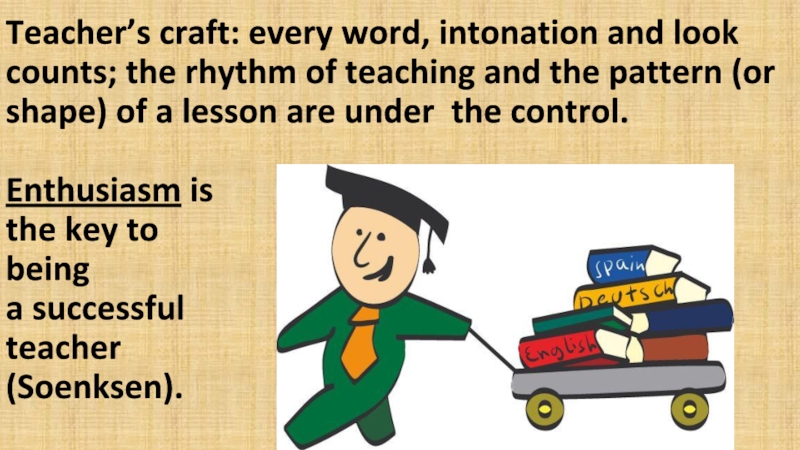
Enthusiasm is
the key to
being
a successful
teacher
(Soenksen).
Слайд 6Effective teachers motivate their students with an enthusiastic style of teaching
(Brophy and Good).
A great teacher has
intensity and
communicates it
enthusiastically
(Hanning)
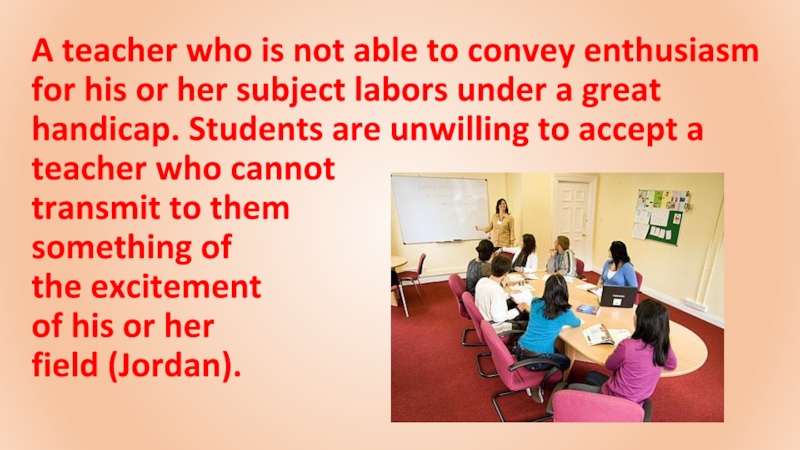
Слайд 7A teacher who is not able to convey enthusiasm for his
or her subject labors under a great handicap. Students are unwilling to accept a teacher who cannot
transmit to them
something of
the excitement
of his or her
field (Jordan).
Слайд 8For boosting teacher’s effectiveness we
must adopt some creative verbal and
nonverbal techniques.
The techniques we recommend are found in the world of the actor.
Слайд 9Teaching is like performing art: both actors and teachers have audience
and a message to convey.
They have common top-tray tools from
a craftperson’s “toolbox”.
Teachers as actors can generate interest, give students a feeling that something important has been achieved.
Слайд 10Teacher’s passion, fascination with the subject, his sense of confidence energize
his students. Successful teaching is a shift from informative
to performative (Conquergood).
Successful practitioners agree: there are real educational foundations for using acting
skills in today’s classroom, and
teaching with energy and freshness.
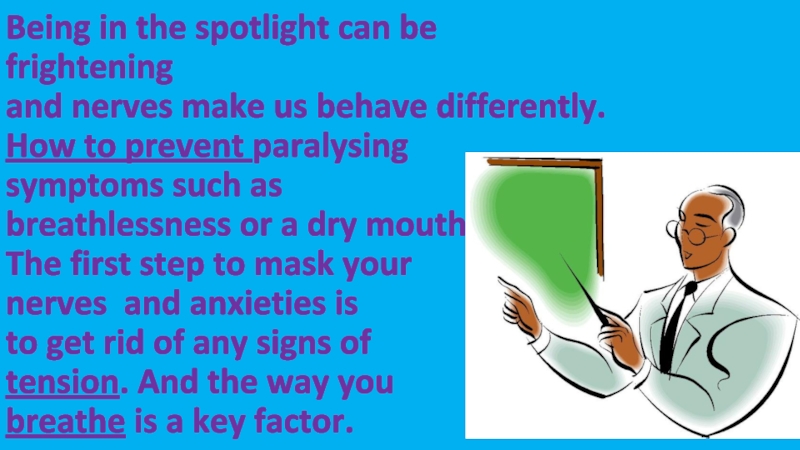
Слайд 11Being in the spotlight can be frightening
and nerves make us
behave differently.
How to prevent paralysing
symptoms such as
breathlessness or a dry mouth?
The first step to mask your
nerves and anxieties is
to get rid of any signs of
tension. And the way you
breathe is a key factor.
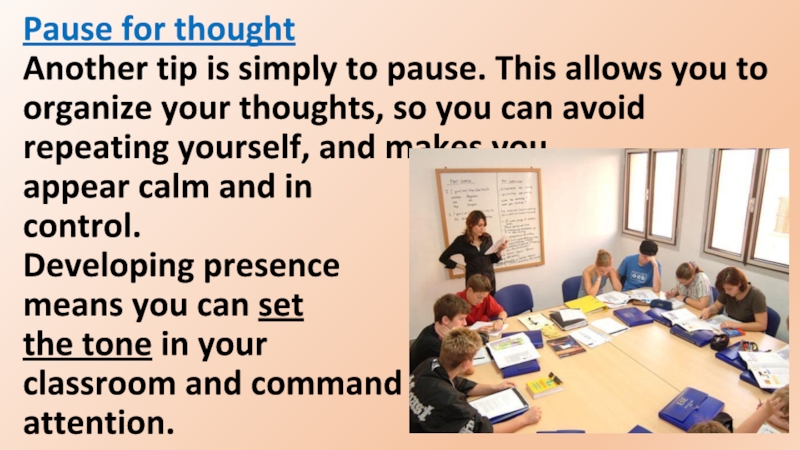
Слайд 12Pause for thought
Another tip is simply to pause. This allows you
to organize your thoughts, so you can avoid repeating yourself, and makes you
appear calm and in
control.
Developing presence
means you can set
the tone in your
classroom and command
attention.
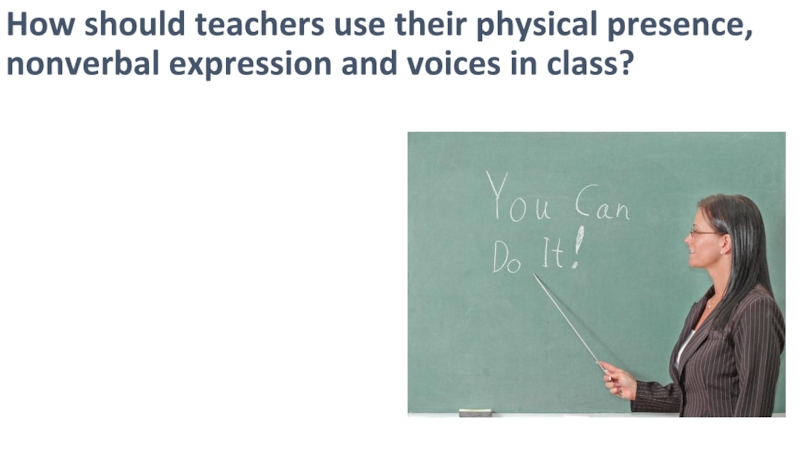
Слайд 13How should teachers use their physical presence, nonverbal expression and voices
in class?
Слайд 14What is nonverbal communication (NVC)?
All communication conveyed other than the words:
Kinesics
(body movement/expressions/gestures)
Physical characteristics (appearance/smell)
Haptics (i.e. touching)
Proxemics (space/physical environment)
Chronemics (time)
Paralanguage (voice)
Objects and visuals
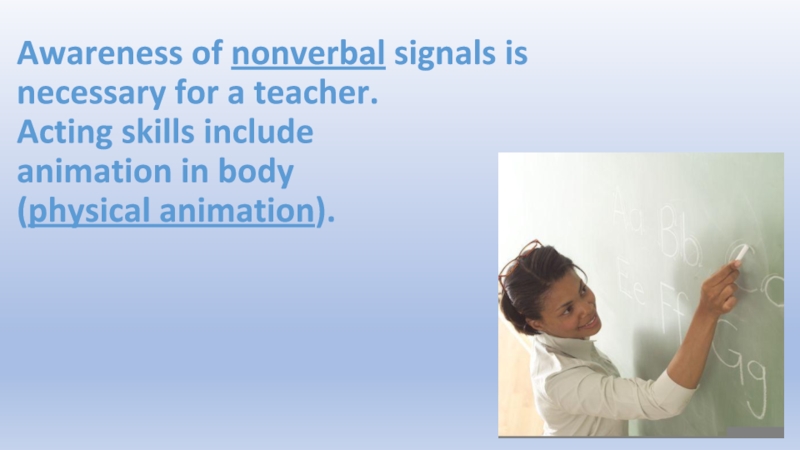
Слайд 15Awareness of nonverbal signals is
necessary for a teacher.
Acting skills
include
animation in body
(physical animation).
Слайд 16A physically dynamic teacher uses the tools of postural changes and
commands the class' attention, shows that he has something important to say, emphasizes and encourages.
We know that actions speak louder than words! It is very important to move about the classroom and
to communicate with students physically.
Слайд 17Recommendations for productive
teacher animation: adopt a relaxed and
positive facial
expression; make eye contact; smile!
Try to see yourself through the students’ eyes: think about your appearance.
Use different gestures to help clarity,
to express delight or boredom.
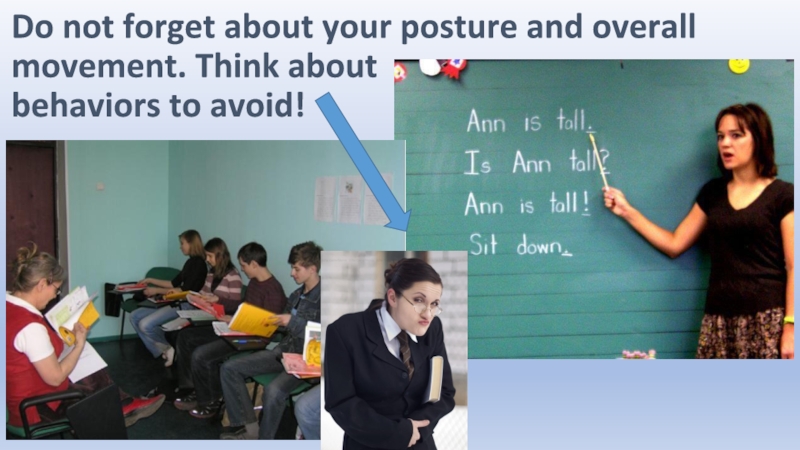
Слайд 18Do not forget about your posture and overall movement. Think about
behaviors
to avoid!
Слайд 19How should teachers talk to students?
We must improve our personal
speech
(communicating vocally is one of
the crucial acting skills)
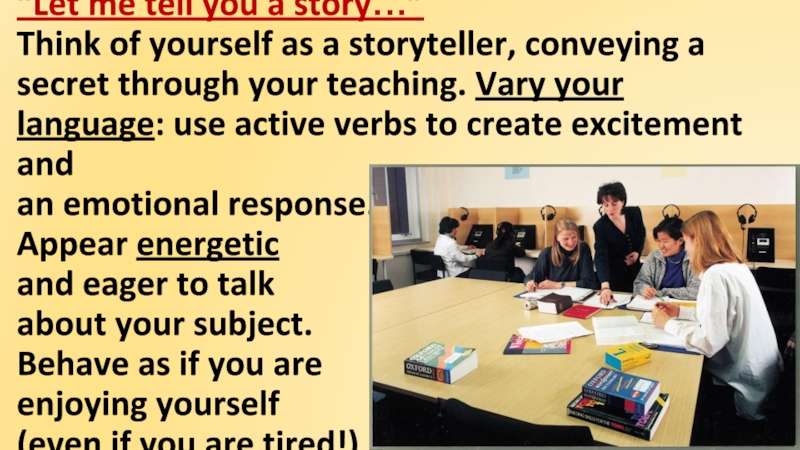
Слайд 20“Let me tell you a story…”
Think of yourself as a storyteller,
conveying a secret through your teaching. Vary your language: use active verbs to create excitement and
an emotional response.
Appear energetic
and eager to talk
about your subject.
Behave as if you are
enjoying yourself
(even if you are tired!)
Слайд 21Some practical strategies of stress management: take care of yourself so
that you can take care of your students.
Treat every day as a new day and strive to be a little
better each day.
But don’t try to be
perfect. Focus on what is
in your
control.
Слайд 22Try to free up your teaching style.
For some time move
away from chalk,
books and talk.
Ask yourself: what can I really do
to help my students learn?
Do not forget that drama
techniques and your own
acting skills are
powerful teaching
strategies.