9 Forms
- Главная
- Разное
- Образование
- Спорт
- Естествознание
- Природоведение
- Религиоведение
- Французский язык
- Черчение
- Английский язык
- Астрономия
- Алгебра
- Биология
- География
- Геометрия
- Детские презентации
- Информатика
- История
- Литература
- Математика
- Музыка
- МХК
- Немецкий язык
- ОБЖ
- Обществознание
- Окружающий мир
- Педагогика
- Русский язык
- Технология
- Физика
- Философия
- Химия
- Шаблоны, фоны, картинки для презентаций
- Экология
- Экономика
Презентация, доклад на тему Past simple tense (7 form)
Содержание
- 1. Past simple tense (7 form)
- 2. *Past Time Main eventsThe past simple is
- 3. *We can use the past simple, to
- 4. *1. Background Description Past Continuous TenseThe past
- 5. * When telling a story,describing background.I
- 6. *Past Before Past The past perfect is
- 7. *Past TenseIt is not always necessary if
- 8. *Interrupted Past ContinuousWe often contrast an action
- 9. *Participle Clauses Participle clauses are introduced by
- 10. *Habits in the PastThe past simple is
- 11. *Used toUsed to is used to describe
- 12. *Would Would is used to describe a
- 13. * Past Continuous Politeness and Uncertainty
- 14. *ExercisesI suddenly remembered that I forgot /
- 15. *4. Who was driving / drove
- 16. *6. Davud ate / had eaten Japanese
- 17. *.I used to like / was liking
- 18. *10. Jale missed the party because no-one
- 19. *13. While I ............ to get my
- 20. *15. Maria .......... her glasses at the
- 21. *17. Sorry, I ............ to you. I
- 22. *Ercan DemirEnglish teacherDilfem language course
*Past Time Main eventsThe past simple is used to describe finished events in the past. Susan went into the station and bought a ticket.Ali cleaned all the shoes two hours ago.We finished our homework and played
Слайд 2*
Past Time
Main events
The past simple is used to describe finished events
in the past.
Susan went into the station and bought a ticket.
Ali cleaned all the shoes two hours ago.
We finished our homework and played tennis.
Did you fill in the form yesterday?
Susan went into the station and bought a ticket.
Ali cleaned all the shoes two hours ago.
We finished our homework and played tennis.
Did you fill in the form yesterday?
ercan demir:
English Teacher
Слайд 3*
We can use the past simple, to say that one thing
happened after another.
When the telephone rang, Ali answered it.
I sheltered under the oak tree when it started to rain.
When Ayse arrived, Osman made some coffee.
I got up late yesterday morning and had a shower and then had breakfast.At 8 I left the house for school.
When the telephone rang, Ali answered it.
I sheltered under the oak tree when it started to rain.
When Ayse arrived, Osman made some coffee.
I got up late yesterday morning and had a shower and then had breakfast.At 8 I left the house for school.
Слайд 4*
1. Background Description
Past Continuous Tense
The past continuous is used to describe
actions still in progress, and is used for background description.
There were a lot of people waiting in the station. Some were sleeping on the benches, and others were walking up and down. Susan was looking for Graham, so she didn't sit down.
There were a lot of people waiting in the station. Some were sleeping on the benches, and others were walking up and down. Susan was looking for Graham, so she didn't sit down.
Слайд 5*
When telling a story,describing background.
I was standing outside the
bus station. It was getting late and I was feeling tired. I was waiting for a man called Johnny.
And past simple for events and actions.
Suddenly, a woman came round the corner and walked right up to me.’Are you Mr Marlowe? She asked.
And past simple for events and actions.
Suddenly, a woman came round the corner and walked right up to me.’Are you Mr Marlowe? She asked.
Слайд 6*
Past Before Past
The past perfect is used to describe a past
event which took place before another past event.
By the time the train arrived, Susan had managed to push her way to the front of the crowd.
By his second day at camp he had made several friends.
After he had packed his bag, he left the house.
By the time the train arrived, Susan had managed to push her way to the front of the crowd.
By his second day at camp he had made several friends.
After he had packed his bag, he left the house.
Слайд 7*
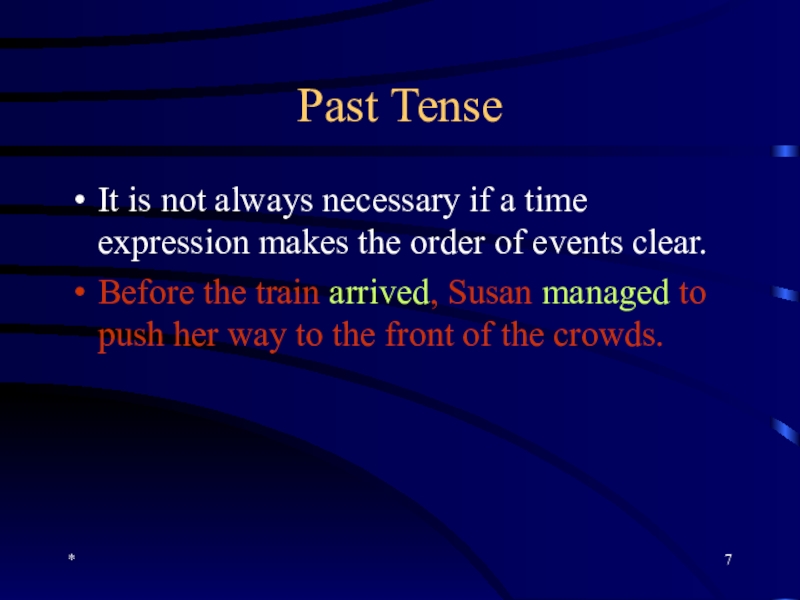
Past Tense
It is not always necessary if a time expression makes
the order of events clear.
Before the train arrived, Susan managed to push her way to the front of the crowds.
Before the train arrived, Susan managed to push her way to the front of the crowds.
Слайд 8*
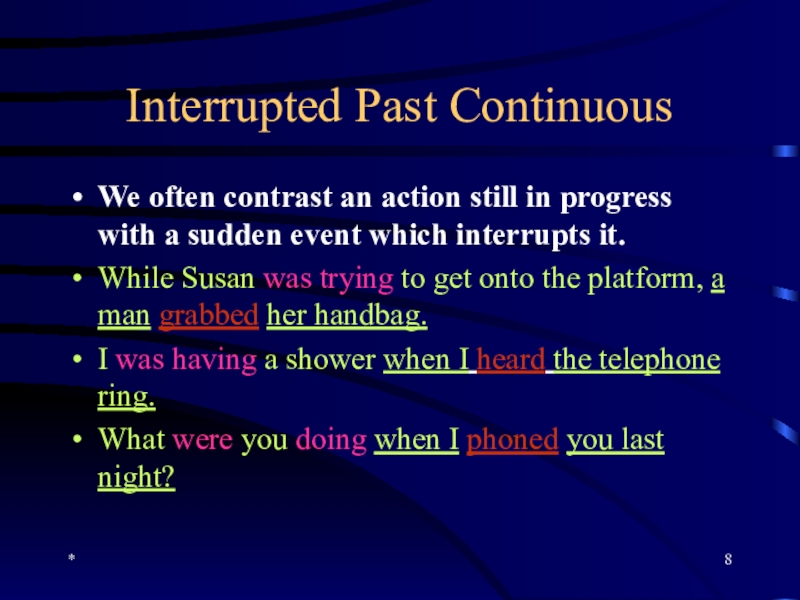
Interrupted Past Continuous
We often contrast an action still in progress with
a sudden event which interrupts it.
While Susan was trying to get onto the platform, a man grabbed her handbag.
I was having a shower when I heard the telephone ring.
What were you doing when I phoned you last night?
While Susan was trying to get onto the platform, a man grabbed her handbag.
I was having a shower when I heard the telephone ring.
What were you doing when I phoned you last night?
Слайд 9*
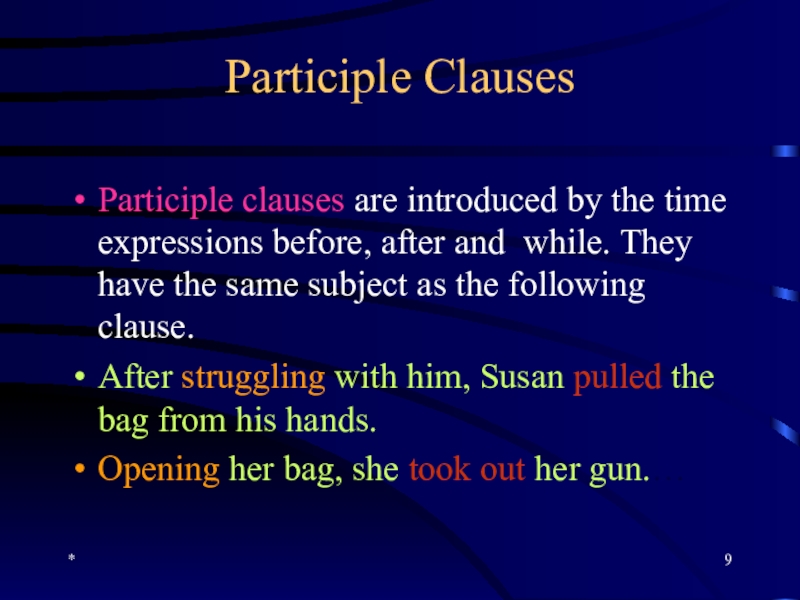
Participle Clauses
Participle clauses are introduced by the time expressions before, after
and while. They have the same subject as the following clause.
After struggling with him, Susan pulled the bag from his hands.
Opening her bag, she took out her gun.…
After struggling with him, Susan pulled the bag from his hands.
Opening her bag, she took out her gun.…
Слайд 10*
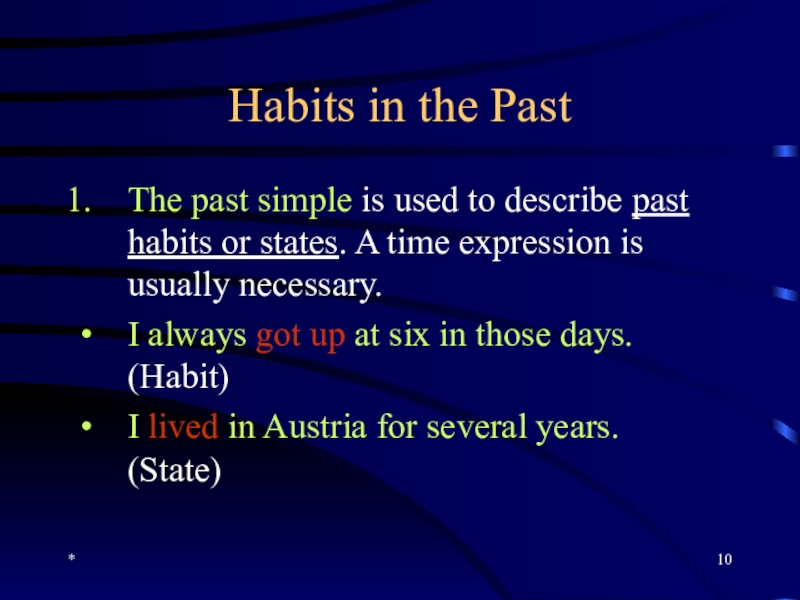
Habits in the Past
The past simple is used to describe past
habits or states. A time expression is usually necessary.
I always got up at six in those days. (Habit)
I lived in Austria for several years. (State)
I always got up at six in those days. (Habit)
I lived in Austria for several years. (State)
Слайд 11*
Used to
Used to is used to describe past habits, usually in
contrast with the present. A time expression is not necessary.
I used to get up at six, but now I get up at eight.
When I was young, I used to go climbing once a month.
He used to live in Ankara.
Used to can also describe past states.
I used to own a horse. (I owned a horse once.)
I didn’t use to like beer.
I used to get up at six, but now I get up at eight.
When I was young, I used to go climbing once a month.
He used to live in Ankara.
Used to can also describe past states.
I used to own a horse. (I owned a horse once.)
I didn’t use to like beer.
Слайд 12*
Would
Would is used to describe a person's typical activities in the
past.
It can only be used to describe repeated actions, and is mainly used in writing, and in personal reminiscences.
Every evening was the same. Jack would turn on the radio, light his pipe and fall asleep.
It can only be used to describe repeated actions, and is mainly used in writing, and in personal reminiscences.
Every evening was the same. Jack would turn on the radio, light his pipe and fall asleep.
Слайд 13*
Past Continuous Politeness and
Uncertainty
The past continuous can be used to
describe a repeated action in the past, often an annoying habit. A frequency adverb is necessary.
When Peter was younger, he was always getting into trouble.
When Peter was younger, he was always getting into trouble.
The past continuous with the verb wonder has a polite meaning.
I was wondering if you could help me.
2. With the verb think the past continuous suggests uncertainty
I was thinking of having a party next week.
Слайд 14*
Exercises
I suddenly remembered that I forgot / had forgotten my keys.
Had forgotten
While Diana watched / was watching her favorite television programme, there was a power-cut.
Was watching
Tom used to live / would live in the house at the end of the street.
Used to live
While Diana watched / was watching her favorite television programme, there was a power-cut.
Was watching
Tom used to live / would live in the house at the end of the street.
Used to live
Слайд 15*
4. Who was driving / drove the car at the
time of the accident?
Was driving
5. By the time Serdar got back, Oguz went / had gone.
Had gone
Was driving
5. By the time Serdar got back, Oguz went / had gone.
Had gone
Слайд 16*
6. Davud ate / had eaten Japanese food before, so he
knew what to order.
Had eaten
7. I did / was doing some shopping yesterday, when I saw that Dutch friend of yours.
Was doing
Had eaten
7. I did / was doing some shopping yesterday, when I saw that Dutch friend of yours.
Was doing
Слайд 17*
.
I used to like / was liking sweets much more than
I do now.
Used to like
9. What exactly were you doing / did you do when I came into your office yesterday?
Were you doing
Used to like
9. What exactly were you doing / did you do when I came into your office yesterday?
Were you doing
Слайд 18*
10. Jale missed the party because no-one was telling / had
told her about it.
Had told
11. Esra would / used to be a doctor.
used to
12. After phoning the airport, Faruk packed / had packed / was packing his suitcase.
packed
Had told
11. Esra would / used to be a doctor.
used to
12. After phoning the airport, Faruk packed / had packed / was packing his suitcase.
packed
Слайд 19*
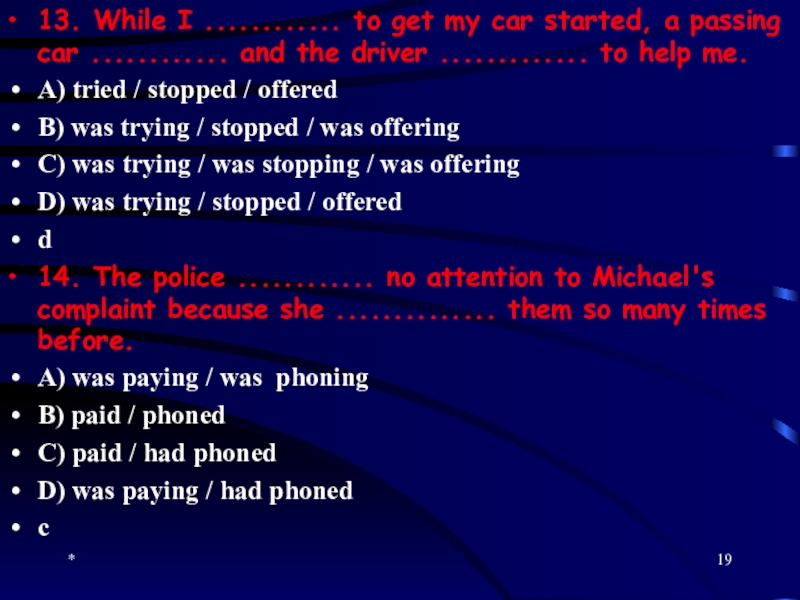
13. While I ............ to get my car started, a passing
car ............ and the driver ............. to help me.
A) tried / stopped / offered
B) was trying / stopped / was offering
C) was trying / was stopping / was offering
D) was trying / stopped / offered
d
14. The police ............ no attention to Michael's complaint because she .............. them so many times before.
A) was paying / was phoning
B) paid / phoned
C) paid / had phoned
D) was paying / had phoned
c
A) tried / stopped / offered
B) was trying / stopped / was offering
C) was trying / was stopping / was offering
D) was trying / stopped / offered
d
14. The police ............ no attention to Michael's complaint because she .............. them so many times before.
A) was paying / was phoning
B) paid / phoned
C) paid / had phoned
D) was paying / had phoned
c
Слайд 20*
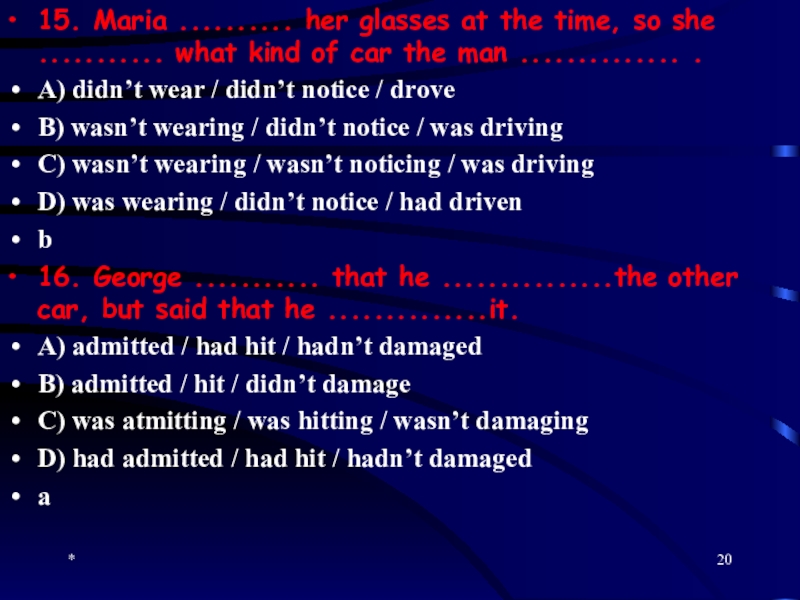
15. Maria .......... her glasses at the time, so she ...........
what kind of car the man .............. .
A) didn’t wear / didn’t notice / drove
B) wasn’t wearing / didn’t notice / was driving
C) wasn’t wearing / wasn’t noticing / was driving
D) was wearing / didn’t notice / had driven
b
16. George ........... that he ...............the other car, but said that he ..............it.
A) admitted / had hit / hadn’t damaged
B) admitted / hit / didn’t damage
C) was atmitting / was hitting / wasn’t damaging
D) had admitted / had hit / hadn’t damaged
a
A) didn’t wear / didn’t notice / drove
B) wasn’t wearing / didn’t notice / was driving
C) wasn’t wearing / wasn’t noticing / was driving
D) was wearing / didn’t notice / had driven
b
16. George ........... that he ...............the other car, but said that he ..............it.
A) admitted / had hit / hadn’t damaged
B) admitted / hit / didn’t damage
C) was atmitting / was hitting / wasn’t damaging
D) had admitted / had hit / hadn’t damaged
a
Слайд 21*
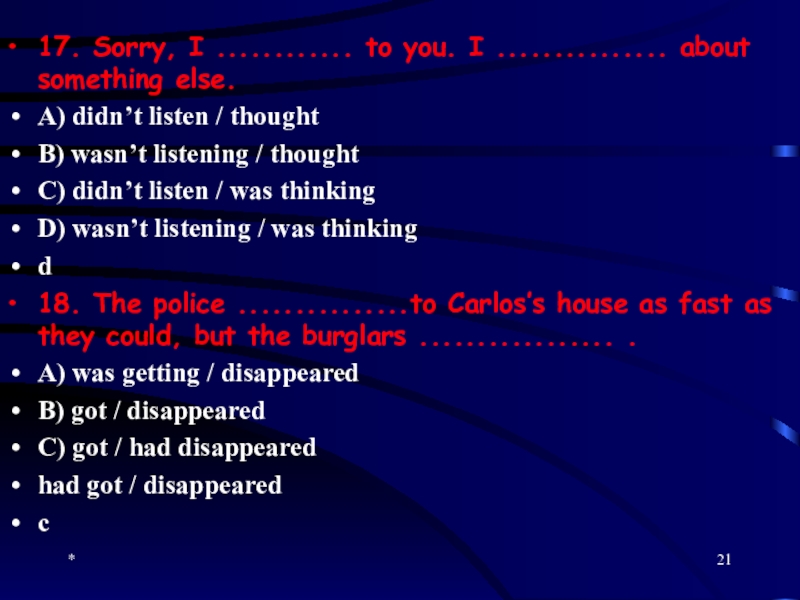
17. Sorry, I ............ to you. I ............... about something else.
A)
didn’t listen / thought
B) wasn’t listening / thought
C) didn’t listen / was thinking
D) wasn’t listening / was thinking
d
18. The police ...............to Carlos’s house as fast as they could, but the burglars ................. .
A) was getting / disappeared
B) got / disappeared
C) got / had disappeared
had got / disappeared
c
B) wasn’t listening / thought
C) didn’t listen / was thinking
D) wasn’t listening / was thinking
d
18. The police ...............to Carlos’s house as fast as they could, but the burglars ................. .
A) was getting / disappeared
B) got / disappeared
C) got / had disappeared
had got / disappeared
c