ГИА
- Главная
- Разное
- Образование
- Спорт
- Естествознание
- Природоведение
- Религиоведение
- Французский язык
- Черчение
- Английский язык
- Астрономия
- Алгебра
- Биология
- География
- Геометрия
- Детские презентации
- Информатика
- История
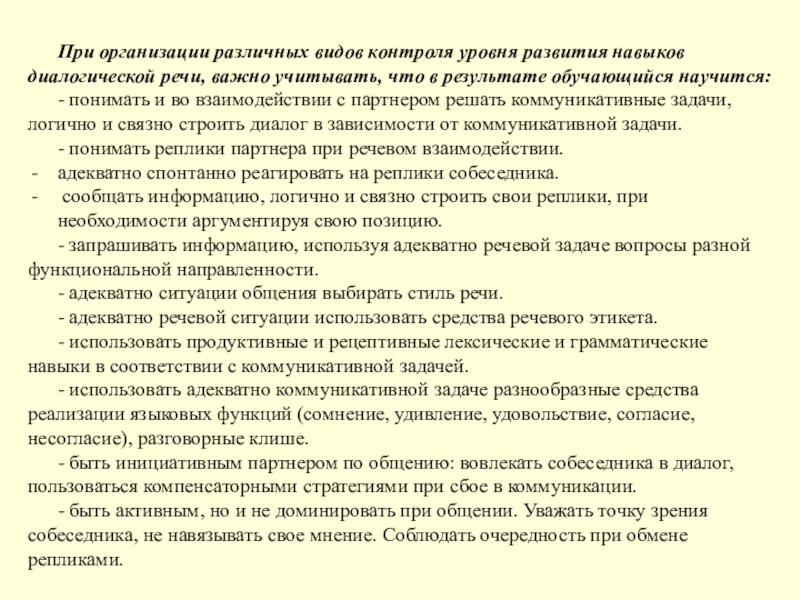
- Литература
- Математика
- Музыка
- МХК
- Немецкий язык
- ОБЖ
- Обществознание
- Окружающий мир
- Педагогика
- Русский язык
- Технология
- Физика
- Философия
- Химия
- Шаблоны, фоны, картинки для презентаций
- Экология
- Экономика
Презентация, доклад на тему Организация контроля речи при подготовке к ОГЭ и ЕГЭ
Содержание
- 1. Организация контроля речи при подготовке к ОГЭ и ЕГЭ
- 2. Устная коммуникация может протекать в формеМонолога Диалога
- 3. Монологическая речь зависит от интенции говорящего, который
- 4. Монологическая речь
- 5. Два основных пути формирования умений монологического высказывания
- 6. Примеры заданий на развитие монологических навыков без
- 7. Task. Why do people learn foreign languages?
- 8. Описательные упражненияTask. Describe the school where you
- 9. Some models and useful patterns:1. Building, facilities,
- 10. Диалогическая речь
- 11. Три стадии диалогаИнициирование разговора объяснение ситуации, запрос
- 12. Речевые образцы для диалогического высказывания1. Как инициировать
- 13. 4. Как согласиться или не согласиться с
- 14. 7. Как высказать мнениеIt’s very difficult to
- 15. Примеры заданий для контроля диалогической речи
- 16. Task. You are staying with your friend
- 17. Task 1. Отреагируйте на различные высказывания.I'm interested
- 18. Task 3. Прочитайте высказывания одного участника разговора
- 19. При организации различных видов контроля уровня развития
- 20. Спасибо за внимание!
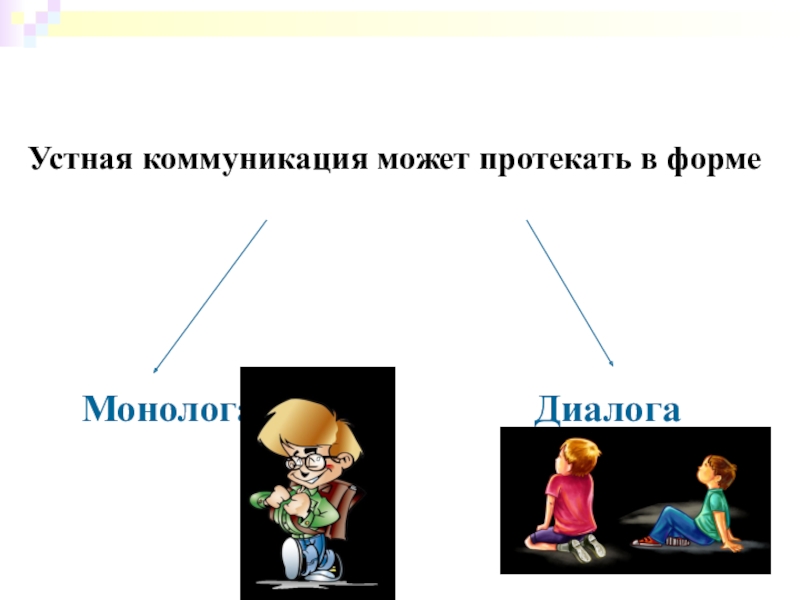
Устная коммуникация может протекать в формеМонолога Диалога
Слайд 3
Монологическая речь зависит от интенции
говорящего, который строит свое развернутое
высказывание
в зависимости от им самим
выбранной стратегии
выбранной стратегии
Диалогическая речь – это, прежде всего,
взаимодействие двух партнеров, где реализуются
речевые интенции и стратегии его участников

Слайд 5Два основных пути формирования умений
монологического высказывания
на основе прочитанного
конкретного
текста
без опоры на текст, отталкиваясь
от тематики и проблематики
обсуждаемых вопросов
1. Ответить на вопросы на понимание прочитанного текста.
2. Согласиться с утверждениями или опровергнуть утверждения.
3. Найти в тексте предложения, которые можно употребить для обобщения, заключения, выводов.
4. Соотнесите план тематического высказывания с возможностями данного текста и выясните, какую информацию нужно ещё найти и добавить.
5. Составьте план монологического высказывания, подберите к нему информацию из дополнительных текстов.
6. Подготовьте развёрнутое монологическое высказывание с использованием текстовых материалов для раскрытия всех аспектов, представленных в ситуации.
1. Высказывание в течение 1 минуты по тематической ситуации с использованием опор в качестве помощи для порождения речевого высказывания. Также нужна помощь в виде речевых образцов, разговорных клише, таблиц, схем, блоков. Другие учащиеся могут добавить, не согласиться с мнением говорящего и выдвинуть своё мнение.
2. Высказывание в течение 2 минут по тематической ситуации с использованием опор. Экзаменационное высказывание по тематической ситуации проходит в течение 2-х минут. Для успешного выполнения задания необходимы предварительные задания по совершенствованию разговорных навыков.
Слайд 6Примеры заданий на развитие
монологических навыков без опоры на текст
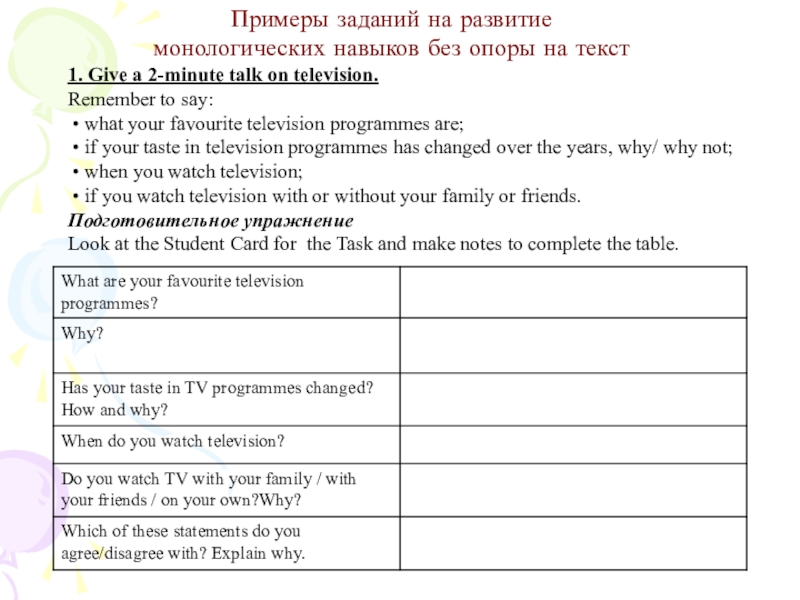
1. Give
a 2-minute talk on television.
Remember to say:
• what your favourite television programmes are;
• if your taste in television programmes has changed over the years, why/ why not;
• when you watch television;
• if you watch television with or without your family or friends.
Подготовительное упражнение
Look at the Student Card for the Task and make notes to complete the table.
Remember to say:
• what your favourite television programmes are;
• if your taste in television programmes has changed over the years, why/ why not;
• when you watch television;
• if you watch television with or without your family or friends.
Подготовительное упражнение
Look at the Student Card for the Task and make notes to complete the table.
Слайд 7
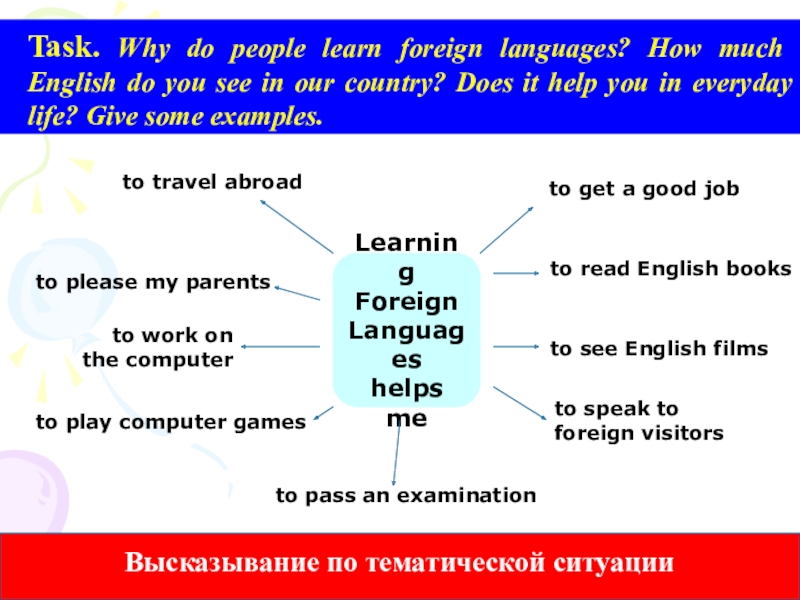
Task. Why do people learn foreign languages? How much English do
you see in our country? Does it help you in everyday life? Give some examples.
Learning
Foreign
Languages
helps me
to get a good job
to read English books
to see English films
to speak to
foreign visitors
to travel abroad
to please my parents
to work on
the computer
to play computer games
to pass an examination
Высказывание по тематической ситуации
Слайд 8Описательные упражнения
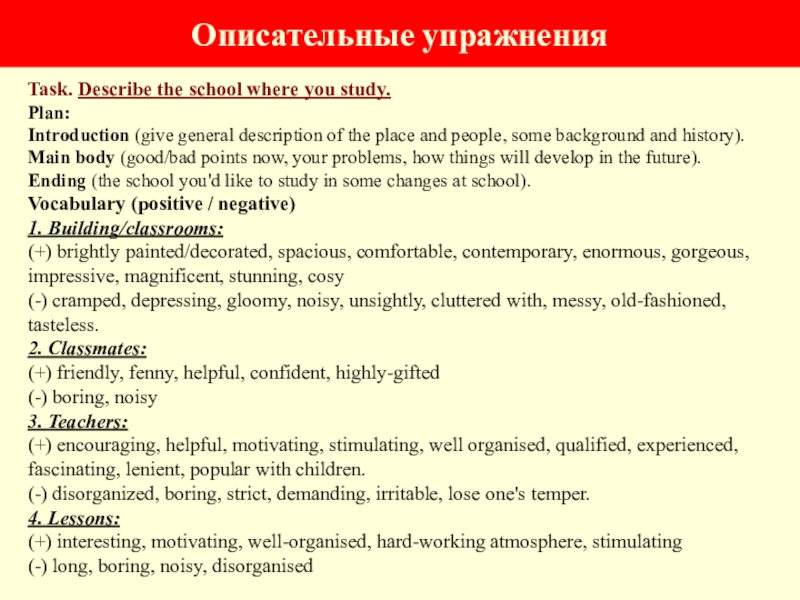
Task. Describe the school where you study.
Plan:
Introduction (give general description
of the place and people, some background and history).
Main body (good/bad points now, your problems, how things will develop in the future).
Ending (the school you'd like to study in some changes at school).
Vocabulary (positive / negative)
1. Building/classrooms:
(+) brightly painted/decorated, spacious, comfortable, contemporary, enormous, gorgeous, impressive, magnificent, stunning, cosy
(-) cramped, depressing, gloomy, noisy, unsightly, cluttered with, messy, old-fashioned, tasteless.
2. Classmates:
(+) friendly, fenny, helpful, confident, highly-gifted
(-) boring, noisy
3. Teachers:
(+) encouraging, helpful, motivating, stimulating, well organised, qualified, experienced, fascinating, lenient, popular with children.
(-) disorganized, boring, strict, demanding, irritable, lose one's temper.
4. Lessons:
(+) interesting, motivating, well-organised, hard-working atmosphere, stimulating
(-) long, boring, noisy, disorganised
Main body (good/bad points now, your problems, how things will develop in the future).
Ending (the school you'd like to study in some changes at school).
Vocabulary (positive / negative)
1. Building/classrooms:
(+) brightly painted/decorated, spacious, comfortable, contemporary, enormous, gorgeous, impressive, magnificent, stunning, cosy
(-) cramped, depressing, gloomy, noisy, unsightly, cluttered with, messy, old-fashioned, tasteless.
2. Classmates:
(+) friendly, fenny, helpful, confident, highly-gifted
(-) boring, noisy
3. Teachers:
(+) encouraging, helpful, motivating, stimulating, well organised, qualified, experienced, fascinating, lenient, popular with children.
(-) disorganized, boring, strict, demanding, irritable, lose one's temper.
4. Lessons:
(+) interesting, motivating, well-organised, hard-working atmosphere, stimulating
(-) long, boring, noisy, disorganised
Слайд 9Some models and useful patterns:
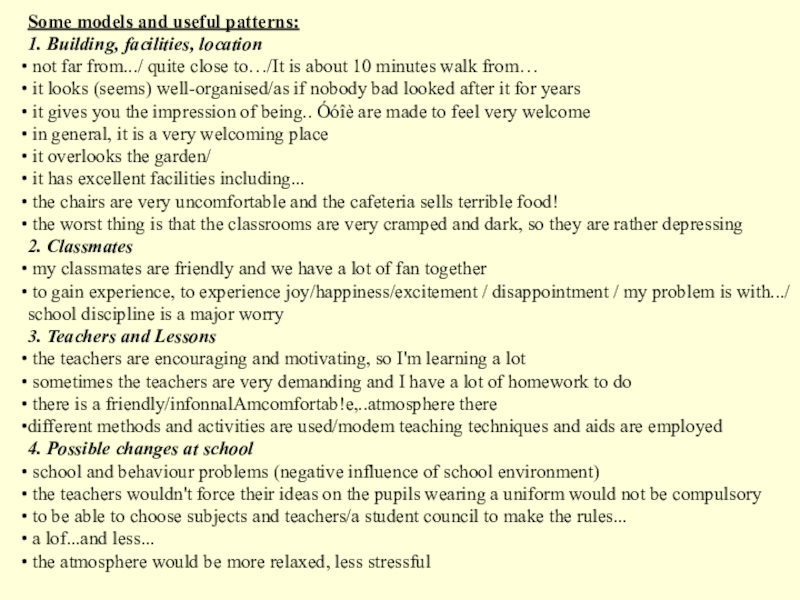
1. Building, facilities, location
not far from.../
quite close to…/It is about 10 minutes walk from…
it looks (seems) well-organised/as if nobody bad looked after it for years
it gives you the impression of being.. Óóîè are made to feel very welcome
in general, it is a very welcoming place
it overlooks the garden/
it has excellent facilities including...
the chairs are very uncomfortable and the cafeteria sells terrible food!
the worst thing is that the classrooms are very cramped and dark, so they are rather depressing
2. Classmates
my classmates are friendly and we have a lot of fan together
to gain experience, to experience joy/happiness/excitement / disappointment / my problem is with.../ school discipline is a major worry
3. Teachers and Lessons
the teachers are encouraging and motivating, so I'm learning a lot
sometimes the teachers are very demanding and I have a lot of homework to do
there is a friendly/infonnalAmcomfortab!e,..atmosphere there
different methods and activities are used/modem teaching techniques and aids are employed
4. Possible changes at school
school and behaviour problems (negative influence of school environment)
the teachers wouldn't force their ideas on the pupils wearing a uniform would not be compulsory
to be able to choose subjects and teachers/a student council to make the rules...
a lof...and less...
the atmosphere would be more relaxed, less stressful
it looks (seems) well-organised/as if nobody bad looked after it for years
it gives you the impression of being.. Óóîè are made to feel very welcome
in general, it is a very welcoming place
it overlooks the garden/
it has excellent facilities including...
the chairs are very uncomfortable and the cafeteria sells terrible food!
the worst thing is that the classrooms are very cramped and dark, so they are rather depressing
2. Classmates
my classmates are friendly and we have a lot of fan together
to gain experience, to experience joy/happiness/excitement / disappointment / my problem is with.../ school discipline is a major worry
3. Teachers and Lessons
the teachers are encouraging and motivating, so I'm learning a lot
sometimes the teachers are very demanding and I have a lot of homework to do
there is a friendly/infonnalAmcomfortab!e,..atmosphere there
different methods and activities are used/modem teaching techniques and aids are employed
4. Possible changes at school
school and behaviour problems (negative influence of school environment)
the teachers wouldn't force their ideas on the pupils wearing a uniform would not be compulsory
to be able to choose subjects and teachers/a student council to make the rules...
a lof...and less...
the atmosphere would be more relaxed, less stressful
Слайд 11
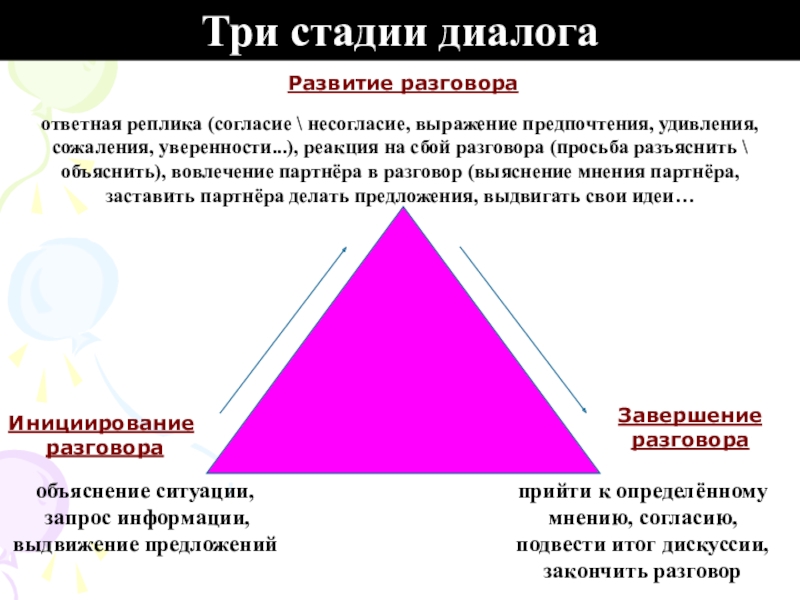
Три стадии диалога
Инициирование
разговора
объяснение ситуации,
запрос информации,
выдвижение предложений
Развитие
разговора
ответная реплика (согласие \ несогласие, выражение предпочтения, удивления, сожаления, уверенности...), реакция на сбой разговора (просьба разъяснить \ объяснить), вовлечение партнёра в разговор (выяснение мнения партнёра, заставить партнёра делать предложения, выдвигать свои идеи…
прийти к определённому
мнению, согласию,
подвести итог дискуссии,
закончить разговор
Завершение
разговора
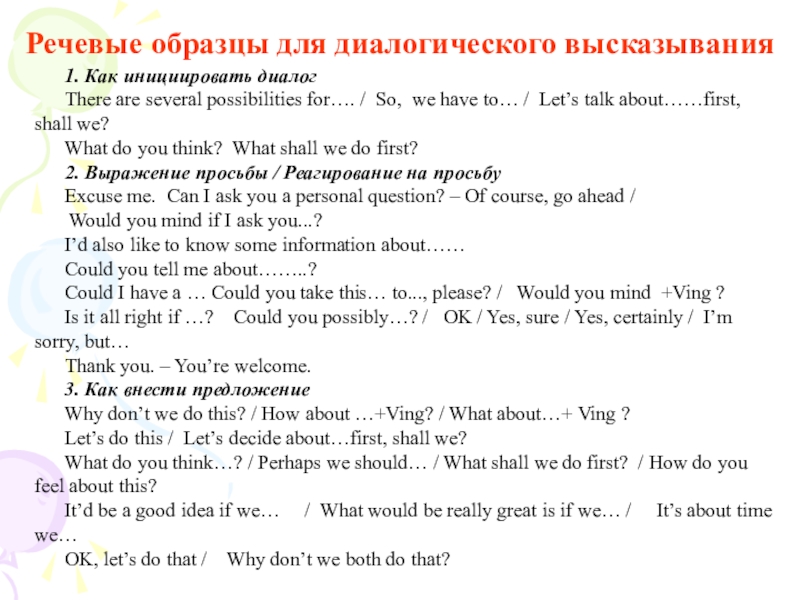
Слайд 12Речевые образцы для диалогического высказывания
1. Как инициировать диалог
There are several
possibilities for…. / So, we have to… / Let’s talk about……first, shall we?
What do you think? What shall we do first?
2. Выражение просьбы / Реагирование на просьбу
Excuse me. Can I ask you a personal question? – Of course, go ahead /
Would you mind if I ask you...?
I’d also like to know some information about……
Could you tell me about……..?
Could I have a … Could you take this… to..., please? / Would you mind +Ving ?
Is it all right if …? Could you possibly…? / OK / Yes, sure / Yes, certainly / I’m sorry, but…
Thank you. – You’re welcome.
3. Как внести предложение
Why don’t we do this? / How about …+Ving? / What about…+ Ving ?
Let’s do this / Let’s decide about…first, shall we?
What do you think…? / Perhaps we should… / What shall we do first? / How do you feel about this?
It’d be a good idea if we… / What would be really great is if we… / It’s about time we…
OK, let’s do that / Why don’t we both do that?
What do you think? What shall we do first?
2. Выражение просьбы / Реагирование на просьбу
Excuse me. Can I ask you a personal question? – Of course, go ahead /
Would you mind if I ask you...?
I’d also like to know some information about……
Could you tell me about……..?
Could I have a … Could you take this… to..., please? / Would you mind +Ving ?
Is it all right if …? Could you possibly…? / OK / Yes, sure / Yes, certainly / I’m sorry, but…
Thank you. – You’re welcome.
3. Как внести предложение
Why don’t we do this? / How about …+Ving? / What about…+ Ving ?
Let’s do this / Let’s decide about…first, shall we?
What do you think…? / Perhaps we should… / What shall we do first? / How do you feel about this?
It’d be a good idea if we… / What would be really great is if we… / It’s about time we…
OK, let’s do that / Why don’t we both do that?
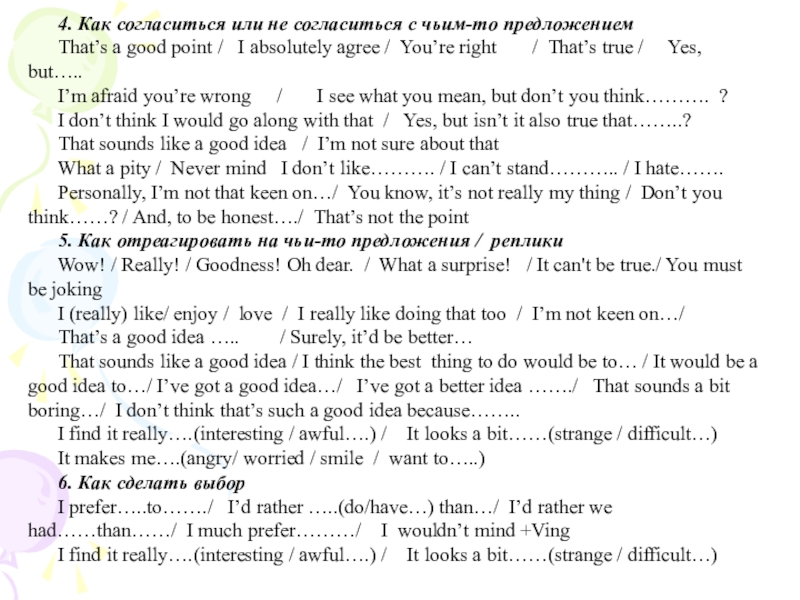
Слайд 134. Как согласиться или не согласиться с чьим-то предложением
That’s a
good point / I absolutely agree / You’re right / That’s true / Yes, but…..
I’m afraid you’re wrong / I see what you mean, but don’t you think………. ?
I don’t think I would go along with that / Yes, but isn’t it also true that……..?
That sounds like a good idea / I’m not sure about that
What a pity / Never mind I don’t like………. / I can’t stand……….. / I hate…….
Personally, I’m not that keen on…/ You know, it’s not really my thing / Don’t you think……? / And, to be honest…./ That’s not the point
5. Как отреагировать на чьи-то предложения / реплики
Wow! / Really! / Goodness! Oh dear. / What a surprise! / It can't be true./ You must be joking
I (really) like/ enjoy / love / I really like doing that too / I’m not keen on…/
That’s a good idea ….. / Surely, it’d be better…
That sounds like a good idea / I think the best thing to do would be to… / It would be a good idea to…/ I’ve got a good idea…/ I’ve got a better idea ……./ That sounds a bit boring…/ I don’t think that’s such a good idea because……..
I find it really….(interesting / awful….) / It looks a bit……(strange / difficult…)
It makes me….(angry/ worried / smile / want to…..)
6. Как сделать выбор
I prefer…..to……./ I’d rather …..(do/have…) than…/ I’d rather we had……than……/ I much prefer………/ I wouldn’t mind +Ving
I find it really….(interesting / awful….) / It looks a bit……(strange / difficult…)
I’m afraid you’re wrong / I see what you mean, but don’t you think………. ?
I don’t think I would go along with that / Yes, but isn’t it also true that……..?
That sounds like a good idea / I’m not sure about that
What a pity / Never mind I don’t like………. / I can’t stand……….. / I hate…….
Personally, I’m not that keen on…/ You know, it’s not really my thing / Don’t you think……? / And, to be honest…./ That’s not the point
5. Как отреагировать на чьи-то предложения / реплики
Wow! / Really! / Goodness! Oh dear. / What a surprise! / It can't be true./ You must be joking
I (really) like/ enjoy / love / I really like doing that too / I’m not keen on…/
That’s a good idea ….. / Surely, it’d be better…
That sounds like a good idea / I think the best thing to do would be to… / It would be a good idea to…/ I’ve got a good idea…/ I’ve got a better idea ……./ That sounds a bit boring…/ I don’t think that’s such a good idea because……..
I find it really….(interesting / awful….) / It looks a bit……(strange / difficult…)
It makes me….(angry/ worried / smile / want to…..)
6. Как сделать выбор
I prefer…..to……./ I’d rather …..(do/have…) than…/ I’d rather we had……than……/ I much prefer………/ I wouldn’t mind +Ving
I find it really….(interesting / awful….) / It looks a bit……(strange / difficult…)
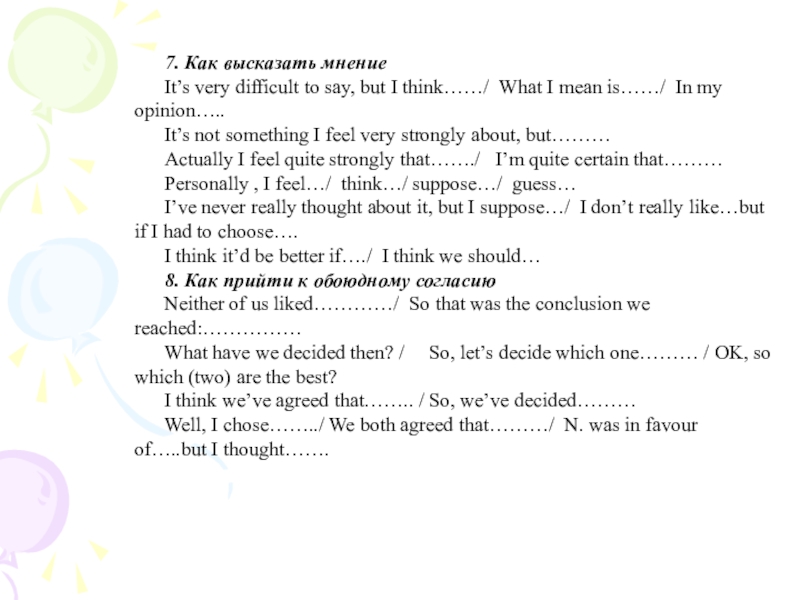
Слайд 147. Как высказать мнение
It’s very difficult to say, but I think……/
What I mean is……/ In my opinion…..
It’s not something I feel very strongly about, but………
Actually I feel quite strongly that……./ I’m quite certain that………
Personally , I feel…/ think…/ suppose…/ guess…
I’ve never really thought about it, but I suppose…/ I don’t really like…but if I had to choose….
I think it’d be better if…./ I think we should…
8. Как прийти к обоюдному согласию
Neither of us liked…………/ So that was the conclusion we reached:……………
What have we decided then? / So, let’s decide which one……… / OK, so which (two) are the best?
I think we’ve agreed that…….. / So, we’ve decided………
Well, I chose……../ We both agreed that………/ N. was in favour of…..but I thought…….
It’s not something I feel very strongly about, but………
Actually I feel quite strongly that……./ I’m quite certain that………
Personally , I feel…/ think…/ suppose…/ guess…
I’ve never really thought about it, but I suppose…/ I don’t really like…but if I had to choose….
I think it’d be better if…./ I think we should…
8. Как прийти к обоюдному согласию
Neither of us liked…………/ So that was the conclusion we reached:……………
What have we decided then? / So, let’s decide which one……… / OK, so which (two) are the best?
I think we’ve agreed that…….. / So, we’ve decided………
Well, I chose……../ We both agreed that………/ N. was in favour of…..but I thought…….

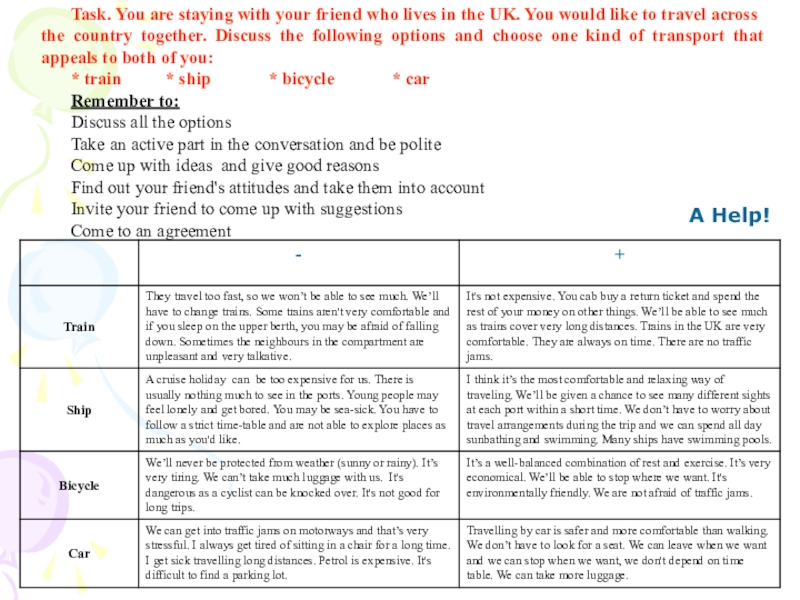
Слайд 16Task. You are staying with your friend who lives in the
UK. You would like to travel across the country together. Discuss the following options and choose one kind of transport that appeals to both of you:
* train * ship * bicycle * car
Remember to:
Discuss all the options
Take an active part in the conversation and be polite
Come up with ideas and give good reasons
Find out your friend's attitudes and take them into account
Invite your friend to come up with suggestions
Come to an agreement
* train * ship * bicycle * car
Remember to:
Discuss all the options
Take an active part in the conversation and be polite
Come up with ideas and give good reasons
Find out your friend's attitudes and take them into account
Invite your friend to come up with suggestions
Come to an agreement
A Help!
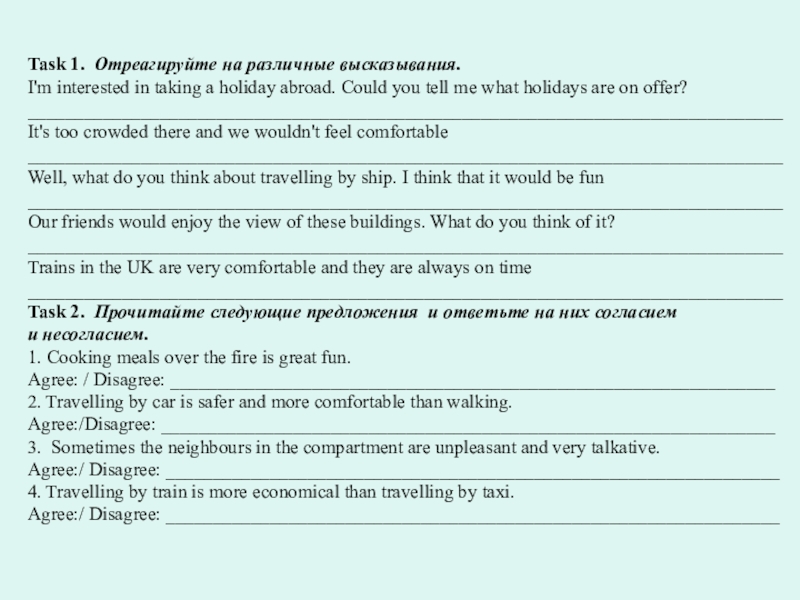
Слайд 17Task 1. Отреагируйте на различные высказывания.
I'm interested in taking a holiday
abroad. Could you tell me what holidays are on offer?
________________________________________________________________________________
It's too crowded there and we wouldn't feel comfortable
________________________________________________________________________________
Well, what do you think about travelling by ship. I think that it would be fun
________________________________________________________________________________
Our friends would enjoy the view of these buildings. What do you think of it?
________________________________________________________________________________
Trains in the UK are very comfortable and they are always on time
________________________________________________________________________________
Task 2. Прочитайте следующие предложения и ответьте на них согласием
и несогласием.
1. Cooking meals over the fire is great fun.
Agree: / Disagree: ________________________________________________________________
2. Travelling by car is safer and more comfortable than walking.
Agree:/Disagree: _________________________________________________________________
3. Sometimes the neighbours in the compartment are unpleasant and very talkative.
Agree:/ Disagree: _________________________________________________________________
4. Travelling by train is more economical than travelling by taxi.
Agree:/ Disagree: _________________________________________________________________
________________________________________________________________________________
It's too crowded there and we wouldn't feel comfortable
________________________________________________________________________________
Well, what do you think about travelling by ship. I think that it would be fun
________________________________________________________________________________
Our friends would enjoy the view of these buildings. What do you think of it?
________________________________________________________________________________
Trains in the UK are very comfortable and they are always on time
________________________________________________________________________________
Task 2. Прочитайте следующие предложения и ответьте на них согласием
и несогласием.
1. Cooking meals over the fire is great fun.
Agree: / Disagree: ________________________________________________________________
2. Travelling by car is safer and more comfortable than walking.
Agree:/Disagree: _________________________________________________________________
3. Sometimes the neighbours in the compartment are unpleasant and very talkative.
Agree:/ Disagree: _________________________________________________________________
4. Travelling by train is more economical than travelling by taxi.
Agree:/ Disagree: _________________________________________________________________
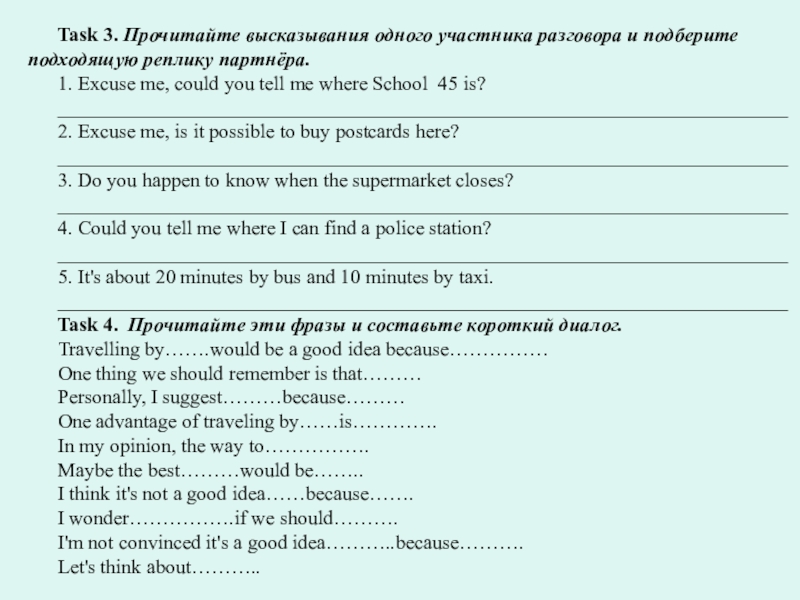
Слайд 18Task 3. Прочитайте высказывания одного участника разговора и подберите подходящую реплику
партнёра.
1. Excuse me, could you tell me where School 45 is?
_________________________________________________________________________
2. Excuse me, is it possible to buy postcards here?
_________________________________________________________________________
3. Do you happen to know when the supermarket closes?
_________________________________________________________________________
4. Could you tell me where I can find a police station?
_________________________________________________________________________
5. It's about 20 minutes by bus and 10 minutes by taxi.
_________________________________________________________________________
Task 4. Прочитайте эти фразы и составьте короткий диалог.
Travelling by…….would be a good idea because……………
One thing we should remember is that………
Personally, I suggest………because………
One advantage of traveling by……is………….
In my opinion, the way to…………….
Maybe the best………would be……..
I think it's not a good idea……because…….
I wonder…………….if we should……….
I'm not convinced it's a good idea………..because……….
Let's think about………..
1. Excuse me, could you tell me where School 45 is?
_________________________________________________________________________
2. Excuse me, is it possible to buy postcards here?
_________________________________________________________________________
3. Do you happen to know when the supermarket closes?
_________________________________________________________________________
4. Could you tell me where I can find a police station?
_________________________________________________________________________
5. It's about 20 minutes by bus and 10 minutes by taxi.
_________________________________________________________________________
Task 4. Прочитайте эти фразы и составьте короткий диалог.
Travelling by…….would be a good idea because……………
One thing we should remember is that………
Personally, I suggest………because………
One advantage of traveling by……is………….
In my opinion, the way to…………….
Maybe the best………would be……..
I think it's not a good idea……because…….
I wonder…………….if we should……….
I'm not convinced it's a good idea………..because……….
Let's think about………..
Слайд 19При организации различных видов контроля уровня развития навыков диалогической речи, важно
учитывать, что в результате обучающийся научится:
- понимать и во взаимодействии с партнером решать коммуникативные задачи, логично и связно строить диалог в зависимости от коммуникативной задачи.
- понимать реплики партнера при речевом взаимодействии.
адекватно спонтанно реагировать на реплики собеседника.
сообщать информацию, логично и связно строить свои реплики, при необходимости аргументируя свою позицию.
- запрашивать информацию, используя адекватно речевой задаче вопросы разной функциональной направленности.
- адекватно ситуации общения выбирать стиль речи.
- адекватно речевой ситуации использовать средства речевого этикета.
- использовать продуктивные и рецептивные лексические и грамматические навыки в соответствии с коммуникативной задачей.
- использовать адекватно коммуникативной задаче разнообразные средства реализации языковых функций (сомнение, удивление, удовольствие, согласие, несогласие), разговорные клише.
- быть инициативным партнером по общению: вовлекать собеседника в диалог, пользоваться компенсаторными стратегиями при сбое в коммуникации.
- быть активным, но и не доминировать при общении. Уважать точку зрения собеседника, не навязывать свое мнение. Соблюдать очередность при обмене репликами.
- понимать и во взаимодействии с партнером решать коммуникативные задачи, логично и связно строить диалог в зависимости от коммуникативной задачи.
- понимать реплики партнера при речевом взаимодействии.
адекватно спонтанно реагировать на реплики собеседника.
сообщать информацию, логично и связно строить свои реплики, при необходимости аргументируя свою позицию.
- запрашивать информацию, используя адекватно речевой задаче вопросы разной функциональной направленности.
- адекватно ситуации общения выбирать стиль речи.
- адекватно речевой ситуации использовать средства речевого этикета.
- использовать продуктивные и рецептивные лексические и грамматические навыки в соответствии с коммуникативной задачей.
- использовать адекватно коммуникативной задаче разнообразные средства реализации языковых функций (сомнение, удивление, удовольствие, согласие, несогласие), разговорные клише.
- быть инициативным партнером по общению: вовлекать собеседника в диалог, пользоваться компенсаторными стратегиями при сбое в коммуникации.
- быть активным, но и не доминировать при общении. Уважать точку зрения собеседника, не навязывать свое мнение. Соблюдать очередность при обмене репликами.